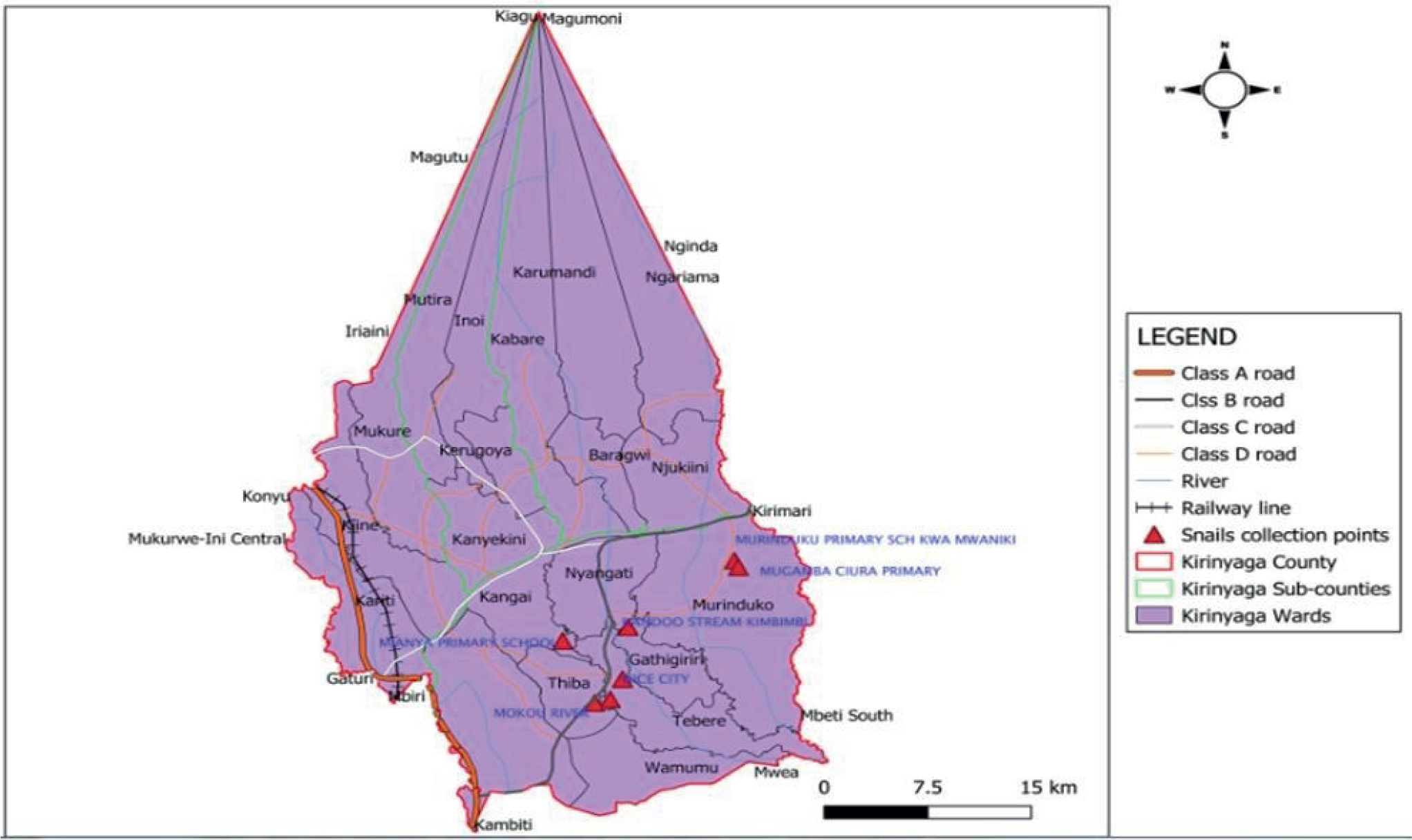
Fig. 1.
Snail collection points in Mwea Area Kirinyaga Count.
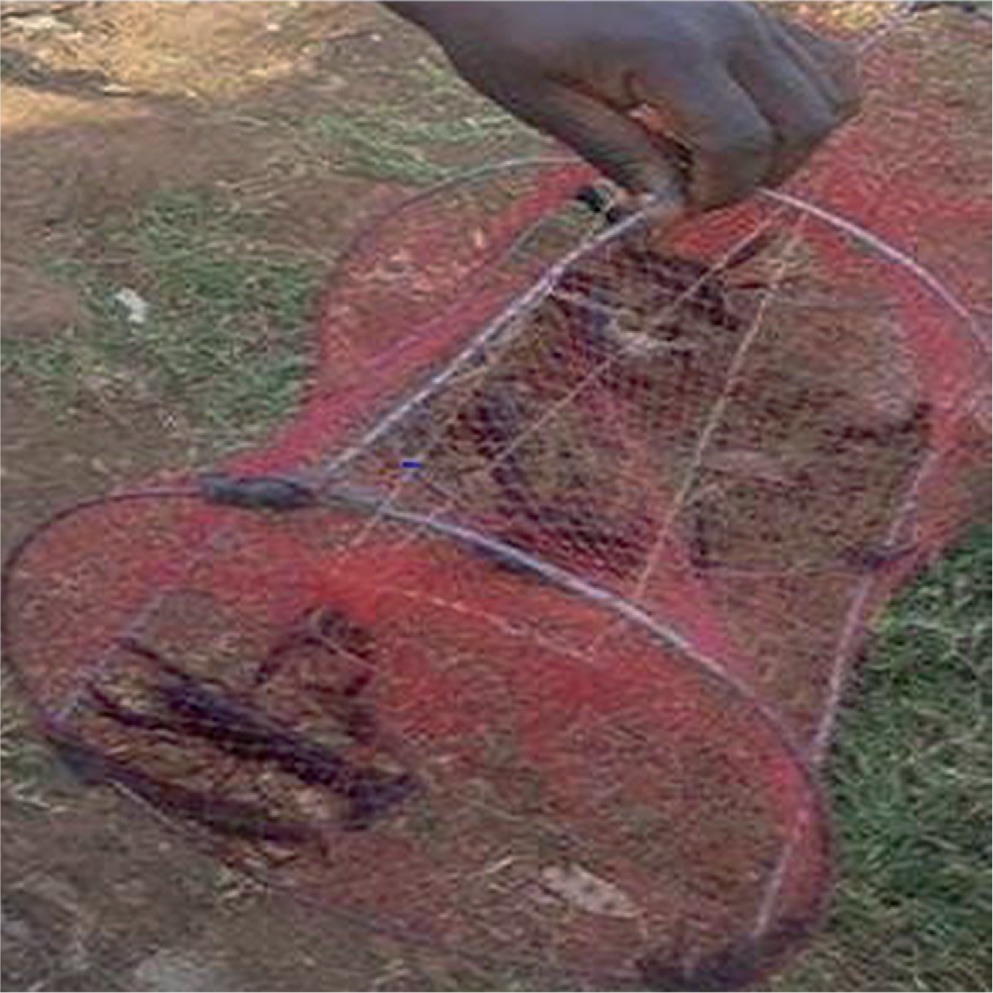
Appendix 1.
Crayfish trap with few caught P. clarkii.
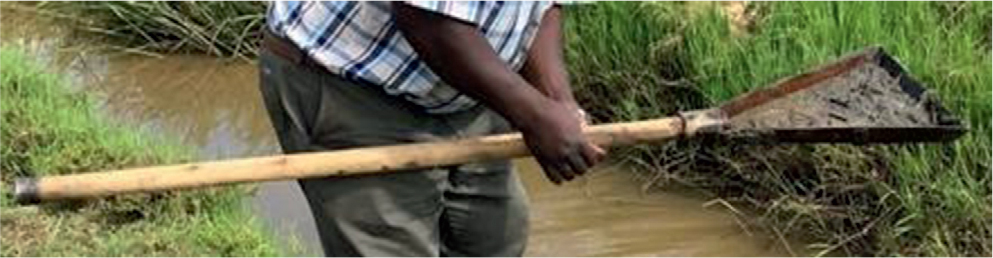
Appendix 2.
Snail scoop used to catch crayfish in littoral shallow water.
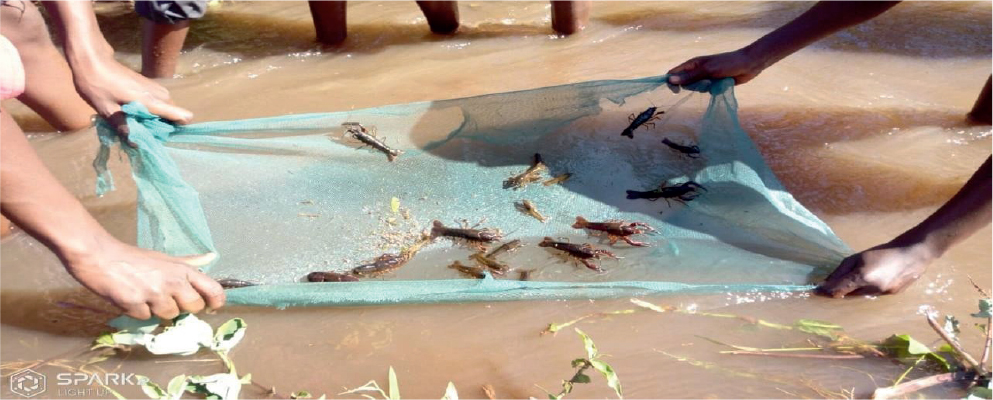
Appendix 3.
Torn and tattered mosquito net invented by villagers to trap crayfish.
Table 1.
Summary of mean abiotic features over the 2-year study period and coordinates of study areas.
| Water pH | Water turbidity (ppt) | Water temp. (°C) | Water Velocity (m/S) | Air velocity (m/S) | Air temp. (°C) | GPS | |
|---|---|---|---|---|---|---|---|
| Mokou | 7.97 | 0.09 | 21.9 | 0.5 | 0.7 | 27.8 | Lat. 0°41’5.14482” Long.37°20’40.58988”E Alt. 1115.14 M |
| Nguka | 7.1 | 0.11 | 25.7 | 0.2 | 3.83 | 33.4 | Lat. 0°38’38.55” S Long. 37°18’1772’E Alt. 1179.99M |
| Nice | 7.33 | 0.15 | 25.6 | 0 | 7 | 29.5 | Lat. 0°39’58.30”S Long. 37°21’45.38”E Alt. 1145.14M |
| Mianya | 7.45 | 0.05 | 22.9 | 0.4 | 2.2 | 28 | Lat. 0°38’10.49”S Long. 37°19’25.85’E Alt. 1168.59M |
| Nineveh | 6.88 | 0.06 | 25.1 | 0 | 10.2 | 27.3 | Lat. 0°37’31.44”S Long. 37°21’59.07”E Alt. 1145.14M |
Table 2.
Relative abundance of crayfish in the sampled sites (Baseline).
| Site | Procambarus clarkii | Relative Abundance (%) |
|---|---|---|
| Mianya | 0 | 0.0 |
| Murinduko | 0 | 0.0 |
| Nice | 82 | 37.6 |
| Nineveh | 0 | 0.0 |
| Nguka | 104 | 47.7 |
| Mokou | 32 | 14.7 |
Table 3.
The association between the Crayfish and the snail population in various study sites.
| Model | Site | Estimate | STD Error | R2 | P-value | 95% CI |
|---|---|---|---|---|---|---|
| 1 | Mokou | -6.002 | 3.165 | 0.3393 | 0.09976 | -13.48561 – 1.482581 |
| 2 | Mianya | -1.432 | 1.677 | 0.09435 | 0.4214 | -5.398256 – 2.533673 |
| 3 | Nineve | -2.133 | 3.301 | 0.0563 | 0.5387 | -9.939124 – 5.672457 |
| 4 | Nguka | 0.8898 | 0.4651 | 0.3434 | 0.09729 | -0.2099173 – 1.989456 |
| 5 | Nice | -0.2187 | 0.3748 | 0.04639 | 0.5779 | -1.105067 – 0.667622 |
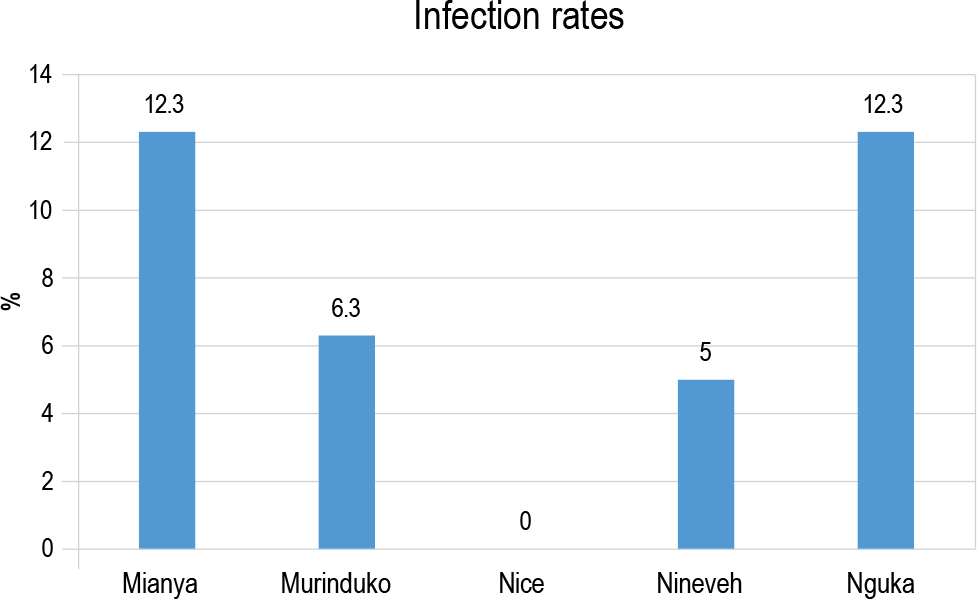
Fig. 2.
Snail abundance and prevalence of S. mansoni infection in the study habitats during the rainy season (November – December 2022).
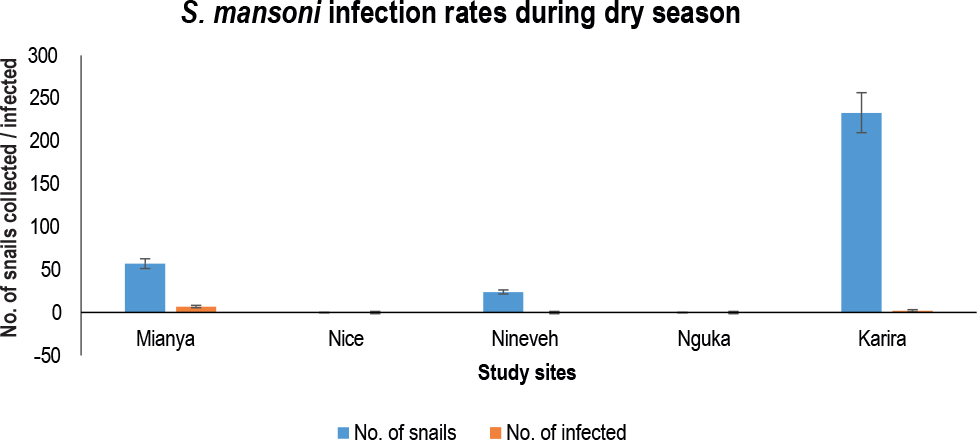
Fig. 3.
Snail abundance and prevalence of S. mansoni infection in the study habitats during the dry season (March – April 2022).
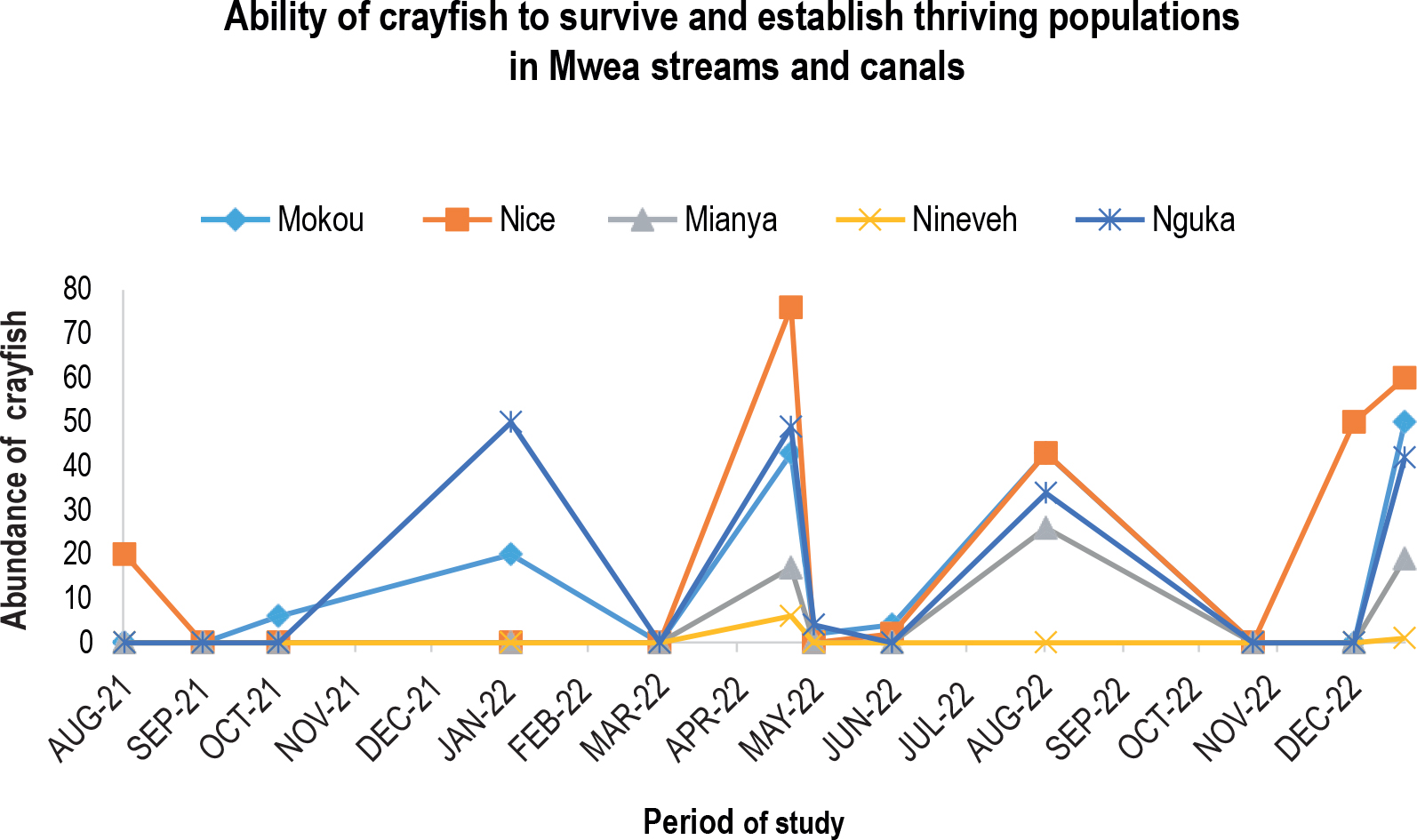
Fig. 4.
Ability of crayfish to survive and establish thriving populations in Mwea streams habitats after introduction.
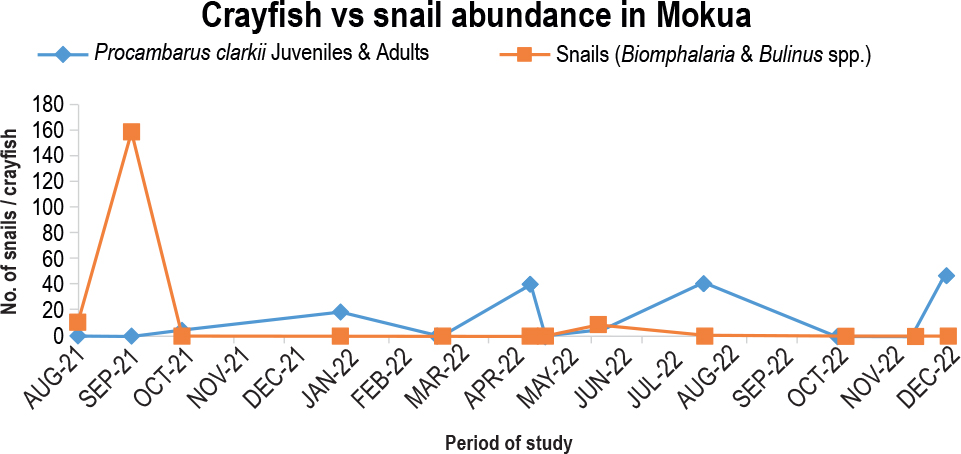
Fig. 5.
Predation potential of P. clarkii in Mokou stream.
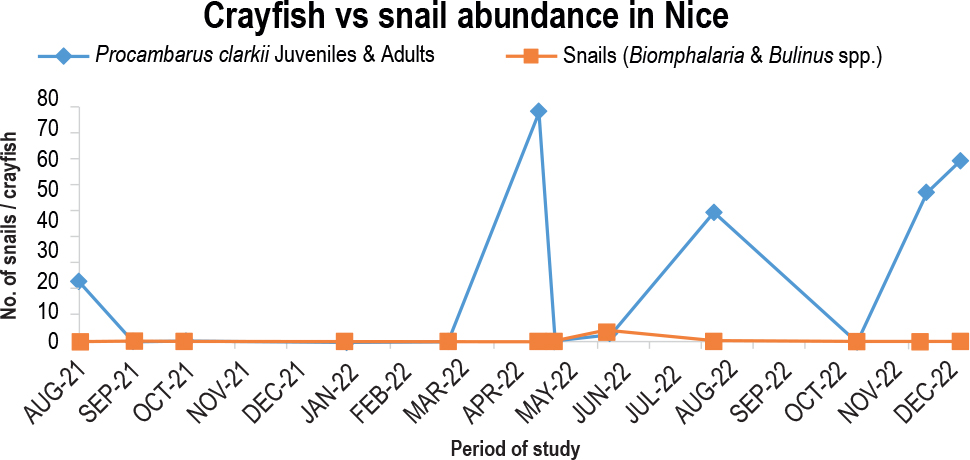
Fig. 6.
Predation potential of P. clarkii in Nice stream.
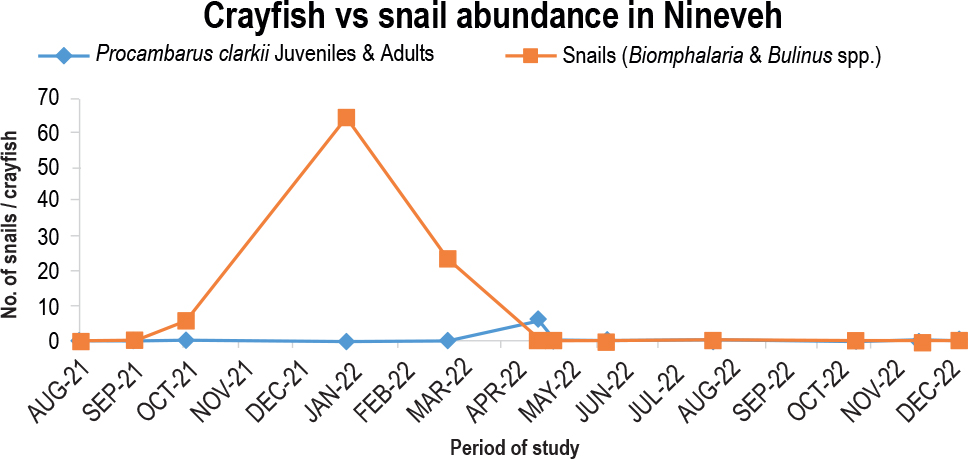
Fig. 7.
Predation potential of P. clarkii in Nineveh stream.
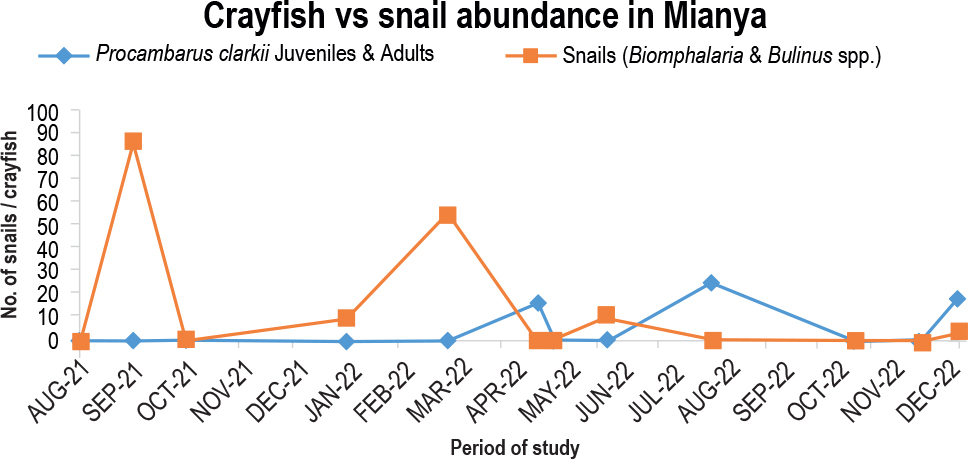
Fig. 8.
Predation potential of P. clarkii in Mianya stream.
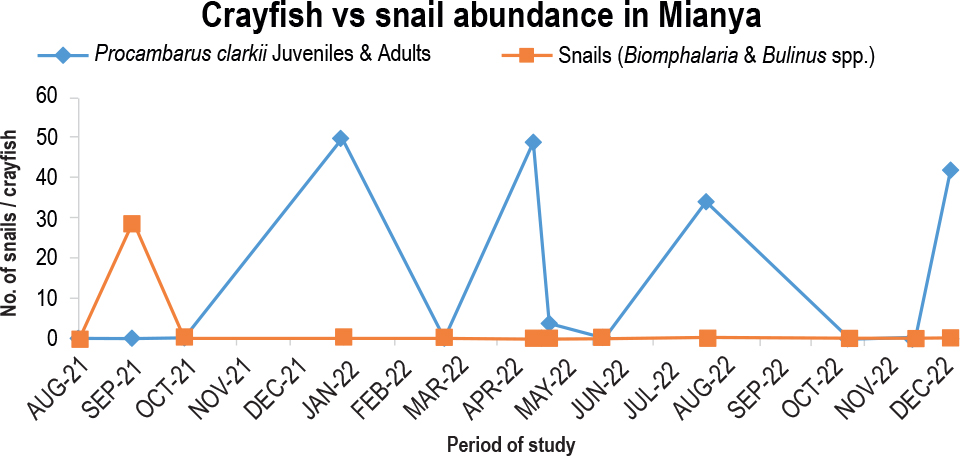
Fig. 9.
Predation potential of P clarkii in Nguka stream.
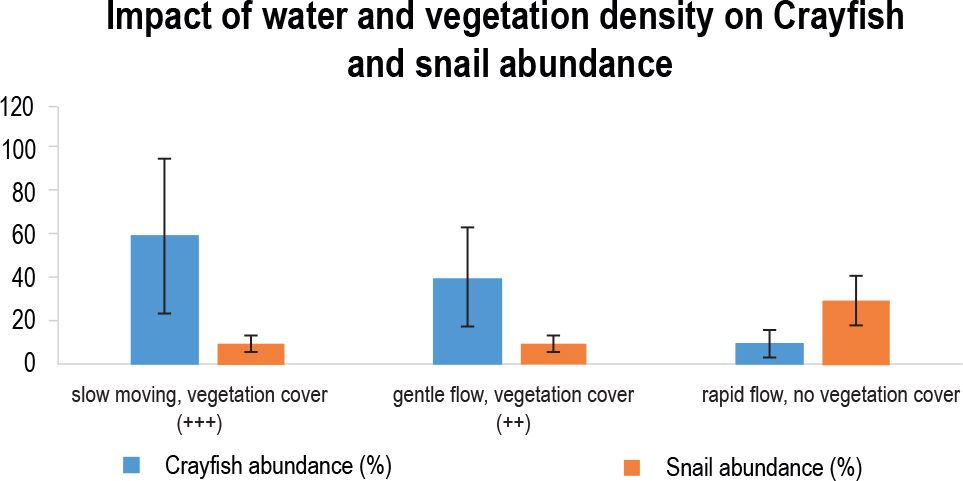
Fig. 10.
Impact of water velocity and vegetation cover on predation potential of crayfish against snails.
Table 4.
Species Checklist of some of the native aquatic biodiversity.
| Taxa | Scooped, trapped and seen |
|---|---|
| Crustaceans | Crabs and crayfish |
| Coleoptera | Water beetles |
| Hemiptera | Water scorpions, Belostoma |
| Ephemeroptera | Mayfly |
| Odonata | dragonfly |
| Plecoptera | stonefly |
| Hirudina | Leeches |
| Pisces | Cichlids, mudfish |
| Diptera | Adult mosquitoes and larva |
| Ceratopogonidae | biting midges |
| Gastropoda | Bi-valves, Lymnea, Belamya, Pila ovata, Melanoides tuberculata, Ancylids, physa acuta, Apple snail eggs and adults, Ceratophallus. |
| Nematodes | Oligochaetes, |
| Water fowls | Comorants, Little egrets, Egyptian geese, open billed stocks, whistling ducks, quilea quilea, African jacana |
| Amphibians | Toads and frogs |
| Reptiles | Monitor lizards (Varanus niloticus) |
| Macrophytes | Submerged: Ceratophyllum demersum and Najas horrida. Emergent: Arrow arum, Papyrus, Floating aquatic plants: Water lettuce, Elephant’s eye, Water hyacinth |