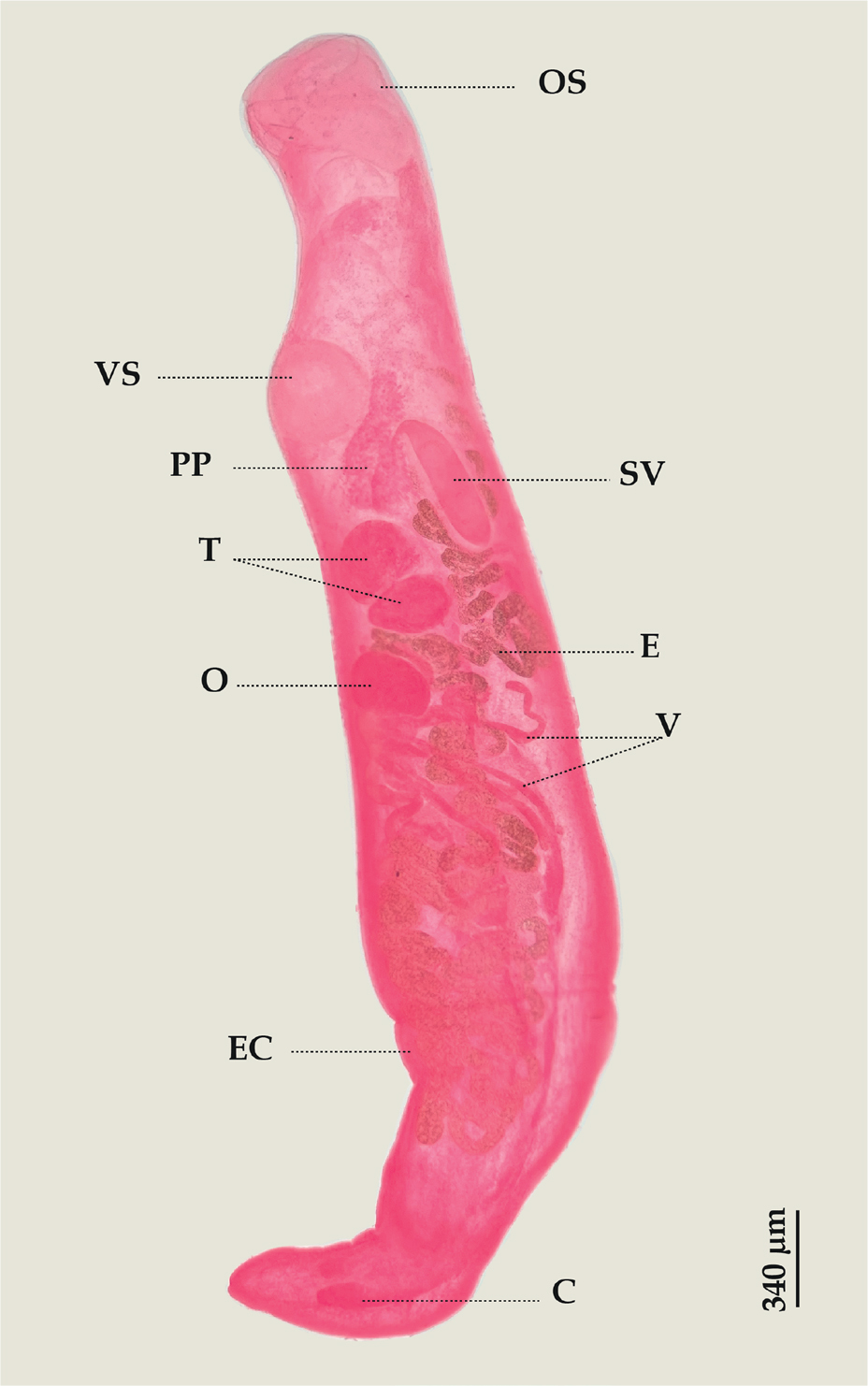
Fig. 1.
Lecithocladium excisum: (Lateral view), (C) Ceaca, (E) Eggs, (EC) Ecsoma, (O) Ovary, (OS) Oral sucker, (PP) Pars prostatica, (SV) Seminal vesicle, (T) Testes, (V) Vitellarium, (VS) Ventral sucker.
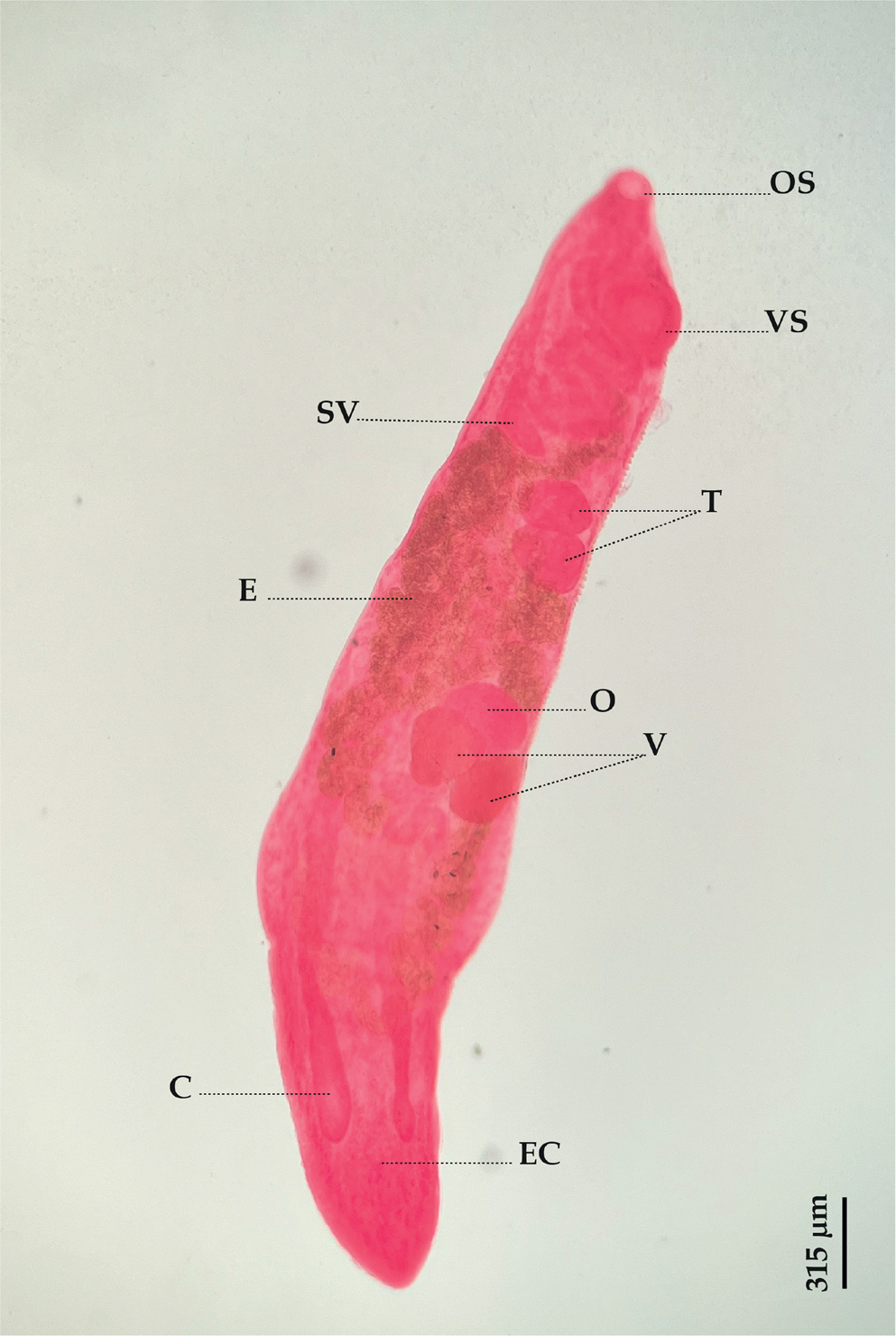
Fig. 2.
Parahemiurus merus: (Lateral view), (C) Ceaca, (E) Eggs, (EC) Ecsoma, (O) Ovary, (OS) Oral sucker (SV) Seminal vesicle, (T) Testes, (V) Vitellarium, (VS) Ventral sucker.
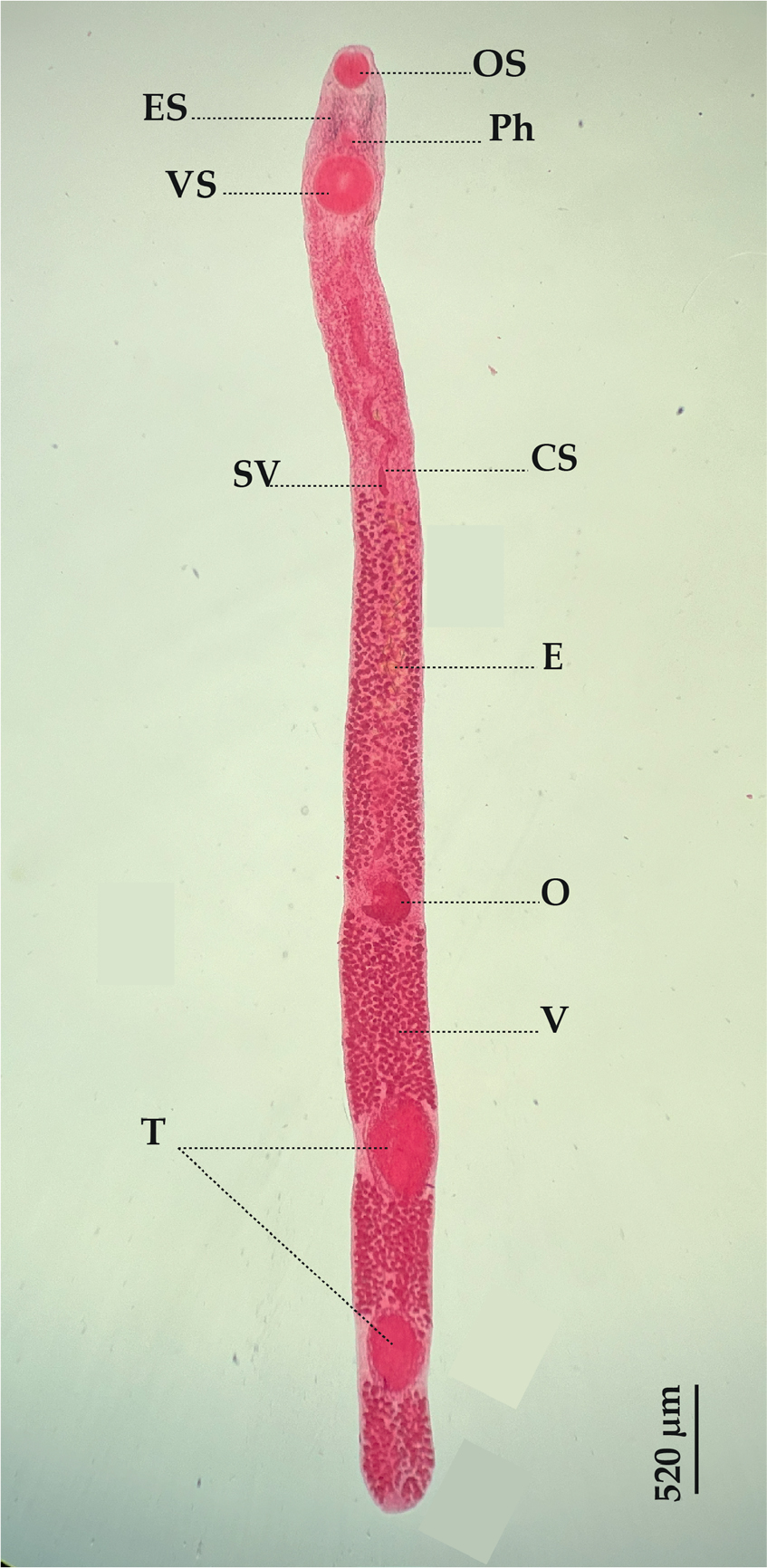
Fig. 3.
Tormopsolus orientalis: (Ventral view), (CS) Cirrus-sac, (E) Eggs, (ES) Eye-spot pigment, (O) Ovary, (OS) Oral sucker, (Ph) Pharynx, (SV) Seminal vesicle, (T) Testes, (V) Vitellarium, (VS) Ventral sucker.
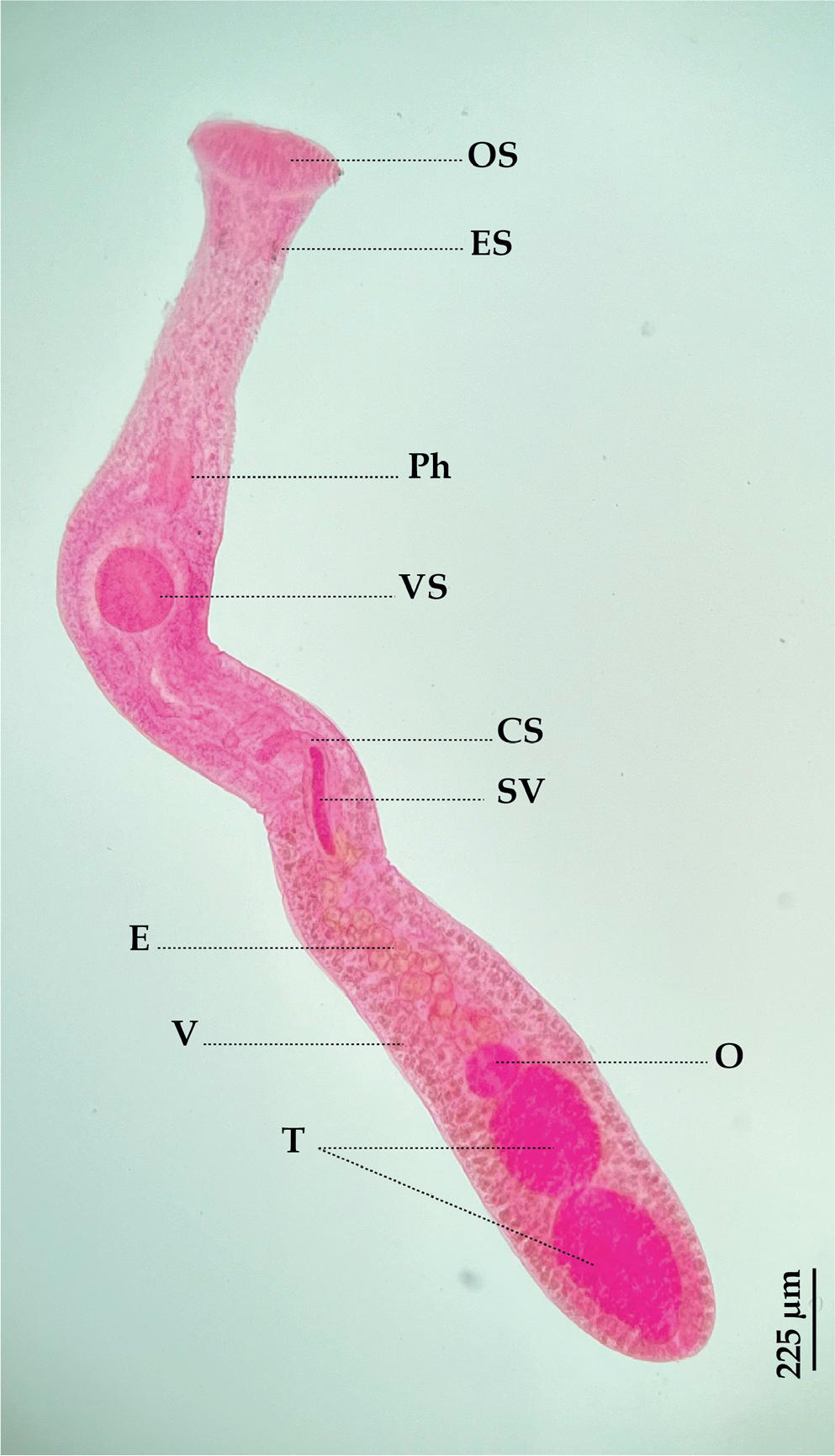
Fig. 4.
Stephanostomum euzeti: (Ventral view), (CS) Cirrus-sac, (E) Eggs, (ES) Eye-spot pigment, (O) Ovary, (OS) Oral sucker, (Ph) Pharynx, (SV) Seminal vesicle, (T) Testes, (V) Vitellarium, (VS) Ventral sucker.
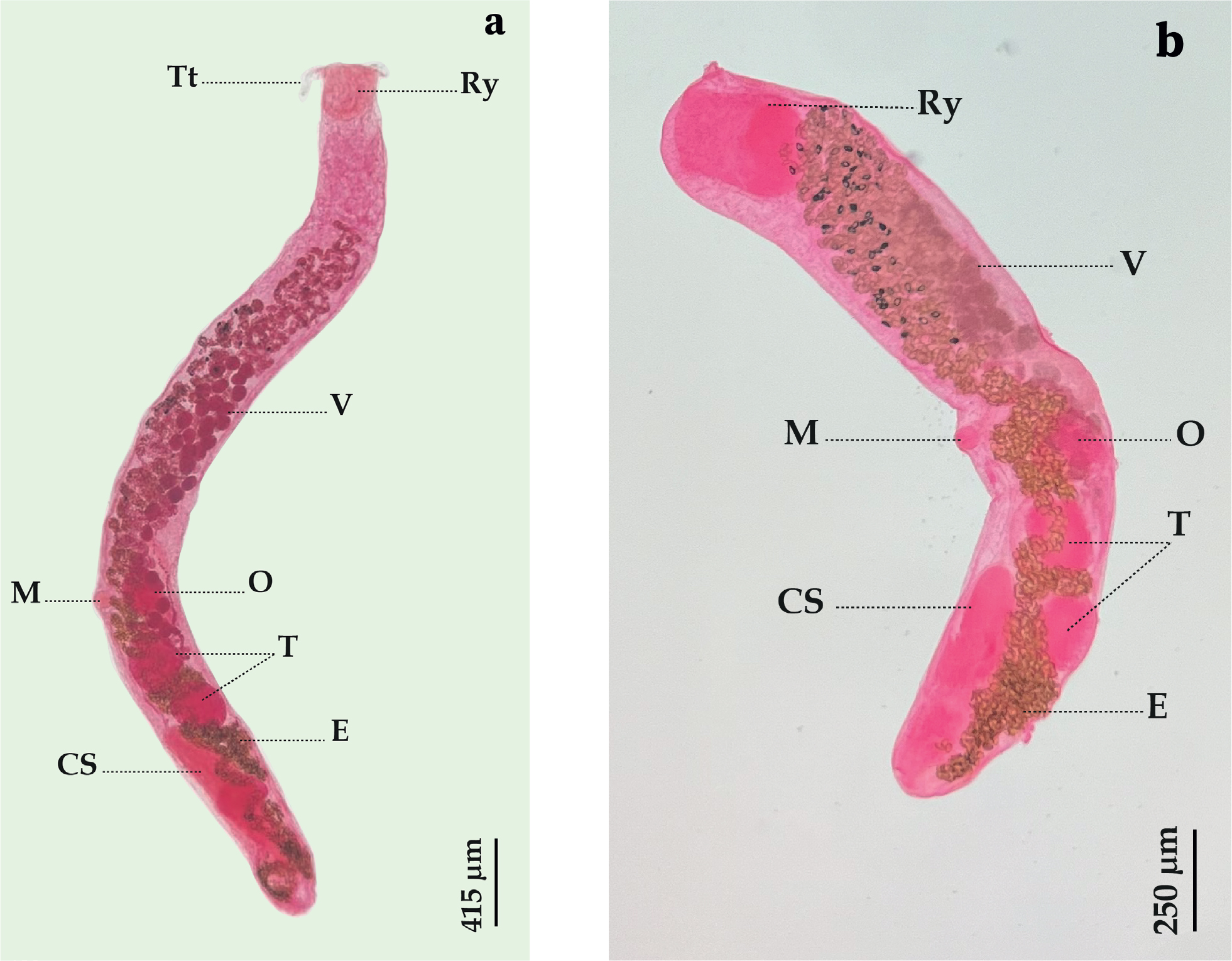
Fig. 5.
Bucephalus gorgon: (5.a) B. gorgon with expanded rynchus (lateral view), (5.b) B. gorgon with retracted rynchus (lateral view),(CS) Cirrus-sac, (E) Eggs, (M) Mouth, (O) Ovary, (Ry) Rynchus, (T) Testes, (Tt) Tentacule, (V) Vitellarium.
Table 1.
Digenean of Seriola dumerili from the Algerian coastline collected between March 2023 and February 2024.
| Species | Number of infested fish | Number of parasites | Prevalence | Abundance | Intensity | Range of intensity | Classification of the species in the community |
|---|---|---|---|---|---|---|---|
| % (CI) | Mean ±SD | Mean ±SD | |||||
| Lecithocladium excisum | 15 | 54 | 12.40 (7.11-19.62) | 0.45±1.61 | 3.60±3.16 | 1-10 | Satellite |
| Parahemiurus merus | 32 | 80 | 26.45 (18.84-35.24) | 0.66±1.58 | 2.50±2.21 | 1-9 | Satellite |
| Tormopsolus orientalis | 13 | 57 | 10.74 (5.85-17.67) | 0.47±2.61 | 4.38±7.03 | 1-26 | Satellite |
| Stephanostomum euzeti | 6 | 24 | 4.96 (1.84-10.48) | 0.20±1.01 | 4.00±2.53 | 1-8 | Satellite |
| Bucephalus gorgon | 104 | 7744 | 85.95 (78.46-91.60) | 64.00±99.64 | 74.46±103.82 | 1-562 | Core |
Table 2.
Parasites associations of the digenean infesting Seriola dumerili.
| Species number (P %) | Species composition | Number of infested hosts | |
|---|---|---|---|
| n | P % | ||
| 1 (59.26 %) | Bucephalus gorgon | 60 | 55.56 |
| Parahemiurus merus | 4 | 3.70 | |
| 2 (26.85%) | Bucephalus gorgon - Parahemiurus merus | 15 | 13.89 |
| Bucephalus gorgon - Tormopsolus orientalis | 5 | 4.63 | |
| Bucephalus gorgon - Lecithocladium excisum | 5 | 4.63 | |
| Bucephalus gorgon - Stephanostomum euzeti | 4 | 3.70 | |
| 3 (10.2%) | Bucephalus gorgon -Parahemiurus merus - Tormopsolus orientalis | 3 | 2.78 |
| Bucephalus gorgon - Parahemiurus merus - Lecithocladium excisum | 6 | 5.56 | |
| Bucephalus gorgon - Lecithocladium excisum-Tormopsolus orientalis | 1 | 0.93 | |
| Bucephalus gorgon - Lecithocladium excisum - Stephanostomum euzeti | 1 | 0.93 | |
| 4 (3.71%) | Bucephalus gorgon - Parahemiurus merus - Lecithocladium excisum-Tormopsolus orientalis | 3 | 2.78 |
| Bucephalus gorgon - Parahemiurus merus - Tormopsolus orientalis - Stephanostomum euzeti | 1 | 0.93 | |
Table 3.
Information related to the weight classes of Seriola dumeríli.
| Weight classes | Host examined | Digenea Species | |||||||||
|---|---|---|---|---|---|---|---|---|---|---|---|
| Lecithocladium excisum | Parahemiurus merus | Tormopsolus orientalis | Stephanostomum euzeti | Bucephalus gorgon | |||||||
| Host infested | Number of parasites | Host infested | Number of parasites | Host infested | Number of parasites | Host infested | Number of parasites | Host infested | Number of parasites | ||
| 138-254 g | 20 | 2 | 6 | 5 | 5 | 1 | 1 | 0 | 0 | 9 | 345 |
| 254.01-370.01 g | 46 | 5 | 12 | 11 | 33 | 4 | 9 | 0 | 0 | 42 | 2245 |
| 370.02-486.02 g | 30 | 5 | 26 | 10 | 30 | 4 | 5 | 0 | 0 | 30 | 2536 |
| 486.03-602.03 g | 5 | 0 | 0 | 0 | 0 | 0 | 0 | 2 | 10 | 5 | 568 |
| 602.04-718.04 g | 9 | 0 | 0 | 4 | 5 | 2 | 36 | 1 | 3 | 8 | 1525 |
| 718.05-834.05 g | 6 | 2 | 9 | 2 | 7 | 1 | 4 | 2 | 6 | 5 | 463 |
| 834.06-950.06 g | 5 | 1 | 1 | 0 | 0 | 1 | 2 | 1 | 5 | 5 | 62 |
Table 4.
Information related to the length classes of Seriola dumeríli.
| Length classes | Host examined | Digenea Species | |||||||||
|---|---|---|---|---|---|---|---|---|---|---|---|
| Lecithocladium excisum | Parahemiurus merus | Tormopsolus orientalis | Stephanostomum euzeti | Bucephalus gorgon | |||||||
| Host infested | Number of parasites | Host infested | Number of parasites | Host infested | Number of parasites | Host infested | Number of parasites | Host infested | Number of parasites | ||
| 22.5-25.71 cm | 6 | 0 | 0 | 0 | 0 | 0 | 0 | 0 | 0 | 2 | 210 |
| 25.72-28.93 cm | 30 | 4 | 11 | 8 | 11 | 3 | 3 | 0 | 0 | 25 | 784 |
| 28.94-32.15 cm | 43 | 6 | 22 | 13 | 50 | 3 | 9 | 0 | 0 | 37 | 2191 |
| 32.16-35.37 cm | 20 | 2 | 7 | 6 | 10 | 3 | 6 | 0 | 0 | 18 | 1953 |
| 35.38-38.59 cm | 7 | 0 | 0 | 2 | 2 | 1 | 10 | 2 | 10 | 7 | 1061 |
| 38.60-41.81 cm | 11 | 3 | 14 | 3 | 7 | 3 | 29 | 3 | 9 | 11 | 1449 |
| 41.82-45.03 cm | 4 | 0 | 0 | 0 | 0 | 0 | 0 | 1 | 5 | 4 | 96 |
Table 5.
Spearman’s correlation analysis of digenean species mean abundance and mean intensity with host parameters (weight and total length).
| Digenea | Mean abundance | Mean intensity | ||||||
|---|---|---|---|---|---|---|---|---|
| Weight (g) | Total length (cm) | Weight (g) | Total length (cm) | |||||
| rs | p | rs | p | rs | p | rs | p | |
| Lecithocladium excisum | -0.162 | 0.728 | 0 | 1 | -0.270 | 0.558 | 0.074 | 0.874 |
| Parahemiurus merus | -0.090 | 0.848 | 0 | 1 | -0.109 | 0.816 | 0 | 1 |
| Tormopsolis orientalis | 0.607 | 0.148 | 0.360 | 0.427 | 0.429 | 0.337 | 0.288 | 0.531 |
| Stephanostomum euzeti | 0.730 | 0.063 | 0.788 | 0.035* | 0.794 | 0.033* | 0.837 | 0.019* |
| Bucephalus gorgon | 0.036 | 0.939 | 0.178 | 0.702 | 0.143 | 0.760 | 0.107 | 0.819 |
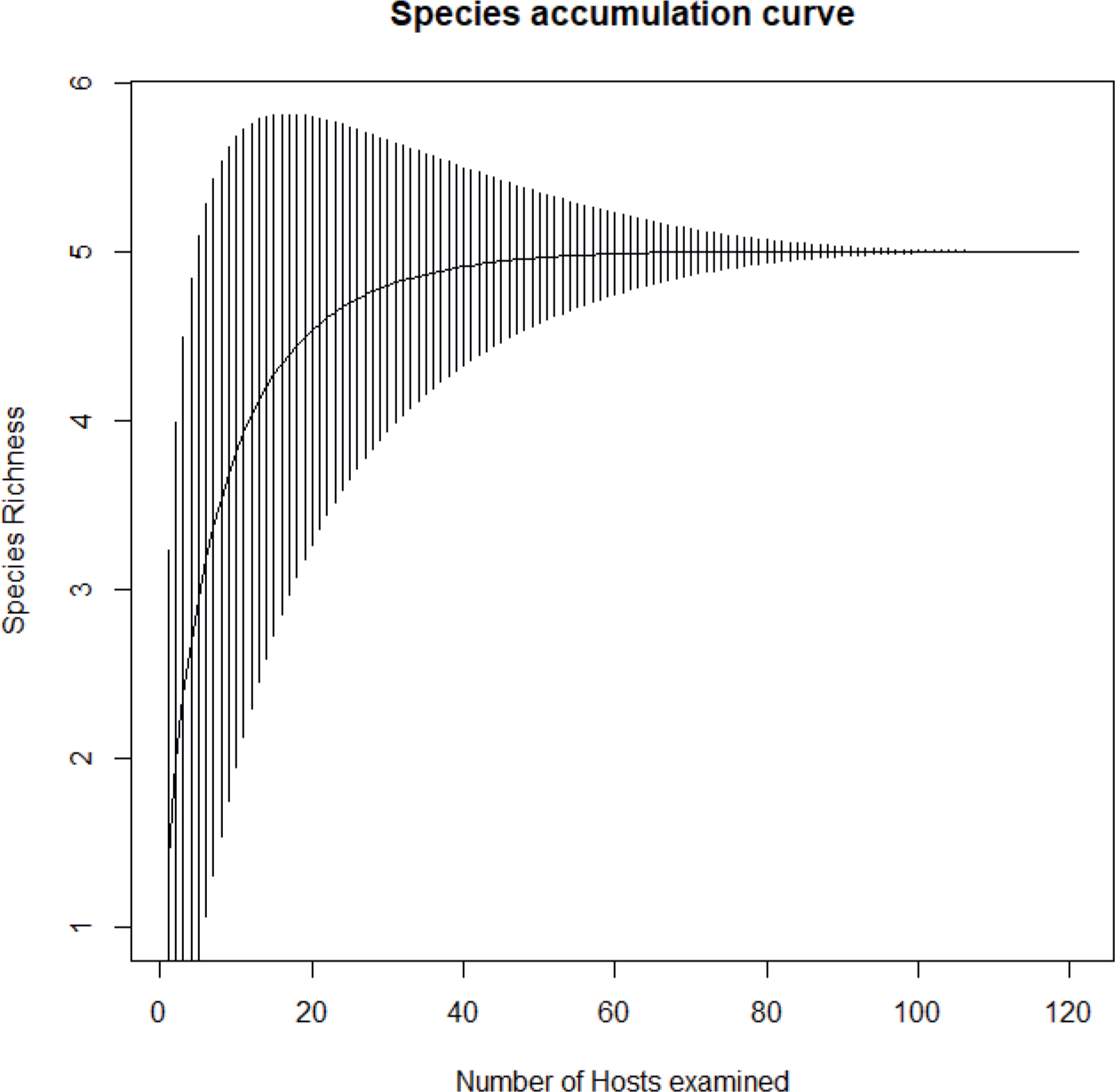
Fig. 6
Species accumulation curve for the sampled Digenea from Seriola dumerili (n = 121) off the Algerian coast.