Introduction
The marine fish species woolly sculpin Clinocottus analis (Girard, 1858) (Perciformes: Cottidae) and opaleye Girella nigricans (Ayres, 1860) (Centrarchiformes: Girellidae) are two of the most abundant species of the rocky intertidal fish assemblage from the western coast of the Baja California peninsula, Mexico (Ruiz-Campos & Hammann, 1991; Ruiz-Campos et al., 2010). These two co-dominant fish species exhibit distinct feeding habits that are closely tied to their respective habitats. Clinocottus analis is a carnivorous predator that lives in rocky tide pools during all its developmental stages, while G. nigricans feeds omnivorously as a juvenile in tide pools but shifts to a predominantly herbivorous diet in adulthood within the infralittoral zone (Wells, 1986; Ruiz-Campos & Hammann, 1991, 2002; Behrens & Lafferty, 2012).
Studying fish parasite communities in the rocky intertidal zone is essential for understanding the complex interactions that shape these varying ecosystems (Mouritsen & Poulin, 2002, 2005; Muñoz & Cortés, 2009; Leiva et al., 2020). The rocky intertidal zone is a marine-coastal ecosystem subject to the daily influence of high and low tides and is considered a transitional ecosystem between marine and terrestrial environments (Horn & Martin, 2006). Helminth parasite communities may be influenced by the dietary preferences of their hosts (Mouritsen & Poulin, 2002, 2005; Muñoz & Randhawa, 2011).
Although 49 fish species from 20 families have been recorded in the rocky intertidal zone of the State of Baja California, their parasitic communities’ structure has not been characterized to our knowledge. In the case of C. analis and G. nigricans the available information is limited to several helminth parasite records from the northwestern Mexican and Californian coastal marine region (i.e., estuaries, island coasts, lagoons and rocky intertidal) (Annereaux, 1947; Manter & van Cleave, 1951; Hargis, 1955; Bravo-Hollis, 1957; Montgomery, 1957; Noble & King, 1960; Arai, 1962; Caballero & Caballero, 1969, 1976; Dailey, 1970; Yamaguti, 1971; Caballero, 1977; Nahhas & Krupin, 1977; Martin, 1978; Love & Moser, 1983; Wells, 1986; Estrada-García et al., 2018; Aguilar-Aguilar et al., 2019; Morton et al., 2021; Aguilar-Aguilar, & Martorelli, 2024), but their helminth components from the rocky intertidal zone of Ensenada, Baja California, Mexico are unknown. Characterizing parasite interactions with fish, such as C. analis and G. nigricans, and their dietary preferences enhances understanding of the parasite diversity and their role in food webs within marine ecosystems (Hechinger et al., 2011; Mouritsen et al., 2011; Zilz et al., 2024).
As a part of an ongoing research focused on understanding the patterns of the parasite diversity of the marine fishes from the Baja California peninsula, this study aims to record the endohelminth fauna of two fish species inhabiting the rocky intertidal zone of Punta Morro, at Ensenada, Baja California, Mexico, describing their parasitic community structure at infracommunity and component community levels, in terms of taxonomic composition, species richness and diversity.
Materials and Methods
During November 2018 and June and September 2019, 63 individuals of C. analis and 36 of G. nigricans were collected from the rocky intertidal zone of Punta Morro, Todos Santos Bay (31° 51′ 41.48″ N; 116° 39′ 58.98″ W), Baja California, Mexico. Following the recommendations of Horn et al. (1999), intertidal fish were collected during low tide conditions, identified in advance using MAR v.1.0 software (González, 2011). Fish sampling was carried out using manual spray pumps containing a solution of 10 % Eugenol (clove oil) as an anesthetic (Munday & Wilson, 1997; Griffiths, 2000). After 10 minutes, dip nets were used to remove the narcotized fish from the rocky tide pools. Fish were kept alive in separate 20 L containers filled with clean marine water and artificial aeration, and then transported to the Evolutionary Biology of Parasites Lab, Facultad de Ciencias, Universidad Autónoma de Baja California, campus Ensenada. Fish hosts were examined within 24 h after capture. Each individual fish was dissected, and all internal organs were separated and placed in Petri dishes containing 0.75 % saline, after which they were observed under a stereomicroscope. Trematodes and nematodes were isolated from the organs and fixed in near-boiling 4 % formalin. Acanthocephalans were maintained at 4°C for 12 h in distilled water and then fixed in 100 % ethanol. Trematodes and acanthocephalans were stained with hydrochloric carmine and mounted on permanent slides using Canada balsam. Nematodes were cleared in graded solutions of glycerin-water (1:20, 1:10, 1:5, 1:2) (Vidal-Martínez et al., 2001). Identification of helminth taxa was based on Manter & van Cleave (1951), Yamaguti (1971), Martin (1978), Gibson et al. (2002), Jones et al. (2005), and Madhavi & Bray (2018) for trematodes; Aguilar-Aguilar et al. (2019) for nematodes; Arai (1989), Bravo-Hollis (1969) and Rosas-Valdez et al. (2012) for acanthocephalans. Voucher specimens of selected helminths were deposited at the Helminthological Collection of the Centro de Investigación y de Estudios Avanzados del Instituto Politécnico Nacional, campus Unidad Mérida, Yucatán, Mexico (CHCM-IPN-Mérida) (Table 1).
Table 1.
Helminth parasites of Clinocottus analis and Girella nigricans from the rocky intertidal zone of Punta Morro, Baja California, Mexico.
| Taxa | Clinocottus analis (N = 63) | Girella nigricans (N = 36) | CHCM No. | ||||||
|---|---|---|---|---|---|---|---|---|---|
| IS | P (%) | MA (± sd) | MI (± sd) | IS | P (%) | MA (± sd) | MI (± sd) | ||
| TREMATODA (Adults) | |||||||||
| Haplosplanchnidae | |||||||||
| Schikhobalotrema girellaeG, A | I | 2 | 0.03 ± 0.25 | 2 ± 0 | I, Pc | 31 | 0.83 ± 1.78 | 2.72 ± 2.33 | 711/706 |
| Hemiuridae | |||||||||
| Opisthadena cheniS, A | – | – | – | – | I | 3 | 0.03 ± 0.17 | 1 ± 0 | 708 |
| Opecoelidae | |||||||||
| Opecoelus adsphaericusG, A | I, St, Pc | 52 | 2.91 ± 4.53 | 5.55 ± 4.97 | I, Pc | 64 | 1.69 ± 1.67 | 2.65 ± 1.34 | 712/707 |
| TREMATODA (Metacercaria) | |||||||||
| Bucephalidae | |||||||||
| Prosorhynchoides sp.A | – | – | – | – | I | 3 | 0.03 ± 0.17 | 1 ± 0 | 709 |
| NEMATODA (Adult) | |||||||||
| Cystidicolidae | |||||||||
| Ascarophis morroneiS, A | St | 2 | 0.08 ± 0.63 | 5 ± 0 | – | – | – | – | 713 |
| ACANTHOCEPHALA (Cysthacant) | |||||||||
| Neoechinorhynchidae | |||||||||
| Floridosentis sp.A | – | – | – | – | I | 3 | 0.03 ± 0.17 | 1 ± 0 | 710 |
[i] A = Autogenic; G = Generalist; I = Intestine; IS = Infection site; MA = Mean abundance; MI = Mean intensity; N = Number of individual fish examined; P (%) = Prevalence; Pc = Pyloric caeca; S = Specialist; sd = standard deviation; St = Stomach. CHCM No. = Voucher number at the Helminthological Collection, CINVESTAV-IPN-Mérida.
A species accumulation curve was constructed for each host taxon, enabling us to estimate the maximum number of species that could be recorded in the area using the employed sampling method (Moreno et al., 2018). The species accumulation curves were obtained using Estimates v.9.1.0 (Colwell, 2013). They were complemented with Bootstrap’s non-parametric species richness estimator to extrapolate the number of missing species for each component community (Poulin, 1998). The infection parameters, such as prevalence ( % of infected hosts in a sample), mean abundance (mean number of parasites of a single species in the sample) and mean intensity (mean number of parasites per infected host), were calculated following Bush et al. (1997) and Reiczigel et al. (2019). Parasite species were designated as specialists (those restricted to a single species, genus, or host family) and generalists (those parasitizing multiple host families) according to Rohde (1993). Parasite communities were analyzed at the infracommunity level (i.e., all helminths in each host) and the component community level (i.e., all helminths in all individuals of each host species) (Holmes & Price, 1986). For each host taxon, the infracommunity level was characterized by the mean number of helminth species per host (species richness), the mean number of individual helminths, and the mean value of the Brillouin diversity index. On the other hand, species richness and Berger-Parker dominance index values were used to characterize each component community. The ecological relevance of each helminth species forming the component communities was determined by an Olmstead-Tukey corner test of association (Steel & Torrie, 1981), which discriminates the species as ecologically dominant (high prevalence and abundance) and rare (low prevalence and abundance).
Ethical Approval and/or Informed Consent
The research on animal use has been conducted following all relevant institutional policies for the care and use of animals in Mexico (DOF, 2001).
Results
A total of 190 individual helminths belonging to the species Schikhobalotrema girellae (Manter & van Cleave, 1951) (Trematoda: Haplosplachnidae), Opecoelus adsphaericus Manter & van Cleave, 1951 (Trematoda: Opecoelidae), and Ascarophis morronei Aguilar-Aguilar, Ruiz-Campos, Martorelli, Montes & Martínez-Aquino, 2019 (Nematoda: Cystidicolidae) were found as adults in C. analis. The species accumulation curve and corresponding Bootstrap estimator suggest that at least one parasite species is missing from this component community (Fig. 1a). The range of individual helminths was 1 – 20, with a mean of 3.01 ± 2.95 by host. Only the species O. adsphaericus exhibited a prevalence higher than 50 %, while the two remaining species showed lower values. The three helminth species’ mean abundance and mean intensity values were also low (Table 1). The nematode A. morronei is considered a specialist associated with C. analis, while O. adspahericus and S. girellae appear generalists (Table 1). Twenty-eight individuals of C. analis were parasite-free, 34 harbored a single helminth species, and only one hosted two species. The mean number of species per host was 0.57 ± 0.532. The Brillouin index calculated for the infracommunity with two parasite species is 0.488, whereas the mean Brillouin diversity across all infracommunities is 0.007 ± 0.056. The dominant species of these infracommunities was O. adsphaericus.
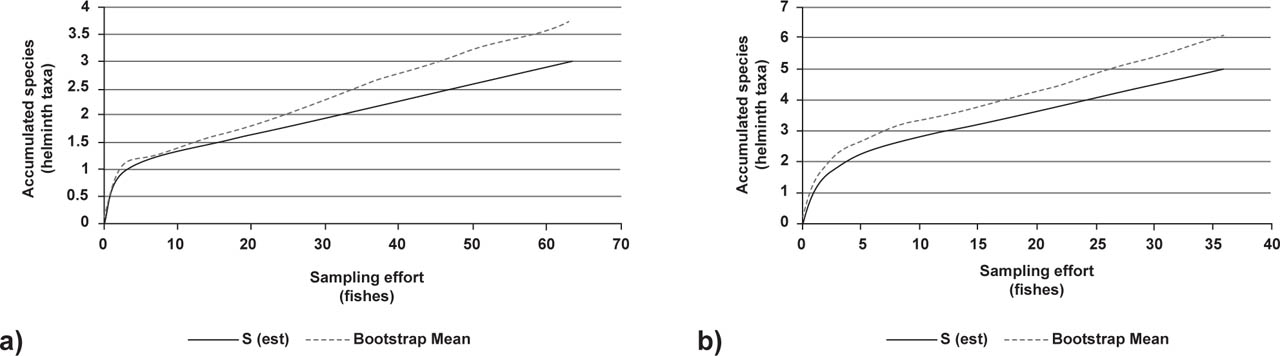
Fig. 1.
Species accumulation curves of a) Clinocottus analis and b) Girella nigricans from the rocky intertidal zone of Punta Morro, Baja California, Mexico. Y axis refers to helminth taxa, while X axis refers to individual fishes
The parasite component community from C. analis exhibits a species richness of 3, and the Berger-Parker value (1.04) indicates a strong dominance by O. adsphaericus. At the same time, S. girellae and A. morronei are rare species.
Clinocottus analis exhibits carnivorous feeding habits, as its diet primarily consists of amphipods, small crustaceans, mollusks such as polyplacophorans (chitons), and gastropods (including limpets). On the other hand, a total of 94 individual helminths belonging to five taxa were collected from G. nigricans, namely the adult trematodes O. adsphaericus, Opisthadena cheni Martin, 1978 (Bunocotylidae), and S. girellae, the metacercariae of Prosorhynchoides sp. (Bucephalidae), and the cystacanth acanthocephalan Floridosentis sp. (Neoechinorhynchidae). The species accumulation curve and Bootstrap estimator indicate that at least one parasite taxa is absent from this component community (Fig. 1b). The range of individual helminths varied from 1 to 7, with a mean of 6.611 ± 1.275 by host. The trematode species O. adsphaericus and S. girellae exhibited relatively high prevalence (60 % and 30 %, respectively), while the remaining taxa showed very low values. The five helminth taxa’s mean abundance and mean intensity were very low (Table 1). The trematodes O. cheni and S. girellae could be considered specialists for G. nigricans, while O. adsphaericus is a generalist. The status of Prosorhynchoides sp. and Floridosentis sp. remains uncertain, as only larval stages were observed (Table 1). Eight G. nigricans were parasite-free, 27 harbored one species, and only one had three. The mean number of species per host was 1.028 ± 0.774. The mean Brillouin index calculated for the infracommunities with two or more species was 0.112 ± 0.222.
At the component community level, species richness was 5, and the Berger-Parker value (1.54) indicates that this component is dominated by O. adsphaericus or O. adsphaericus and S. girellae, while the remaining three are rare.
Girella nigricans exhibits omnivorous feeding habits. Its diet primarily consists of green and red algae, seagrass, small crustaceans, gastropods, and mollusks associated with this flora.
The six helminth taxa identified in both hosts are considered auto-genic, as their entire life cycle occurs within the aquatic environment. Opecoelus adsphaericus was the numerically dominant species, with the highest prevalence values, infecting more than half of both analyzed host species. Opecoelus adsphaericus was the only species found in both hosts during all sampled months (Tables 2 and 3).
Table 2.
Collection data for helminth parasites of Clinocotus analis from the rocky intertidal zone of Punta Morro, Baja California, Mexico.
| Sampling event (month and year) | NH | Schikhobalotrema girellae | Opecoelus adsphaericus | Ascarophis morronei |
|---|---|---|---|---|
| 1 (11/2018) | 10 | 1 | 41 | 0 |
| 2 (06/2019) | 8 | 0 | 46 | 0 |
| 3 (08/2019) | 34 | 0 | 61 | 5 |
| 4 (09/2019) | 11 | 1 | 35 | 0 |
| Total | 63 | 2 | 183 | 5 |
Table 3.
Collection data for helminth parasites of Girella nigricans from the rocky intertidal zone of Punta Morro, Baja California, Mexico.
| Sampling event (month and year) | NH | Schikhobalotrema girellae | Opisthadena cheni | Opecoelus adsphaericus | Prosorhynchoides sp. | Floridosentis sp. |
|---|---|---|---|---|---|---|
| 1 (11/2018) | 5 | 13 | 1 | 7 | 0 | 1 |
| 2 (06/2019) | 11 | 10 | 0 | 26 | 0 | 0 |
| 3 (07/2019) | 20 | 7 | 0 | 28 | 1 | 0 |
| Total | 36 | 30 | 1 | 61 | 1 | 1 |
Discussion
Of the six helminth taxa parasitizing both fish species, only A. morronei and O. adsphaericus have been previously recorded in C. analis from the rocky intertidal zone of Punta Morro, Ensenada, Baja California, Mexico (Aguilar-Aguilar et al., 2019; Aguilar-Aguilar & Martorelli, 2024). Opisthadena cheni, Prosorhynchoides sp., and Floridosentis sp. are newly recorded in C. analis. In contrast, S. girellae is recorded for the first time in C. analis and G. nigricans, all found in this rocky intertidal zone.
The low prevalence and abundance, and developmental stage of Prosorhynchoides sp. and Floridosentis sp. in G. nigricans suggest that their infections are accidental and rare in the rocky intertidal zone, because these taxa are primarily reported in pelagic fish, their definitive hosts, such as Scombridae, Serranidae, and Sphyraenidae for Prosorhynchoides sp. (Bravo-Hollis & Sogandares-Bernal, 1956; Vidal-Martínez et al., 1998; Aguirre-Macedo et al., 2007) and Mugilidae for Floridosentis sp. (Ward, 1953; Bravo-Hollis, 1969; Rosas-Valdez et al., 2020).
Despite the very low prevalence of O. cheni, this trematode is considered a common species of girellid fish from California to Hawaii (Martin, 1978; León-Règagnon et al., 1996, 1997). The low prevalence may be due to the fact that G. nigricans specimens were collected during their juvenile phase, whereas studies reporting a higher number of O. cheni were based on adult fish (Martin, 1978; Morton et al., 2021). Future studies on trematodes in adult G. nigricans from the infralittoral zone of Punta Morro, Bahia, could provide insights into whether these fish harbor higher numbers of O. cheni. Schikhobalotrema girellae was found in both host species, and although it has frequently been reported for G. nigricans (e.g., Manter & van Cleave, 1951; Martin, 1978), this trematode is reported for the first time in C. analis. This double occurrence may result from the characteristics of the haplosplanchnid life cycle and host feeding behavior. Haplosplanchnid cercariae encyst in open environments, with cysts adhering to algae (Cable, 1954; Fares & Maillard, 1975). Examination of the gastrointestinal contents of G. nigricans revealed a diet primarily consisting of red and green algae, seagrasses, and a few small gastropods and crustaceans associated with this flora. In contrast, C. analis is predominantly a carnivorous predator, although algae comprise a small portion (5–20 %) of its diet throughout all developmental stages (Wells, 1986; Ruiz-Campos & Hammann, 1991, 2002). Their feeding preferences can explain the difference in prevalence between them.
In a previous study, the nematode A. morronei was described based on 15 C. analis specimens collected from the same locality during March – May 2018 (see Aguilar-Aguilar et al., 2019); however, infection parameters (e.g., prevalence) were not reported. These nematodes were found only in one host collected in August 2019, with a relatively high mean intensity value (MI = 5; Table 2). To date, A. morronei has only been found in the stomach of C. analis, indicating a certain degree of host specificity. The third-stage larva of several species of Ascarophis occurs in amphipods and decapod crustaceans (Martorelli et al., 2000; Moravec et al., 2024), which are a common prey group for C. analis (Wells, 1986; Ruiz-Campos & Hammann, 1991). Locally occurring crustaceans likely play a role in the life cycle of A. morronei, as indicated by the presence of ghost and mud shrimp, along with striped shore and hermit crabs, in the stomach contents of some C. analis. However, further research is necessary to detect larvae in crustaceans inhabiting the rocky intertidal zone, considering periods of seasonal availability and/or approaches based on morphological matching and/or genetic matching between larval and adult stages of nematodes, to provide information on their life cycle.
Both analyzed component communities were depauperate and dominated by O. adsphaericus. The dominance of this trematode species can be explained as generalist parasitic strategy, being able to parasitize marine fishes from families Cottidae, Girellidae, Mullidae, Scorpaenidae, Serranidae, and Stichaeidae (Manter & van Cleave, 1951; Arai, 1962; Banerjee, 1965; Pritchard, 1966; Martin, 1978; de Fabio, 1981; Wells, 1986; Morton et al., 2021; Aguilar-Aguilar & Martorelli, 2024), and commonly recorded from the southern California bight ecoregion (Spalding et al., 2007). On the other hand, the life cycle of O. adsphaericus may play a significant role in its dominance. Although the life cycle of O. adsphaericus remains unknown, evidence from a congeneric species suggests that snails serve as the first intermediate hosts, crustaceans as the second intermediate hosts, and teleosts as the definitive hosts (Cribb, 1985; Cribb et al., 2001). Here, snails and crustaceans were observed in the intestinal contents of both host fish species. In this context, likely, the intermediate hosts of O. adsphaericus are consistently present in the rocky intertidal zone. When ingested by their definitive hosts, this availability may contribute to the parasite´s high prevalence in C. analis and G. nigricans.
Feeding habits and the differential availability of intermediate hosts containing larval phases are considered the main factors structuring the parasite communities in marine teleosts (e.g., Marcogliese, 2002; Violante-González et al., 2008). In this study, the helminth infracommunities found in both host species are thought to be determined by the host’s feeding preferences, since most of the taxa are recruited through ingestion. The relevance of the feeding habits of the hosts influencing the structure of parasite communities has been widely discussed (Lo et al., 1998; Poulin, 2002; Dugarov et al., 2011), suggesting that hosts with carnivorous habits usually present richer and more diverse parasite communities than those with omnivorous or herbivorous habits (Marcogliese, 2002; Luque et al., 2004). However, this pattern was not observed in this study, likely due to dietary variations in G. nigricans, which is omnivorous in the rocky intertidal zone during its juvenile stages and herbivorous in the subtidal zone as an adult (Behrens & Lafferty, 2012). This dietary variation enables the consumption of a broad range of prey, thereby increasing the likelihood of successfully transmitting parasitic intermediate stages.
Prior to this study, no published evidence has characterized the structure of helminth parasite communities in the rocky intertidal zone of Baja California. Here, a depauperate parasite assemblage was found, similar to the results reported from fishes inhabiting intertidal rocky environments from Central Chile (e.g., Muñoz & Cortés, 2009; Fernández-Cisternas et al., 2017). The low parasite diversity in intertidal fish species can be attributed to the high variability in environmental conditions driven by tidal fluctuations (Horn & Martin, 2006; Muñoz & Cortés, 2009; Fernández-Cisternas et al., 2017). The rocky intertidal zone of California exhibits pronounced seasonal and spatial variability in tidepool fish abundance (Yoshiyama, 1981; Yoshiyama et al., 1986). Fernández-Cisternas et al. (2017) suggested that these fluctuations likely affect the parasite community; however, they also noted that the scarcity of studies on the parasite communities of intertidal rocky fish in the southern California bight makes comparisons difficult. This study contributes to the understanding of host-parasite associations and their relationship to host dietary preferences. It also provides a basis for future studies on parasitic communities to understand the diversity of parasites in intertidal fishes.
Acknowledgments
AGM and ARS were supported by SECIHTI scholarships 1519333123 and 1569233633, respectively, to accomplish their MSc. Degrees in the Graduate Program MSc and PhD in Sciences and Engineering (MyDCI, Faculty of Science, UABC). Thanks to Ángel Felix Jiménez Rojas for his help during fieldwork. Dr. Julio Lorda-Solórzano and Dr. Ana Luisa May-Tec made beneficial comments on the analyses performed in this study. This work was financially supported by Grant No. 400/2356 (Programa para el Desarrollo Profesional Docente [UABC–PRODEP–2019]) from the Secretaría de Educación Pública (SEP), Mexico, to AMA, and by Grant #400/1/C/23/23 (23a Convocatoria Interna UABC-2023) to AMA and GRC. We thank Dr. F.S. Cecarrelli for help with language editing and constructive criticism. The manuscript has greatly benefited from the comments of two anonymous referees.