Introduction
Jordan is a highly diversified area in terms of variation in biogeographic regions and richness in biological diversity elements, especially plant biodiversity. Aquatic plants, also called hydrophytes or macrophytes, are natural and beneficial parts of Jordan’s water bodies (fresh and marine water). Their growth forms define aquatic plants as emergent, submerged, floating-leaved, or free-floating.
Aquatic plants offer numerous benefits to ecosystems, including habitat provision, influencing water flow and biogeochemical cycles, and providing food and oxygen (French & Chambers, 1996; Chambers et al., 1999). They are valuable for various human uses like fisheries, medicine, and recreation (Suren et al., 2000; Gross et al., 2001; O’Hare et al., 2018). The health of aquatic plant communities reflects the overall health of the ecosystem. Environmental factors can significantly impact these plants. Nematodes play vital roles within these ecosystems as a major component of aquatic sediments. Plant-parasitic nematodes can severely damage aquatic plants, yet they remain understudied. For example, Hirschmanniella caudacrena attacks the roots of coontail (Ceratophyllum demersum L.), causing symptoms like chlorosis, stem deformation, and ultimately, plant death when present in high numbers (Gerber & Smart, 1987).
In Jordan, no prior records of nematodes are associated with aquatic plants. To address this knowledge gap, we conducted a study to investigate the nematode community structure of aquatic plants in Jordan. During this survey, a sheathoid nematode belonging to the genus Hemicycliophora was recovered from soil surrounding the submerged aquatic plant, Juncus maritimus Lam., growing on the banks of the Zarqa River. The genus Hemicycliophora de Man, 1921 (Nematoda: Criconematidae) represents a large group of migratory root-ectoparasites of various plant species, including aquatic plants, that cause poor root development and damaged foliage.
This study represents the first record of this sheathoid nematode, Hemicyliophora conida Thorne, 1955, in Jordan associated with roots of J. maritimus, including its morphological and molecular characterization.
Materials and Methods
During a study of nematodes associated with aquatic plants in Jordan, soil samples were collected from the rhizosphere of sea rush plants, Juncus maritimus Lam., from the Zarqa River (32°08′52.6″ N, 36°03′25.2″). Nematodes were extracted using the Baermann funnel method (Niblack & Hussey, 1985) and the centrifugation-sugar flotation method (Christie & Perry, 1951). After extraction, some of the collected nematodes were kept at −80 °C for molecular characterization and others were killed, fixed in hot buffered formalin, and mounted in glycerin for morphological identification (Humason, 1972; Seinhorst, 1959).
Morphological identification of the species Hemicycliophora was confirmed by sequencing two regions of rDNA (18S gene and D2/D3 expansion segments of the 28S rRNA gene). Two sets of primers were used: the D2A forward primer and the D3B reverse primer for amplification of the D2/D3 expansion segment of the 28S rRNA gene (Subbotin et al., 2006). Meanwhile, the forward GI8SU and the reverse R18Tyll amplify the partial 18S rRNA gene (Chizhov et al., 2006). DNA was extracted using a modified proteinase K protocol (Chizhov et al., 2006).
Ethical Approval and/or Informed Consent
The result of this work has not been published previously and is not under consideration elsewhere.
Results and Discussions
The morphological features of ten adult females are characterized by a slightly curved body ventrally; the cuticle outside the lateral field is divided into many small blocks by numerous longitudinal lines. Cuticular sheath is tightly adpressed to the body, the stylet is slightly curved, knobs rounded, backward sloping with distinct cavity at base, lip region is rounded with two annuli, the excretory pore is situated slightly posterior to the pharyngeal bulb, vulval lips are slightly protruding but not elongated, the lateral field begins with a single line in the anterior end of the body, then transitions into two or three longitudinal lines, with the tail tapering gradually to a conoid terminus (Fig. 1). Body length = 801.4 μm (735 – 840 μm), greatest body diameter = 43.5 μm (36 – 54 μm), stylet length = 70.7 μm (63 – 77 μm), a = 18.6 (15 – 23), pharynx length = 150.1 μm (130 – 180 μm), b = 5.3 (4.5 – 6.2), V (%) = 84 (78 – 87), m (%) = 69.4 (50 – 86), R = 216 (192 – 240), Rex = 50 (43 – 54), and Rv = 39 (35 – 45). The seven recovered adult males are characterized by a ventrally curved body. The lip region is rounded, not annulated, a stylet absent, a pharynx reduced, an excretory pore situated posterior to the base of the pharynx, a tail tapering gradually to a finely conoid pointed terminus, and a bursa well developed (Fig. 2). Body length = 678.9 μm (641 – 712 μm), greatest body diameter = 26.4 μm (21 – 32 μm), tail length = 113.6 μm (106 – 122 μm), Rv = 78 (70 – 84), spicules = 43.2 μm (36 – 49 μm), and gubernaculum = 8.6 μm (7 – 9.8 μm).
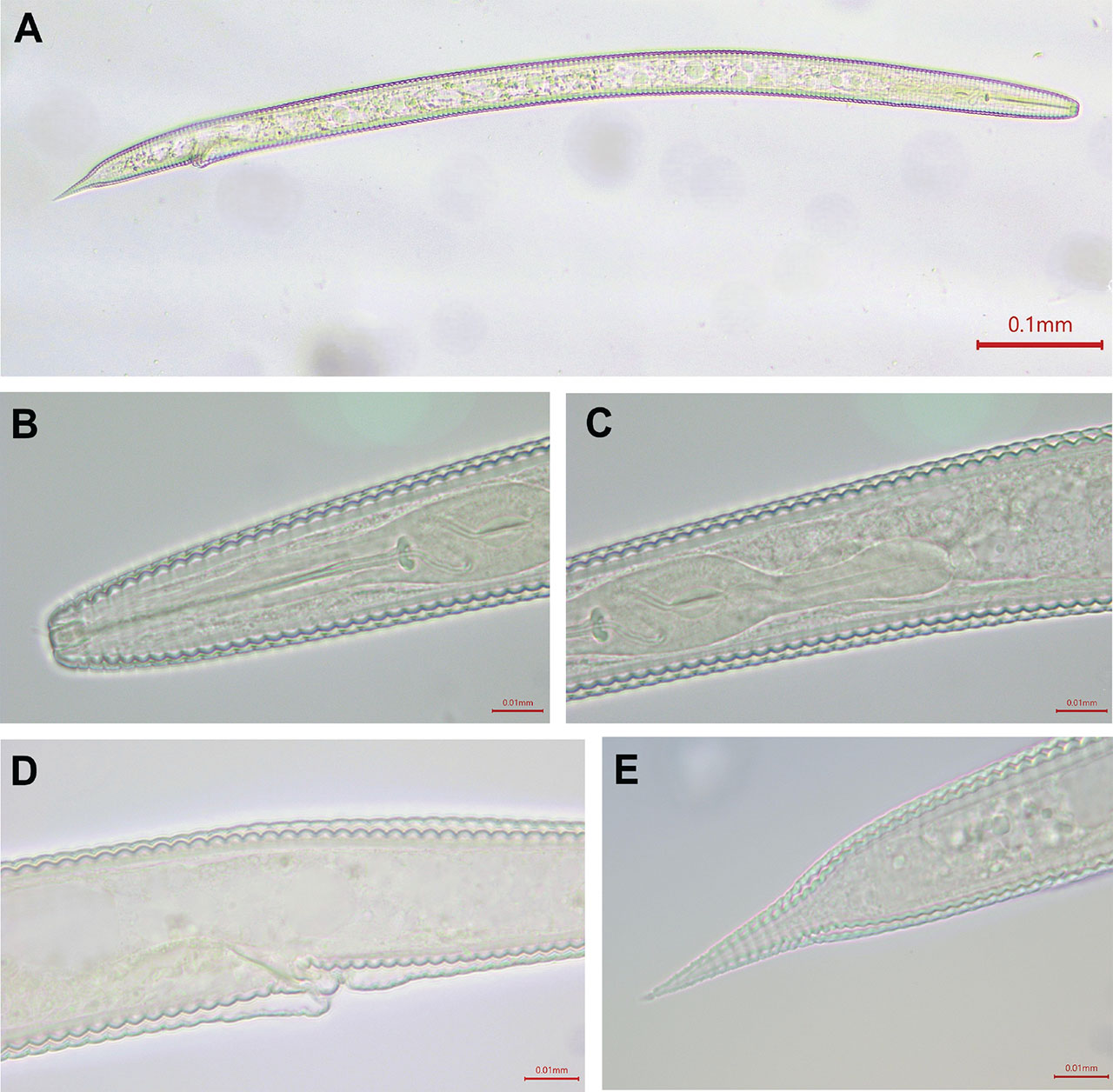
Fig. 1.
Hemicycliophora conida female. A: Entire body; B–C: Anterior body region; D–E: Posterior body region.
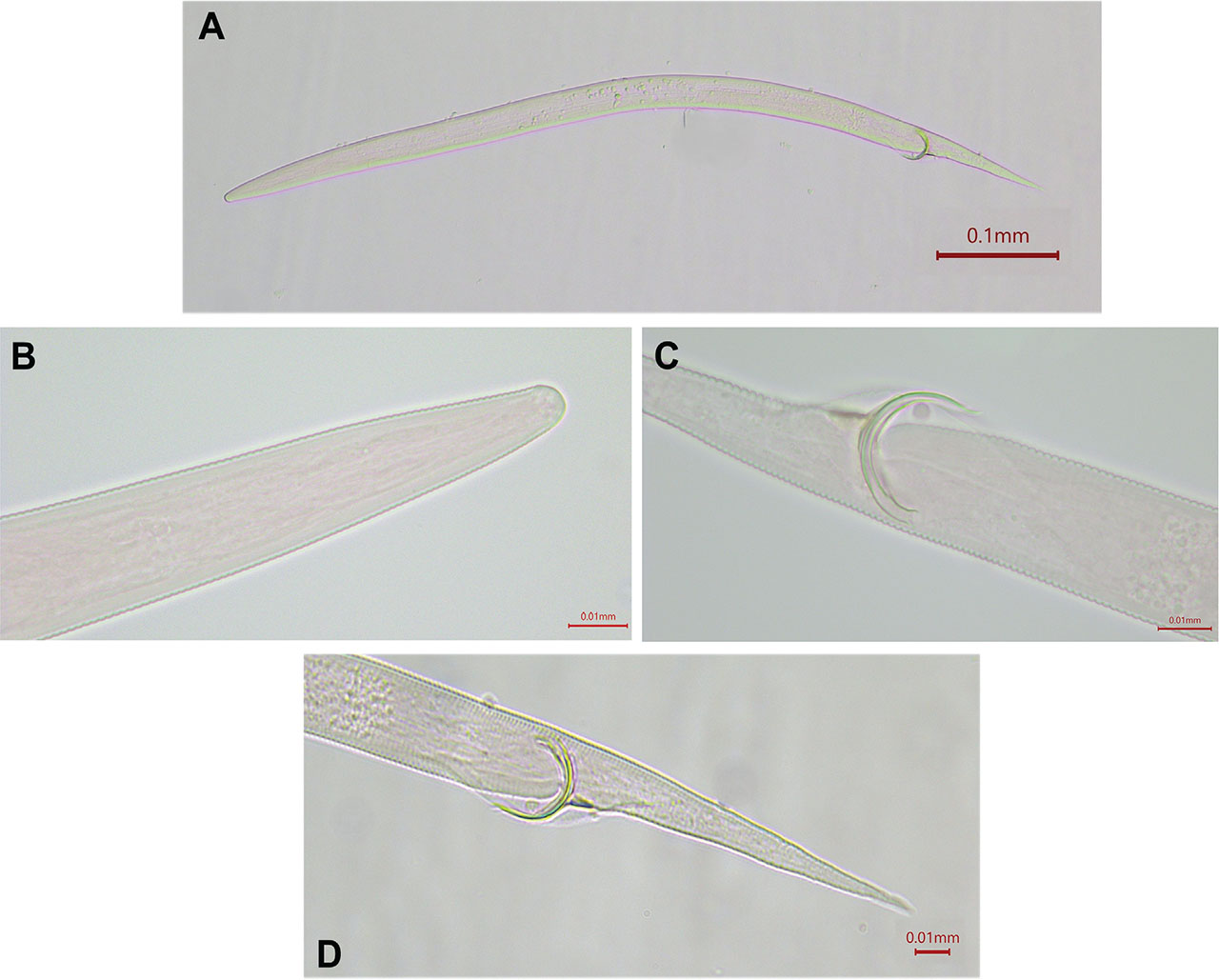
Fig. 2.
Hemicycliophora conida male. A: Entire body; B: Anterior body region; C–D: Posterior body region.
The recovered species of Hemicycliophora was molecularly characterized by sequencing two regions of rDNA (18S gene and D2/D3 expansion segments of the 28S rRNA gene). The sequences with accession numbers were deposited in GenBank. PQ776791 (18S rRNA: 411bp) and PQ776265 (28S rRNA: 687bp), and were compared by BLASTn on the NCBI website. BLASTn analysis of the 18S and D2–D3 regions showed 100 % similarity with two Iranian isolates of Hemicycliophora conida (= H. typica Raski & Luc, 1987) MW740208 and MN888470. These morphological and molecular data confirmed the first detection of H. conida in Jordan. To our knowledge, this is the first record of H. conida in Jordan. Its presence could harm plants like J. maritimus, a widespread aquatic species in the Zarqa River in Jordan, with medicinal, industrial, and economic values. It was also reported that J. maritimus controls salt accumulation in saline habitats and is considered an environmental quality indicator for high salinity and alkalinity environments (Suren et al., 2000). The impact of H. conida on this and other aquatic plants in the Zarqa River needs further study.
Notes
Acknowledgments
Funding was received from the Deanship of the Scientific Research, the University of Jordan.