Table 1.
Prevalence of trematodes (Fasciola hepatica and paramphistomids) in cattle in southeastern Mexico in the samplings carried out during 2022 and 2023.
| Farm and sampling date | Physiological stage | Fasciola hepatica | Paramphistomids | |
|---|---|---|---|---|
| Farm 1 DNA | May-22 | Lactating cows | 25.8 % (8/31) | 22.6 % (7/31) |
| Salto de Agua, Chiapas | June-22 | Lactating cows | 50.0 % (13/26) | 15.4 % (4/26) |
| August-22 | Lactating cows | 0.0 % (0/39) | 41.0 % (16/39) | |
| Farm 2 DRG | May-22 | Calves | 0.0 % (0/17) | 70.6 % (12/17) |
| Salto de Agua Chiapas | June-22 | Calves | 0.0 % (0/17) | 0.0 % (0/17) |
| August-22 | Lactating cows | 20.0 % (7/35) | 48.6 % (17/35) | |
| September-22 | Lactating cows | 0.0 % (0/11) | 0.0 % (0/11) | |
| Farm 4 DNT | August-23 | Calves | 4.2 % (1/24) | 0.0 % (0/24) |
| Salto de Agua, Chiapas | September-23 | Calves | 4.0 % (2/50) | 0.0 % (0/50) |
| October-23 | Calves | 9.8 % (4/41) | 7.3 % (3/41) | |
| November-23 | Calves | 0.0 % (0/25) | 4.0 % (1/25) | |
| December-23 | Calves | 4.2 % (1/24) | 0.0 % (0/24) | |
| Farm 5 Rita | July-23 | Lactating cows | 28.6 % (4/14) | 28.6 % (4/14) |
| Farm 6 Frank | August-23 | Lactating cows | 3.4 % (1/29) | 0.0 % (0/29) |
| Farm 7 JSalv | September-23 | Lactating cows | 0.0 % (0/51) | 2.0 % (1/51) |
| Farm 8 PNR2 | October-23 | Lactating cows | 10.3 % (7/68) | 13.2 % (9/68) |
| Farm 9 RNat | November-23 | Lactating cows | 40.6 % (13/32) | 56.3 % (18/32) |
| Farm 10 RNat2 | November-23 | Lactating cows | 26.7 % (12/45) | 35.6 % (16/45) |
| Farm 11 R1CM | November-23 | Lactating cows | 10.0 % (3/30) | 33.3 % (10/30) |
| Farm 12 R2CM | November-23 | Lactating cows | 3.2 % (1/31) | 41.9 % (13/31) |
| Total | 12 % (77/640) | 20.5 % (131/640) | ||
Table 2.
Prevalence of the main genera of gastrointestinal parasites in cattle from the municipalities of Salto de Agua, Chiapas, and Teapa, Tabasco, Mexico.
| Date | Trichostrongylids¥ | Strongyloides | Trichuris | Dictyocaulus | Toxocara | Coccidia | |
|---|---|---|---|---|---|---|---|
| Farm 1 DNA | May-22 | 66.7 | 73.3 | - | 6.7 | - | - |
| Salto de Agua, Chis. | June-22 | 52.9 | 88.2 | 11.8 | 17.7 | - | 17.7 |
| August-22 | 51.4 | - | - | - | - | - | |
| September-22 | 81.8 | - | 10.0 | - | - | - | |
| Farm 2 DRG | May-22 | 76.7 | 26.7 | 6.5 | 3.2 | 6.5 | 25.8 |
| Salto de Agua, Chis. | June-22 | 16.0 | - | 3.9 | - | 23.1 | 3.9 |
| August-22 | 36.8 | 2.6 | 2.6 | - | - | - | |
| Farm 3 GCh | May-22 | 92.9 | 57.4 | - | - | - | - |
| Teapa, Tab. | June-22 | 35.7 | 71.4 | - | - | - | 14.3 |
| Farm 4 DNT | June-23ψ | 33.3 | 7.4 | 4.0 | 4.0 | - | 36.0 |
| Salto de Agua, Chis. | July-23 | 44.4 | 22.2 | - | 4.0 | 4.0 | 12.0 |
| August-23 | 29.6 | 14.8 | - | 4.0 | - | 4.0 | |
| September-23 | 57.4 | 20.4 | - | - | - | - | |
| October-23θ | 63.0 | 3.7 | 4.0 | - | 4.0 | - | |
| November-23 | 63.0 | - | - | - | - | - | |
| December-23 | 70.4 | 3.7 | - | - | - | 54.0 |
Table 3.
Severity of infection by trichostrongylids and Strongyloides spp. in pre-weaning calves in the municipality of Salto de Agua.
| Farms | Month | N | Trichostrongylids¥ | Strongyloides | ||
|---|---|---|---|---|---|---|
| Mean | SD | Mean | SD | |||
| Farm 1 DNA | May | 31 | 216 | 240 | 71 | 210 |
| June | 26 | 29 | 87 | 2 | 10 | |
| August | 39 | 46 | 94 | 0 | 0 | |
| Farm 2 DRG | May | 15 | 353 | 616 | 16,877 | 54,504 |
| June | 17 | 100 | 129 | 959 | 1566 | |
| August | 46 | 92 | 122 | 0 | 0 | |
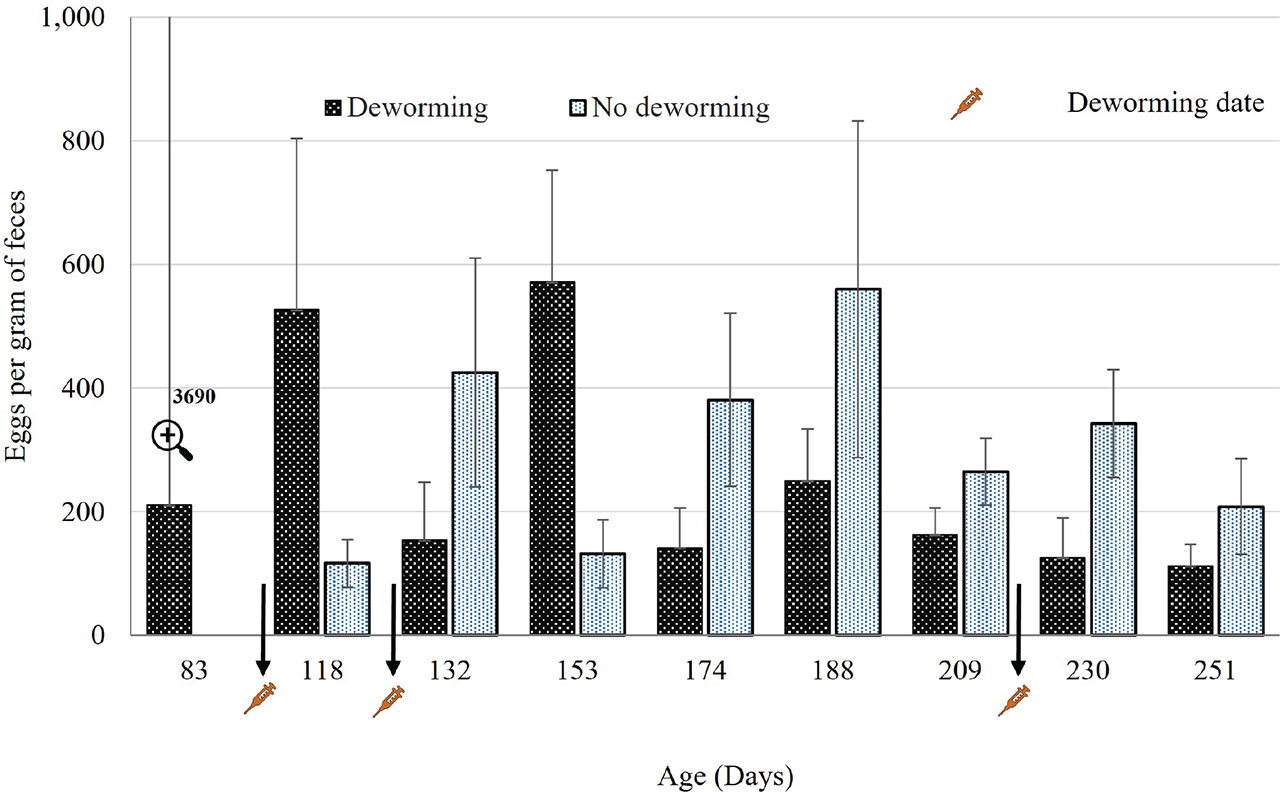
Fig. 1.
Fecal nematode egg counts during the study for two groups of calves (dewormed and non-dewormed) on farm 4 (DNT). One calf had a notably high count of 35,000 eggs per gram of feces (EPG), resulting in an average value of 3,690 EPG for the dewormed group.
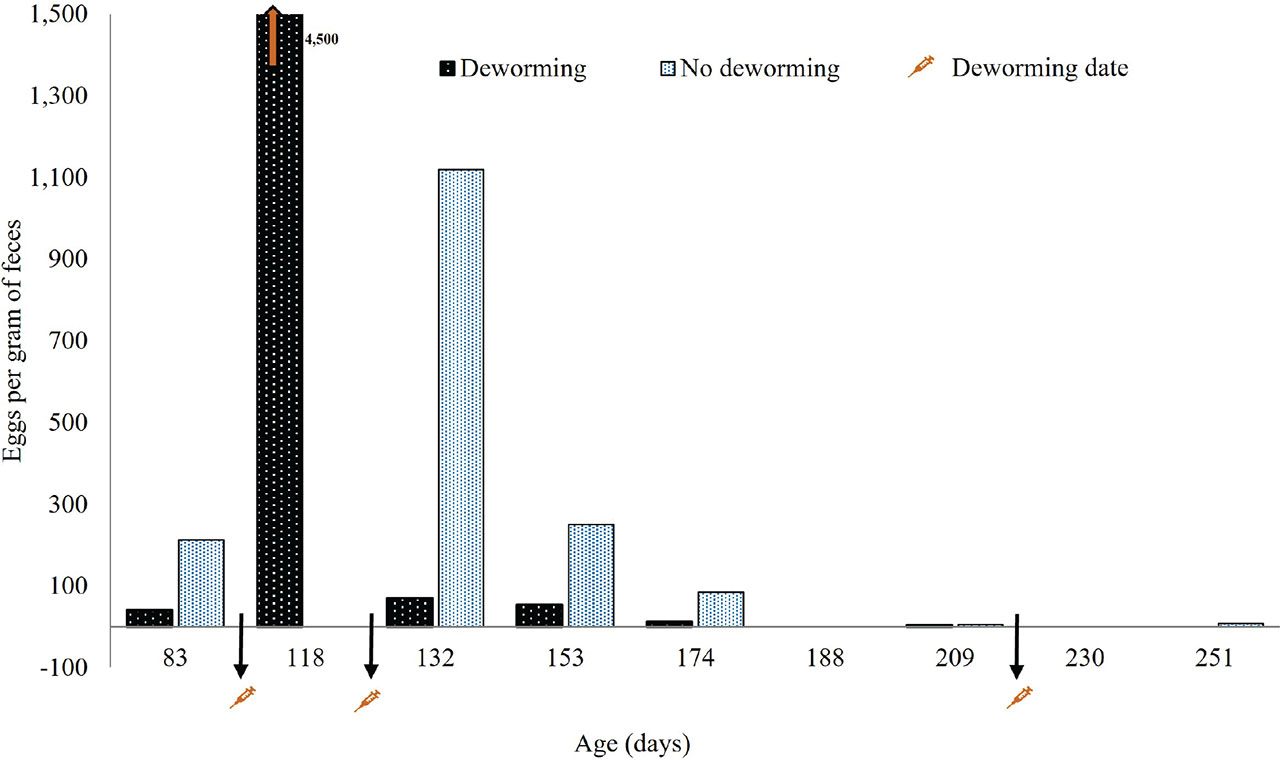
Fig. 2.
Fecal egg count trends of Strongyloides spp. throughout the study, categorized by treatment.
Table 4.
Average fecal nematode egg count by treatment and sex of calves.
| Treatment | Sex | EPG* | Strongyloides |
|---|---|---|---|
| Deworming | Female | 193 | 376 |
| Male | 814 | 722 | |
| No deworming | Female | 316 | 246 |
| Male | 278 | 84 |
Table 5.
Severity of Fasciola hepatica and paramphistomid infection in cattle in the municipality of Salto de Agua, Chiapas.
| N | Mean | SE | Rank | Mean | SE | Rank | |
|---|---|---|---|---|---|---|---|
| Farm DNA | 96 | 3.9a | 1.2 | 0 – 88 | 3.3a | 1.0 | 0 – 60 |
| Farm DRG | 78 | 0.3b | 0.1 | 0 – 4 | 1.0b | 0.2 | 0 – 8 |
| Sampling-May | 46 | 3.5a | 2.0 | 0 – 88 | 2.2a | 1.2 | 0 – 52 |
| Sampling-June | 43 | 5.0ab | 1.6 | 0 – 44 | 1.1a | 0.8 | 0 – 32 |
| Sampling-August | 85 | 0.3b | 0.1 | 0 – 4 | 2.8a | 0.8 | 0 – 60 |
| Females | 66 | 2.2a | 0.9 | 0 – 44 | 2.1a | 0.6 | 0 – 32 |
| Males | 51 | 4.4a | 2.0 | 0 – 88 | 1.4a | 1.0 | 0 – 52 |
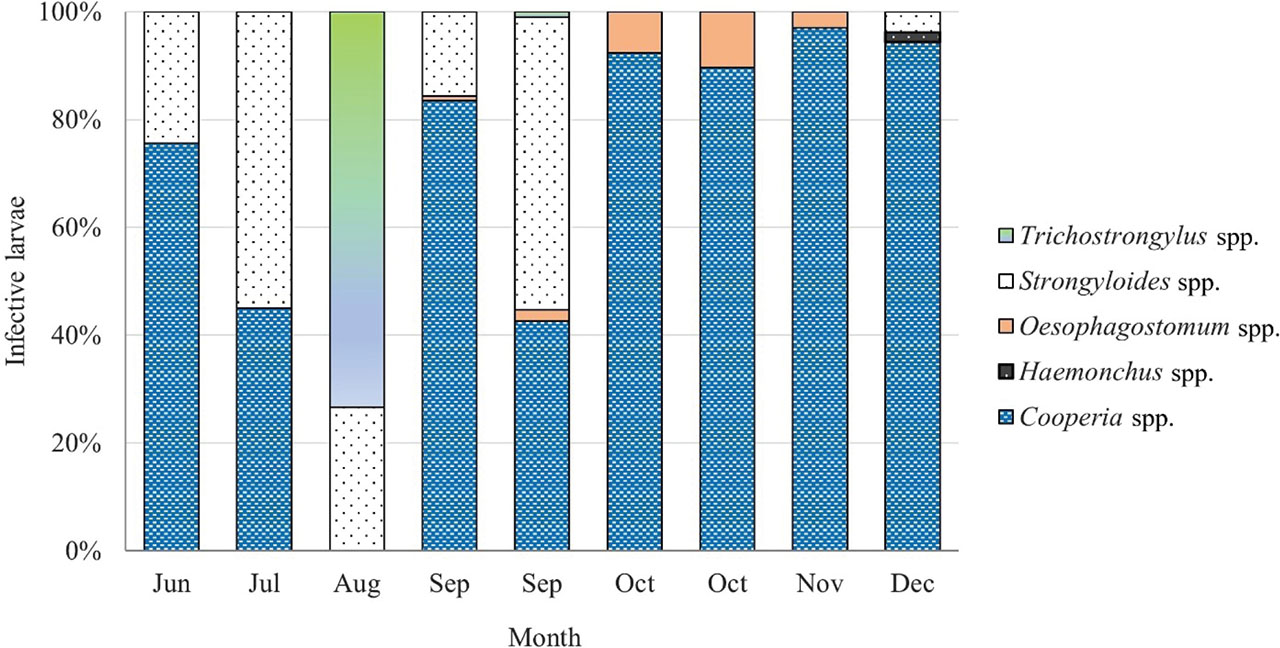
Fig. 3.
Genera of gastrointestinal nematodes identified morphologically in the larval stage.