Introduction
The global emergence of nematodes resistant to benzimidazoles (BZ), levamisole (LEV), ivermectin (IVM), and moxidectin (MOX) is expanding rapidly, particularly in Europe, though there remain knowledge gaps in certain regions (Beleckė et al., 2021; Papadopoulos et al., 2012; Vineer et al., 2020). Several factors contribute to the development of anthelmintic resistance (AR), including the high frequency of anthelmintic treatments, underdosing of anthelmintics, and lack of rotation among anthelmintic groups (Sargison et al., 2007). Infections with gastrointestinal nematodes (GIN) can lead to symptoms ranging from diarrhea and digestive issues to anemia and, in severe cases, animal death. However, most infections are subclinical, resulting in decreased productivity (Beleckė et al., 2021). Subclinical infections lead to reduced growth and lower milk and wool production, causing significant economic impact. Moreover, parasitic worms affect animal welfare and, indirectly, human well-being through impacts on farm management, production, and food security (Charlier et al., 2023). The total cost of helminthic infections in sheep farming is estimated at €357 million, with resistance to MOX alone costing approximately €38 million annually in Europe, and this cost is increasing. Since 2010, the average prevalence of AR in sheep and goats in Europe has been 86 % for BZ, 52 % for macrocyclic lactones (ML), 48 % for LEV, and 21 % for MOX (Charlier, J. et al., 2020; Vineer et al., 2020).
The presence of nematode strains resistant to BZ, IVM and ML has been repeatedly reported, particularly for the three genera: Haemonchus, Teladorsagia and Trichostrongylus (Papadopoulos et al., 2012). However, multidrug resistance (MDR) has been identified in 10 Europe countries, but likely to be more widespread than reported (Charlier, J. et al., 2022; Vineer et al., 2020).
Various in vitro tests are available to detect AR with the Egg Hatch Test (EHT) being the most commonly used. However, the Larval Development Test (LDT) is considered the most efficient for detecting resistance to BZ, LEV, and IVM, despite being more laborious and time-consuming. LDT is applicable for detecting resistance to all broad-spectrum anthelmintics, including macrocyclic lactones, whereas EHT is limited to BZ resistance detection. In vitro tests have shown higher sensitivity, identifying even as low proportions of resistant parasites within a population as 4 % (Babják et al., 2021; Várady et al., 2007).
The in vivo fecal egg count reduction test (FECRT), recommended by the World Association for the Advancement of Veterinary Parasitology (WAAVP), is effective but costly and time-consuming, requiring multiple tests on herd animals, which often makes it impractical for farmers (Kaplan et al., 2023; Mickiewicz et al., 2021). Assessing all five licensed anthelmintic groups, including IVM and MOX, along with a control group, demands a substantial number of animals, further limiting feasibility for commercial farms. As a result, most studies evaluate only a limited range of anthelmintics. While the controlled in vivo efficacy test is the gold standard for anthelmintic resistance assessment, it’s reliance on animal slaughter makes it unsuitable for commercial farm monitoring (Vineer et al., 2020). Additionally, molecular tests remain limited to detecting BZ resistance (Coles et al., 2006).
AR research often lacks studies with large, randomly selected samples, typically relying on farmer self-selection or samples from regions near universities due to resource limitations. The median sample size for AR studies is five farms (Vineer et al., 2020). In most Nordic-Baltic countries randomized studies have not been carried out (Beleckė et al., 2021). In Norway, lower BZ resistance was found in randomly selected farms compared to non-randomly selected ones (Domke et al., 2012). Only a few studies using in vitro and in vivo tests have been carried out in central and southern parts of Lithuania. They involved non-randomly selected farms usually with a history of regular use of anthelmintics (Kupčinskas et al., 2016; Kupčinskas et al., 2015a; Kupčinskas et al., 2015b).
This nationwide randomized study aimed to investigate the prevalence and current status of resistance of GIN to BZ, IVM, and LEV in Lithuania using the in vitro micro-agar larval development test (MALDT).
Materials and Methods
Study design
The study was conducted in years 2021 – 2022 and sheep farms were randomly selected to participate in the survey. The only inclusion criterion was that farms must have at least 15 sheep to ensure a representative sample of actively managed flocks with established anthelmintic treatment practices. A total of 38 sheep farms, representing 19.7 % of the 193 farms invited by the Lithuanian Sheep Breeders Association, agreed to participate. The sample size was determined based on practical feasibility and insights from similar studies (e.g., Dolinska et al., 2014; Kupčinskas et al., 2015b). A convenience-based sampling approach was employed to ensure the inclusion of a sufficient number of farms for meaningful statistical comparisons.
Farmers were asked to complete a structured questionnaire providing information on farm size, sheep breeds, the purchase of sheep from other farms or abroad, and deworming history over the past three years, including the frequency and types of drugs used. To assess AR, the in vitro MALDT to detect resistance to BZ, IVM, and LEV. These anthelmintics were selected based on previous surveys indicating them as the most commonly used in Lithuania (Kupčinskas et al., 2016).
On each farm, faecal samples were collected directly from the rectum of 15 – 20 randomly selected sheep. Pooled faecal samples weighing 50 – 100 g were stored anaerobically in plastic tubes filled with water at room temperature and processed within two days.
Nematode eggs were extracted by sieving the feces through a series of sieves with decreasing aperture sizes (250, 100, and 20 μm). The material retained on the 20-μm sieve was washed with tap water, sedimented, and further processed using the salt flotation method to recover trichostrongylid eggs for the in vitro MALDT (Dolinska et al., 2014).
In vitro test
The MALDT, as described by Coles et al. (2006), was used. Tests were conducted in 96-well microtiter plates. Stock solutions of ivermectin aglycone (IVM-Ag) and thiabendazole (TBZ) were serially diluted 1:2 with dimethyl sulfoxide (DMSO) and LEV was diluted with deionized water to produce 12 concentrations ranging from 0.084 to 173.6 ng/ml for IVM-Ag, 0.0006 to 1.28 µg/ml for TBZ and from 0.0156 to 32 µg/ml for LEV. Then, 12 μl of each stock solution at different final concentrations were mixed with 150 μl of 2 % Bacto agar (Difco, USA) and stored at 4 °C for 5 min. To inhibit fungal growth, 10 μl of eggs (final number of 50 eggs per well) in a 0.3 mg/ml solution of amphotericin B (Sigma-Aldrich, Germany) were mixed with 10 μl of yeast extract and added to the agar (Kupčinskas et al., 2015a; Kupčinskas et al., 2015b). The yeast extract was prepared as described by Hubert and Kerboeuf (Hubert & Kerboeuf, 1984) (1 g of yeast extract in 90 ml of 0.85 % NaCl was autoclaved for 20 min, and then 27 ml of this solution were mixed with 3 ml of 10× concentrated Earle’s solution). DMSO (1.3 %) was used in the control wells. The plates were incubated for 7 days at 27 °C. Incubation was terminated by adding Lugol’s iodine solution to each well. After incubation, the proportions of unhatched eggs, L, L2 and L3 stage larvae at each concentration were determined under an inverted stereomicroscope (Kupčinskas et al., 2015a; Kupčinskas et al., 2015b). The L3 larvae in the discriminating concentration were differentiated and identified by morphological features (Van Wyk et al., 2004).
Statistical analysis
Data were analyzed using a threshold discriminating concentration instead of conventional threshold values (LC50 or LC99). Farms were classified as resistant when L3 larvae were found at concentration 21.6 ng/ml for IVM-Ag, 0.04 µg/ml for TBZ and 2 µg/ml for LEV (Babják et al., 2018; Dolinska et al., 2014; Kupčinskas et al., 2015a; Kupčinskas et al., 2015b; Taylor, 1990). The percentage of developed L3 larvae at the threshold concentration was categorized as mild (< 10 %), moderate (10 – 50 %), and severe (> 50 %) (Mickiewicz et al., 2021).
Statistical analyses were performed using “SPSS for Windows version 20”. Descriptive statistics were calculated, and comparisons between groups were made using the Mann-Whitney U test, Pearson’s chi-square, or Fisher exact test. The significance level was set as 0.05. The 95 % confidence intervals (CI 95 %) were calculated using one-sample binomial success rate (Clopper-Pearson).
Results
Sheep farms characteristics
The study included 38 farms located throughout Lithuania, covering 8 out of 10 provinces. The size of the farms varied from 15 to 1500 adult sheep, with a median of 84 sheep. Most farms kept non-Lithuanian sheep breeds (47.4 %), including Romanov, Suffolk, German Black-headed, Sarole, Merinofleischschaf, Berichon du Cher, and Texel. Lithuanian local breeds, such as Lithuanian Black-headed sheep and Lithuanian Coarse, were maintained on 36.8 % of the farms, while the remaining 15.8 % kept crossbreeds. Three farms had imported sheep from abroad in the past three years. The majority of farms dewormed their sheep twice a year (n=23; 60.5 %; CI 95 %: 43.4 %, 76.0 %), while 8 farms (21.1 %; CI 95 %: 9.6 %, 37.3 %) dewormed once a year and 3 farms (7.9 %; CI 95 %: 1.7 %, 21.4 %) dewormed three times a year. Four farms (10.5 %; CI 95 %: 2.9 %, 24.8 %) did not engage in routine de-worming. The most commonly used anthelmintic was IVM used by 22 farms (57.9 %; CI 95 %: 40.8 %, 73.7 %). Ten farms rotated IVM with BZ (26.3 %; CI 95 %: 13.4 %, 43.1 %), and one farm rotated IVM with LEV and BZ (2.6 %; CI 95 %: 0.07 %, 13.8 %). Only one farm (2.6 %; CI 95 %: 0.1 %, 13.8 %) used LEV exclusively. Additionally, only 8 farmers (21.1 %; CI 95 %: 9.6 %, 37.3 %) regularly consulted with veterinarians and conducted deworming tests.
Micro-agar larval development test
The results MALDT are presented in Figure 1. The most prevalent resistance was to IVM. L3 larvae development at the IVM threshold concentration indicated resistance in 18/38 farms (47.4 %; CI 95 %: 31.0 %, 64.2 %). Among these, moderate levels of IVM resistance were detected in 12 farms (66.7 %), while 3 farms exhibited mild (16.7 %) and another three severe (16.7 %) levels of AR. BZ resistance was less common, detected in 15/38 farms (39.5 %; CI 95 %: 24.0 %, 56.6 %). Among these, 8 farms (53.3 %) had moderate levels of BZ resistance, 4 farms (26.7 %) had severe levels of BZ resistance, and 3 farms (20.0 %) had mild levels of BZ resistance. LEV resistance was not detected in any of the Lithuanian sheep farms (0 %; CI 95 %: 0 %, 9.3 %). Notably, eight farms on which BZ had not been used in previous three years showed BZ resistance. Similarly, one farm showed IVM resistance despite no reported use.
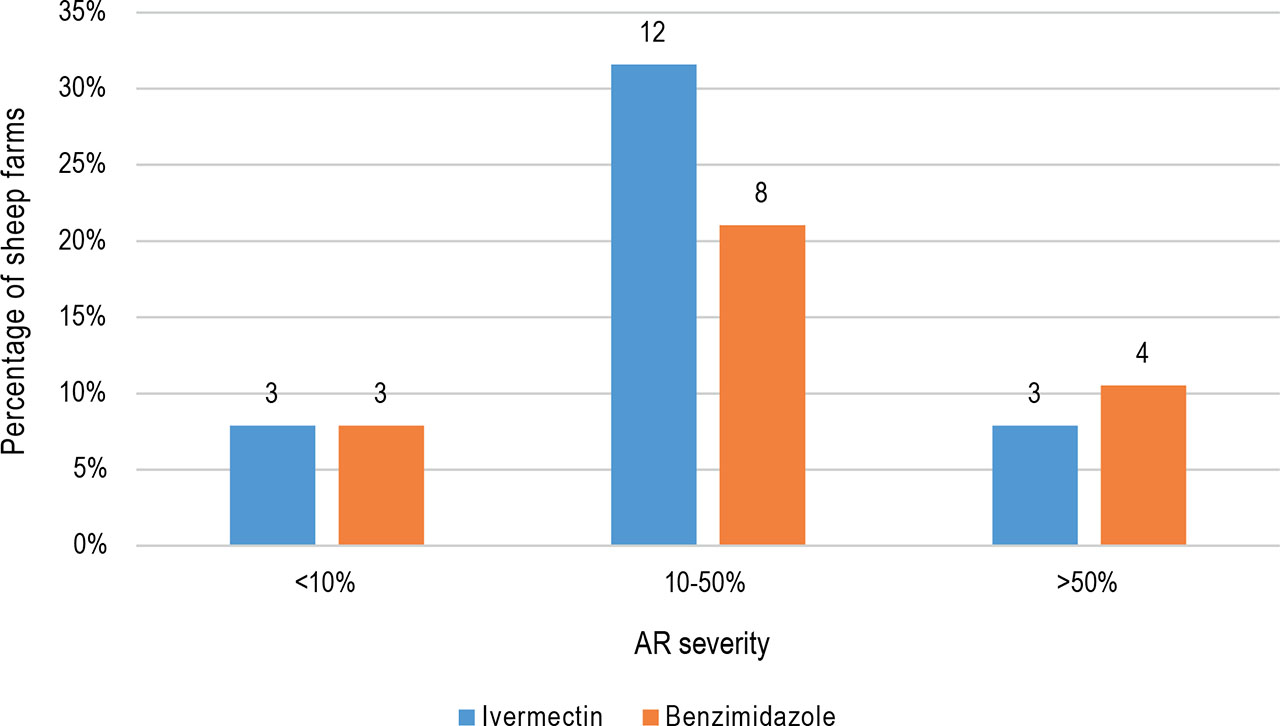
Fig. 1.
Number of sheep farms where the development of L3 larvae was present at the threshold concentration 21.6 ng/ml for IVM-Ag and 0.04 µg/ml for TBZ in sheep farms in Lithuania
Sixteen farms (42.1 %) were free from resistance to all anthelmintics. Resistance to at least one anthelmintic was detected on 22/38 farms (57.9 %; CI 95 %: 40.8 %, 73.7 %) - resistance to a single anthelmintic on 11/38 farms (28.9 %; CI 95 %: 15.4 %, 45.9 %) and AR to BZ and IVM on another 11/38 farms (28.9 %; CI 95 %: 15.4 %, 45.9 %). MDR was significantly associated with non-Lithuanian sheep farms breeds (p = 0.007).
BZ resistance was significantly associated with farms raising either Lithuanian local breeds or non-Lithuanian breeds (p = 0.001), but this was not the case for IVM resistance. However, no significant relationship was found between crossbreeds and the use of BZ or IVM. The use of BZ was significantly linked to BZ resistance, whereas IVM use was not significantly related to IVM resistance. The frequency of deworming per year did not link with the intensity of AR for any anthelmintic (IVM: p = 0.103, BZ: p = 0.234).
L3 larvae were differentiated at the discriminating concentration. In the case of BZ resistance, Trichostrongylus spp. was found on 8/15 farms (53.3 %; CI 95 %: 26.6 %, 78.7 %), in 6 farms (40.0 %; CI 95 %: 16.3 %, 67.7 %) – Teladorsagia circumcincta, and in 1 farm (6.7 %; CI 95 %: 0.2 %, 31.9 %) – H. contortus. In the case of IVM resistance, Trichostrongylus spp. was identified on 10/18 farms (55.6 %; CI 95 %: 30.8 %, 78.5 %), in 2 farms (11.1 %; CI 95 %: 1.4 %, 34.7 %) T. circumcincta, and in 2 farms (11.1 %; CI 95 %: 1.4 %, 34.7 %) – H. contortus. In one farm where H. contortus was found, MDR was present. In other MDR cases presence of Trichostrongylus (5/11; 45.5 %; CI 95 %: 16.7 %, 76.6 %) and Teladorsagia (5/11; 45.5 %) was revealed.
Discussion
The prevalence of AR has shown an upward trend over the past 41 years, with a gradual increase for BZ and a more abrupt rise for ML (Vineer et al., 2020). This study is the first nationwide randomized survey in Lithuania, without any criteria related to previous anthelmintic treatment. According to Vineer at al. (2020), non-random sampling, such as researchers selecting farms with suspected AR or farmers self-selecting due to suspicion of AR on their farms, can inflate prevalence estimates. Often, studies sample single farms near universities or research institutes, with a median sample size of only five farms for AR studies on GIN (Domke et al., 2012). In northern Europe, many studies are case reports and surveys often lack random sampling of farms (Beleckė et al., 2021).
The first study in Lithuania to investigate IVM resistance using the MALDT was conducted in 2013 – 2014, documenting IVM resistance in 13 out of 21 farms (61.9 %). BZ resistance, detected using the EHT, was found in all farms studied (Kupčinskas et al., 2015a). A subsequent study in 2014 using MALDT found BZ resistance in 12 out of 17 farms (70.6 %) and LEV resistance in 2 out of 6 farms (33.4 %) (Kupčinskas et al., 2015b). These studies were limited to central and southern Lithuania and focused on farms with a history of anthelmintic use (Kupčinskas et al., 2015a; Kupčinskas et al., 2015b). Our current results indicate a lower presence of AR to BZ and IVM in Lithuania compared to previous studies, with no detected resistance to LEV. This aligns with findings from northern Europe, where moxidectin and LEV remain highly effective compared to the rest of Europe (Beleckė et al., 2021). Moreover, levels of AR on GIN to BZ and IVM become lower than in previous studies. This could lead to a wider random study. Only one randomly selected study in Europe was performed and the result showed that randomly selected farms resistance of BZ was lower than in non-randomly selected farms (Domke et al., 2012).
Interestingly, eight farms reported not using BZ in the last three years, yet BZ resistance was detected in these farms. A similar situation was observed on one farm with IVM resistance. The same situation was described in Polish goat herds where 3 herds were resistant to LEV, 9 to ML, and 3 to BZ (Mickiewicz et al., 2021). As explained by Mickiewicz et al. (2021) this discrepancy could arise from farmers’ unawareness or forgetfulness regarding anthelmintic use or from the acquisition of animals previously treated with these anthelmintics. Lithuanian farmers were also not fully aware of the anthelmintics they used. 10.5 % did not use routine deworming or they had forgotten the fact of using the drugs in their farms. Given the small size of Lithuania and the common practice of transitioning sheep between farms, the introduction of resistant GIN populations from other farms with unknown deworming histories is plausible. As well as there is also known cross-resistance in which a parasite strain can tolerate the therapeutic doses of anthelmintics that are unrelated chemically or anthelmintics having different mechanisms of action (Fissiha & Kinde, 2021). The mechanisms of resistance to BZ, LV, and ML are different, and there is virtually no cross-resistance between them (Bartram et al., 2012; Coles & Roush, 1992; de Lourdes Mottier & Prichard, 2008). However, Mottier and Prichard (2008), described the study on H. contortus which showed correlation between exposure and/or resistance to MLs and an increase in the frequency of the b-tubulin alleles containing codons, which are determinants for benzimidazole resistance. This means that ML use may predispose parasitic nematodes to benzimidazole resistance.
The prevalence of MDR in Lithuania remains a significant concern. In a previous study, MDR to BZ and ML was detected in five out of 13 sheep farms (38.5 %) using the FECRT (Kupčinskas et al., 2016). Our study, also employing FECRT, found MDR to IVM and BZ on 11 out of 38 farms (28.9 %). While the percentage of farms with MDR appears lower in the current study, this may be explained by differences in study size and the larger number of farms investigated. Furthermore, MDR remains a persistent issue, consistent with trends observed in other countries. MDR to common anthelmintics has been reported in Scotland (Sargison et al., 2007), the United Kingdom (Taylor et al., 2009), Ireland (Keegan et al., 2015), Denmark (Holm et al., 2014), Norway (Odden et al., 2018), France (Paraud et al., 2009), Greece, Italy (Geurden et al., 2014), and Austria (Untersweg et al., 2021). These findings highlight the emerging and ongoing challenges posed by MDR in gastrointestinal nematodes worldwide.
In Lithuania, the most prevalent resistant GIN genera are Trichostrongylus, Teladorsagia, Haemonchus. Previous study in Lithuania revealed the presence of Teladorsagia and Trichostrongylus spp. in all MALDT tests (Kupčinskas et al., 2015b). European studies show that the most common resistant species are Haemonchus, Teladorsagia, Trichostrongylus, Cooperia, and Nematodirus (Charlier et al., 2022; Kenyon et al., 2009; Vineer et al., 2020).
Only 38 out of 193 invited farms (19.7 %) participated in the study, reflecting a low response rate that may be influenced by several factors specific to Lithuania. Time constraints could play a significant role, as farmers often face demanding daily routines, particularly during peak agricultural seasons, leaving them with limited availability for participation in studies. Distrust in institutions is another important factor, with some farmers expressing skepticism toward governmental institutions, researchers, or scientific studies. Concerns about data confidentiality and how the information will be used may further discourage participation. Additionally, a lack of interest in scientific research is observed in certain farming communities, where there is a tendency to prioritize initiatives that provide immediate financial or practical benefits. A unique contextual factor in this study was farmers’ focus on other priorities. During the data collection period, many farmers were more engaged in advocating for the reduction of wolf populations, which they considered a more urgent issue than contributing to scientific research.
Conclusions
This study demonstrates that AR of GIN to BZ and IVM is widespread in Lithuanian sheep farms, whereas LEV remains highly effective. The prevalence of AR is not as high as previously reported, underscoring the importance of randomized studies. To prevent the development of AR in Lithuanian sheep farms, an appropriate strategy for anthelmintic treatment is crucial. Collaboration among researchers, veterinarians, and farmers is essential to halt the spread and reduce the levels of AR.
Notes
Acknowledgment
This study was supported by the Lithuanian Agricultural Ministry - Research Grant No. MT-18-6 and by the COST action No. CA16230 - Combatting anthelmintic resistance in ruminants (COMBAR).