Recent research, published in the American Journal of Case Reports, examined the case of a 52-year-old American man without a recent travel history exhibiting atypical migraine symptoms which ultimately led to a diagnosis of neurocysticercosis (NC) (Byrnes et al., 2024). This neglected tropical disease is endemic in most countries in Asia, Sub-Saharan Africa, and Latin America, clearly linked to poor sanitation and hygiene practices, and free-range pig rearing, among other factors (Sciutto et al., 2000). Additionally, it is included in the PAHO/WHO action plan for its elimination (PAHO/WHO, 2016).
The casual agent of NC is Taenia solium (Cestoda, Cyclophyllidea, Taeniidae). This parasite's larvae migrates through the bloodstream of the human body, which is an accidental host, and eventually reaches the brain. However, it is also known to affect the eyes, liver, muscles, lungs, and kidneys, among other organs (CSPH et al., 2020). NC is a severe illness frequently associated with epilepsy, headaches, cognitive deficits, and stands as a leading cause of death among food-borne diseases (Havelaar et al., 2015). Given that the United States is not considered an endemic country, the story garnered worldwide attention from various digital media outlets. However, many of these reports have been characterized by a notable lack of scientific rigor, incorrectly attributing the condition to the consumption of undercooked pork.
Understanding the parasite's life cycle is crucial to contextualize the situation. Taeniosis occurs when individuals consume undercooked pork containing embedded larval cysts, known as cysticercus, which develop into adult tapeworms in the human small intestine. This presentation typically does not cause severe illness but can lead to occasional symptoms such as nausea, vomiting, loss of appetite, and weight loss. However, harbouring a single T. solium tapeworm poses a significant health risk, as humans may develop cysticercosis by ingesting T. solium eggs, typically transmitted through poor hygiene practices resulting in fecal-oral transmission (Nash et al., 2013). This can occur either by touching the hands of a carrier of the adult form with poor personal hygiene, or by consuming vegetables, fruits, or water contaminated by T. solium eggs. Additionally, pigs may ingest these eggs, which then develop into larvae, subsequently forming oncospheres, and eventually maturing into infective tapeworm cysts in their muscle (Fig. 1). The most common places to find these cysts are the psoas, masseters, triceps, tongue, diaphragm, and heart (Boa et al., 2002).
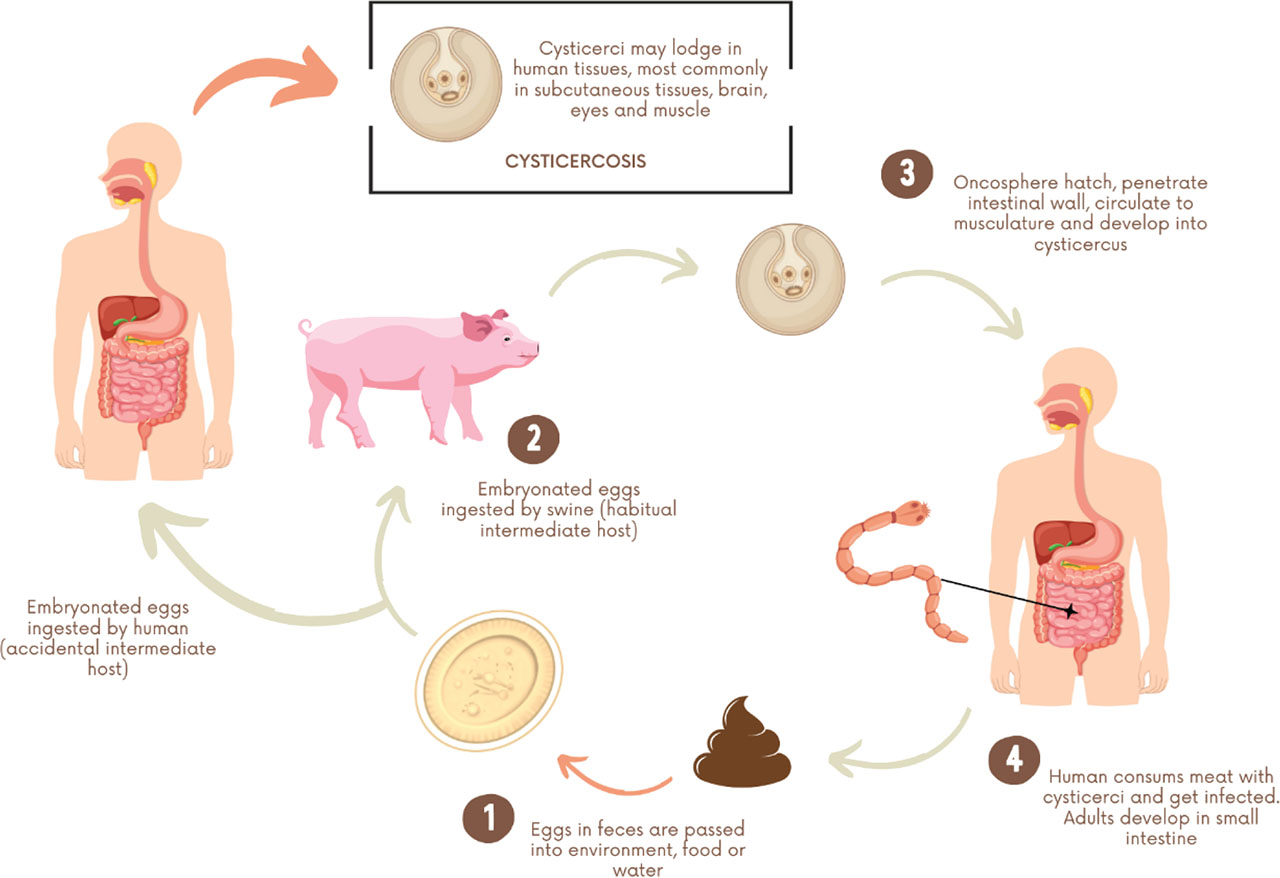
Fig. 1.
Taenia solium life cycle.
Byrnes et al. (2024) speculated on the possibility of the patient contracting NC through autoinfection due to improper handwashing after acquiring taeniosis from his eating habits. However, it should be noted that this is merely a hypothesis by the authors, who did not conclusively diagnose taeniosis in the patient. Furthermore, contracting the adult form of T. solium through pork consumption is limited to regions with inadequate sanitation measures, predominantly found in rural communities within endemic areas. Here, pigs are often raised close to households for self-consumption, without any veterinary control. Misinterpretation of information has caused the media to erroneously associate NC with the consumption of undercooked pork, as evidenced by several headlines in digital press platforms from various countries. Recent media coverage has showcased scientific publications concerning this disease, exemplified by the fatal case of an 18-year-old Indian male diagnosed with disseminated cysticercosis, presenting numerous well-defined cystic lesions in the brain (Dev & Abbas, 2019). This case attracted substantial media attention, with most outlets once again attributing the cause of the infection to pork consumption in their headlines. Some examples of the news that inaccurately echoed these case reports are displayed in Table 1.
Table 1.
Some examples of sensationalism news about different T. solium case reports in different countries.
| Byrnes et al. 2024 | Neurocysticercosis Presenting as Migraine in the United States |
|---|---|
| Date of publication | 10/03/2024 |
| Media | Le Parisien |
| Country | France |
| Headline | “Des vers retrouvés dan le cerveau d'un homme qui avait mangé du bacon mal cuit” |
| Link | https://www.leparisien.fr/faits-divers/des-vers-retrouves-dans-le-cerveau-dun-homme-en-floride-apres-quil-a-mange-du-bacon-mal-cuit-10-03-2024-YRV7SQHGYBGOLJ56KC23D7IMYI.php |
| Date of publication | 10/03/2024 |
| Media | The National Desk (TND) |
| Country | USA |
| Headline | “Doctors discover man suffering from chronic migraines had worm eggs in his brain” |
| Link | https://thenationaldesk.com/news/americas-news-now/doctors-discover-man-suffering-from-chronic-migraines-had-worm-eggs-in-his-brain-tapeworm-cyst-neurocysticercosis-bacon-pork-hospital-doctor-health-wellness-ct-mri-tests-swelling |
| Date of publication | 12/03/2024 |
| Media | NBC News |
| Country | USA |
| Headline | “Man finds out migraines caused by tapeworms; undercooked bacon may be culprit” |
| Link | https://www.nbcnews.com/news/us-news/man-finds-migraines-caused-brain-tapeworms-undercooked-bacon-may-culpr-rcna143011 |
| Date of publication | 13/03/2024 |
| Media | The Guardian |
| Country | UK |
| Headline | “Tapeworms found in brain of US man who ate undercooked bacon” |
| Link | https://www.theguardian.com/us-news/2024/mar/13/brain-tapeworms-undercooked-bacon |
| Date of publication | 14/03/2024 |
| Media | El Mundo |
| Country | Spain |
| Headline | “Hallan Tenia en el cerebro de un estadounidense que comió tocino poco hecho” |
| Link | https://www.elmundo.es/ciencia-y-salud/2024/03/14/65f2a14a21efa05e448b4591.html |
| Date of publication | 14/03/2024 |
| Media | TVI Notícias |
| Country | Portugal |
| Headline | “Este homem sofria de enxaquecas horríveis. Tinha larvas de ténia no cérebro. A causa? Bacon mal pasado” |
| Link | https://tvi.iol.pt/noticias/dores-de-cabeca/enxaquecas/este-homem-sofria-de-enxaquecas-horriveis-tinha-larvas-de-tenia-no-cerebro-a-causa-bacon-mal-passado/20240314/65f30f9dd34e87e0c08abb2f |
| Date of publication | 15/03/2024 |
| Media | News9Live |
| Country | India |
| Headline | “Bacon lovers, beware! Man complains of excruciating migraine pain after eating uncooked pork” |
| Link | https://www.news9live.com/health/health-news/bacon-lovers-beware-man-complains-of-excruciating-migraine-pain-after-eating-uncooked-pork-2465479 |
| Date of publication | 16/03/2024 |
| Media | Corriere della Sera |
| Country | Italy |
| Headline | “Mal di testa causato da larve di verme solitario nel cervello: forse dopo aver mangiato pancetta poco cotta” |
| Link | https://www.corriere.it/salute/24_marzo_16/mal-di-testa-larve-verme-solitario-nel-cervello-ee32ee06-72d3-44ab-9767-db43645c7xlk.shtml |
| Dev & Abbas 2019 | Disseminated Cysticercosis |
|---|---|
| Date of publication | 28/03/2019 |
| Media | Correio da Manhã |
| Country | Portugal |
| Headline | “Jovem morre com larvas acumuladas no cérebro por comer porco mal cozinhado” |
| Link | https://www.cmjornal.pt/mundo/detalhe/jovem-morre-com-larvas-acumuladas-no-cerebro-por-comer-porco-mal-cozinhada |
| Date of publication | 28/03/2019 |
| Media | New York Post |
| Country | USA |
| Headline | “Teen dies after brain infection from eating undercooked pork” |
| Link | https://nypost.com/2019/03/28/teen-dies-after-brain-infection-from-eating-undercooked-pork/ |
| Date of publication | 28/03/2019 |
| Media | TN |
| Country | Argentina |
| Headline | “Comió carne de cerdo cruda y su cerebro se llenó de gusanos que le causaron la muerte” |
| Link | https://tn.com.ar/salud/familia/2019/03/28/comio-carne-de-cerdo-cruda-y-su-cerebro-se-lleno-de-gusanos-que-le-causaron-la-muerte/ |
| Date of publication | 28/03/2019 |
| Media | Daily Mail |
| Country | UK |
| Headline | “How eating under cooked pork can kill you by invading your brain: Neural scans of ‘white spots’ reveal how teenager, 18, died when parasitic larvae built-up in his central nervous system and triggered deadly seizures” |
| Link | https://www.dailymail.co.uk/health/article-6859681/Man-18-dies-eating-undercooked-pork-caused-parasitic-larvae-invade-BRAIN.html |
| Date of publication | 29/03/2019 |
| Media | Il Giornale |
| Country | Italy |
| Headline | “India, mangia carne di maiale poco cotta: 18enne ucciso dalla tenia” |
| Link | https://www.ilgiornale.it/news/mondo/india-mangia-carne-maiale-poco-cotta-18enne-ucciso-tenia-1670578.html |
| Date of publication | 29/03/2019 |
| Media | Doctissimo |
| Country | France |
| Headline | “Un jeune indien meurt d'une infestation de larves de ténia dan son cervau” |
| Link | https://www.doctissimo.fr/sante/news/manger-porc-mal-cuit-mort |
| Date of publication | 30/03/2019 |
| Media | El Comercio |
| Country | Spain |
| Headline | “Muere por un afectación de larvas en el cerebro tras comer carne cruda” |
| Link | https://www.elcomercio.es/sociedad/muere-joven-afectacion-larvas-cerebro-carne-cruda-20190330063538-nt.html |
| Date of publication | 01/04/2019 |
| Media | Sky News |
| Country | UK |
| Headline | “Man, 18, dies from tapeworm larvae in his brain after eating pork” |
| Link | https://news.sky.com/story/man-18-dies-from-tapeworm-larvae-in-his-brain-after-eating-pork-11681211 |
Such cases are likely rooted in the viral dissemination of digital misinformation, a phenomenon in which media outlets propagate or amplify stories without conducting fact-checking or verification, merely echoing the narrative of the original source. Media coverage of medical issues sometimes introduces fake news driven by ignorance or sensationalism, as previously addressed by García and Del Brutto (2020) concerning other cases associated with NC. Humans navigate the world through a collective process of gathering, filtering, and disseminating information. The integrity of this process is crucial, as misinformation can have far-reaching consequences (West & Bergstrom, 2021), including in the realm of Global Health. The dissemination of inaccurate information regarding the detrimental health effects of consuming pork can also precipitate significant economic ramifications within the swine industry. Such misinformation may instigate consumer reluctance towards pork consumption, leading to decreased demand and subsequently impacting swine producers' revenue streams. Thus, the dissemination of accurate, clear, and well-contextualized information is vital to empower individuals against the spread of serious diseases like NC.
Finally, effective prevention can be achieved through targeted hygiene practices, including consistent handwashing, and ensuring raw vegetables and fruits are washed with potable water. Additionally, to prevent taeniosis in high-risk areas, it is recommended to cook whole cuts of meat to a minimum internal temperature of 145 °F (63 °C), and ground meats to 160 °F (71 °C), following CDC (2013) guidelines. Also, freezing pork at 39 °F (4 °C) for more than 1 month, or at −4 °F (−20 °C) for 1 – 3 days, is an effective measure to kill cysticerci (Sotelo et al., 1986).
Notes
[1] Conflicts of interest Conflict of Interest
The authors have no conflicts of interest to declare.
[2] Disclosure
The opinions expressed in this manuscript are the responsibility of the authors and do not necessarily reflect the criteria or policy of Helminthologia.