Table 1.
Distribuition of birds across aviaries and number of cohabitants per animal at the Wildlife Conservation Institute in Mineiros, Brazil.
| Species | Aviary | Subsection | Cohabitants |
|---|---|---|---|
| Ara macao | A1 | 1 | 5 |
| Ara macao | A1 | 1 | 5 |
| Ara macao | A1 | 1 | 5 |
| Ara chloropterus | A1 | 1 | 5 |
| Ara chloropterus | A1 | 1 | 5 |
| Ara ararauna | A1 | 1 | 5 |
| Ramphastos tucanus | A2 | 1 | 2 |
| Ramphastos tucanus | A2 | 1 | 2 |
| Ramphastos tucanus | A2 | 1 | 2 |
| Ramphastos dicolorus | A2 | 2 | 2 |
| Ramphastos dicolorus | A2 | 2 | 2 |
| Ramphastos dicolorus | A2 | 2 | 2 |
| Pteroglossus castanotis | A2 | 3 | 0 |
| Anodorhynchus hyacinthinus | A3 | 1 | 1 |
| Anodorhynchus hyacinthinus | A3 | 1 | 1 |
| Megascops choliba | A4 | 1 | 1 |
| Strix huhula | A4 | 1 | 1 |
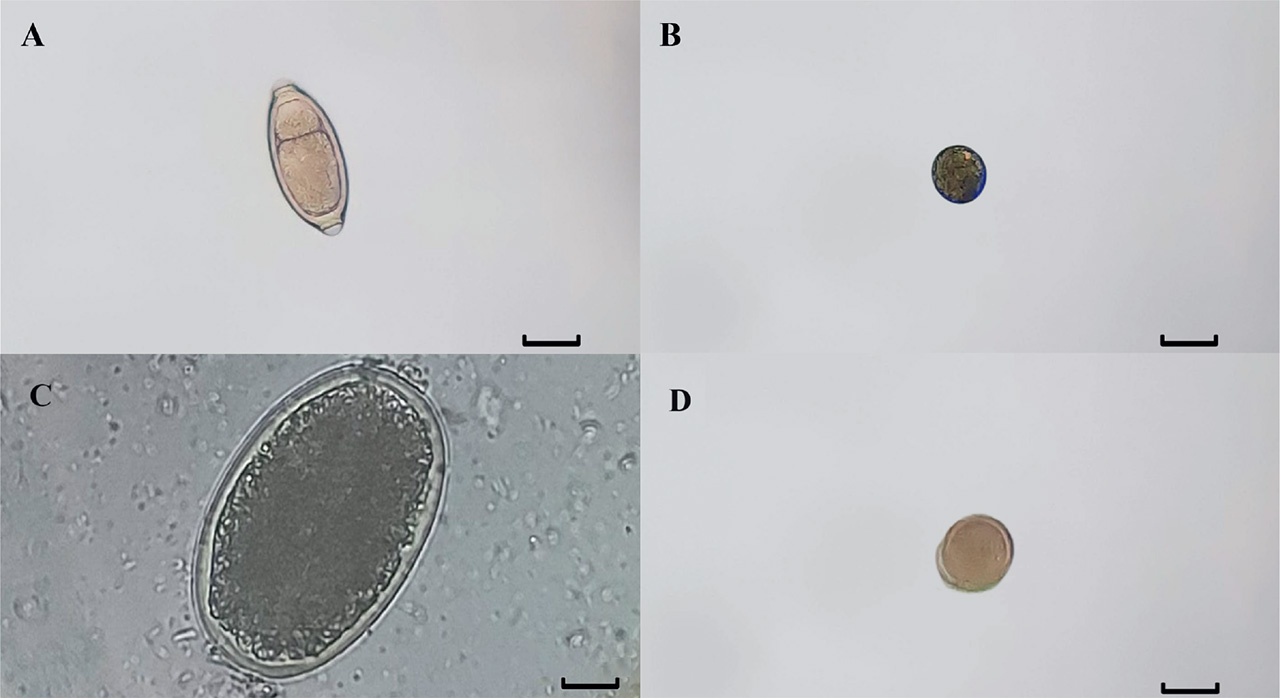
Fig. 1.
Light micrograph of coproparasitological examination in wild birds. (A) Capillarinae eggs in Ara macao, Scale bar 30µm. (B) Entamoeba spp. oocyst in Ara macao, Scale bar 15µm. (C) Ascaridia spp. egg in Ara chloropterus, Scale bar 20µm. (D) Ascarididae egg in Anodorhynchus hyacinthinus, Scale bar 40µm.
Table 2.
Coproparasitological examination results of flotation and sedimentation of birds from a Conservation Institution in Mineiros, Goiás in Brazilian Cerrado bioma.
| Species | N | Flotation | Sedimentation | ||||
|---|---|---|---|---|---|---|---|
| Positives | Identification | Prevalence | Positives | Identification | Prevalence | ||
| Ara macao | 3 | 1 | Capillarinae | 33.3% | 3 | Entamoeba spp.; Capillarinae; Ascaridia spp. | 100% |
| Ara chloropterus | 2 | 1 | Capillarinae | 50% | 2 | Ascaridia spp.; Capillarinae | 100% |
| Ara ararauna | 1 | 1 | Capillarinae | 100% | 1 | Capillarinae | 100% |
| Ramphastos tucanus | 3 | 0 | - | 0% | 0 | - | 0% |
| Ramphastos dicolorus | 3 | 0 | - | 0% | 1 | NI* | 33.3% |
| Pteroglossus castanotis | 1 | 1 | Ascarididae | 100% | 0 | - | 0% |
| Anodorhynchus hyacinthinus | 2 | 2 | Capillarinae; Ascarididae | 100% | 1 | Capillarinae; Trematoda | 50% |
| Megascops choliba | 1 | 0 | - | 0% | 0 | - | 0% |
| Stix huhula | 1 | 1 | Ascarididae | 100% | 0 | - | 0% |