Table 1.
List of primers used for PCR amplification of Ascaridia columbae.
| Gene ID | Direction | Sequencing | References |
|---|---|---|---|
| Cox-1 | Cox1-F | 5′-TGGTGGTTTAAGTGTTTGACTG-3′ | Hamzah. et al., 2020 |
| Cox1-R | 5′-CCAACAACAAAGGCAACATT-3′ | ||
| ITS1-5.8s-ITS2 rDNA region | Physa-F | 5′-GCGAAC GGC TCA TTA TAA CA-3′ | Al Quraishy et al., 2020 |
| Physa-R | 5′-AAT TTCACC TCT CAC GCA-3′ |
Table 2.
Optimized cycling condition of Cox -1 gene.
| PCR program of Cox -1 | ||||||
|---|---|---|---|---|---|---|
| Hold | 1 Cycles | 35 Cycles | 1 Cycles | Cycles | ||
| Final Extention | Extention | Anneling | Denaturation | Initial Denaturation | STEP | |
| 4 C | 72 C | 72 C | 52 C | 95 C | 95 C | TEMP |
| ∞ | 7 min | 45 sec | 1 min | 30 sec | 3 min | TIME |
Table 3.
Optimized cycling condition of ITS1-5.8s-ITS2 rDNA gene.
| PCR program of ITS1-5.8s-ITS2 rDNA | ||||||
|---|---|---|---|---|---|---|
| Hold | 1 Cycles | 35 Cycles | 1 Cycles | Cycles | ||
| Final Extention | Extention | Anneling | Denaturation | Initial Denaturation | STEP | |
| 4 C | 72 C | 72 C | 54 C | 95 C | 95 C | TEMP |
| ∞ | 7 min | 1 min | 1 min | 30 sec | 3 min | TIME |
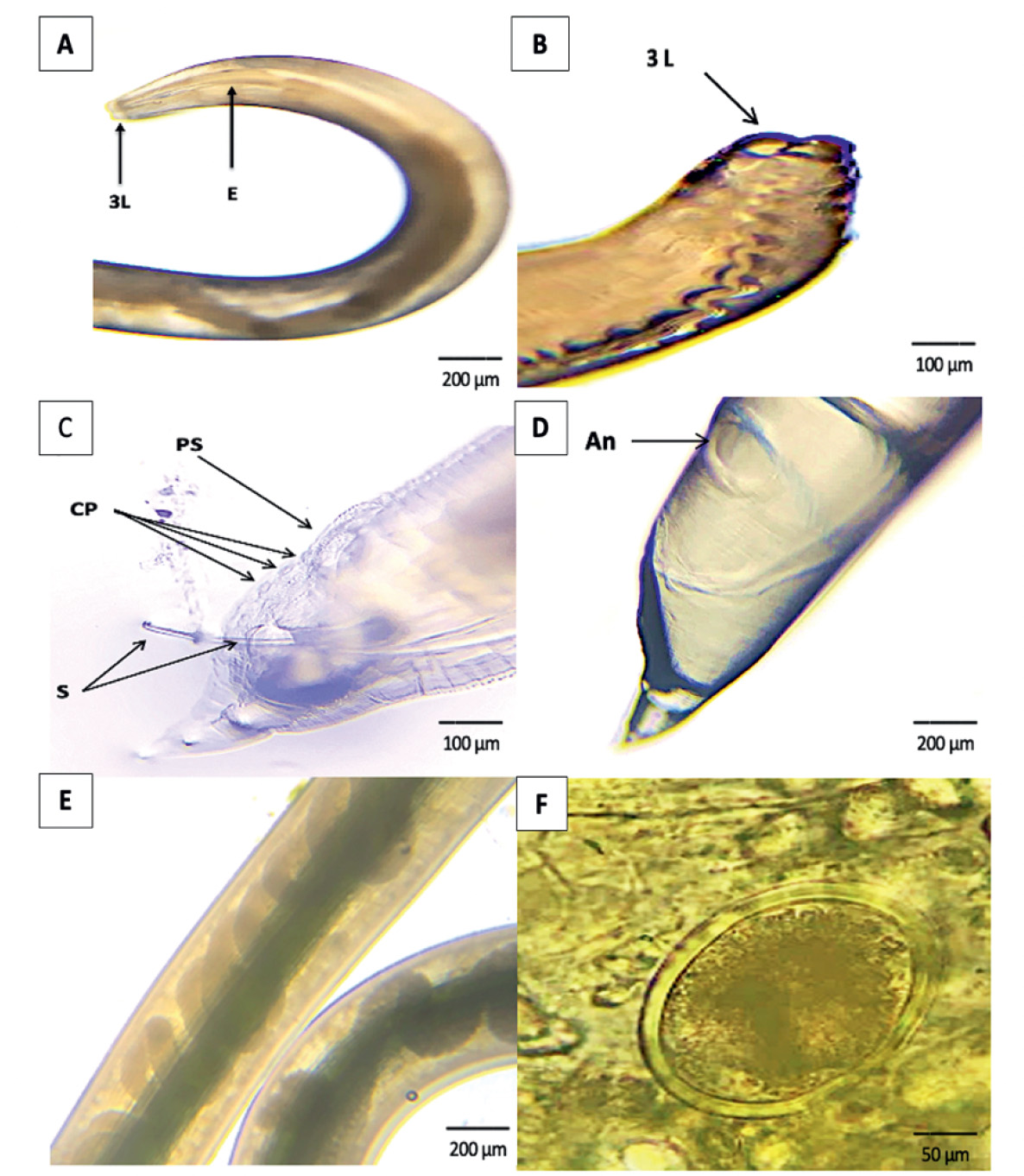
Fig. 1.
(A & B) The anterior end of A. columbae showing a mouth with three trilobed lips (L) and a cylindrical esophagus (E) (Lactophenol) (Scale bar=200 µm) (Scale bar=100 µm).(C) The posterior end of A. columbae male showing 2 spicules (S), precloacal suker (PS), and caudal papillae (CP) (Lactophenol) (Scale bar=100 µm). (D) The posterior end of A. columbae female with anus (An) (Lactophenol) (Scale bar=200 µm). (E) The middle part of A. columbae female showing the uterus with eggs (Lactophenol) (Scale bar=200 µm). (F) The egg of A. columbae in feces of infected pigeon without stain (Scale bar=50 µm)
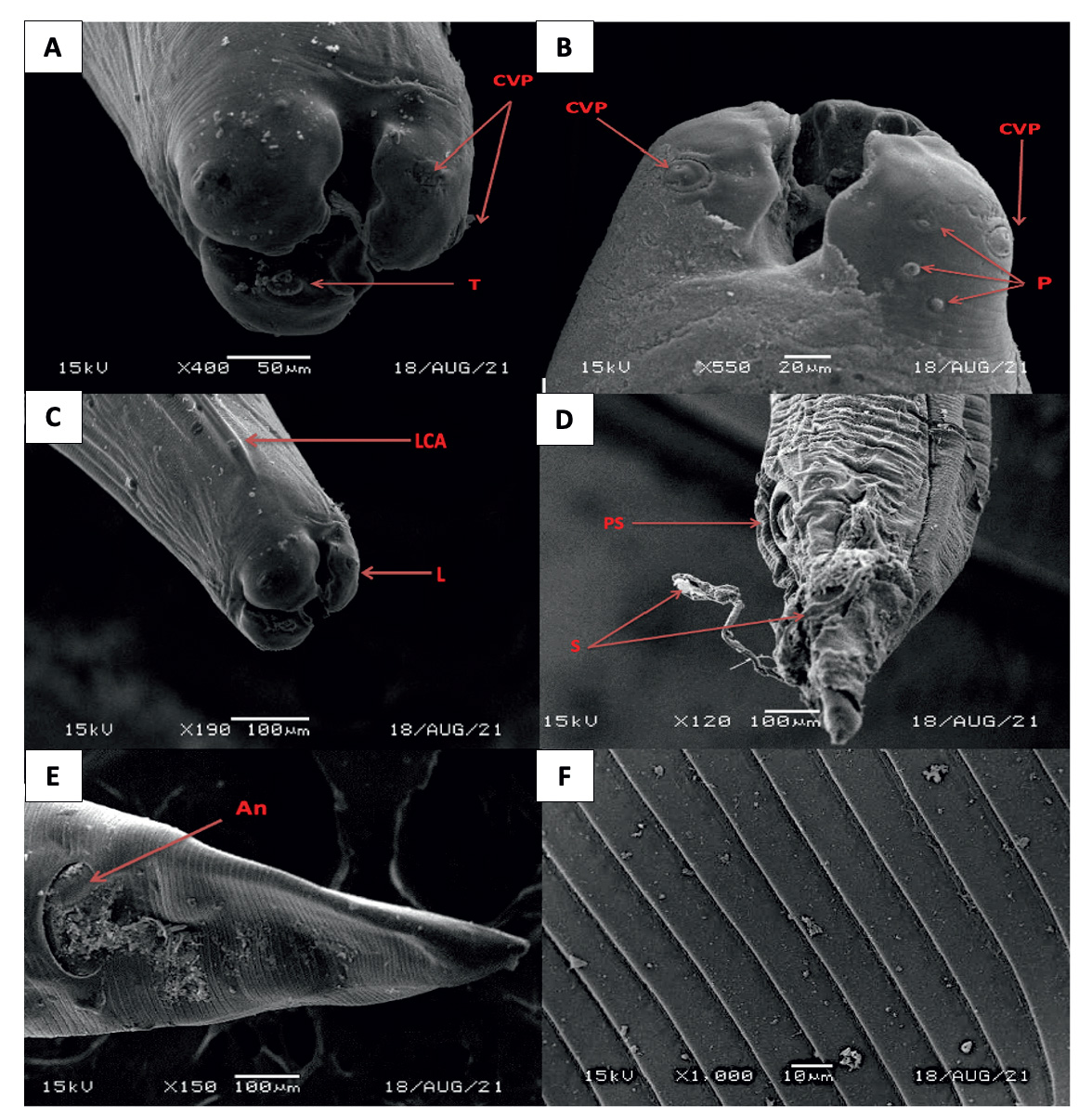
Fig. 2.
SEM micrographs of A. columbae; (A). The anterior end showing three lips with teeth (T) and two cervical papillae behind each lip (CVP). (B). The anterior end showing cervical papillae (CVP) and amphidial pores (P). (C). The anterior end showing three lips (L) and lateral cephalic alae (LCA). (D). The posterior end of the male showing precloacal sucker (PS) and two spicules (S). (E). The posterior end of the female showing anus (An). (F). The body surface is ornamented with cuticular transverse striations.
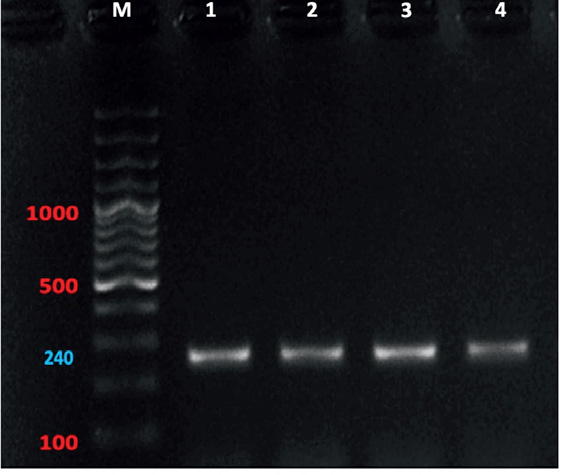
Fig. 3.
Gel electrophoresis of PCR products of Cox-1 gene for Ascaridia columbae (n=4) on 1.5 agarose gel. The molecular size of the ladder is 1500 bp (M)
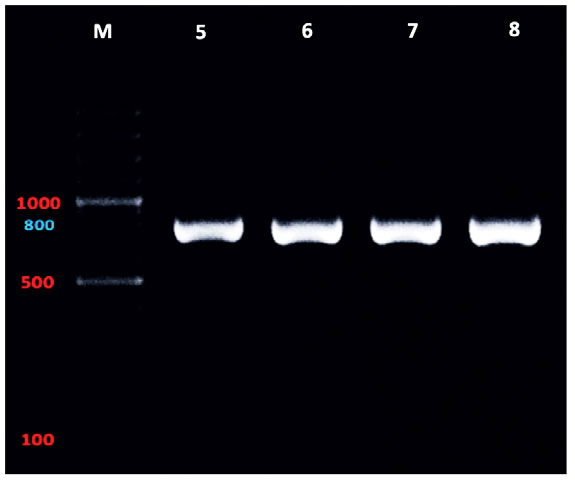
Fig. 4.
Gel electrophoresis of PCR products of ITS1-5.8s- ITS2 rDNA gene for Ascaridia columbae (n=4) on 1.5 agarose gel. The molecular size of the ladder is 1500 bp (M)
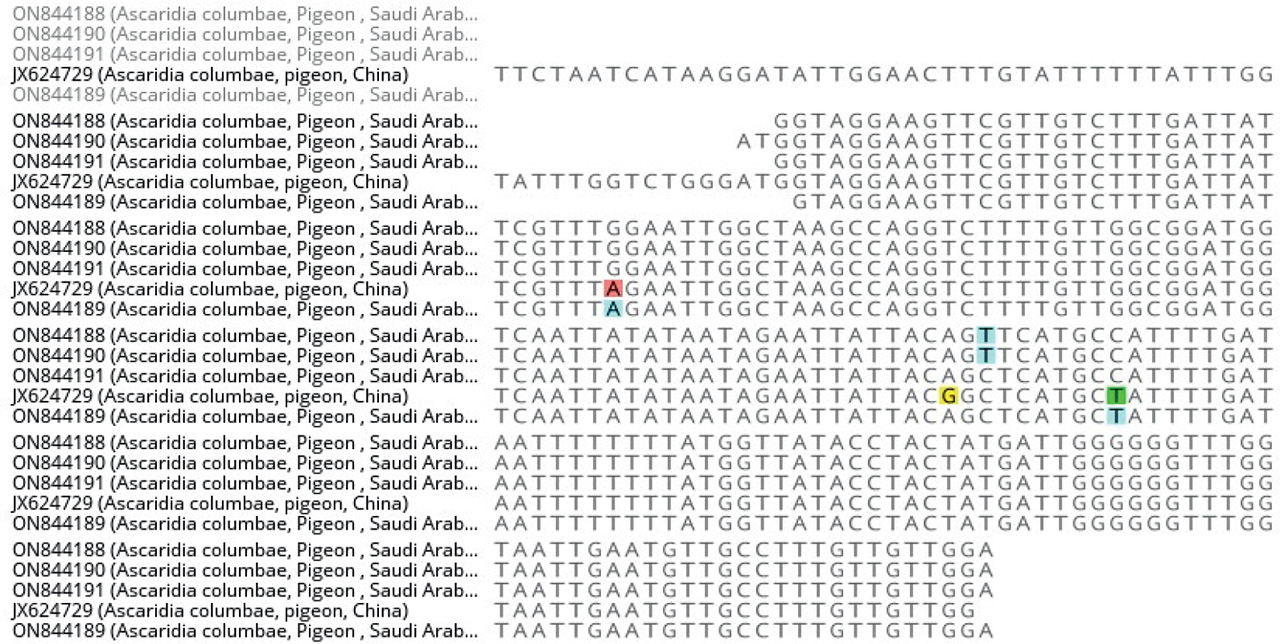
Fig. 5.
Multiple sequence alignment of the four sequences of the Cox-1 gene in this study aligned with Ascaridia columbae (JX624729)
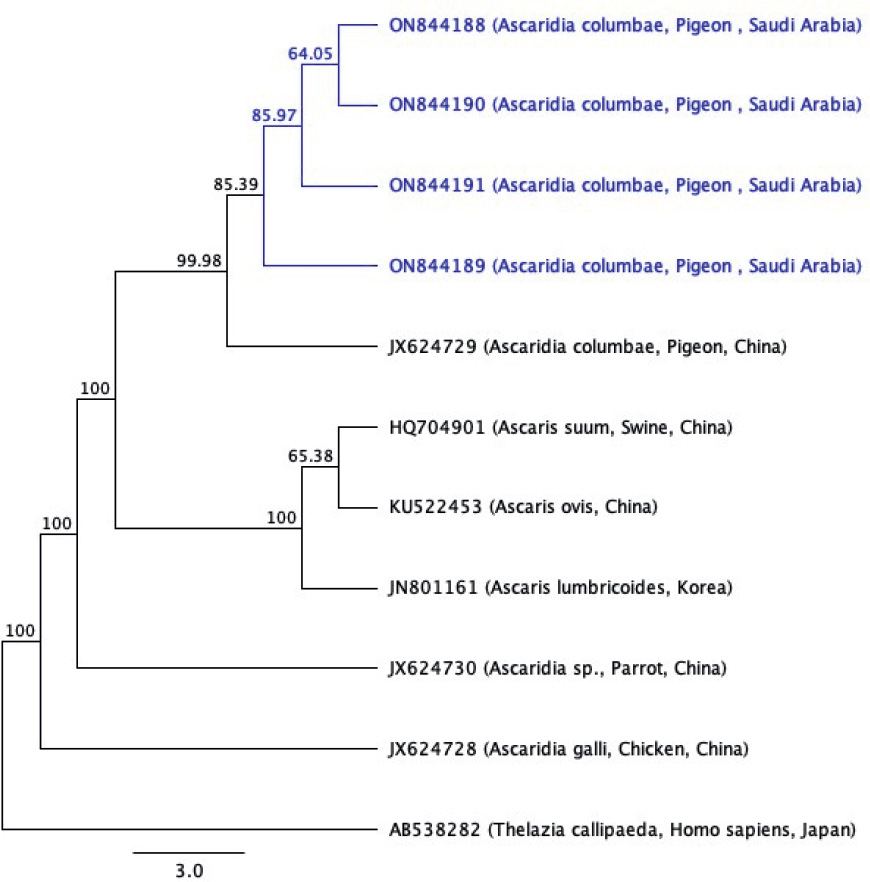
Fig. 6.
Maximum likelihood tree of the four sequences of the Cox-1 gene in the current study with other species downloaded from GenBank.
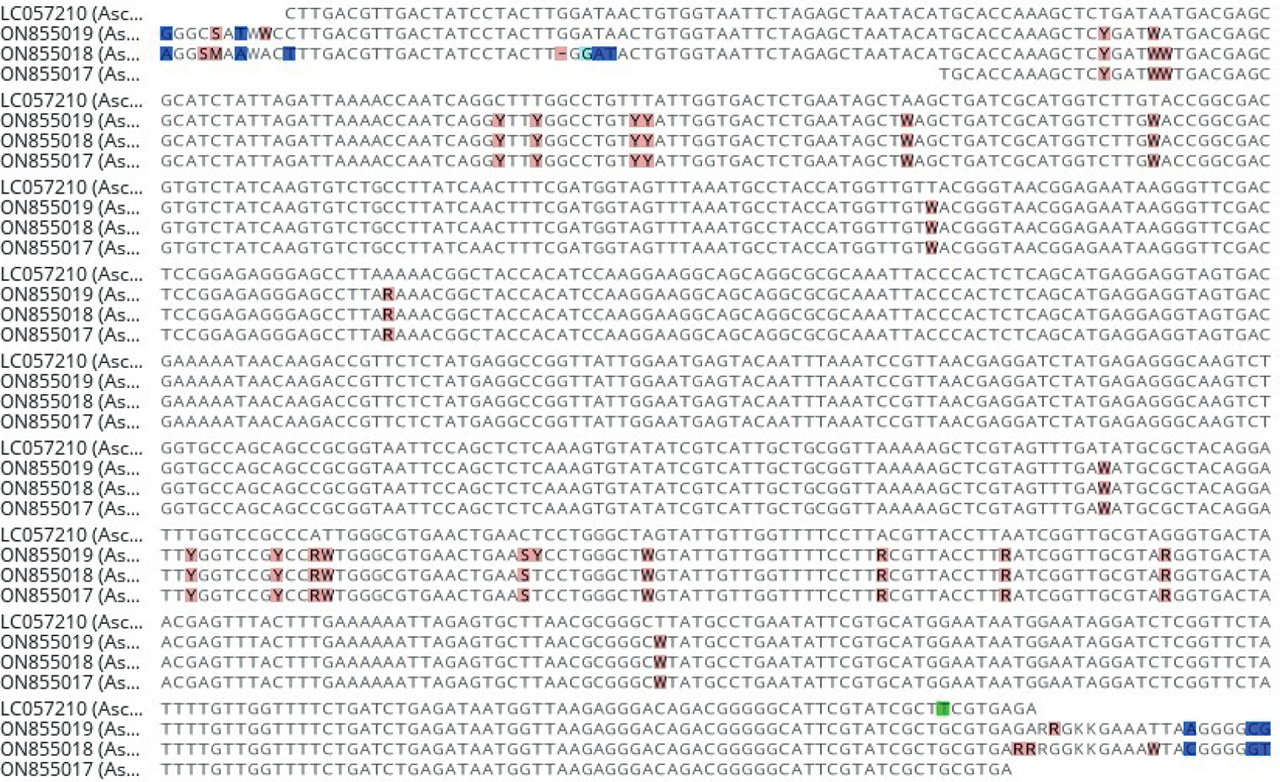
Fig. 7.
Multiple sequence alignment of the three sequences of the ITS1-5.8s- ITS2 rDNA gene in this study aligned with Ascaridia nymphii (LC057210)
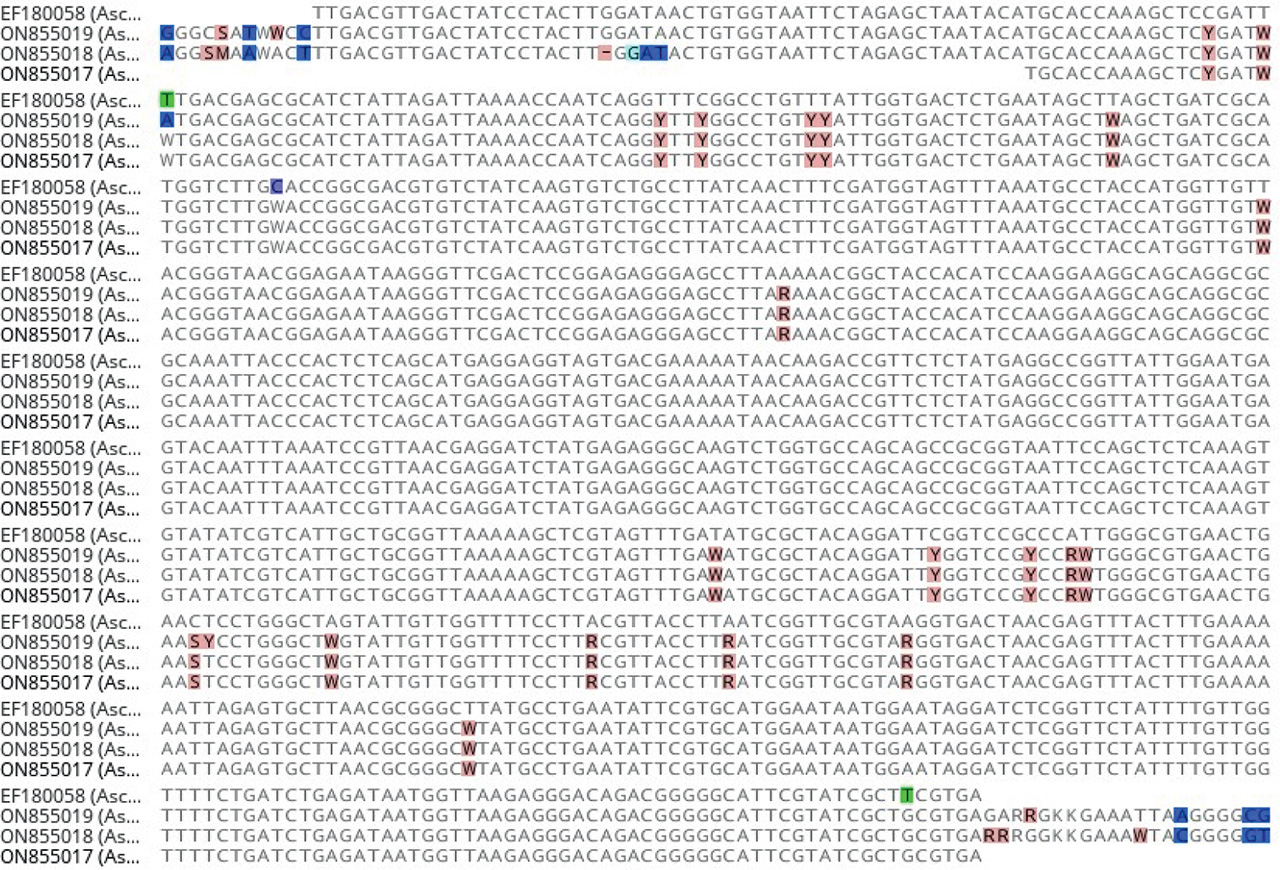
Fig. 8.
Multiple sequence alignment of the three sequences of the ITS1-5.8s- ITS2 rDNA gene in this study aligned with Ascaridia galli (EF180058)
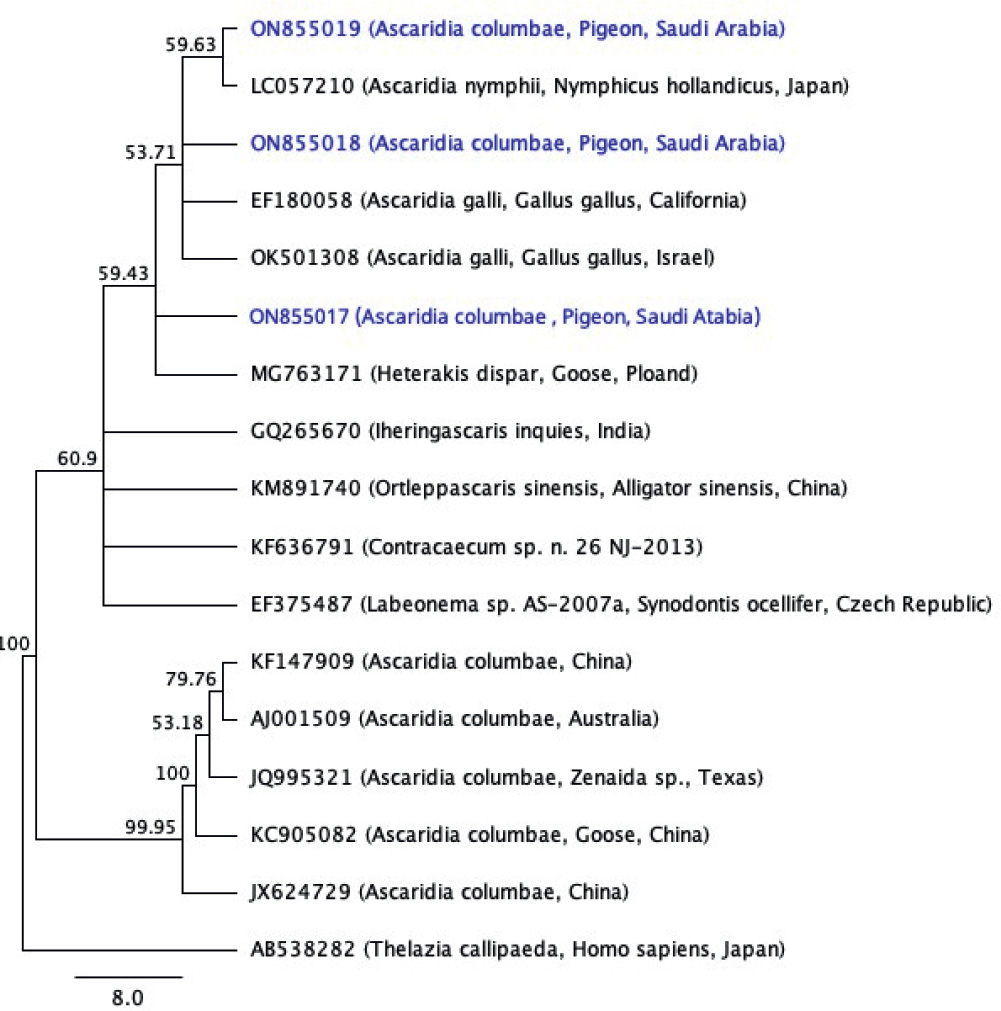
Fig. 9.
Maximum likelihood tree of the three sequences of the ITS1-5.8s- ITS2 rDNA gene in the current study with other species downloaded from GenBank.