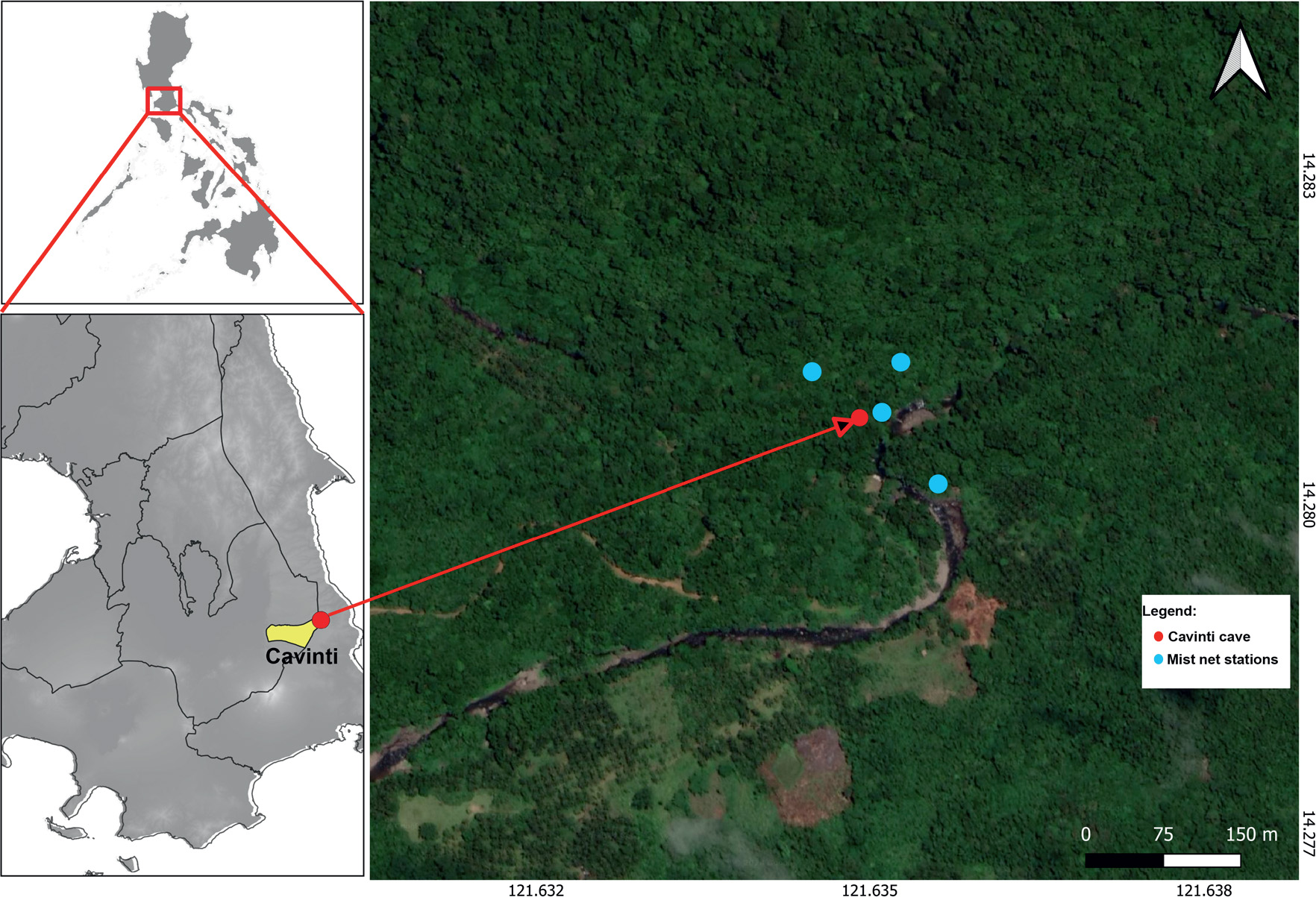
Fig. 1.
Location map of Cavinti, Laguna (left) and sampling sites in Cavinti Underground River and Cave Complex (CURCC) (right).
Table 1.
List of bat species including prevalence (P, %) and mean intensity (MI, mean number of helminths/bat individual) of each helminth group isolated from bats collected in Cavinti Underground River and Cave Complex (CURCC), Cavinti, Laguna.
| Bat Species | n | Trematodes | Nematodes | Cestodes | TOTAL | ||||
|---|---|---|---|---|---|---|---|---|---|
| P | MI | P | MI | P | MI | P | MI | ||
| Rousettus amplexicaudatus | 32 | 0 | 0 | 14.29 | 3 | 25.71 | 4 | 40 | 4 |
| Cynopterus brachyotis | 16 | 0 | 0 | 0 | 0 | 6.25 | 3 | 6.25 | 3 |
| Ptenochirus jagori | 13 | 0 | 0 | 38.46 | 1 | 0 | 0 | 38.4 | 1 |
| Haplonycteris fischerii | 2 | 0 | 0 | 0 | 0 | 0 | 0 | 0 | 0 |
| Eonycteris robusta | 1 | 0 | 0 | 0 | 0 | 0 | 0 | 0 | 0 |
| Hipposideros lekaguli | 20 | 0 | 0 | 0 | 0 | 0 | 0 | 0 | 0 |
| Hipposideros diadema | 15 | 13.33 | 11 | 6.67 | 2 | 26.67 | 1 | 40 | 5 |
| Hipposideros pygmaeus | 21 | 5 | 1 | 15 | 1 | 0 | 0 | 15 | 2 |
| Rhinolophus inops | 17 | 64.76 | 0 | 0 | 0 | 5.88 | 1 | 64.71 | 6 |
| Rhinolophus arcuatus | 1 | 0 | 0 | 0 | 0 | 0 | 0 | 0 | 0 |
| Rhinolophus rufous | 9 | 33.33 | 3 | 22.22 | 4 | 44.44 | 2 | 66.67 | 3 |
| Miniopterus paululus | 24 | 75 | 20 | 25 | 2 | 50 | 4 | 91.3 | 18 |
| Myotis horsefieldii | 1 | 0 | 0 | 0 | 0 | 0 | 0 | 0 | 0 |
| TOTAL | 172 | 18.97 | 13 | 12.64 | 3 | 12.07 | 2 | 39.66 | 8 |
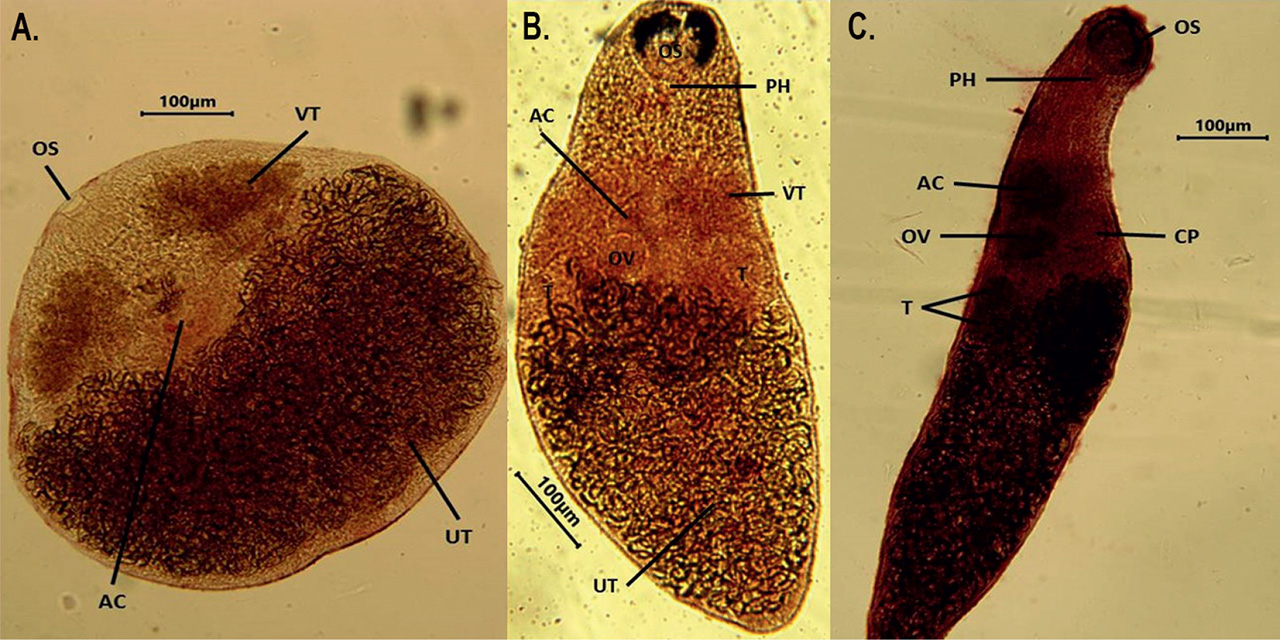
Fig. 2.
Trematodes isolated from bats collected in Cavinti Underground River and Cave Complexes (CURCC), Laguna: A. Prosthodendrium sp. adult B. Acanthatrium sp. adult. C. Plagiorchis sp. adult. AC—Acetabulum, CP—cirrus pouch, OS—Oral Sucker, OV—Ovary, PH—Pharynx, T—Testes, UT—Uterus, VT—Vitellaria
Table 2.
Number of bat hosts infected (% prevalence) infected by helminths identified in Cavinti Underground River and Cave Complexes (CURCC), Laguna.
| Helminth Taxon | Number of hosts infected (Prevalence %) | ||||||
|---|---|---|---|---|---|---|---|
| R. amplexicaudatus | P. jagori | H. diadema | H. pygmaeus | R. rufus | R. inops | M. paululus | |
| Trematodes | |||||||
| Acanthatrium sp. | - | - | - | - | 3 (33%) | 11 (64.71%) | 18 (75%) |
| Prosthodendrium sp. | - | - | 2 (13.33%) | - | - | - | - |
| Nematodes | |||||||
| Nycteridostrongylus | - | - | 1 (6.67%) | - | 1 (11.11%) | 1 (5.88%) | 12 (50%) |
| Toxocara sp. | 8 (25%) | - | - | - | - | - | - |
| Cestodes | |||||||
| Vampirolepis sp. | 6 (18.18%) | 5 (38.46%) | 1 (6.67%) | 3 (15.00%) | 4 (44.44%) | - | 6 (25.00%) |
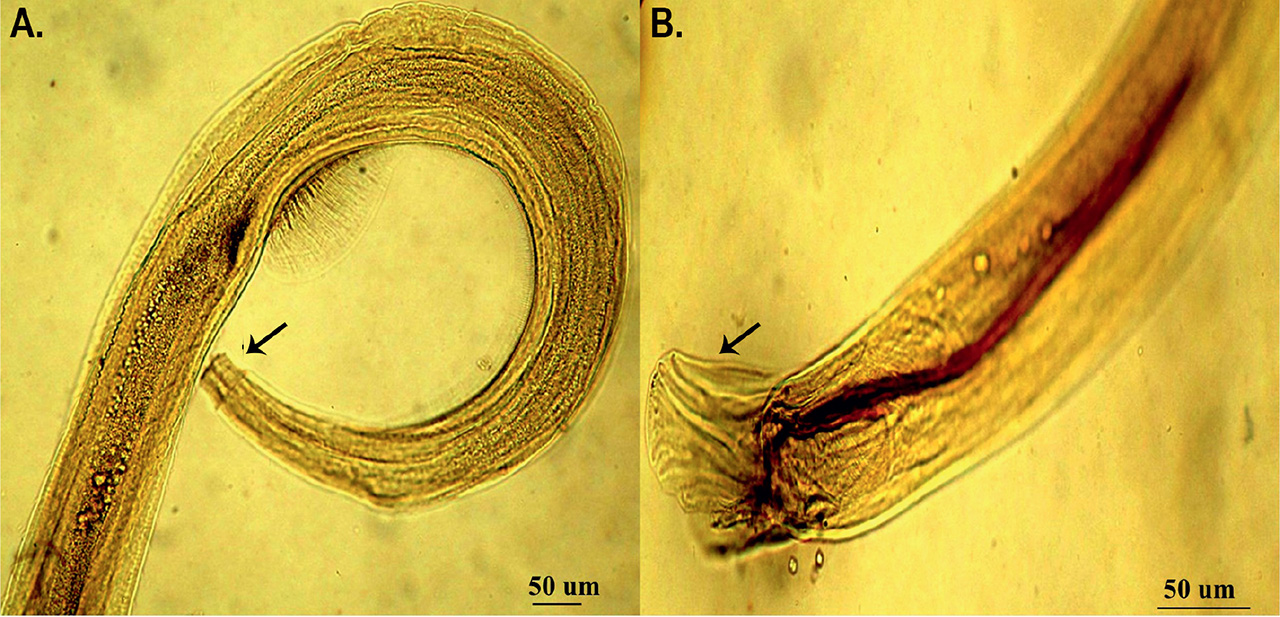
Fig. 3.
Nematode Nycteridostrongylus sp. (A) anterior part showing cephalic head and (B) copulatory bursa.
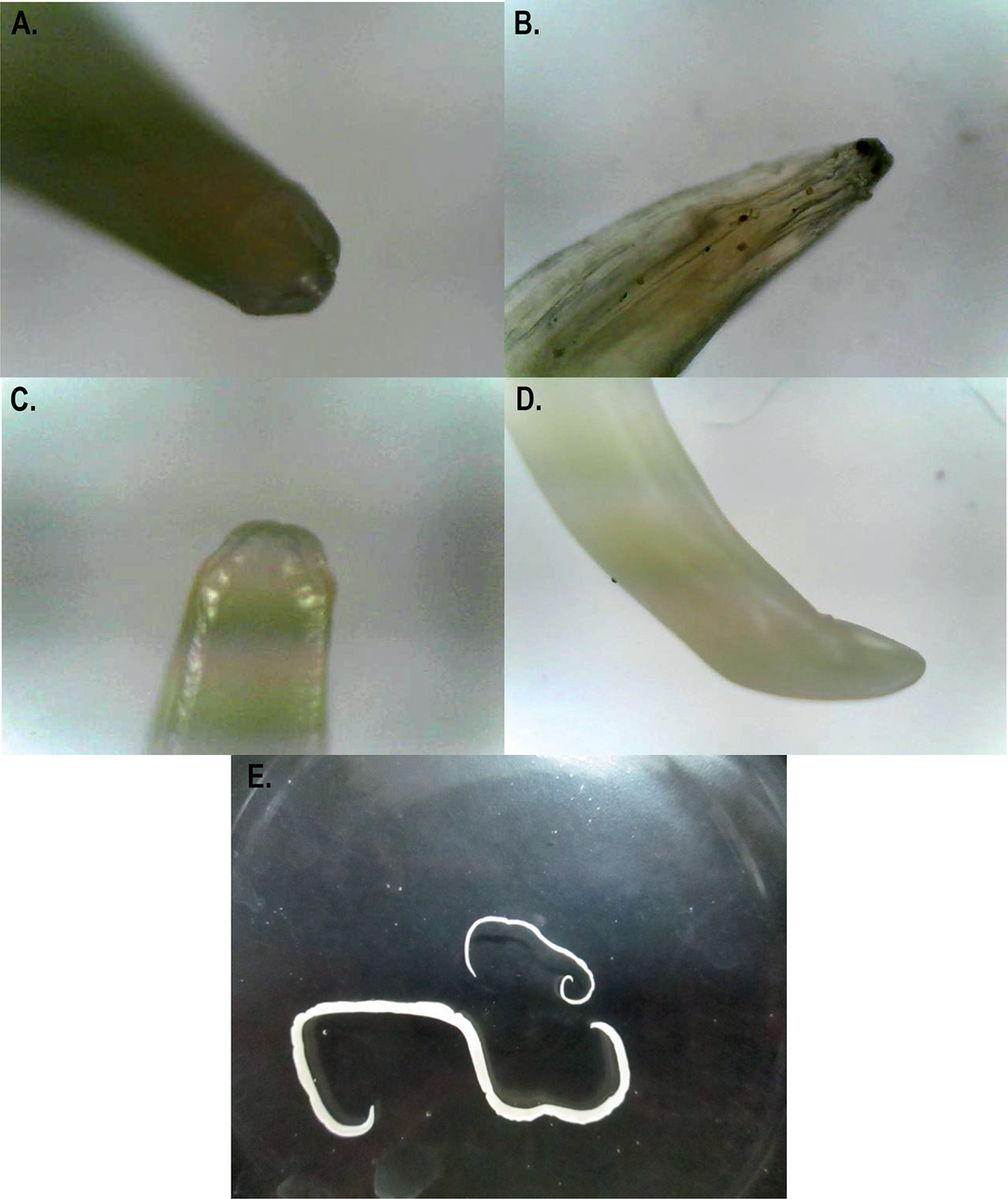
Fig. 4.
Male Toxocara sp. (A) anterior and (B) posterior part. Female Toxocara sp. (C) anterior and (D) posterior part. (E) Toxocara sp. adult male (top) and female (bottom).
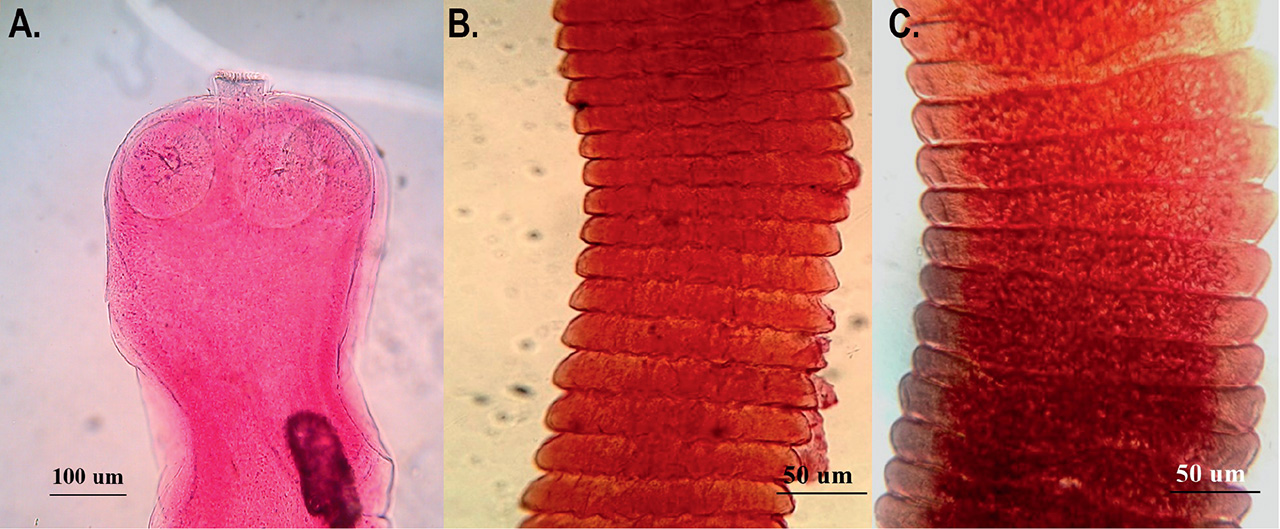
Fig. 5.
Cestode Vampirolepis sp. scolex (A), mature segment (B), and gravid segment (C).
Table 3.
Prevalence and mean intensity of helminths from bats collected in Cavinti Underground River and Cave Complex (CURCC), Cavinti, Laguna with respect to host’s sex, diet, age, and roosting site.
| Host Characteristic | n | Prevalence (%) | Mean Intensity | p-value | ||
|---|---|---|---|---|---|---|
| (# of parasites/bat) | Prevalence | Mean Intensity | ||||
| Sex | Male | 91 | 49.5 | 4.0 | 0.032* | 0.231 |
| Female | 81 | 33.3 | 16.0 | |||
| Diet | Fruit bats | 64 | 26.6 | 3.3 | 0.019* | 0.006* |
| Insectivorous bats | 108 | 44.4 | 9.9 | |||
| Roosting Site | Cave-dwelling | 141 | 41.8 | 8.9 | 0.019* | 0.009* |
| Non-cave dwelling | 31 | 19.4 | 1.7 | |||
| Age | Sub-adult | 43 | 37.2 | 3.5 | 0.653 | 0.171 |
| Adult | 129 | 41.1 | 9.1 | |||