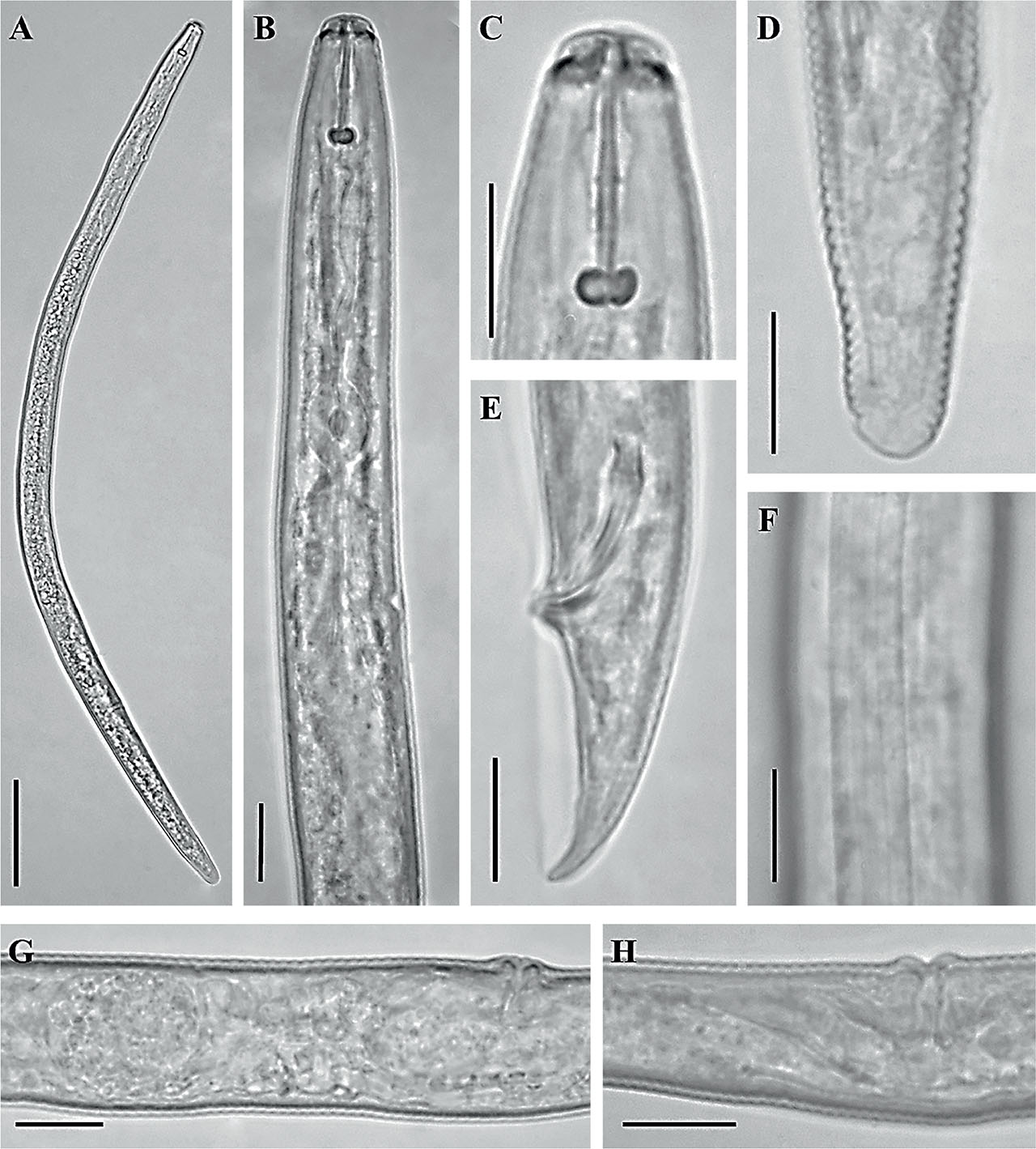
Fig. 1.
Light microscopy pictures of Pratylenchus coffeae from this study. A-D, F-H: Female. A: Entire body, B: Anterior part of the body showing lip and pharynx region; C: Anterior end region; D: Tail region; F: Lateral field at mid-body; G: Vulva region showing spermatheca; H: vulva and post-uterine sac. E: Tail region of the male. (Scale bar: A: 50 μm; B-H: 10 μm).
Table 1.
Measurements of Pratylenchus coffeae from Ming aralia and coffee in Vietnam.
| Characters | Pratylenchus coffeae (Zimmermann, 1898) Filipjev & Schuurmans Stekhoven, 1941 | |||
|---|---|---|---|---|
| Host plant | Ming aralia | Coffee | ||
| Sex | Female | Male | Female | Male |
| n | 10 | 10 | 10 | 10 |
| a | 23 ± 2.4 (22 – 28) | 28.6 ± 1.2 (27.6 – 30.7) | 27 ± 1.4 (25.5 – 29.1) | 31 ± 2.9 (25.9 – 36.4) |
| b | 6.0 ± 0.3 (5.7 – 6.5) | 5.9 ± 0.2 (5.7 – 6.2) | 6 ± 0.3 (5.7 – 6.5) | 6 ± 0.3 (5.7 – 6.4) |
| b′ | 4.2 ± 0.2 (4.1 – 4.5) | 4.2 ± 0.2 (4 – 4.6) | 4 ± 0.2 (3.8 – 4.4) | 4.2 ± 0.2 (3.8 – 4.5) |
| c | 18.8 ± 0.5 (18.3 – 19.6) | 19.5 ± 1.4 (18.3 – 21) | 19.2 ± 1.4 (17.4 – 22) | 20 ± 1.5 (18.5 – 23) |
| c′ | 1. 9 ± 0.1 (1.7 – 2.1) | 2.3 ± 0.2 (2 – 2.7) | 2.2 ± 0.2 (1.9 – 2.5) | 2.1 ± 0.2 (1.9 – 2.4) |
| Body length (L) | 519 ± 25 (485 – 550) | 497 ± 24 (476 – 542) | 473 ± 28 (440 – 531) | 494 ± 26.7 (454 – 533) |
| V | 79 ± 3 (74 – 82) | – | 80 ± 2 (78 – 84) | – |
| Stylet length | 15.9 ± 0.2 (15.7 – 16.1) | 14.5 ± 0.3 (13.9 – 14.9) | 15.9 ± 0.4 (15.3 – 16.6) | 14.7 ± 0.8 (13.8 – 16) |
| Dorsal gland opening from stylet base (DGO) | 3.2 ± 0.7 (2.2 – 3.9) | 3.3 ± 0.3 (2.9 – 3.6) | 2.9 ± 0.4 (2.3 – 3.3) | 3.1 ± 0.4 (2.5 – 3.7) |
| Anterior end to valve of median bulb | 56 ± 3 (52 – 58) | 53 ± 1.4 (52 – 55) | 50 ± 3.4 (46 – 58) | 52 ± 1.8 (49 – 55) |
| Anterior end to nerve ring | 70 ± 3.3 (64 – 72) | 65 ± 3 (63 – 69) | 61 ± 4 (57 – 70) | 64 ± 2 (61 – 68) |
| Anterior end to secretory-excretory pore | 80 ± 2 (78 – 82) | 76 ± 3 (72 – 79) | 75 ± 5 (69 – 81) | 76 ± 2 (72 – 79) |
| Anterior end to pharyngo-intestinal junction | 87 ± 5 (79 – 91) | 84 ± 2 (81 – 87) | 79 ± 5 (74 – 89) | 82 ± 4 (74 – 86) |
| Anterior end to end of pharyngeal gland | 123 ± 8 (109 – 129) | 118 ± 6 (108 – 124) | 117 ± 5 (109 – 123) | 119 ± 7 (109 – 127) |
| Pharyngeal gland overlap | 36 ± 4 (30 – 39) | 34 ± 5 (27 – 42) | 38 ± 4 (31 – 44) | 37 ± 4 (31 – 43) |
| Max body diam. | 22 ± 1.5 (20 – 24) | 17.4 ± 0.7 (16.3 – 18.5) | 17.5 ± 1 (16.2 – 19.3) | 16.1 ± 2.1 (13.6 – 19.6) |
| Vulval body diam. | 19.9 ± 1 (19 – 22) | – | 16.3 ± 1.4 (14.4 – 19.4) | – |
| Post-uterine sac (PUS) | 21 ± 4 (16.4 – 26) | – | 27 ± 2 (24 – 30) | – |
| Anal body diam. | 14.7 ± 0.3 (14.3 – 15) | 11 ± 0.4 (10.3 – 11.6) | 11.3 ± 0.4 (10.7 – 12) | 11.4 ± 1 (10.1 – 12.9) |
| Tail length | 28 ± 2 (25 – 30) | 26 ± 2 (23 – 30) | 25 ± 2 (21 – 27) | 24 ± 2 (21 – 28) |
| Spicule length | – | 18.4 ± 1 (17.2 – 19.9) | – | 17.8 ± 1 (16.1 – 19.3) |
| Gubernaculum length | – | 4.5 ± 0.3 (3.9 – 4.8) | – | 4.3 ± 0.6 (3.5 – 5.5) |
[i] All measurements are in μm (except for ratio) and in the form: mean±s.d. (range)
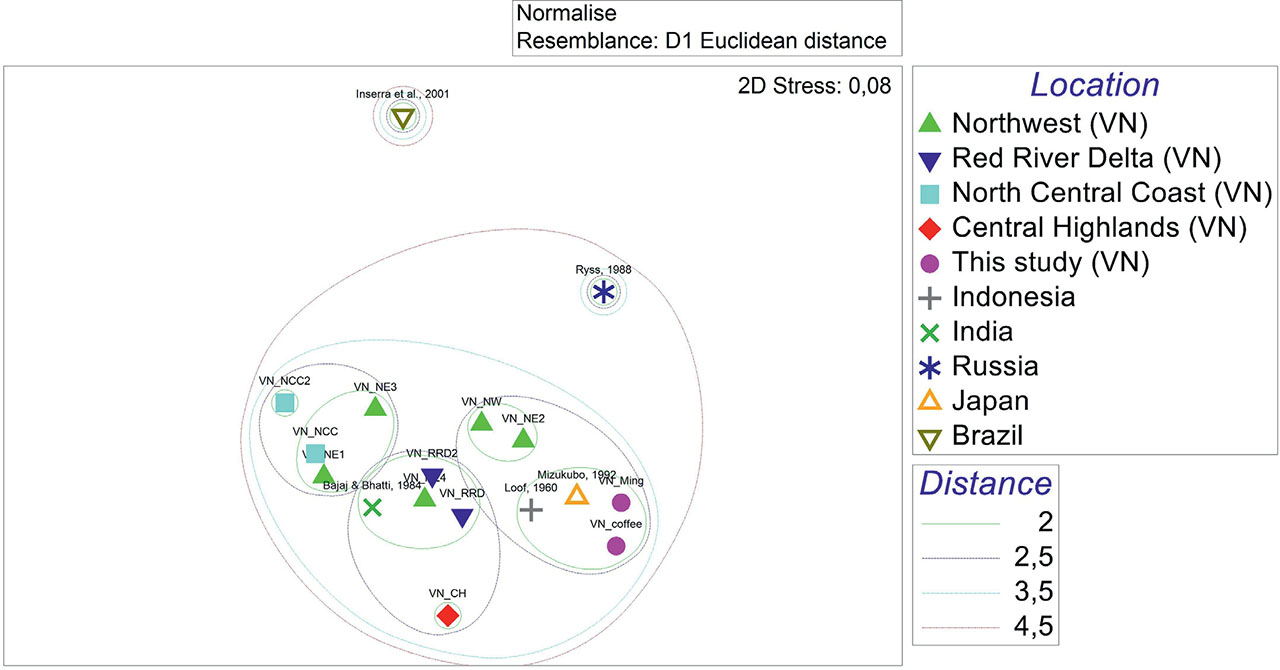
Fig. 2.
Cluster and MDS analyses of Pratylenchus coffeae from 17 populations in the world.
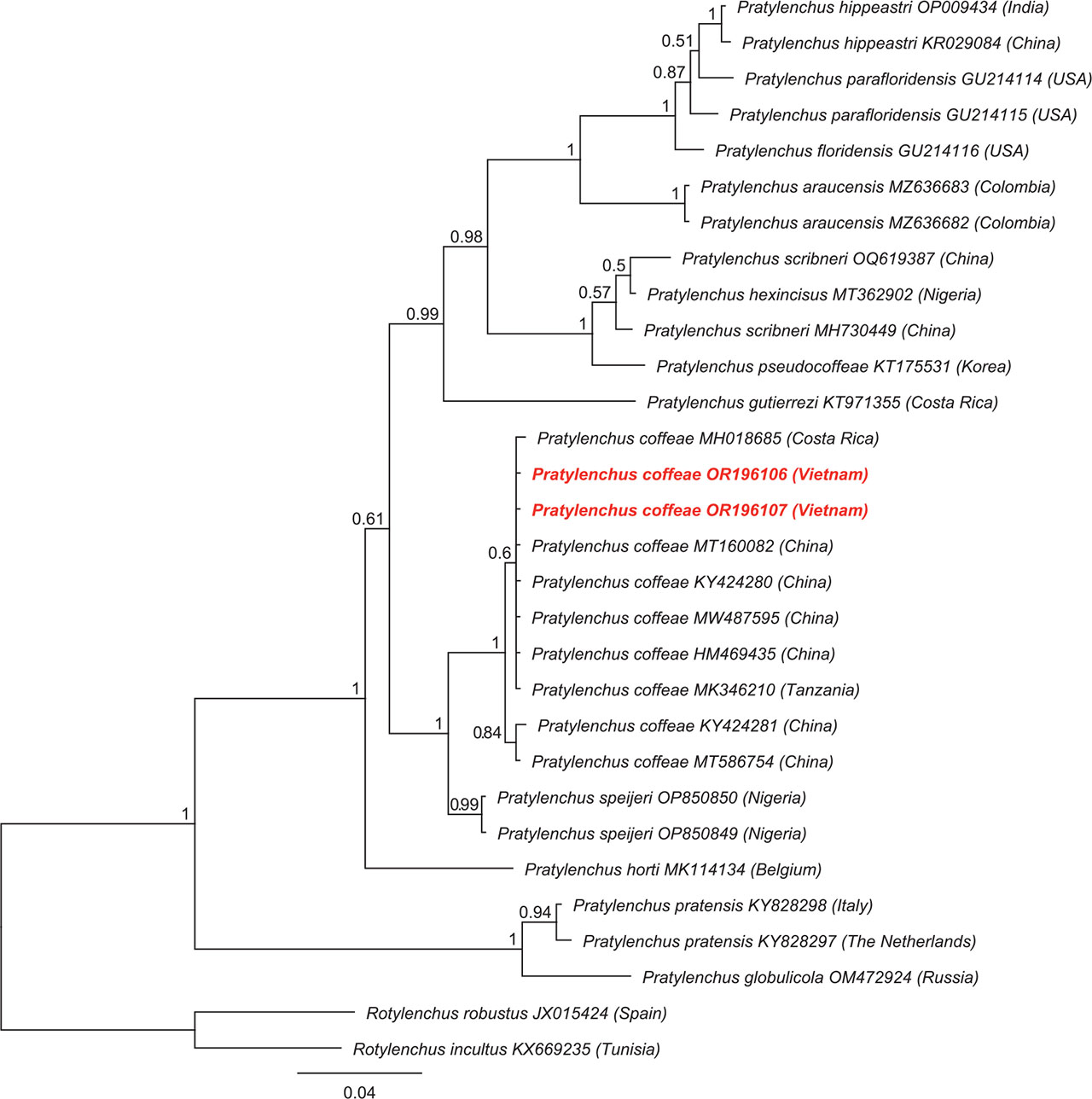
Fig. 3.
Bayesian phylogenetic tree of Pratylenchus species generated from D2D3 of 28S rRNA genes using the HKY+G model. Posterior Probability support was given next to each node. The sequences from this study were marked by red and bold.
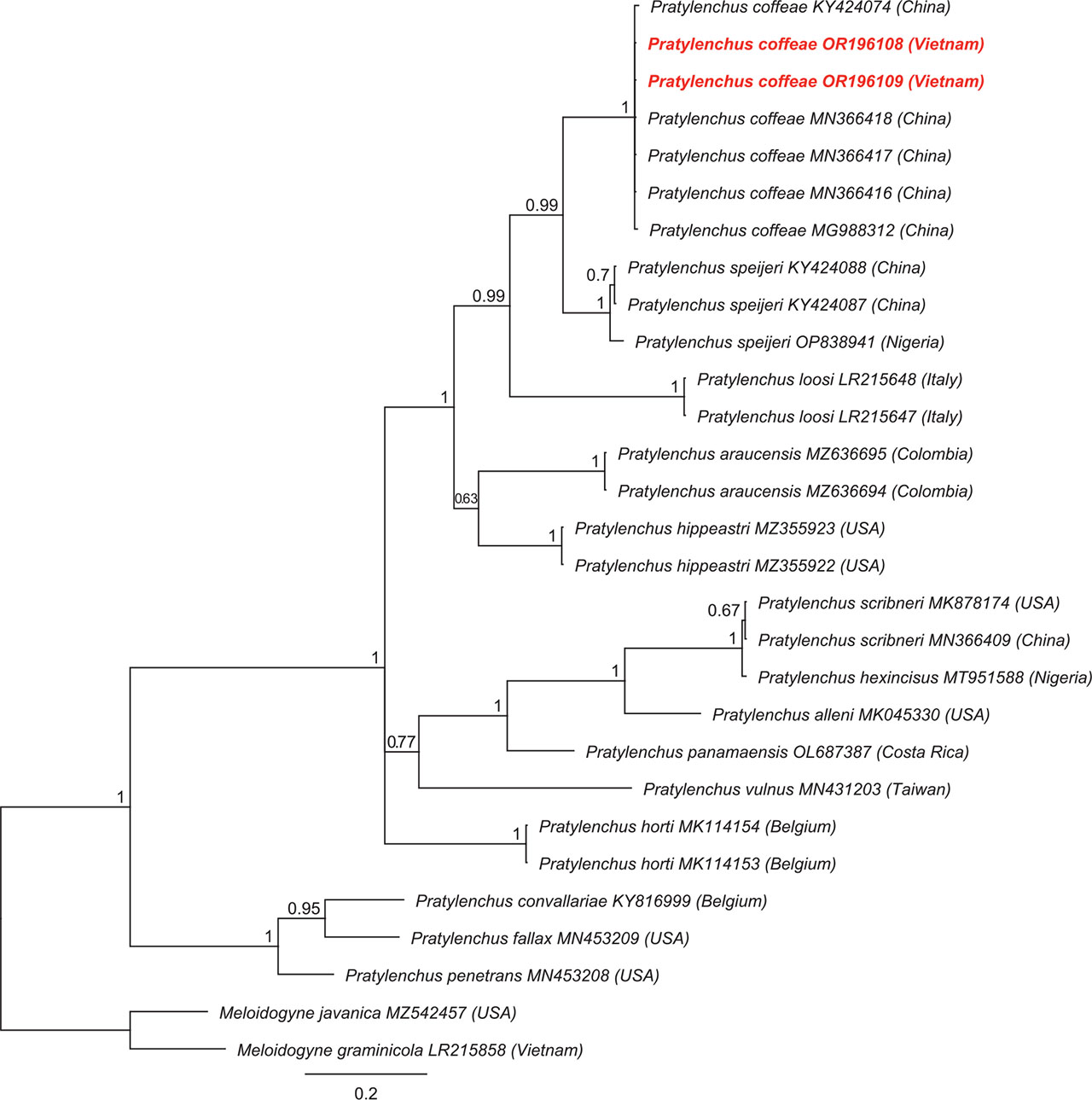
Fig. 4.
Bayesian phylogenetic tree of Pratylenchus species generated from COI mtDNA genes using the HKY+G model. Posterior Probability support was given next to each node. The sequences from this study were marked by red and bold.