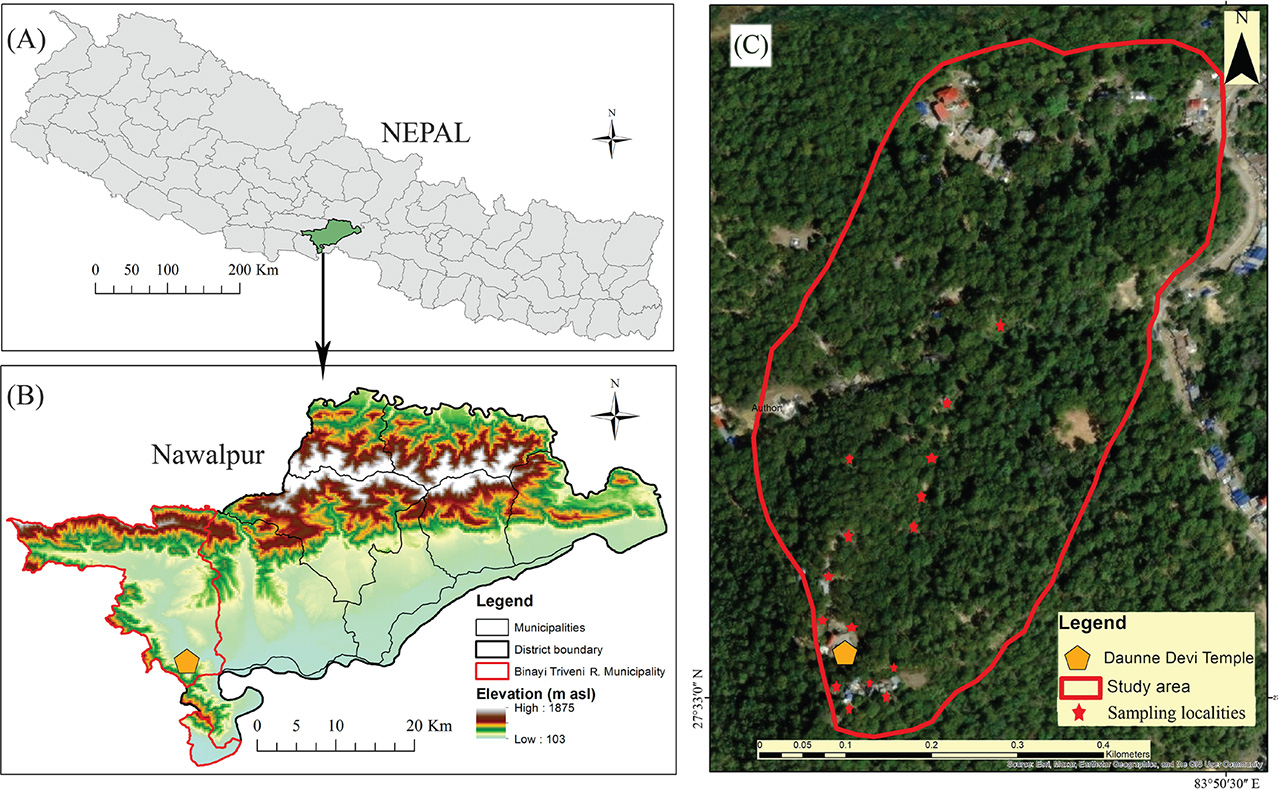
Fig. 1.
Location of the study area; A - Map of Nepal with Nawalpur District highlighted. B - Nawalpur District indicating the Binayee Tribeni Rural Municipality. C - Daunne Devi Temple in the Daunne Forest area.
Table 1.
Age-sex categories and sample number of macaques in the study (n=120).
| S.N. | Category | Description |
|---|---|---|
| 1. | Adult male (61) | Full grown with adult morphology (e.g., pink scrotum and prominent testes) |
| 2. | Adult female (35) | Full grown with adult morphology (e.g., elongated nipples, carrying baby) |
| 3. | Young (13) | Individuals lacking secondary sexual characteristics and have near adult size |
| 4. | Infant (11) | Small individuals nursed or are still in frequent proximity to a female |
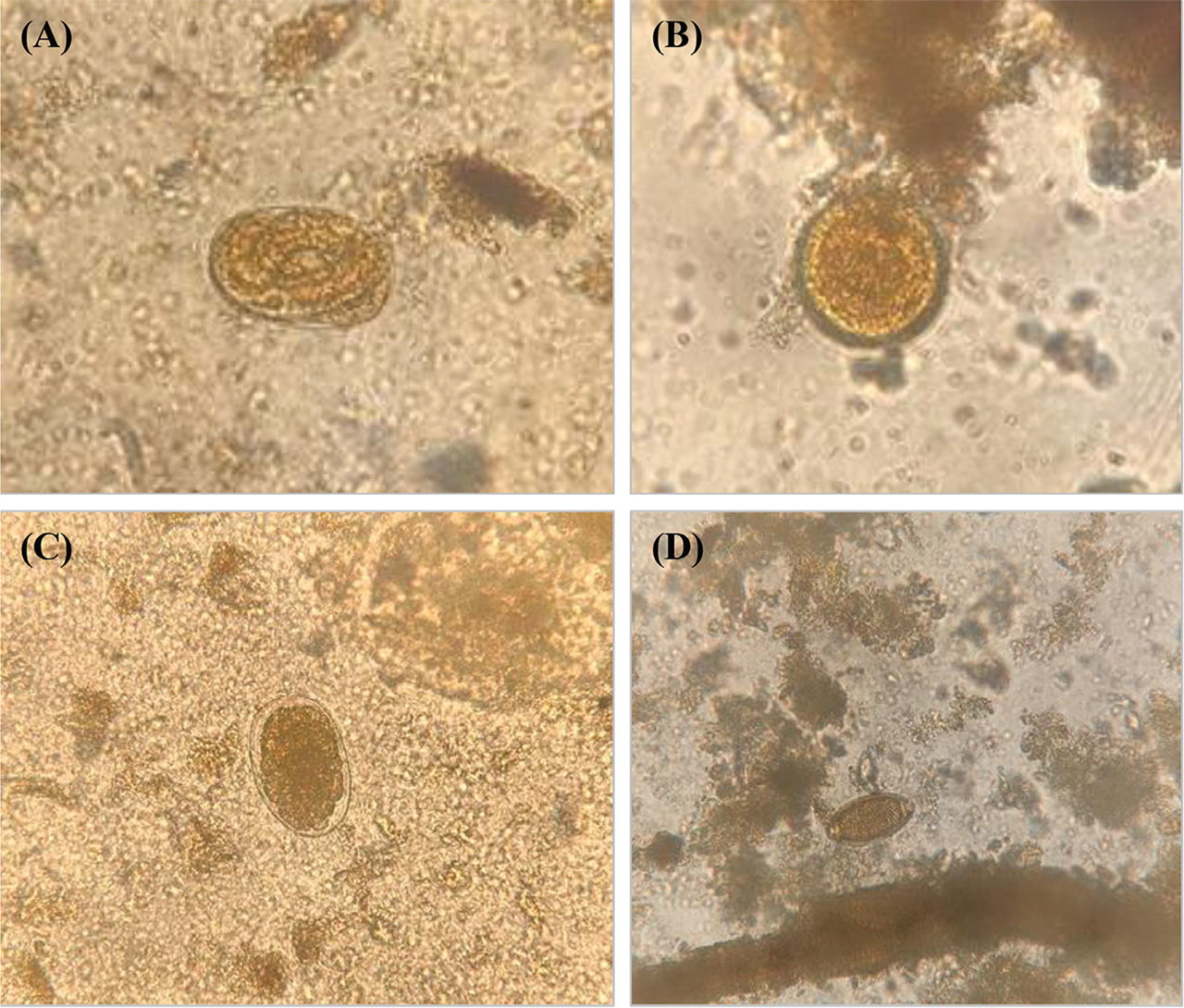
Fig. 2.
Identified intestinal helminth parasites (400×). A - Egg of Strongyloides sp. (60μm×39μm); B - Egg of Ascaris sp. (52μm×55μm); C - Egg of hookworm (75μm×45μm); and D- Egg of Trichuris sp. (55μm×24μm).
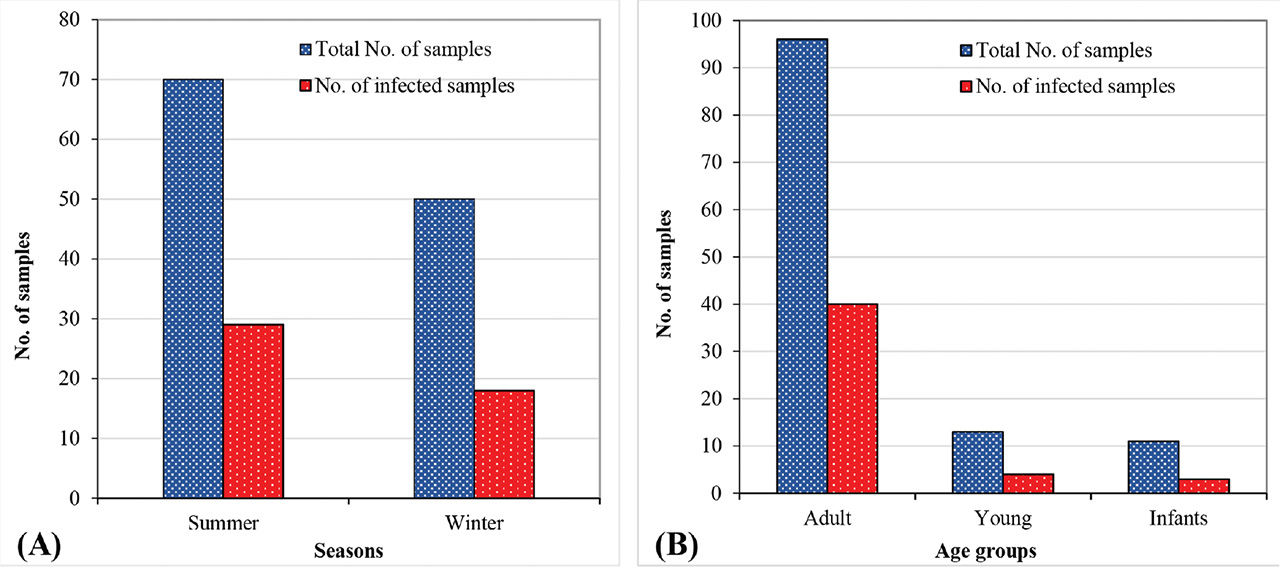
Fig. 3.
Prevalence of GI helminth parasites in rhesus macaques. A- Seasonal prevalence, B- Age wise prevalence.
Table 2.
GI helminth parasite prevalence in rhesus macaques and local people.
| Rhesus macaques (n=120) | Local people (n=70) | |||
|---|---|---|---|---|
| Parasite | Number of positive samples | Prevalence (%) | Number of positive samples | Prevalence (%) |
| Strongyloides sp. | 23 | 19.17 | 0 | 0 |
| Ascaris sp. | 16 | 13.33 | - | - |
| Ascaris lumbricoides | - | - | 8 | 11.4 |
| Hookworm | 13 | 10.83 | 0 | 0 |
| Trichuris sp. | 5 | 4.17 | 0 | 0 |