Table 1.
Main morphologic features that separate Quentinia Spasskii, 1969 from Catenotaenia sensu lato (Catenotaeniidae) and associate it with Monoecocestus Beddard, 1914 sensu Beveridge (1994) (Anoplocephalidae sensu stricto).
| Quentinia | Monoecocestus | Catenotaenia sensu lato | |
|---|---|---|---|
| Dorsal longitudinal osmoregulatory canals, position | lateral to ventral canals | lateral to ventral canals | medial to ventral canals, pass between arches of transverse connecting canals |
| Genital atrium, size | prominent, capable of forming genital papilla | prominent, capable of forming genital papilla | inconspicuous, not capable of forming genital papilla |
| Genital pores, alternation | irregularly in very short series | regularly or irregularly in very short series | irregularly in relatively long series |
| Vagina, position | runs anterior to cirrus sac distally, opens anterior to male pore | runs (partly) anterior to cirrus sac, opens anterior to male pore | runs posterior to cirrus sac, opens posterior or postero-ventral to male pore |
| Ovary, shape | symmetrical, arched | symmetrical; arched, transversely elongated or ovoid | asymmetrical, extensive |
| Vitellarium, position | median | median or slightly poral | poral |
| Fully developed uterus, shape | sparsely lobulated/sacculated without distinct trunk, secondary ramifications absent | sparsely lobulated/sacculated without distinct trunk, secondary ramifications absent | deeply lobulated with distinct trunk, secondary ramifications usually present (“dendritic”) |
| Pyriform apparatus in eggs, presence | present in Q. eljefe, undefined in Q. mesovitellinica | present | absent |
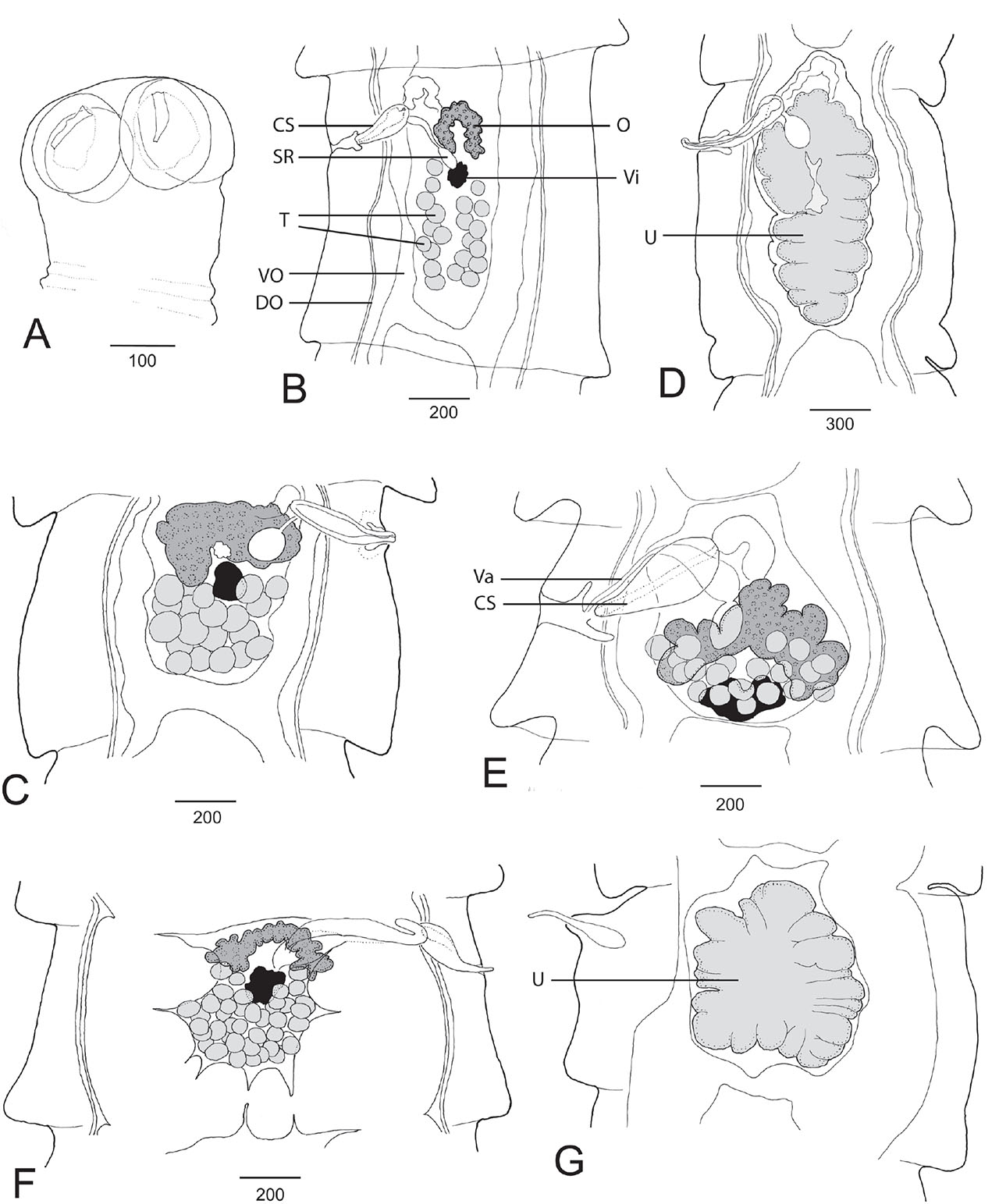
Fig. 1.
A–D, Quentinia mesovitellinica (Rêgo, 1967), redrawn from Quentin (1967). A, scolex. B, early mature proglottid. C, late mature proglottid. D, gravid proglottid. E, Monoecocestus petiso Haverkost & Gardner, 2010, mature proglottid. F, G, Quentinia eljefe (Haverkost & Gardner, 2010) n. comb. F, mature proglottid. G, gravid proglottid (scale-bar not available). E–G redrawn from Haverkost & Gardner (2010). Scale-bars in micrometers. T, testes; CS, cirrus sac; O, ovary; Va, vagina; Vi, vitellarium; SR, seminal receptacle; U, uterus; VO, ventral longitudinal osmoregulatory canal; DO, dorsal longitudinal osmoregulatory canal.
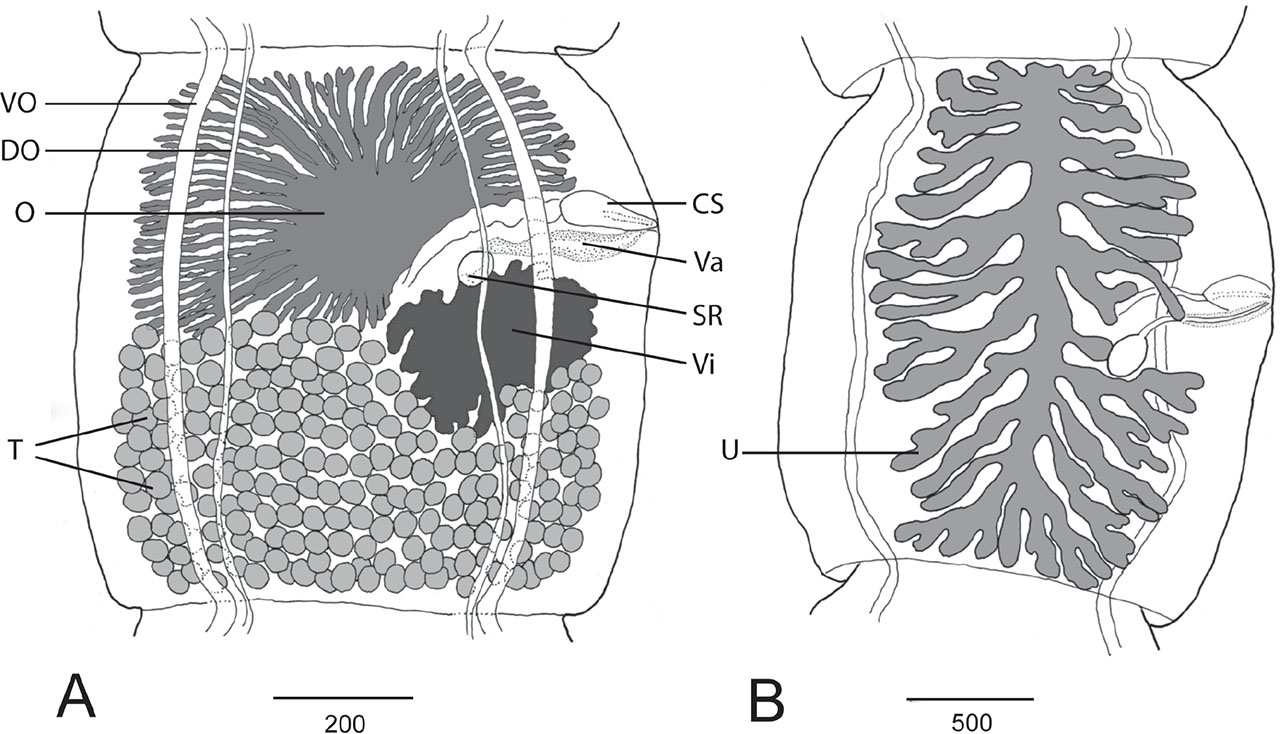
Fig. 2.
Catenotaenia matovi Genov, 1971. A, mature proglottid, redrawn from Tenora et al. (1980). Longitudinal osmoregulatory canals ventral to terminal genital ducts; dorso-ventral position with respect to other organs undefined. B, pregravid proglottid, redrawn from Genov (1971). Scale-bars in micrometers. For symbols, see Fig. 1.