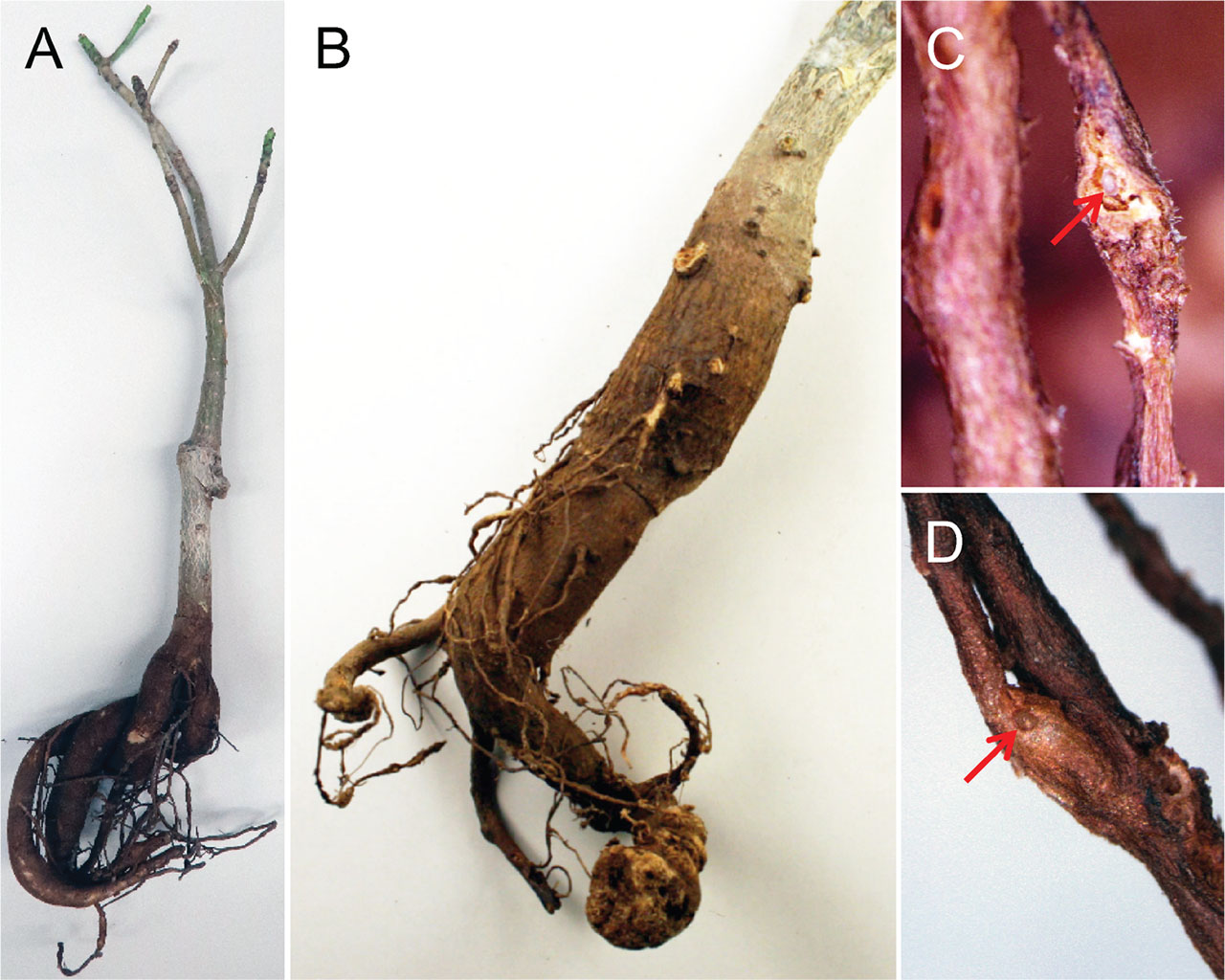
Fig. 1.
Baobab seedling infested by Meloidogyne enterolobii. (A) Infested baobab seedling; (B) Baobab roots showing galls caused by M. enterolobii; (C, D) Females of M. enterolobii parasitizing roots of baobab (red arrow indicating female).
Table 1.
Morphometrics of second-stage juveniles of Meloidoyne enterolobii. All measurements are in μm and in the form: mean ± s.d. (range).
| Character | Thailand | China | Puerto Rico |
|---|---|---|---|
| This study | Yang & Eisenback (1983) | Rammah & Hirschmann (1988) | |
| n | 10 | 30 | 35 |
| L | 466.7 ± 33.8 (423.8 – 527.3) | 436.6 ± 16.6 (405.0 – 472.9) | 453.6 ± 28.4 (390.4 – 528.0) |
| a | 31.2 ± 1.4 (29.0 – 32.9) | 28.6 ± 1.9 (24.0 – 32.5) | 30.9 ± 1.9 (26.4 – 34.7) |
| c | 8.8 ± 0.8 (8.0 – 10.0) | 7.8 ± 0.7 (6.8 – 10.1) | 8.3 ± 0.4 (7.0 – 9.2) |
| Body diam. at mid-body | 14.8 ± 0.7 (13.8 – 16.3) | 15.3 ± 0.9 (13.9 – 17.8) | 14.7 ± 0.5 (13.8 – 15.8) |
| Stylet length | 11.0 ± 0.5 (10.5 – 11.8) | 11.7 ± 0.5 (10.8 – 13.0) | 11.6 ± 0.3 (11.1 – 12.2) |
| DGO | 2.7 ± 0.5 (2.0 – 3.4) | 3.4 ± 0.3 (2.8 – 4.3) | 3.9 ± 0.2 (3.3 – 4.3) |
| Anterior end to median bulb valve | 58.0 ± 2.5 (54.5 – 61.3) | – | 58.2 ± 1.8 (55.2 – 62.9) |
| Anterior end to excretory pore | 92.0 ± 2.1 (89.0 – 94.4) | 91.7 ± 3.3 (84.0 – 98.6) | 87.6 ± 3.3 (79.9 – 97.9) |
| Tail length | 53.1 ± 4.7 (44.0 – 60.9) | 56.4 ± 4.5 (41.5 – 63.4) | 54.4 ± 3.6 (49.2 – 62.9) |
| Length of hyaline part of tail | 9.8 ± 3.9 (5.1 – 15.3) | – | – |
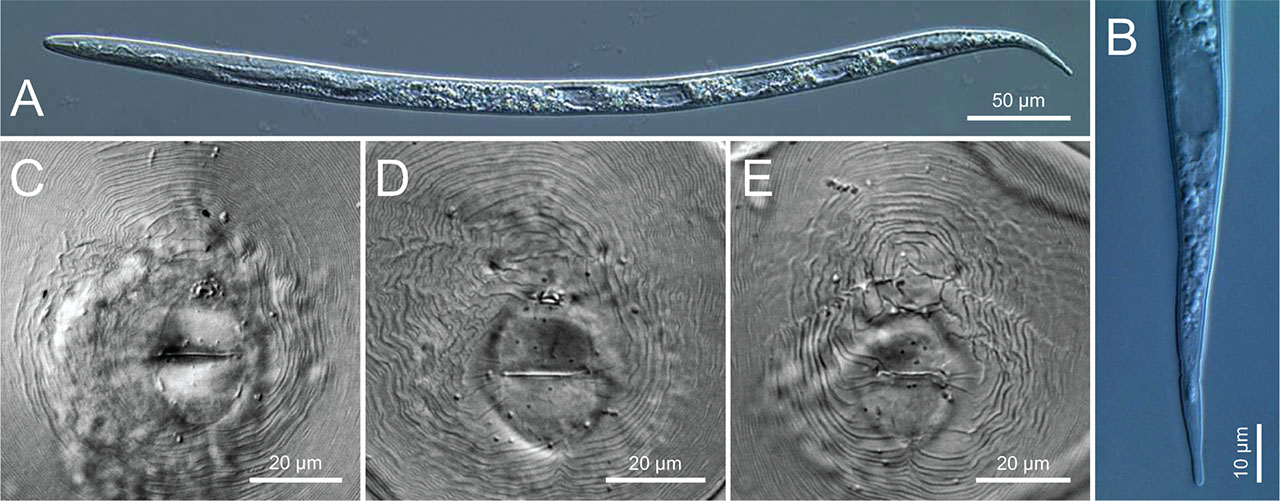
Fig. 2.
Light micrographs of Meloidogyne enterolobii intercepted from baobab seedlings. (A) Whole body of second-stage juvenile (J2); (B) Tail of J2; (C–E) Perineal patterns of females.
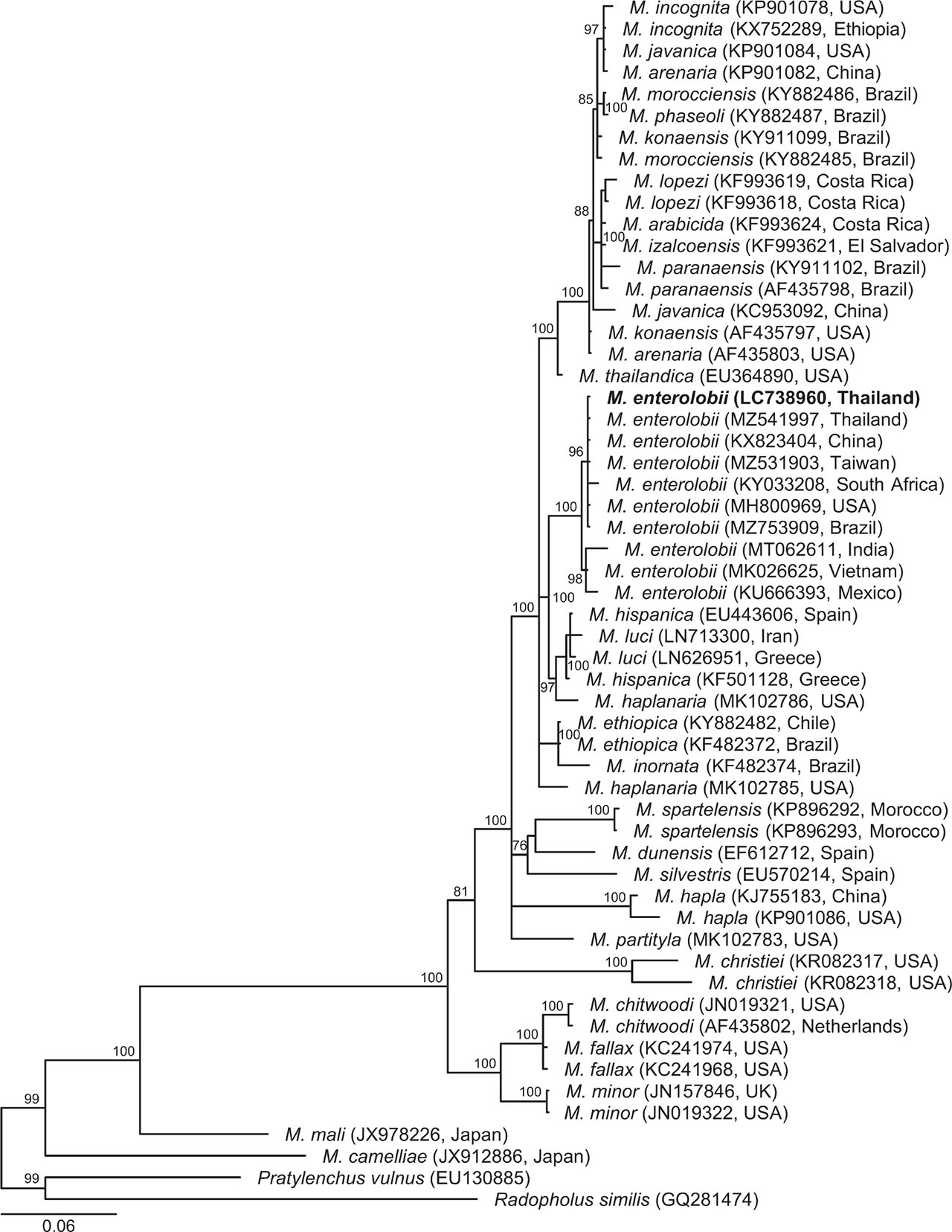
Fig. 3.
Phylogenetic relationships within Meloidogyne species: Bayesian 50% majority rule consensus trees from two runs as inferred from analysis of the D2–D3 of 28S rRNA gene sequence alignment under the GTR + G model. Posterior probabilities equivalent to or exceeding 70% are given for appropriate clades. New sequence is indicated in bold.
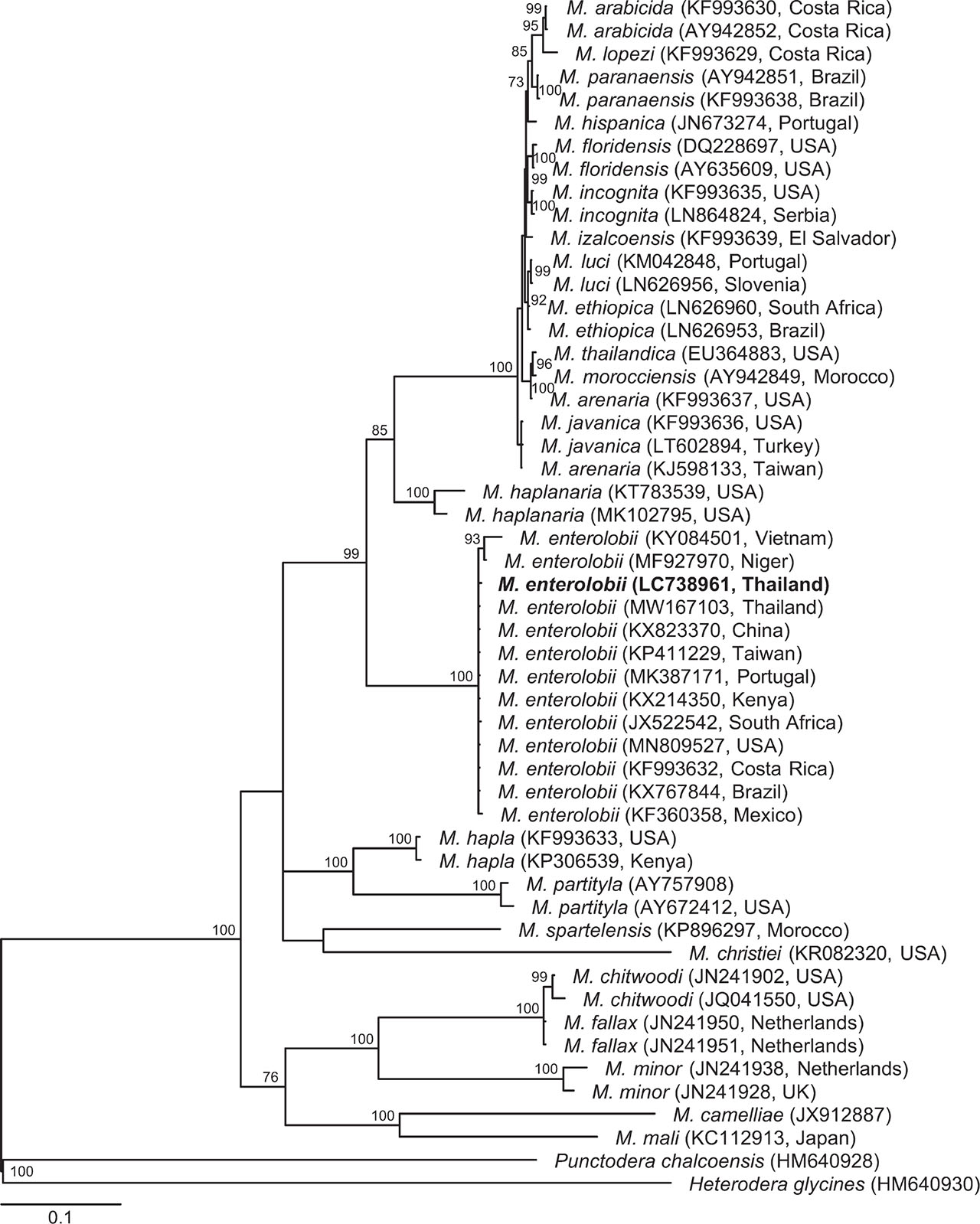
Fig. 4.
Phylogenetic relationships within Meloidogyne species: Bayesian 50% majority rule consensus trees from two runs as inferred from analysis of the intergenic COII-16S rRNA gene sequence alignment under the GTR + G model. Posterior probabilities equivalent to or exceeding 70% are given for appropriate clades. New sequence is indicated in bold.
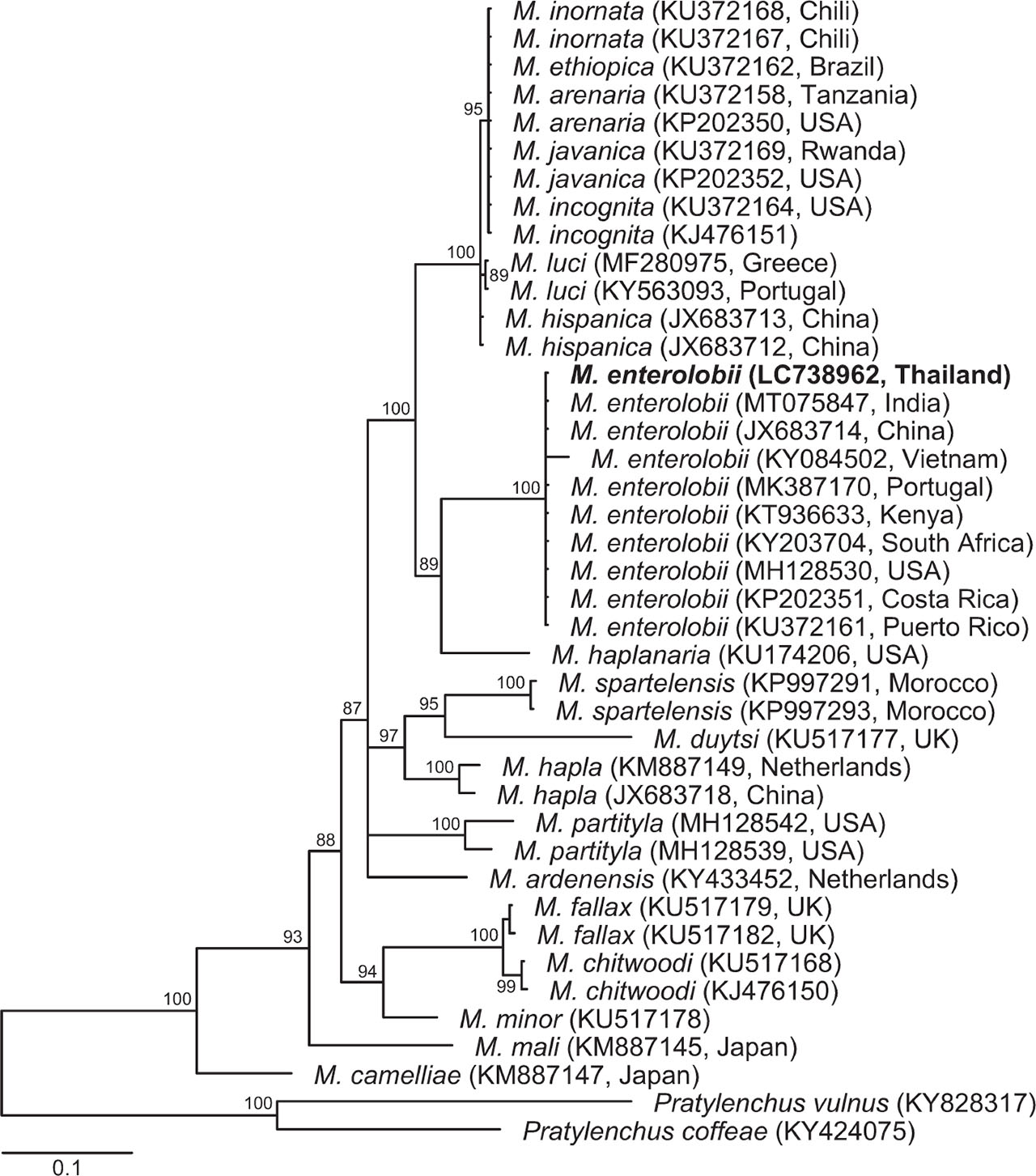
Fig. 5.
Phylogenetic relationships within Meloidogyne species: Bayesian 50% majority rule consensus trees from two runs as inferred from analysis of the COI gene sequence alignment under the GTR + G model. Posterior probabilities equivalent to or exceeding 70% are given for appropriate clades. New sequence is indicated in bold.