Table 1
Measurements of females of Aphelenchoides bicaudatus from South Africa. All measurements are in μm and in form: mean ± SD (range), except for ratio.
| Province | Western Cape | Limpopo |
|---|---|---|
| Locality | Cape Town | Magoebaskloof |
| n | 8 females | 4 females |
| L | 455.3 ± 64.5 (409 – 529) | 451.7 ± 56.7 (415 – 517) |
| a | 29.1 ± 2.0 (27.1 – 31.1) | 28.9 ± 0.7 (28.2 – 29.6) |
| b | 4.6 ± 0.5 (4.1 – 5.1) | 4.4 ± 0.3 (4.1 – 4.7) |
| M | 47.9 ± 3.4 (44.1 – 50.6) | 49.4 ± 3.6 (45.5 – 52.6) |
| c | 16.3 ± 2.0 (14.1 – 17.8) | 15.2 ± 1.3 (14.3 – 16.7) |
| c’ | 3.2 ± 0.6 (2.6 – 3.6) | 3.3 ± 0.3 (3.1 – 3.6) |
| V (%) | 68.8 ± 1.6 (67 – 71) | 68.7 ± 1.7 (67 – 70) |
| Lip region height | 2.8 ± 0.9 (2 – 4) | 3.1 ± 0.5 (3 – 4) |
| Lip region width | 5.7 ± 0.1 (5.6 – 5.8) | 5.4 ± 0.4 (5.1 – 5.8) |
| Stylet length | 11.1 ± 1.7 (10 – 13) | 9.6 ± 0.6 (9.5 – 10) |
| Conus | 4.7 ± 0.3 (4.5 – 5.0) | 4.8 ± 0.3 (4.5 – 5.0) |
| Mid of median bulb to anterior end. | 47.3 ± 3.2 (45 – 51) | 48.3 ± 2.6 (46 – 51) |
| Median bulb diameter | 9.0 ± 0.8 (8.5 – 10.0) | 9.2 ± 0.8 (8.0 – 10.0) |
| Median bulb length | 11.2 ± 0.7 (11 – 12) | 10.9 ± 1.0 (10 – 12) |
| Pharynx length | 88.3 ± 11.2 (76 – 98) | 93.2 ± 7.3 (86 – 100) |
| Neck | 99.0 ± 8.7 (89 – 104) | 103.3 ± 7.5 (95 – 110) |
| Nerve ring from anterior end | 71.7 ± 0.6 (71 – 76) | 73.0 ± 2.0 (71 – 75) |
| Excretory pore from anterior end | 61.3 ± 3.2 (60 – 65) | 60.3 ± 1.5 (59 – 62) |
| Body diameter at median bulb | 12.5 ± 1.8 (11 – 15) | 12.3 ± 1.5 (11 – 14) |
| Body diameter at mid body | 15.6 ± 1.5 (14 – 17) | 15.7 ± 2.1 (14 – 18) |
| Body diameter at anus | 8.8 ± 0.7 (8 – 9) | 9.1 ± 0.1 (8 – 10) |
| Anterior branch of reproductive system | 179.3 ± 18.0 (167 – 200) | 199.7 ± 53.2 (167 – 261) |
| Post-vulval uterine sac | 47.0 ± 2.6 (45 – 50) | 46.0 ± 1.0 (45 – 47) |
| Vagina length | 6.3 ± (6 – 7) | 6.7 ± 0.6 (6 – 7) |
| Rectum | 14.3 ± (12 – 16) | 14.7 ± 1.5 (13 – 16) |
| Tail length | 28.0 ± (24 – 31) | 29.7 ± 1.2 (29 – 31) |
Table 2
Morphological important characters of females of Aphelenchoides bicaudatus from various localities. All measurements are in pm and in form: mean ± SD (range), except for ratio. * = extracted from original drawings.
| Present study | Imamura, 1931 (Filipjev and Schuurmans Stekhoven (1941)) | Siddiqui and Taylor (1967) | Jen etal., 2012 | Kim et a/., 2016 | Israr et al., 2017 | |
|---|---|---|---|---|---|---|
| Population | South Africa | Japan | USA | Taiwan | South Korea | Pakistan |
| L(μm) | 455.3 ± 64.5 (409-529) | 430 (380 - 470) | 460 (410-550) | 499.12 ±67.95 (376-637) | 517.9 ±3.8 (513.6-522.6) | 360 |
| a | 29.1 ±2.0 (27.1-31.1) | 31.5 (31.3-31.7) | 28.0 (25-31) | 33.03 ± 2.42 (27.00-38.64) | 28.3 ± 0.5 (27.7-28.8) | 30.1 -32.7 |
| b | 4.6 ±0.5 (4.1-5.1) | 7.4 (6.8-8.4) | 8.2 (7.3-9.6) | 9.0 ±0.7 (7.5-10.0) | 7.3 ±0.0 (7.3-7.4) | 7.2-8.8 |
| c | 16.3 ±2.0 (14.1-17.8) | 10.6 (9.4-12.6) | 11.4(9.8-13.7) | 11.94 ± 0.93 (10.16-14.80) | 11.3 ±0.5 (10.7-11.9) | 11.3-12.0 |
| c' | 3.2 ±0.6 (2.6-3.6) | 4.4* | 4.7* | 5.41 ±0.56 (4.13-7.14) | 4.6 ±0.1 (4.4-4.8) | 2.9-3.7 |
| Tail (μm) | 28.0 ±3.6 (24-31) | 44* | 41 | 37-43 | 45.9 ±2.5 (43.1 -48.8) | 30-31 |
| V(%) | 68.8 ± 1.6 (67-71) | 70.4 (61.7-90.2) | 67.5 (65-70) | 68.53 ± 1.20 (64.90-71.83) | 66.0 ± 0.2 (65.7-66.4) | 66.8-67.2 |
| Stylet (μm) | 11.1 ±1.7(10-13) | 10* | 11.2(10-12) | 10.38 ±0.63 (9-12) | 11.2 ± 0.5 (10.4 - 11.7) | 10-11 |
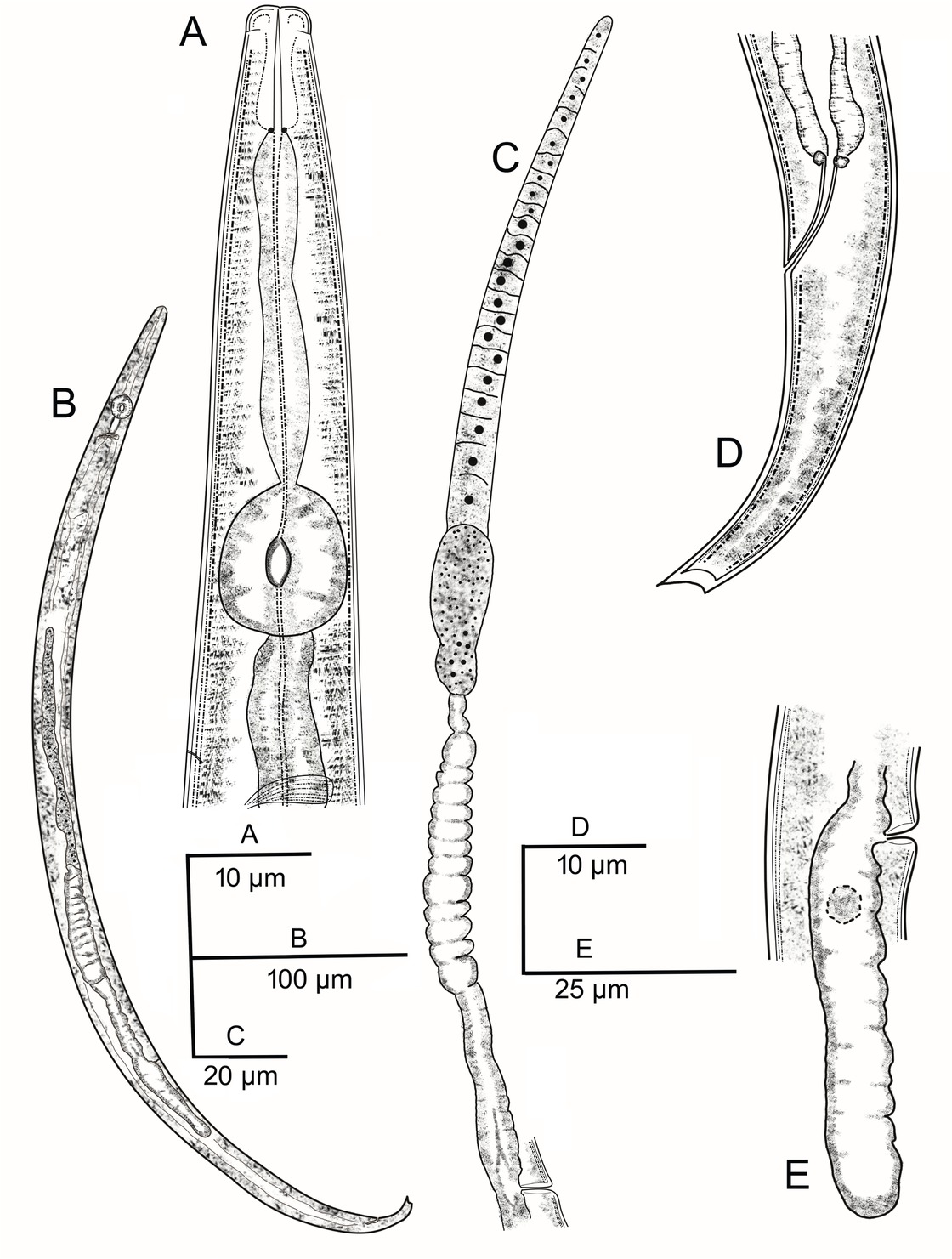
Fig. 1
Aphelenchoides bicaudatus (Imamura, 1931) Filipjev and Schuurmans Stekhoven, 1941.
(A) anterior end; (B) entire female; (C) reproductive system; (D) female posterior end; (E) Post-vulval uterine sac.
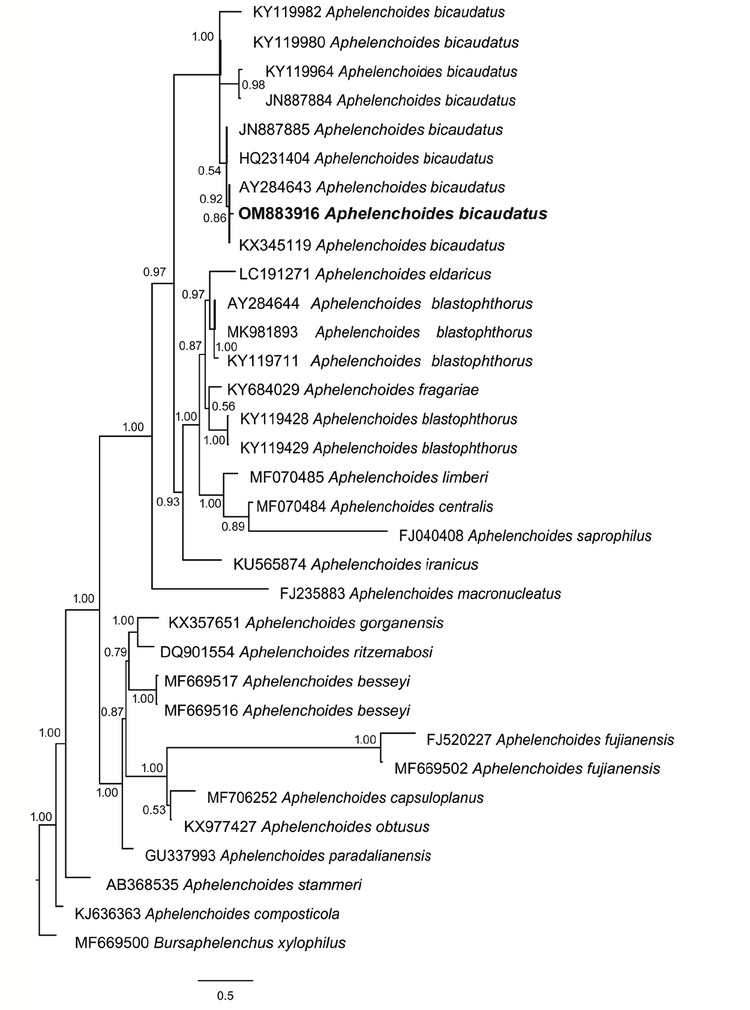
Fig. 2
Phylogenetic position of Aphelenchoides bicaudatus from South Africa based on 18S rDNA.
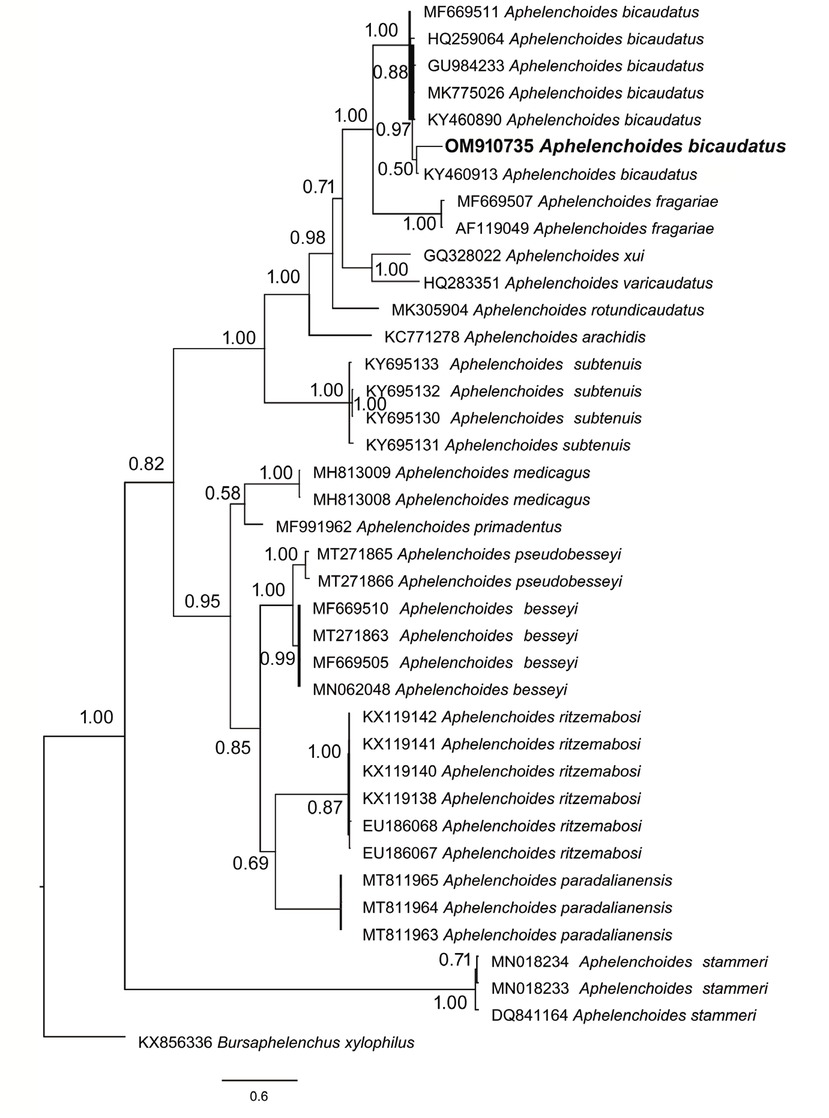
Fig. 3
Phylogenetic position of Aphelenchoides bicaudatus from South Africa based on ITS rDNA.
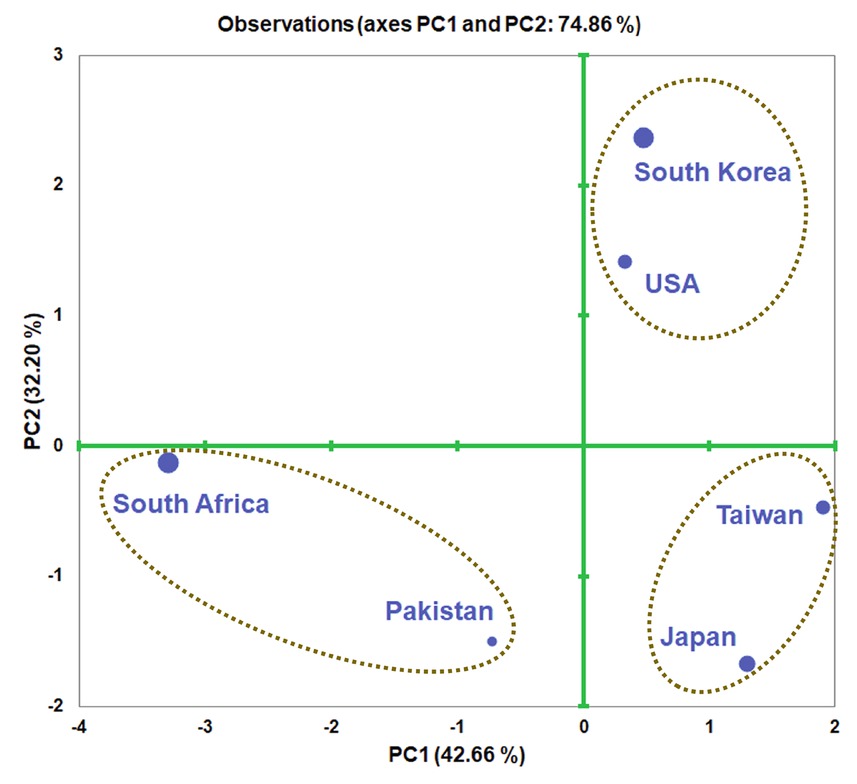
Fig. 4
PCA plot of different populations of Aphelenchoides bicaudatus from various locations.