
Table 1
The full names of the investigated genes and their primers sequences used in this study.
| Gene | Abbreviation | Species | Accession number | Primers sequences (5`-3`) | Product size (bp) |
|---|---|---|---|---|---|
| Glyceraldehyde 3-phosphate dehydrogenase | Gapdh | Mus musculus | NM_001289726, transcript variant 1 | TCCTCGTCCCGTAGACAAAATG –F AATCTCCACTTTGCCACTGC – R | 103 |
| Glucosamine (UDP-N- acetyl) – 2 – epimerase/N- acetylmannosamine kinase | Gne | Mus musculus | NM_015828.3 | AATCCTGCAGATGTGTGTGG –F AATGCAGCACAACTCCTTCC – R | 119 |
| Dystroglycan 1 | Dag1 | Mus musculus | NM_001276485.1, transcript variant 5 | GTTGGCATTCCAGACGGTAC –F AGTGTAGCCAAGACGGTAAGG – R | 136 |
| ST3 beta-galactoside alpha- 2,3-sialyltransferase 6 | St3gal6 | Mus musculus | NM_018784.2 | TCCCAGCTGAAGAAATGAGGAC –F TCAGCTCTGCACAGAAATGG – R | 112 |
| Expansion segment V | ESV | Trichinella spiralis | * | GTTCCATGTGAACAGCAGT –F CGAAAACATACGACAACTGC – R | 173 |
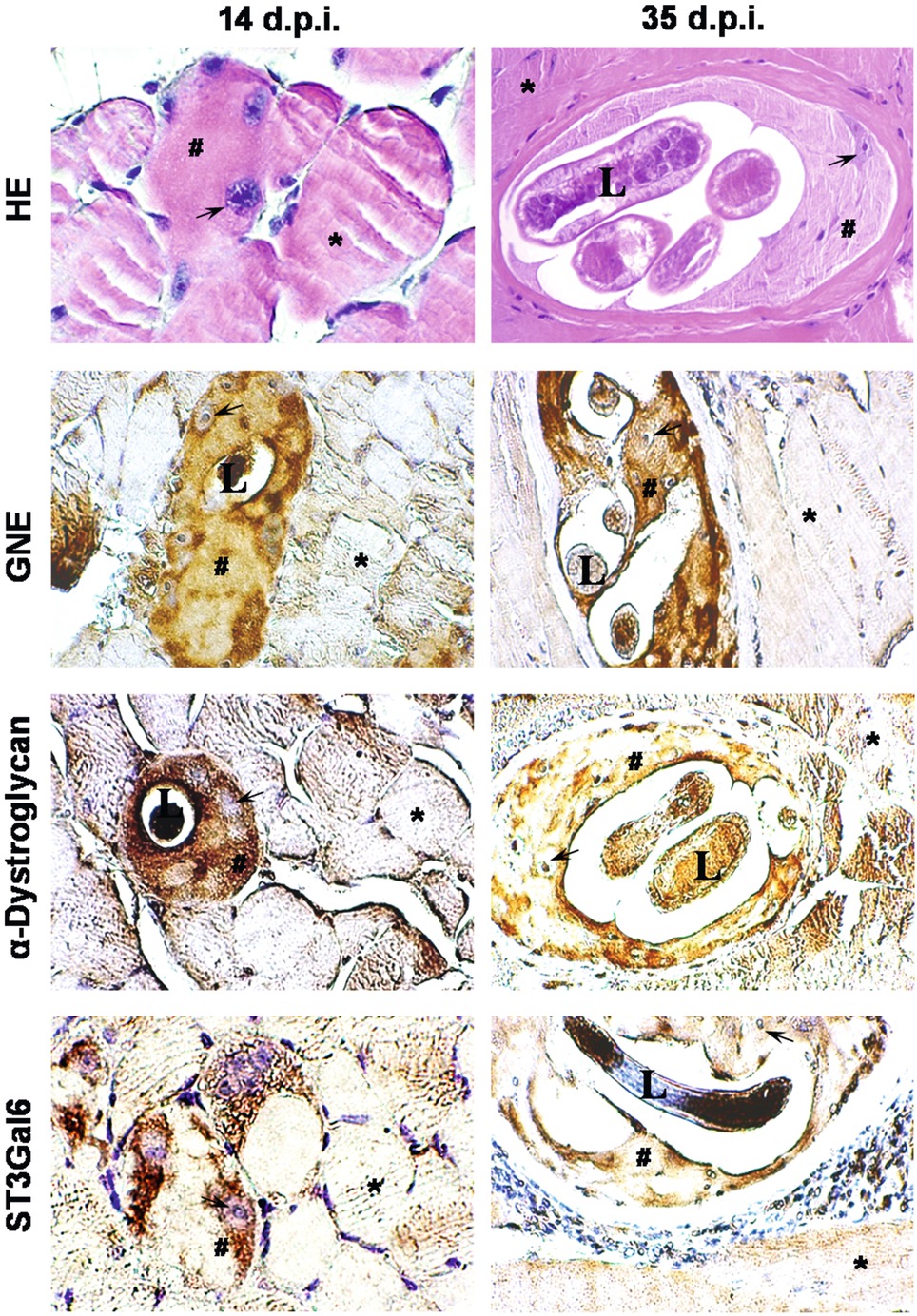
Fig. 1
Immunohistochemistry. Modified methacarn fixed sections from mouse skeletal muscles with Trichinella spiralis at days 14 and 35 post invasion (d.p.i.) were stained with rabbit polyclonal antibodies against glucosamine (UDP-N-acetyl)-2-epimerase/N-acetylmannosamine kinase (GNE), α-dystroglycan and ST3 beta-galactoside alpha-2,3-sialyltransferase 6 (ST3Gal6). Paralel sections were subjected to H&E staining to facilitate the histological orientation. Strong expressions of GNE and α-dystroglycan, and moderate expression of ST3Gal6 were observed on days 14 and 35 after invasion, suggesting these proteins as permanent characteristics of the Nurse cell of T. spiralis. The brown colour indicates positive immunohistochemical reaction, hashtag indicates the occupied sarcoplasm, star – non-occupied skeletal muscle cell, arrow – enlarged nucleus, L– larva. H&E, HRP anti-rabbit IgG, DAB. Scale bar 20 μm.
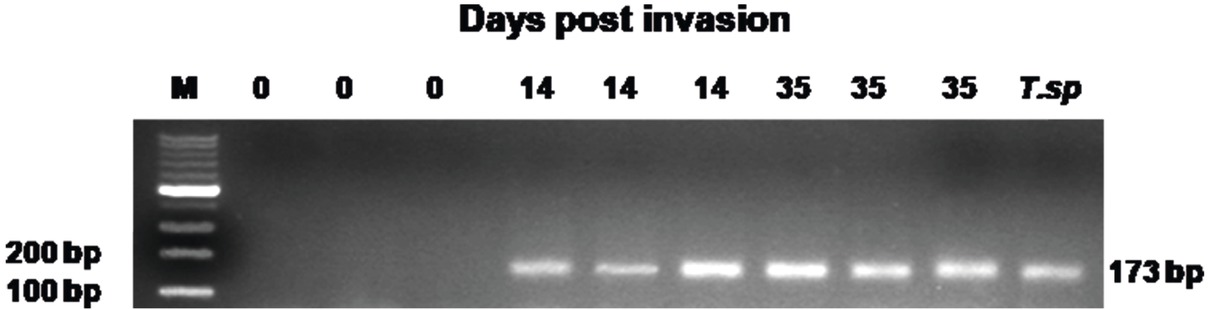
Fig. 2
Agarose gel analysis of Trichinella spiralis ESV fragment PCR. Polymerase chain reaction was performed on modified methacarn fixed mouse skeletal muscle tissue sections, selected on days 0, 14 and 35 after T. spiralis invasion. Genomic DNA from T. spiralis infectious larvae was used as a positive control sample. Presence of 173 bp fragment of expansion segment V of the T. spiralis genome was detected only in the mouse samples collected on days 14 and 35 after invasion. The photograph is a representative of three randomly selected samples from each experimental group.
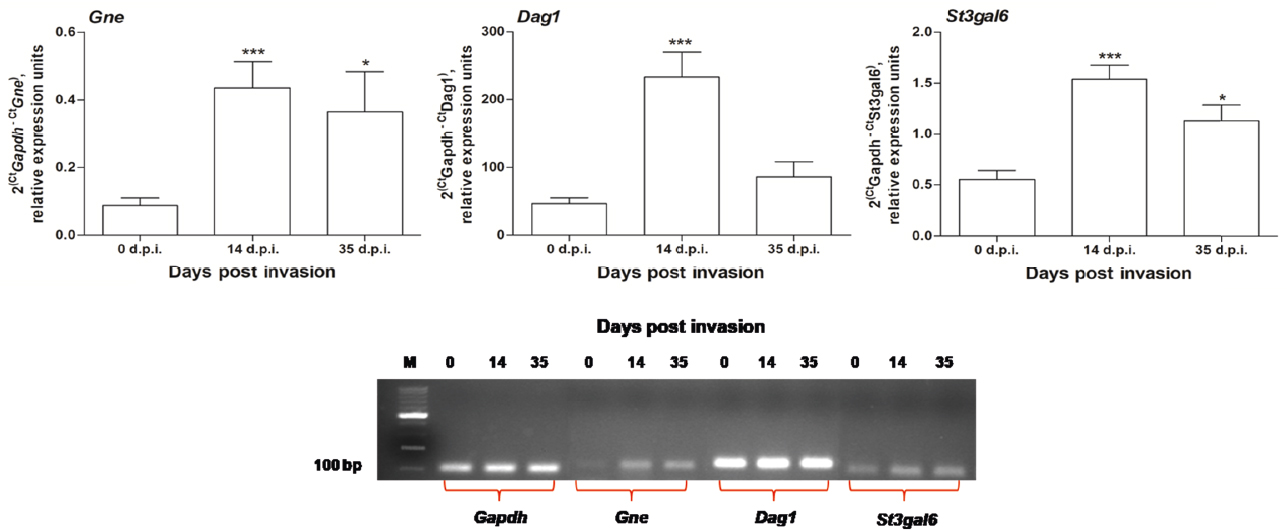
Fig. 3
Expressions of mouse glucosamine (UDP-N-acetyl)-2-epimerase/N-acetylmannosamine kinase (Gne), dystroglycan 1 (Dag1) and ST3 beta-galactoside alpha-2,3-sialyltransferase 6 (St3gal6) analysed by real time RT-PCR in modified methacarn fixed mouse skeletal muscle tissue sections, selected on days 0, 14 and 35 after T. spiralis invasion. The graphs show the relative quantification of the gene expressions calculated by the ΔΔCt method versus glyceraldehyde phosphate dehydrogenase (Gapdh) as a reference gene from five individual samples in triplicate. The bars show the standard error of mean. The products of amplification were loaded on 2.5% agarose gel versus Perfect 100-1000 bp DNA Ladder.