Table 1
GenBank accession numbers of cox1 and nad1 of Echinococcus genotypes used in phylogenetic analysis in the current study
| Accession No. for NAD1 | Locality | Host origin | Genotype | Accession No. for Cox1 | Locality | Host origin | Genotype |
|---|---|---|---|---|---|---|---|
| MW183240 | Egypt | Camel | G7* | MW173485 | Egypt | Camel | G7* |
| MW183239 | Egypt | Camel | G7* | MW173484 | Egypt | Camel | G7* |
| MH301013 | France | Pig | G7 | MH301013 | France | Pig | G7 |
| KX010897 | Hungary | Pig | G6/7 | MH301019 | Italy | Pig | G7 |
| KX010890 | France | Pig | G6/7 | MH301010 | France | Pig | G7 |
| KX010889 | Namibia | Oryx | G6/7 | MH301009 | France | Pig | G7 |
| KX010886 | Sudan | Camel | G6/7 | MH301008 | France | Pig | G7 |
| MH301016 | France | Pig | G7 | MH300939 | Sudan | Camel | G6 |
| KX510135 | Serbia | Pig | G6/7 | KX010833 | Kenya | Camel | G6/7 |
| KX231668 | Armenia | Pig | G6/7 | MT166286 | Nigeria | Camel | G6 |
| KX010880 | Ethiobia | Cattle | G6/7 | MT166284 | Nigeria | Cattle | G6 |
| MT525964 | Kenya | Cattle | G6/7 | MH301021 | Ukraine | Pig | G6 |
| MT166290 | Nigeria | Camel | G6 | MH301006 | Poland | Pig | G7 |
| MT166289 | Nigeria | Cattle | G6 | MH301005 | Poland | Homosapiens | G7 |
| JN191326 | Egypt | Donkey | G4 | JN191319 | Egypt | Donkey | G4 |
| MK644934 | South Korea | Human | Taenia saginata | MK644934 | South Korea | Human | Taenia saginata |
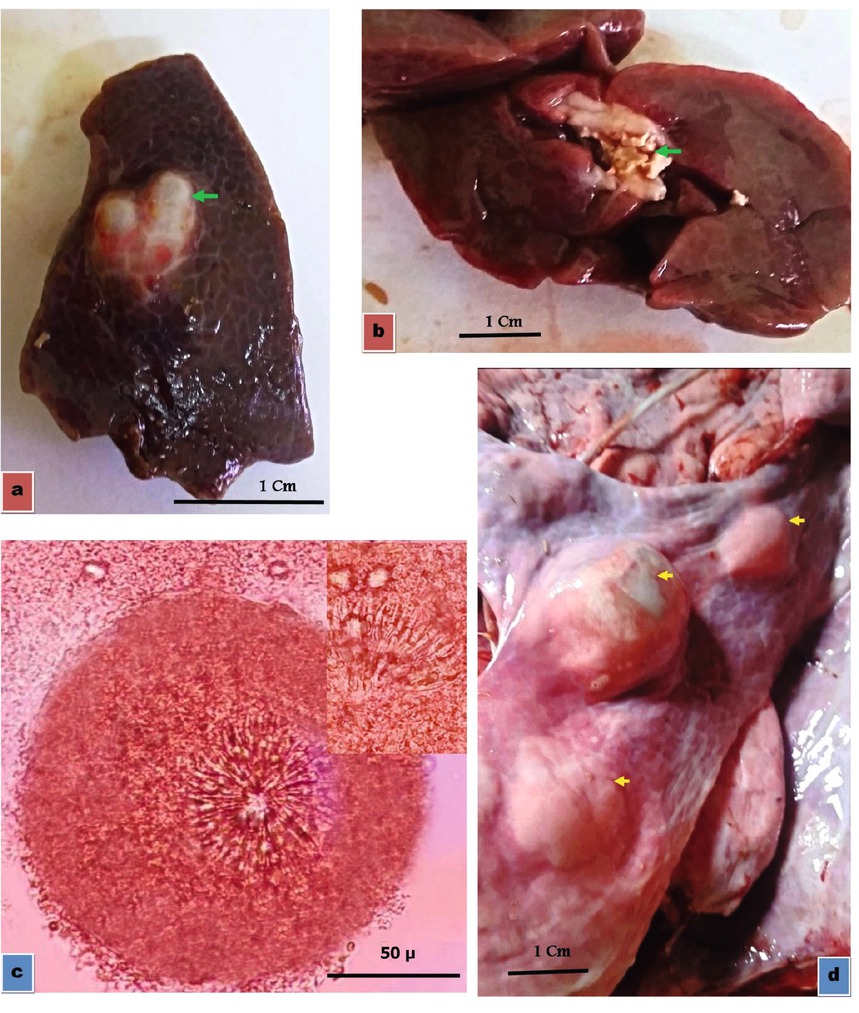
Fig. 1
a, b) Calcified cyst; c) Protoscoleces; d) Multiple fertile cysts in the lung (yellow arrow head).
Table 2
Comparative biochemical analysis of hydatid fluids collected from dromedary camels and cattle infected with cystic echinococcosis (mean ± SE, n = 5).
| Camel | Cattle | |
|---|---|---|
| Total protein (g/l) | 3.76 ± 0.73 | 2.42 ± 0.01 |
| Glucose (mmol/L) | 3.36 ± 0.16 | 2.58 ± 0.47 |
| Urea (mmol/L) | 5.21 ± 0.17 | 4.36 ± 0.5 |
| Cholesterol (mmol/L) | 2.94 ± 0.61 | 2.19 ± 0.31 |
| Creatinine (μmol/L) Calcium (mmol/L) | 101.22 ± 3.09 2.937 ± 0.03 | 80.67 ± 0.66 3.224 ± 0.02 |
| Triglycerides (mmol/L) | 0.039 ± 0.01 | 0.186 ± 0.003 |
| Sodium (mmol/L) | 111.35 ± 5.45 | 118.09 ± 0.54 |
| Potassium (mmol/L) | 13.92 ± 7.41 | 10.05 ± 0.05 |
| Magnesium (mmol/L) | 1.113 ± 0.33 | 1.019 ± 0.02 |
| Copper (ppm) | 0.42 ± 0.11 | 0.338 ± 0.016 |
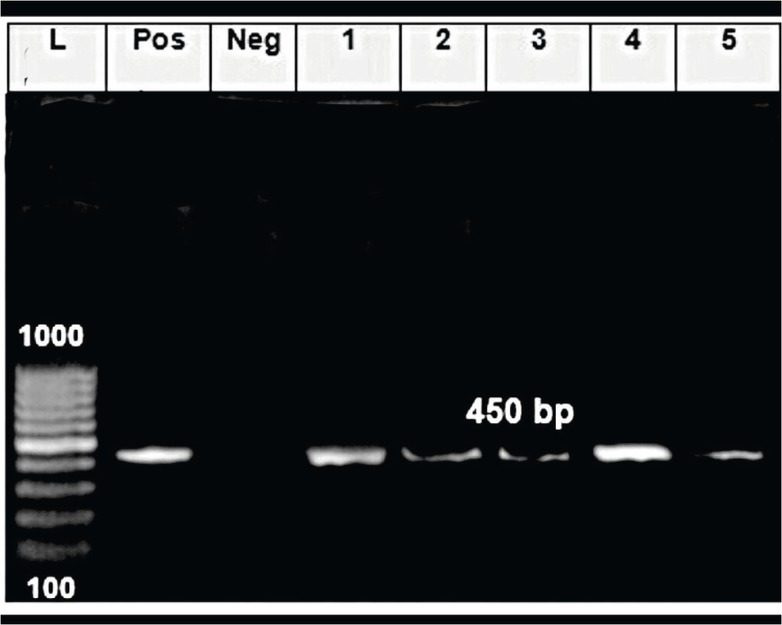
Fig. 2
Agarose (1.5%) gel electrophoresis of PCR-products of cox1 gene (450bp) of E. granulosus isolates in camel samples.
L: ladder, Pos.: positive control, Neg.: negative control, 1, 2, 3, 4and 5 samples (all +ve).
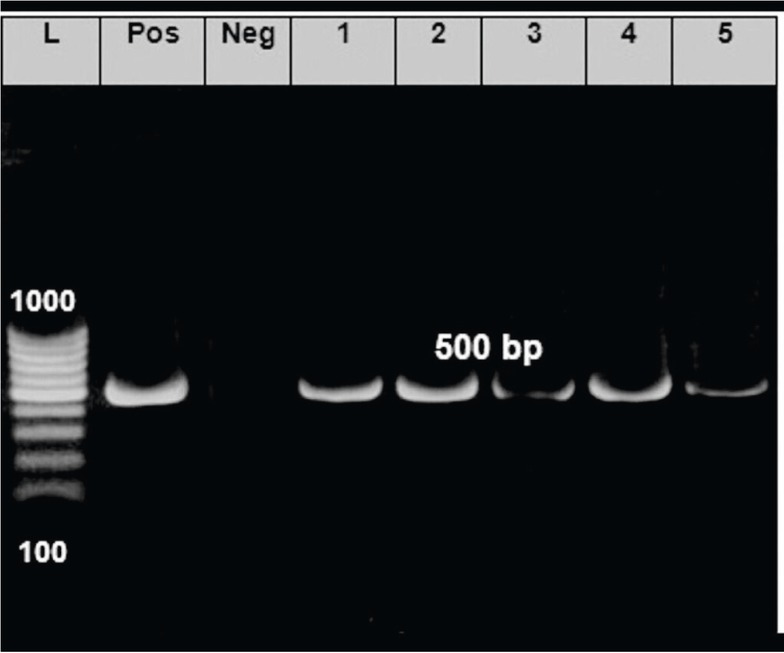
Fig. 3
Agarose (1.5%) gel electrophoresis of PCR-products of Nad1 gene (500bp) of E. granulosus isolates in camel samples.
L: ladder, Pos.: positive control, Neg.: negative control, 1, 2, 3,4and 5 samples (all +ve).
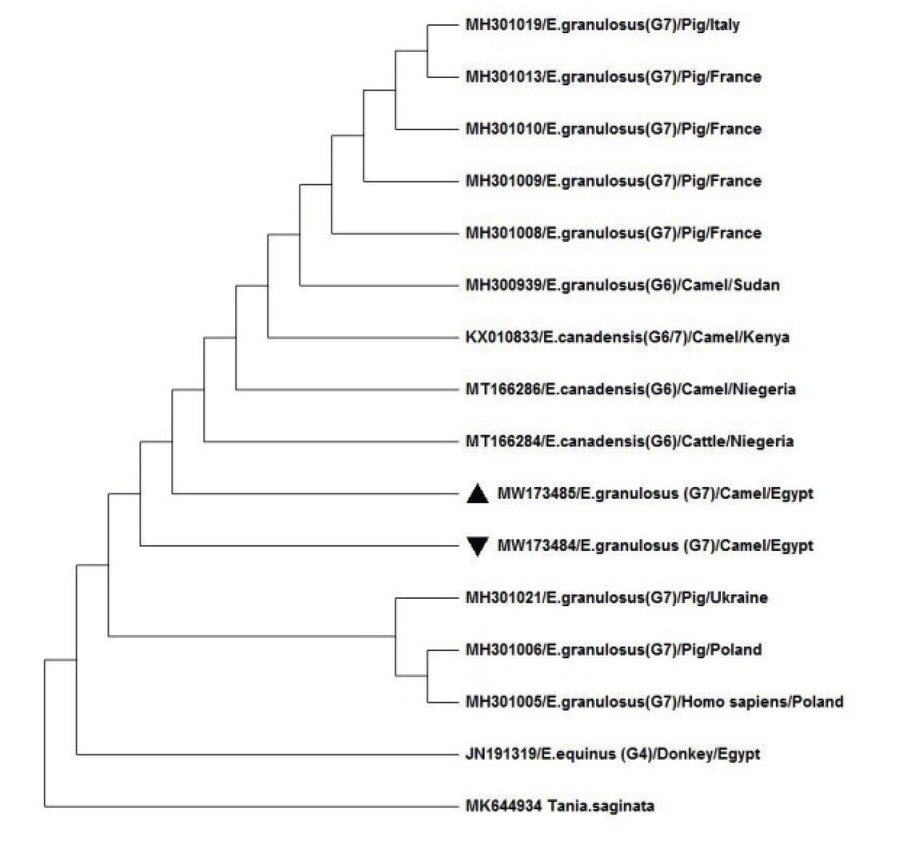
Fig. 4
Genetic relationships of the obtained genotypes from camel in the present study and reference sequences related genotypes of E. granulosus as well as Taenia saginata as the outgroup. The relationships were inferred based on phylogenetic tree (cox1 gene). The phylogenetic tree was constructed using Maximum Likelihood Tree implemented in MEGA software version 6.
Table 3
Difference in bases at the nad1 locus of E. granulosus s.l.
| Accession No. | Genotype | Nucleotide Substitution No. | Substitution/Position | Substitution/Position | Substitution/Position |
|---|---|---|---|---|---|
| (MH301013) | G7 (Pig, France) | Three | G to A 180/381/387 | - | - |
| (KX010880) | G6/7 (Cattle, Ethiobia) | Four | G to A 180 / 381 | C to T 336 | A to G 432 |
| (MT166290) | G6 (Camel, Nigeria) | Five | G to A 180 /381/387 | C to T 336 | A to G 432 |
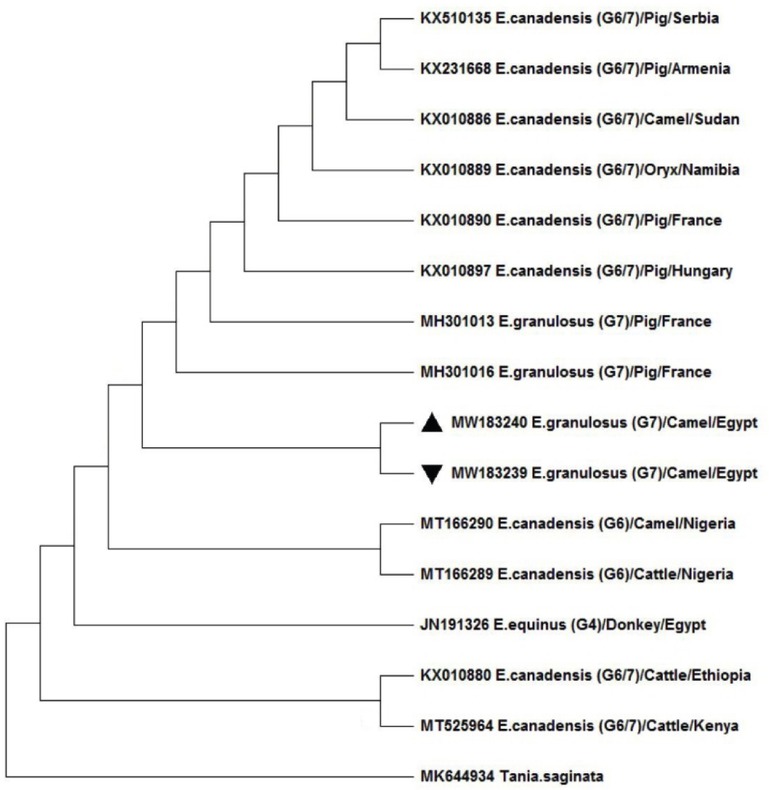
Fig. 5
Genetic relationships of the obtained genotypes from camel in the present study and reference sequences related genotypes of E. granulosus as well as Taenia saginata as the out-group. The relationships were inferred based on phylogenetic tree (nad1 gene). The phylogenetic tree was constructed using Maximum Likelihood Tree implemented in MEGA software version 6.