Have a personal or library account? Click to login
Human encounter with a horsehair worm (Nematomorpha): Is there a reason to worry? Cover

Human encounter with a horsehair worm (Nematomorpha): Is there a reason to worry?

Open Access
|Sep 2022

Figures & Tables

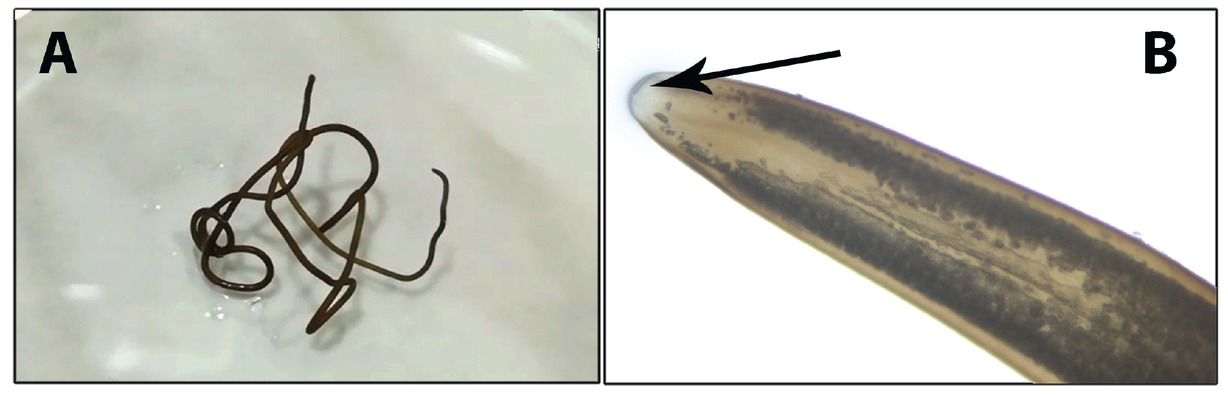
Fig. 1. A

Macroscopic view of the worm in the Petri dish; B. Anterior portion of the worm, arrow pointing at the calotte, x40.
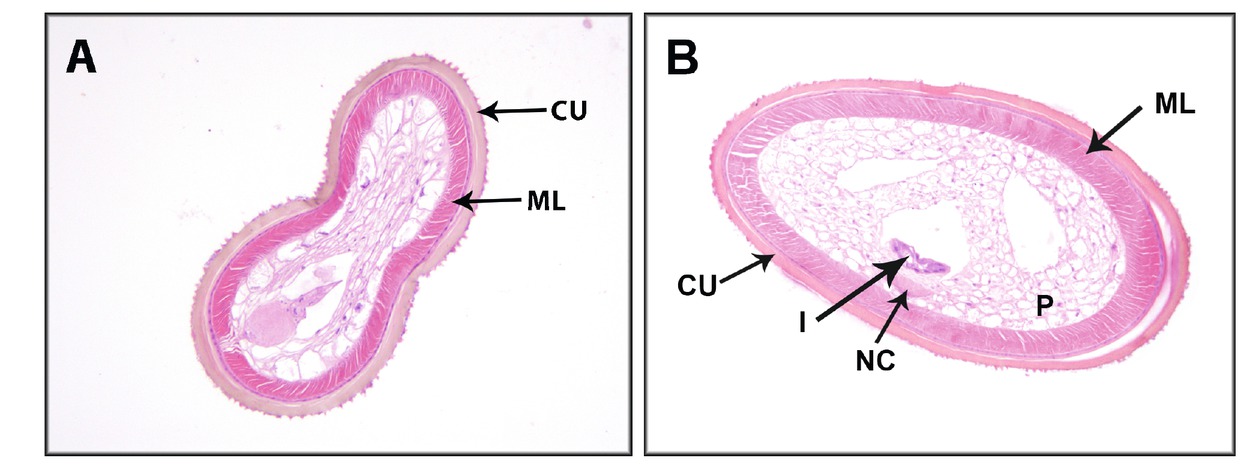

Fig. 2. A

Section trough anterior portion of the worm, CU - cuticle, ML - muscle layer, x160; B. Section trough medium part of the worm body. CU - cuticle, ML - muscle layer, NC - nerve cord, I – intestine, P- parenchyma, x160.
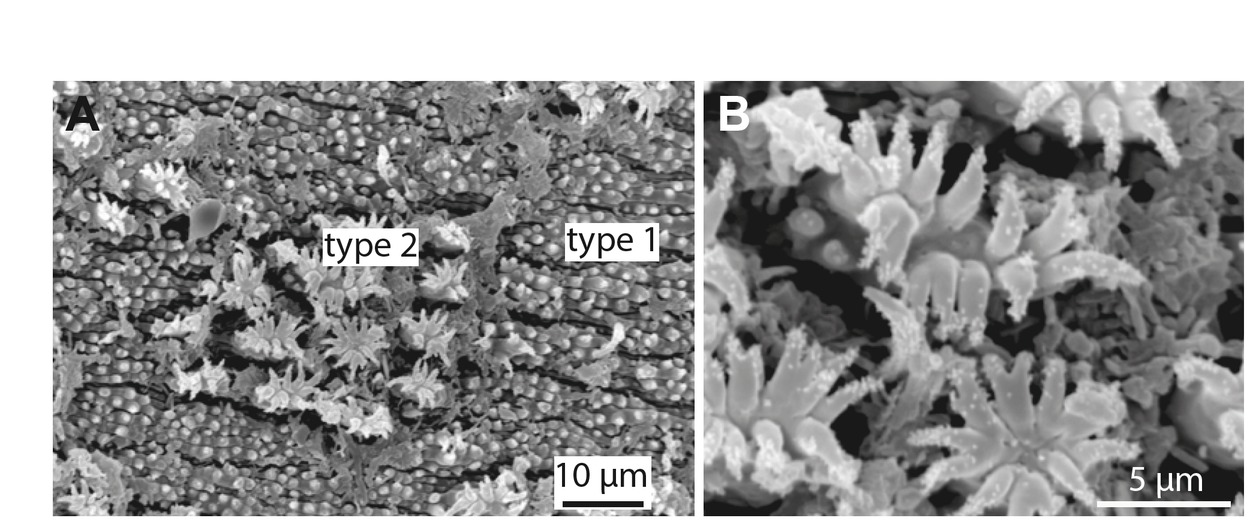

Fig. 3

Scanning electron microscopical images of the cuticular surface of Spinochordodes bacescui. A. Two types of areoles are present in patches on the cuticle. B. Magnification of the elevated type of areoles.
DOI: https://doi.org/10.2478/helm-2022-0020 | Journal eISSN: 1336-9083 | Journal ISSN: 0440-6605
Language: English
Page range: 200 - 203
Submitted on: Feb 2, 2022
|
Accepted on: Jun 1, 2022
|
Published on: Sep 3, 2022
In partnership with: Paradigm Publishing Services
Publication frequency: Volume open

© 2022 N. Miladinović-Tasić, A. Schmidt-Rhaesa, V. Petrović, published by Slovak Academy of Sciences, Institute of Parasitology
This work is licensed under the Creative Commons Attribution-NonCommercial-NoDerivatives 4.0 License.