Table 1
The different parasitic species collected and their locations
| Species | Location | Number of infested chikens |
|---|---|---|
| Nematodes | ||
| Ascaridia galli | Different parts of the small intestine | 5 |
| Heterakis gallinarum | Caecum | 6 |
| Cestodes | ||
| Raillietina cesticillus | Duodenum and jejunum | 2 |
| Raillietina tetragona | Duodenum and jejunum | 1 |
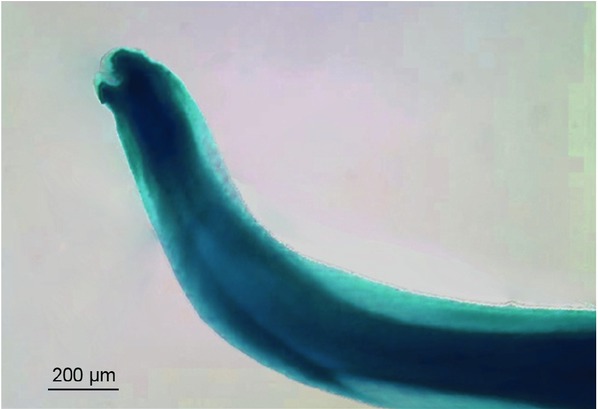
Fig. 1
Ascaridia galli (Schrank, 1788), Anterior part, 5 % eosin stain, ×40. The body of this worm is semi-transparent, creamy white, and cylindrical. The anterior end is characterized by a mouth, which is surrounded by three large trilobed lips. The body is completely covered with a transversely striated cuticle. Females are considerably longer and more robust. Males are relatively shorter and smaller.
Table 2
Comparative characteristics of Ascaridia galli
| Source | Present study | Euzéby (1963) | Yousfi (2012) | Laouel (2017) | ||||
|---|---|---|---|---|---|---|---|---|
| Gender | Male | Female | Male | Female | Male | Female | Male | Female |
| Length (mm) | 21 – 70 | 40 – 90 | 50 – 70 | 80 – 100 | 17.6 – 71 | 22.45 – 102 | 20.83 | 74 |
| Width (mm) | 0.5 – 1.02 | 0.5 – 1.5 | 0.60 | 1.5 | 0.41 – 1.22 | 0.46 – 1.5 | 0.71 | 0.78 |
| Spicule (mm) | 1 – 2.5 | / | 4 | / | 0.60 – 2.41 | / | 0.225 | / |
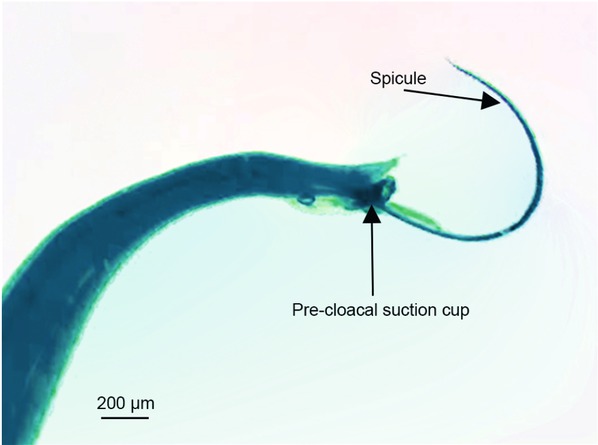
Fig. 2
Heterakis gallinarum (Schrank, 1788), 5 % eosin stain, × 40. The pre-cloacal suction cup is circular with a chitinous mount with a diameter of 0.07 to 0.08 mm. There is no gubernaculum. The spicules are unequal and dissimilar, a slender, long and wingless 1.5 – 2.2 mm long; the other short, 0.5 to 1.1mm wide. The caudal end is thin and slightly curved in its distal part.
Table 3
Comparative characteristics of Heterakis gallinarum.
| Source | Present study | Euzéby (1963) | Yousfi (2012) | Laouel (2017) | ||||
|---|---|---|---|---|---|---|---|---|
| Gender | Male | Female | Male | Female | Male | Female | Male | Female |
| Length (mm) | 6 – 11 | 7 – 13 | 7.12 | 5.82 – 10.42 | 11.25 – 12 | 6.035 | 6.67 | |
| Width (mm) | 0.25 – 0.35 | 0.30 – 0.40 | 0.30 | – 0.35 | 0.21 – 0.34 | 0.35 | 0.387 | |
| Spicule | 1.5 – 2 | 2 – 2.17 | 1.33 – 2.12 | 1.75-2 | ||||
| (mm) | 0.70 – 1 | 0.56 – 0.76 | ||||||
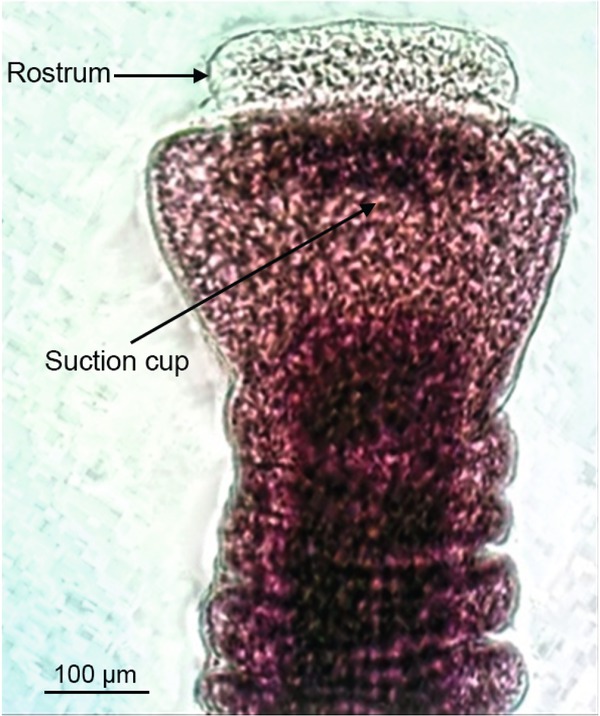
Fig. 3
Raillietina cesticillus (Molin, 1858), hematoxylin stain, × 40. The body consists of the ‘scolex’, an unsegmented ‘neck’ and a highly segmented body called a strobila made up of a chain of ribbon-shaped proglottids. The scolex bears an apical rounded, the rostellum prominent and protruding, surrounded by four poorly developed suckers completely devoid of thorns.
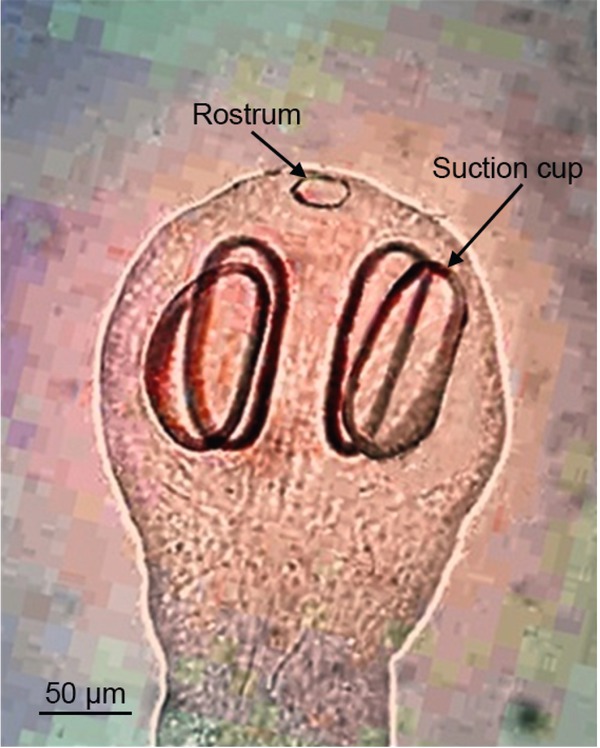
Fig. 4
Raillietina (Raillietina) tetragona (Molin, 1858), hematoxylin stain, × 40. This worm has a tetragonal scolex with a rostrum armed with a hundred hooks arranged in a single crown and 4 suckers lined with 8 to 10 rows of small thorns.
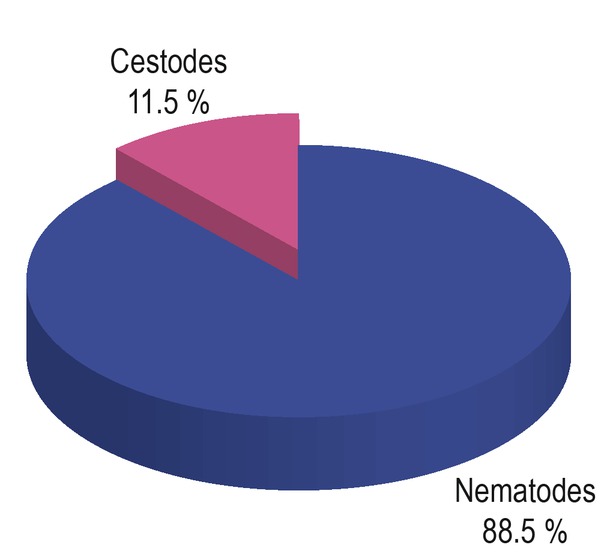
Fig. 5
Infestation rate by identified helminths. The difference between nematodes and cestodes is very significant (p <0.05).
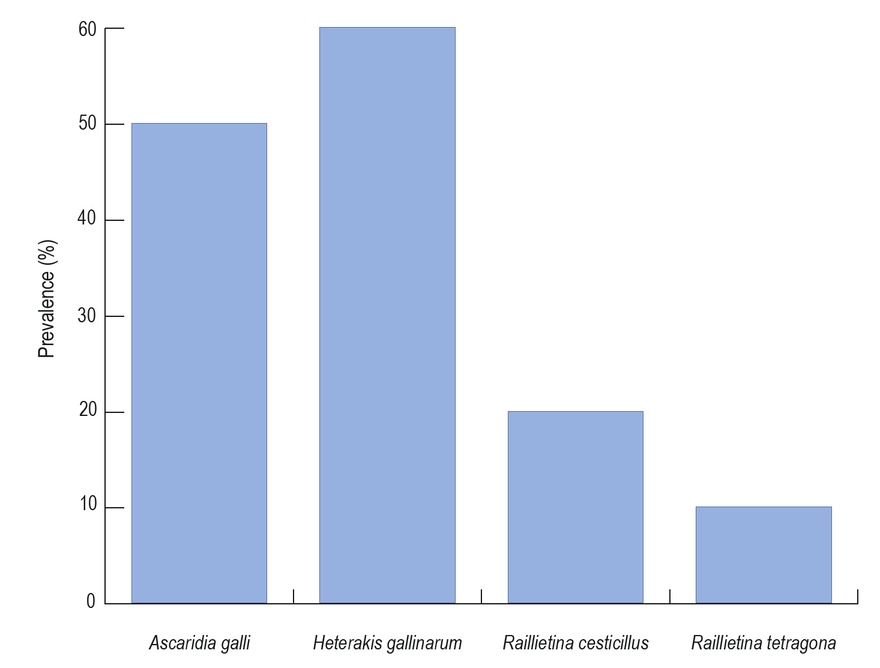
Fig. 6
Prevalence of identified helminth. Among the identified species, H. gallinarum represents the most widespread nematode with a rate of 60% followed by A. galli. The cestodes R. cesticillus and much more R. tetragona were found at relatively low rates.