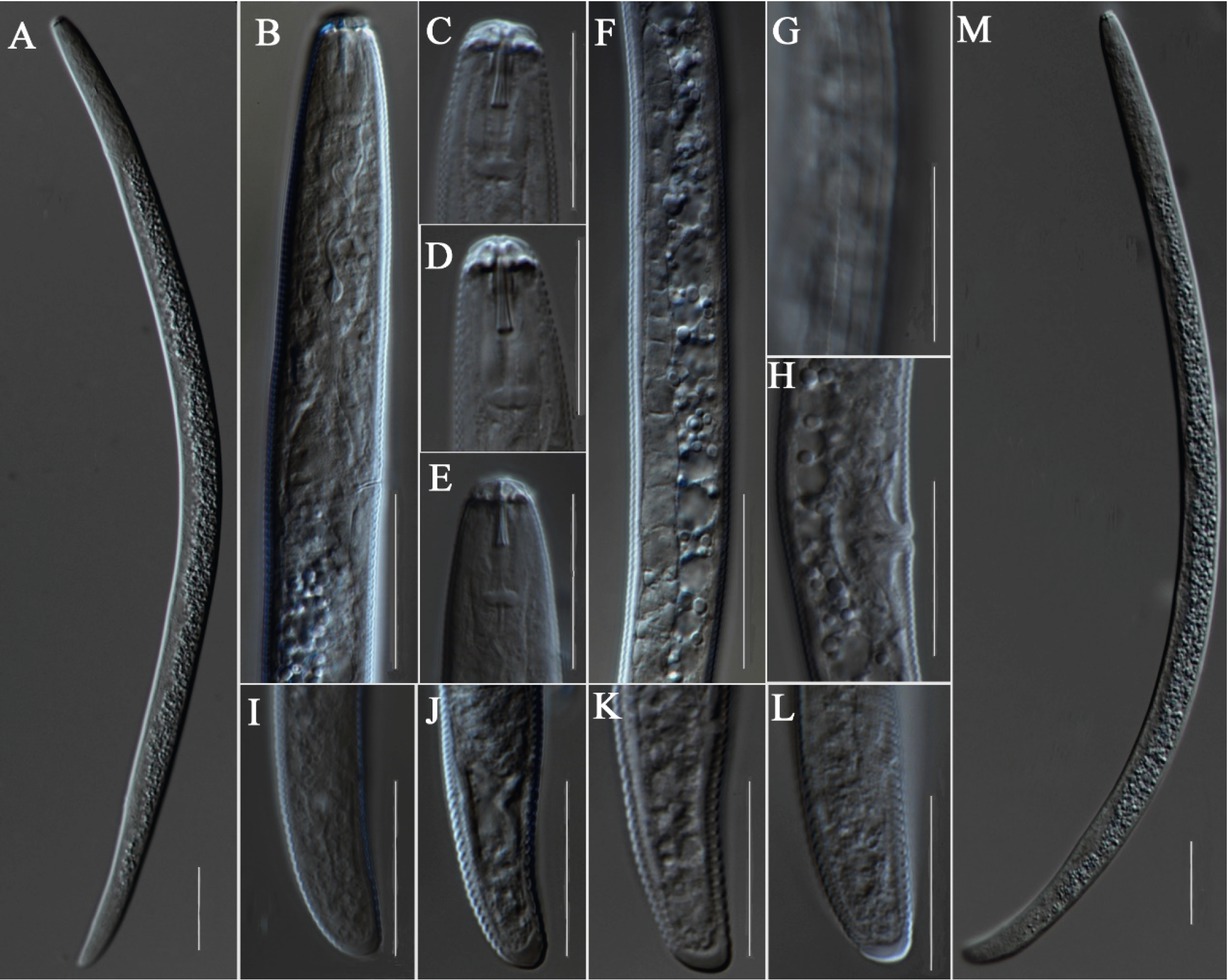
Fig. 1
Light micrographs of Pratylenchus neglectus from corn in Henan Province of China. Females (A -M): A and M, Entire body; B: Anterior region; C-E: lip region; F: Anterior end of genital gland; G: Lateral line; H: Post-vulval region and ovary; I-L: tail region. Scale bars: 50μm (A, M) and 20μm (B-L).
Table 1
Measurements of the Pratylenchus neglectus population morphological characteristics.
| Character | SY-X | Pourjam et al. (1999) | Ryss (1988) |
|---|---|---|---|
| n | 16 | 32 | 10 |
| L | 459.0 ± 23.0(431.0 – 498.0) | 490(300 – 590) | 600(410 – 700) |
| a | 22.9 ± 1.6(20.0 – 26.1) | 26.7(22.3 – 32.2) | 24(17 – 31) |
| b | 5.7 ± 0.5(5.0 – 6.6) | 6.0(4.3 – 7.6) | 6.3(4.9 – 7.1) |
| b’ | 4.3 ± 0.3(3.9 – 4.7) | 4.3(3.4 – 5.2) | __ |
| c | 18.7 ± 2.2(15.2 – 24.7) | 21.4(14.8 – 28.2) | 21(13 – 31) |
| c’ | 2.1 ± 0.3(1.5 – 2.6) | 2.1(1.5 – 3.0) | 1.9(1.5 – 2.5) |
| V | 80.5 ± 2.1(77.5 – 84.6) | 82(80 – 85) | 83(77 – 85) |
| Stylet length | 15.8 ± 1.1(14.3 – 17.4) | 16(14 – 18) | 16(15.5 – 17.5) |
| Stylet shaft | 8.1 ± 0.5(7.3 – 9.3) | __ | __ |
| Stylet knob width | 4.1 ± 0.4(3.2 – 4.8) | __ | __ |
| Stylet knob height | 2.0 ± 0.3(1.6 – 2.7) | __ | __ |
| DGO from stylet base | 2.5 ± 0.5(1.4 – 3.3) | __ | __ |
| center of metacorpus | 45.7 ± 2.7(40.3 – 50.5) | __ | __ |
| end of pharyngeal gland lobe | 107.0 ± 4.3(98.5 – 113.0) | __ | __ |
| Anterior end to excretory pore | 74.5 ± 4.5(68.5 – 85.0) | __ | __ |
| Pharyngeal overlap | 26.7 ± 4.9 (19.6 – 39.4) | __ | __ |
| Max body diam. | 20.1 ± 1.6 (17.8 – 23.7) | __ | __ |
| Vulval body diam. | 17.9 ± 1.2(16.0 – 20.00) | __ | __ |
| Anal body diam. | 12.0 ± 1.1(10.6 – 14.8) | __ | __ |
| Anterior genital trace length | 147.4 ± 21.9(102.8 – 192.7) | __ | __ |
| Tail length | 24.8 ± 2.4(20.0 – 29.0) | __ | __ |
| No. of tail annuli | 20.7 ± 2.3(18 – 24) | __ | __ |
| Vulva to annus distance | 68.0 ± 11.5(53.5 – 96.5) | __ | __ |
| Post- uterine sac length | 19.7 ± 4.2(13.0 – 21.7) | __ | __ |
| Lateral field width | 7.2 ± 1.1(5.8 – 8.8) | __ | __ |
| Lip width | 8.1 ± 0.4(7.1 – 8.6) | __ | __ |
| Lip height | 2.4 ± 0.4(1.7 – 3.1) | __ | __ |
[i] Note: All measurements are in μm and in the form of mean ± SD (range). n: Number of specimens measured; L: Body length; a: Body length/greatest body width; b: Body length/length from the lips to the junction of esophageal gland and intestine; b’: Body length/ length from the lips to esophageal gland end; c: Body length/ tail length; c’: Tail length/tail diameter at anus; V: Distance of vulva from the lips×100/body length; DGO: Distance between dorsal esophageal gland opening and stylet knobs.
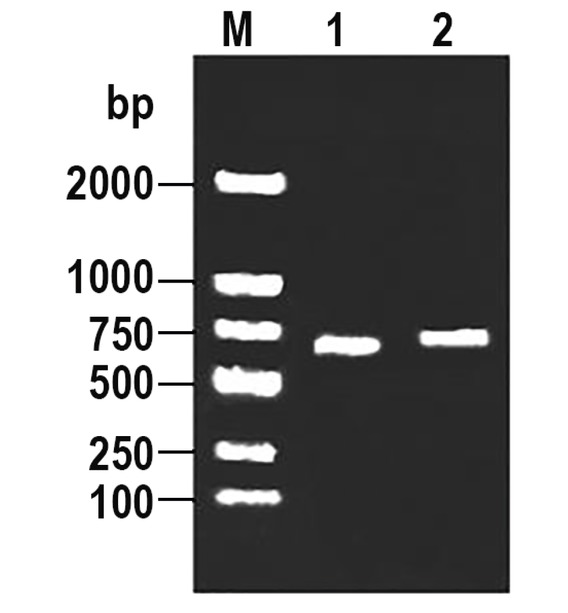
Fig. 2
PCR amplification of the rDNA-ITS and rDNA 28S D2-D3 expansion region of Pratylenchus neglectus. M: DL2000 Marker; 1: rDNA-ITS; 2: D2-D3 expansion region of the 28S rDNA.
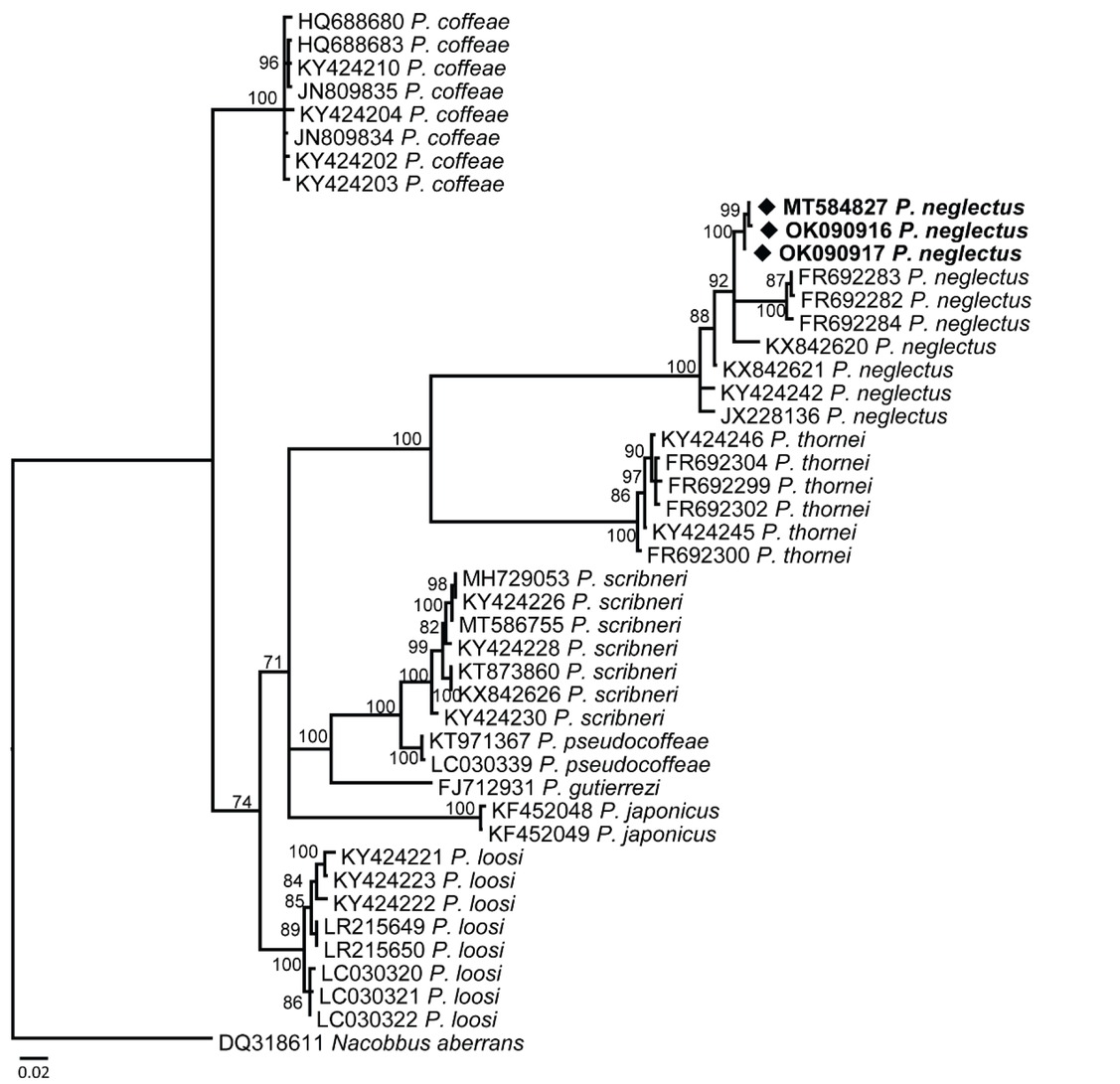
Fig. 3
Bayesian tree of Pratylenchus as inferred from rDNA-ITS sequences under GTR+I+G model. Posterior probabilities more than 50% are given for appropriate clades. Newly obtained sequence is indicated in bold font.
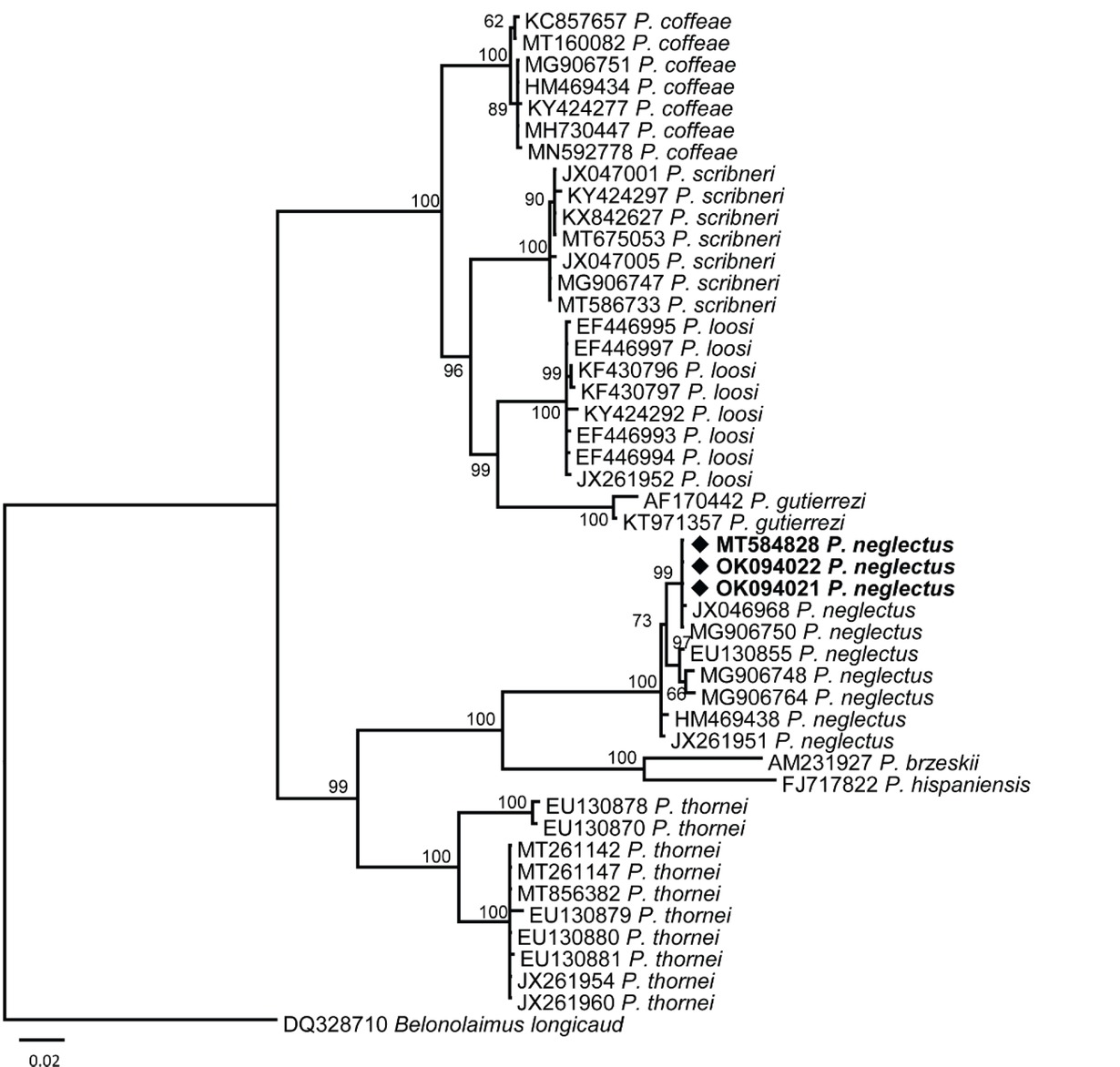
Fig. 4
Bayesian tree of Pratylenchus as inferred from rDNA 28S D2-D3 sequences under GTR+I+G model. Posterior probabilities more than 50% are given for appropriate clades. Newly obtained sequence is indicated in bold font.