Table 1
Infection rates of adult parasites of H. diminuta and H. nana in commensal rodents when found alone and in concurrence to each other.
| Rodents species | Endoparasites Found | Number of host infected | Percent host infected | Number of parasites found | Mean intensity | Mean abundance |
|---|---|---|---|---|---|---|
| H. diminuta | 106 | 52.73 | 238 | 2.24 | 1.18 | |
| Rattus rattus | H. nana | 128 | 63.70 | 575 | 4.49 | 2.86 |
| (n=201) | Concurrent infection | 102 | 50.74 | 613 | 6.01 | 3.04 |
| H. diminuta | 50 | 55.55 | 112 | 2.24 | 1.24 | |
| bengalensis Bandicota | H. nana | 61 | 67.78 | 285 | 4.67 | 3.16 |
| (n=90) | Concurrent infection | 46 | 51.11 | 265 | 5.76 | 2.94 |
| (n=291) | Overall | 197 | 67.70 | 1210 | 6.14 | 4.15 |
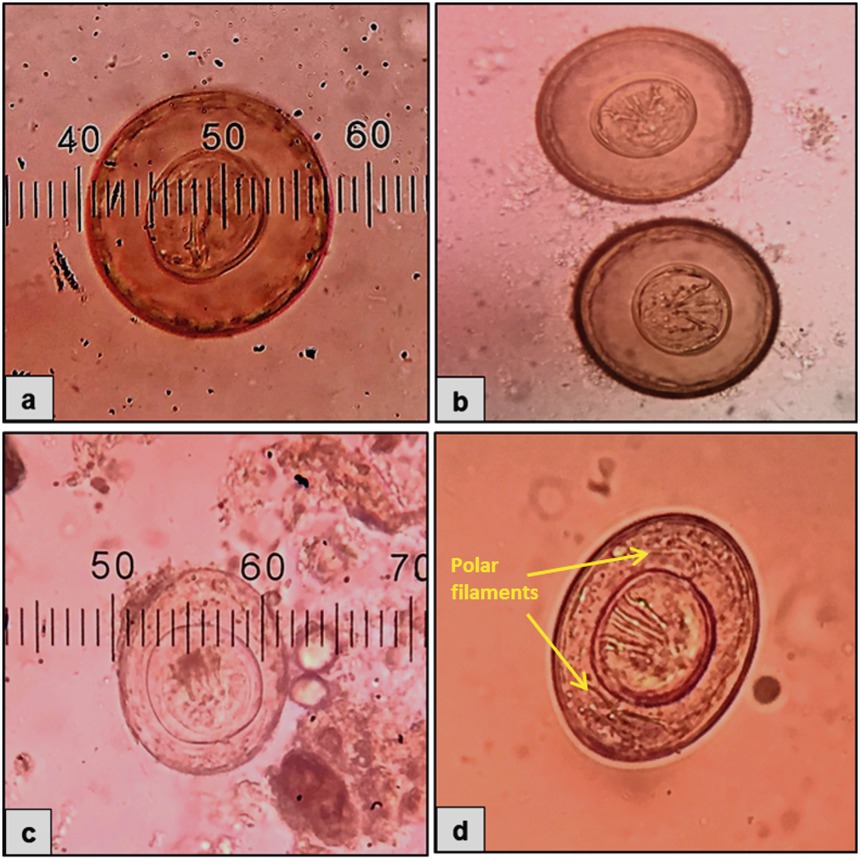
Fig. 1
Eggs of H. diminuta in an unstained wet mount of the faecalsample showing presence of hooks in the oncosphere and no polar filaments at 40x (a & b); Eggs of H. nana in an unstained wet mount of the faecal sample showinghooks in the oncosphere and polar filaments within the space between the oncosphere and outer shell at 40x (c & d)
Table 2
Comparative study of H. diminuta in two commensal rodents from different locations of Ludhiana with relation to season, age and sex of the host.
| infected | Lower limit | Upper limit | ||||||||||
|---|---|---|---|---|---|---|---|---|---|---|---|---|
| Seasons | Winter | 96 | 46 | 50 | 47.91 | 102 | 2.42 | 0.29 | 0.92 | 1.00 | 0.74 | 1.35 |
| Summer | 97 | 58 | 39 | 59.79 | 130 | (2) | 1.48 | 1.26 | 0.96 | 1.65 | ||
| Monsoon | 98 | 52 | 46 | 53.06 | 118 | 1.13 | 1.13 | 0.85 | 1.50 | |||
| Location | Residences/shops | 111 | 67 | 44 | 60.36 | 160 | 3.46 | 0.17 | 1.52 | 1.15 | 0.90 | 1.47 |
| Poultry farms | 120 | 58 | 62 | 48.33 | 119 | (2) | 0.93 | 1.00 | 0.76 | 1.29 | ||
| Fish market | 60 | 31 | 29 | 51.67 | 71 | 1.06 | 1.06 | 0.78 | 1.45 | |||
| Species | R. rattus | 201 | 106 | 95 | 52.74 | 238 | 0.68 | 0.40 | 1.11 | 1.00 | 0.83 | 1.20 |
| B. bengalensis | 90 | 50 | 40 | 55.55 | 112 | (1) | 1.25 | 1.05 | 0.84 | 1.32 | ||
| Sex | Male | 126 | 69 | 57 | 54.76 | 144 | 0.016 | 0.89 | 1.21 | 1.03 | 0.83 | 1.29 |
| Female | 165 | 87 | 78 | 52.72 | 206 | (1) | 1.11 | 1.00 | 0.81 | 1.23 | ||
| Age | Mature | 238 | 145 | 93 | 60.92 | 326 | 28.12 | <0.0001* | 1.56 | 2.82 | 1.65 | 4.83 |
| Young | 53 | 11 | 42 | 20.75 | 24 | (1) | 0.26 | 1.00 | 0.47 | 2.10 | ||
| Overall | 291 | 156 | 135 | 53.60 | 350 | -- | -- | -- | -- | -- | -- |
Table 3
Comparative study of H. nana in two commensal rodents from different locations of Ludhiana with relation to season, age and sex of the host.
| infected | Lower limit | Upper limit | ||||||||||
|---|---|---|---|---|---|---|---|---|---|---|---|---|
| Seasons | Winter | 96 | 56 | 40 | 58.33 | 265 | 0.61 | 0.73 (2) | 1.40 | 1.00 | 0.78 | 1.27 |
| Summer | 97 | 70 | 27 | 72.16 | 306 | 2.59 | 1.25 | 1.00 | 1.55 | |||
| Monsoon | 98 | 63 | 35 | 64.28 | 289 | 1.80 | 1.12 | 0.89 | 1.41 | |||
| Location | Residences/shops | 111 | 81 | 30 | 72.97 | 368 | 0.28 | 0.86 (2) | 2.70 | 1.15 | 0.95 | 1.40 |
| Poultry farms | 120 | 70 | 50 | 58.33 | 314 | 1.40 | 1.00 | 0.80 | 1.23 | |||
| Fish market | 60 | 38 | 22 | 63.33 | 178 | 1.72 | 1.08 | 0.85 | 1.38 | |||
| Species | R. rattus | 201 | 128 | 73 | 63.68 | 575 | 0.14 | 0.69 (1) | 1.75 | 1.00 | 0.86 | 1.15 |
| B. bengalensis | 90 | 61 | 29 | 67.78 | 285 | 2.10 | 1.06 | 0.89 | 1.26 | |||
| Sex | Male | 126 | 82 | 44 | 65.07 | 370 | 0.08 | 0.77 (1) | 1.86 | 1.01 | 0.84 | 1.19 |
| Female | 165 | 107 | 58 | 64.84 | 490 | 1.84 | 1.00 | 0.84 | 1.17 | |||
| Age | Mature | 238 | 163 | 75 | 68.49 | 792 | 7.18 | 0.007* | 2.17 | 1.34 | 1.00 | 1.79 |
| Young | 53 | 26 | 27 | 49.06 | 68 | (1) | 0.96 | 1.00 | 0.67 | 1.47 | ||
| Overall | 291 | 189 | 102 | 64.94 | 860 | -- | -- | -- | -- | -- | -- |
| (Range) | (Range) | Length (μm) | Breadth (μm) | (Wharyet al., 2015) | |
|---|---|---|---|---|---|
| H. diminuta | 72.75 – 80.25 | 64.75 – 70.50 | 76.50±3.01 | 67.62±2.42 | 70 – 85 x 60 – 80 |
| H. nana | 45.75 – 50.00 | 32.00 – 40.25 | 47.87±1.95 | 36.12±3.05 | 40 – 60 x 30 – 50 |
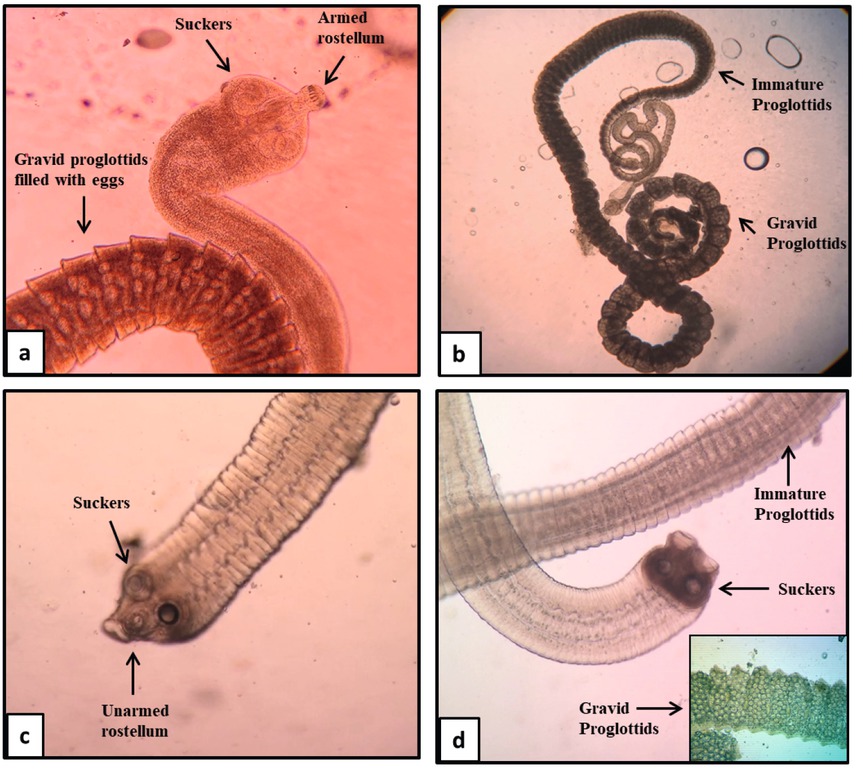
Fig. 2
Tapeworm of H. nana showing four suckers (two visible in the view), an armed rostellum and gravid proglottids filled with eggs at 10x (a) and 40x (b); Tapeworm of H. diminuta showing four suckers, but only two visible in this view, an unarmed rostellum, mature proglottids and gravid proglottids containing a large number of eggs at 40x (c and d)
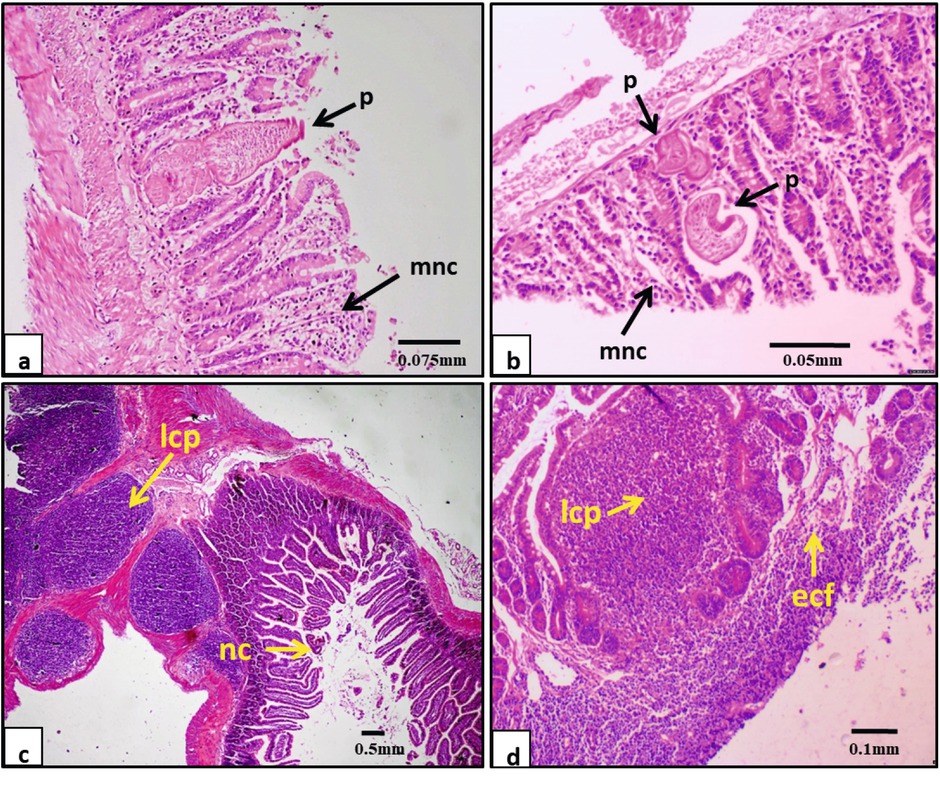
Fig. 3
Section of intestine showing parasitic enteritis (p), scolex of H. nana embedded in the mucosa (arrows), sloughing of intestinal mucosa with infiltration of mononuclear cells (mnc) and necrosis (nc) of villi at 20x (a)&40x (b); Section of intestine infected with H. nana showing severe mucous degeneration with lymphoid cell proliferation (lcp) andnecrosis in the submucosa (arrow) at 4x (c); Section of intestine infected with H. diminuta showing lymphoid cell proliferation (lcp) and eosinophilic cellular infiltration (ecf) in the submucosa at 10x (d)
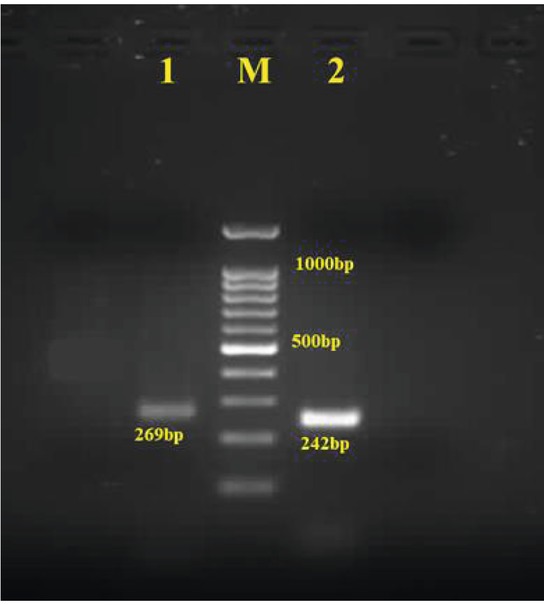
Fig. 4
The PCR amplification of ITS-2 regions of the adult cestodes showing single band of H. diminuta (269 Bp) and H. nana (242 bp)
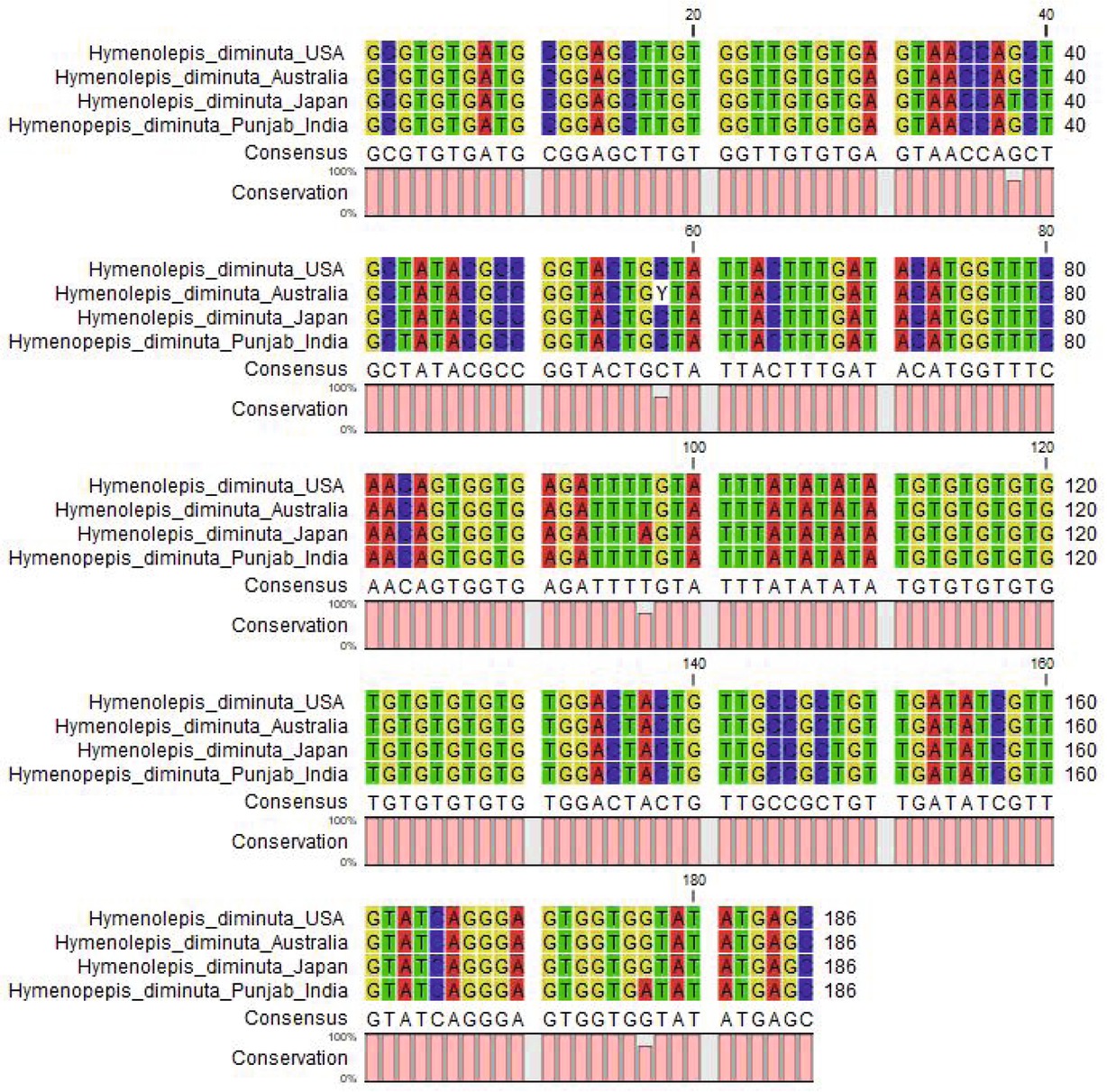
Fig. 5
Multiple alignment of H. diminuta (Punjab, India) with different geographical isolates.
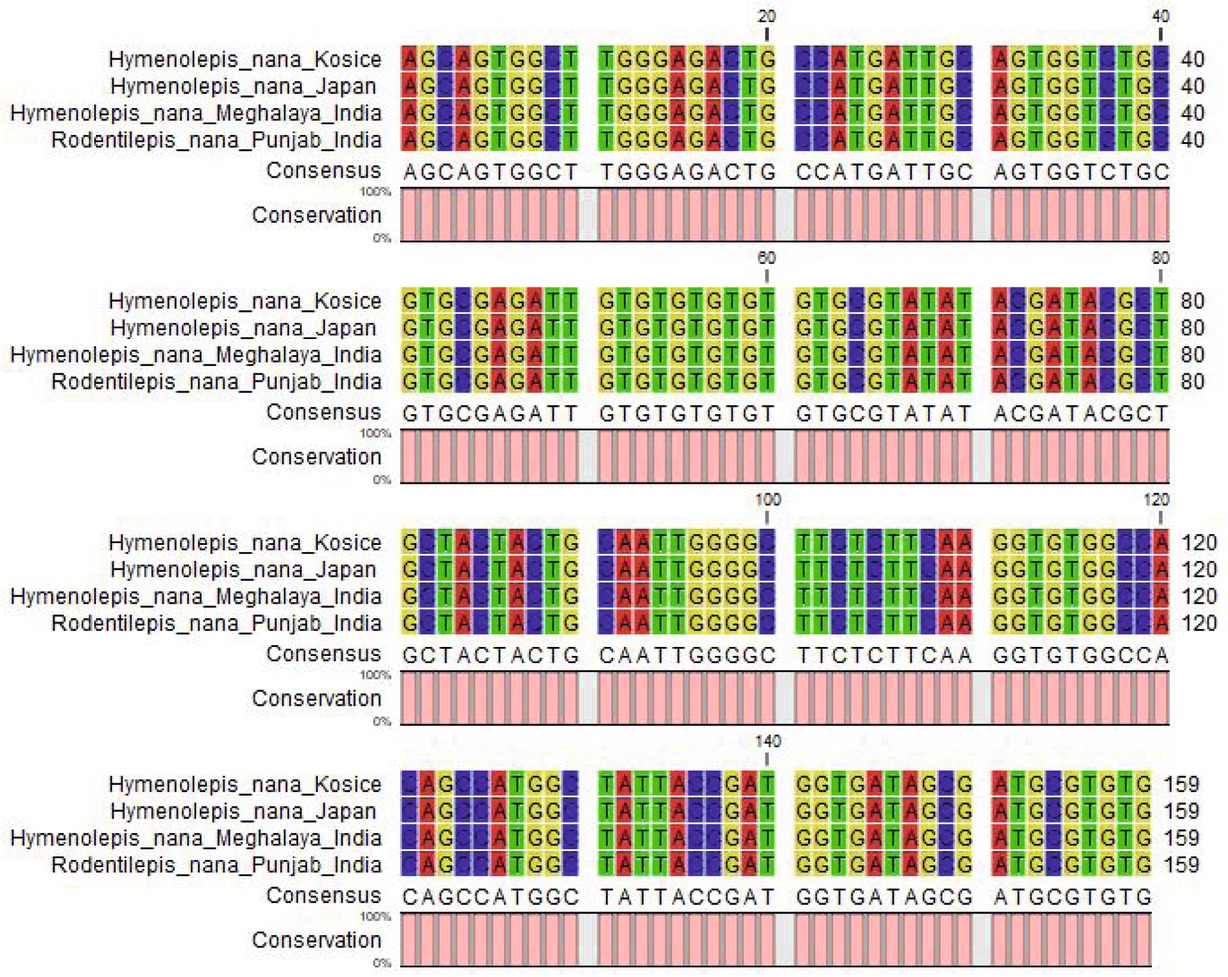
Fig. 6
Multiple alignment of H. nana (Punjab, India) with different geographical isolates.
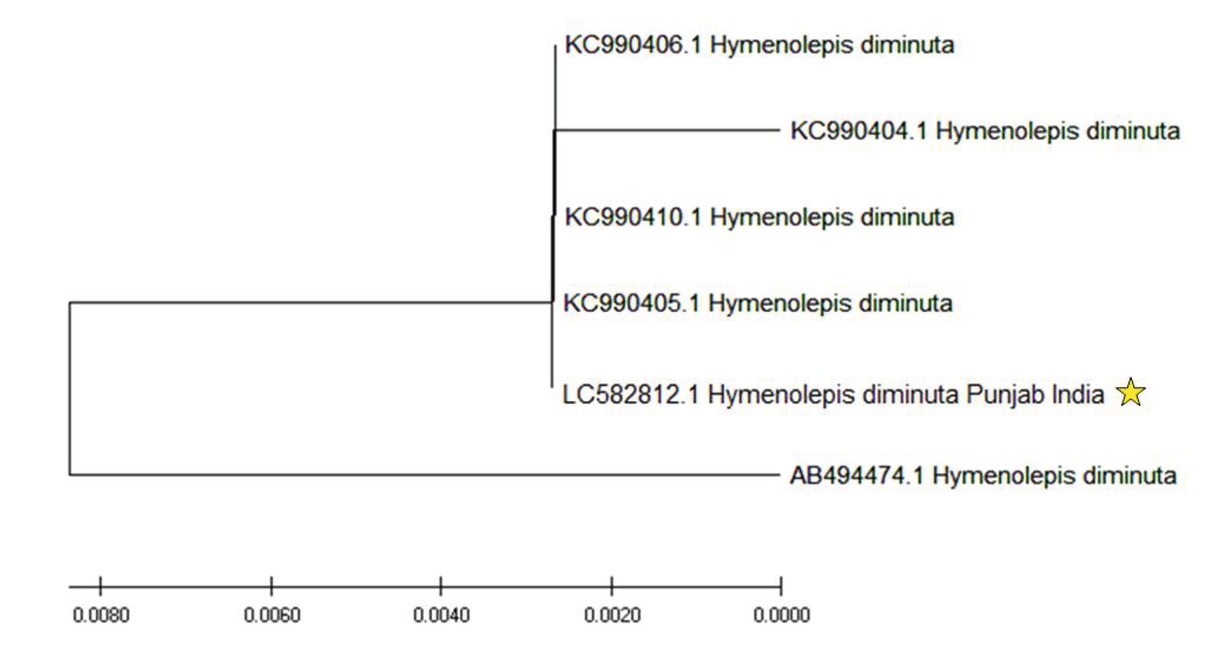
Fig. 7
Phylogenetic tree of H. diminuta (Punjab, India) constructed using Maximum Likelihood method in MEGA X software.
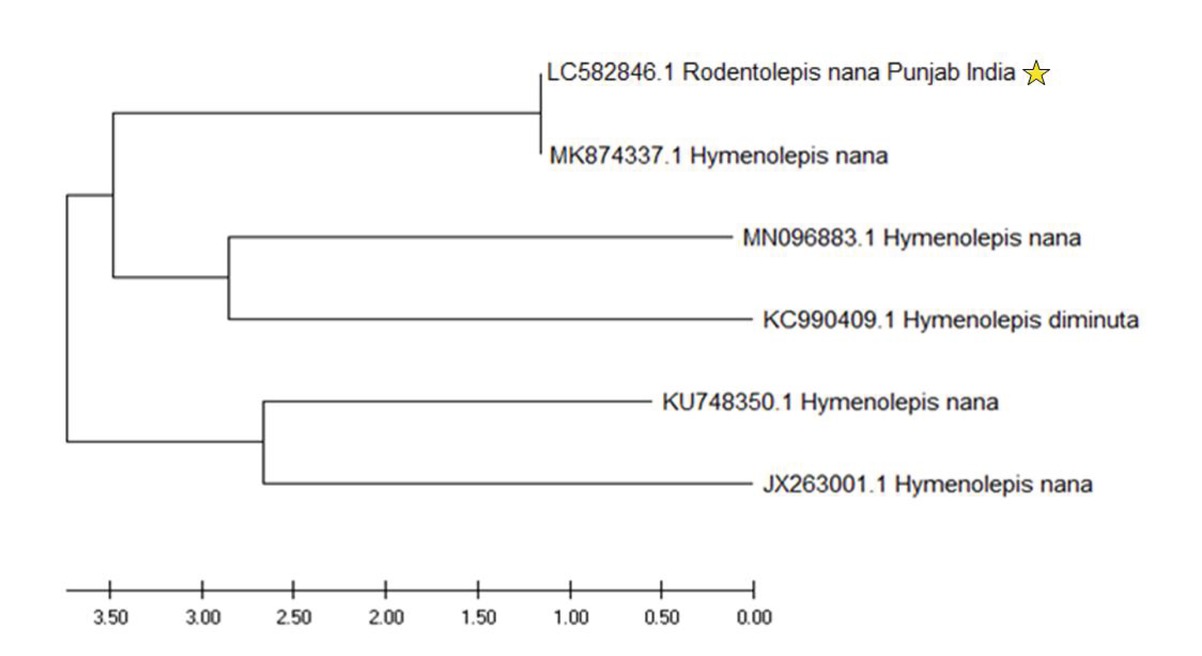
Fig. 8
Phylogenetic tree of H. nana (Punjab, India) constructed using Maximum Likelihood method in MEGA X software.