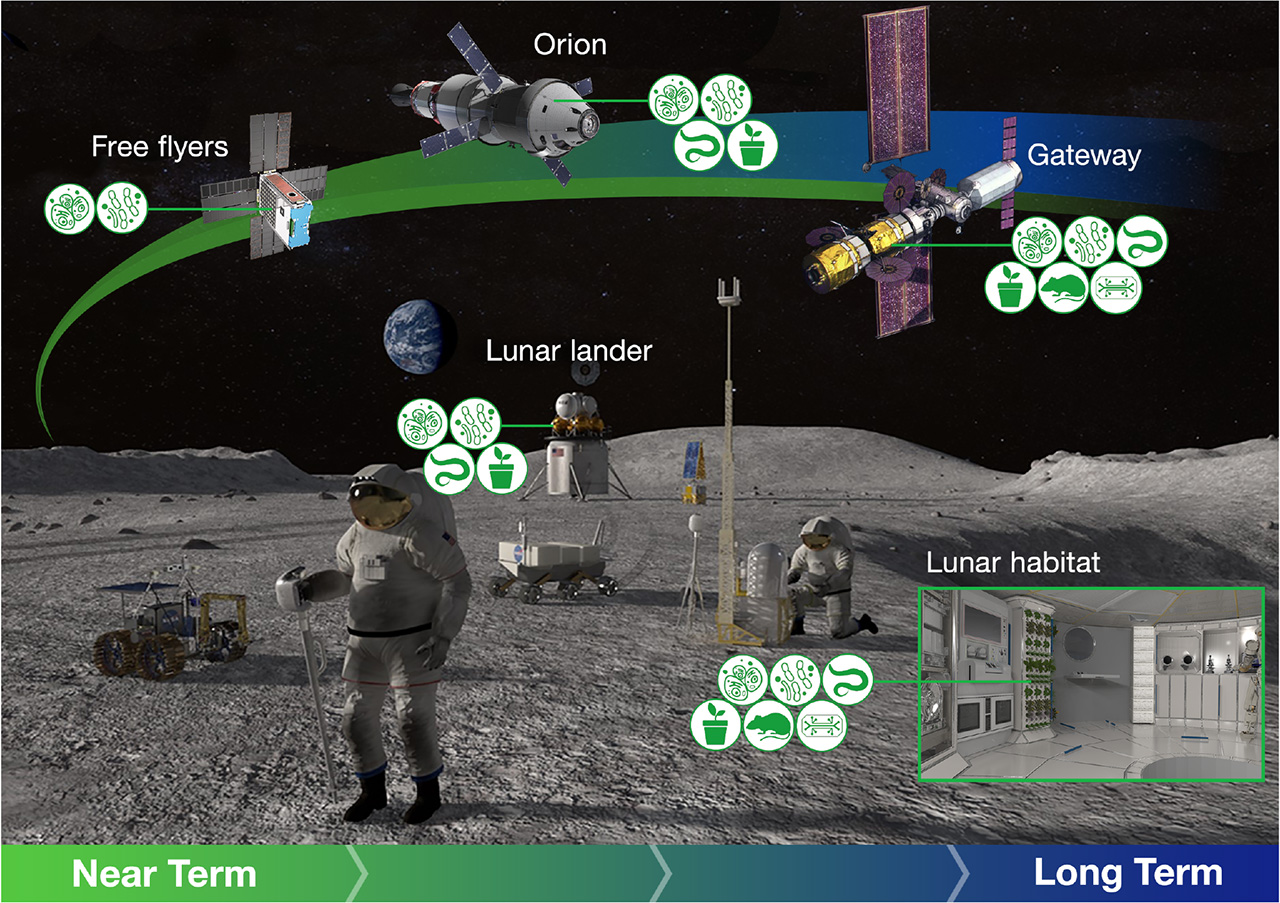
Figure 1.
Summary of future platforms and the likely increasingly complex organisms each can support.
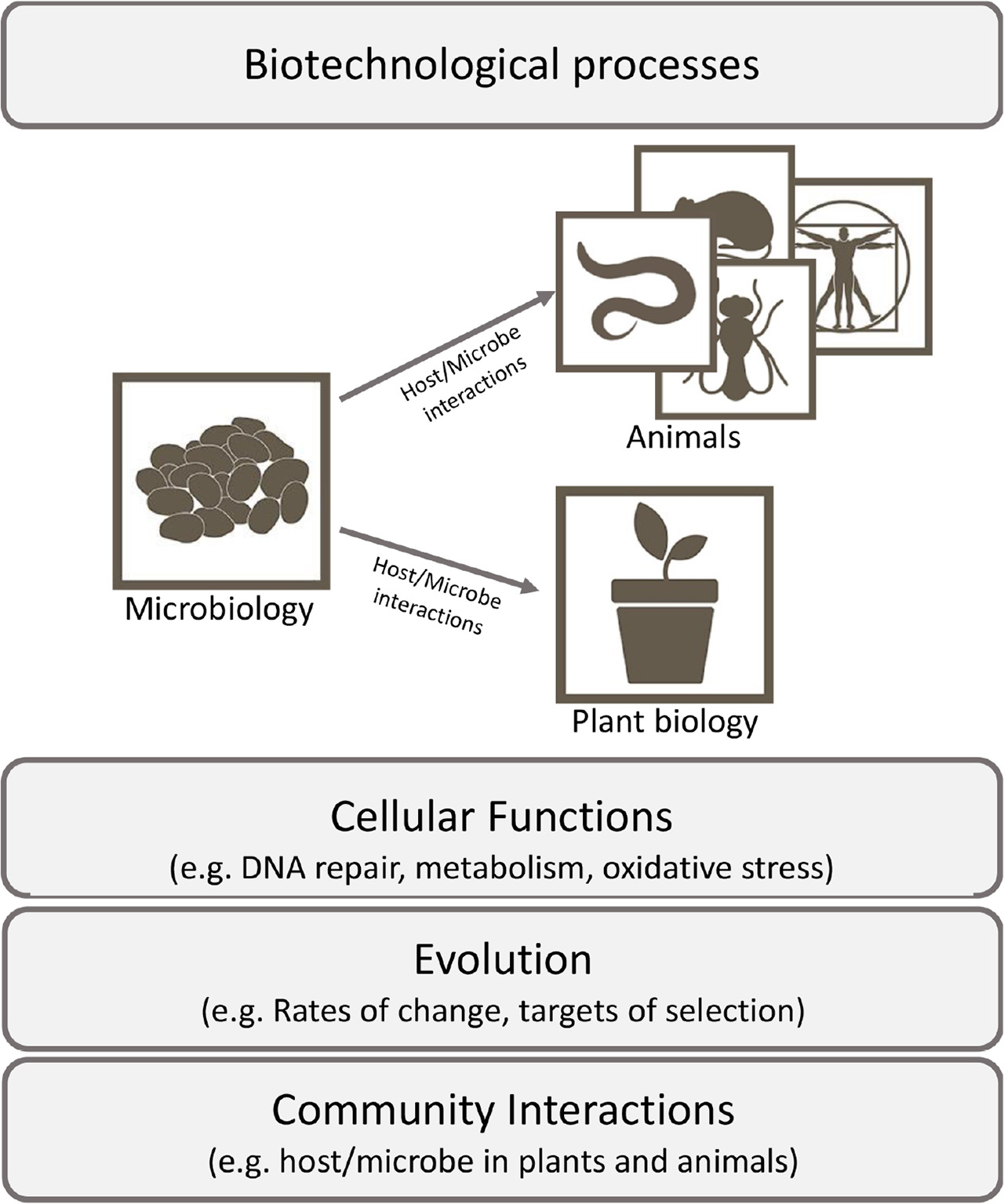
Figure 2.
Summary of Questions of Importance. Evolution and cellular functions are foundational as they impact everything above. Biotechnology is applied and relies on everything.
Table 1.
Organisms and Sample Types Proposed for Space Biology Research Beyond LEO in the Next 5 years.
| Research Themes / Sections | ||||||||
|---|---|---|---|---|---|---|---|---|
| Organism / Sample Type | Considerations & Rationale | SECTION A. Cellular Functions | SECTION B. Fundamental Microbiology and Ecology | SECTION C. Multicellular Physiology | SECTION D. Plant Development and Physiology | SECTION E. Host-Microbe Interactions | SECTION F. Evolution | SECTION G. Biotechnological Processes |
| Cell Cultures | Mammalian and plant experiments are possible without experiment and hardware requirements necessary for vertebrates or large plants | Mammalian cell culture Specifically, cell types related to the Human Research Program risk gaps | Not applicable | Organ on a chip | Plant cell culture | Organ on a chip (JJ) | Open | Mammalian, human and plant cell cultures Organ on a chip |
| Model Bacteria and Archaea | Extensive published understanding of organism characteristics, often with flight heritage and established experimental systems | Single-celled bacteria and archaea |
| Not applicable | Pathogenic and plant growth promoting bacteria Cyanobacteria |
|
| Single-celled bacteria and archaea |
| Model Eukarya | Extensive published understanding of organism characteristics, often with flight heritage and established experimental systems |
| Representatives of fungi and protists that carry out specific functions and/or are stress tolerant. | Yeasts Small animal eukaryote e.g. worms, flies, fish Mus | Green algae including Chlorella Moss species Arabidopsis Crop species as seeds and mature plants e.g. lettuce, tomato, peppers, maize | Arabidopsis Crop species e.g. lettuce, mizuna, peppers Hydra Rotifers Chlorella | Green algae i.e. Chlorella Yeasts and filamentous fungi Small animal eukaryotes e.g. Nematodes and Tardigrades Small plants e.g. Brassica cultivars, Arabidopsis | Single-celled yeasts Filamentous fungi |
| Organisms Useful for Targeted Functions or Questions | Studies of specific species, biological behaviors or processes of interest in spaceflight and BLEO; can include non-model organisms | Engineered organisms e.g. with promoter-reporter constructs, fluorescent protein vector | Nitrogen-cycle bacteria Oxygenic and anoxygenic photosynthetic bacteria Sulfur metabolism Halotrophy and radiation resistance Chemo- and autotrophic metabolisms | Open | Pathogenic and plant growth promoting bacteria Plants suited for efficient food production (tubers, beets, microgreens) | Probiotics for plants and humans | Nitrogen-cycle bacteria Oxygenic and anoxygenic photosynthetic bacteria Chemo- and autotrophic metabolisms | Chemolithoautotrophs Thermophiles |
| Co-Cultures | The effects of the BLEO environment on interaction effects between organisms in a defined and controlled manner | Open | Metabolic interactions of microbes and coordinated functions Symbiosis, commensalism and syntrophy Competition and predation | Open | Pathogenic and plant growth promoting bacteria | Hydra and algae Model host-microbe symbiotic systems e.g. hydra and algae Organ-on-a-chip (human cells co-cultured with specific microbes) | Plant-associated and plant growth promoting bacteria Symbiosis, commensalism and syntrophy Competition and predation | Syntrophy |
| Complex Communities | The responses of complex, natural communities to the BLEO and extreme built environment that cannot be reliably predicted from reductionist approaches. | Combined phenotypes |
| Not applicable | Naturally-evolved communities e.g. soils Gut-, skin-, plant- and built-microbiome | Gut-, skin-, plant- and built-microbiome Termites | Synthetic model communities Gut-, skin-, plant- and built-microbiome | Biofilms |