Figure 1
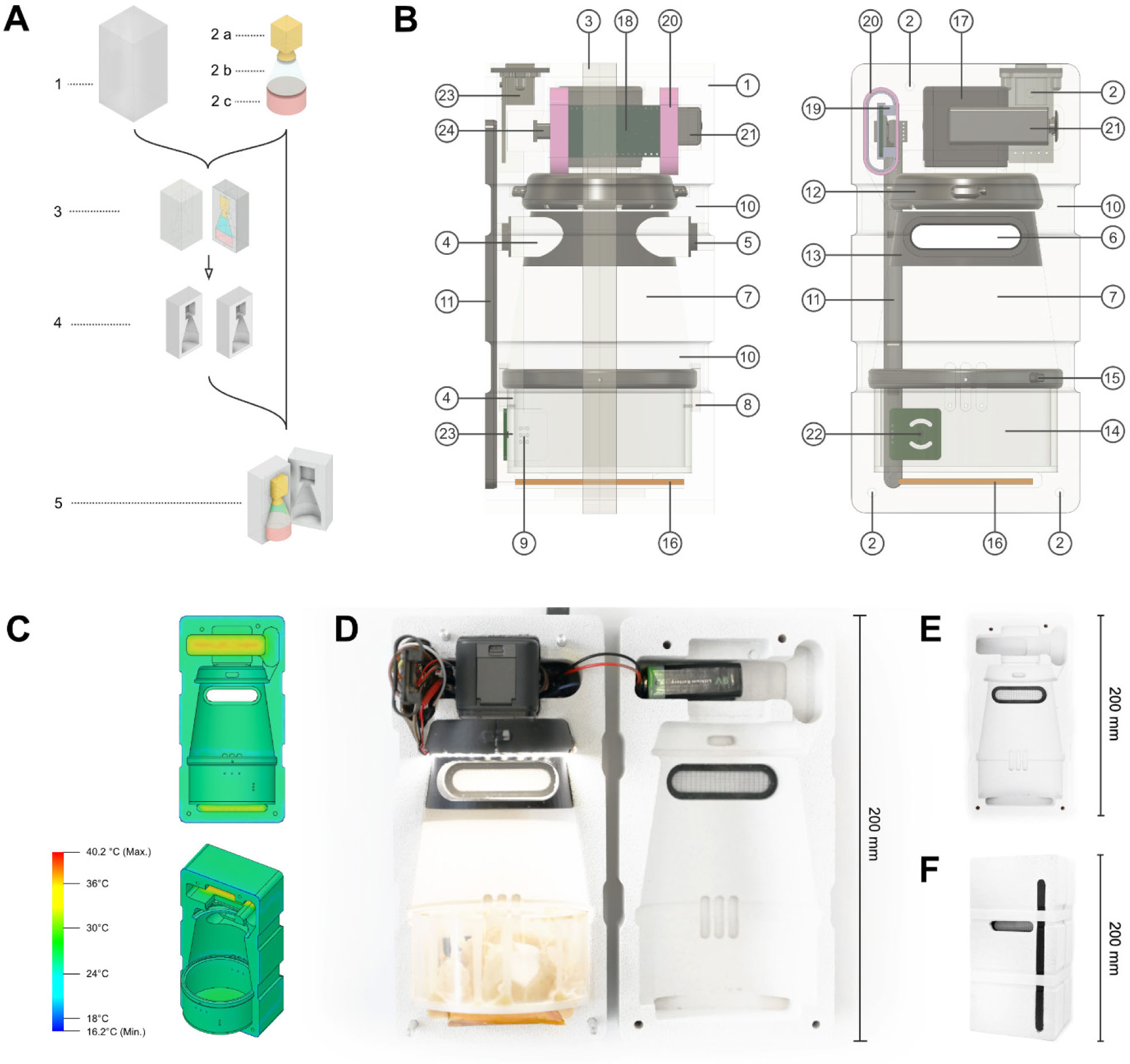
A generalizable method for experimental payload module design. (A) A process diagram detailing the module design and fabrication method: 1: In a CAD environment, define the available payload volume, 2: arrange experimental component according to functional interactions (e.g., a: Camera volume, b: Field of view, c: Bee compartment), and 3: subtract the experiment volume from payload volume and introduce a central split line. 4: To manufacture, use a CNC-milling machine to fabricate the two-part foam chassis. 5: To assemble, press-fit to integrate experiment components. (B) Labeled schematic of the video-enabled experimental module design: 1: Polyurethane Foam, 2: Alignment Pin (×4, aluminum), 3: Sealing Tape, 4: Vent Cutout, 5: 3D Printed (3DP) Vent Cover, 6: Netting (insect impermeable), 7: Main Chamber, 8: Internal Air Vent (×3, for airflow between main chamber and bee compartment), 9: Vent Holes in Bee Compartment (×9, 1 mm each), 10: Groove and Silicone Band (bands not depicted for visual clarity), 11: 3DP External Cover for Cable Channel, 12: Lens Assembly (with glass macro lens and LED ring), 13: 3DP Lens Hood, 14: Bee Compartment (furnished with beeswax), 15: 3DP Bee Compartment Lid Retainer (includes ×4 steel M2 screws), 16: Electric Heating Pad, 17: Camera (GoPro Hero5 Session) 18: Microcontroller/Logger (Feather Adalogger M0), 19: 3DP Holding Brace for Microcontroller, 20: Soft Foam Cushion/Antistatic Foam Tape, 21: 9V Li-Ion Battery (U9VLJPBK, Ultralife), 22: Temperature/Humidity Sensor, 23: USB B Breakout Board (glued in), and 24: USB Micro Breakout Board (glued in). (C) A thermal simulation of heat generation from components of the payload module. Images display (D) payload module including all components, laid open, (E) payload module shown without electronics and bee compartment, and (F) payload module shown in closed state. CNC, computer numerical control; CAD, computer-aided design.
Table 1
Payload performance tests. Category headings are bolded.
| Payload performance testing | |||||
|---|---|---|---|---|---|
| Test Name | Aim | Process | Min. Duration | Outcome | Output |
| Mechanical | |||||
| Static load | Ensure payload can withstand static load. | ≥15 lb of static load applied to each axis of the chassis (x, y, z) for 2 min | 2 min, per axis | Each axis was photographed before/during/after weight application; no deformation or destruction of the capsule is observed. | Photo |
| Accelerative load and shock | Ensure payload withstands flight g-loads and shock. | 30 g (×2 nominal peak acceleration) applied in the form of static load force (i.e., ×30 the weight of the object) to each object. | 50 ms | To incorporate the Acceleration Load and Shock tests into the Static Load test, 30 lbs of static load was tested on each axis. | |
| Vibration | Ensure hardware can perform in a vibration environment. | Periodic vibration, 7.85 g at 50 Hz applied via Vortex Mixer (VWR, 3000 rpm/4.9 mm orbit), and a qualitative assessment of damage or displacement. | 1 min, per axis | No changes (damage, shifting, debris) occur over the course of several minutes. Note: This test is not directly comparable to a random vibration environment. | Video |
| Thermal | |||||
| Touch-temperature | Ensure payload has minimal thermal effect on neighboring experiments. | Temperature of external faces of chassis sampled by IR-camera (FLIR C3, FLIR Systems) with all heat-generating electrical systems running for 30 min. | 30 min, or until temp. plateau | External temperature leveled at 26.7°C and 31.7°C, respectively, with electronic heating systems and battery run a maximum performance for 30 min (simulating an electronic “loss of control,” reaching an internal temperature of 53.3°C). | Temp. time course |
| Other | |||||
| Flammability | Ensure non-ignitable or self-extinguishing properties. | Prolonged exposure to an open flame, simulating an electronic or battery short. | 1 min | Foam held over open flame is shown to self-extinguish with minimal shape change or expansion; corroborated by technical data sheet for material. | Video |
| Fragmentation (Point-of-Force) | Ensure minimal particulate in case of payload fragmentation. | Weighted chisel (6 lb) dropped from 1 m onto the chassis, head-on and top-down video used to document the size and amount of particulate generated. | n/a | Foam in contact with the sharp edge broke into multiple pieces but produced minimal dust. Much of the module stayed intact, components remained in place, and the specimen compartment deflected blow without damage. | Video |
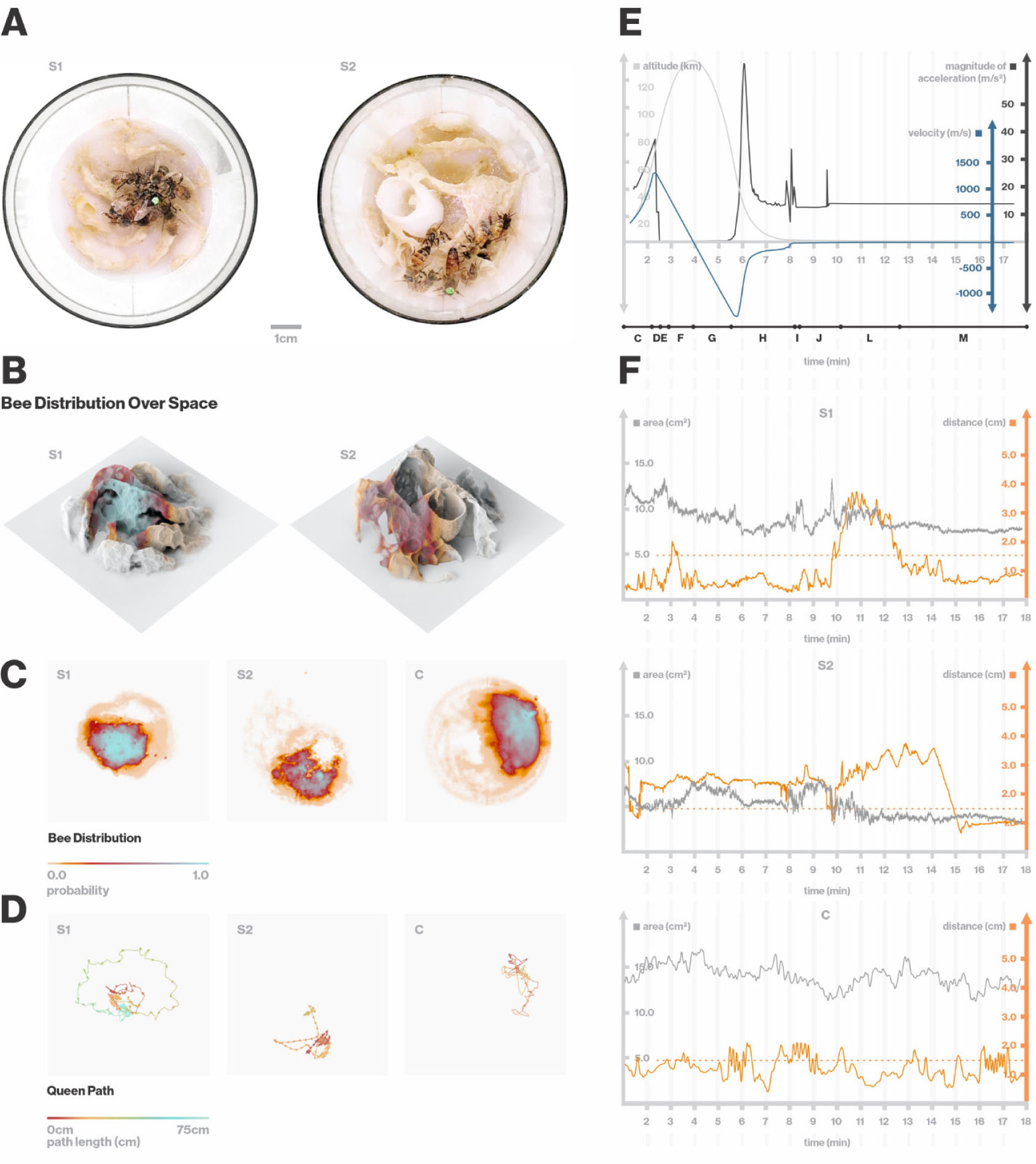
Figure 2
Analysis of video data for queen and retinue bee regulatory mechanics during suborbital flight. (A) A video frame from each space-bound module at a sample timepoint during flight; queens S1 and S2 each bear a green dot on their thorax, while ~10 worker bees per module form a retinue (for full video, see SI Video 1). (B–F) Quantification of queen and retinue behavior was derived through several computational video analysis techniques: (B) Bee Spatial Distribution within the compartment was calculated from video data by assigning a value of 1.0 to pixels containing bees per each frame and 0.0 elsewhere, and summing values over all frames (L+0 m to L+18.75 m). Values were normalized to a range from 0.0 to 1.0 and assigned a heatmap color; subsequently, this was mapped to the 3D topology of the beeswax-furnished compartment for S1 and S2, and (C) also displayed in a 2D format for comparison of S1, S2, and control C1. (D) Queen Tracking, obtained by isolating the G channel of the RGB image sequence and mapping the trajectory of the green marker sequentially across all frames, visualized the 2D path of queens during the flight; this was assigned a color gradient according to arc length for comparison of S1, S2, and C1 queen paths. (E) Data-logged IMU and flight phase data are translated to altitude (m, gray line), velocity (m/s, blue line), and acceleration force (m/s2, black line) per 1 s time increments and graphed over time. Letter Codes correspond to flight phases in Table S2. (F) Cluster Area Measurement (“retinue area,” gray line) and Queen Distance-From-Cluster-Centroid Measurement (“queen distance,” orange line) are respectively calculated by determining total area of bee-occupied pixels per frame and measuring distance from the centroid of the total bee area to the centroid of the queen dot per frame. Each is plotted over time for S1, S2, and C1 queens as a proxy for maintenance of nominal retinue formation around the queen. As a benchmark for Queen Distance-From-Cluster-Centroid values, a common definition for retinue ellipse establishes ≤1.5 cm (orange dashed line) as the nominal distance from a queen to an attending retinue.
Table 2
Experimental module weight allotment. Category headings are bolded; in-line bolded values represent the summed weight (g) of the components within that category (listed below the heading), followed in parenthesis by the weights’ percentage out of the of the maximum weight limit. The total experimental module weight was 439.6 g, with 59.4 g of unallotted weight remaining.
| Maiden flight 2U payload module characteristics (L = 102 mm, W = 102 mm, H = 200 mm) | |||||
|---|---|---|---|---|---|
| Item | Bulk weight | Unit | Amount | Unit | Weight (g) |
| Housing components | 146.6 (29%) | ||||
| Foam housing (not including coating) | 0.096 | g/cm3 | 1,226 | cm3 | 117.7 |
| Paint coating | 16.0 | ||||
| Silicon straps | 6.45 | g | 2 | pcs | 12.9 |
| Electronic and video components | 211.4 (42%) | ||||
| GoPro Hero5 Session | 72.3 | g | 1 | Pcs | 72.3 |
| Lens | 40.6 | g | 1 | pcs | 40.6 |
| Battery | 37.0 | g | 1 | pcs | 37.0 |
| Wires | 20.0 | g | 1 | pcs | 15.0 |
| USB connector | 12.0 | g | 1 | pcs | 12.0 |
| Lens assembly | 10.0 | g | 1 | pcs | 10.0 |
| NeoPixel Ring LED light | 6.2 | g | 1 | pcs | 6.2 |
| Custom connector board | 6.0 | g | 1 | pcs | 6.0 |
| Feather Adalogger | 5.5 | g | 1 | pcs | 5.5 |
| Heating pad | 3.8 | g | 1 | pcs | 3.8 |
| Sensors board (temp and humidity) | 3.0 | g | 1 | pcs | 3.0 |
| Bee compartment | 81.6 (16%) | ||||
| Acrylic compartment (including lid) | 1.185 | g/cm3 | 50 | cm3 | 59.3 |
| Beeswax | 20.0 | gr | 1 | pcs | 20.0 |
| Worker bees | 0.113 | gr | 10 | pcs | 1.1 |
| Queen bee | 0.193 | gr | 1 | pcs | 0.2 |
| Solid sugar fondant | 1.0 | gr | 1 | pcs | 1.0 |
| Total weight | 439.6 (88%) | ||||
| Max. weight | 499.0 | ||||