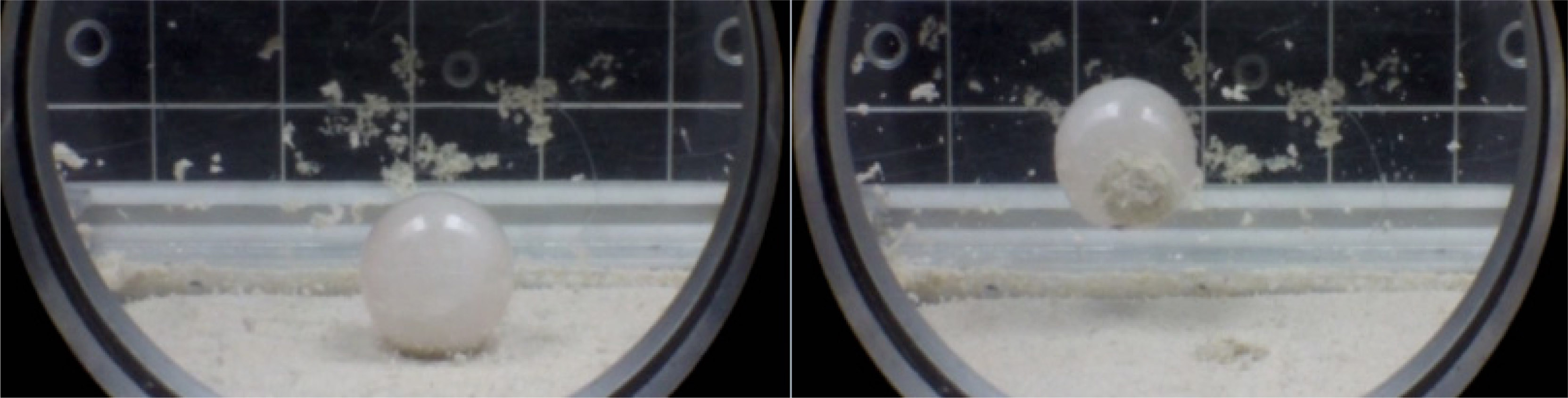
Figure 1
Still frames of a 10-g quartz impactor (left) contacting quartz sand at an impact speed of 23 cm/s and (right) rebounding with observable mass transfer.
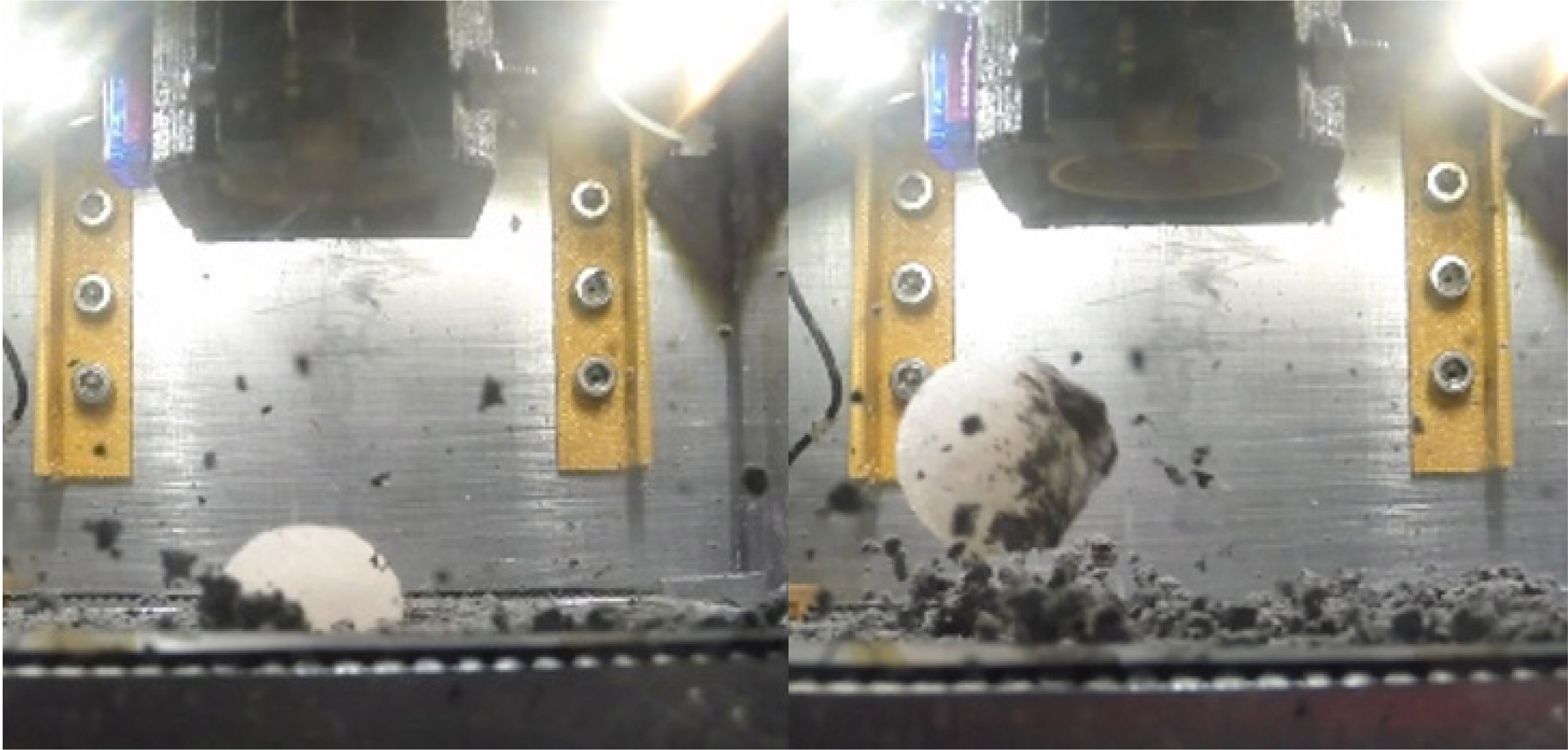
Figure 2
Still frame of 10-g quartz sand coated impactor (left) contacting Orgueil at an impact speed of 52 cm/s and (right) rebounding with observable mass transfer.
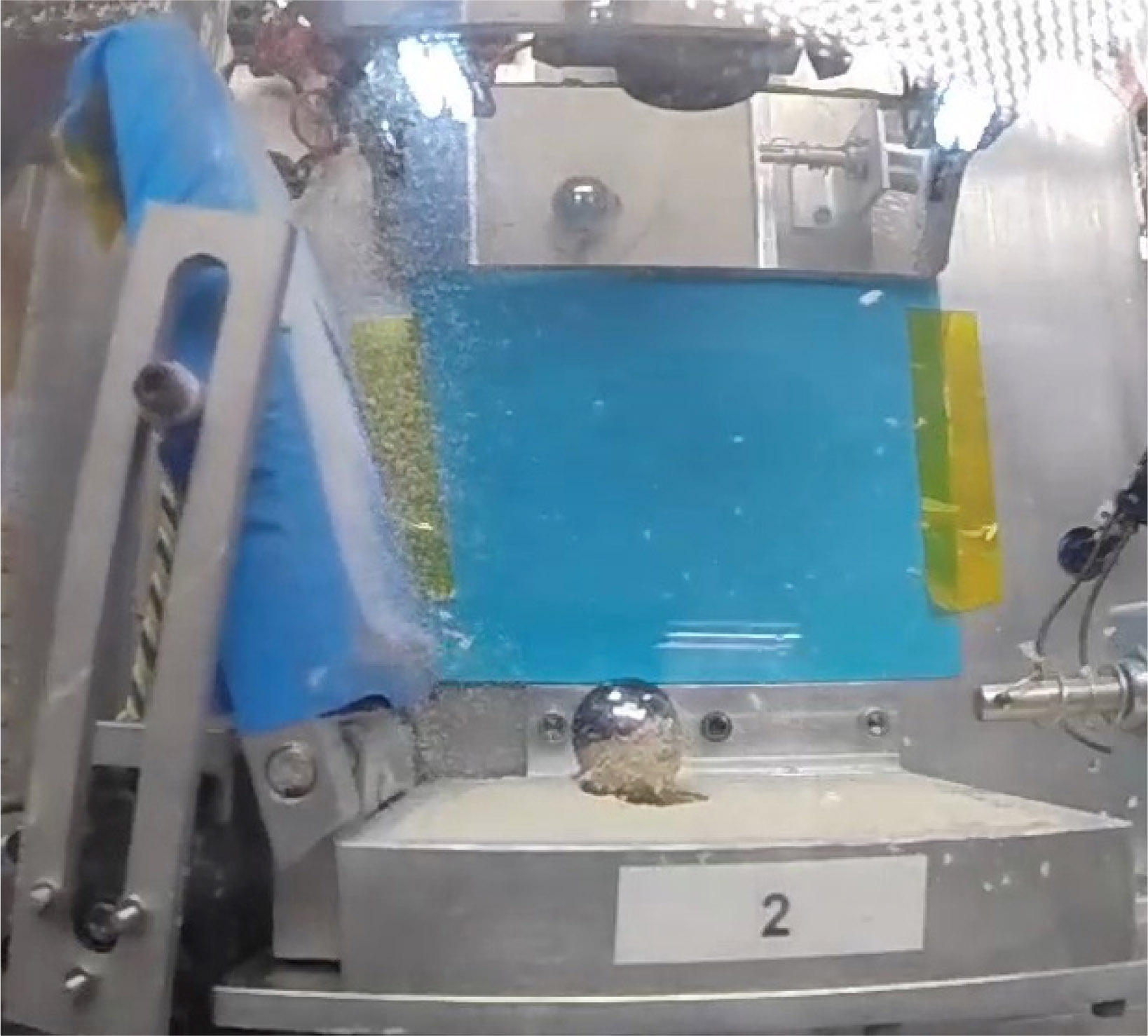
Figure 3
Example of a PRIME-3 experiment that resulted in the mass transfer of quartz sand onto a 31-g steel marble.
Table 1
PRIME-3 experiment parameters.
| Projectile | Regolith | |||
|---|---|---|---|---|
| Diameter (cm) | Mass (g) | Material | Grain type | Grain size (μm) |
| 1.9 | 10 | Quartz | JSC-1 | 125–250 |
| 31 | Steel | Quartz Sand | 75–250 | |
Table 2
PRIME-4 experiment parameters.
| Projectile | Regolith | |||
|---|---|---|---|---|
| Diameter (cm) | Mass | Material | Grain type | Grain size (μm) |
| 1.9 | 10 | Quartz | JSC-1 | 125–250 250–500 |
| Sand Coated Quartz | Orgueil | 125–250 | ||
Table 3
COLLIDE-3 experiment parameters.
| Projectile | Regolith | |||
|---|---|---|---|---|
| Diameter (cm) | Mass | Material | Grain type | Grain size (μm) |
| 1.9 | 10 | Quartz | Quartz Sand | <250 |
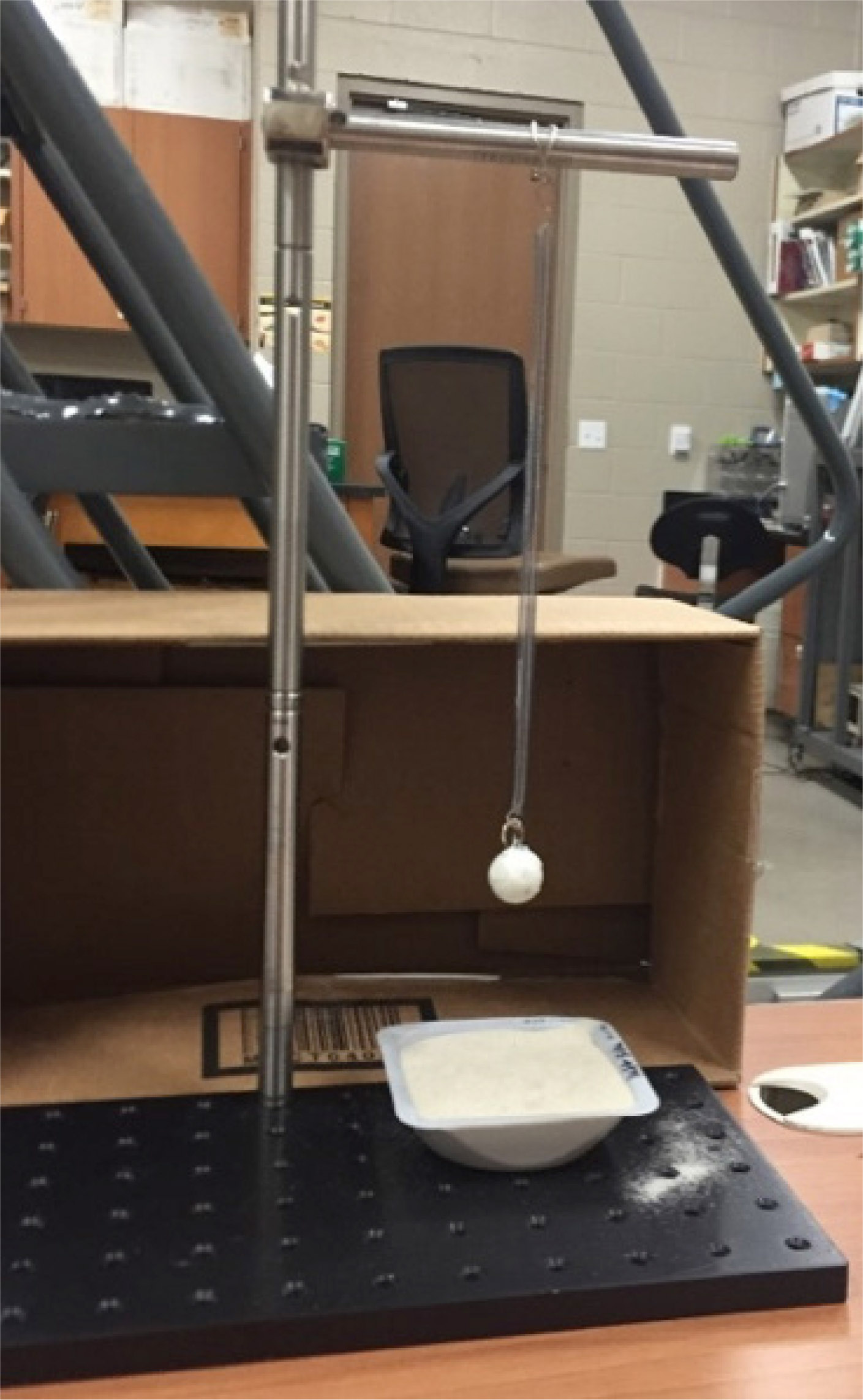
Figure 4
1-g granular impact experiment spring pendulum apparatus.
Table 4
Tabletop experiment parameters.
| Spring pendulum parameters | Regolith parameters | |||
|---|---|---|---|---|
| Mass (g) | Spring constant (N/m) | Spring length (m) | Grain type | Grain size (μm) |
| 31 | 3.5 | 0.27 | Quartz Sand | 75–250 200–500 |
| JSC-1 | <75 75–100 125–250 | |||
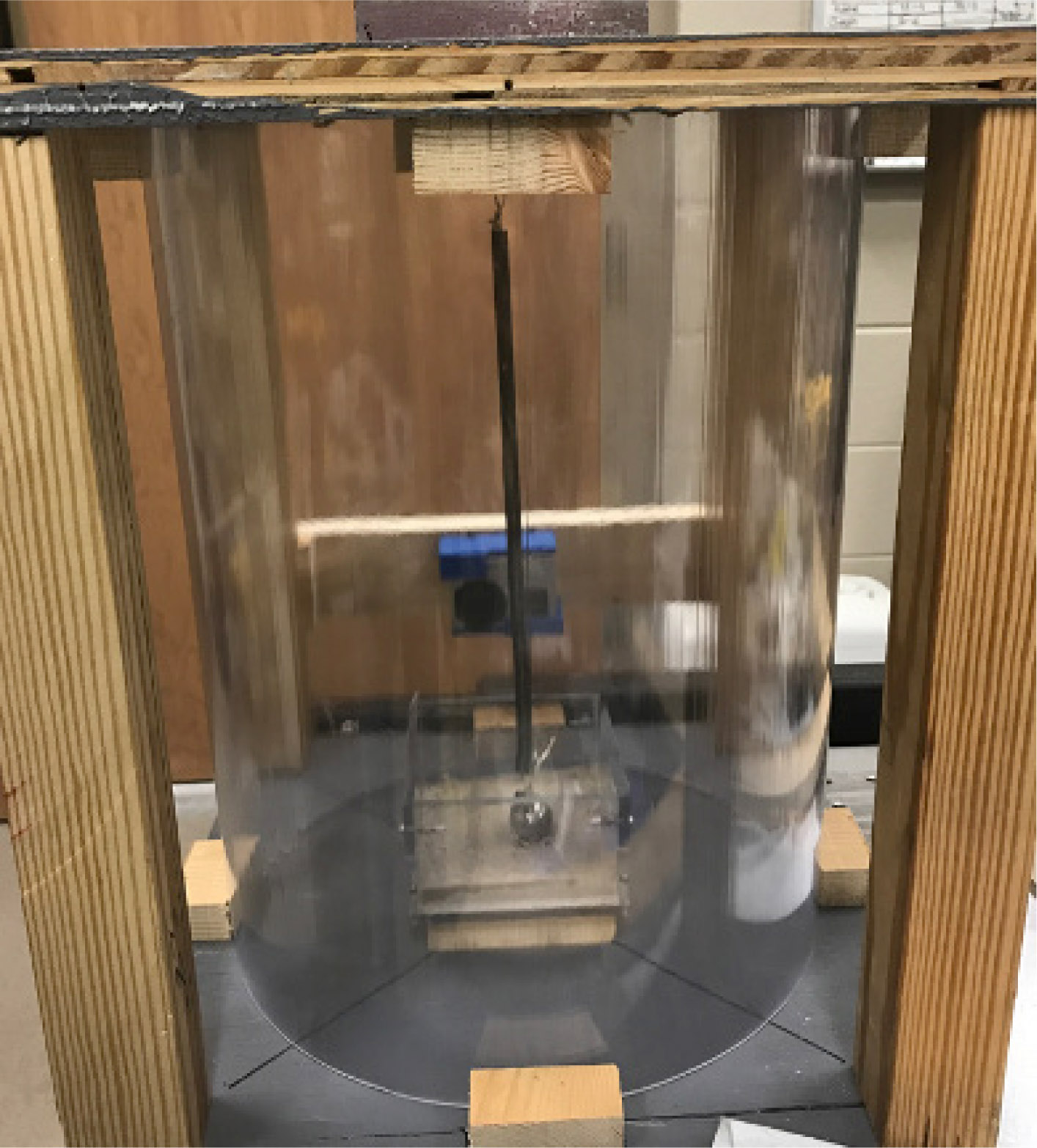
Figure 5
Open-air drop tower experiment apparatus.
Table 5
Open-air drop tower experiment parameters.
| Projectile | Regolith | |||
|---|---|---|---|---|
| Diameter (cm) | Mass (g) | Material | Grain type | Grain size (μm) |
| 1.9 | 10 | Quartz | Quartz Sand JSC-1 | 75–250 125–250 |
| 31 | Steel | 250–500 | ||
| Orgueil | 125–250 | |||
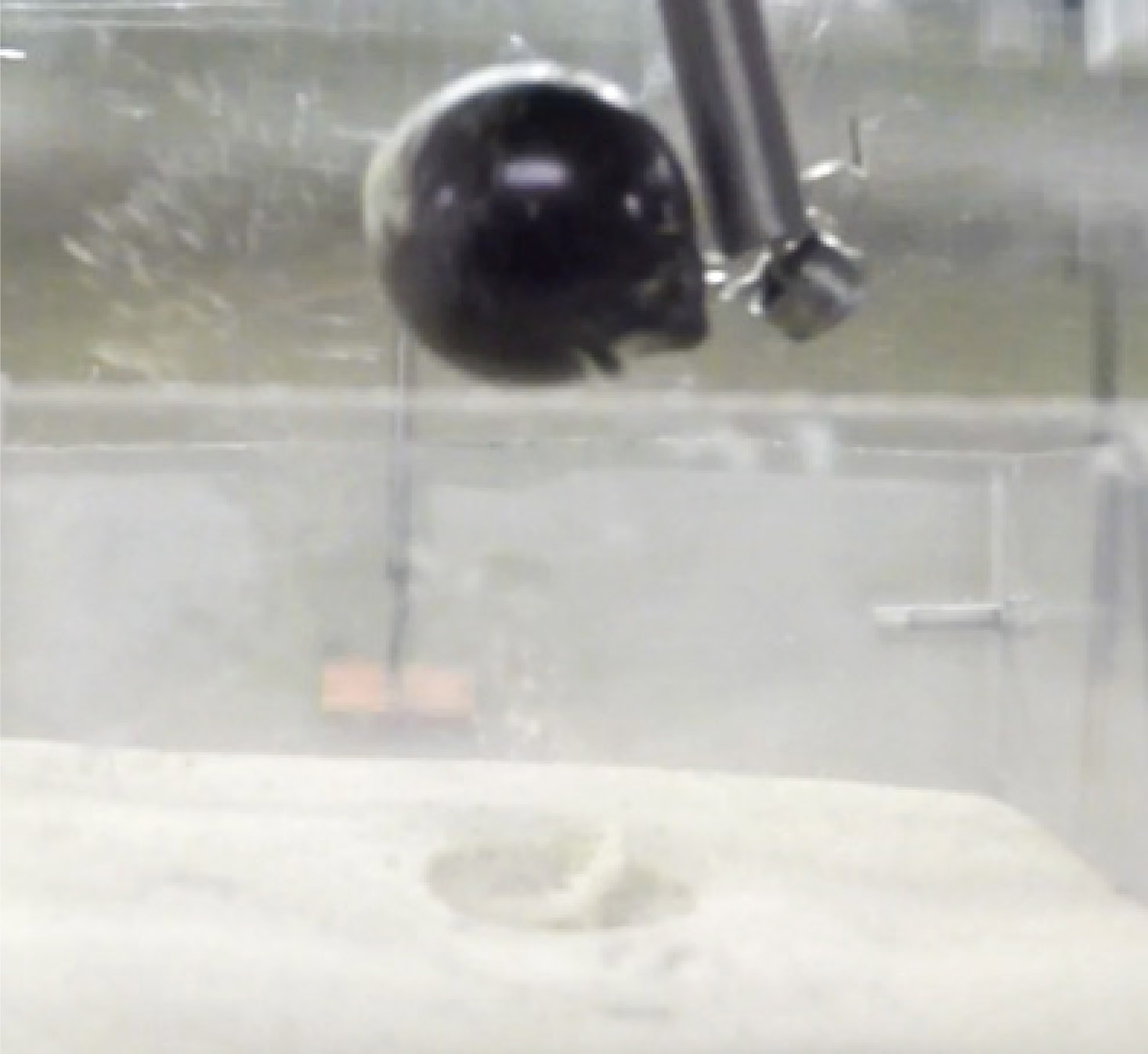
Figure 6
Still frame of 31-g steel projectile with observable mass transfer from quartz sand. Contrast enhanced for mass transfer visibility.
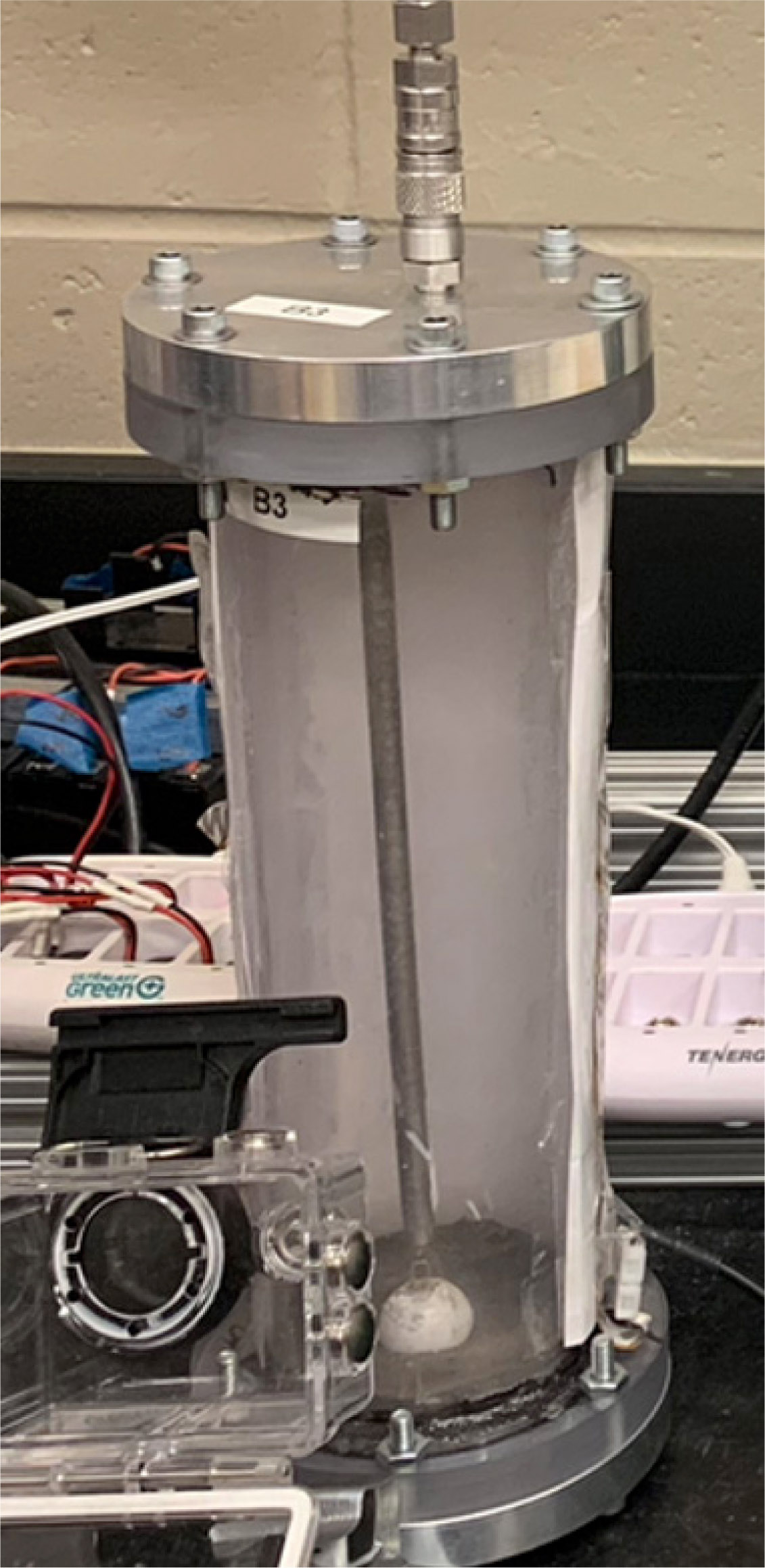
Figure 7
Vacuum drop tower apparatus. The chamber is detached from a vacuum pump shortly before an experiment is performed, and a Swagelok quick-disconnect fitting maintains the vacuum inside the tube for the duration of the experiment.
Table 6
Vacuum drop tower experiment parameters.
| Projectile | Regolith | |||
|---|---|---|---|---|
| Diameter (cm) | Mass (g) | Material | Grain type | Grain size (μm) |
| 1.9 | 10 | Quartz | Quartz Sand | 75–250 250–500 |
| 31 | Steel | JSC-1 | 125–250 | |
| 2.54 | 20 | |||
| 67 | 250–500 | |||
| 3.81 | 226 | Orgueil | 125–250 | |
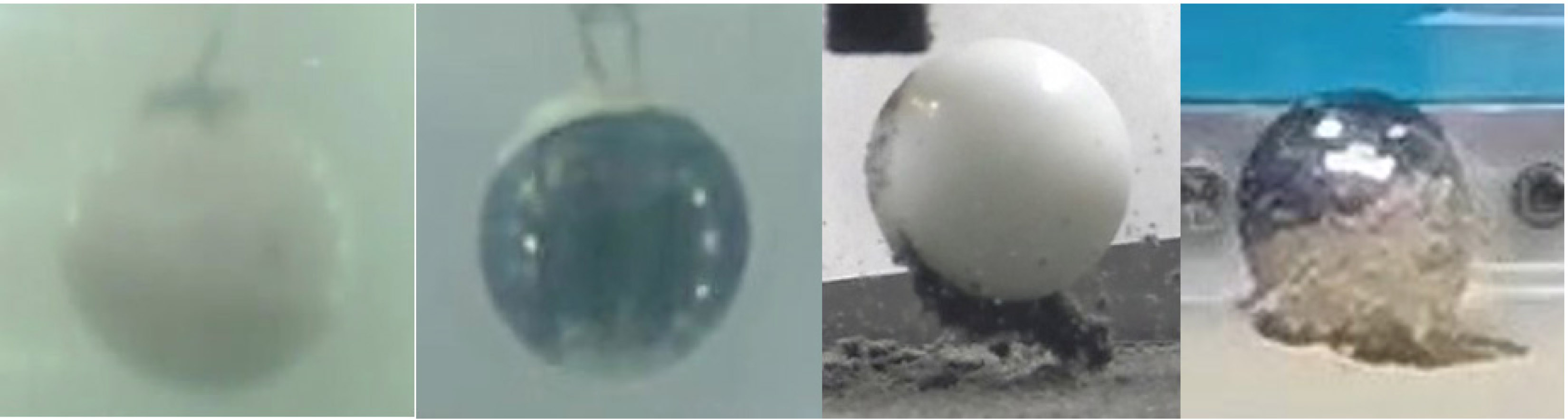
Figure 8
From left to right: Example of no mass transfer (monolayer), low mass transfer, medium mass transfer, and high mass transfer.
Table 7
Experiment parameters yielding mass transfer for the flight experiments.
| Regolith (μm) | Marble mass | Impact velocity (cm/s) | Rebound acceleration (m/s2) | Mass transfer |
|---|---|---|---|---|
| Orgueil (125–250) | 10 | 16.2 | 0.16 | Low |
| JSC (125–250) | 10 | 27.8 | 0.31 | Low |
| Orgueil (125–250) | 10 | 34.8 | 0.96 | Low |
| Orgueil (125–250) | 10 | 51.8 | 5.40 | Low |
| Quartz (75–250) | 10 | 23.2 | 0.004 | Medium |
| JSC (125–250) | 31 | 29.6 | 0.07 | Medium |
| JSC (125–250) | 31 | 14.9 | 0.08 | Medium |
| JSC (125–250) | 31 | 4.1 | 0.09 | Medium |
| JSC (125–250) | 10 | 4.1 | 0.09 | Medium |
| Quartz (75–250) | 10 | 37.1 | 0.03 | High |
| Quartz (75–250) | 10 | 38.5 | 0.03 | High |
| Orgueil (125–250) | 10 | 31.8 | 0.11 | High |
| Orgueil (125–250) | 10 | 26.6 | 0.16 | High |
| Quartz (75–250) | 31 | 14.1 | 0.38 | High |
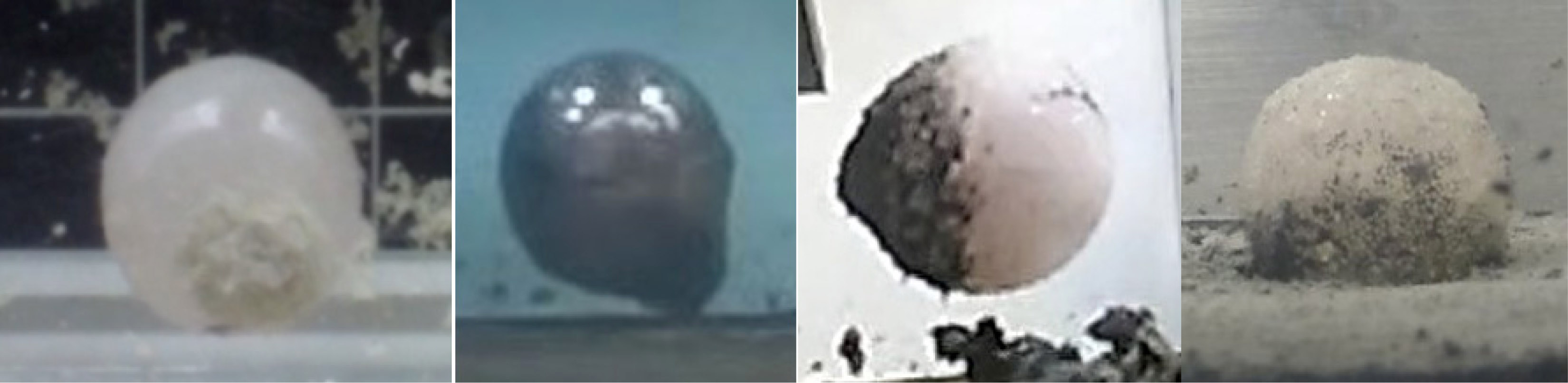
Figure 9
Observations of mass transfer from regolith onto cm-size marbles in various flight experiments.
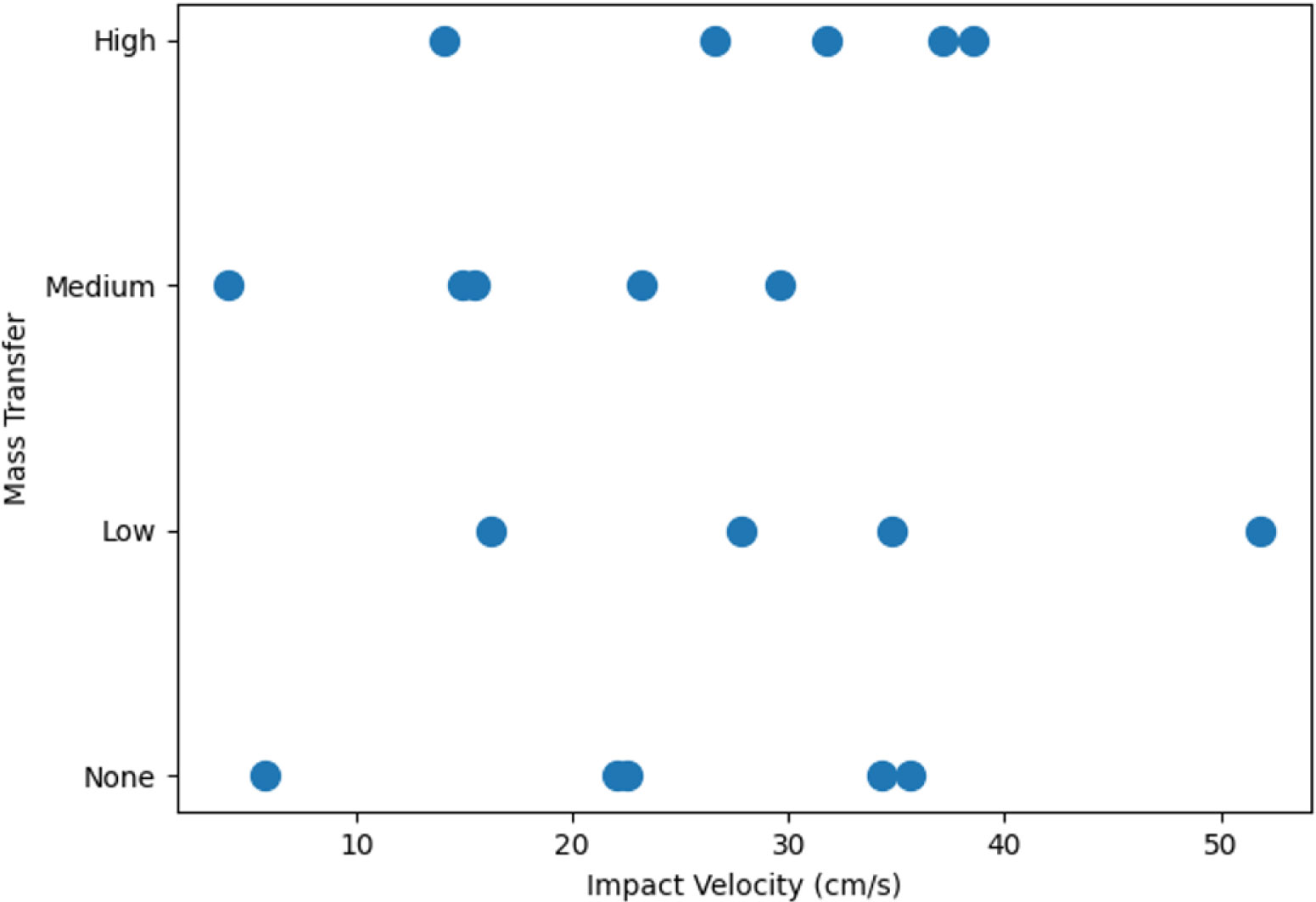
Figure 10
Mass transfer outcome vs. projectile impact velocity for flight experiments.
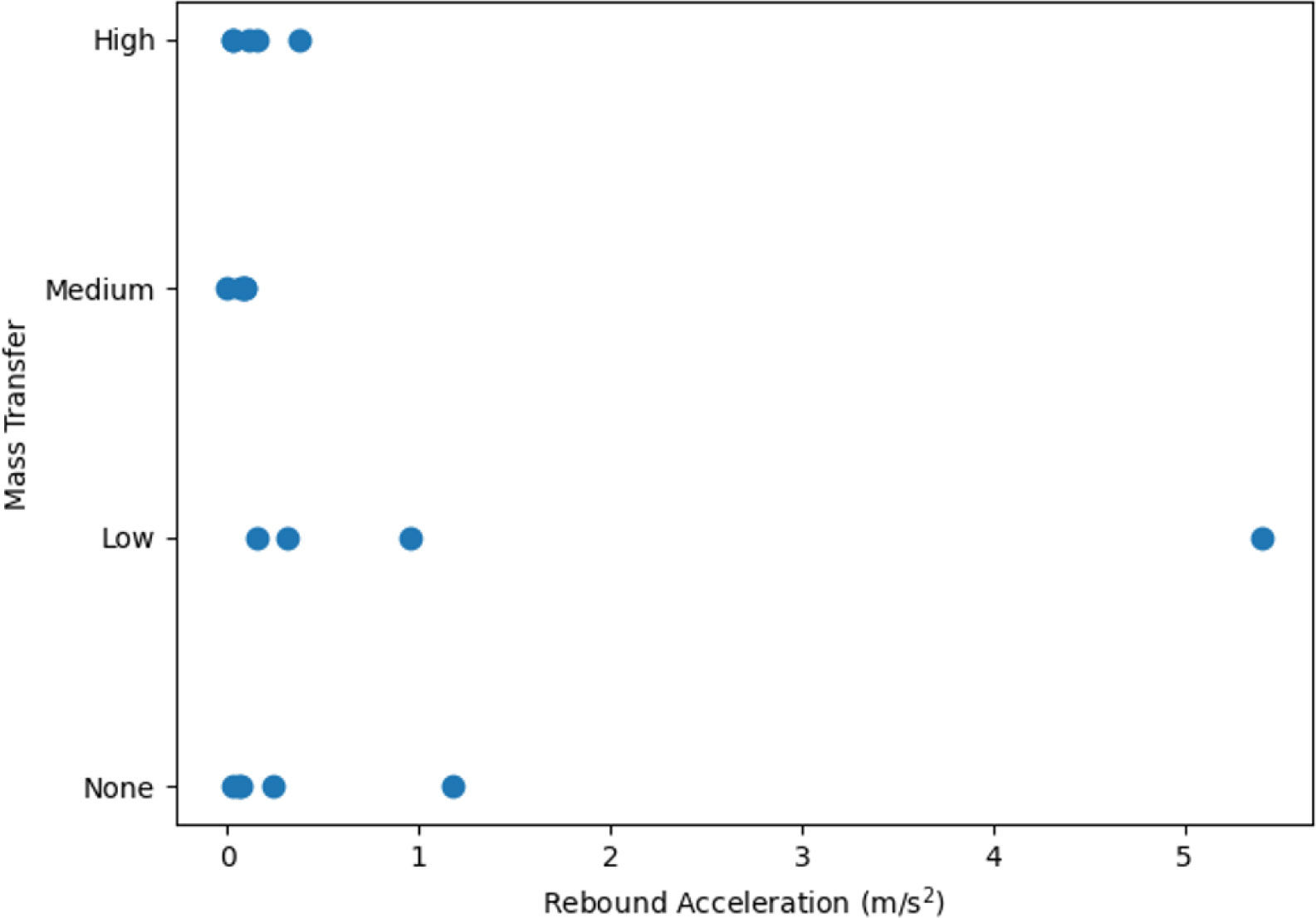
Figure 11
Mass transfer outcome vs. rebound acceleration for flight experiments.
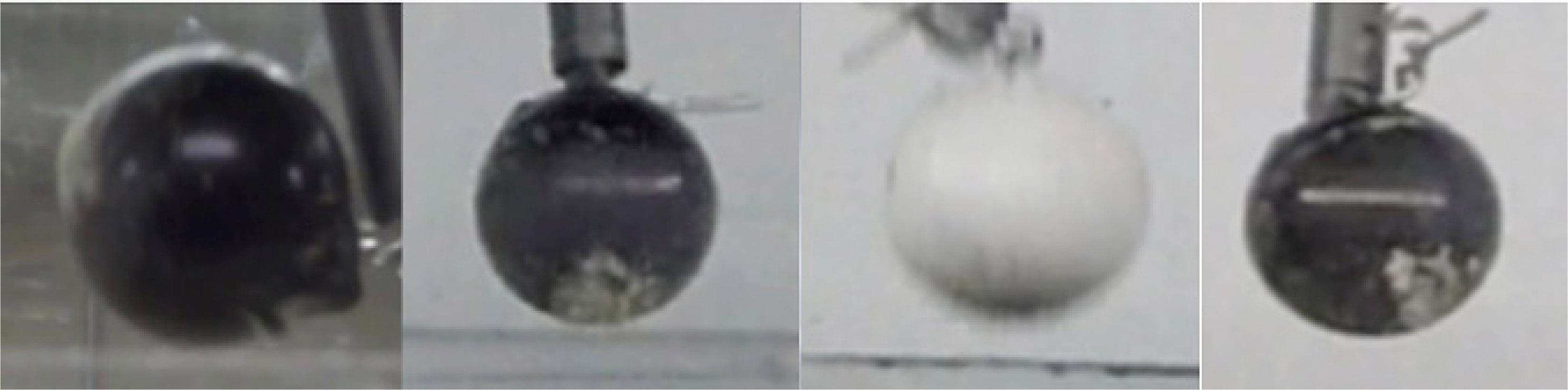
Figure 12
Observations of mass transfer from regolith onto cm-size marble in an open-air, free-fall environment.
Table 8
Experiment parameters for experiments yielding mass transfer (MTO = “low”) for open-air drop tower experiments.
| Regolith (μm) | Marble mass | Rebound acceleration (m/s2) |
|---|---|---|
| Quartz (75–250) | 31 | 3.7 |
| Quartz (75–250) | 31 | 4.5 |
| JSC (250–500) | 31 | 4.9 |
| JSC (250–500) | 31 | 5.1 |
| Quartz (75–250) | 31 | 5.5 |
| JSC (250–500) | 31 | 5.5 |
| JSC (250–500) | 31 | 5.6 |
| Quartz (75–250) | 31 | 5.8 |
| Quartz (75–250) | 31 | 5.8 |
| Orgueil (125–250) | 31 | 6.5 |
| JSC (250–500) | 31 | 6.6 |
| JSC (250–500) | 31 | 6.8 |
| JSC (250–500) | 31 | 7.4 |
| JSC (125–250) | 31 | 7.6 |
| JSC (125–250) | 31 | 7.7 |
| Quartz (75–250) | 31 | 7.8 |
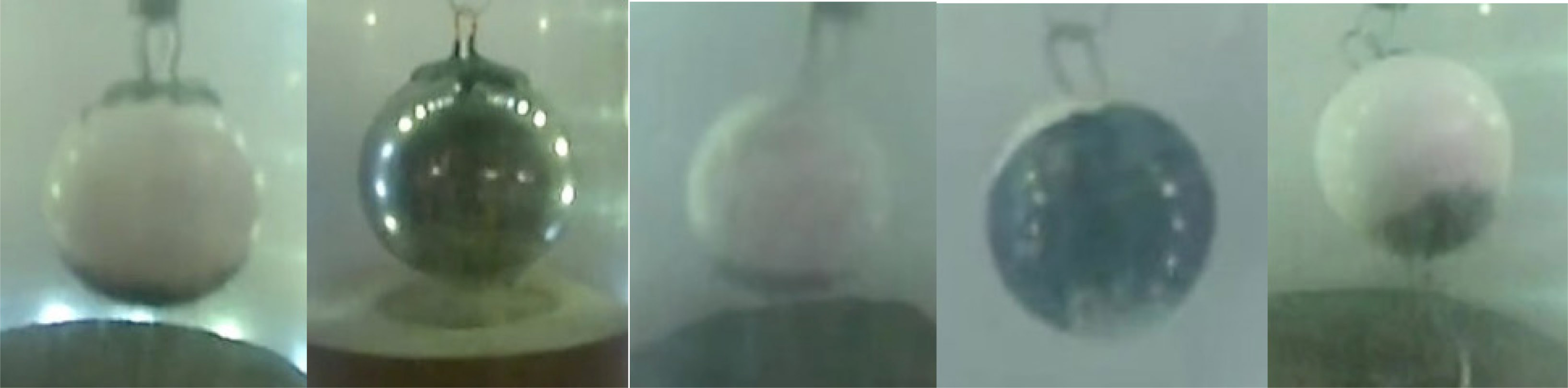
Figure 13
Observations of mass transfer from regolith onto cm-size marble in a free-fall, vacuum environment.
Table 9
Experiment parameters yielding mass transfer for our vacuum drop tower experiments.
| Regolith (μm) | Marble mass | Rebound acceleration (m/s2) | MTO |
|---|---|---|---|
| JSC (250–500) | 67 | 0.89 | Medium |
| JSC (250–500) | 67 | 3.8 | Medium |
| Orgueil (125–250) | 226 | 0.84 | Low |
| JSC (125–250) | 226 | 1.2 | Low |
| JSC (125–250) | 226 | 1.3 | Low |
| Orgueil (125–250) | 226 | 1.3 | Low |
| Orgueil (125–250) | 226 | 1.3 | Low |
| Quartz (250–500) | 67 | 1.5 | Low |
| JSC (125–250) | 226 | 1.7 | Low |
| JSC (125–250) | 226 | 1.8 | Low |
| JSC (125–250) | 226 | 2.2 | Low |
| Quartz (250–500) | 67 | 2.7 | Low |
| Quartz (250–500) | 67 | 2.9 | Low |
| Quartz (75–250) | 31 | 3.0 | Low |
| Quartz (75–250) | 31 | 3.1 | Low |
| Orgueil (125–250) | 67 | 3.2 | Low |
| Orgueil (125–250) | 67 | 3.2 | Low |
| Quartz (75–250) | 31 | 3.2 | Low |
| Orgueil (125–250) | 67 | 3.5 | Low |
| JSC (250–500) | 67 | 3.8 | Low |
| Orgueil (125–250) | 67 | 3.9 | Low |
| Quartz (75–250) | 10 | 4.3 | Low |
| JSC (250–500) | 31 | 4.3 | Low |
| Quartz (75–250) | 31 | 4.8 | Low |
| Quartz (75–250) | 31 | 5.1 | Low |
| Orgueil (125–250) | 31 | 5.2 | Low |
| JSC (125–250) | 31 | 5.3 | Low |
| Orgueil (125–250) | 31 | 5.4 | Low |
| Quartz (75–250) | 31 | 5.5 | Low |
| Quartz (75–250) | 10 | 5.6 | Low |
| Orgueil (125–250) | 31 | 5.9 | Low |
| Quartz (75–250) | 10 | 6.2 | Low |
| Orgueil (125–250) | 31 | 7.0 | Low |
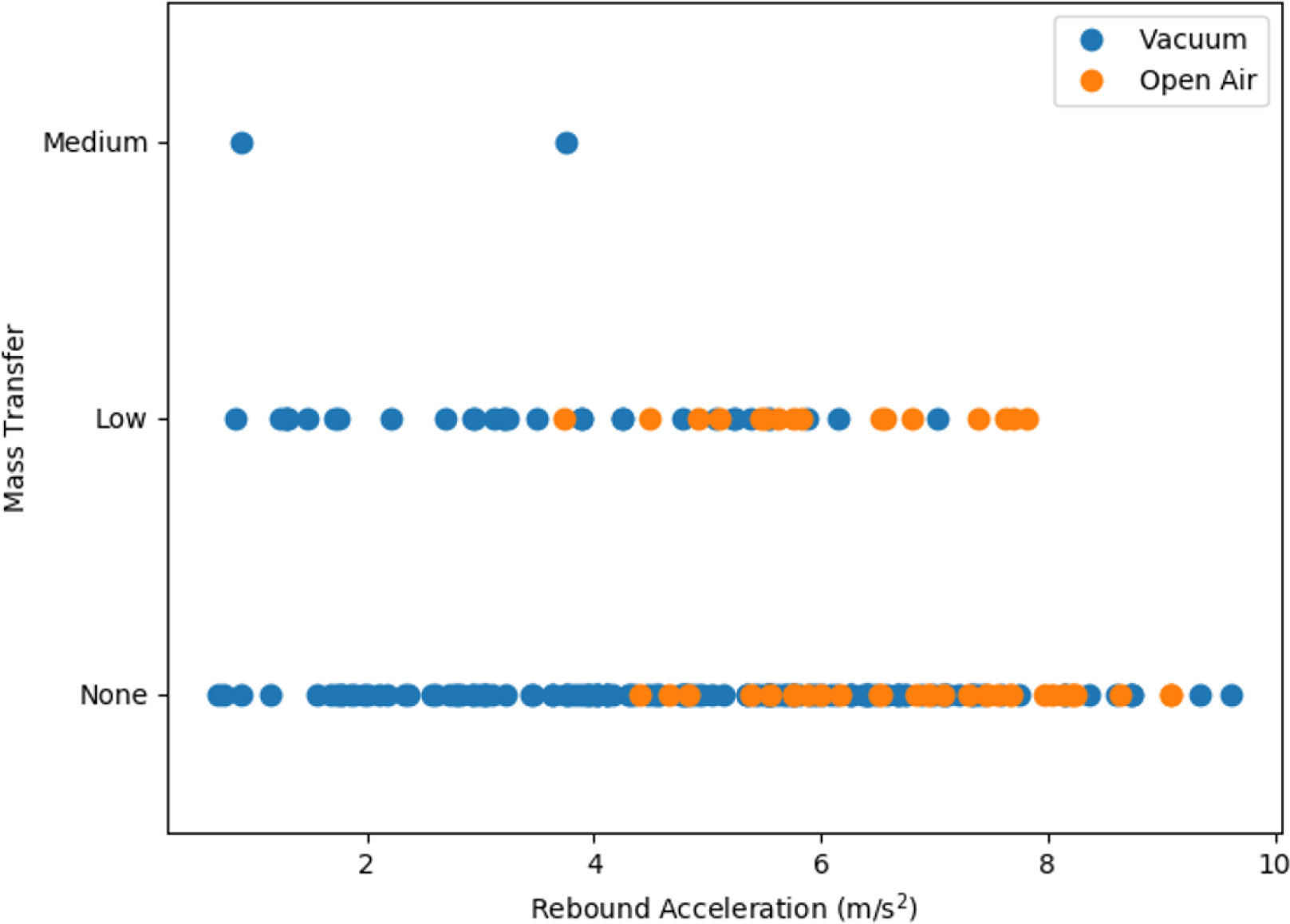
Figure 14
Mass transfer outcome vs. rebound acceleration for our open-air and vacuum drop tower experiments.
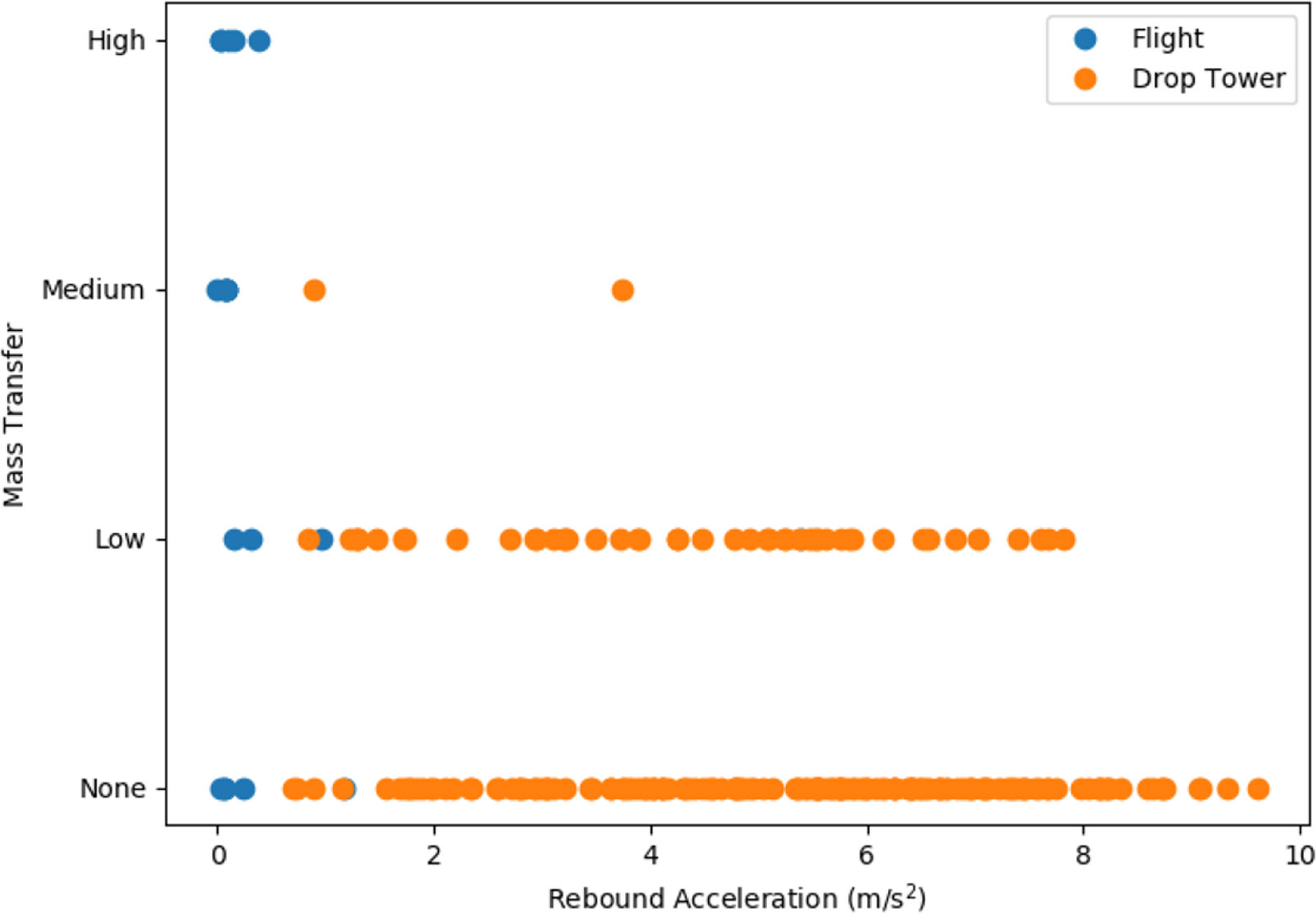
Figure 15
Mass transfer outcome vs. rebound acceleration for flight and drop tower data.