Have a personal or library account? Click to login
Daily Acute Bouts of Weight-bearing During Hindlimb Unloading Mitigate Disuse-Induced Deficits in Cancellous Bone Cover

Daily Acute Bouts of Weight-bearing During Hindlimb Unloading Mitigate Disuse-Induced Deficits in Cancellous Bone

Open Access
|Jul 2020

Figures & Tables

Figure 1

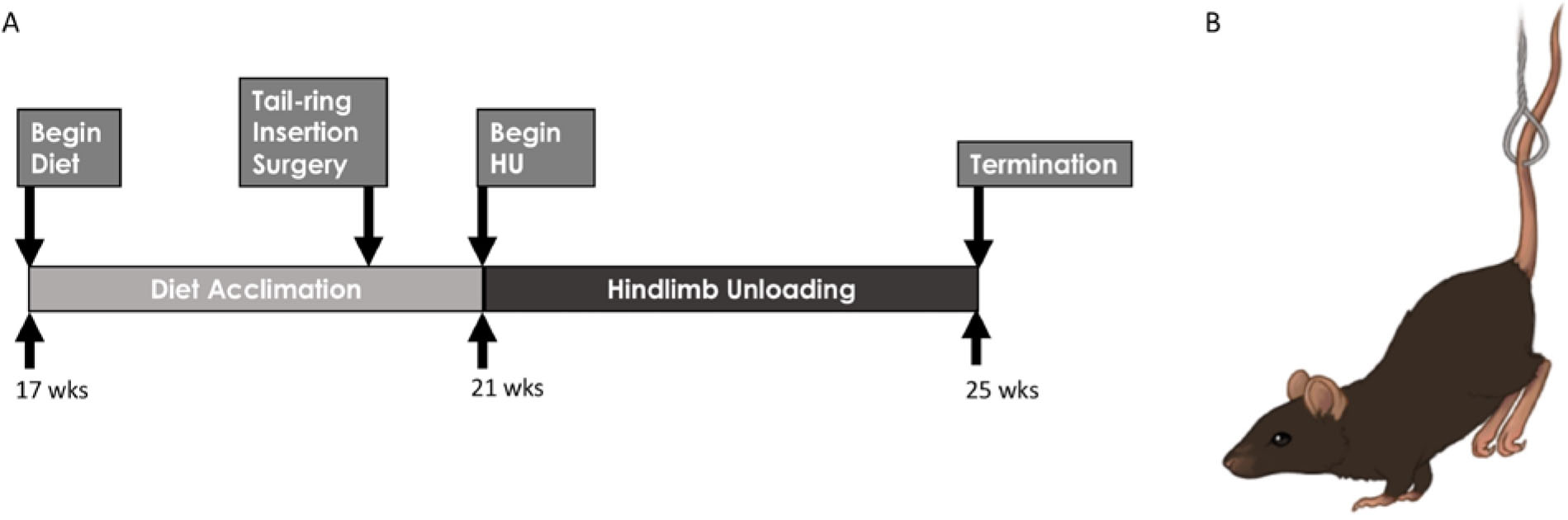
Study information. A) Study timeline: Animals acclimated to AIN-93G diet starting at 17 weeks of age. HU animals began HU four weeks later, while HU+WB animals were removed from tail suspension and allowed weight-bearing cage activity for 75 minutes per day. B) HU mouse suspended via tail ring.
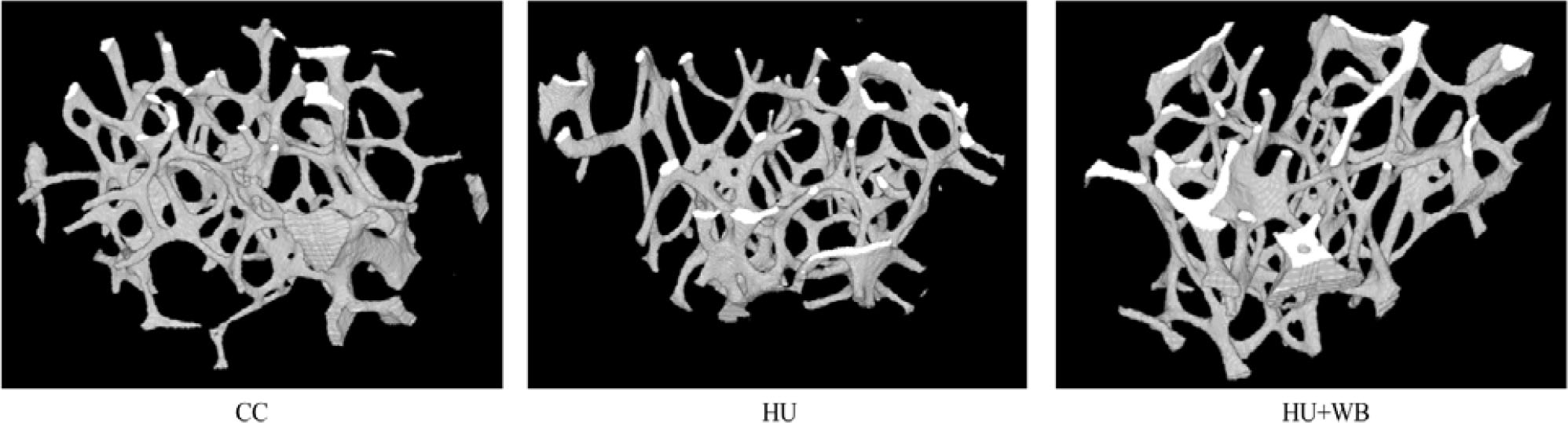

Figure 2

Representative images of cancellous bone volume and microarchitecture at the distal femur after 4 weeks for cage control (CC), hindlimb unloaded (HU), and hindlimb unloaded + weight-bearing (HU+WB) mice.

Figure 3

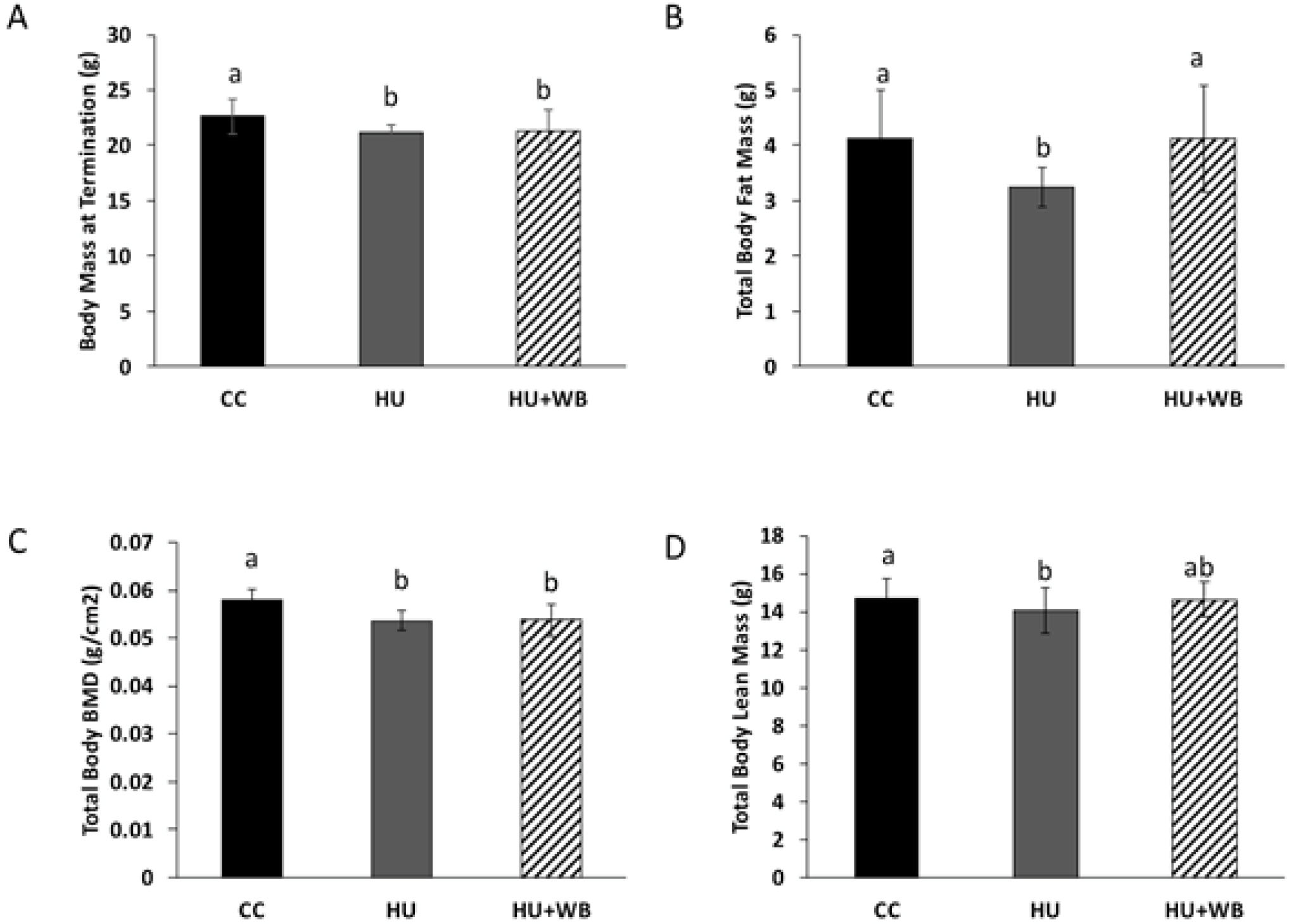
Body mass and body composition after 4 weeks for cage control (CC), hindlimb unloaded (HU), and hindlimb unloaded + weight-bearing (HU+WB) mice. A) Body mass at the end of HU was lower in HU (−9%) and HU+WB (−7%) mice compared to cage controls (CC). B) Total body BMD was lower in HU (−7%), and HU+WB (−7%) vs. CC. C) Fat mass was lower in HU (−21%) compared to CC and HU+WB. D) Lean mass was lower in HU compared to CC (−5%) with no difference from HU+WB. Groups sharing a letter are not different from one another by one-way ANOVA (p<0.05).
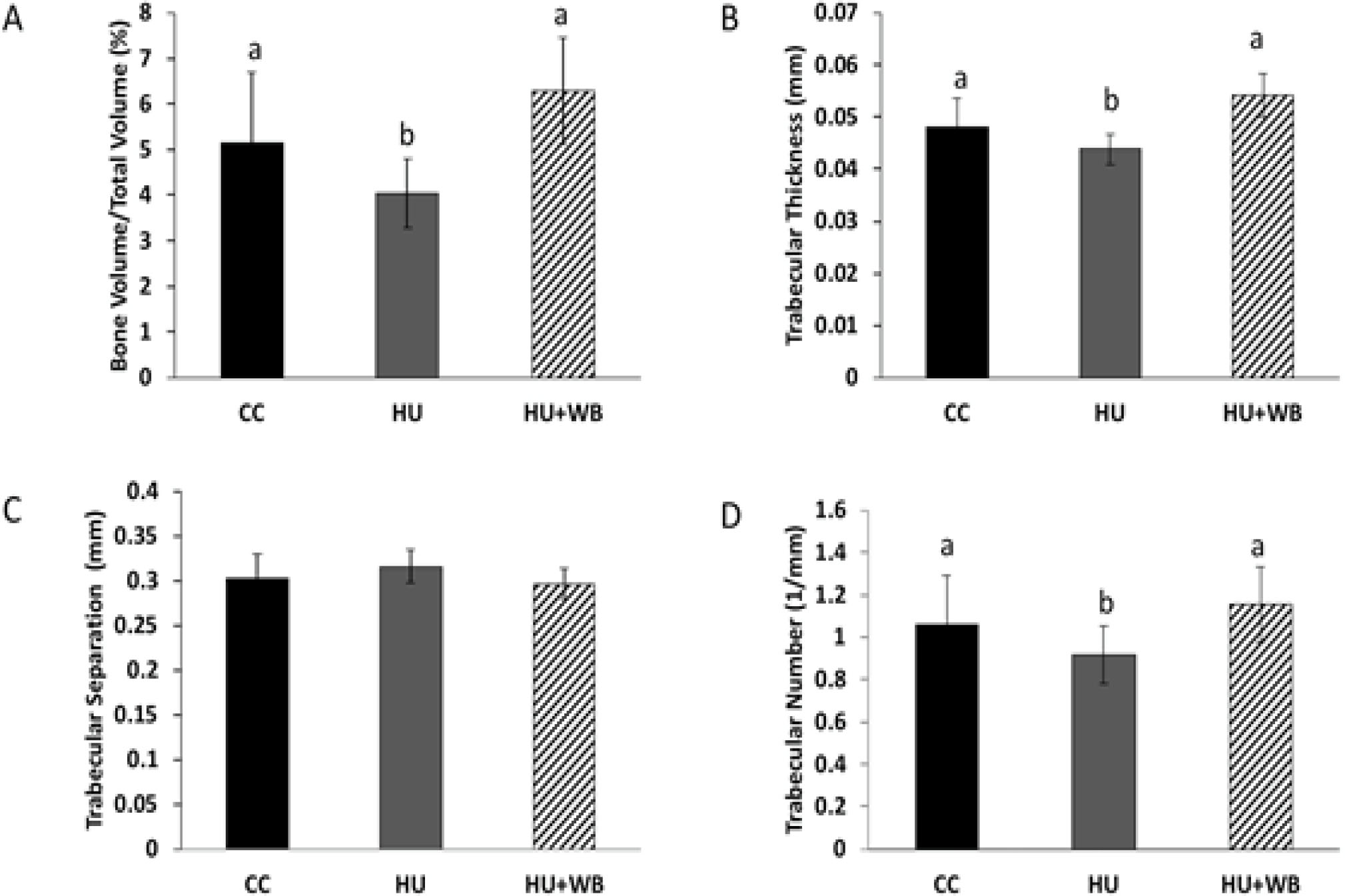

Figure 4

Cancellous bone volume and microarchitecture at the distal femur after 4 weeks for cage control (CC), hindlimb unloaded (HU), and hindlimb unloaded + weight-bearing (HU+WB) mice. A) % bone volume/total volume (%BV/TV) was 22% lower in HU compared to cage controls (CC), whereas this value in HU+WB was equivalent to CC mice. B) Trabecular thickness was 9% lower in HU compared to CC and HU+WB. C) Trabecular separation was not different among groups. D) Trabecular number was 13% lower in HU compared to CC, whereas HU+WB was not different than CC mice. Groups sharing a letter are not different from one another by one-way ANOVA (p<0.05)

Total body bone mineral density at the start of hindlimb unloading (HU)_ There were no differences in intermittent weight-bearing (HU+WB) or HU compared to cage controls (CC)_

CCHUHU+WB
Total Body Bone Mineral Density (g/cm2) One Day Prior to Hindlimb Unloading0.060 ± 0.0010.055 ± 0.0010.057 ± 0.004
Language: English
Page range: 2 - 11
Published on: Jul 21, 2020
Published by: American Society for Gravitational and Space Research
In partnership with: Paradigm Publishing Services
Publication frequency: 2 issues per year

© 2020 Rihana S. Bokhari, Corinne E. Metzger, Matthew R. Allen, Susan A. Bloomfield, published by American Society for Gravitational and Space Research
This work is licensed under the Creative Commons Attribution-NonCommercial-NoDerivatives 3.0 License.