Table 1
Primers of target genes used for RT-qPCR.
| Gene name | AGI code | Primer sequences (5’ to 3’) |
|---|---|---|
| AtHSP70-1 | AT5G02500 | F: AAACCCTAGCCGCCTTATTC |
| R: GATAGCTGGTCCTTCTCCTTTAC | ||
| AtHSP70-2 | AT5G02490 | F: AGCTTGTGAGAGAGCAAAGAG |
| R: ACGGGTGATTGGAGAATAGA | ||
| AtHSP70-3 | AT3G09440 | F: GACATTAGTGGAAACCCGAGAG |
| R: GTCTGAGCCGTAGATGACAAAG | ||
| AtHSP70-4 | AT3G12580 | F: AGGGCACGAACAAAGGACAACAAC |
| R: TCAGCCGACACATTCAGGATACCA | ||
| AtHSP70-5 | AT1G16030 | F: GGAGCTATCTCTGGGCTTAATG |
| R: GGCCTTCGTACCCTTCTTATC | ||
| AtHSP90-1 | AT5G52640 | F: GTTACCCTATCTACCTTTGGACCG |
| R: CTGCTTGTTGATGAGTTCCCAC | ||
| AtHSP90-2, | AT5G56030 | To detect mRNA of three genes in total: |
| AtHSP90-3, | AT5G56010 | F: GCTACCCAATCTCTCTCTGGATT |
| AtHSP90-4 | AT5G56000 | R: GTACTCCTCCTTGTTGATCTCCTC |
| AtUBQ5 | AT3G62250 | F: AACCCTTGAGGTTGAATCATCC |
| R: GTCCTTCTTTCTGGTAAACGT |
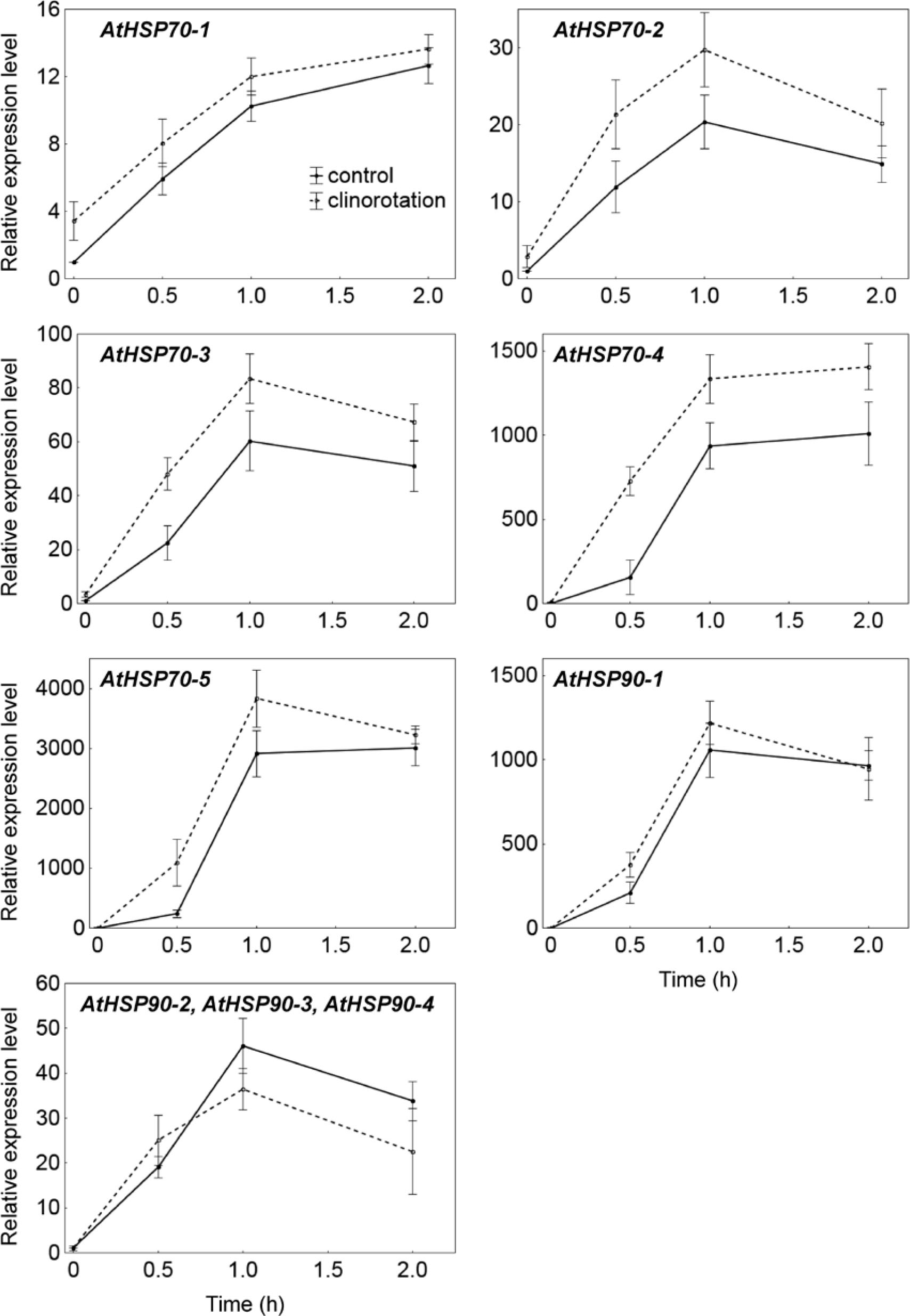
Figure 1
An effect of clinostat rotation on induction of HSP70 and HSP90 genes in Arabidopsis thaliana (Col) seedlings during heat shock. 12-d-old seedlings grown under stationary conditions (control) or clinorotation were exposed at 37°C for the indicated times. Expression levels were assessed using RT-qPCR, and normalized with respect to UBQ5 mRNA. Relative mRNA amounts were calculated as a fold change to the control (= 0 h of the heat treatment). Data are means of three independent biological samples with three analytical replicates ± s.d. The effect of high temperature was significant for all the HSPs; the effect of clinorotation was significant for AtHSP70-2, AtHSP70-3, AtHSP70-4, AtHSP70-5, and AtHSP90-1 (Two-way ANOVA, p < 0.05).
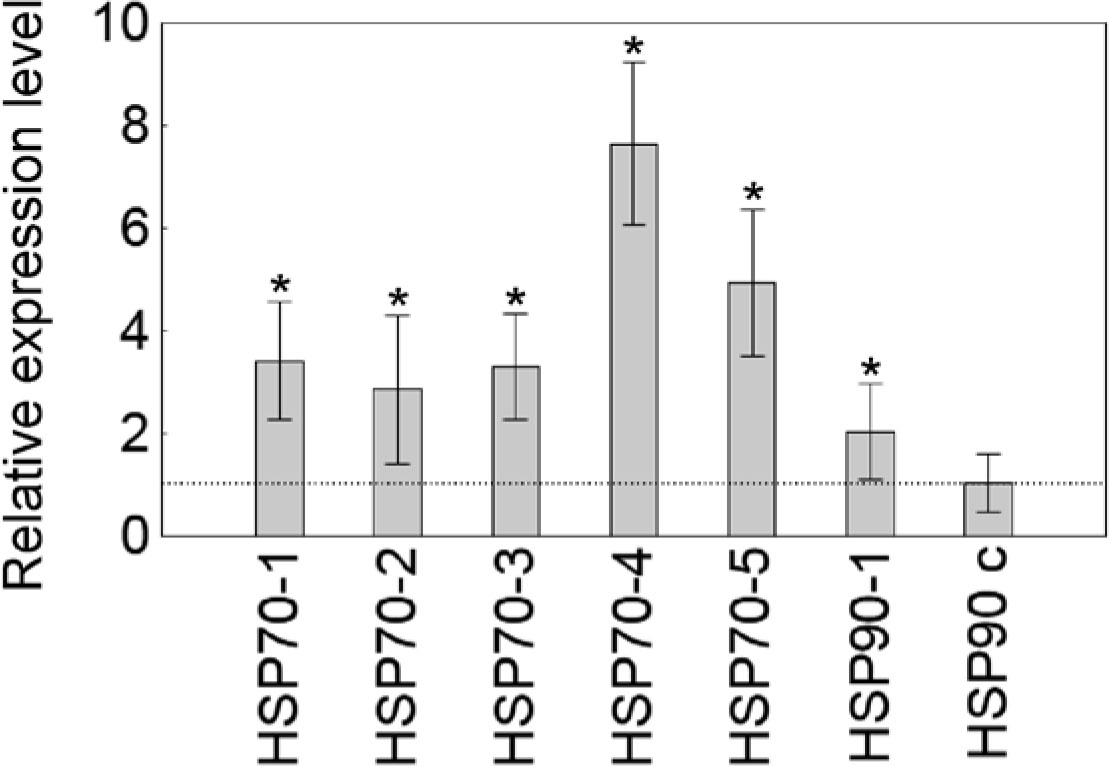
Figure 2
An effect of clinostat rotation on expression of HSP70 and HSP90 genes in Arabidopsis thaliana (Col) seedlings. The bars present the fold change of transcript abundance in 12-d-old seedlings grown under clinorotation relative to the control (seedlings grown under stationary conditions, = 1; dotted line). HSP90 c represents AtHSP90-2, AtHSP90-3, and AtHSP90-4 (in total). Bars denoted with an asterisk (*) indicate differences between the rotated and control seedlings that are statistically significant, compared with the control (Student's t-test, p < 0.05). Expression levels were assessed using RT-qPCR and normalized with respect to UBQ5 mRNA. Data are means of three independent biological samples with three analytical replicates ± s.d.
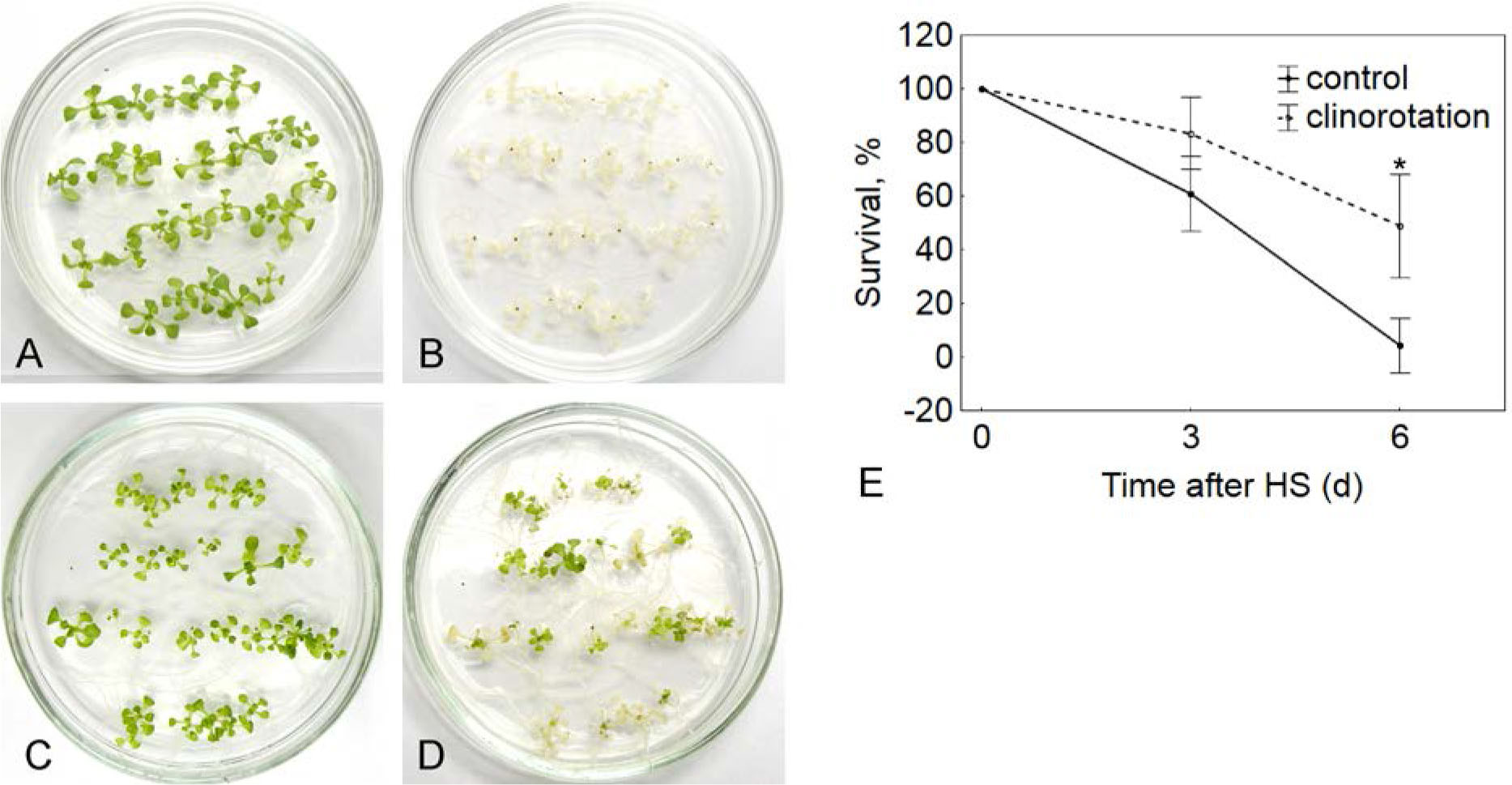
Figure 3
An effect of clinostat rotation on heat shock survival of Arabidopsis thaliana (Col) seedlings. 12-d-old seedlings grown under stationary conditions (control) (A, B) or clinorotation (C, D) at 22 ± 1°C were exposed at 45°C for 45 min and recovered under the stationary conditions. (A, C) seedlings before the heat treatment and (B, D) seedlings after a 6-d recovery period (B, D). (E) Survival rate of the seedlings after the heat treatment. Data are means ± s.d. (n = 3 plates with ~25 seedlings each; * Student's t-test, p < 0.05).
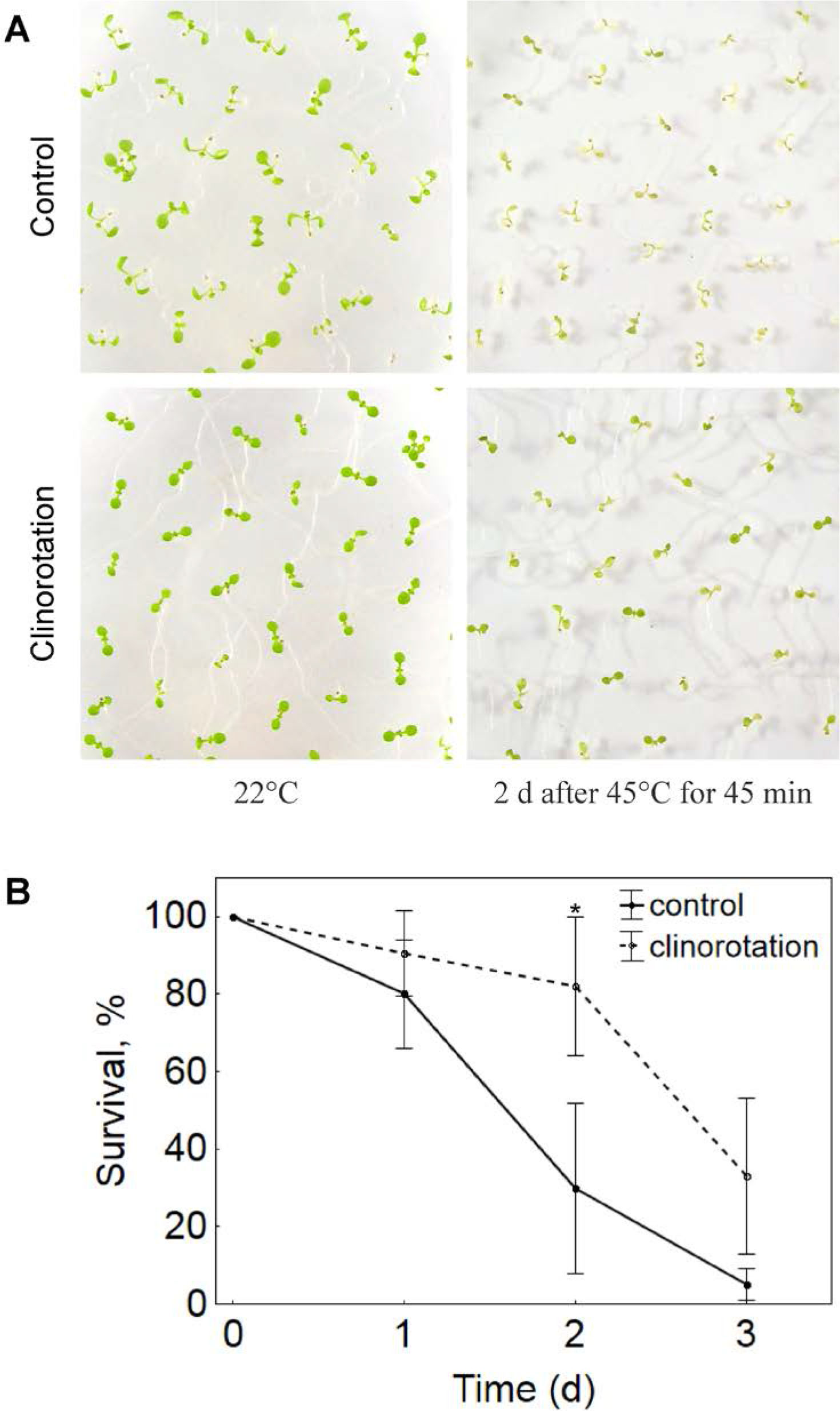
Figure 4
An effect of clinostat rotation on heat shock survival of Arabidopsis thaliana (Col) seedlings. (A) 5-d-old seedlings grown in the stationary conditions or under clinostat rotation at 22 ± 1°C were exposed at 45°C for 45 min, and recovered under the stationary conditions for 3 d. (B) Survival rate of the seedlings after the heat treatment. Data are means ± s.d. (n = 3; * Student's t-test, p < 0.05).