Have a personal or library account? Click to login
Hemodynamic and Neuroendocrinological Responses to Artificial Gravity Cover

Hemodynamic and Neuroendocrinological Responses to Artificial Gravity

Open Access
|Jul 2020

Figures & Tables

Figure 1

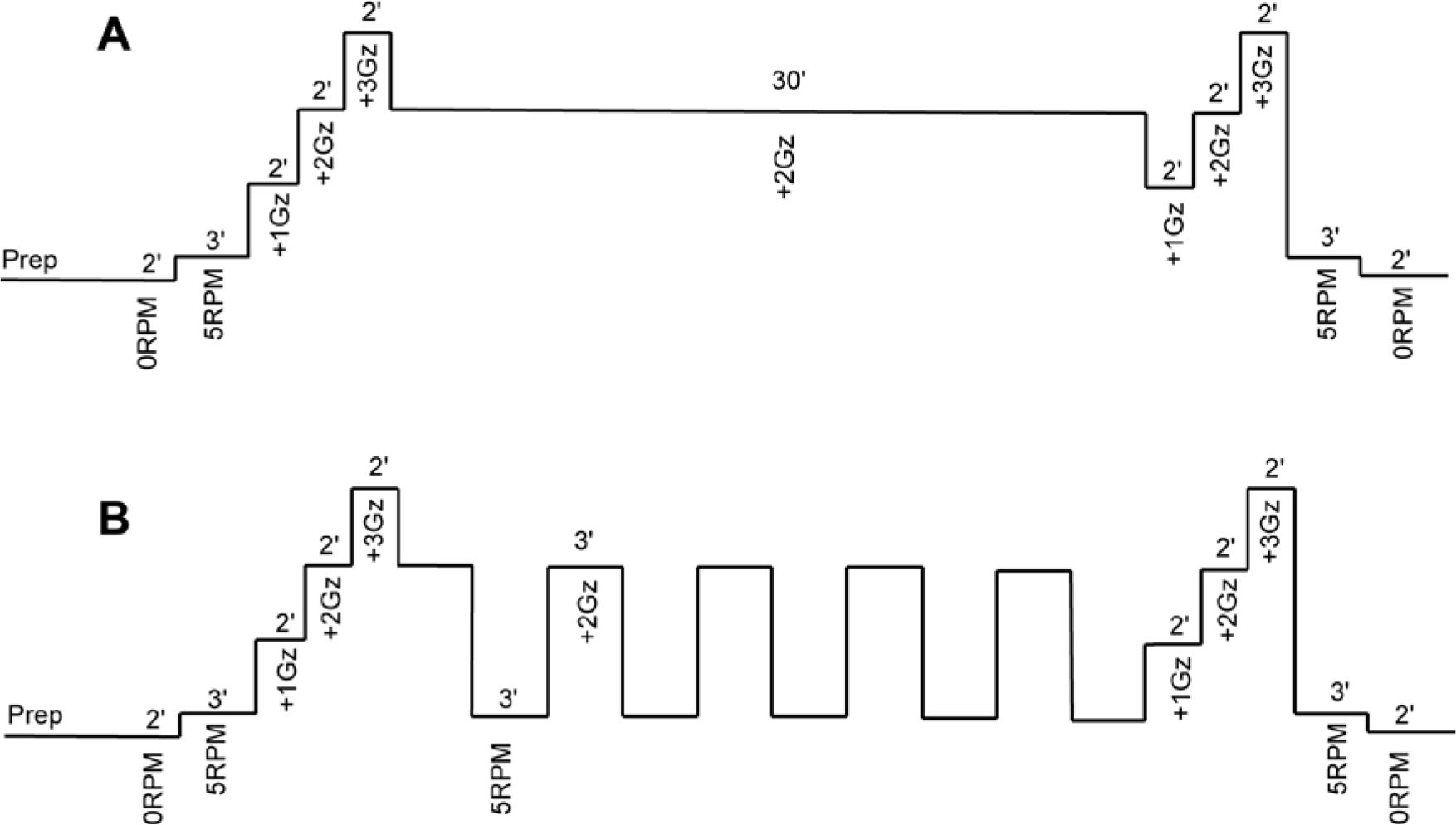
Experimental protocol of continuous (A) or intermittent (B) application of artificial gravity (AG). Panel (A) displays the results generated by a short arm centrifuge, illustrating periods of baseline measurement and all Gz accelerations (at 5 RPM, 1 Gz, 2 Gz, and 3 Gz), including the duration of each Gz acceleration (1′, 2′, and 30′). Panel B displays the results generated by a short arm centrifuge, illustrating periods of baseline measurement and all Gz accelerations (at 5 RPM, 1 Gz, 2 Gz, and 3 Gz), including the duration of each Gz acceleration (1′, 2′, 3′, and 30′). ′ indicates minutes.
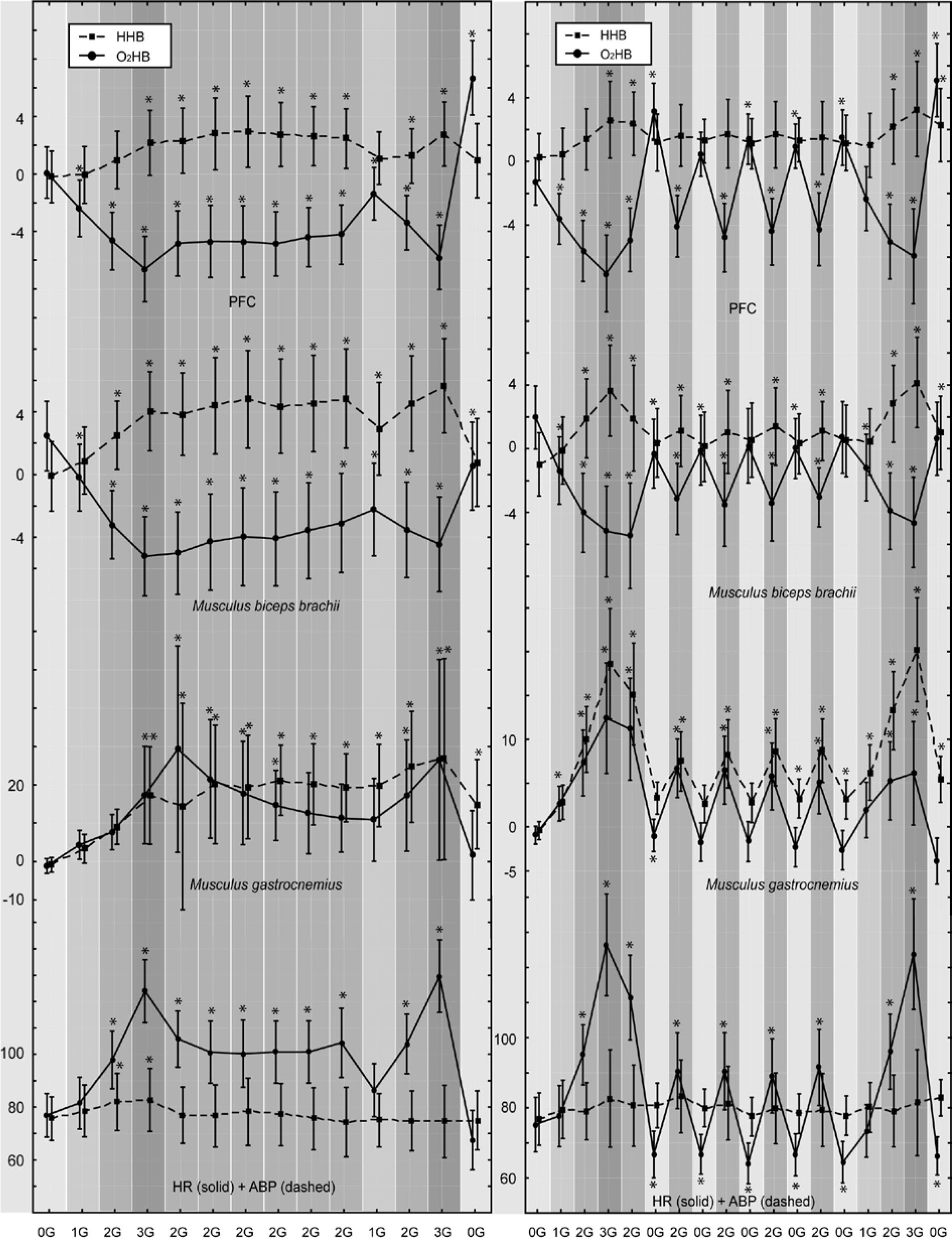

Figure 2

Analysis of oxygenated blood (O2Hb) and deoxygenated blood (HHb) in response to either continuous or intermittent artificial gravity (AG) application. Means and confidence intervals (95%) for O2Hb and HHb concentrations in the prefrontal cortex (PFC) are shown in the graphs on the top row, for the Musculus biceps brachii in the graphs in the second row, for the Musculus gastrocnemius in the graphs on the third row, and for heart rate (HR) and blood pressure (BP) in the graphs on the bottom row. The graphs on the left are the results from the continuous protocol, while the graphs on the right are the results from the intermittent protocol. Asterisks (*) mark differences (p<.05) from baseline (0 G, 5 RPM) values.

Brain-derived neurotrophic factor (BDNF), insulin-like growth factor 1(IGF-1), and vascular endothelial growth factor (VEGF) values pre and post interventions_

AG constant [pg/ml]AG intermittent [pg/ml]
PrePostPrePost
BDNFn=1112212,66±8716,7710028,43±10637,029912,01±10748,1312195,94±11949,15
IGF-1n=10139,31±68,64144,48±74,03137,99±60,75143,53±69,55
VEGFn=10174,77±146,25159,61±169,65186,29±166,47180,22±181,45
Language: English
Page range: 80 - 88
Published on: Jul 21, 2020
Published by: American Society for Gravitational and Space Research
In partnership with: Paradigm Publishing Services
Publication frequency: 2 issues per year

© 2020 Stefan Schneider, Vanja Sebastian Zander, Tobias Vogt, Vera Abeln, Heiko K. Strüder, Amrei Jacubowski, Heather Carnahan, Petra Wollseiffen, published by American Society for Gravitational and Space Research
This work is licensed under the Creative Commons Attribution-NonCommercial-NoDerivatives 3.0 License.