
| CNT | = | Nanoporous Carbon Composites |
| ESP | = | Energetic Solar Particle |
| EVA | = | Extravehicular Activity |
| GCR | = | Galactic Cosmic Ray |
| GEO | = | Geostationary Orbit |
| GLE | = | Ground Level Event |
| GTO | = | Geostationary Transfer Orbit |
| HDPE | = | High Density Polyethylene |
| LEO | = | Low Earth Orbit |
| MEO | = | Medium Earth Orbit |
| MH | = | Metal Hydride |
| MOF | = | Metal Organic Framework |
| SPE | = | Solar Particle Event |
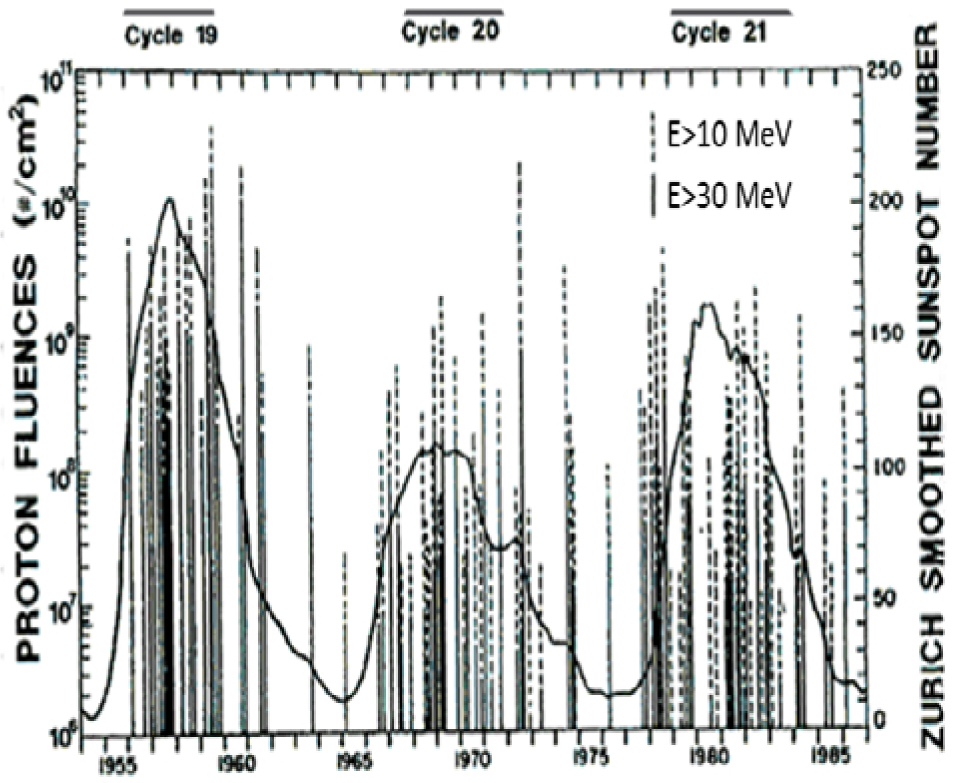
Figure 1.
SPEs in accordance with the solar cycle (NASA, 2008). (This figure is from a NASA document and is not subject to copyright within the US.)
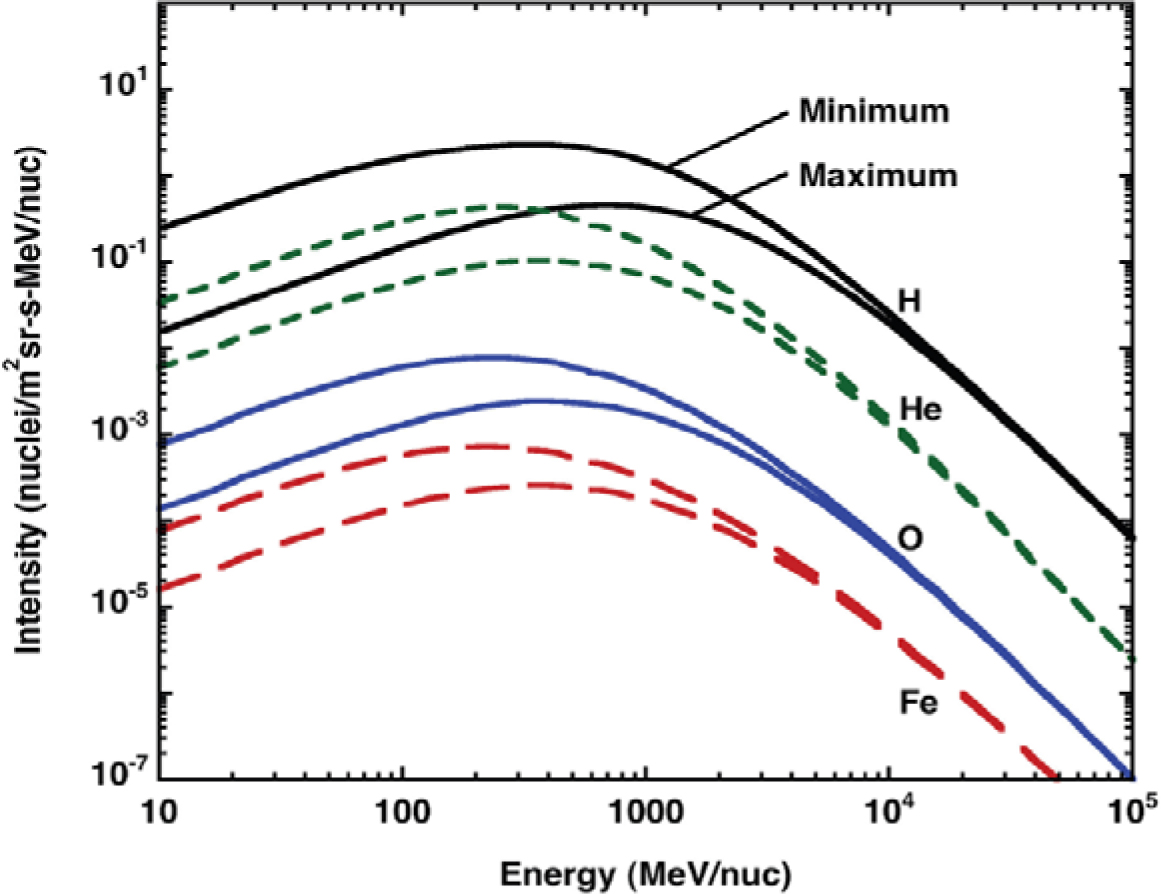
Figure 2.
Differential fluence of several GCR elemental species (hydrogen, helium, oxygen, and iron) for both solar minimum and solar maximum (Badhwar et al., 1994). (This figure is from NASA research and is not subject to copyright within the US.)
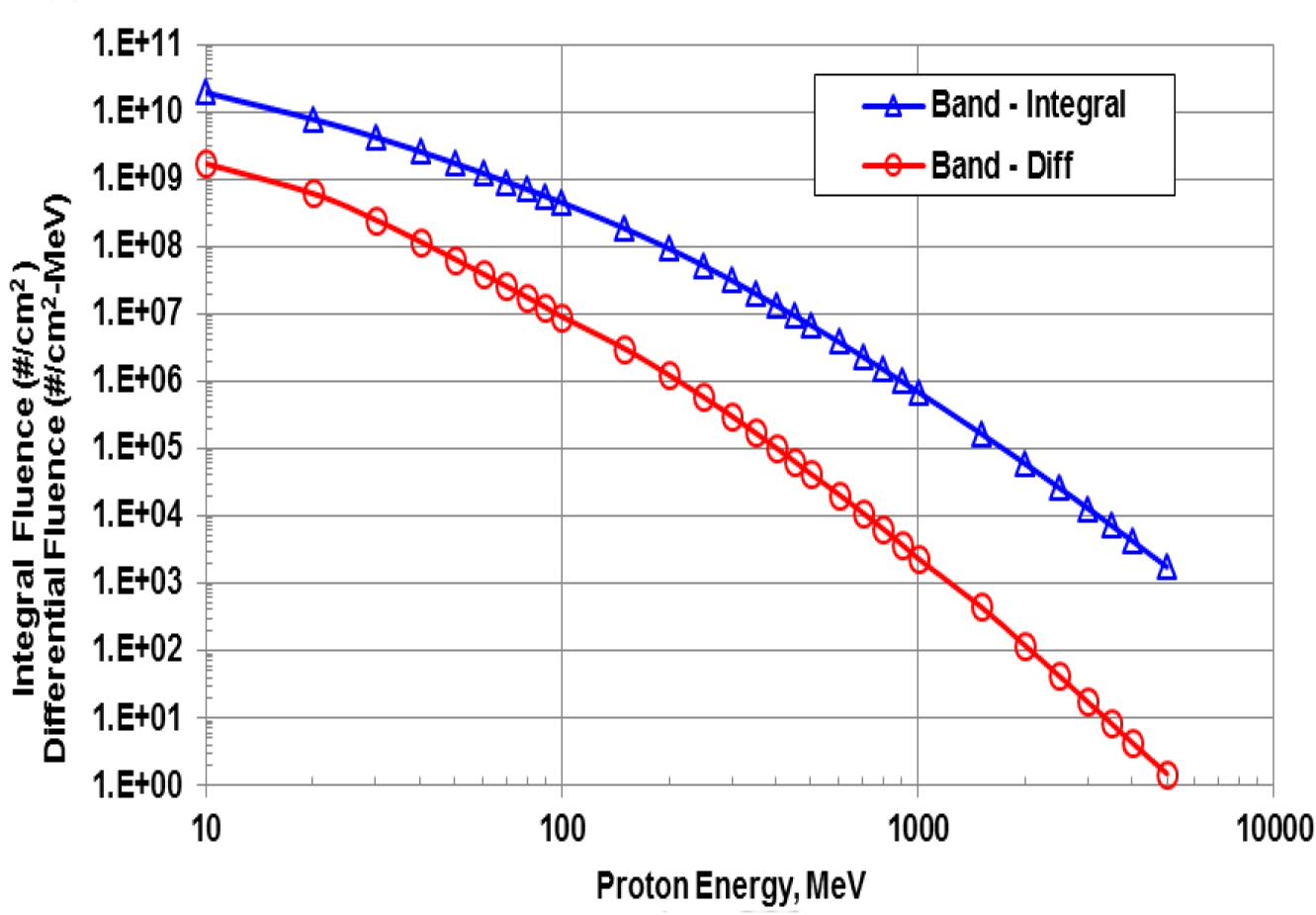
Figure 3.
Integral and differential energy spectra for the SPEs occurring 19-24 October 1989, which exhibited a high fluence of higher energy protons (Tylka and Dietrich, 2009). (The data in this figure was provided by William Atwell for the referenced paper and he has given permission for replication here.)
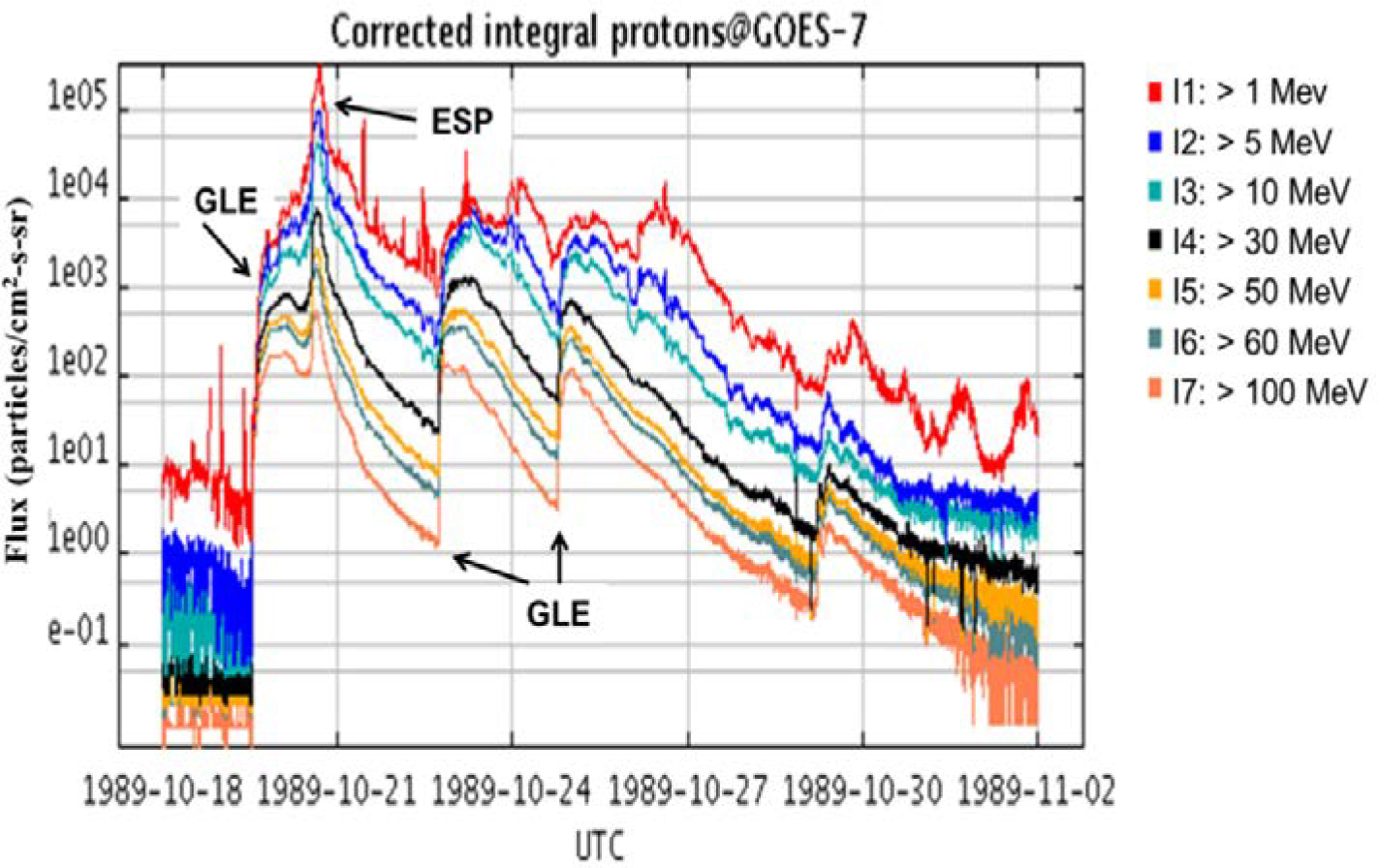
Figure 4.
Geostationary Operational Environmental Satellite system (GOES) satellite measurements of particle fluxes of various energies during the four SPEs of 19-24 October 1989. The times of the Ground Level Enhancements (GLE) and Energetic Solar Particles (ESP) are indicated on the plot. The ESP occurs when there is a bow shock enhancement of solar protons (NOAA, 2014). (The data in this figure is from the NOAA online database and is not subject to copyright within the US.)
Table 1.
Results of a preliminary study (Atwell et al., 2014).
| MOFs | CNTs | MHs | Total | |
|---|---|---|---|---|
| Superior to HDPE | 1 | 7 | 1 | 9 |
| Between Al and HDPE | 9 | 7 | 14 | 30 |
| Inferior to Al | 0 | 0 | 25 | 25 |
Table 2.
MOF material formulas and densities used for radiation transport calculations and the simulated space radiation environment (“Exposure”) used. “Base” signifies the unaltered material, “H” is the hydrogen-loaded version, and “CH4” is the methane-loaded version. This information was provided by Drs. Daniel Liang, Matthew Hill, and Song Song.
| MOF | |||
|---|---|---|---|
| Loading Condition | Chemistry | Density (g/cm 3) | Exposure |
| Base | C432H288Be48O144 | 0.42 | GCR |
| H | C432H1120Be48O144 | 0.46 | GCR |
| Base | Mg18O54H18C72 | 0.91 | GCR |
| H | Mg18O54H141C72 | 0.95 | GCR |
| Base | Al4O32C56H44 | 1.61 | GCR |
| H | Al4O32C56H96 | 1.68 | GCR |
| Base | C200H128* | 0.31 | GCR |
| H | C200H325* | 0.35 | GCR |
| Base | C27H31NO22Sc3 | 1.03 | GCR |
| H | C27H66NO22Sc3 | 1.07 | GCR |
| Base | Zn216C3132O702H1242 | 0.25 | SPE, GCR |
| H | Zn216C3132O702H14814 | 0.30 | SPE, GCR |
| CH4 | Zn216C4189O702H5470 | 0.31 | SPE, GCR |
| Base | C1536H864Cu96N32O480 | 0.47 | SPE, GCR |
| H | C1536H2734Cu96N32O480 | 0.50 | SPE, GCR |
| CH4 | C1908H2352Cu96N32O480 | 0.55 | SPE, GCR |
| Base | C288H96Cu48O240 | 0.95 | SPE, GCR |
| H | C288H531Cu48O240 | 0.99 | SPE, GCR |
| CH4 | C362H392Cu48O240 | 1.06 | SPE, GCR |
| Base | H112C192O128Zr12Ti12 | 1.10 | SPE, GCR |
| H | H260C192O128Zr12Ti12 | 1.33 | SPE, GCR |
| CH4 | H208C216O128Zr12Ti12 | 1.17 | SPE, GCR |
| Base | H112C192O128Zr24 | 1.20 | SPE, GCR |
| H | H260C192O128Zr24 | 1.22 | SPE, GCR |
| CH4 | H208C216O128Zr24 | 1.27 | SPE, GCR |
Table 3.
CNT material formulas and densities used for radiation transport calculations and the simulated space radiation environment (“Exposure”) used. “Base” signifies the unaltered material, “H” is the hydrogen-loaded version, and “CH4” is the methane-loaded version. The subscripts give the mole percent of each radical in the group. This information was provided by Drs. Daniel Liang, Matthew Hill, and Song Song.
| CNT | |||
|---|---|---|---|
| Loading Condition | Chemistry | Density (g/cm 3) | Exposure |
| Base | C2H4 | 0.95 | SPE, GCR |
| Base | (C2H4)97.7C2.30 | 0.95 | SPE, GCR |
| H | (C2H4)97.7(CH3)2.3 | 0.95 | SPE, GCR |
| CH4 | (C2H4)97.7(CH4)0.32C1.98 | 0.95 | SPE, GCR |
| Base | (C2H4)93.27C6.73 | 0.96 | SPE, GCR |
| H | (C2H4)93.27(CH3)6.73 | 0.96 | SPE, GCR |
| CH4 | (C2H4)93.27(CH4)0.93C5.8 | 0.96 | SPE, GCR |
| Base | (C2H4)89.06C10.94 | 0.97 | SPE, GCR |
| H | (C2H4)89.06(CH3)10.94 | 0.97 | SPE, GCR |
| CH4 | (C2H4)89.06(CH4)1.51C9.43 | 0.97 | SPE, GCR |
| Base | (C2H4)79.41C20.59 | 1.00 | SPE, GCR |
| H | (C2H4)79.41(CH3)20.59 | 1.00 | SPE, GCR |
| CH4 | (C2H4)79.41(CH4)2.84C17.75 | 1.00 | SPE, GCR |
| Base | (C2H4)63.16C36.84 | 1.04 | SPE, GCR |
| H | (C2H4)63.16(CH3)36.84 | 1.04 | SPE, GCR |
| CH4 | (C2H4)63.16(CH4)5.08C31.76 | 1.04 | SPE, GCR |
| Base | (C2H4)50C50 | 1.10 | SPE, GCR |
| H | (C2H4)50(CH3)50 | 1.11 | SPE, GCR |
| CH4 | (C2H4)50(CH4)6.9C43.1 | 1.10 | SPE, GCR |
| Base | (C2H4)39.13C60.87 | 1.16 | SPE, GCR |
| H | (C2H4)39.13(CH3)60.87 | 1.17 | SPE, GCR |
| CH4 | (C2H4)39.13(CH4)8.4C52.49 | 1.16 | SPE, GCR |
Table 4.
MH material formulas and densities used for radiation transport calculations and the simulated space radiation environment (“Exposure”) used. “Base” signifies the unaltered material and “H” is the hydrogen-loaded version. This information was provided by Drs. Daniel Liang, Matthew Hill, and Song Song.
| MH | |||
|---|---|---|---|
| Loading Condition | Chemistry | Density (g/cm3) | Exposure |
| Base | Li2.35Si | 1.67 | GCR |
| H | 91% Li2.35Si and 9% H | 0.84 | GCR |
| Base | LiB | 1.65 | GCR |
| H | 91% LiB and 9% H | 0.67 | GCR |
| Base | CaNi5 | 6.60 | GCR |
| H | 96% CaNi5 and 4% H | 6.6 | GCR |
| H | CaNi5H6 | 5.01 | GCR |
| Base | LaNi4.7Al0.3 | 8.00 | GCR |
| H | LaNi4.7Al0.3H6 | 6.08 | GCR |
| H | 96% LaNi4.7Al0.3 and 4% H | 7.6 | GCR |
| Base | LaNi4.8Sn0.2 | 8.40 | GCR |
| H | LaNi4.8Sn0.2H6 | 6.38 | GCR |
| H | 96% LaNi4.8Sn0.2 and 4% H | 8.4 | GCR |
| Base | LaNi5 | 8.20 | GCR |
| H | LaNi5H6 | 6.22 | GCR |
| Base | Al2Cu | 5.83 | GCR |
| H | Al2CuH | 5.39 | GCR |
| Base | Al | 2.70 | GCR |
| H | AlH3 | 2.5 | GCR |
| H | BaAlH5 | 3.30 | GCR |
| H | SrAl2H2 | 2.64 | GCR |
| Base | Ti0.98Zr0.02V0.48Fe0.09Cr0.05Mn1.5 | 7.20 | GCR |
| H | Ti0.98Zr0.02V0.48Fe0.09Cr0.05Mn1.5H3.3 | 5.80 | GCR |
| Base | TiCr1.8 | 5.70 | GCR |
| H | TiCr1.8H3.5 | 4.50 | GCR |
| Base | TiFe0.9Mn0.1 | 6.50 | GCR |
| H | TiFe0.9Mn0.1H2 | 5.20 | GCR |
| H | LiAlH4 | 0.92 | GCR |
| H | LiMg(AlH4)3 | 1.80 | GCR |
| H | Mg(AlH4)2 | 2.24 | GCR |
| H | NaAlH4 | 1.81 | GCR |
| H | Y3Al2H6.5 | 4.10 | GCR |
| Base | V | 6.00 | GCR |
| H | VH | 5.60 | GCR |
| H | VH2 | 2.30 | GCR |
| Base | Li | 0.53 | GCR |
| H | 80% Li and 20% H | 0.57 | GCR |
| H | 85% Li and 15% H | 0.56 | GCR |
| H | 90% Li and 10% H | 0.55 | GCR |
| H | 95% Li and 5% H | 0.54 | GCR |
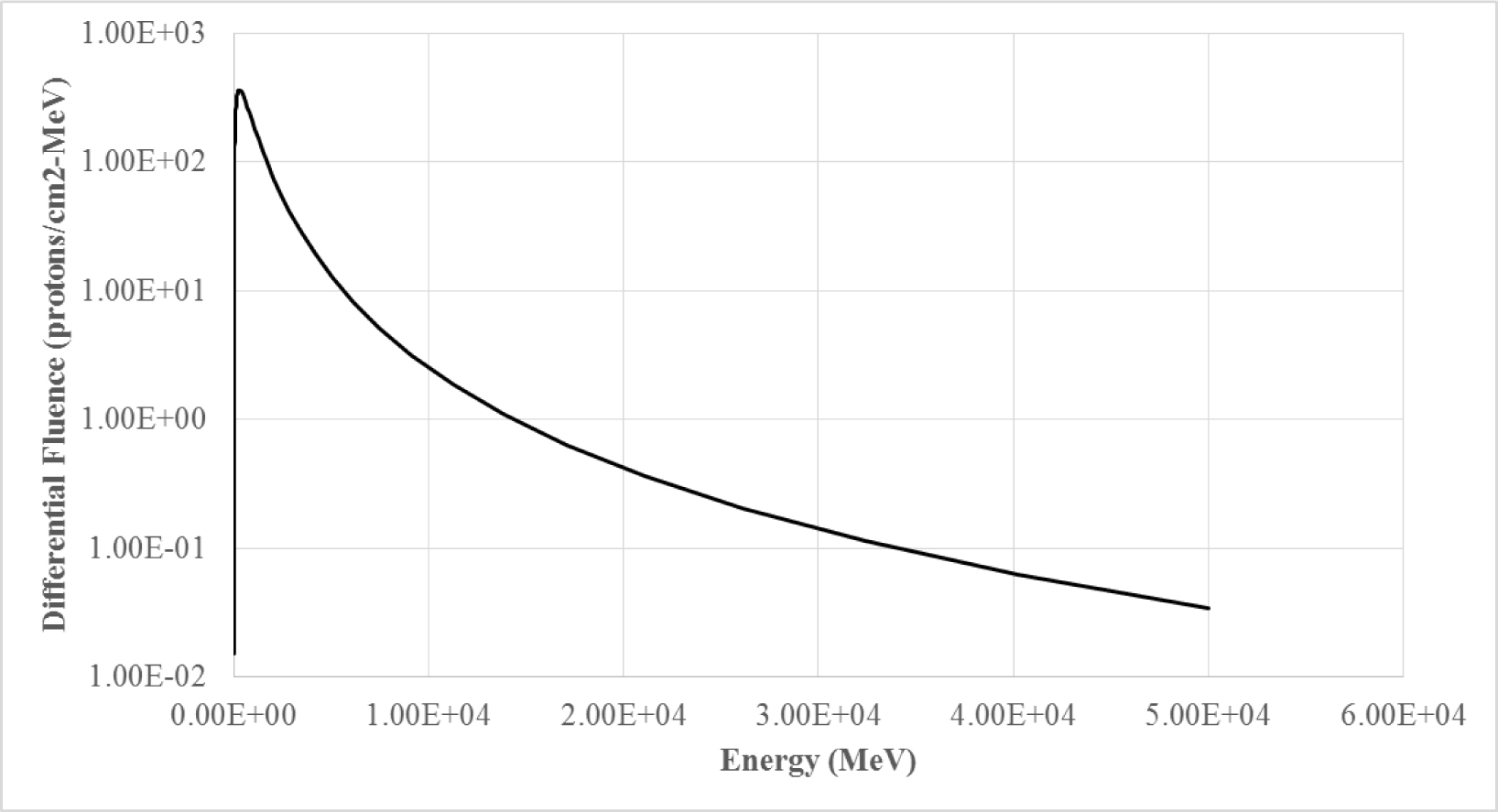
Figure 5.
Differential spectrum of the 1977 solar minimum GCR environment pre-coded into HZETRN. For ease of viewing, only the protons are plotted. The code includes a total of 39 species for the GCR environment.
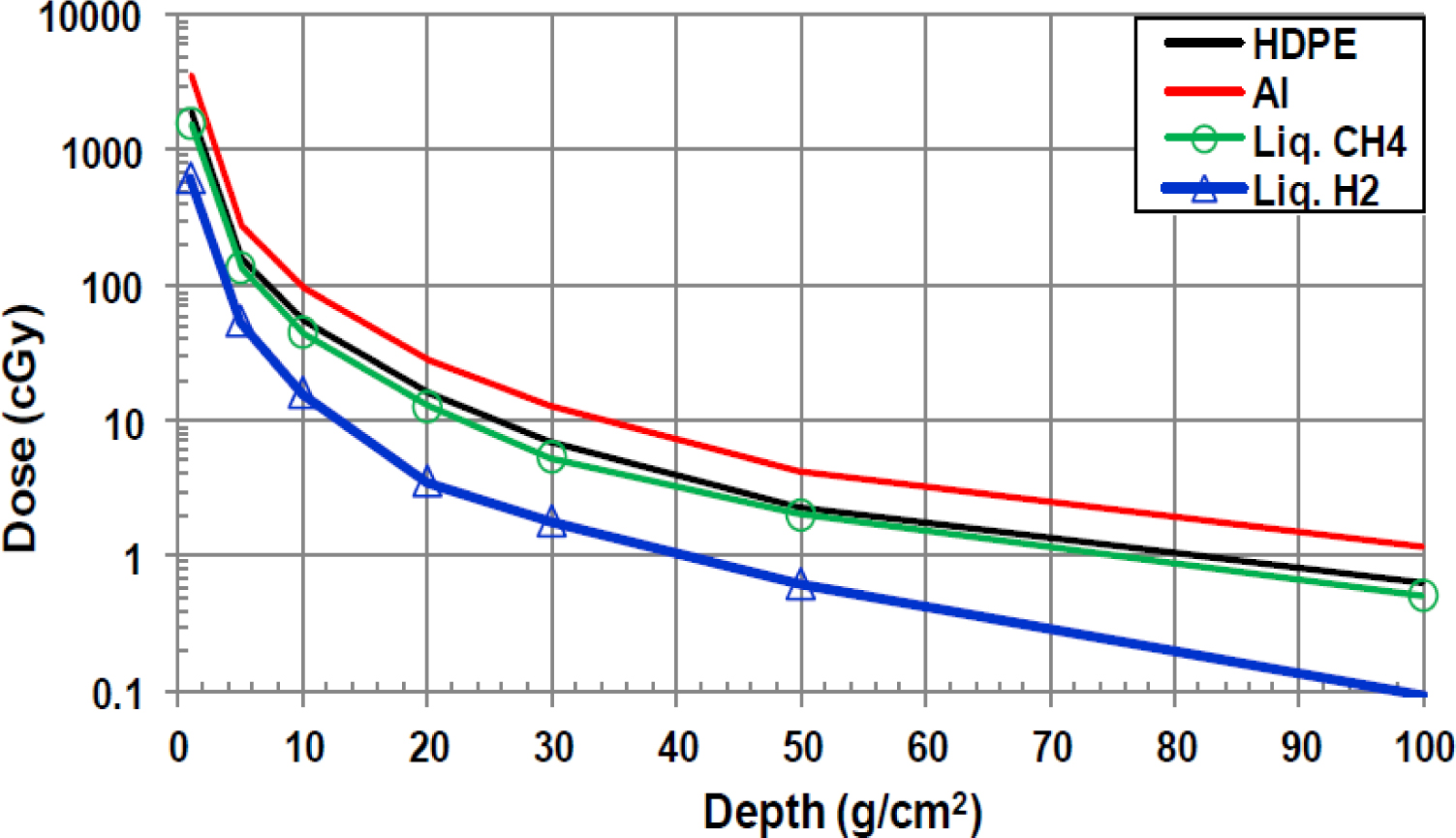
Figure 6.
SPE dose as a function of depth for liquid hydrogen, liquid methane, aluminum, and HDPE (Atwell et al., 2014). The input environment for this calculation is the Band fit of the October 1989 series of events (Figure 3), and the resultant data presented in this figure is from a simulation performed with HZETRN 2010 (Wilson et al., 1991; Wilson et al., 1995; Wilson et al., 2006; Slaba et al., 2010a; Slaba et al., 2010b).
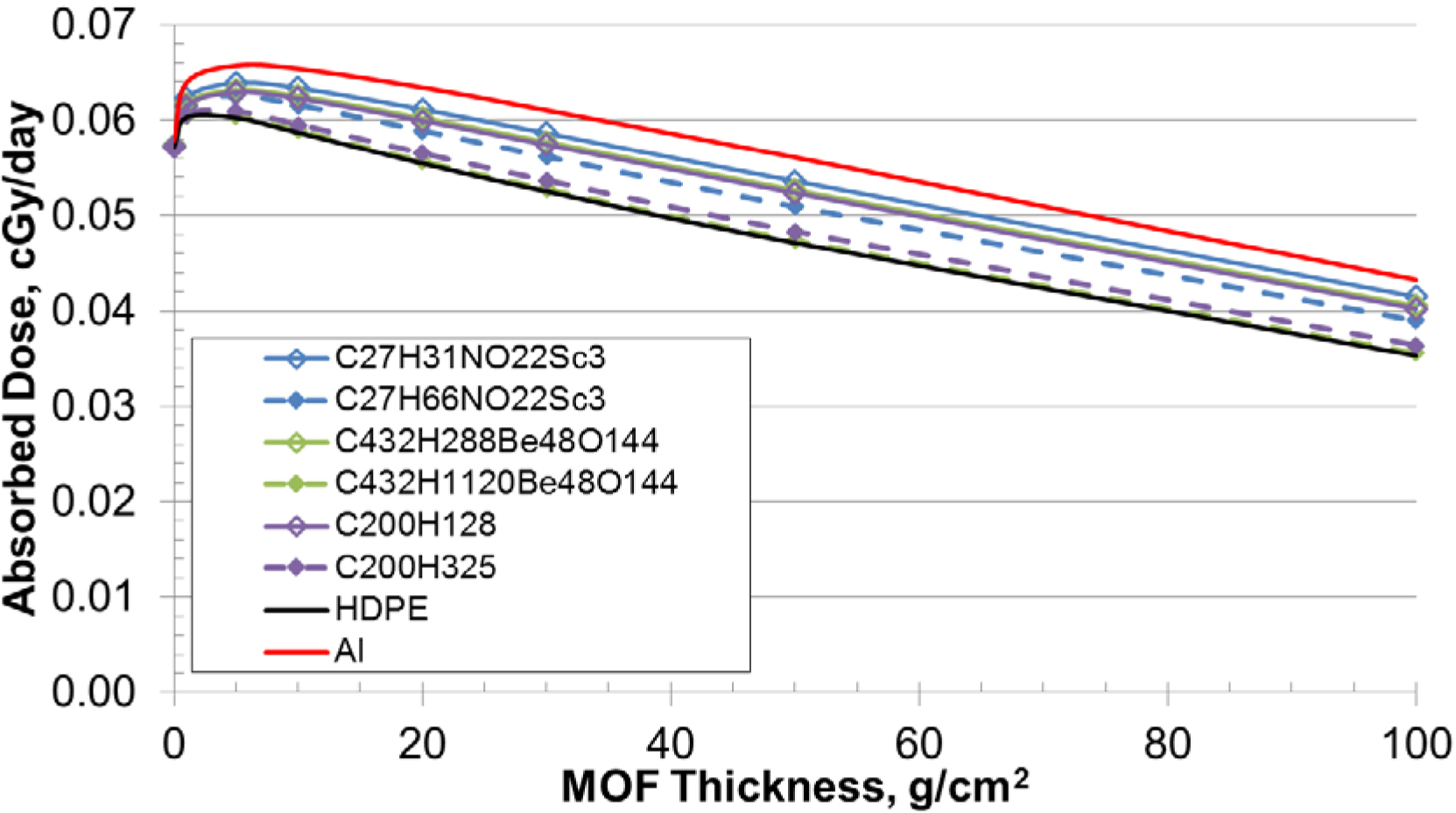
Figure 7.
GCR absorbed dose curves for three MOF materials and their hydrogen-loaded counterparts compared with aluminum (red) and HDPE (black). The hydrogen-loaded versions are denoted by a dashed line and a filled in marker. The non-hydrogen-loaded MOF is denoted by a solid line and an open marker.
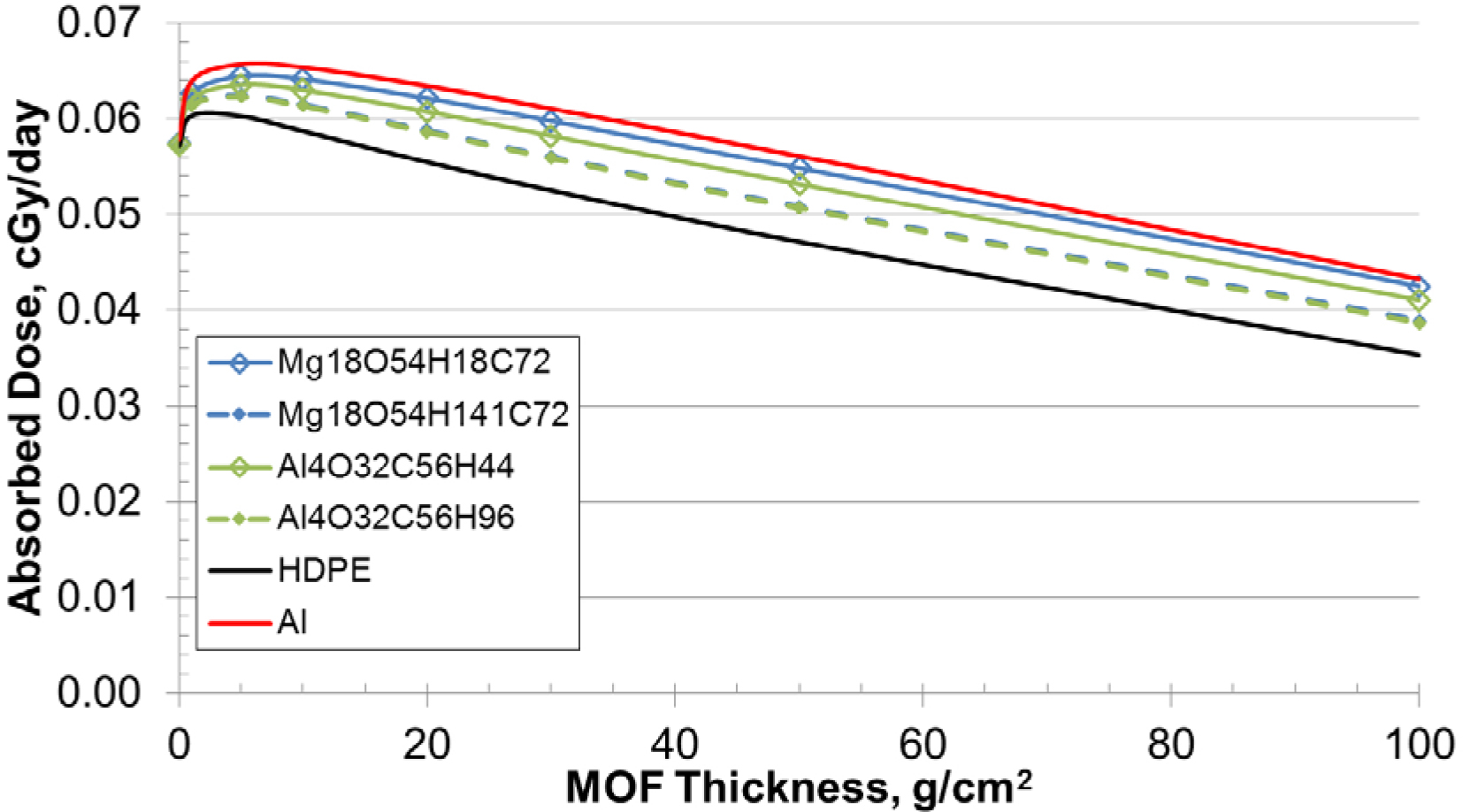
Figure 8.
GCR absorbed dose curves for two additional MOF materials and their hydrogen-loaded counterparts compared with aluminum (red) and HDPE (black). The hydrogen-loaded versions are denoted by a dashed line and a filled in marker. The non-hydrogen-loaded MOF is denoted by a solid line and an open marker.
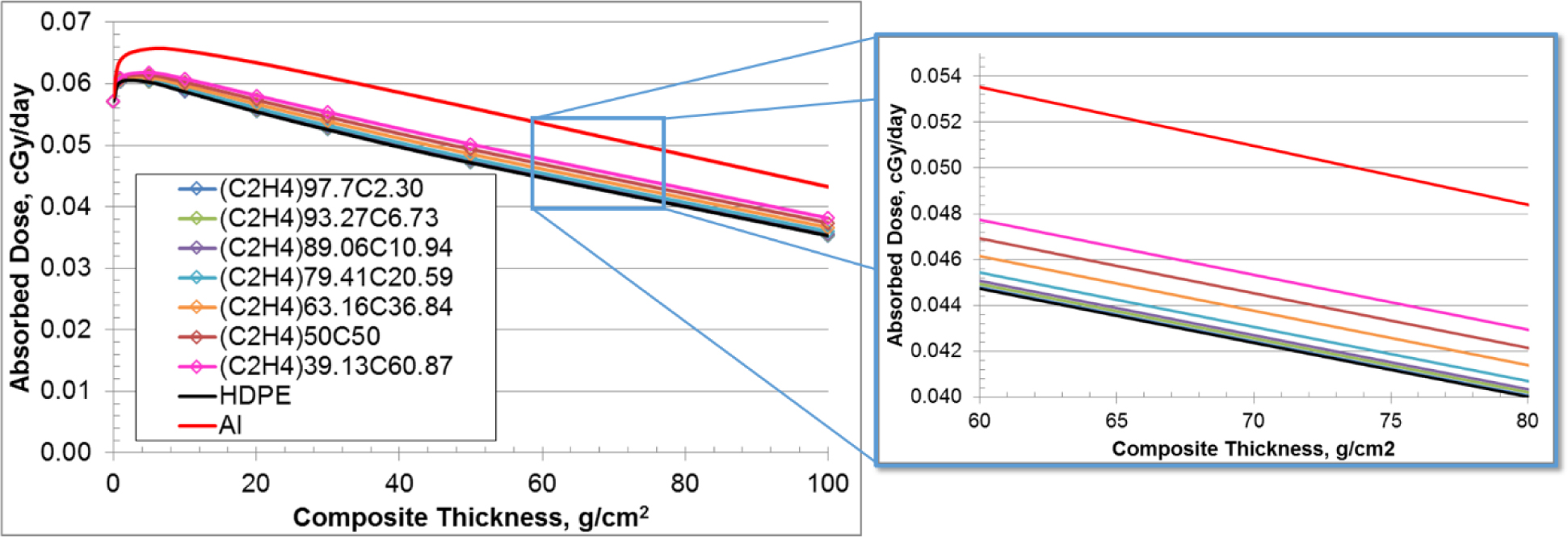
Figure 9.
GCR absorbed dose curves for seven non-hydrogen-loaded CNTs compared with aluminum (red) and HDPE (black).
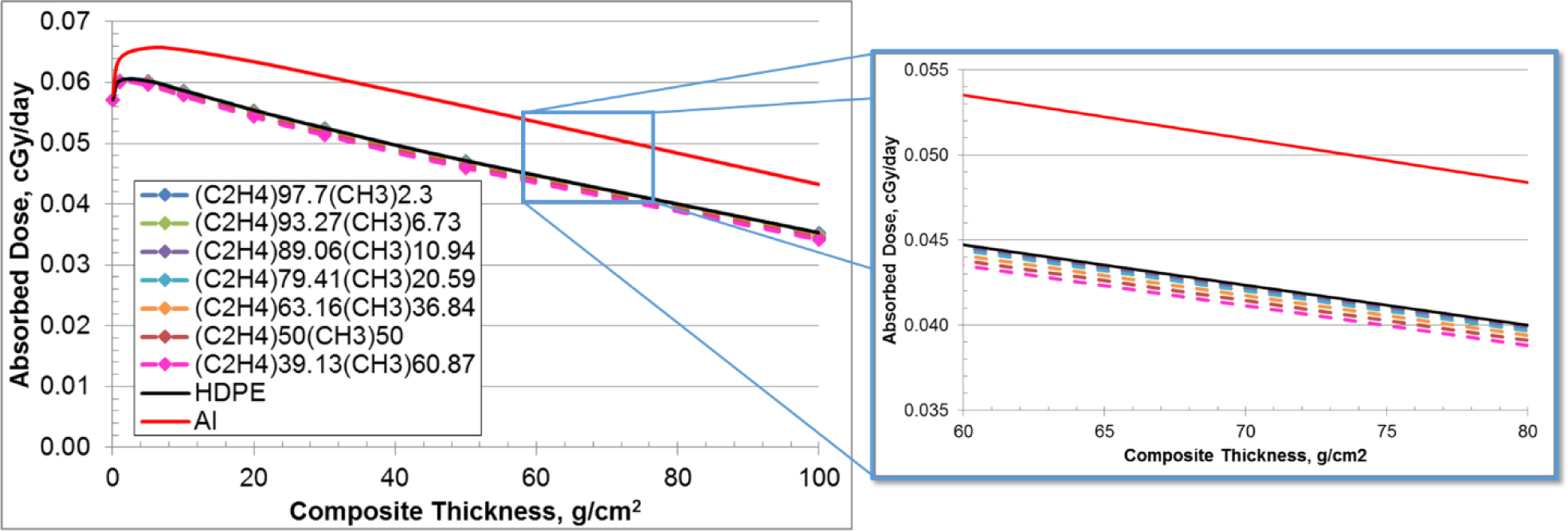
Figure 10.
GCR absorbed dose curves for seven hydrogen-loaded CNTs compared with aluminum (red) and HDPE (black).
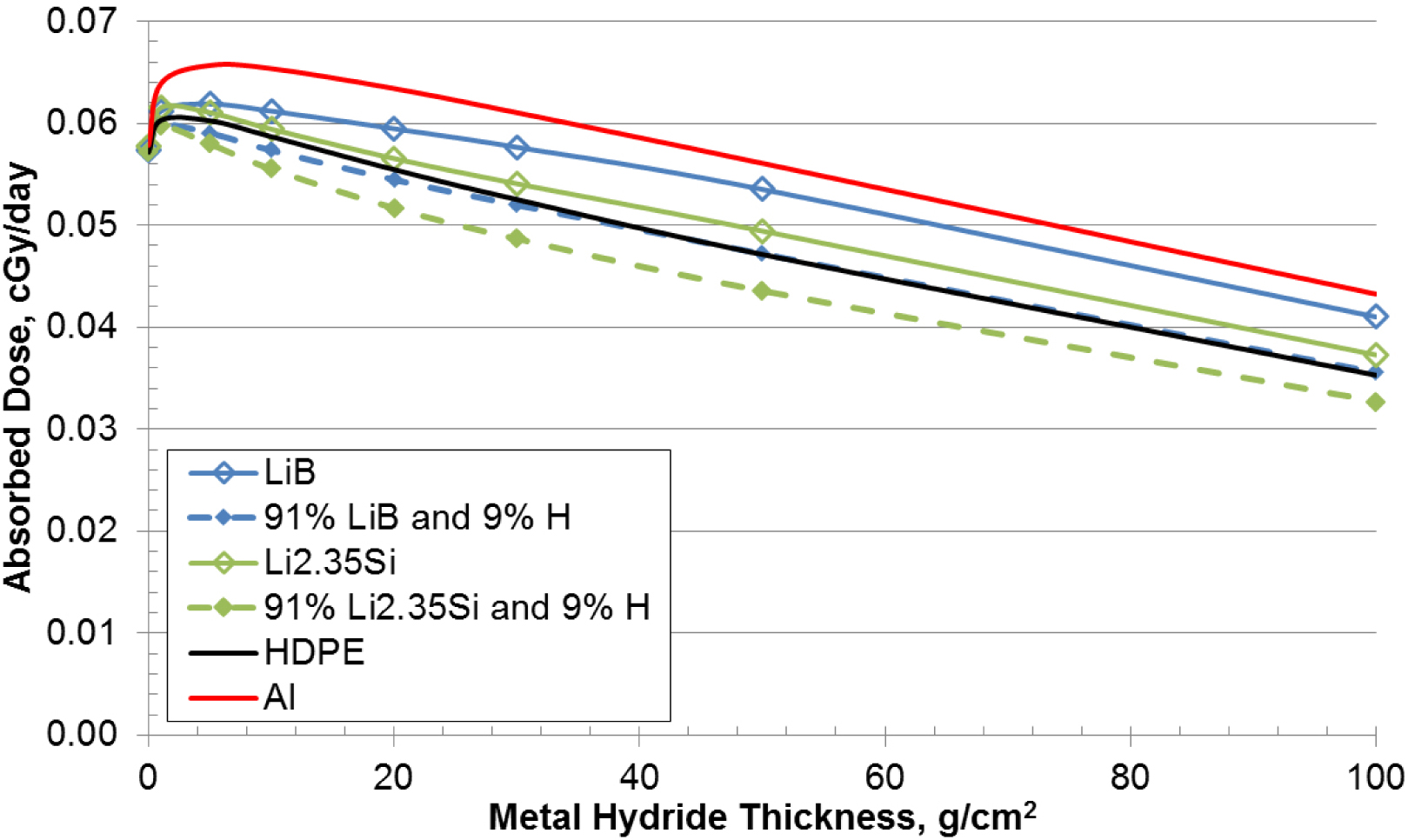
Figure 11.
GCR absorbed dose curves for five hydrogen-loaded lithium MHs compared with aluminum (red) and HDPE (black).
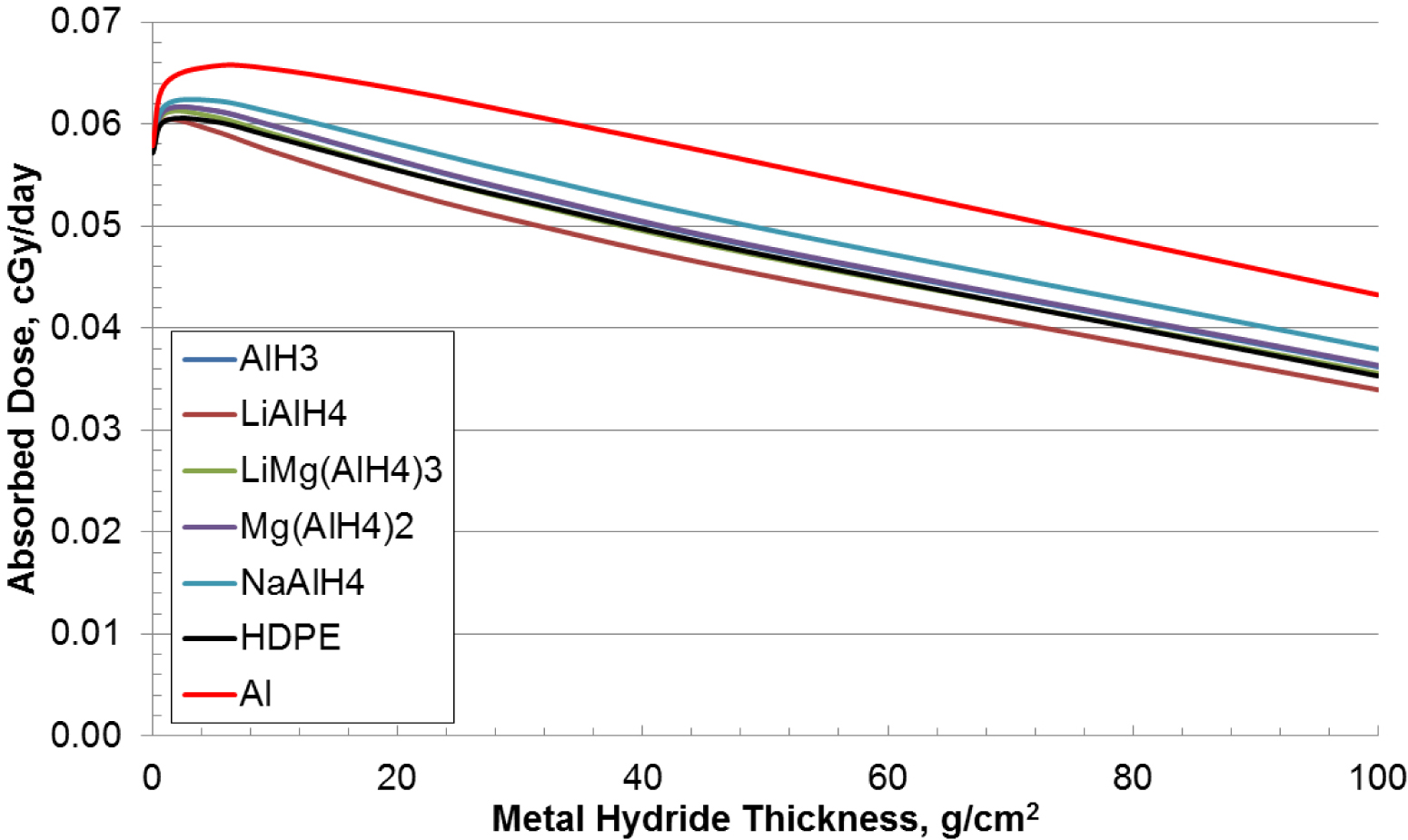
Figure 12.
GCR absorbed dose curves for five hydrogen-loaded MHs compared with aluminum (red) and HDPE (black).
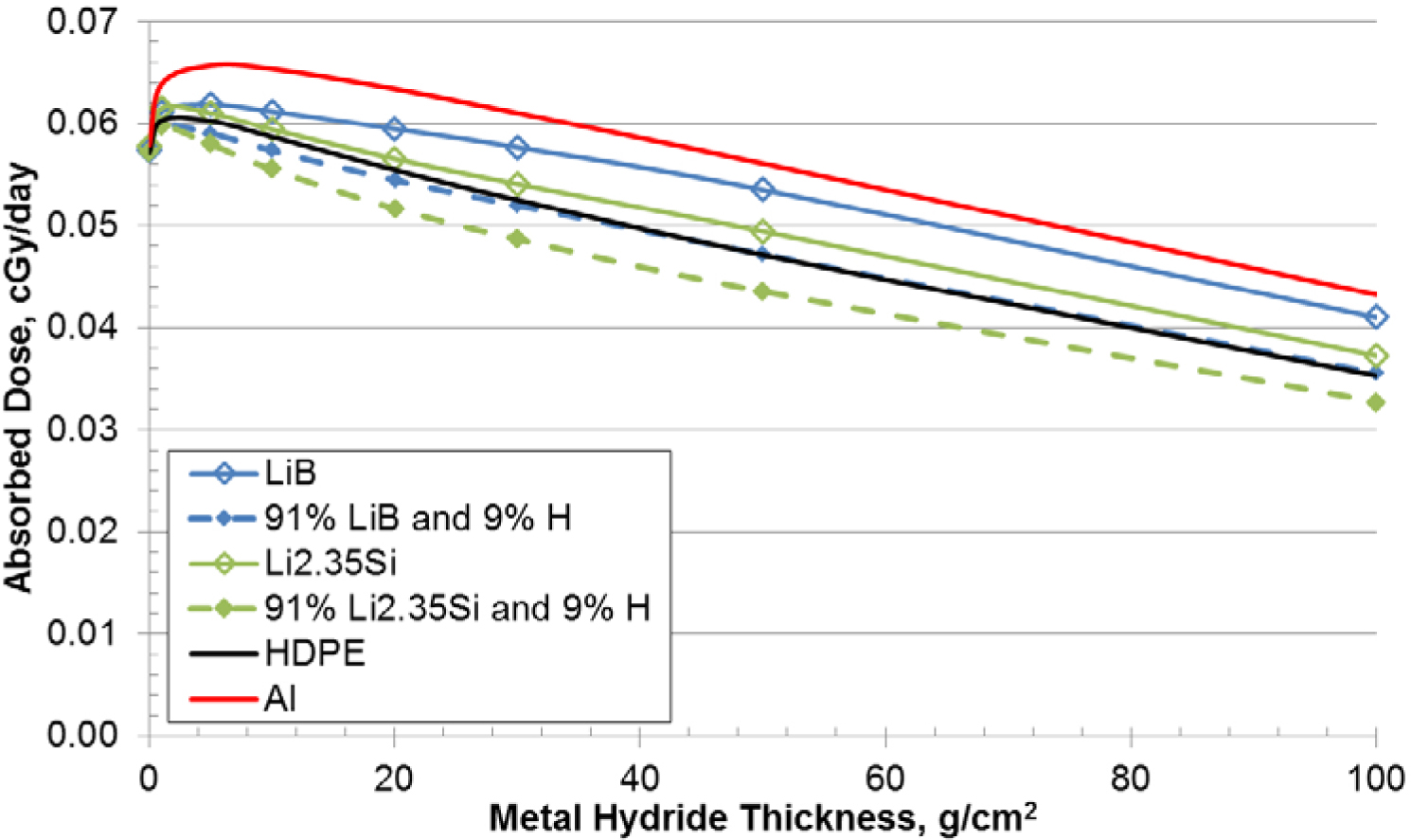
Figure 13.
GCR absorbed dose curves for two MHs and their hydrogen-loaded counterparts compared with aluminum (red) and HDPE (black). The non-loaded versions have solid lines and open markers. The hydrogen-loaded versions have dashed lines and filled markers.
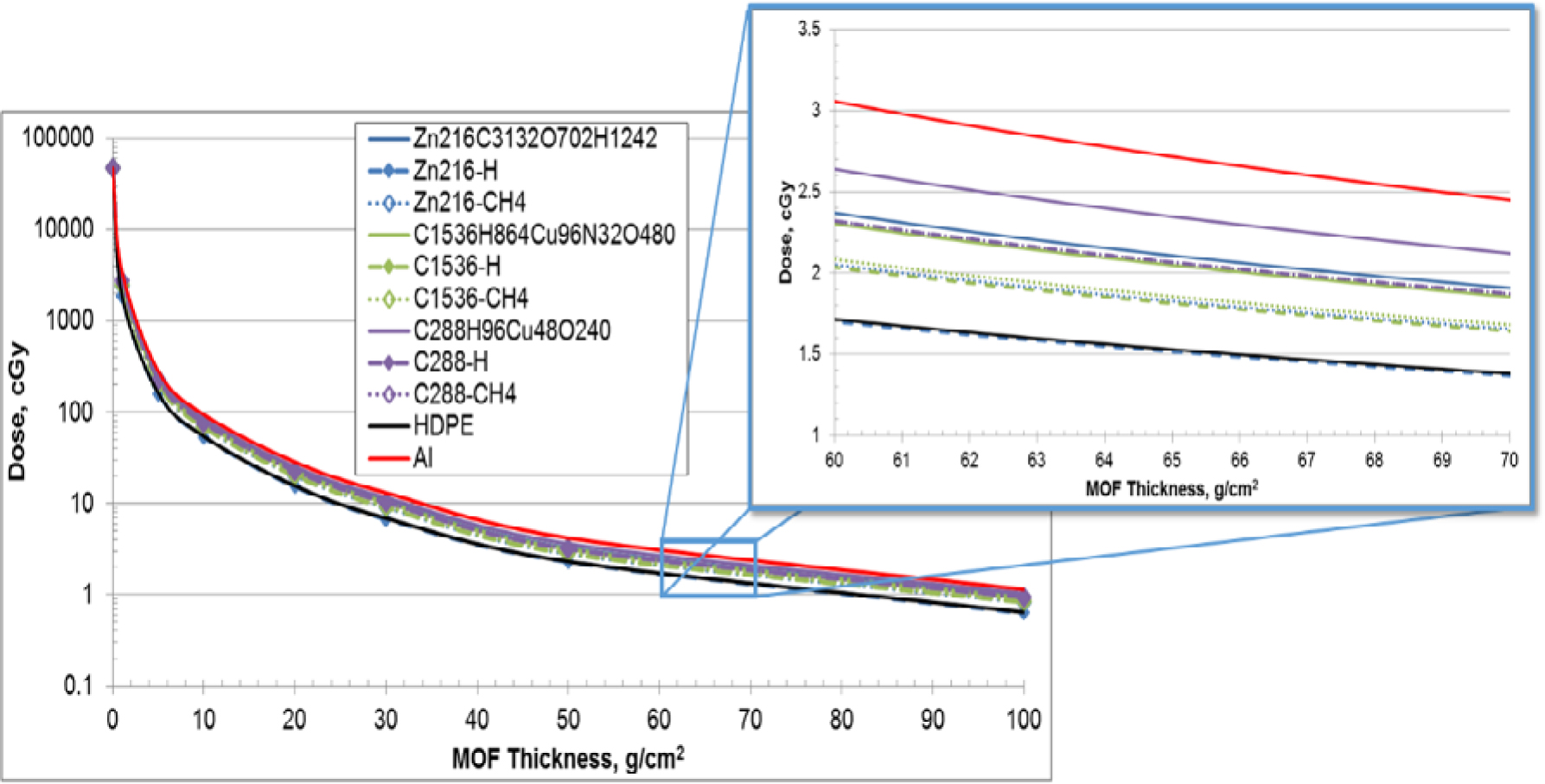
Figure 14.
SPE absorbed dose curves for three MOFs compared with their hydrogen-loaded and methane-loaded versions, as well as aluminum (red) and HDPE (black). The base MOF is depicted by a solid line, the hydrogen-loaded version is depicted by a dashed line and a filled marker, and the methane-loaded version is depicted by a dotted line and an open marker.
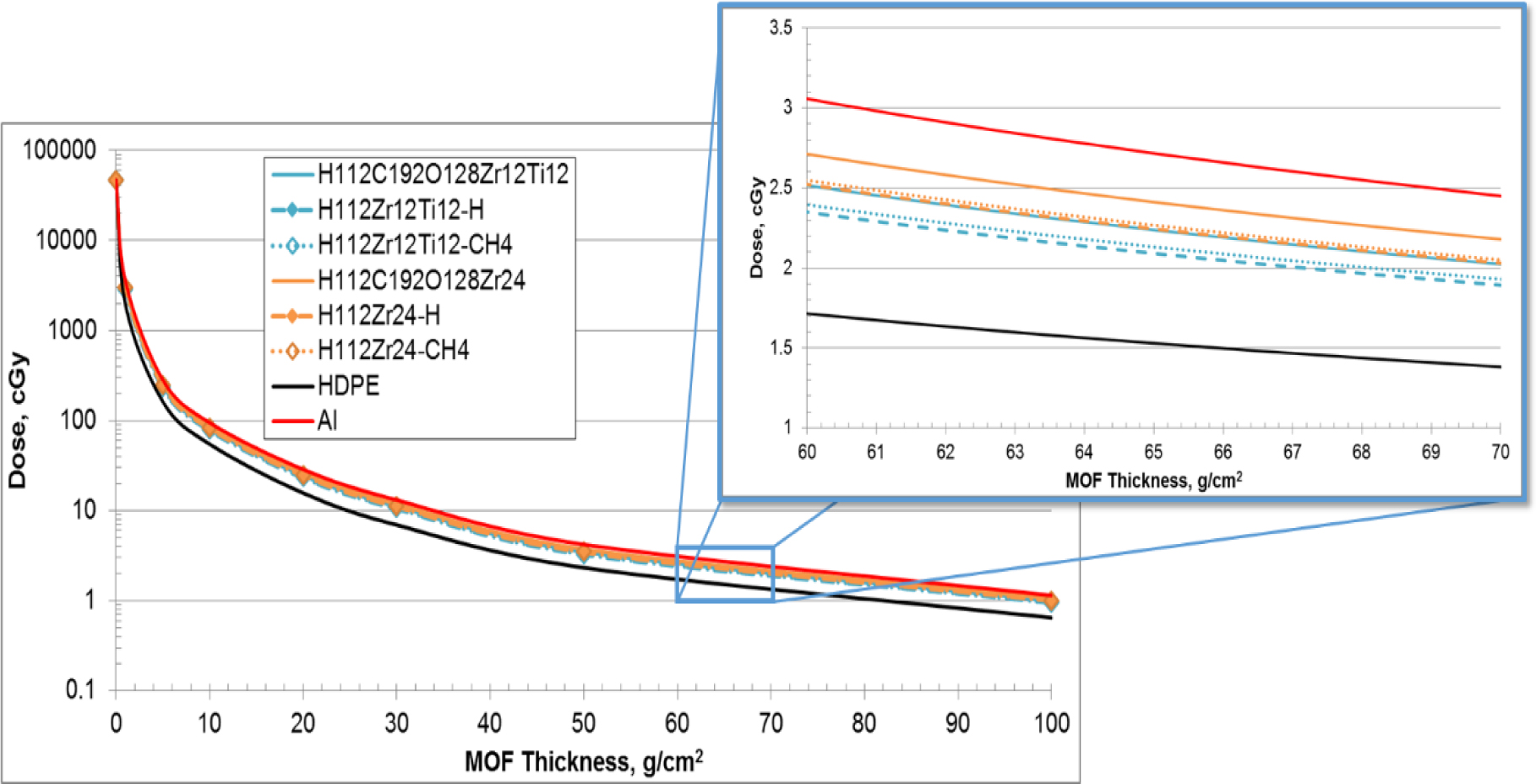
Figure 15.
SPE absorbed dose curves for two MOFs compared with their hydrogen-loaded and methane-loaded versions, as well as aluminum (red) and HDPE (black). The base MOF is depicted by a solid line, the hydrogen-loaded version is depicted by a dashed line and a filled marker, and the methane-loaded version is depicted by a dotted line and an open marker.
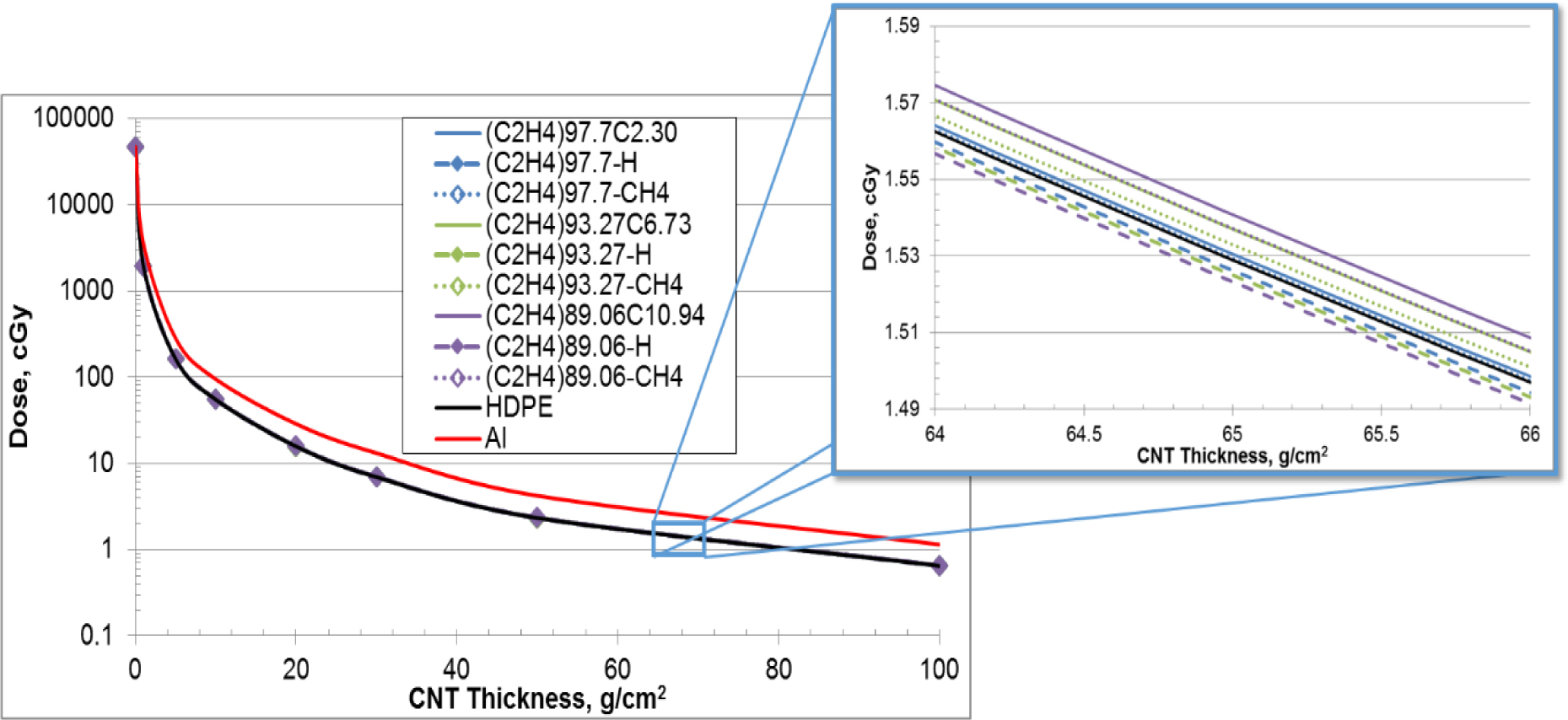
Figure 16.
SPE absorbed dose curves for three CNT materials compared with their hydrogen- and methane-loaded versions, as well as compared with aluminum (red) and HDPE (black). The base material is depicted by a solid line, the hydrogen-loaded version is depicted by a dashed line and a filled marker, and the methane-loaded version is depicted by a dotted line and an open marker.
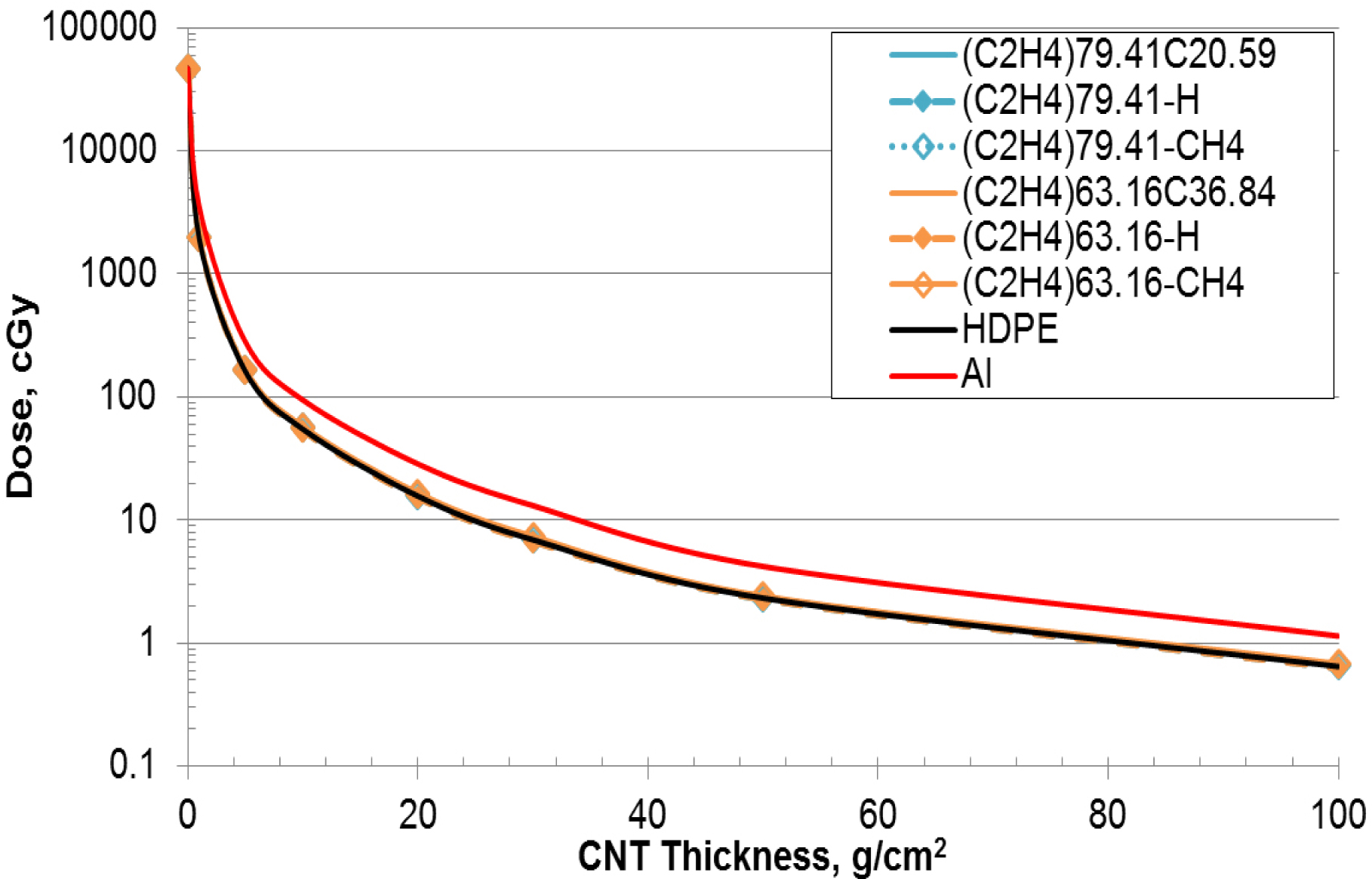
Figure 17.
SPE absorbed dose curves for two CNT materials compared with their hydrogen- and methane-loaded versions, as well as compared with aluminum (red) and HDPE (black). The base material is depicted by a solid line, the hydrogen-loaded version is depicted by a dashed line and a filled marker, and the methane-loaded version is depicted by a dotted line and an open marker.
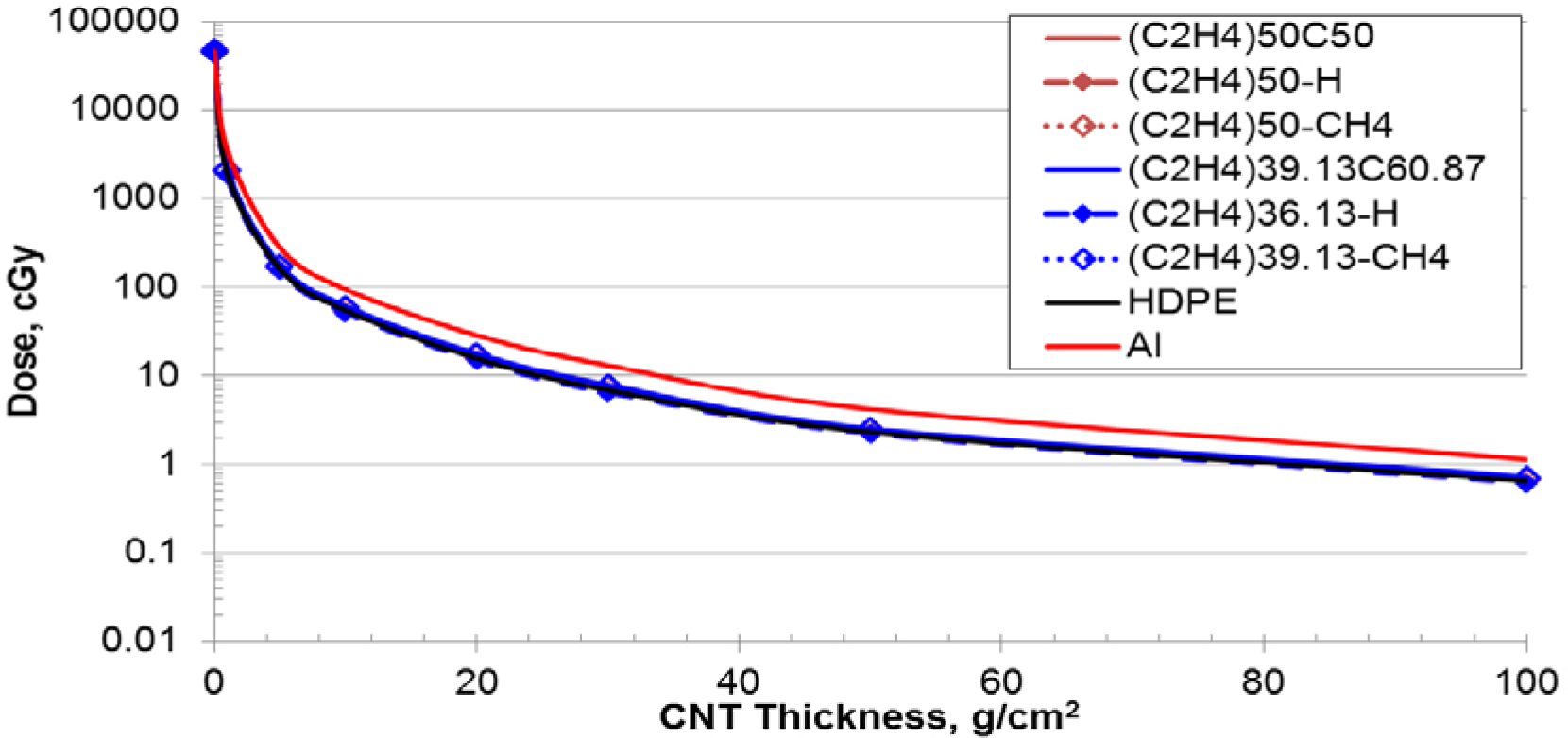
Figure 18.
SPE absorbed dose curves for two CNT materials compared with their hydrogen- and methane-loaded versions, as well as compared with aluminum (red) and HDPE (black). The base material is depicted by a solid line, the hydrogen-loaded version is depicted by a dashed line and a filled marker, and the methane-loaded version is depicted by a dotted line and an open marker.
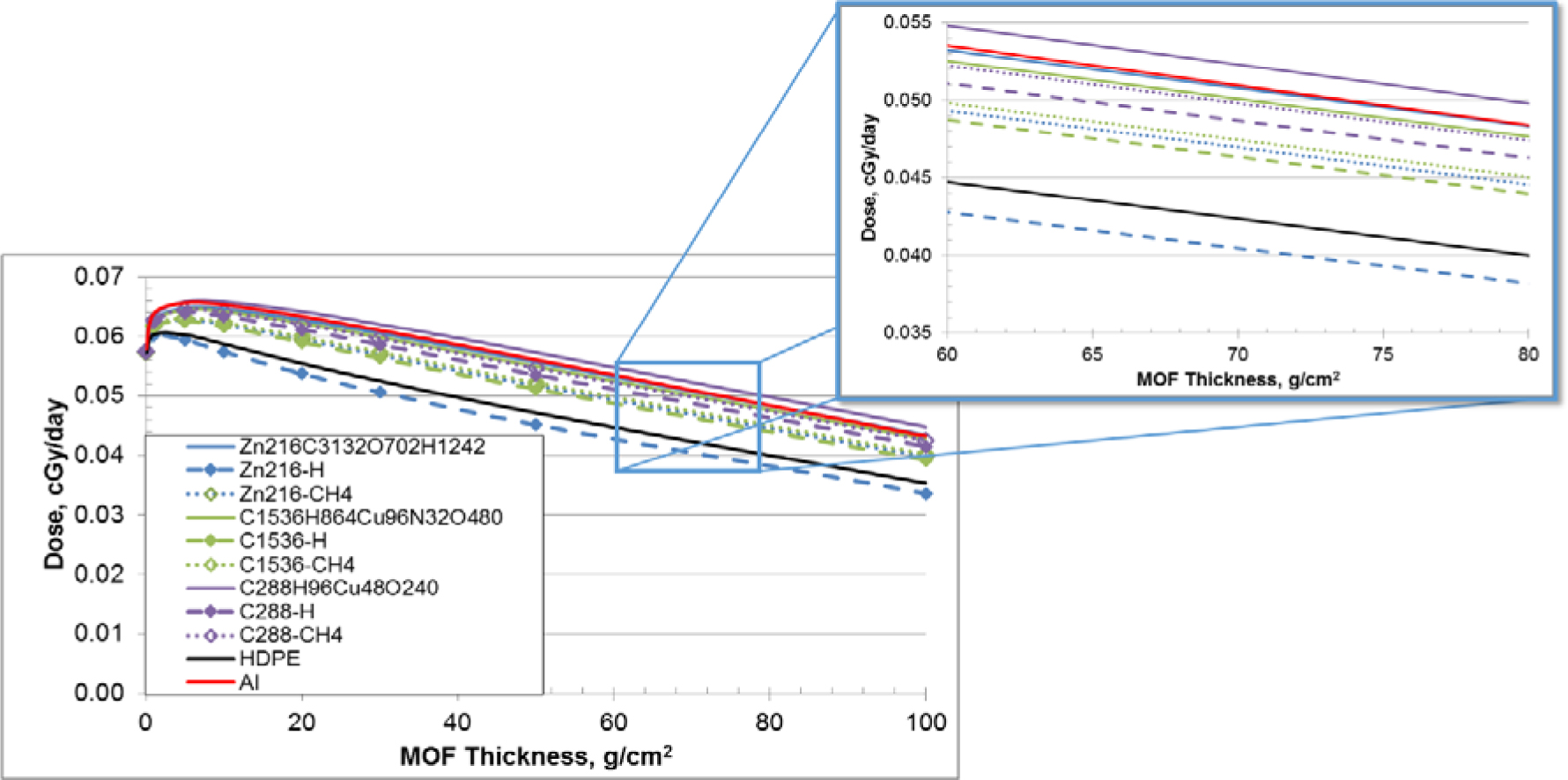
Figure 19.
GCR absorbed dose curves for three MOF materials and their hydrogen-loaded and methane-loaded counterparts, compared with aluminum (red) and HDPE (black). The base material is depicted by a solid line, the hydrogen-loaded version is depicted by a dashed line and closed marker, and the methane-loaded version is depicted by a dotted line with an open marker.
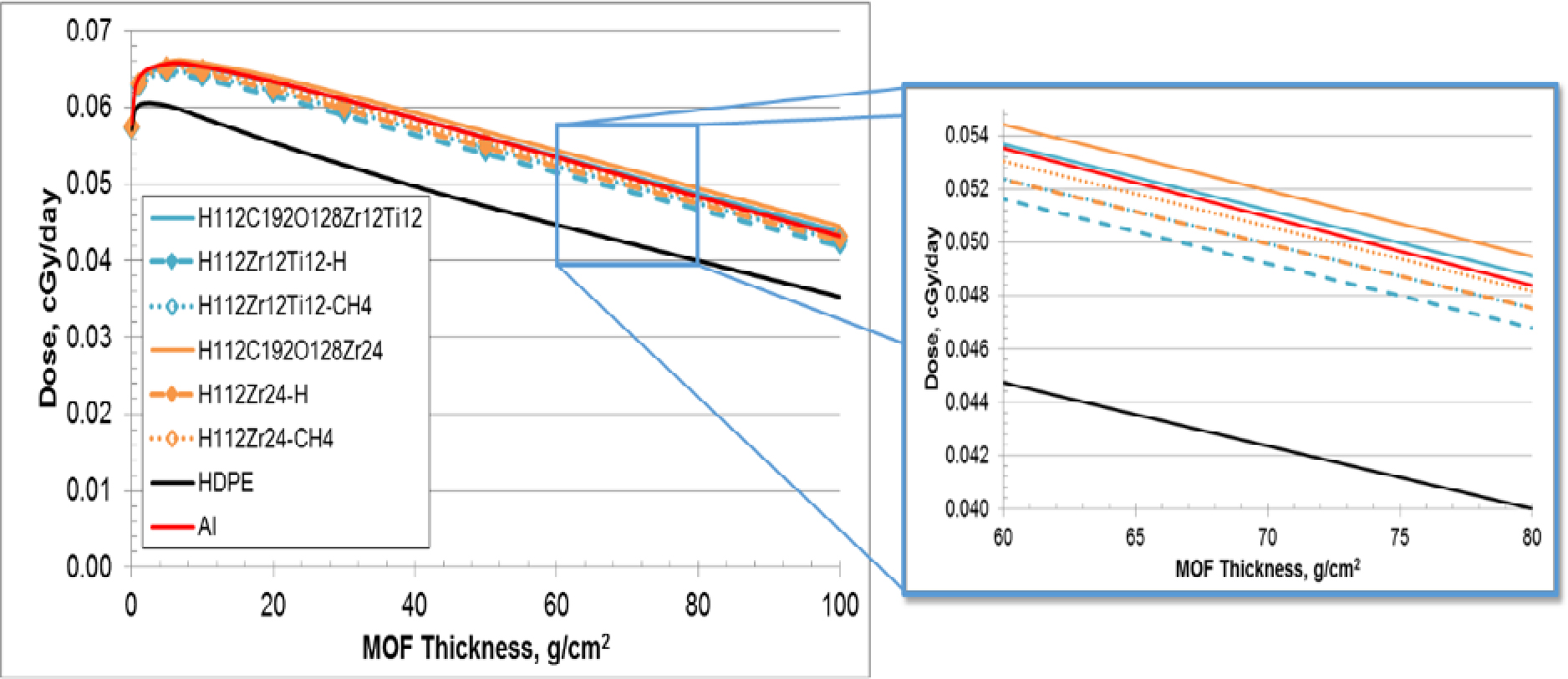
Figure 20.
GCR absorbed dose curves for two MOFs and their hydrogen-loaded and methane-loaded counterparts, compared with aluminum (red) and HDPE (black). The base material is depicted by a solid line, the hydrogen-loaded version is depicted by a dashed line and closed marker, and the methane-loaded version is depicted by a dotted line with an open marker.
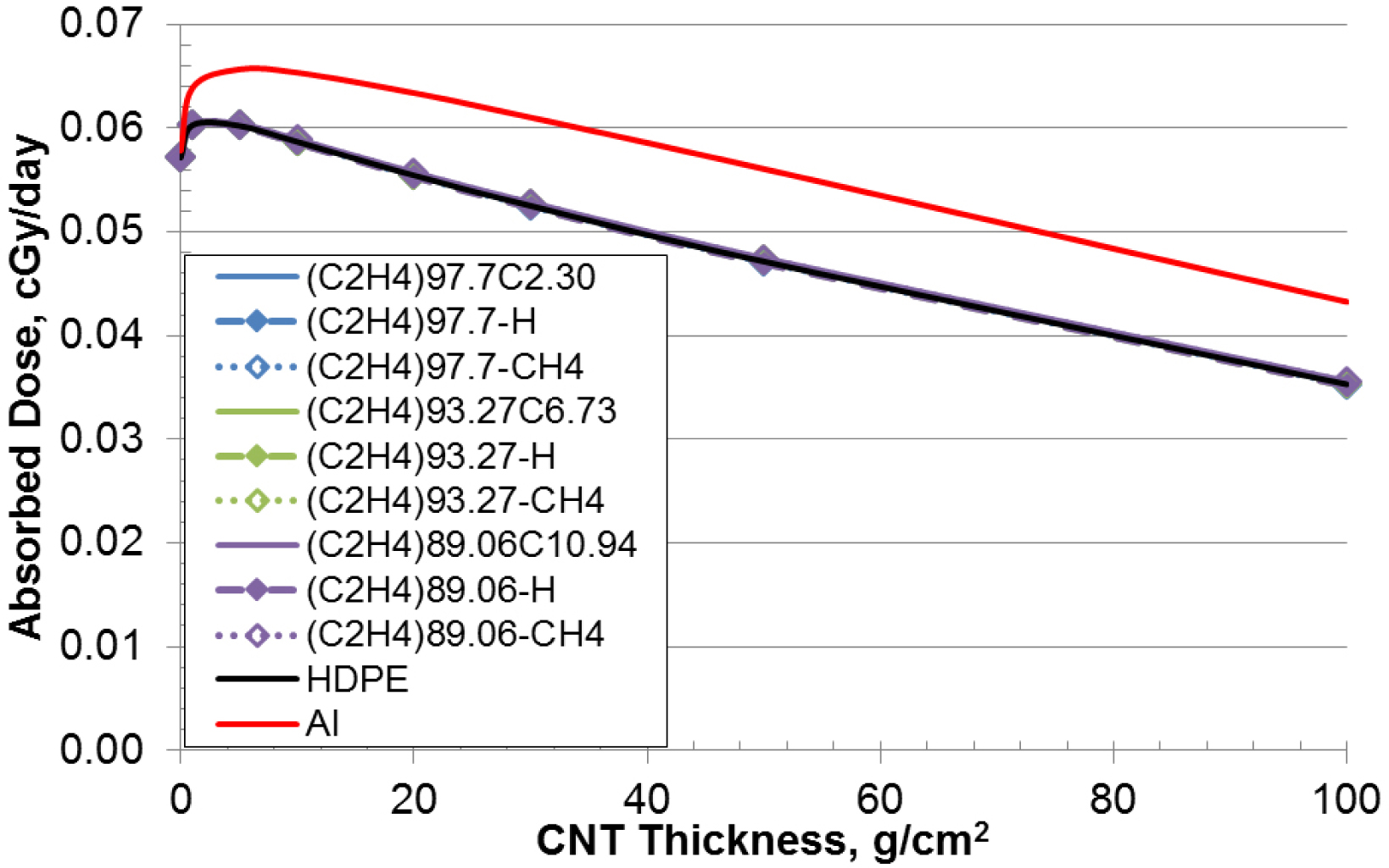
Figure 21.
GCR absorbed dose curves for three CNTs and their hydrogen-loaded and methane-loaded counterparts, compared with aluminum (red) and HDPE (black). The base material is depicted by a solid line, the hydrogen-loaded version is depicted by a dashed line and a closed marker, and the methane-loaded version is depicted by a dotted line and an open marker.
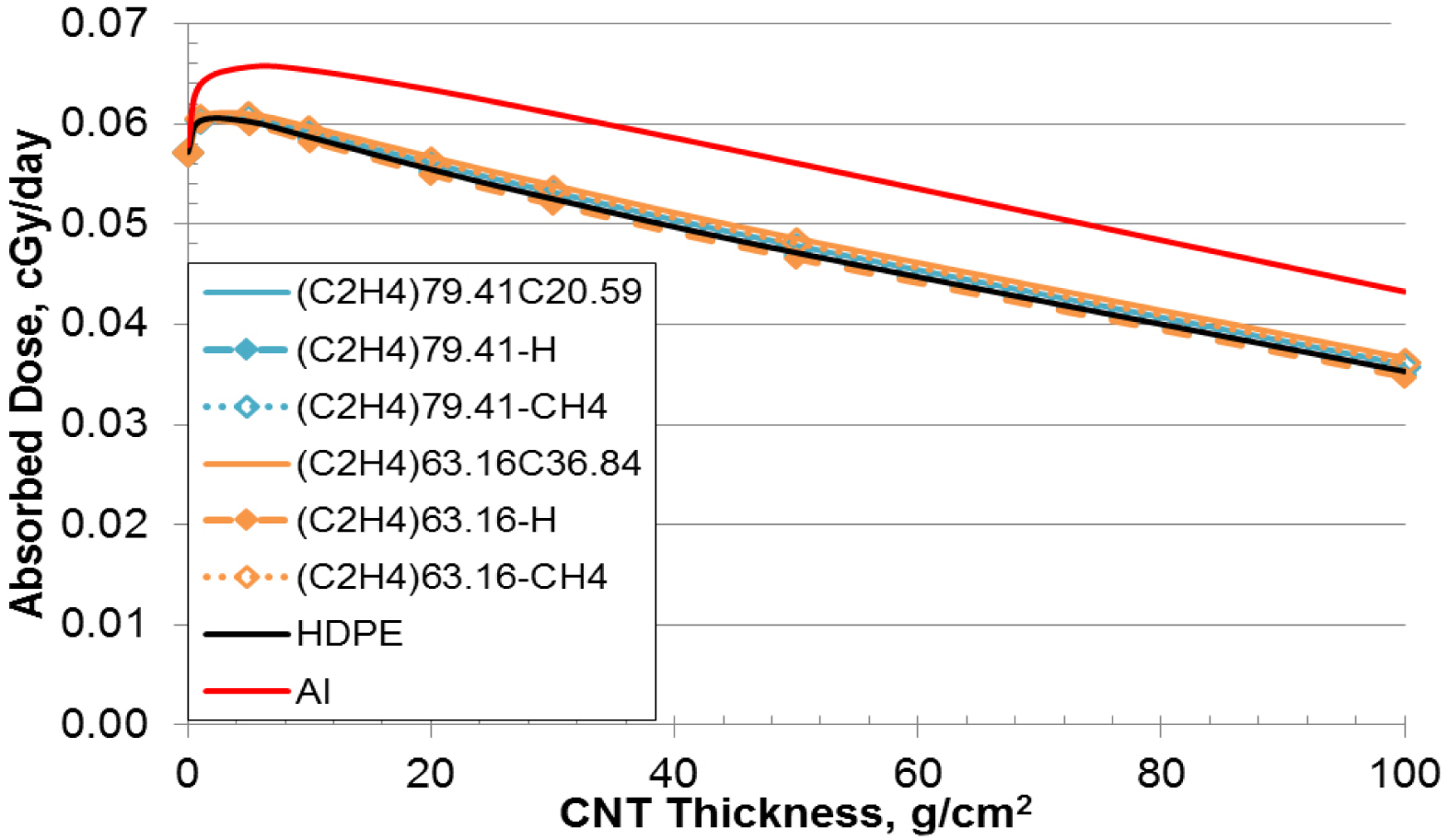
Figure 22.
GCR absorbed dose curves for two CNTs and their hydrogen-loaded and methane-loaded counterparts, compared with aluminum (red) and HDPE (black). The base material is depicted by a solid line, the hydrogen-loaded version is depicted by a dashed line and a closed marker, and the methane-loaded version is depicted by a dotted line and an open marker.
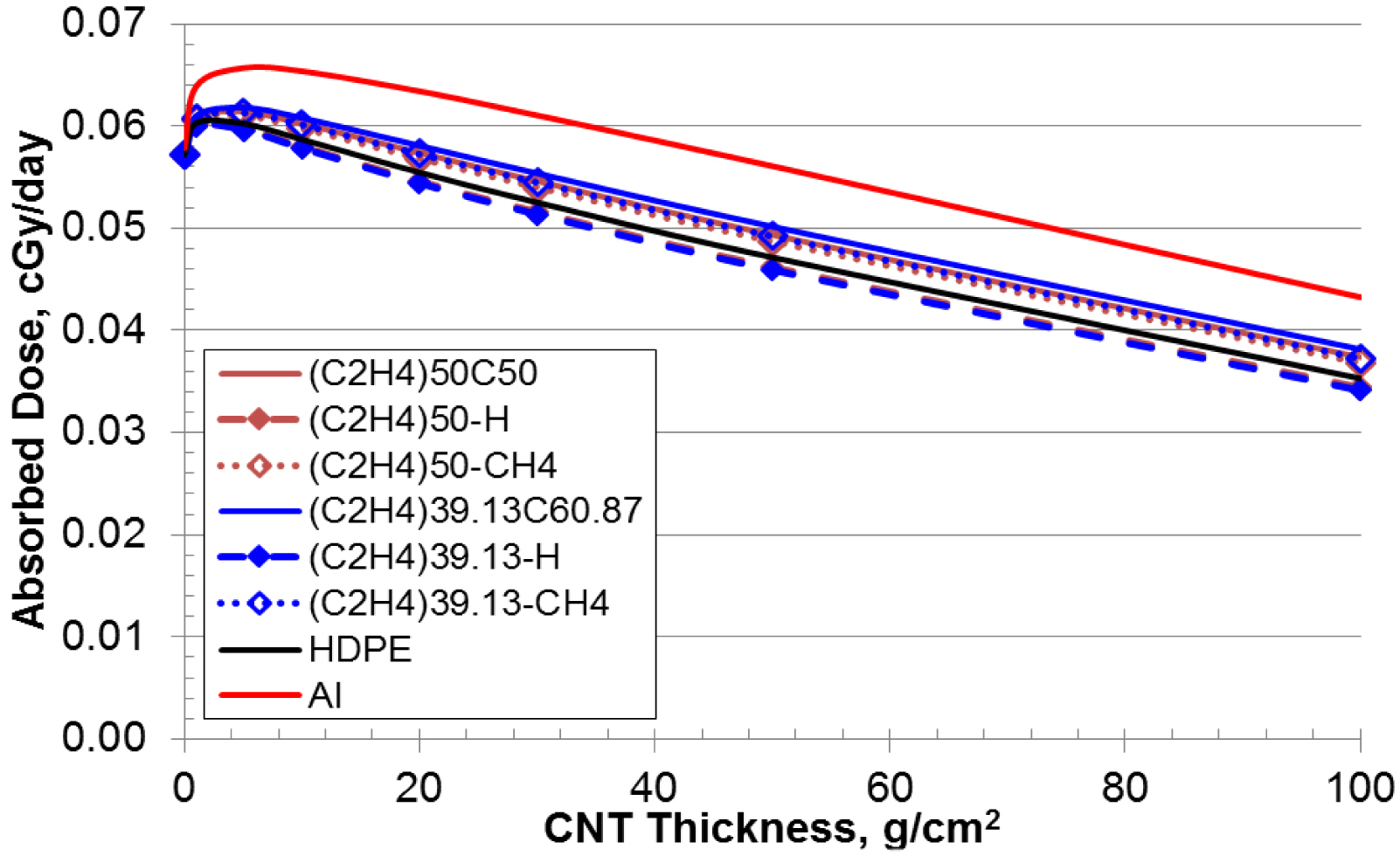
Figure 23.
GCR absorbed dose curves for two CNTs and their hydrogen-loaded and methane-loaded counterparts, compared with aluminum (red) and HDPE (black). The base material is depicted by a solid line, the hydrogen-loaded version is depicted by a dashed line and a closed marker, and the methane-loaded version is depicted by dotted line and an open marker.
Table 5.
Aggregated data of materials exposed to a SPE and how they compare with a typical spacecraft material (aluminum) and the standard radiation shielding material (HDPE).
| SPEs | |||||||
|---|---|---|---|---|---|---|---|
| MOFs | CNTs | ||||||
| non-loaded | H-loaded | CH4-loaded | non-loaded | H-loaded | CH4-loaded | Total | |
| Superior to HDPE | 0 | 1 | 0 | 0 | 7 | 0 | 8 |
| Between Al and HDPE | 5 | 4 | 5 | 7 | 0 | 7 | 28 |
| Inferior to Al | 0 | 0 | 0 | 0 | 0 | 0 | 0 |
Table 6.
Aggregated data of materials exposed to a GCR and how they compare with a typical spacecraft material (aluminum) and the standard radiation shielding material (HDPE).
| GCR | |||||||||
|---|---|---|---|---|---|---|---|---|---|
| MOFs | CNTs | MHs | |||||||
| non-loaded | H-loaded | CH4-loaded | non-loaded | H-loaded | CH4-loaded | non-loaded | H-loaded | Total | |
| Superior to HDPE | 0 | 1 | 0 | 0 | 7 | 0 | 1 | 7 | 16 |
| Between Al and HDPE | 7 | 9 | 5 | 7 | 0 | 7 | 2 | 4 | 41 |
| Inferior to Al | 3 | 0 | 0 | 0 | 0 | 0 | 9 | 16 | 28 |
Table 7.
The percent increase in dose for the methane-loaded MOF materials compared with the hydrogen-loaded equivalents for both the SPE and GCR cases. The comparisons were made for a thickness of 30 g/cm 2.
| MOF | ||
|---|---|---|
| Base Material | CH4 dose higher than H | |
| SPE | GCR | |
| Zn216C3132O702H1242 | 34% | 12% |
| C1536H864Cu96N32O480 | 3% | 2% |
| C288H96Cu48O240 | 0% | 2% |
| H112C192O128Zr12Ti12 | 2% | 1% |
| H112C192O128Zr24 | 1% | 1% |
Table 8.
The percent increase in dose for the methane-loaded CNT materials compared with the hydrogen-loaded equivalents for both the SPE and GCR cases. The comparisons were made for a thickness of 30 g/cm 2.
| CNT | ||
|---|---|---|
| Base Material | CH4 dose higher than H | |
| SPE | GCR | |
| (C2H4)97.7C2.30 | 0% | 0% |
| (C2H4)93.27C6.73 | 1% | 0% |
| (C2H4)89.06C10.94 | 2% | 1% |
| (C2H4)79.41C20.59 | 4% | 2% |
| (C2H4)63.16C36.84 | 8% | 3% |
| (C2H4)50C50 | 12% | 5% |
| (C2H4)39.13C60.87 | 17% | 6% |