
INTRODUCTION
Physician suicide is concerning for the medical community and general public and remains poorly understood. Several medical organizations have begun launching various initiatives to address physician well-being; yet, efforts to address physician suicide remain specific to the organization or institution. To identify important knowledge and implementation gaps toward physician suicide prevention, this scoping literature review aims to map the landscape of published research and perspectives on physician suicide. Specifically, the aim is to describe research on physician suicidal behaviors among medical students, postgraduate trainees, including residents and fellows, and physicians. Findings could serve as a roadmap for informing further study, evidence-based policy, and interventions to prevent physician suicide.
METHODS
Search Strategy
This scoping review was conducted following the Arksey and O’Malley framework as expanded upon and outlined within the Joanna Briggs Institute Reviewers’ Manual (Arksey and O’Malley 2005; Peters et al. 2015). A scoping review, in contrast to other review types, can map evidence in an emerging research area, and thereby identify the conceptual boundaries of a topic, clarifying gaps and key concepts and reporting on existing types of evidence that address the topic (The Joanna Briggs Institute 2015). This differs from a systematic review, which gathers and assesses the quality of quantitative evidence to report on the effectiveness of a particular intervention in achieving a certain outcome (The Joanna Briggs Institute 2015).
The research question was broadly designed to gather and analyze articles that mention physician suicide. No date range for the search was specified. The initial searches were performed on August 21, 2017 in Ovid MEDLINE and on October 11, 2017 in Ovid PsycINFO. Authors contributed seed articles that they had previously identified as relevant to physician suicide (Hem et al. 2000; Aasland, Ekeberg, and Schweder 2001; Tyssen et al. 2004; Hawton, Malmberg, and Simkin 2004; Gold, Sen, and Schwenk 2013), which were analyzed by the medical librarian co-author. Search terms and databases were then selected and tested based on this analysis. The search strategy also underwent a peer review process with two additional medical librarians. An updated search was run again on April 28, 2018 in Ovid MEDLINE, PsycINFO, and Scopus. Detailed search terms are available in Appendix 1.
Eligibility Criteria
Inclusion criteria were English-language papers with a primary outcome, measure, or thesis focused on death by suicide or suicidal behaviors among physicians, including suicide attempts, and suicidal thoughts and ideation. Physicians included medical students, postgraduate trainees (residents and fellows), and physicians at any career stage. Opinion articles were also included if they otherwise met the inclusion criteria. These included perspectives, letters to the editor or their replies, essays, and viewpoints with a focus specifically on physician suicide. Exclusion criteria were non-English publications and those only pertaining to physician burnout, mental health, substance use disorders, or other media, such as newspaper, magazine, or other journalistic articles. Query results totaled 1,596 articles after deduplication. Two authors reviewed abstracts and titles for inclusion in the full-text review round and disagreements were adjudicated by a third author. Next, during the full-text review round, two authors again reviewed the full-text articles for inclusion with a third author adjudicating disagreements. Covidence, a literature review management software, was used to review articles during inclusion and exclusion steps.
Data Extraction and Analysis
Two authors (TL, SP) performed data extraction using a data charting table. Data extracted included: primary thesis or outcome measure (e.g. death by suicide, suicide attempt, suicidal ideation or thoughts), date of publication, authors’ country affiliation, type of publication, study design, country of participants, tools used to ascertain outcome measures, and physician population (specialties, career stage). While reviewing articles, authors used an open coding approach to tag articles by key topics or themes (e.g. suicidal ideation, depression, prevention, substance use, etc.). The aim was to inductively identify key themes across the published literature included in this scoping review. During each subsequent round of review, tags could be added to articles. After all articles were reviewed and tagged by two authors (TL, SP, CYAC), one of the authors (TL) re-reviewed all articles to add tags until a point of saturation was reached and no further topic tags could be added. Tags were then condensed into a core set of themes. These themes were assembled into a framework based on their frequency of occurrence, resulting in a map of the most published themes about physician suicide. Findings are summarized in narrative form.
RESULTS
The 347 articles that met the inclusion criteria (Figure 1) covered a broad range of publication types over time and from countries worldwide. The earliest publications were editorials (Table 1), with the first published in 1903 by an unknown author. Overall, 143 (41.2%) opinion articles were published, suggesting an ongoing public dialog about physician suicide in academic journals lasting over a century. Of the remaining 204 (58.8%) articles, cross-sectional study design involving a survey was the most common study design. Of these, 13 described interventions intended to prevent physician suicide. Such articles frequently introduced the paper by describing “a tragic case,” when the death of one or more physicians by suicide stimulates the development or implementation of an intervention (Shanafelt et al. 2019).
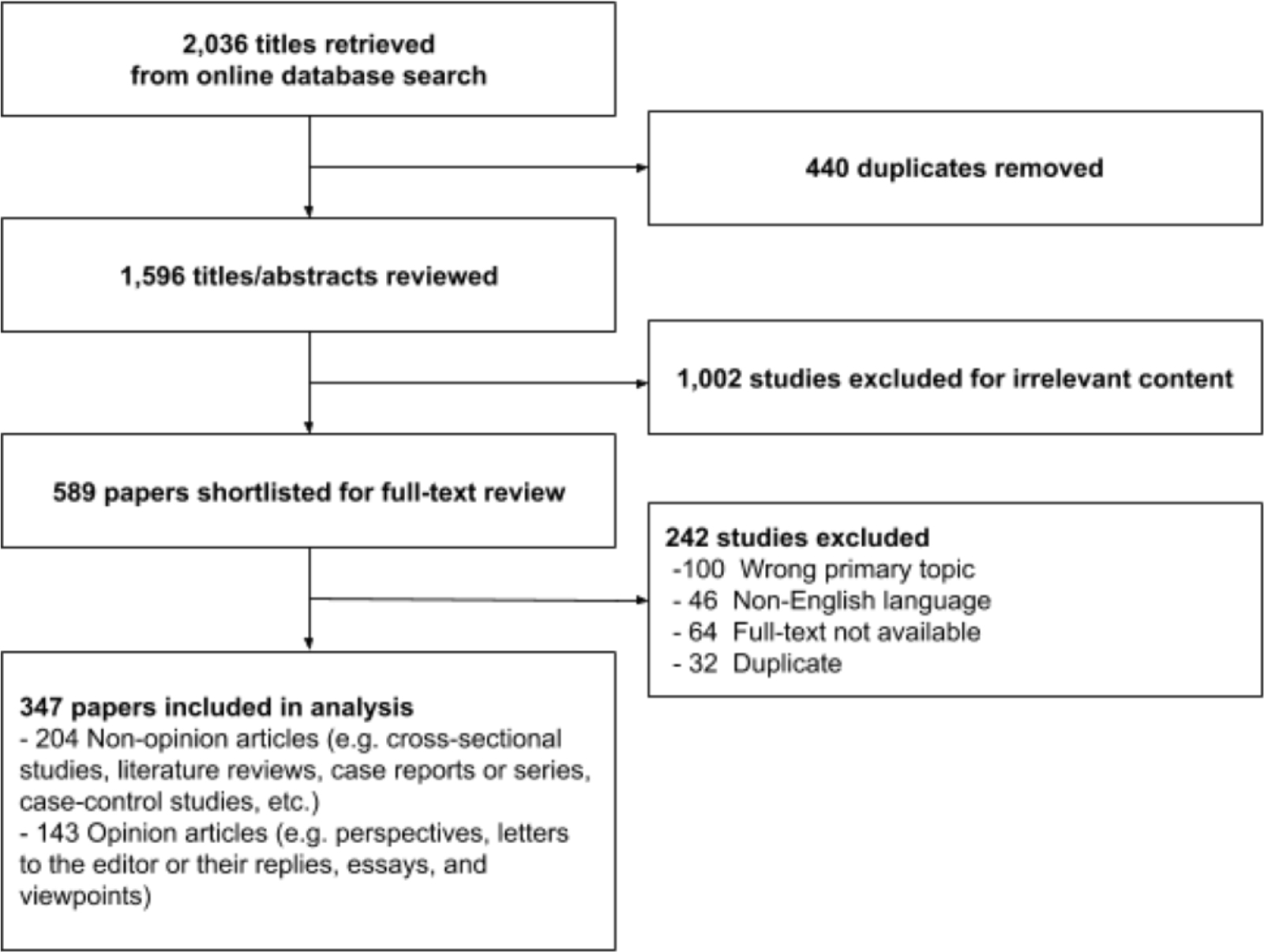
Figure 1
PRISMA diagram of study selection for inclusion
Table 1
Article characteristics from scoping review of literature on physician suicide, 1903–2018
| Publication date range | No. (%) of non-opinion articles | No. (%) of opinion articles |
| 1900–1919 | 0 | 1 (0.7%) |
| 1920–1949 | 0 | 1 (0.7%) |
| 1950–1959 | 0 | 0 |
| 1960–1969 | 5 (2.4%) | 9 (6.3%) |
| 1970–1979 | 24 (11.7%) | 19 (13.3%) |
| 1980–1989 | 20 (9.8%) | 18 (12.7%) |
| 1990–1999 | 26 (12.7%) | 14 (9.9%) |
| 2000–2009 | 42 (20.5%) | 37 (26.1%) |
| 2010–2018 | 88 (42.9%) | 43 (30.3%) |
| Study design or publication type | No. (%) of non-opinion articles | No. (%) of opinion articles N/A |
| Cross-sectional studies | 85 (41.5%) | |
| Survey-based | 63 | |
| Review | 34 (16.6%) | |
| Narrative | 30 | |
| Case report or case series | 22 (10.7%) | |
| Case–control | 19 (9.3%) | |
| Cohort studies | 14 (6.8%) | |
| Intervention† | 13 (6.3%) | |
| Other†† | 18 (8.8%) | |
Authors from 37 countries published English-language articles on physician suicidal behaviors, including the United States, United Kingdom, Finland, Norway, Sweden, Italy, Japan, Canada, China, Denmark, Hungary, Brazil, Egypt, Germany, Lebanon, Pakistan, Poland, Taiwan, Austria, Belgium, Bosnia and Herzegovina, India, Iran, Malaysia, Nepal, New Zealand, Portugal, Serbia, South Korea, Spain, Thailand, Turkey, and the United Arab Emirates. Some countries have only published opinion articles about the subject, including Israel, Nigeria, and Pakistan. Six articles were opinion articles that contained no information about the country of origin.
Ascertaining Suicidal Behaviors
Estimating Suicide Incidence
Suicide is estimated to occur at a higher rate among physicians than the general population and perhaps even other professions (Schernhammer and Colditz 2004; Gold, Sen, and Schwenk 2013); however, estimates by profession vary (Peterson et al. 2018). Death by suicide was the only primary topic in 108 (31.1%) of all articles. Non-opinion articles primarily sought to estimate epidemiology of suicidal behaviors among physician populations. In other words, death by suicide was most often studied among attending physicians because of availability of data on occupation and death, particularly in vital statistics or death certificates. However, the tools used to perform such estimates varied. Deaths by suicide were most frequently estimated based on 9th or 10th Revision of the International Classification of Diseases (ICD-9 or ICD-10) codes on death certificates.
Other commonly used sources of data included membership masterfiles from physician organizations or associations (Juel, Mosbech, and Hansen 1999), published obituaries, and charts from medical records or forensic reports (Table 2). These data are primarily limited by potential undercoding. Undercoding can result from deaths being coded as accidental deaths, for example, leading to underestimation of the actual incidence of suicides among physicians. In an editorial, one author notes, “Suicide is a way to die and not a cause of death. And there are several means to this end: the ICD-10 lists at least 31 different ways to perform a suicide” (Aasland 2013). Rimpelä et al. articulated this in 1987 also: “Differentiation between suicide, accident, poisoning, and violence as a cause of death is often difficult, and suicide might sometimes be falsely, even deliberately, classified as an accident and even differently in different occupational groups” (Rimpelä et al. 1987).
Table 2
Methods of ascertainment of suicidal behaviors and related risk factors for 204 non-opinion publications
| Methods of ascertainment |
|---|
| Suicide death |
| Death certificates (vital statistics by U.S. state or non-U.S. country) |
| Forensic, pathology, or autopsy reports, for example, from a medical examiner’s office |
| Medical chart reviews of physician patients |
| Professional membership masterfiles |
| Obituaries published in journals (e.g. JAMA) |
| Family confirmation or interviews |
| Suicide attempt |
| Paykel’s Instrument (assesses suicidal ideation and suicide attempts) |
| Beck Hopelessness Scale |
| Investigator-developed question(s) or questionnaire |
| Suicidal thoughts or ideation |
| Patient Health Questionnaire 9 |
| Beck Scale for Suicidal Ideation |
| Acquired Capability for Suicide Scale |
| Self-harm Behavior Questionnaire |
| Suicidal Behaviors Questionnaire |
| Investigator-developed question(s) or questionnaire |
Suicides are typically reported as a suicide mortality rate (SMR) in epidemiologic literature, which is the number of deaths by suicide per 100,000 person-years. A suicide rate ratio can be calculated by dividing the SMR among physicians, or a subpopulation thereof, and dividing by a comparison group, such as the general population. Despite these standardized manners of suicide reporting, included papers showed inconsistencies in reporting, often reporting a crude mortality rate, which is calculated by the absolute number of physician suicides divided by the number of years in a study period, then reported per 100,000 physicians. For example, in 1968, Craig and Pitts counted 228 suicides among physicians based on the obituary materials collected by the Deaths Editor of the Journal of the American Medical Association between May 1965 and May 1967 (Craig and Pitts 1968). Combined with an estimation of approximately 296,000 physicians in the U.S. at the time, this resulted in a crude annual suicide rate of 38.4 per 100,000 physicians (Craig and Pitts 1968). Multiplying this crude annual suicide rate and the U.S. physician population of approximately 953,000, which was reported by a 2016 census from the Federation of State Medical Boards, leads to an estimate of 366 physician deaths by suicide annually.
Underreporting undermines the accuracy of physician suicide incidence estimates using death certificates, membership files, and medical charts. Surveys also can lead to underreporting. One study surveyed the deans of 116 medical schools in the 1970s about medical student suicides; 88 respondents reported 52 medical student suicides between 1970 and 1978 (Pepitone-Arreola-Rockwell, Rockwell, and Core 1981). Another approach to studying physician suicides is psychological autopsy, in which a psychological profile about a person is constructed after their death. Time-intensive and not a standard practice, psychological autopsy involves collecting information through interviews of relatives and healthcare professionals, along with data from forensic examinations, police investigations, psychiatry, medical and social agency records, and any other information available, such as suicide notes (Lindeman et al. 1998). Such an approach can elucidate potential contributors to an individual’s death, providing detailed contextual information, their life circumstances, and how they managed such circumstances up until their death. However, psychological autopsies are not systematically applied in the setting of deaths by suicide. Case reports also may describe a psychological profile, in addition to medical and clinical aspects of the case (Lindeman et al. 1998; Hawton, Malmberg, and Simkin 2004; Koekkoek et al. 2008), but this was also infrequently published. In 2013, Gold et al. examined data from the U.S. National Violent Death Reporting System (NVDRS), which is a combination of information and data from death certificates, coroner and medical examiner reports, toxicology reports, and law enforcement reports (Gold, Sen, and Schwenk 2013), the only study to triangulate multiple data sources to estimate suicide incidence. The wide variety of data sources and methods of estimation suggest that there is no standard.
Suicide Clusters
Suicide clusters are suicides that occur near each other, typically with respect to time and geography. Suicide contagion refers to spread of information about a suicide via media and other channels, which can increase suicide risk in a community. Only three studies acknowledged these topics. Two opinion papers described suicide clusters that occurred in a short time span and in a focused geographic region, one in Winnipeg, Canada (Williams 1997) and another cited suicides in Australia that had been reported in news media (Clarke and McKee 2017). Both articles focused on intense or distressing working conditions as important factors in the suicide deaths, but did not elaborate further on suicide clusters. In fact, the Canadian article, along with one other case series of physicians who died by suicide while on probation in Oregon state (Crawshaw et al. 1980), used the term “epidemic” rather than “clusters.” Nevertheless, these three articles referred to the concepts of suicide clusters and suggest contagion, even though they did not use these terms explicitly. These were articles that were tagged with the public health theme.
Suicide clusters also appeared to follow physician subpopulations, although numbers were small in such case series and opinion articles. Other physician subpopulations included, for example, immigrant physicians (Richings, Khara, and McDowell 1986), physician pilots (Cath 1974), and physicians who experienced war either as victims or as wartime medics (Bock et al. 2016; Likeman 2015). In 2016, Bock et al. described a case series of 62 Hungarian Jewish dermatologists during the Holocaust: some emigrated, some died during Nazi rule, and others survived (Bock et al. 2016). Three of these dermatologists died by suicide, which was “very common among the doctors (under the Nazi ordeal), especially those physicians of the older generation” (Bock et al. 2016). Another analysis described issues relevant to physician terrorists (Marvasti and Vahidy 2008), who are physicians who die by suicide and also experience “feelings of hopelessness, frustration, anger, and helplessness, as well as other kinds of psychic pain.” Nevertheless, the authors contrast “clinical suicide” and “suicide bombing” by exploring their differing motivations (death of self vs. death and terrorization of others via death of self) and the relative lack of psychopathology and greater reliance on public perceptions of their actions among suicide bombers. This was not a population further described in this literature review.
Estimating Suicidal Ideation and Attempts
Overall, suicidal ideation was the second most studied thesis among articles included in this literature review, especially suicidal ideation among medical students. To assess suicidal ideation and attempts, surveys were most common; overall, 61 cross-sectional survey studies were performed (Table 1). Validated surveys are available to assess suicidal ideation (Table 2); however, investigator-developed items and surveys were also used. Only four studies compared physician subpopulations between countries. In the Health and Organization among University Hospital Physicians in Europe (HOUPE) study, investigators sought to compare suicidal thoughts and work-related stressors between practicing physicians in Italy and Sweden (Fridner et al. 2009, 2011, 2012). Another study compared lifetime prevalence of suicidal thoughts among practicing physicians in Norway and Germany (Rosta and Aasland 2013).
Suicide attempts, in general, were poorly studied in any physician subpopulation, but suicidal behaviors among postgraduate trainees were the least studied of all, with resident physicians’ behaviors studied more than fellows (Figure 2). Among the articles reviewed, only two validated tools, Paykel’s Instrument and the Beck Hopelessness Scale, were identified that were specifically designed to assess suicide attempts; otherwise, investigators developed survey items to assess respondents’ self-reported attempts.
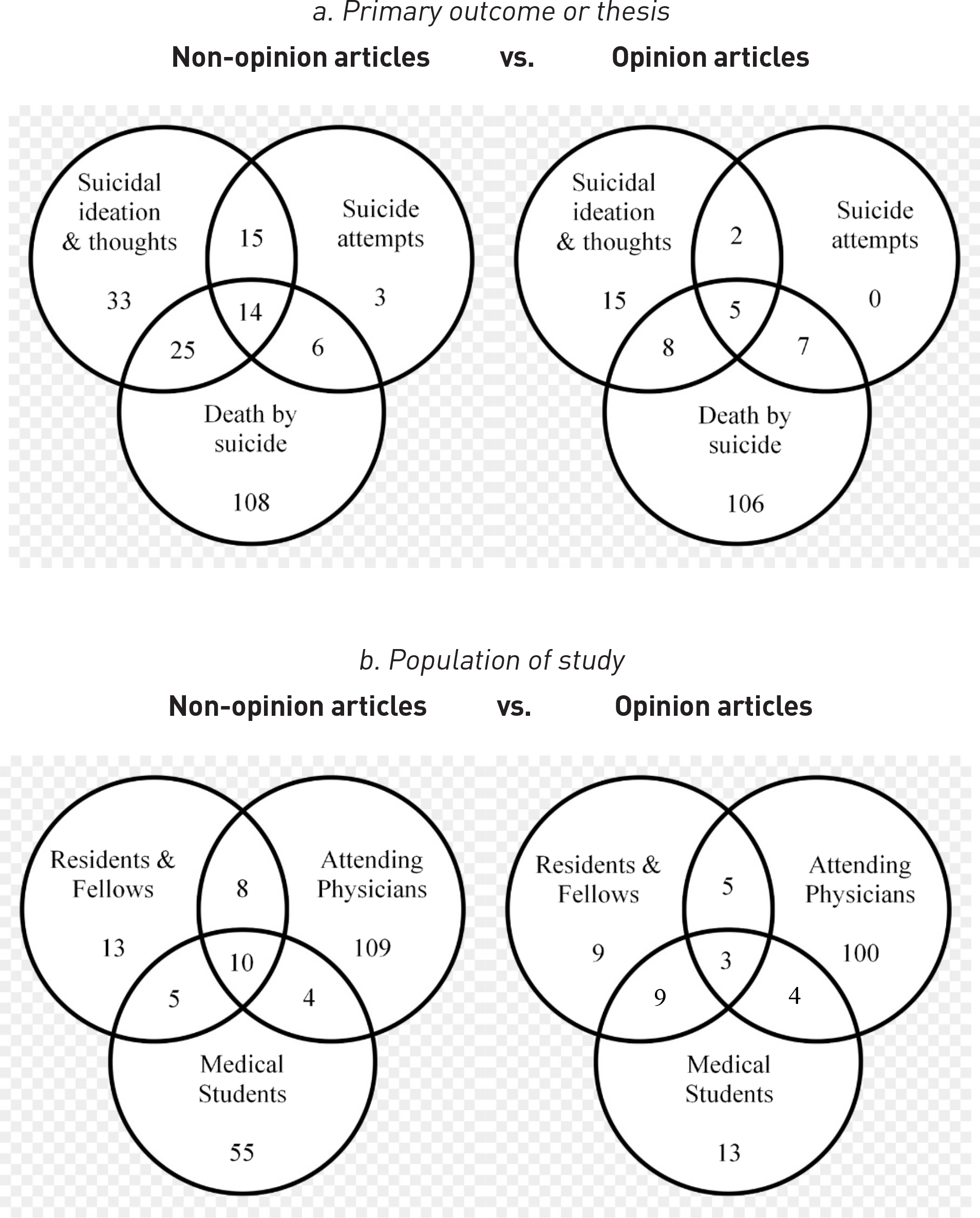
Figure 2
Death by suicide was the only and primary measure or thesis in a larger proportion of all articles; suicide attempts were the least well-studied or discussed (a). Attending or practicing physicians were the most studied population (b), especially when death by suicide was the primary thesis, while medical students were the second most studied population, with a focus on suicidal ideation (data not shown)
Physician-specific Risk Factors
Mental Health and Burnout
Physicians’ risk factors for suicidal behaviors, especially mental health disorders, are among the most common topics of study. Gold et al. examined the NVDRS data and identified certain risks unique to physicians compared to non-physicians: physicians were more likely to have a job problem preceding death by suicide and a greater likelihood of known mental health disorders, yet no accompanying increased likelihood of antidepressant therapy (Gold, Sen, and Schwenk 2013). Additional risk factors potentially include professional setbacks prior to suicide death, such as facing complaints (Crawshaw et al. 1980; Casey and Choong 2016), feeling overloaded, working long hours, being unable to cope with job responsibilities (Keith Hawton, Malmberg, and Simkin 2004), or experiencing disability as a result of medical illness (Cath 1974; Lindeman et al. 1998; Thomas 2014). Related to these conditions, physicians are also at high risk of burnout, which has been found to be associated with suicidal ideation in U.S. medical students (Dyrbye et al. 2008) and Dutch residents (Van Der Heijden et al. 2008), although no direct relationship between burnout and death by suicide has been established. To assess these risk factors, a variety of validated questionnaires were used to inquire about general health, burnout and stress, mental health (e.g. depression, anxiety or insomnia), substance use including alcohol use, and other measures of career, work, personality, and other life experiences (Table 2). Additionally, investigator-developed survey questions were also used, for example, to assess attitudes toward suicidal behaviors of a peer.
Because the earliest publications about physician suicide suggested an increased incidence compared to the general population, certain theories have been applied to attempt to explain the increased suicide risk among physicians. For example, Fink-Miller applied the interpersonal psychological theory of suicidal behavior (IPTS) (Cornette et al. 2009; Fink-Miller 2015a) to physician suicide. The IPTS posits three necessary and sufficient precursors to death by suicide: (1) thwarted belongingness, a feeling of disconnection with others; (2) perceived burdensomeness, a miscalculation that one’s death would relieve burdens on others; and (3) acquired capability, habituation to previously provoked fear responses, including losing the fear of pain involved in taking one’s life. This can stem from repeated exposure to painful or provocative stimuli, including events triggering second victimization, such as patients’ poor outcomes, death, and suffering. This can then lead to desensitization when exposed to death in general.
Role strain describes physician risks as a result of their direct work environment or professional norms; a mismatch between social and institutional norms and the physician’s roles can manifest as an unrealistic expectation of perfect function at a maximum level of competence (DeSole, Singer, and Aronson 1969). Professional self-image and identity, along with self-stigma, are also considered relevant mediating themes (Cath 1974; Lindeman et al. 1998; Legha 2012).
Specialty of Practice
Early studies of suicide rates by specialty suggested that psychiatry and anesthesiology had the highest suicide rates (Cornette et al. 2009). A 2014 case series of 87 physician suicides in Japan demonstrated that internists (24.1%), psychiatrists (18.4%), pediatricians (6.9%), and anesthesiologists (5.7%) were most commonly affected specialties, although 16% of cases had unknown specialty (Hikiji and Fukunaga 2014). Small case series in Thailand and China had to few cases to draw a conclusion about specialties (Wang, Liu, and Xu 2017; Yasri and Wiwanitkit 2017), a commonly encountered issue in comparing specialties’ suicide rates. Eighteen non-opinion articles published since 2010 described either cross-sectional survey studies of burnout and its correlation with suicidal ideation per specialty or additional case reports or series of physician suicide deaths. Generally, the findings about which specialties may be at higher risk than others have mixed findings due to data limitations in ascertaining suicide rates, small samples, and inappropriate comparisons or assumptions in data interpolation (Bruce et al. 1968; Bergman 1979; Neil et al. 1987; Swanson, Roberts, and Chapman 2003).
Means of suicide death was also a topic examined in some studies. In a U.K. study examining suicide means, 10 (50%) of 20 anesthesiologists died by overdosing with anesthetic agents compared to other doctors, for example, 2 (16.6%) of 12 surgeons and 10 (4.5%) of 223 physicians overall died by overdose (Hawton et al. 2000). In the 2014 case series published from Japan, authors found a similar trend in studying suicide deaths across specialties (Hikiji and Fukunaga 2014); four of five anesthesiologists (of a total of 87 physicians) used drugs as means of suicide. Based on the IPTS, one proffered but unstudied hypothesis is that some medical specialties may possess more acquired capability, or acquired fearlessness about death, than others (Fink-Miller 2015a, 2015b).
Specialized Knowledge and Access
The access and knowledge hypothesis is a commonly discussed risk factor for suicide death among physicians. Physicians acquire specialized medical knowledge of the human body and have access to the means (e.g. prescription drugs) that can cause lethal self-harm. Observational studies of means of suicide death suggest that firearm, prescription drug overdose, and hanging are among the most common methods used by physicians (Cornette et al. 2009; Rimpelä et al. 1987; Swanson, Roberts, and Chapman 2003), although this varies by country. Psychological autopsies are consistent with the access and knowledge hypothesis. One set of psychological autopsies in the United Kingdom examined 38 physician suicides, finding that 28 of the physicians died by self-poisoning and 11 by self-injury (other than poisoning), as 1 physician used both methods (Keith Hawton, Malmberg, and Simkin 2004). In a Finnish psychological autopsy of seven physician suicides, only two had previous suicide attempts, suggesting that physicians may be more likely to cause self-harm leading to death by suicide; in other words, physicians who die by suicide may not have had any prior suicide attempt, which is a risk factor in the general population (Lindeman et al. 1998). Self-treatment or self-prescription is also a concerning contributor due to specialized access to controlled substances, as “medical doctors exploit their profession for purpose of self-treatment” (Lindeman et al. 1998).
Personality Traits, Upbringing, and Cultural Context
Personality and life experience prior to medical training might also contribute to physician suicide risk, although they are poorly studied. In a prospective study of Norwegian medical students, a version of the Basic Character Inventory, originally developed in 1920, was used to measure major personality dimensions, including neuroticism, control, and extroversion (Tyssen et al. 2001, 2004). The control personality trait, or the degree of compulsiveness, was independently linked to suicidal ideation; and more neuroticism as a medical student, which is linked to the vulnerability personality trait including sensitivity to other people’s opinions and criticism, independently predicted more serious suicidal ideations and planning in the first two postgraduate years (Graves and Thomas 1991; Tyssen et al. 2004, 2001).The reality weakness personality trait, more commonly associated with serious psychiatric pathology such as paranoid traits, predicted a transition from suicide ideation to planning (Tyssen et al. 2004).
One editorial speculates about the influence of adverse childhood experiences on risk for physician suicide (Johnson 1991). A South Korean study found a more than threefold risk of lifetime suicidal ideation, planning, and attempts among medical students who experienced emotional abuse early in life, characterized by “a continuously cold and uncaring parental attitude” (Jeon et al. 2009). In China, medical students were surveyed about parental relationships and parenting communication styles, hypothesizing that this could be a highly influential aspect of the student’s character (Sun et al. 2017). The study found that for Chinese medical students, a good relationship with parents was statistically significantly associated with less suicidal ideation, plans, and attempts.
Some studies sought to identify risk factors unique to their cultural context. Researchers in the United Arab Emirates collaborated with Eskin (Eskin et al. 2011) to again assess medical students’ religiosity and their attitudes toward suicide (Amiri et al. 2013). In this study, investigators suggested that the Islamic faith may serve as a protective factor against suicidal thoughts and death by suicide among their medical students. In Pakistan, a study of suicidal ideation among medical students included religion as a demographic characteristic, but did not otherwise include religion in further analyses (Osama et al. 2014). Among opinion articles, certain conceptualizations of suicide also varied. For example, in one commentary from Japan, two concepts directly link overwork with death: karoshi (death due to overwork) and karojisatsu (suicide due to overwork) are considered causes of death in the Japanese culture (Hiyama and Yoshihara 2008), but nowhere else in the world.
Gender
Early studies in the 1970s and earlier explicitly excluded female and minority physicians (Thomas and Greenstreet 1973; Ullmann et al. 1991; Graves and Thomas 1991). Results published in 1999 from the Women Physicians’ Health Study, which surveyed a sample of women physicians from the American Medical Association masterfile (Frank and Dingle 1999), described previous studies that reported an odds ratio as high as 4 for women physician suicides compared to other categories of women, but that such studies were based on small numbers of suicide deaths. This study found that women physicians had similar rates of depression (19.5%) compared to women in the general population, but 1.5% of women physicians attempted suicide compared to 2.9% of women in the general population (Frank and Dingle 1999); the authors postulated that women physicians may have less suicidal intent, and therefore less suicide attempts, or it could be that they have a higher rate of completion than women in the general population, and therefore also less suicide attempts since attempts more often resulted in death.
In 2004, Schernhammer performed a systematic review and meta-analysis, concluding that the suicide rate ratio for women physicians was 2.27 compared to the general women population and for male physicians was 1.41 compared to the general male population (Schernhammer and Colditz 2004). In 2013, a Polish study of perimenopausal female physicians examined sociodemographic and lifestyle variables’ relationship to participants’ subjective sense of health, including suicidal ideation. Eight of 221 participants reported suicidal thoughts, which was statistically significantly correlated with poorer subjective sense of health (Gojdź et al. 2013). Another study in Pakistan appeared to show no gender difference in terms of rates of suicidal ideation among medical students (Ghazanfar et al. 2015).
Little data is known on suicide among physicians of gender minorities, as there is only one perspective piece written by a nurse who wrote about her transgender child who died by suicide (Dippo 2007).
Themes in Physician Suicide Literature
This scoping literature review revealed several themes in physician suicide literature, with greatest attention to identifying risk factors such as mental health. Culture of practice and context of suicide, which include, for example, mental health stigma, physician attitudes toward suicide, and job conflicts, also were subjects of increased focus. These and the remaining themes identified are illustrated in Figure 3, where the most common themes are positioned at the broadest (top) level of an inverted pyramid. With each successive level of the inverted pyramid, fewer papers describe such issues. We chose an inverted pyramid to illustrate how the weight of the risk factors for physician suicides balances precariously over the vertex, where less attention is paid on postvention and public health initiatives for surveillance and prevention. This imbalance quickly identifies potential areas for further work. Themes such as suicide as a public health issue, postvention, and legal issues were far less studied than others.
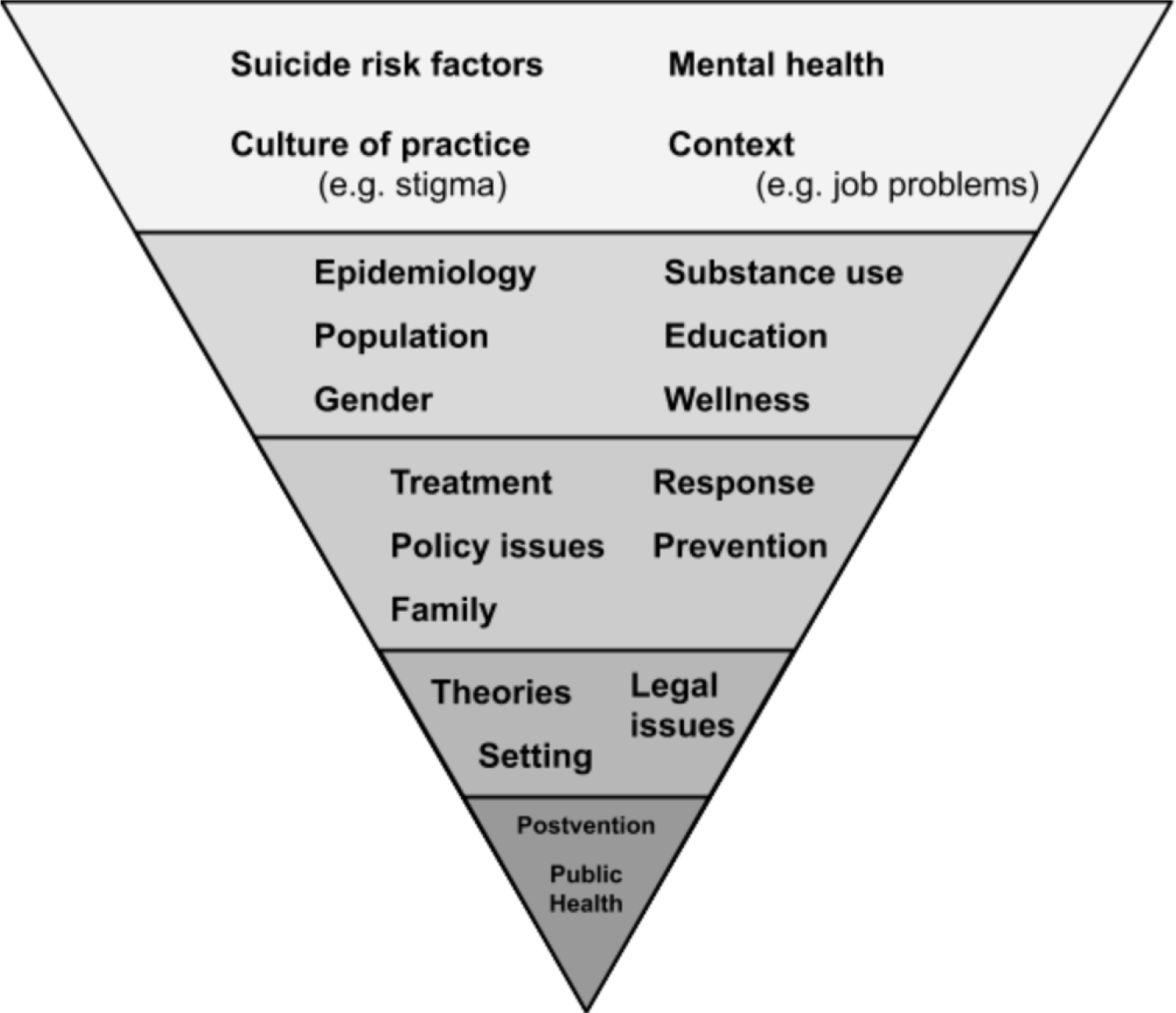
Figure 3
Framework of common publication themes on physician suicide
In the second level of the framework are epidemiologic and demographic focuses for study, which were previously described in the section on Physician-specific Risk Factors. Along with these subjects are a relatively lesser focus on substance use, compared to other risk factors such as mental health, and on developing educational curricula to address knowledge gaps about suicide and its prevention. Wellness is an increasingly popular topic for publication on this level of the framework. In the third level of the framework are prevention approaches. Thirteen articles described interventions with a primary aim of preventing physician suicides. Frequently, programs were implemented as an organizational response to a physician suicide. Five interventions implemented the American Foundation for Suicide Prevention’s Interactive Screening Program for suicide prevention (Ey et al. 2016; Haskins et al. 2016) as a component of a larger initiative to promote physician well-being; three of the five came from the same institution (Moutier et al. 2012; Downs et al. 2014; Zisook et al. 2016). Only 1 of 13 was a randomized controlled trial of a web-based screening program (Guille et al. 2015).
Treatments and responses to physician suicide were discussed as frequently as prevention; treatments and responses differed because treatments tended to focus on individual physician treatment for suicidal behaviors or related mental health disorders, and responses tended to focus on a small group, physician health program, or medical board responses to individual circumstances. For example, Young et al. described the difficult grieving process for a healthcare team after the death of a physician (Young et al. 1989). Patients were told that the physician who had died “was not available,” trust between staff and administrators eroded, morale decreased, and grieving, guilt, and other negative consequences remained unaddressed until 6 weeks after the physician’s death (Young et al. 1989). The process of facilitating a normal grieving process after a suicide death has occurred requires active planning, called postvention. In another study by Kaltreider et al., 20 medical students were interviewed after the death of a classmate by suicide (Kaltreider 1990). This qualitative study found that students experienced intense, intrusive, and persistent thoughts and emotions relating to their classmate’s death, sometimes lasting for months. Proximity to the site of the death, prior exposure to another suicide previously, or familiarity with depression in themselves or family seemed to increase these effects.
Legal and policy issues are increasingly recognized as affecting physician health and well-being and appear in the third and fourth levels of Figure 3. Physicians may avoid seeking mental health treatment, avoid self-report, and self-treat mental health and other health issues (Johnston 1979; Feeney et al. 2016), out of fear of reputational damage or concern about perceived weakness or impairment (Worley 2008). Licensure application questions could be improved (Worley 2008) and compassionate, confidential assistance programs, such as one implemented in the United Kingdom in 2010, could offer bespoke services to physicians who might be considered at risk of suicide (Feeney et al. 2016). In 2015, the United Kingdom’s General Medical Council was recommended to fund a pilot program that would include developing a national support service for doctors (Meerten et al. 2011). However, no literature was found to describe such policies in other countries.
Only three articles describe suicide clustering and suicide contagion (Williams 1997; Clarke and McKee 2017; Crawshaw et al. 1980). With minimal coverage of suicide clusters in physician suicide literature, there is a notable absence also of related concepts that have been previously described in suicidology literature, such as Werther syndrome or copycat suicide. These are unique public health concepts pertaining to suicide. Because postvention and public health approaches in physician suicide are poorly implemented and studied, both concepts were positioned at the bottom of the inverted pyramid (Figure 3).
DISCUSSION
As a scoping literature review, this review did not include a quality assessment of quantitative evidence from included papers nor did it perform a meta-analysis or any statistical comparisons of published evidence, which would be characteristic of a systematic review (The Joanna Briggs Institute 2015). More papers on physician suicide have been published over the last two decades than before. This follows an overall trend in published literature on physician well-being and may also reflect growing public recognition of and decreasing stigma relating to suicide. Furthermore, the proportion of opinion articles published is lower in the recent past compared to previously, indicating growing application of contemporary statistical and scientific methods to the study of physician suicide. Nonetheless, themes identified reveal opportunities for further work. The inverted pyramid framework (Figure 4) suggests that there is a dearth of work on examining physician suicide using typical public health approaches to investigate suicide clusters.
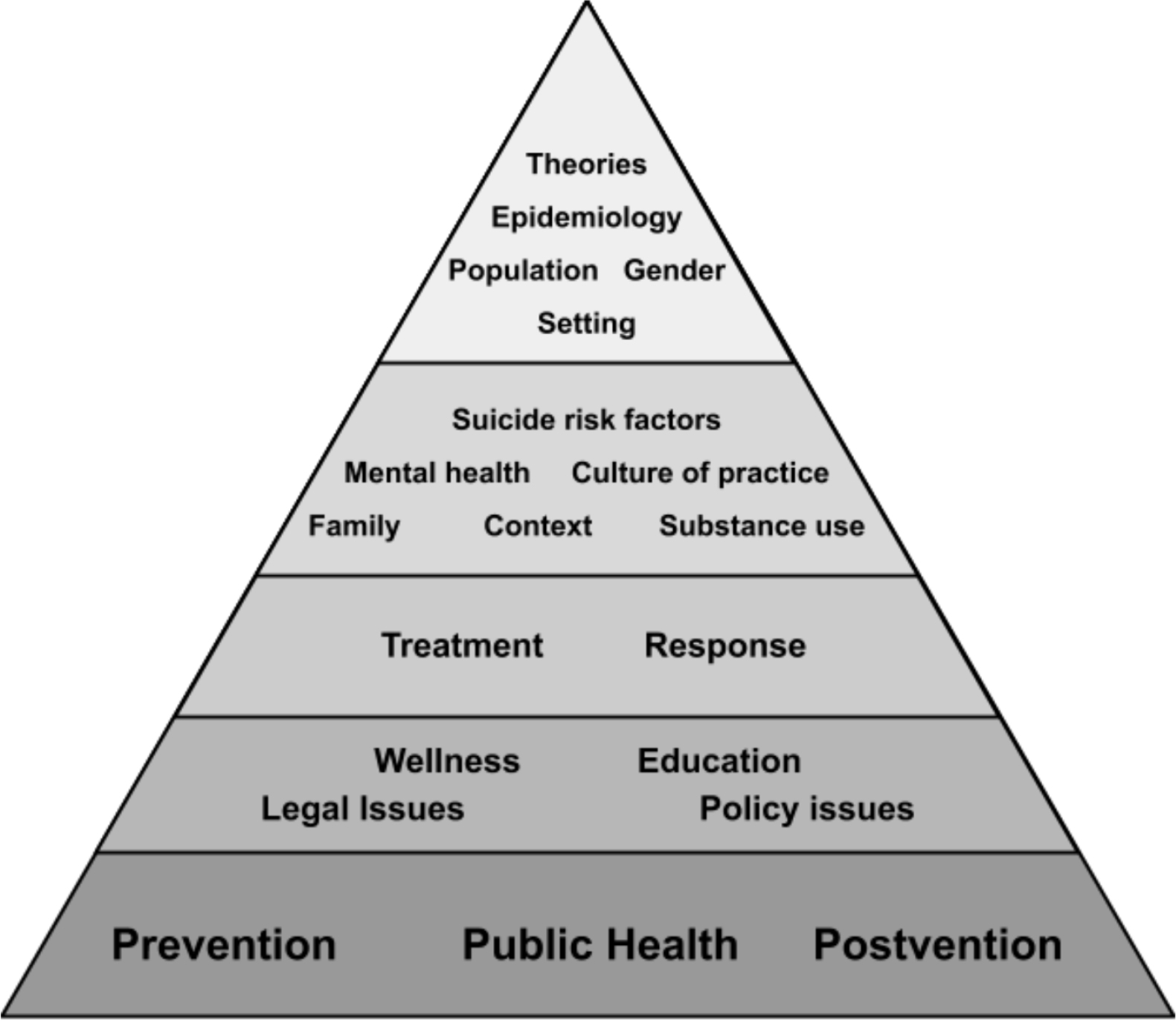
Figure 4
Proposed framework to highlight priorities for continued work on physician suicide
Figure 4 offers a proposed framework that highlights priorities for continued work on physician suicide. This framework highlights the potential for developing an organized public health approach to preventing physician suicide. The pyramid’s base identifies several areas for immediate, targeted action.
First, mandatory reporting, an approach used for workplace injury reporting, could improve surveillance of physician deaths by suicide (prevention). This also offers the potential for improved incidence detection and investigation of possible suicide clusters (public health). Furthermore, identifying minimum acceptable community standards of validated instruments used to assess suicidal ideation and attempts (prevention, public health) would also facilitate more accurate incidence estimates of such suicidal behaviors.
Fortunately, institution-based prevention programs with an explicit aim to prevent physician suicide have already been developed. More widespread development and implementation of evidence-based screening and service provision for suicide risk factors (prevention) are also still needed beyond institution-based initiatives for the greatest impact. Implementation and dissemination of postvention best practices and related programs are the necessary components to both support suicide loss survivors and prevent suicide clusters or contagion (postvention). They are as follows:
- increased education in the healthcare community about suicide warning signs and prevention (education, wellness);
- standardized education in the medical community about appropriate reporting on suicides to prevent suicide contagion (education); and
- reduction of barriers to help-seeking behavior and reduction of systematic stigma in licensing and investigative processes (policy issues, legal issues).
Top levels in Figure 4 include continued study of persistent risk factors, contextual and cultural challenges, social factors like family, and health inequities resulting from gender, immigrant, or other minority status, among other concerns. Currently available information is insufficient to draw conclusions about physician subgroups or their cultural or health system contexts. Such information on understudied physician subgroups could better inform future revisions of public health, prevention, and postvention programs to include diversity-sensitive suicide prevention approaches.
Additional articles have been published on physician suicide since the end of the last search period of April 2018. The necessity of accurately estimating physician suicide incidence remains a vital undertaking (Dutheil et al. 2019; Duarte et al. 2020). Editorials also demonstrate increasingly diverse and important views on the subject, including those of medical students (Chen 2019; Isaacs 2020), interns (Bullock 2020), or practicing physicians (Lynch 2020) who recount first-hand experiences with suicidal ideations or attempts. Others are physician suicide loss survivors (Hagens 2020) or advocates or researchers who publish about the impact of physician suicide (Poorman 2019; Gold and Schwenk 2020). The first-hand accounts are increasingly common and are a promising signal of potentially decreasing stigma in the medical community around discussing personal experiences of physician suicidal behaviors. More recently, with the COVID-19 pandemic in 2020, there may be a destigmatization of mental illness that could lead to an increasing attention and willingness in the medical community to address physician suicidality. This presents emerging opportunities for the study and prevention of suicide among physicians (Reger, Stanley, and Joiner 2020).
The strengths of this scoping literature review are its breadth and inclusiveness in examining multiple article types published in scholarly journals. However, due to the volume of citations generated by the searches, we excluded grey literature (e.g. conference proceedings, poster presentations, etc.) and snowballing of references was not performed. Additionally, because physician suicide involves multiple disciplines, additional electronic databases in future searches may be needed to capture broader perspectives on physician suicide. Finally, excluding non-English language publications may have led to overrepresentation of countries where English is the official language. Among the 46 non-English language papers excluded (Figure 1), potentially relevant papers were published in German, Spanish, Dutch, Finnish, Japanese, Chinese, French, Swedish, and Hungarian, which could reveal relevant themes in physician suicide, including cultural or health system context. Future studies could identify opportunities for cross-disciplinary and cross-cultural learning and suicide prevention.
CONCLUSION
This scoping review offers a landscape view of physician suicide literature and opportunities for further work on physician suicide prevention. Interventions are needed at multiple levels to mitigate the risks of physician suicide, which could begin with an organized public health approach. As a part of such an approach, consistency and reliability of data and information about physician suicides could be improved. Data limitations partly contribute to these issues. For example, annual rates of physician suicide reported and quoted may result from extrapolated estimates from old data, such as those collected by Craig and Pitts in 1968 (Craig and Pitts 1968). Reliable and trackable data and information can provide more continuously updated insights into the actual SMR ratios of physician suicide compared to other populations (Leung et al. 2019). Also, systems could be developed for better surveillance of physician suicides, including studying and tracking possible suicide clusters or contagion. These may improve investigation and interventions for the benefit of physicians’ and public health. Physician suicide should be approached as a public health issue and as a shared responsibility between individuals and institutions to prevent physician deaths by suicide.
ACKNOWLEDGMENTS
The authors wish to acknowledge Dr. Christine Moutier and Dr. Srijan Sen for their critical review and feedback on the manuscript, as well as Dr. Matthew Goldberg for his early contributions to the background and initial design considerations for this review.
Notes
[3] Contributed by AUTHOR CONTRIBUTIONS
TIL, SP, and CYAC designed the study and performed study selection. RS performed the literature search. TIL and SP extracted data, and TIL, SP, and CYAC interpreted the data. TIL drafted the manuscript, except for section 2 which was drafted by RS, and the entire manuscript was produced with critical revisions and important intellectual content from all authors.
[4] ETHICAL APPROVAL
Not applicable
[5] FUNDING
This work was supported by a Mapping the Landscape Literature Review grant (2017–2019) from the Arnold P. Gold Foundation Research Institute. The Arnold P. Gold Foundation Research Institute had no role in the study design, data collection and analysis, writing of the report, or decision to submit the manuscript for publication.
[6] INFORMED CONSENT
Not applicable
[7] STUDY REGISTRATION
This scoping literature review protocol was registered with PROSPERO.
[8] DATA AVAILABILITY STATEMENT
The raw data supporting the conclusions of this manuscript will be made available by the authors, without undue reservation, to any qualified researcher. A complete reference list of all included full-text articles is available in Appendix 2.
Appendices
APPENDIX 1
Ovid MEDLINE, PsycInfo, and Scopus Search Terms
| Date | Source | Query |
|---|---|---|
| 8/21/2017 | Investigators | n/a |
| 8/21/2017 | Ovid MEDLINE | 1. (((physician* or intern or interns or internship or fellow or resident* or residency or medical student* or doctor* or ‘medical student*’) adj5 ($suicid$ or self$harm or self$injury)) not ($assisted or euthanasia)).mp. [mp=title, abstract, original title, name of substance word, subject heading word, keyword heading word, protocol supplementary concept word, rare disease supplementary concept word, unique identifier, synonyms] 2. exp Physicians/ 3. Students, Medical/ 4. exp Education, Medical/ 5. 2 or 3 or 4 6. Suicide/ 7. (5 and 6) not ($assisted or euthanasia).mp. [mp=title, abstract, original title, name of substance word, subject heading word, keyword heading word, protocol supplementary concept word, rare disease supplementary concept word, unique identifier, synonyms] 8. 1 or 7 |
| 10/11/2017 | PsycINFO | 1. (((physician* or intern or interns or internship or fellow or resident* or residency or medical student* or doctor* or ‘medical student*’) adj5 ($suicid$ or self$harm or self$injury)) not ($assisted or euthanasia)).mp. [mp=title, abstract, original title, name of substance word, subject heading word, keyword heading word, protocol supplementary concept word, rare disease supplementary concept word, unique identifier, synonyms] 2. exp Physicians/3. Students, Medical/4. exp Education, Medical/5. 2 or 3 or 4 6. Suicide/7. (5 and 6) not ($assisted or euthanasia).mp. [mp=title, abstract, original title, name of substance word, subject heading word, keyword heading word, protocol supplementary concept word, rare disease supplementary concept word, unique identifier, synonyms] 8. 1 or 7 |
| 4/28/2018 | Scopus | ( TITLE-ABS-KEY ( medical AND student* ) OR TITLE-ABS-KEY ( physician* OR fellow OR residency OR doctor* ) W/5 TITLE-ABS-KEY ( suicid* OR self-harm OR self-injury ) ) AND NOT ( TITLE-ABS-KEY ( *assisted OR euthanasia OR nurs* OR patient* OR undergraduate* ) ) |
APPENDIX 2
Included Full-Text Articles for Review
Aasland OG, Ekeberg Ø, Schweder T. Suicide rates from 1960 to 1989 in Norwegian physicians compared with other educational groups. Soc Sci Med. 2001 Jan;52(2):259–65.
OG AaslandØ EkebergT. SchwederSuicide rates from 1960 to 1989 in Norwegian physicians compared with other educational groupsSoc Sci Med2001Jan5222596510.1016/S0277-9536(00)00226-4
Aasland OG, Hem E, Haldorsen T, Ekeberg Ø. Mortality among Norwegian doctors 1960–2000. BMC Public Health. 2011;11(1):173.
OG AaslandE HemT HaldorsenØ. EkebergMortality among Norwegian doctors 1960–2000BMC Public Health201111117310.1186/1471-2458-11-173307065421426552
Aasland OG. Physician suicide-why? Gen Hosp Psychiatry. 2013;35(1):1–2.
OG. AaslandPhysician suicide-why?Gen Hosp Psychiatry20133511210.1016/j.genhosppsych.2012.09.00523123102
Adams Greenup R. The Other Side of the Stethoscope. Acad Psychiatry. 2008 Feb 1;32(1):1–2.
R. Adams GreenupThe Other Side of the StethoscopeAcad Psychiatry2008Feb13211210.1176/appi.ap.32.1.118270273
Adler NR, Adler KA, Grant-Kels JM. Doctors’ mental health, burnout, and suicidality: Professional and ethical issues in the workplace. J Am Acad Dermatol. 2017;77(6):1191–3.
NR AdlerKA AdlerJM. Grant-KelsDoctors’ mental health, burnout, and suicidality: Professional and ethical issues in the workplaceJ Am Acad Dermatol20177761191310.1016/j.jaad.2017.07.01129132858
Agerbo E, Gunnell D, Bonde JP, Bo Mortensen P, Nordentoft M. Suicide and occupation: the impact of socio-economic, demographic and psychiatric differences. Psychol Med. 2007 Aug 20;37(08):1131.
E AgerboD GunnellJP BondeP Bo MortensenM. NordentoftSuicide and occupation: the impact of socio-economic, demographic and psychiatric differencesPsychol Med2007Aug203708113110.1017/S003329170700048717445281
Ahmed SA, Omar QH, Abo Elamaim AA. Forensic analysis of suicidal ideation among medical students of Egypt: A cross-sectional study. J Forensic Leg Med. 2016;44:1–4.
SA AhmedQH OmarAA. Abo ElamaimForensic analysis of suicidal ideation among medical students of Egypt: A cross-sectional studyJ Forensic Leg Med2016441410.1016/j.jflm.2016.08.00927589377
Alexandrino-Silva C, Pereira MLG, Bustamante C, Ferraz ACDT, Baldassin S, De Andrade AG, et al. Suicidal ideation among students enrolled in healthcare training programs: A cross-sectional study. Rev Bras Psiquiatr. 2009;31(4):338–44.
C Alexandrino-SilvaMLG PereiraC BustamanteACDT FerrazS BaldassinAG De AndradeSuicidal ideation among students enrolled in healthcare training programs: A cross-sectional studyRev Bras Psiquiatr20093143384410.1590/S1516-4446200900500000619838592
Allroggen M, Kleinrahm R, Rau TAD, Weninger L, Ludolph AG, Plener PL. Nonsuicidal Self-Injury and Its Relation to Personality Traits in Medical Students. J Nerv Ment Dis. 2014;202(4):300–4.
M AllroggenR KleinrahmTAD RauL WeningerAG LudolphPL. PlenerNonsuicidal Self-Injury and Its Relation to Personality Traits in Medical StudentsJ Nerv Ment Dis20142024300410.1097/NMD.000000000000012224647217
Physician mortality and suicide. Results and implications of the AMA-APA Pilot Study. AMA Council on Scientific Affairs. Conn Med. 1986 Jan;50(1):37–43.
Physician mortality and suicide.Results and implications of the AMA-APA Pilot StudyAMA Council on Scientific Affairs. Conn Med1986Jan5013743
Amiri L, Voracek M, Yousef S, Galadari A, Yammahi S, Sadeghi MR, et al. Suicidal behavior and attitudes among medical students in the United Arab Emirates. Crisis. 2013;34(2):116–23.
L AmiriM VoracekS YousefA GaladariS YammahiMR SadeghiSuicidal behavior and attitudes among medical students in the United Arab EmiratesCrisis20133421162310.1027/0227-5910/a00017023195458
Anders DL. Risky Business. JAMA. 1988;260(21):3184.
DL. AndersRisky BusinessJAMA198826021318410.1001/jama.1988.03410210096048
Anonymous. Suicides of physicians and the reasons. JAMA J Am Med Assoc. 1903 Jul 25;XLI(4):263.
Anonymous.Suicides of physicians and the reasonsJAMA J Am Med Assoc1903Jul25XLI426310.1001/jama.1903.04480010049014
Anonymous. Mental disturbance in doctors. Br Med J. 1969 Jan 16;4(5681):448.
Anonymous.Mental disturbance in doctorsBr Med J1969Jan164568144810.1136/bmj.4.5681.448
Anonymous. Mentally Disturbed Doctors. Br Med J. 1972;(March 11):643.
Anonymous.Mentally Disturbed DoctorsBr Med J1972March1164310.1136/bmj.1.5801.643
Anteski M. Letters: Suicide by Physicians. JAMA. 1984;252(24):3364.
M. AnteskiLetters: Suicide by PhysiciansJAMA198425224336410.1001/jama.1984.03350240014010
Arnetz BB, Hörte LG, Hedberg A, Theorell T, Allander E, Malker H. Suicide patterns among physicians related to other academics as well as to the general population. Acta Psychiatr Scand. 1987 Feb;75(2):139–43.
BB ArnetzLG HörteA HedbergT TheorellE AllanderH MalkerSuicide patterns among physicians related to other academics as well as to the general populationActa Psychiatr Scand1987Feb7521394310.1111/j.1600-0447.1987.tb02765.x3494382
Austin AE, van den Heuvel C, Byard RW. Physician Suicide. J Forensic Sci. 2013 Jan;58(12):S91–3.
AE AustinC van den HeuvelRW. ByardPhysician SuicideJ Forensic Sci2013Jan5812S91310.1111/j.1556-4029.2012.02260.x22900898
Ayala EE, Roseman D, Winseman JS, Mason HRC. Prevalence, perceptions, and consequences of substance use in medical students. Med Educ Online. 2017;22(1):1392824.
EE AyalaD RosemanJS WinsemanHRC. MasonPrevalence, perceptions, and consequences of substance use in medical studentsMed Educ Online2017221139282410.1080/10872981.2017.1392824567844229072119
Balch CM, Shanafelt TD. Combating Stress and Burnout in Surgical Practice: A Review. Adv Surg. 2010 Sep;44(1):29–47.
CM BalchTD. ShanafeltCombating Stress and Burnout in Surgical Practice: A ReviewAdv Surg2010Sep441294710.1016/j.yasu.2010.05.01820919512
Behera C, Swain R, Mridha AR anjan, Pooniya S. Suicide by injecting lispro insulin with an intravenous cannula. Med Leg J. 2015;83(3):147–9.
C BeheraR SwainAR anjan MridhaS. PooniyaSuicide by injecting lispro insulin with an intravenous cannulaMed Leg J2015833147910.1177/002581721557317125748289
Bergman J. The Suicide Rate Among Psychiatrists Revisited. Suicide Life-Threatening Behav. 1979;9(4):219–26.
J. BergmanThe Suicide Rate Among Psychiatrists RevisitedSuicide Life-Threatening Behav1979942192610.1111/j.1943-278X.1979.tb00440.x
Best JA. The Things We Have Lost. JAMA. 2016 Nov 8;316(18):1871–2.
JA. BestThe Things We Have LostJAMA2016Nov8316181871210.1001/jama.2016.995427825012
Birmingham PK, Ward RJ. A High-Risk Suicide Group: The Anesthesiologist Involved in Litigation. Am J Psychiatry. 1985;142(10):1225–6.
PK BirminghamRJ. WardA High-Risk Suicide Group: The Anesthesiologist Involved in LitigationAm J Psychiatry1985142101225610.1176/ajp.142.10.1225b4037141
Bittker TE. Reaching out to the depressed physician. JAMA. 1976 Oct 11;236(15):1713–6.
TE. BittkerReaching out to the depressed physicianJAMA1976Oct11236151713610.1001/jama.1976.03270160035026
Blachly P. Suicide in Physicians. JAMA. 1968;210(2):348.
P. BlachlySuicide in PhysiciansJAMA1968210234810.1001/jama.1969.03160280088032
Black D. When physicians commit suicide. Iowa Med. 1992;82(2):58–61.
D. BlackWhen physicians commit suicideIowa Med19928225861
Bock J, Burgdorf WHC, Hoenig LJ, Parish LC. The fate of Hungarian Jewish dermatologists during the Holocaust: Part 2: Under Nazi rule. Clin Dermatol. 2016;34(6):768–78.
J BockWHC BurgdorfLJ HoenigLC. ParishThe fate of Hungarian Jewish dermatologists during the Holocaust: Part 2: Under Nazi ruleClin Dermatol20163467687810.1016/j.clindermatol.2016.06.00227968937
Bondurant R, Morton N. Implementing Change to Reduce Depression, Suicide, and Burnout Among Physicians-in-Training. Mo Med. 2016;113(1):16–8.
R BondurantN. MortonImplementing Change to Reduce Depression, Suicide, and Burnout Among Physicians-in-TrainingMo Med20161131168
Bourne T, Wynants L, Peters M, Van Audenhove C, Timmerman D, Van Calster B, et al. The impact of complaints procedures on the welfare, health and clinical practise of 7926 doctors in the UK: A cross-sectional survey. BMJ Open. 2015;5(1):1–12.
T BourneL WynantsM PetersC Van AudenhoveD TimmermanB Van CalsterThe impact of complaints procedures on the welfare, health and clinical practise of 7926 doctors in the UK: A cross-sectional surveyBMJ Open20155111210.1136/bmjopen-2014-006687431655825592686
Brandt-Casadevall C, Krompecher T, Giroud C, Mangin P. A case of suicide disguised as natural death. Sci Justice - J Forensic Sci Soc. 2003;43(1):41–3.
C Brandt-CasadevallT KrompecherC GiroudP. ManginA case of suicide disguised as natural deathSci Justice - J Forensic Sci Soc200343141310.1016/S1355-0306(03)71739-0
Braquehais MD. Reconsidering suicide prevention strategies in physicians. Aust N Z J Psychiatry. 2011 Dec;45(12):1095–6.
MD. BraquehaisReconsidering suicide prevention strategies in physiciansAust N Z J Psychiatry2011Dec45121095610.3109/00048674.2011.61529222014104
Braquehais MD, Eiroa-Orosa FJ, Holmes KM, Lusilla P, Bravo M, Mozo X, et al. Differences in Physicians’ and Nurses’ Recent Suicide Attempts: An Exploratory Study. Arch Suicide Res. 2016;20(2):273–9.
MD BraquehaisFJ Eiroa-OrosaKM HolmesP LusillaM BravoX MozoDifferences in Physicians’ and Nurses’ Recent Suicide Attempts: An Exploratory StudyArch Suicide Res2016202273910.1080/13811118.2014.99669325517040
Bressler B. Suicide and Drug Abuse in the Medical Community. Suicide Life-Threatening Behav. 1976;6(3):169–78.
B. BresslerSuicide and Drug Abuse in the Medical CommunitySuicide Life-Threatening Behav19766316978
Broquet KE. Teaching Residents and Program Directors About Physician Impairment. Acad Psychiatry. 2004 Sep 1;28(3):221–5.
KE. BroquetTeaching Residents and Program Directors About Physician ImpairmentAcad Psychiatry2004Sep1283221510.1176/appi.ap.28.3.22115507558
Bruce DL, Eide KA, Linde HW, Eckenhoff JE. Causes of Death among Anesthesiologists: A 20-Year Survey. Anesthesiology. 1968;29(3):565–9.
DL BruceKA EideHW LindeJE. EckenhoffCauses of Death among Anesthesiologists: A 20-Year SurveyAnesthesiology1968293565910.1097/00000542-196805000-000395647504
Burrows GD. Stress and distress in middle age - The mental heath of doctors. Aust Fam Physician. 1976;5(October):1203–10.
GD. BurrowsStress and distress in middle age - The mental heath of doctorsAust Fam Physician19765October120310
Carlson GA, Miller DC. Suicide, Affective Disorder, and Women Physicians. Am J Psychiatry. 1981;138(10):1330–5.
GA CarlsonDC. MillerSuicide, Affective Disorder, and Women PhysiciansAm J Psychiatry1981138101330510.1176/ajp.138.10.13307294189
Carpenter LM, Swerdlow AJ, Fear NT. Mortality of doctors in different specialties: Findings from a cohort of 20 000 NHS hospital consultants. Occup Environ Med. 1997;54(6):388–95.
LM CarpenterAJ SwerdlowNT. FearMortality of doctors in different specialties: Findings from a cohort of 20 000 NHS hospital consultantsOccup Environ Med19975463889510.1136/oem.54.6.38811287989245944
Carr GD. Physician Suicide - A Problem for Our Time. J MSMA. 2008;49(10):308–12.
GD. CarrPhysician Suicide - A Problem for Our TimeJ MSMA2008491030812
Casey D, Choong KA. Suicide whilst under GMC’s fitness to practise investigation: Were those deaths preventable? J Forensic Leg Med. 2016;37:22–7.
D CaseyKA. ChoongSuicide whilst under GMC’s fitness to practise investigation: Were those deaths preventable?J Forensic Leg Med20163722710.1016/j.jflm.2015.10.00226519926
Cath SH. Some Human Factors in the Flying Physician. Aerosp Med. 1974;45(11):1298–302.
SH. CathSome Human Factors in the Flying PhysicianAerosp Med197445111298302
Center C, Davis M, Detre T, Ford DE, Hansbrough W, Hendin H, et al. Confronting Depression and Suicide in Physicians. JAMA. 2003;289(23):3161.
C CenterM DavisT DetreDE FordW HansbroughH HendinConfronting Depression and Suicide in PhysiciansJAMA200328923316110.1001/jama.289.23.316112813122
Cheng J, Kumar S, Nelson E, Harris T, Coverdale J. A National Survey of Medical Student Suicides. Acad Psychiatry. 2014 Oct 25;38(5):542–6.
J ChengS KumarE NelsonT HarrisJ. CoverdaleA National Survey of Medical Student SuicidesAcad Psychiatry2014Oct25385542610.1007/s40596-014-0075-124664602
Clarke R, McKee M. Suicides among junior doctors in the NHS. BMJ. 2017;357:1–2.
R ClarkeM. McKeeSuicides among junior doctors in the NHSBMJ20173571210.1136/bmj.j252728550153
Clements W, Paine R. The Family Physician’s Family. J Fam Pract. 1981;13(1):105–12.
W ClementsR. PaineThe Family Physician’s FamilyJ Fam Pract198113110512
Coentre R, Faravelli C, Figueira ML. Assessment of depression and suicidal behaviour among medical students in Portugal. Int J Med Educ. 2016;7:354–63.
R CoentreC FaravelliML. FigueiraAssessment of depression and suicidal behaviour among medical students in PortugalInt J Med Educ201673546310.5116/ijme.57f8.c468511636427794561
Boxer PA, Burnett C, Swanson N. Suicide and Occupation: A Review of the Literature. J Occup Environ Med. 1995;37:442–52.
PA BoxerC BurnettN. SwansonSuicide and Occupation: A Review of the LiteratureJ Occup Environ Med1995374425210.1097/00043764-199504000-000167670900
Cohen E. Suicide in Physicians. JAMA. 1972 Oct;222(4):489–90.
E. CohenSuicide in PhysiciansJAMA1972Oct22244899010.1001/jama.1972.03210040057027
Cohen E. Suicide and self-assault: an introductory course for medical students. J Med Educ. 1974 Apr;49(4):383–5.
E. CohenSuicide and self-assault: an introductory course for medical studentsJ Med Educ1974Apr494383510.1097/00001888-197404000-00011
Cohen E. Suicide-Prone Physicians. JAMA J Am Med Assoc. 1972 Mar 27;219(13):1762.
E. CohenSuicide-Prone PhysiciansJAMA J Am Med Assoc1972Mar2721913176210.1001/jama.1972.03190390046020
Collier R. Physician suicide too often “brushed under the rug.” CMAJ. 2017;189(39):E1240–1.
R. CollierPhysician suicide too often “brushed under the rug.”CMAJ201718939E1240110.1503/cmaj.1095498562804128970266
Colucci AP, Gagliano-Candela R, Aventaggiato L, De Donno A, Leonardi S, Strisciullo G, et al. Suicide by Self-Administration of a Drug Mixture (Propofol, Midazolam, and Zolpidem) in an Anesthesiologist: The First Case Report in Italy. J Forensic Sci. 2013;58(3):837–41.
AP ColucciR Gagliano-CandelaL AventaggiatoA De DonnoS LeonardiG StrisciulloSuicide by Self-Administration of a Drug Mixture (Propofol, Midazolam, and Zolpidem) in an Anesthesiologist: The First Case Report in ItalyJ Forensic Sci20135838374110.1111/1556-4029.1205323406307
Compton MT, Carrera J, Frank E. Stress and depressive symptoms/dysphoria among us medical students: Results from a large, nationally representative survey. J Nerv Ment Dis. 2008;196(12):891–7.
MT ComptonJ CarreraE. FrankStress and depressive symptoms/dysphoria among us medical students: Results from a large, nationally representative surveyJ Nerv Ment Dis200819612891710.1097/NMD.0b013e3181924d0319077856
Coomber S, Todd C, Park G, Baxter P, Firth-Cozens J, Shore S. Stress in UK intensive care unit doctors. Br J Anaesth. 2002 Dec;89(6):873–81.
S CoomberC ToddG ParkP BaxterJ Firth-CozensS. ShoreStress in UK intensive care unit doctorsBr J Anaesth2002Dec8968738110.1093/bja/aef27312453932
Cornette MM, Deroon-Cassini TA, Fosco GM, Holloway RL, Clark DC, Joiner TE. Application of an interpersonal-psychological model of suicidal behavior to physicians and medical trainees. Arch Suicide Res. 2009;13(1):1–14.
MM CornetteTA Deroon-CassiniGM FoscoRL HollowayDC ClarkTE. JoinerApplication of an interpersonal-psychological model of suicidal behavior to physicians and medical traineesArch Suicide Res200913111410.1080/1381111080257180119123105
Craig AG, Pitts FN. Suicide by physicians. Dis Nerv Syst. 1968 Nov;29(11):763–72.
AG CraigFN. PittsSuicide by physiciansDis Nerv Syst1968Nov291176372
Crawford JP. Mental disturbance in doctors. Br Med J. 1971 Jan 16;1(5741):175.
JP. CrawfordMental disturbance in doctorsBr Med J1971Jan161574117510.1136/bmj.1.5741.175-c17951545539435
Crawshaw R. Suicide by Physicians on Probation-Reply. JAMA J Am Med Assoc. 1981 Apr 17;245(15):1527.
R. CrawshawSuicide by Physicians on Probation-ReplyJAMA J Am Med Assoc1981Apr1724515152710.1001/jama.1981.03310400012010
Crawshaw R, Bruce JA, Eraker PL, Greenbaum M, Lindemann JE, Schmidt DE. An epidemic of suicide among physicians on probation. JAMA. 1980 May 16;243(19):1915–7.
R CrawshawJA BrucePL ErakerM GreenbaumJE LindemannDE. SchmidtAn epidemic of suicide among physicians on probationJAMA1980May16243191915710.1001/jama.1980.03300450029016
Curran TA, Gawley E, Casey P, Gill M, Crumlish N. Depression, suicidality and alcohol abuse among medical and business students. Ir Med J. 2009;102(8):2007–8.
TA CurranE GawleyP CaseyM GillN. CrumlishDepression, suicidality and alcohol abuse among medical and business studentsIr Med J2009102820078
Daneault S. The wounded healer: can this idea be of use to family physicians? Can Fam Physician. 2008;54:1218–9.
S. DaneaultThe wounded healer: can this idea be of use to family physicians?Can Fam Physician20085412189
Das S. The incidence of suicides among physicians and dentists: An unexplained story. Occup Med (Chic Ill). 2008;58(2):150–1.
S. DasThe incidence of suicides among physicians and dentists: An unexplained storyOccup Med (Chic Ill)2008582150110.1093/occmed/kqm15518296692
Daubs J. The mental health crisis in ophthalmology. Am J Optom Arch Am Acad Optom. 1973 Oct;50(10):816–22.
J. DaubsThe mental health crisis in ophthalmologyAm J Optom Arch Am Acad Optom1973Oct50108162210.1097/00006324-197310000-000094520501
De Hart C. Suicide by Physicians. JAMA. 1974;65(2):32–3.
C. De HartSuicide by PhysiciansJAMA1974652323
de la Monte SM, Hutchins GM. Is suicide a special occupational hazard for physicians? JAMA. 1984;251(15):1952–3.
SM de la MonteGM. HutchinsIs suicide a special occupational hazard for physicians?JAMA1984251151952310.1001/jama.1984.033403900160126700097
De Rosis H. Editorial: Suicide among psychiatrists. Am J Psychoanal. 1974;34(2):97–8.
H. De RosisEditorial: Suicide among psychiatristsAm J Psychoanal197434297810.1007/BF012721254473908
Dempsey JJ. Physician Suicide. JAMA J Am Med Assoc. 1987 Sep 25;258(12):1607.
JJ. DempseyPhysician SuicideJAMA J Am Med Assoc1987Sep2525812160710.1001/jama.1987.03400120057016
Derksen DJ. Dolores. Health Aff. 2002;21(5):218–23.
DJ. DerksenDoloresHealth Aff20022152182310.1377/hlthaff.21.5.21812224886
Desjardins M. Physician suicide. Can something be done? Can Fam Physician. 1997 Nov;43:1900–1, 1907–9.
M. DesjardinsPhysician suicideCan something be done? Can Fam Physician1997Nov431900119079
DeSole DE, Singer P, Aronson S. Suicide and Role Strain Among Physicians. Int J Soc Psychiatry. 1969;15(4):294–301.
DE DeSoleP SingerS. AronsonSuicide and Role Strain Among PhysiciansInt J Soc Psychiatry196915429430110.1177/002076406901500407
Devi S. Doctors in distress. Lancet. 2011;377(9764):454–5.
S. DeviDoctors in distressLancet20113779764454510.1016/S0140-6736(11)60145-1
Dippo J. A Mother’s Story. Minn Med. 2007;(December):28–31.
J. DippoA Mother’s StoryMinn Med2007December2831
Dobson R. Stresses on women doctors may cause higher suicide risk. BMJ. 2001;322(21):945.
R. DobsonStresses on women doctors may cause higher suicide riskBMJ200132221945
Domino G, Takahashi Y. Attitudes toward suicide in Japanese and American medical students. Suicide Life Threat Behav. 1991;21(4):345–59.
G DominoY. TakahashiAttitudes toward suicide in Japanese and American medical studentsSuicide Life Threat Behav199121434559
Downs N, Feng W, Kirby B, McGuire T, Moutier C, Norcross W, et al. Listening to Depression and Suicide Risk in Medical Students: the Healer Education Assessment and Referral (HEAR) Program. Acad Psychiatry. 2014 Oct 5;38(5):547–53.
N DownsW FengB KirbyT McGuireC MoutierW NorcrossListening to Depression and Suicide Risk in Medical Students: the Healer Education Assessment and Referral (HEAR) ProgramAcad Psychiatry2014Oct53855475310.1007/s40596-014-0115-x24705825
Duffy JC. The emotional health of physicians. Ann Intern Med. 1968;69(6):1319–22.
JC. DuffyThe emotional health of physiciansAnn Intern Med196869613192210.7326/0003-4819-69-6-13195749682
Duffy JC. Editorial: Suicides by Physicians in Training. J Med Educ. 1968;43(11):1196.
JC. DuffyEditorial: Suicides by Physicians in TrainingJ Med Educ196843111196
Dunn LB. Incidence of Suicides Among Physicians. JAMA J Am Med Assoc. 1965 Dec 13;194(11):1257.
LB. DunnIncidence of Suicides Among PhysiciansJAMA J Am Med Assoc1965Dec1319411125710.1001/jama.1965.03090240091035
Dwyer AJ, Morley P, Reid E, Angelatos C. Distressed doctors: A hospital-based support program for poorly performing and “at-risk” junior medical staff. Med J Aust. 2011;194(9):466–9.
AJ DwyerP MorleyE ReidC. AngelatosDistressed doctors: A hospital-based support program for poorly performing and “at-risk” junior medical staffMed J Aust20111949466910.5694/j.1326-5377.2011.tb03063.x21534905
Dyrbye LN, Thomas MR, Massie FS, Power D V, Eacker A, Harper W, et al. Burnout and suicidal ideation among U.S. medical students. Ann Intern Med. 2008 Sep 2;149(5):334–41.
LN DyrbyeMR ThomasFS MassieV Power DA EackerW HarperBurnout and suicidal ideation among U.S. medical studentsAnn Intern Med.2008Sep214953344110.7326/0003-4819-149-5-200809020-0000818765703
Dyrbye LN. Letters to the Editor: Medical Students and Depression. Acad Med. 2009;84(8):976.
LN. DyrbyeLetters to the Editor: Medical Students and DepressionAcad Med200984897610.1097/ACM.0b013e3181acebd519638756
Dyrbye LN, Power D V., Stanford Massie F, Eacker A, Harper W, Thomas MR, et al. Factors associated with resilience to and recovery from burnout: A prospective, multi-institutional study of US medical students. Med Educ. 2010;44(10):1016–26.
LN DyrbyeV. Power DF Stanford MassieA EackerW HarperMR ThomasFactors associated with resilience to and recovery from burnout: A prospective, multi-institutional study of US medical studentsMed Educ2010441010162610.1111/j.1365-2923.2010.03754.x20880371
Dyrbye LN, Schwartz A, Downing SM, Szydlo DW, Sloan JA, Shanafelt TD. Efficacy of a brief screening tool to identify medical students in distress. Acad Med. 2011;86(7):907–14.
LN DyrbyeA SchwartzSM DowningDW SzydloJA SloanTD. ShanafeltEfficacy of a brief screening tool to identify medical students in distressAcad Med20118679071410.1097/ACM.0b013e31821da61521642810
Dyrbye LN, Harper W, Durning SJ, Moutier C, Thomas MR, Massie FS, et al. Patterns of distress in US medical students. Med Teach. 2011;33(10):834–9.
LN DyrbyeW HarperSJ DurningC MoutierMR ThomasFS MassiePatterns of distress in US medical studentsMed Teach20113310834910.3109/0142159X.2010.53115821942482
Dyrbye LN, Satele D, Sloan J, Shanafelt TD. Utility of a Brief Screening Tool to Identify Physicians in Distress. J Gen Intern Med. 2013;28(3):421–7.
LN DyrbyeD SateleJ SloanTD. ShanafeltUtility of a Brief Screening Tool to Identify Physicians in DistressJ Gen Intern Med2013283421710.1007/s11606-012-2252-9357998323129161
Dyrbye LN, West CP, Satele D, Boone S, Tan L, Sloan J, et al. Burnout among u.s. medical students, residents, and early career physicians relative to the general u.s. population. Acad Med. 2014;89(3):443–51.
LN DyrbyeCP WestD SateleS BooneL TanJ SloanBurnout among u.s. medical students, residents, and early career physicians relative to the general u.s. populationAcad Med20148934435110.1097/ACM.000000000000013424448053
Earle L, Kelly L. Coping strategies, depression, and anxiety among Ontario family medicine residents. Can Fam physician Médecin Fam Can. 2005;51(2):242–3.
L EarleL. KellyCoping strategies, depression, and anxiety among Ontario family medicine residentsCan Fam physician Médecin Fam Can20055122423
Eckleberry-Hunt J, Lick D. Physician Depression and Suicide: A Shared Responsibility. Teach Learn Med. 2015;27(3):341–5.
J Eckleberry-HuntD. LickPhysician Depression and Suicide: A Shared ResponsibilityTeach Learn Med2015273341510.1080/10401334.2015.104475126158336
Edirisinghe PAS, Busuttil A. Medical suicide - Groin stabbing. J Clin Forensic Med. 2006;13(2):92–5.
PAS EdirisingheA. BusuttilMedical suicide - Groin stabbingJ Clin Forensic Med200613292510.1016/j.jcfm.2005.08.00816275154
Eilers GM. Physician suicide. Arch Fam Med. 1996;5(4):197–8.
GM. EilersPhysician suicideArch Fam Med199654197810.1001/archfami.5.4.1978769905
Ellard J. The disease of being a doctor. Med J Aust. 1974 Aug 31;2(9):318–23.
J. EllardThe disease of being a doctorMed J Aust1974Aug31293182310.5694/j.1326-5377.1974.tb70807.x4418912
Eneroth M, Gustafsson Sendén M, Løvseth LT, Schenck-Gustafsson K, Fridner A. A comparison of risk and protective factors related to suicide ideation among residents and specialists in academic medicine. BMC Public Health. 2014;14(1):1–9.
M EnerothM Gustafsson SendénLT LøvsethK Schenck-GustafssonA. FridnerA comparison of risk and protective factors related to suicide ideation among residents and specialists in academic medicineBMC Public Health20141411910.1186/1471-2458-14-271399434524655908
Ennis J, Barnes R. More on suicide and women physicians. Am J Psychiatry. 1980;137(9):1125–6.
J EnnisR. BarnesMore on suicide and women physiciansAm J Psychiatry198013791125610.1176/ajp.137.9.1125-b
Epstein L, Thomas C, Shaffer J, Perlin S. Clinical prediction of physician suicide based on medical student data. Vol. 156, The Journal of Nervous and Mental Disease. 1973. p. 19–29.
L EpsteinC ThomasJ ShafferS. PerlinClinical prediction of physician suicide based on medical student data. Vol 156The Journal of Nervous and Mental Disease1973192910.1097/00005053-197301000-000024690309
Eskin M, Voracek M, Stieger S, Altinyazar V. A cross-cultural investigation of suicidal behavior and attitudes in Austrian and Turkish medical students. Soc Psychiatry Psychiatr Epidemiol. 2011;46(9):813–23.
M EskinM VoracekS StiegerV. AltinyazarA cross-cultural investigation of suicidal behavior and attitudes in Austrian and Turkish medical studentsSoc Psychiatry Psychiatr Epidemiol20114698132310.1007/s00127-010-0254-720563550
Essex C. Doctor’s suicide prompts look at hours. Br Med J. 1994;309(6961):1037.
C. EssexDoctor’s suicide prompts look at hoursBr Med J19943096961103710.1136/bmj.309.6961.1037a7950731
Everson RB, Fraunteni JF. Mortality Among Medical Students and Young Physicians. J Med Educ. 1975;50:809–11.
RB EversonJF. FraunteniMortality Among Medical Students and Young PhysiciansJ Med Educ1975508091110.1097/00001888-197508000-000091152010
Ey S, Moffit M, Kinzie JM, Brunett PH. Feasibility of a Comprehensive Wellness and Suicide Prevention Program: A Decade of Caring for Physicians in Training and Practice. J Grad Med Educ. 2016;8(5):747–53.
S EyM MoffitJM KinziePH. BrunettFeasibility of a Comprehensive Wellness and Suicide Prevention Program: A Decade of Caring for Physicians in Training and PracticeJ Grad Med Educ2016857475310.4300/JGME-D-16-00034.1518053128018541
Familoni OB. An overview of stress in medical practice in Nigeria. Niger Hosp Pract. 2009 Jan 30;2(5):6–7.
OB. FamiloniAn overview of stress in medical practice in NigeriaNiger Hosp Pract2009Jan30256710.4314/nhp.v2i5.41442
Fan APC, Kosik RO, Su TP, Lee FY, Hou MC, Chen YA, et al. Letters to the Editor: Factors associated with suicidal ideation in Taiwanese medical students. Med Teach. 2011;33(3):256–7.
APC FanRO KosikTP SuFY LeeMC HouYA ChenLetters to the Editor: Factors associated with suicidal ideation in Taiwanese medical studentsMed Teach20113332567
Fan APC, Kosik RO, Mandell G a, Tran DT, Cheng HM, Chen CH, et al. Suicidal ideation in medical students: who is at risk? Ann Acad Med Singapore. 2012;41(9):377–82.
APC FanRO KosikG a MandellDT TranHM ChengCH ChenSuicidal ideation in medical students: who is at risk?Ann Acad Med Singapore201241937782
Feeney S, O’Brien K, O’Keeffe N, Iomaire ANC, Kelly ME, McCormack J, et al. Practise what you preach: Health behaviours and stress among non-consultant hospital doctors. Clin Med J R Coll Physicians London. 2016;16(1):12–8.
S FeeneyK O’BrienN O’KeeffeANC IomaireME KellyJ McCormackPractise what you preach: Health behaviours and stress among non-consultant hospital doctorsClin Med J R Coll Physicians London201616112810.7861/clinmedicine.16-1-12495432426833509
Feola A, Cassandro P, Carfora A, Petrella R, Giordano C, Stefanizzi IM, et al. Suicides in physicians: Two cases of poisoning involving fentanyl and phenobarbital. Minerva Psichiatr. 2017;58(2):103–9.
A FeolaP CassandroA CarforaR PetrellaC GiordanoIM StefanizziSuicides in physicians: Two cases of poisoning involving fentanyl and phenobarbitalMinerva Psichiatr2017582103910.23736/S0391-1772.17.01931-8
Fernando GC. A suicide by thiopentone infusion. Am J Forensic Med Pathol. 1990 Dec;11(4):309–11.
GC. FernandoA suicide by thiopentone infusionAm J Forensic Med Pathol1990Dec1143091110.1097/00000433-199012000-000082275467
Fink-Miller EL. An Examination of the Interpersonal Psychological Theory of Suicidal Behavior in Physicians. Suicide Life-Threatening Behav. 2015;45(4):488–94.
EL. Fink-MillerAn Examination of the Interpersonal Psychological Theory of Suicidal Behavior in PhysiciansSuicide Life-Threatening Behav20154544889410.1111/sltb.1214725530088
Fink-Miller EL. Provocative work experiences predict the acquired capability for suicide in physicians. Psychiatry Res. 2015;229(1–2):143–7.
EL. Fink-MillerProvocative work experiences predict the acquired capability for suicide in physiciansPsychiatry Res20152291–2143710.1016/j.psychres.2015.07.05526216167
Fink-Miller EL, Nestler LM. Suicide in physicians and veterinarians: risk factors and theories. Curr Opin Psychol. 2018;22:23–6.
EL Fink-MillerLM. NestlerSuicide in physicians and veterinarians: risk factors and theoriesCurr Opin Psychol20182223610.1016/j.copsyc.2017.07.01930122273
Finlayson AJR, Iannelli RJ, Brown KP, Neufeld RE, DuPont RL, Campbell MD. Re: Physician suicide and physician health programs. Gen Hosp Psychiatry. 2016;40:84–5.
AJR FinlaysonRJ IannelliKP BrownRE NeufeldRL DuPontMD. CampbellRe: Physician suicide and physician health programsGen Hosp Psychiatry20164084510.1016/j.genhosppsych.2016.01.00126874652
Finseth K. Suicide Among Women Physicians. JAMA. 1977;237(16):1693.
K. FinsethSuicide Among Women PhysiciansJAMA197723716169310.1001/jama.1977.03270430035012576670
Fitzgerald F, Murray TJ. On the death of house officers. Ann Intern Med. 1998 Jun 1;128(11):949–50.
F FitzgeraldTJ. MurrayOn the death of house officersAnn Intern Med1998Jun1128119495010.7326/0003-4819-128-11-199806010-000169634436
Frank E, Dingle AD. Self-reported depression and suicide attempts among U.S. women physicians. Am J Psychiatry. 1999 Dec;156(12):1887–94.
E FrankAD. DingleSelf-reported depression and suicide attempts among U.S. women physiciansAm J Psychiatry1999Dec15612188794
Freed H. Occupational hazards to physicians--suicide. Pa Med. 1969 Oct;72(10):65–6.
H. FreedOccupational hazards to physicians--suicidePa Med1969Oct7210656
Fridner A, Belkic K, Marini M, Minucci D, Pavan L, Schenck-Gustafsson K. Survey on recent suicidal ideation among female university hospital physicians in Sweden and Italy (the HOUPE study): Cross-sectional associations with work stressors. Gend Med. 2009;6(1):314–28.
A FridnerK BelkicM MariniD MinucciL PavanK. Schenck-GustafssonSurvey on recent suicidal ideation among female university hospital physicians in Sweden and Italy (the HOUPE study): Cross-sectional associations with work stressorsGend Med2009613142810.1016/j.genm.2009.04.00619467527
Fridner A, Belkić K, Minucci D, Pavan L, Marini M, Pingel B, et al. Work environment and recent suicidal thoughts among male university hospital physicians in Sweden and Italy: The Health and Organization among University Hospital Physicians in Europe (HOUPE) study. Gend Med. 2011;8(4):269–79.
A FridnerK BelkićD MinucciL PavanM MariniB PingelWork environment and recent suicidal thoughts among male university hospital physicians in Sweden and Italy: The Health and Organization among University Hospital Physicians in Europe (HOUPE) studyGend Med2011842697910.1016/j.genm.2011.05.00921727034
Fridner A, Belkić K, Marini M, Sendén MG, Schenck-Gustafsson K. Why don’t academic physicians seek needed professional help for psychological distress? Swiss Med Wkly. 2012;142(JULY):1–8.
A FridnerK BelkićM MariniMG SendénK. Schenck-GustafssonWhy don’t academic physicians seek needed professional help for psychological distress?Swiss Med Wkly2012142JULY1810.4414/smw.2012.1362622802214
Gold MS, Frost-Pineda K, Melker RJ. Letters to the Editor: Physician suicide and drug abuse. Am J Psychiatry. 2005;162(7):1390; author reply 1390.
MS GoldK Frost-PinedaRJ. MelkerLetters to the Editor: Physician suicide and drug abuseAm J Psychiatry200516271390author reply 1390.10.1176/appi.ajp.162.7.139015994734
Goldman ML, Shah RN, Bernstein CA. Addressing Depression and Suicide Among Physician Trainees--Reply. JAMA psychiatry. 2015 Aug;72(8):848–9.
ML GoldmanRN ShahCA. BernsteinAddressing Depression and Suicide Among Physician Trainees--ReplyJAMA psychiatry2015Aug728848910.1001/jamapsychiatry.2015.063926107537
Goldman ML, Shah RN, Bernstein CA. Depression and suicide among physician trainees: Recommendations for a national response. JAMA Psychiatry. 2015;72(5):411–2.
ML GoldmanRN ShahCA. BernsteinDepression and suicide among physician trainees: Recommendations for a national responseJAMA Psychiatry2015725411210.1001/jamapsychiatry.2014.305025738529
Graves PL, Thomas CB. Habits of Nervous Tension and Suicide. Suicide Life-Threatening Behav. 1991;21(2):91–105.
PL GravesCB. ThomasHabits of Nervous Tension and SuicideSuicide Life-Threatening Behav199121291105
Gagné P, Moamai J, Bourget D. Psychopathology and suicide among quebec physicians: A nested case control study. Depress Res Treat. 2011;2011:936327.
P GagnéJ MoamaiD. BourgetPsychopathology and suicide among quebec physicians: A nested case control studyDepress Res Treat2011201193632710.1155/2011/936327314860221822488
Genovese JM, Berek JS. Can Arts and Communication Programs Improve Physician Wellness and Mitigate Physician Suicide? J Clin Oncol. 2016;34(15):1820–2.
JM GenoveseJS. BerekCan Arts and Communication Programs Improve Physician Wellness and Mitigate Physician Suicide?J Clin Oncol201634151820210.1200/JCO.2015.65.177826926683
Gerada C. Doctors and suicide. Br J Gen Pract. 2018;68(669):168–9.
C. GeradaDoctors and suicideBr J Gen Pract201868669168910.3399/bjgp18X695345586365129592922
Gerkin DG. Struggling in Silence: physician suicide. Tenn Med. 2013;106(2):7–8.
DG. GerkinStruggling in Silence: physician suicideTenn Med2013106278
Ghazanfar H, Hameed S, Ghazanfar A, Bhatti JRA, Haq I ul, Saeed R, et al. Suicidal ideation among Pakistani medical students. Rawal Med J. 2015;40(4):458–62.
H GhazanfarS HameedA GhazanfarJRA BhattiI ul HaqR SaeedSuicidal ideation among Pakistani medical studentsRawal Med J201540445862
Gojdź K, Bąk-Sosnowska M, Kołodziej S, Skrzypulec-Plinta V. Quality of life of female physicians aged 45–55 years. Prz Menopauzalny. 2013;17(3):213–5.
K GojdźM Bąk-SosnowskaS KołodziejV. Skrzypulec-PlintaQuality of life of female physicians aged 45–55 yearsPrz Menopauzalny2013173213510.5114/pm.2013.36585
Gold KJ, Sen A, Schwenk TL. Details on suicide among US physicians: data from the National Violent Death Reporting System. Gen Hosp Psychiatry. 2013 Jan;35(1):45–9.
KJ GoldA SenTL. SchwenkDetails on suicide among US physicians: data from the National Violent Death Reporting SystemGen Hosp Psychiatry2013Jan35145910.1016/j.genhosppsych.2012.08.005354902523123101
Gold KJ, Sen A, Schwenk TL. Authors’ response to letter to the editor “Details on suicide among US physicians: Data from the National Violent Death Reporting System.” Gen Hosp Psychiatry. 2013;35(4):449.
KJ GoldA SenTL. SchwenkAuthors’ response to letter to the editor “Details on suicide among US physicians: Data from the National Violent Death Reporting System.”Gen Hosp Psychiatry201335444910.1016/j.genhosppsych.2013.02.00323489337
Gray RW. Physician suicide rates show alarming need for education. Tenn Med. 2009 Jul;102(7):39.
RW. GrayPhysician suicide rates show alarming need for educationTenn Med2009Jul102739
Gray RW. Physician suicide rates show Alarming Need for education. Tenn Med. 2013;106(10):27.
RW. GrayPhysician suicide rates show Alarming Need for educationTenn Med20131061027
Grocott HP, Bryson GL. The physician at risk: disruptive behaviour, burnout, addiction, and suicide. Can J Anesth Can d’anesthésie. 2017;64(2):119–21.
HP GrocottGL. BrysonThe physician at risk: disruptive behaviour, burnout, addiction, and suicideCan J Anesth Can d’anesthésie20176421192110.1007/s12630-016-0782-z27928716
Guclu M, Ersoy C, Imamoglu S. Suicide attempt of a physician with 3600 units of insulin and rapid onset acute hepatitis. Intern Med J. 2009 Dec;39(12):e5-7.
M GucluC ErsoyS. ImamogluSuicide attempt of a physician with 3600 units of insulin and rapid onset acute hepatitisIntern Med J2009Dec3912e5710.1111/j.1445-5994.2009.02090.x20233236
Guille C, Zhao Z, Krystal J, Nichols B, Brady K, Sen S. Web-based cognitive behavioral therapy intervention for the prevention of suicidal ideation in medical interns a randomized clinical trial. JAMA Psychiatry. 2015;72(12):1192–8.
C GuilleZ ZhaoJ KrystalB NicholsK BradyS. SenWeb-based cognitive behavioral therapy intervention for the prevention of suicidal ideation in medical interns a randomized clinical trialJAMA Psychiatry201572121192810.1001/jamapsychiatry.2015.1880486680426535958
Gyorffy Z, Girasek E. Mental Health of Physicians -- Nationwide Representative Study from Hungary. Ideggyogy Sz. 2015;68(7–8):258–69.
Z GyorffyE. GirasekMental Health of Physicians -- Nationwide Representative Study from HungaryIdeggyogy Sz2015687–82586910.18071/isz.68.025826380420
Gyorffy Z, Dweik D, Girasek E. Workload, mental health and burnout indicators among female physicians. Hum Resour Health. 2016;14(1):1–10.
Z GyorffyD DweikE. GirasekWorkload, mental health and burnout indicators among female physiciansHum Resour Health201614111010.1186/s12960-016-0108-9
Hampton T. Experts address risk of physician suicide. J Am Med Assoc. 2005;294(10):1189–91.
T. HamptonExperts address risk of physician suicideJ Am Med Assoc20052941011899110.1001/jama.294.10.1189
Haskins J, Carson JG, Chang CH, Kirshnit C, Link DP, Navarra L, et al. The Suicide Prevention, Depression Awareness, and Clinical Engagement Program for Faculty and Residents at the University of California, Davis Health System. Acad Psychiatry. 2016 Feb 11;40(1):23–9.
J HaskinsJG CarsonCH ChangC KirshnitDP LinkL NavarraThe Suicide Prevention, Depression Awareness, and Clinical Engagement Program for Faculty and Residents at the University of California, Davis Health SystemAcad Psychiatry2016Feb1140123910.1007/s40596-015-0359-0
Hawton K, Clements A, Simkin S, Malmberg A. Doctors who kill themselves: a study of the methods used for suicide. QJM. 2000 Jun;93(6):351–7.
K HawtonA ClementsS SimkinA. MalmbergDoctors who kill themselves: a study of the methods used for suicideQJM2000Jun936351710.1093/qjmed/93.6.351
Hawton K, Clements A, Sakarovitch C, Simkin S, Deeks JJ. Suicide in Doctors: a Study of Risk according to Gender, Seniority and Speciality in Medical Practicioners in England and Wales. J Epidemiol Community Heal. 2001;55(5):296–300.
K HawtonA ClementsC SakarovitchS SimkinJJ. DeeksSuicide in Doctors: a Study of Risk according to Gender, Seniority and Speciality in Medical Practicioners in England and WalesJ Epidemiol Community Heal200155529630010.1136/jech.55.5.296
Hawton K, Malmberg A, Simkin S. Suicide in doctors: A psychological autopsy study. J Psychosom Res. 2004;57(1):1–4.
K HawtonA MalmbergS. SimkinSuicide in doctors: A psychological autopsy studyJ Psychosom Res20045711410.1016/S0022-3999(03)00372-6
Hawton K, Agerbo E, Simkin S, Platt B, Mellanby RJ. Risk of suicide in medical and related occupational groups: A national study based on Danish case population-based registers. J Affect Disord. 2011;134(1–3):320–6.
K HawtonE AgerboS SimkinB PlattRJ. MellanbyRisk of suicide in medical and related occupational groups: A national study based on Danish case population-based registersJ Affect Disord20111341–3320610.1016/j.jad.2011.05.04421676470
Hawton K. Suicide in doctors while under fitness to practise investigation. BMJ. 2015;350(February):1–2.
K. HawtonSuicide in doctors while under fitness to practise investigationBMJ2015350February1210.1136/bmj.h81325680977
Hayashi T, Buschmann C, Riesselmann B, Roscher S, Tsokos M. Circumstantial and toxicological features of deaths from self-administered intravenous anesthetic/narcotic agents. Forensic Sci Med Pathol. 2013;9(2):138–44.
T HayashiC BuschmannB RiesselmannS RoscherM. TsokosCircumstantial and toxicological features of deaths from self-administered intravenous anesthetic/narcotic agentsForensic Sci Med Pathol2013921384410.1007/s12024-012-9374-622926775
Hays LR, Cheever T, Patel P. Medical Student Suicide, 1989–1994. Am J Psychiatry. 1996;153:553–5.
LR HaysT CheeverP. PatelMedical Student Suicide, 1989–1994Am J Psychiatry1996153553510.1176/ajp.153.4.5538599405
Helliwell PJ. Suicide amongst anaesthetists-in-training. Anaesthesia. 1983 Nov;38(11):1097.
PJ. HelliwellSuicide amongst anaesthetists-in-trainingAnaesthesia1983Nov3811109710.1111/j.1365-2044.1983.tb12487.x
Hochberg MS, Berman RS, Kalet AL, Zabar SR, Gillespie C, Pachter HL. The stress of residency: Recognizing the signs of depression and suicide in you and your fellow residents. Am J Surg. 2013;205(2):141–6.
MS HochbergRS BermanAL KaletSR ZabarC GillespieHL. PachterThe stress of residency: Recognizing the signs of depression and suicide in you and your fellow residentsAm J Surg20132052141610.1016/j.amjsurg.2012.08.003
Hubbard SD. Suicide Among Physicians. Am J Public Health. 1922;12(10):857.
SD. HubbardSuicide Among PhysiciansAm J Public Health1922121085710.2105/AJPH.12.10.857-a
Hubbeling D. Letters to the Editor: Medical students and depression. Acad Med. 2009;84(8):976.
D. HubbelingLetters to the Editor: Medical students and depressionAcad Med200984897610.1097/ACM.0b013e3181acf878
Hussey HH. Editorial: Suicide among physicians. JAMA. 1974 May 27;228(9):1149–50.
HH. HusseyEditorial: Suicide among physiciansJAMA1974May27228911495010.1001/jama.1974.03230340051036
Hem E, Grønvold NT, Aasland OG, Ekeberg Ø. The prevalence of suicidal ideation and suicidal attempts among Norwegian physicians. Results from a cross-sectional survey of a nationwide sample. Eur Psychiatry. 2000 May;15(3):183–9.
E HemNT GrønvoldOG AaslandØ EkebergThe prevalence of suicidal ideation and suicidal attempts among Norwegian physiciansResults from a cross-sectional survey of a nationwide sampleEur Psychiatry2000May153183910.1016/S0924-9338(00)00227-3
Hem E, Aasland OG, Ekeberg Ø. Are anaesthetists prone to suicide? A review of rates and risk factors. Anaesth Intensive Care. 2004 Apr;32(2):288–9; author reply 289–90.
E HemOG AaslandØ EkebergAre anaesthetists prone to suicide? A review of rates and risk factorsAnaesth Intensive Care2004Apr3222889author reply 289–90.
Hem E, Haldorsen T, Aasland OG, Tyssen R, Vaglum P, Ekeberg Ø. Suicide among physicians. Am J Psychiatry. 2005;162(11):2199–200.
E HemT HaldorsenOG AaslandR TyssenP VaglumØ EkebergSuicide among physiciansAm J Psychiatry200516211219920010.1176/appi.ajp.162.11.2199-a16263878
Hem E, Haldorsen T, Aasland OG, Tyssen R, Vaglum P, Ekeberg Ø. Suicide rates according to education with a particular focus on physicians in Norway 1960–2000. Psychol Med. 2005;35(6):873–80.
E HemT HaldorsenOG AaslandR TyssenP VaglumØ EkebergSuicide rates according to education with a particular focus on physicians in Norway 1960–2000Psychol Med20053568738010.1017/S003329170400334415997607
Hendin H, Maltsberger JT, Pollinger Haas A. Clinical Case Conference A Physician’s Suicide. Am J Psychiatry. 2003;160(12):2094–7.
H HendinJT MaltsbergerA. Pollinger HaasClinical Case Conference A Physician’s SuicideAm J Psychiatry2003160122094710.1176/appi.ajp.160.12.209414638576
Hendin H, Maltsberger JT, Haas AP. “A physician’s suicide”: Reply. Am J Psychiatry. 2004;161(12):2330–1.
H HendinJT MaltsbergerAP. Haas“A physician’s suicide”: ReplyAm J Psychiatry2004161122330110.1176/appi.ajp.161.12.2330
Hikiji W, Fukunaga T. Suicide of physicians in the special wards of Tokyo Metropolitan area. J Forensic Leg Med. 2014 Feb;22:37–40.
W HikijiT. FukunagaSuicide of physicians in the special wards of Tokyo Metropolitan areaJ Forensic Leg Med2014Feb22374010.1016/j.jflm.2013.12.02224485419
Hiyama T, Yoshihara M. New occupational threats to Japanese physicians: karoshi (death due to overwork) and karojisatsu (suicide due to overwork). Occup Environ Med. 2008 Jun;65(6):428–9.
T HiyamaM. YoshiharaNew occupational threats to Japanese physicians: karoshi (death due to overwork) and karojisatsu (suicide due to overwork)Occup Environ Med2008Jun656428910.1136/oem.2007.03747318487428
Iannelli RJ, Finlayson AJR, Brown KP, Neufeld R, Gray R, Dietrich MS, et al. Suicidal behavior among physicians referred for fitness-for-duty evaluation. Gen Hosp Psychiatry. 2014;36(6):732–6.
RJ IannelliAJR FinlaysonKP BrownR NeufeldR GrayMS DietrichSuicidal behavior among physicians referred for fitness-for-duty evaluationGen Hosp Psychiatry2014366732610.1016/j.genhosppsych.2014.06.008425419825085717
IsHak W, Nikravesh R, Lederer S, Perry R, Ogunyemi D, Bernstein C. Burnout in medical students: a systematic review. Clin Teach. 2013 Aug;10(4):242–5.
W IsHakR NikraveshS LedererR PerryD OgunyemiC. BernsteinBurnout in medical students: a systematic reviewClin Teach2013Aug104242510.1111/tct.1201423834570
Issam E-R, Fadia H, Viviane C, Christine D. Suicidal behavior among medical students. Med Teach. 2009 Jan 3;31(3):315–6.
E-R IssamH FadiaC VivianeD. ChristineSuicidal behavior among medical studentsMed Teach2009Jan3313315610.1080/0142159080234818419140064
Jackson ER, Shanafelt TD, Hasan O, Satele D V., Dyrbye LN. Burnout and alcohol abuse/dependence among U.S. Medical Students. Acad Med. 2016;91(9):1251–6.
ER JacksonTD ShanafeltO HasanD V. SateleLN. DyrbyeBurnout and alcohol abuse/dependence among U.S. Medical StudentsAcad Med20169191251610.1097/ACM.000000000000113826934693
Jeon HJ, Roh MS, Kim KH, Lee JR, Lee D, Yoon SC, et al. Early trauma and lifetime suicidal behavior in a nationwide sample of Korean medical students. J Affect Disord. 2009;119(1–3):210–4.
HJ JeonMS RohKH KimJR LeeD LeeSC YoonEarly trauma and lifetime suicidal behavior in a nationwide sample of Korean medical studentsJ Affect Disord20091191–3210410.1016/j.jad.2009.03.00219324420
Jha MK, Mazumder A, Garg A. Suicide by medical students - A disturbing trend. J Punjab Acad Forensic Med Toxicol. 2014;14(1):40–2.
MK JhaA MazumderA. GargSuicide by medical students - A disturbing trendJ Punjab Acad Forensic Med Toxicol2014141402
Johnson WDK. Predisposition to emotional distress and psychiatric illness amongst doctors: The role of unconscious and experiential factors. Br J Med Psychol. 1991;64(4):317–29.
WDK. JohnsonPredisposition to emotional distress and psychiatric illness amongst doctors: The role of unconscious and experiential factorsBr J Med Psychol19916443172910.1111/j.2044-8341.1991.tb01670.x1786225
Johnston C. Suicide totals for MDs sad reminder of stresses facing medicine, conference told. Cmaj. 1996;155(1):109–11.
C. JohnstonSuicide totals for MDs sad reminder of stresses facing medicine, conference toldCmaj1996155110911
Johnston GP. Dangers of Self-Prescription. J Indiana State Med Assoc. 1979;72(8):570–2.
GP. JohnstonDangers of Self-PrescriptionJ Indiana State Med Assoc19797285702
Jones RE. A study of 100 physician psychiatric inpatients. Am J Psychiatry. 1977 Oct;134(10):1119–23.
RE. JonesA study of 100 physician psychiatric inpatientsAm J Psychiatry1977Oct1341011192310.1176/ajp.134.10.1119900265
Juel K, Mosbech J, Hansen ES. Mortality and causes of death among Danish medical doctors 1973–1992. Int J Epidemiol. 1999;28(3):456–60.
K JuelJ MosbechES. HansenMortality and causes of death among Danish medical doctors 1973–1992Int J Epidemiol19992834566010.1093/ije/28.3.45610405848
Kaltreider NB. The impact of a medical student’s suicide. Suicide Life Threat Behav. 1990;20(3):195–205.
NB. KaltreiderThe impact of a medical student’s suicideSuicide Life Threat Behav1990203195205
Khan R, Lin JS, Mata DA. Letter to the Editor: Addressing Depression and Suicide Among Physician Trainees. JAMA psychiatry. 2015 Aug;72(8):848.
R KhanJS LinDA. MataLetter to the Editor: Addressing Depression and Suicide Among Physician TraineesJAMA psychiatry2015Aug72884810.1001/jamapsychiatry.2015.0643
Kirsling RA, Kochar MS. Suicide and the Stress of Residency Training: A Case Report and Review of the Literature. Psychol Rep. 1989 Jun;64(3):951–9.
RA KirslingMS. KocharSuicide and the Stress of Residency Training: A Case Report and Review of the LiteraturePsychol Rep1989Jun643951910.2466/pr0.1989.64.3.951
Kitchen LW. Suicide among medical students. West J Med. 1978;45(3):145–9.
LW. KitchenSuicide among medical studentsWest J Med19784531459
Koekkoek B, Gunderson JG, Kaasenbrood A, Gutheil TG. Chronic suicidality in a physician: An alliance yet to become therapeutic. Harv Rev Psychiatry. 2008;16(3):195–204.
B KoekkoekJG GundersonA KaasenbroodTG. GutheilChronic suicidality in a physician: An alliance yet to become therapeuticHarv Rev Psychiatry200816319520410.1080/10673220802167832
Kõlves K, De Leo D. Suicide in medical doctors and nurses: An analysis of the Queensland suicide register. J Nerv Ment Dis. 2013;201(11):987–90.
K KõlvesD. De LeoSuicide in medical doctors and nurses: An analysis of the Queensland suicide registerJ Nerv Ment Dis2013201119879010.1097/NMD.0000000000000047
Krakowski AJ. Stress and the practice of medicine- The myth and reality. J Psychosom Res. 1982;26(1):91–8.
AJ. KrakowskiStress and the practice of medicine- The myth and realityJ Psychosom Res198226191810.1016/0022-3999(82)90068-X
Kuhn CM, Flanagan EM. Self-care as a professional imperative: physician burnout, depression, and suicide. Can J Anesth. 2017;64(2):158–68.
CM KuhnEM. FlanaganSelf-care as a professional imperative: physician burnout, depression, and suicideCan J Anesth20176421586810.1007/s12630-016-0781-027910035
Ladouceur R. Distress among residents. Can Fam Physician. 2015;61(2):105–6.
R. LadouceurDistress among residentsCan Fam Physician20156121056
Lederer W. Job conflicts and suicide among physicians. Eur Psychiatry. 2010;25(7):435.
W. LedererJob conflicts and suicide among physiciansEur Psychiatry201025743510.1016/j.eurpsy.2010.06.00120813503
Lees C. The gmc and doctors’ suicides. BMJ. 2014;349(December):7740.
C. LeesThe gmc and doctors’ suicidesBMJ2014349December774010.1136/bmj.g774025552263
Legato MJ. Physician suicide: Unnecessary losses. Gend Med. 2009;6(1):247–8.
MJ. LegatoPhysician suicide: Unnecessary lossesGend Med200961247810.1016/j.genm.2009.04.00219467520
Legha RK. A History of Physician Suicide in America. J Med Humanit. 2012;33(4):219–44.
RK. LeghaA History of Physician Suicide in AmericaJ Med Humanit20123342194410.1007/s10912-012-9182-822872527
Lieberman EJ, Wolin SJ. Letters to the editor. Am J Surg. 1992 Feb;163(2):273–4.
EJ LiebermanSJ. WolinLetters to the editorAm J Surg1992Feb1632273410.1016/0002-9610(92)90116-9
Likeman RK. Physician, heal thyself. Med J Aust. 2015 Apr 20;202(7):383.
RK. LikemanPhysician, heal thyselfMed J Aust2015Apr20202738310.5694/mja15.0008013482529
Lim M. Physician Depression and Suicide. Virtual Mentor. 2003;5(9):1–3.
M. LimPhysician Depression and SuicideVirtual Mentor20035913
Linde HW, Mesnick PS, Smith NJ. Causes of death among anesthesiologists: 1930–1946. Anesth Analg. 1981 Jan;60(1):1–7.
HW LindePS MesnickNJ. SmithCauses of death among anesthesiologists: 1930–1946Anesth Analg1981Jan6011710.1213/00000539-198101000-00001
Lindeman S, Läärä E, Hakko H, Lönnqvist J. A Systematic Review on Gender-Specific Suicide Mortality in Medical Doctors. Br J Psychiatry. 1996 Mar 2;168(03):274–9.
S LindemanE LääräH HakkoJ. LönnqvistA Systematic Review on Gender-Specific Suicide Mortality in Medical DoctorsBr J Psychiatry1996Mar216803274910.1192/bjp.168.3.2748833679
Lindeman S, Läärä E, HIRVONEN J, Lönnqvist J. Suicide mortality among medical doctors in Finland: are females more prone to suicide than their male colleagues? Psychol Med. 1997 Sep;27(5):S0033291796004680.
S LindemanE LääräJ HIRVONENJ. LönnqvistSuicide mortality among medical doctors in Finland: are females more prone to suicide than their male colleagues?Psychol Med1997Sep275S003329179600468010.1017/S00332917960046809300526
Lindeman S, Läärä E, Lönnqvist J. Medical surveillance often precedes suicide among female physicians in Finland: A case-control study. J Occup Environ Med. 1997;39(11):1115–7.
S LindemanE LääräJ. LönnqvistMedical surveillance often precedes suicide among female physicians in Finland: A case-control studyJ Occup Environ Med199739111115710.1097/00043764-199711000-000139383723
Lindeman S, Läärä E, Vuori E, Lönnqvist J. Suicides among physicians, engineers and teachers: The prevalence of reported depression, admissions to hospital and contributory causes of death. Acta Psychiatr Scand. 1997;96(1):68–71.
S LindemanE LääräE VuoriJ. LönnqvistSuicides among physicians, engineers and teachers: The prevalence of reported depression, admissions to hospital and contributory causes of deathActa Psychiatr Scand1997961687110.1111/j.1600-0447.1997.tb09907.x9259227
Lindeman S, Heinänen H, Väisänen E, Lönnqvist J. Suicide among medical doctors: Psychological autopsy data on seven cases. Arch Suicide Res. 1998;4(2):135–41.
S LindemanH HeinänenE VäisänenJ. LönnqvistSuicide among medical doctors: Psychological autopsy data on seven casesArch Suicide Res1998421354110.1080/13811119808260443
Lindeman S, Henriksson M, Isometsä E, Lönnqvist J. Treatment of mental disorders in seven physicians committing suicide. Crisis. 1999;20(2):86–9.
S LindemanM HenrikssonE IsometsäJ. LönnqvistTreatment of mental disorders in seven physicians committing suicideCrisis199920286910.1027//0227-5910.20.2.8610434473
Lindfors PM, Meretoja OA, Luukkonen RA, Elovainio MJ, Leino TJ. Suicidality among Finnish anaesthesiologists. Acta Anaesthesiol Scand. 2009 Sep;53(8):1027–35.
PM LindforsOA MeretojaRA LuukkonenMJ ElovainioTJ. LeinoSuicidality among Finnish anaesthesiologistsActa Anaesthesiol Scand2009Sep53810273510.1111/j.1399-6576.2009.02014.x19572941
Lipkin M. When Suicide Happens in the Medical Community. J Gen Intern Med. 2018 Nov 13 [cited 2019 Jan 30];1–3.
M. LipkinWhen Suicide Happens in the Medical CommunityJ Gen Intern Med2018Nov13[cited 2019 Jan 30];1–3.10.1007/s11606-018-4734-x
Lister J. Selection of Medical Students -- Occupational Mortality. N Engl J Med. 1987;298(21):1182–4.
J. ListerSelection of Medical Students -- Occupational MortalityN Engl J Med1987298211182410.1056/NEJM197805252982107
Loas G, Lefebvre G, Rotsaert M, Englert Y. Relationships between anhedonia, suicidal ideation and suicide attempts in a large sample of physicians. PLoS One. 2018;13(3):1–23.
G LoasG LefebvreM RotsaertY. EnglertRelationships between anhedonia, suicidal ideation and suicide attempts in a large sample of physiciansPLoS One201813312310.1371/journal.pone.0193619
Mahmood K. Time to Act - Alarming Rise in Suicides Among Medical Professionals in Pakistan. J Coll Physicians Surg Pakistan. 2016 Dec;26(12):947–9.
K. MahmoodTime to Act - Alarming Rise in Suicides Among Medical Professionals in PakistanJ Coll Physicians Surg Pakistan2016Dec26129479
Manning CL, Peters D, Lewith G. Doctors’ suicides: Economic considerations and beyond. BMJ. 2015;350(March):2015.
CL ManningD PetersG. LewithDoctors’ suicides: Economic considerations and beyondBMJ2015350March201510.1136/bmj.h1412
Marchand WR, Palmer CA, Gutmann L BW 3rd. Medical student impairment: a review of the literature. W V Med J. 1985;81(11):244–8.
WR MarchandCA PalmerL BW Gutmann 3rd.Medical student impairment: a review of the literatureW V Med J198581112448
Marcus DC. Suicide by Physicians. JAMA. 1974;229(2):141.
DC. MarcusSuicide by PhysiciansJAMA1974229214110.1001/jama.1974.03230400017017
Margolis PM. M.D. suicides. Why? Mich Med. 1968;67(9):589.
PM. MargolisM.D suicides Why?Mich Med.1968679589
Martinac M, Sakić M, Skobić H, Jakovljević M. Suicidal ideation and medical profession: from medical students to hospital physicians. Psychiatr Danub. 2003 Dec;15(3–4):185–8.
M MartinacM SakićH SkobićM. JakovljevićSuicidal ideation and medical profession: from medical students to hospital physiciansPsychiatr Danub2003Dec153–41858
Marvasti JA, Vahidy A. How Healers Become Killers: Physicians as Suicide Bombers. Am J Forensic Psychaitry. 2008;29(4):39–55.
JA MarvastiA. VahidyHow Healers Become Killers: Physicians as Suicide BombersAm J Forensic Psychaitry20082943955
McCabe S. Where have we gone wrong? Br J Gen Pract. 2013 Jan;63(606):35.
S. McCabeWhere have we gone wrong?Br J Gen Pract.2013Jan636063510.3399/bjgp13X660832
McCarron P, Okasha M, McEwen J, Davey Smith G. Association between course of study at university and cause-specific mortality. J R Soc Med. 2003;96(8):384–8.
P McCarronM OkashaJ McEwenG. Davey SmithAssociation between course of study at university and cause-specific mortalityJ R Soc Med2003968384810.1177/014107680309600805
McFarlane J. Suicide Junkie - poems by doctors. Br J Psychiatry. 2016;209(5):392.
J. McFarlaneSuicide Junkie - poems by doctorsBr J Psychiatry2016209539210.1192/bjp.bp.116.181669
McGuire T, Moutier C, Downs N, Zisook S. In response to “Details on suicide among US physicians: Data from the National Violent Death Reporting System.” Gen Hosp Psychiatry. 2013;35(4):448.
T McGuireC MoutierN DownsS. ZisookIn response to “Details on suicide among US physicians: Data from the National Violent Death Reporting System.”Gen Hosp Psychiatry201335444810.1016/j.genhosppsych.2013.02.002
McManus IC. Increased mortality in women doctors. Lancet. 1995;345(8952):796–7.
IC. McManusIncreased mortality in women doctorsLancet19953458952796710.1016/S0140-6736(95)90676-2
Meerten M, Bland J, Gross SR, Garelick AI. Doctors’ experience of a bespoke physician consultation service: cross-sectional investigation. Psychiatrist. 2011;35(06):206–12.
M MeertenJ BlandSR GrossAI. GarelickDoctors’ experience of a bespoke physician consultation service: cross-sectional investigationPsychiatrist201135062061210.1192/pb.bp.110.031047
Melamed Y. Letter to the Editor: A Colleague’s Suicide. Am J Psychiatry. 1999;156(9):1472.
Y. MelamedLetter to the Editor: A Colleague’s SuicideAm J Psychiatry199915691472
Menezes RG, Subba SH, Sathian B, Kharoshah MA, Senthilkumaran S, Pant S, et al. Suicidal ideation among students of a medical college in Western Nepal: A cross-sectional study. Leg Med. 2012;14(4):183–7.
RG MenezesSH SubbaB SathianMA KharoshahS SenthilkumaranS PantSuicidal ideation among students of a medical college in Western Nepal: A cross-sectional studyLeg Med2012144183710.1016/j.legalmed.2012.02.00422522041
Merlo LJ, Curran JS, Watson R. Gender differences in substance use and psychiatric distress among medical students: A comprehensive statewide evaluation. Subst Abus. 2017;38(4):401–6.
LJ MerloJS CurranR. WatsonGender differences in substance use and psychiatric distress among medical students: A comprehensive statewide evaluationSubst Abus2017384401610.1080/08897077.2017.135587128832279
Middleton JL. Today I’m grieving a physician suicide. Ann Fam Med. 2008;6(3):267–9.
JL. MiddletonToday I’m grieving a physician suicideAnn Fam Med200863267910.1370/afm.840238498718474891
Miletic V, Lukovic JA, Ratkovic N, Aleksic D, Grgurevic A. Demographic risk factors for suicide and depression among Serbian medical school students. Soc Psychiatry Psychiatr Epidemiol. 2015;50(4):633–8.
V MileticJA LukovicN RatkovicD AleksicA. GrgurevicDemographic risk factors for suicide and depression among Serbian medical school studentsSoc Psychiatry Psychiatr Epidemiol2015504633810.1007/s00127-014-0950-925205334
Miller MN, McGowen KR. The painful truth: physicians are not invincible. South Med J. 2000 Oct;93(10):966–73.
MN MillerKR. McGowenThe painful truth: physicians are not invincibleSouth Med J2000Oct93109667310.1097/00007611-200093100-00004
Morrison L, Gillies J. Dr Pat Manson and the way forward. Br J Gen Pract. 2012;62(604):603–603.
L MorrisonJ. GilliesDr Pat Manson and the way forwardBr J Gen Pract20126260460360310.3399/bjgp12X658421348150923211172
Mount BM. Dealing with our losses. J Clin Oncol. 1986;4(7):1127–34.
BM. MountDealing with our lossesJ Clin Oncol19864711273410.1200/JCO.1986.4.7.11273723168
Moutier C, Norcross W, Jong P, Norman M, Kirby B, McGuire T, et al. The Suicide Prevention and Depression Awareness Program at the University of California, San Diego School of Medicine. Acad Med. 2012 Mar;87(3):320–6.
C MoutierW NorcrossP JongM NormanB KirbyT McGuireThe Suicide Prevention and Depression Awareness Program at the University of California, San Diego School of MedicineAcad Med2012Mar873320610.1097/ACM.0b013e31824451ad22373625
Muller D. Kathryn. N Engl J Med. 2017 Mar 23;376(12):1101–3.
D. MullerKathrynN Engl J Med2017Mar23376121101310.1056/NEJMp161514128328338
Murphy GE. Suicide by physicians on probation. JAMA. 1981 Apr 17;245(15):1526–7.
GE. MurphySuicide by physicians on probationJAMA1981Apr17245151526710.1001/jama.1981.03310400012009
Murphy JFA. The vulnerability of doctors. Ir Med J. 2005;98(7):196.
JFA. MurphyThe vulnerability of doctorsIr Med J2005987196
Murray RM. Psychiatric Illness in Doctors. Lancet. 1974;303(7868):1211–3.
RM. MurrayPsychiatric Illness in DoctorsLancet197430378681211310.1016/S0140-6736(74)91017-4
Murray RM. Characteristics and prognosis of alcoholic doctors. Br Med J. 1976;2(December):1537–9.
RM. MurrayCharacteristics and prognosis of alcoholic doctorsBr Med J19762December1537910.1136/bmj.2.6051.1537
Murray RM. The health of doctors: a review. J R Coll Physicians Lond. 1978 Oct;12(5):403–15.
RM. MurrayThe health of doctors: a reviewJ R Coll Physicians Lond1978Oct12540315
Naidech A. The death of house officers. Ann Intern Med. 1999 Jan 5;130(1):81.
A. NaidechThe death of house officersAnn Intern Med1999Jan513018110.7326/0003-4819-130-1-199901050-00035
Neil HAW, Fairer JG, Coleman MP, Thurston A, Vessey MP. Mortality among male anaesthetists in the United Kingdom, 1957–83. BMJ. 1987 Aug 8;295(6594):360–2.
HAW NeilJG FairerMP ColemanA ThurstonMP. VesseyMortality among male anaesthetists in the United Kingdom, 1957–83BMJ1987Aug82956594360210.1136/bmj.295.6594.360
Nichols GP. Adams offered us excellent advice. Wis Med J. 1992;91(9):521–5.
GP. NicholsAdams offered us excellent adviceWis Med J19929195215
Nogueira-Martins LA, Stella RC, Nogueira HE. A pioneering experience in Brazil: the creation of a center for assistance and research for medical residents (NAPREME) at the Escola Paulista de Medicina, Federal University of São Paulo. Sao Paulo Med J. 1997;115(6):1570–4.
LA Nogueira-MartinsRC StellaHE. NogueiraA pioneering experience in Brazil: the creation of a center for assistance and research for medical residents (NAPREME) at the Escola Paulista de Medicina, Federal University of São PauloSao Paulo Med J199711561570410.1590/S1516-31801997000600003
North CS, Ryall J-EM. Psychiatric illness in female physicians. Are high rates of depression an occupational hazard? Postgrad Med. 1997;101(5):240,242.
CS NorthJ-EM. RyallPsychiatric illness in female physicians. Are high rates of depression an occupational hazard?Postgrad Med19971015240242
Okasha A, Lotaif F, Sadek A. Prevalence of suicidal feelings in a sample of non-consulting medical students. Acta Psychiatr Scand. 1981;63(5):409–15.
A OkashaF LotaifA. SadekPrevalence of suicidal feelings in a sample of non-consulting medical studentsActa Psychiatr Scand19816354091510.1111/j.1600-0447.1981.tb00690.x
Olkinuora M, Asp S, Juntunen J, Kauttu K, Strid L, Aärimaa M. Stress symptoms, burnout and suicidal thoughts of Finnish physicians. Scand J Work Environ Health. 1992 Feb;18 Suppl 2(2):110–2.
M OlkinuoraS AspJ JuntunenK KauttuL StridM. AärimaaStress symptoms, burnout and suicidal thoughts of Finnish physiciansScand J Work Environ Health1992Feb18Suppl 22110210.1007/BF00794986
Osama M, Islam MY, Hussain SA, Masroor SMZ, Burney MU, Masood MA, et al. Suicidal ideation among medical students of Pakistan: A cross-sectional study. J Forensic Leg Med. 2014;27:65–8.
M OsamaMY IslamSA HussainSMZ MasroorMU BurneyMA MasoodSuicidal ideation among medical students of Pakistan: A cross-sectional studyJ Forensic Leg Med20142765810.1016/j.jflm.2014.08.006
Osmond H. Suicide, medicine and psychoanalysis. Ala J Med Sci. 1975;12(4):394–5.
H. OsmondSuicide, medicine and psychoanalysisAla J Med Sci19751243945
Pan Y-JJ, Lee M-BB, Lin C-SS. Physician suicide in Taiwan, 2000-2008: preliminary findings. J Formos Med Assoc. 2009 Apr;108(4):328–32.
Y-JJ PanM-BB LeeC-SS. LinPhysician suicide in Taiwan, 2000-2008: preliminary findingsJ Formos Med Assoc2009Apr10843283210.1016/S0929-6646(09)60073-5
Patz JA, Jodrey D. Occupational Health in Surgery: Risks Extend Beyond the Operating Room. Aust N Z J Surg. 1995;65(9):627–9.
JA PatzD. JodreyOccupational Health in Surgery: Risks Extend Beyond the Operating RoomAust N Z J Surg1995659627910.1111/j.1445-2197.1995.tb00667.x7575289
Pepitone-Arreola-Rockwell F, Rockwell D, Core N. Fifty-two medical student suicides. Am J Psychiatry. 1981 Feb;138(2):198–201.
F Pepitone-Arreola-RockwellD RockwellN. CoreFifty-two medical student suicidesAm J Psychiatry1981Feb138219820110.1176/ajp.138.2.1987457640
Prather E. Ultimate failure. Tex Med. 2005 May;101(5):30–8.
E. PratherUltimate failureTex Med2005May1015308
Petersen MR, Burnett CA. The suicide mortality of working physicians and dentists. Occup Med (Chic Ill). 2008;58(1):25–9.
MR PetersenCA. BurnettThe suicide mortality of working physicians and dentistsOccup Med (Chic Ill)200858125910.1093/occmed/kqm11717965446
Petry JJ. Physician suicide. Plast Reconstr Surg. 2002 May;109(6):2171; author reply 2171.
JJ. PetryPhysician suicidePlast Reconstr Surg2002May10962171author reply 2171.10.1097/00006534-200205000-0008211994651
Pitts FN, Schuller AB, Rich CL, Pitts AF. Suicide among U.S. women physicians, 1967–1972. Am J Psychiatry. 1979 May;136(5):694–6.
FN PittsAB SchullerCL RichAF. PittsSuicide among U.S. women physicians, 1967–1972Am J Psychiatry1979May1365694610.1176/ajp.136.5.694434249
Plutzer MD. Family Therapy and a Physician’s Suicide. Am J Psychiatry. 2003;161(2):2328–9.
MD. PlutzerFamily Therapy and a Physician’s SuicideAm J Psychiatry200316122328910.1176/appi.ajp.161.12.2328-a15569916
Pompili M, Mancinelli I, Girardi P, Tatarelli R. Letter to the Editor: On female physicians committing suicide. MedGenMed Medscape Gen Med. 2004;6(2):60.
M PompiliI MancinelliP GirardiR. TatarelliLetter to the Editor: On female physicians committing suicideMedGenMed Medscape Gen Med20046260
Pompili M, Innamorati M, Narciso V, Kotzalidis GD, Dominici G, Talamo A, et al. Burnout, hopelessness and suicide risk in medical doctors. Clin Ter. 2010;161(6):511–4.
M PompiliM InnamoratiV NarcisoGD KotzalidisG DominiciA TalamoBurnout, hopelessness and suicide risk in medical doctorsClin Ter201016165114
Pond DA. Doctors’ mental health. N Z Med J. 1969;69(442):131–5.
DA. PondDoctors’ mental healthN Z Med J1969694421315
Povar GJ, Belz M. Helping Ourselves. J Med Educ. 1980;55:632–4.
GJ PovarM. BelzHelping OurselvesJ Med Educ1980556324
Preven DW. Physician suicide. Hillside J cCinical Psychiatry. 1981;3(1):61–70.
DW. PrevenPhysician suicideHillside J cCinical Psychiatry198131617010.1007/978-1-4684-4304-2_4
Pruthi S, Gupta V, Goel A. Medical students hanging by a thread. Educ Heal Chang Learn Pract. 2015;28(2):150–1.
S PruthiV GuptaA. GoelMedical students hanging by a threadEduc Heal Chang Learn Pract20152821501
Puthran R, Zhang MWB, Tam WW, Ho RC. Prevalence of depression amongst medical students: a meta-analysis. Med Educ. 2016;50(4):456–68.
R PuthranMWB ZhangWW TamRC. HoPrevalence of depression amongst medical students: a meta-analysisMed Educ20165044566810.1111/medu.1296226995484
Raeisei A, Mojahed A, Bakhshani N-M. The Relationship between Personality Styles of Sociotropy and Autonomy and Suicidal Tendency in Medical Students. Glob J Health Sci. 2015;7(3):345–50.
A RaeiseiA MojahedN-M. BakhshaniThe Relationship between Personality Styles of Sociotropy and Autonomy and Suicidal Tendency in Medical StudentsGlob J Health Sci2015733455010.5539/gjhs.v7n3p345480208825948467
Rakatansky H. Letter to the Editor: Physician Suicide. N Engl J Med. 2005;353(11):1185–1185.
H. RakatanskyLetter to the Editor: Physician SuicideN Engl J Med2005353111185118510.1056/NEJMc05191616162895
Rakatansky H. Physicians at high risk for suicide in US; incidence higher in women doctors. R I Med J. 2016;99(11):11–2.
H. RakatanskyPhysicians at high risk for suicide in US; incidence higher in women doctorsR I Med J20169911112
Renshaw DC. Physician heal thyself. Aust Fam Physician. 1977 Jun;6(6):598–602.
DC. RenshawPhysician heal thyselfAust Fam Physician1977Jun66598602
Revicki DA, May HJ. Physician suicide in North Carolina. South Med J. 1985 Oct;78(10):1205–7.
DA RevickiHJ. MayPhysician suicide in North CarolinaSouth Med J1985Oct78101205710.1097/00007611-198510000-00016
Reynolds CF, Clayton PJ. Commentary: Out of the silence: Confronting depression in medical students and residents. Acad Med. 2009;84(2):159–60.
CF ReynoldsPJ. ClaytonCommentary: Out of the silence: Confronting depression in medical students and residentsAcad Med20098421596010.1097/ACM.0b013e31819397c7
Reynolds CF. Preventing Suicidal Ideation in Medical Interns. JAMA psychiatry. 2015 Dec;72(12):1169–70.
CF. ReynoldsPreventing Suicidal Ideation in Medical InternsJAMA psychiatry2015Dec721211697010.1001/jamapsychiatry.2015.2112
Rich CL, Pitts FN. Suicide by male physicians during a five-year period. Am J Psychiatry. 1979;136(8):1089–90.
CL RichFN. PittsSuicide by male physicians during a five-year periodAm J Psychiatry1979136810899010.1176/ajp.136.8.1089
Richings JC, Khara GS, McDowell M. Suicide in young doctors. Br J Psychiatry. 1986 Oct;149:475–8.
JC RichingsGS KharaM. McDowellSuicide in young doctorsBr J Psychiatry1986Oct149475810.1192/bjp.149.4.475
Rimmer A. GMC urges national support service for doctors’ health concerns. BMJ. 2014;349(December):g7777.
A. RimmerGMC urges national support service for doctors’ health concernsBMJ2014349Decemberg777710.1136/bmj.g7777
Rimpelä AH, Pulkkinen PO, Nurminen MM, Rimpelä MK, Valkonen T. Mortality of Doctors: Do Doctors Benefit From Their Medical Knowledge? Lancet. 1987;329(8524):84–6.
AH RimpeläPO PulkkinenMM NurminenMK RimpeläT. ValkonenMortality of Doctors: Do Doctors Benefit From Their Medical Knowledge?Lancet1987329852484610.1016/S0140-6736(87)91919-2
Rimpelä AH. Death amongst doctors. Stress Med. 1989;51989:73–5.
AH. RimpeläDeath amongst doctorsStress Med19895198973510.1002/smi.2460050203
Rao NG, Menezes RG, Nagesh KR, Kamath GS. Suicide by combined insulin and glipizide overdose in a non-insulin dependent diabetes mellitus physician: a case report. Med Sci Law. 2006 Jul;46(3):263–9.
NG RaoRG MenezesKR NageshGS. KamathSuicide by combined insulin and glipizide overdose in a non-insulin dependent diabetes mellitus physician: a case reportMed Sci Law2006Jul463263910.1258/rsmmsl.46.3.26316909651
Robinson A, Sullivan P. The death of a doctor. Can Med Assoc J. 1993 Jun 1;148(11):1994–7.
A RobinsonP. SullivanThe death of a doctorCan Med Assoc J1993Jun11481119947
Rockwell DA. Physicians’ Knowledge and Attitudes About Suicide. JAMA J Am Med Assoc. 1973;225(11):1347.
DA. RockwellPhysicians’ Knowledge and Attitudes About SuicideJAMA J Am Med Assoc197322511134710.1001/jama.1973.03220390043011
Rockwell DA. Suicide in Physicians. West J Med. 1975;122(5):419–20.
DA. RockwellSuicide in PhysiciansWest J Med1975122541920
Rosiek A, Rosiek-Kryszewska A, Leksowski Ł, Leksowski K. Chronic stress and suicidal thinking among medical students. Int J Environ Res Public Health. 2016;13(2).
A RosiekA Rosiek-KryszewskaŁ LeksowskiK. LeksowskiChronic stress and suicidal thinking among medical studentsInt J Environ Res Public Health201613210.3390/ijerph13020212477223226891311
Ross M. Suicide among physicians. Psychiatry Med. 1971 Jul;2(3):189–98.
M. RossSuicide among physiciansPsychiatry Med1971Jul231899810.2190/0DUY-Y1LX-EQNY-4J8L4948172
Ross M. Suicide among physicians. A psychological study. Dis Nerv Syst. 1973 Mar;34(3):145–50.
M. RossSuicide among physicians. A psychological studyDis Nerv Syst1973Mar34314550
Ross M. Physician suicide risk: practical recognition and management. South Med J. 1975 Jun;68(6):699–702.
M. RossPhysician suicide risk: practical recognition and managementSouth Med J1975Jun68669970210.1097/00007611-197506000-000101135644
Rosta J, Aasland OG. Changes in the lifetime prevalence of suicidal feelings and thoughts among Norwegian doctors from 2000 to 2010: A longitudinal study based on national samples. BMC Psychiatry. 2013;13(1):1–10.
J RostaOG. AaslandChanges in the lifetime prevalence of suicidal feelings and thoughts among Norwegian doctors from 2000 to 2010: A longitudinal study based on national samplesBMC Psychiatry201313111010.1186/1471-244X-13-322421950724286517
Rotenstein LS, Ramos MA, Torre M, Segal JB, Peluso MJ, Guille C, et al. Prevalence of Depression, Depressive Symptoms, and Suicidal Ideation Among Medical Students. JAMA. 2016 Dec 6;316(21):2214.
LS RotensteinMA RamosM TorreJB SegalMJ PelusoC GuillePrevalence of Depression, Depressive Symptoms, and Suicidal Ideation Among Medical StudentsJAMA2016Dec631621221410.1001/jama.2016.17324561365927923088
Rothblum ED. Depression among women in medicine. Conn Med. 1981 Aug;45(8):501–3.
ED. RothblumDepression among women in medicineConn Med1981Aug4585013
Sansone RA, Sansone LA. Physician suicide: a fleeting moment of despair. Psychiatry (Edgmont). 2009;6(1):18–22.
RA SansoneLA. SansonePhysician suicide: a fleeting moment of despairPsychiatry (Edgmont)2009611822
Rubin R. Recent suicides highlight need to address depression in medical students and residents. JAMA. 2014;312(17):1725–7.
R. RubinRecent suicides highlight need to address depression in medical students and residentsJAMA2014312171725710.1001/jama.2014.1350525369478
Russell AT, Pasnau RO, Taintor ZC. Emotional problems of residents in psychiatry. Am J Psychiatry. 1975 Mar;132(3):263–7.
AT RussellRO PasnauZC. TaintorEmotional problems of residents in psychiatryAm J Psychiatry1975Mar1323263710.1176/ajp.132.3.2631115266
Sakinofsky I. Suicide In Doctors and Wives of Doctors. Can Fam Physician. 1980;26:837–44.
I. SakinofskySuicide In Doctors and Wives of DoctorsCan Fam Physician19802683744
Sakinofsky I. Suicide in doctors and their wives. Br Med J. 1980 Aug 2;281(6236):386–7.
I. SakinofskySuicide in doctors and their wivesBr Med J1980Aug22816236386710.1136/bmj.281.6236.38617134917427285
Samkoff JS, Hockenberry S, Simon LJ, Jones RL. Mortality of young physicians in the United States, 1980–1988. Acad Med. 1995 Mar;70(3):242–4.
JS SamkoffS HockenberryLJ SimonRL. JonesMortality of young physicians in the United States, 1980–1988Acad Med1995Mar703242410.1097/00001888-199503000-000187873015
Sargent DA, Jensen VW, Petty TA, Raskin H. Preventing physician suicide. The role of family, colleagues, and organized medicine. JAMA. 1977 Jan 10;237(2):143–5.
DA SargentVW JensenTA PettyH. RaskinPreventing physician suicide. The role of family, colleagues, and organized medicineJAMA.1977Jan102372143510.1001/jama.237.2.143576152
Sargent DA. My Dear Colleague: Are You Considering Suicide. JAMA. 1986;255(19):2599.
DA. SargentMy Dear Colleague: Are You Considering SuicideJAMA198625519259910.1001/jama.1986.03370190083011
Schernhammer ES, Colditz GA. Suicide rates among physicians: a quantitative and gender assessment (meta-analysis). Am J Psychiatry. 2004 Dec;161(12):2295–302.
ES SchernhammerGA. ColditzSuicide rates among physicians: a quantitative and gender assessment (meta-analysis)Am J Psychiatry2004Dec16112229530210.1176/appi.ajp.161.12.229515569903
Schernhammer E. Taking Their Own Lives — The High Rate of Physician Suicide. N Engl J Med. 2005;352(24):2473–6.
E. SchernhammerTaking Their Own Lives — The High Rate of Physician SuicideN Engl J Med2005352242473610.1056/NEJMp05801415958803
Schlicht SM, Gordon IR, Ball JR, Christie DG. Suicide and related deaths in Victorian doctors. Med J Aust. 1990 Nov 5;153(9):518–21.
SM SchlichtIR GordonJR BallDG. ChristieSuicide and related deaths in Victorian doctorsMed J Aust1990Nov515395182110.5694/j.1326-5377.1990.tb126190.x2233473
Schultz SL, Russell AT. The emotionally disturbed child psychiatry trainee. J Am Acad Child Psychiatry. 1984 Mar;23(2):226–32.
SL SchultzAT. RussellThe emotionally disturbed child psychiatry traineeJ Am Acad Child Psychiatry1984Mar2322263210.1097/00004583-198403000-000186715746
Schwenk TL, Davis L, Wimsatt L a. Depression, stigma, and suicidal ideation in medical students. JAMA. 2010 Sep 15;304(11):1181–90.
TL SchwenkL DavisL a. WimsattDepression, stigma, and suicidal ideation in medical studentsJAMA2010Sep153041111819010.1001/jama.2010.130020841531
Seagroatt V, Rooney C. Suicide in doctors. BMJ. 1993 Aug 14;307(6901):447.
V SeagroattC. RooneySuicide in doctorsBMJ1993Aug14307690144710.1136/bmj.307.6901.44716784208374474
Selby JB. Physician suicide. W V Med J. 2008;104(4):40–1.
JB. SelbyPhysician suicideW V Med J20081044401
Shanafelt TD, Balch CM, Dyrbye L, Bechamps G, Russell T, Satele D, et al. Special Report: Suicidal Ideation Among American Surgeons. Arch Surg. 2011 Jan;146(1):54–62.
TD ShanafeltCM BalchL DyrbyeG BechampsT RussellD SateleSpecial Report: Suicidal Ideation Among American SurgeonsArch Surg2011Jan1461546210.1001/archsurg.2010.29221242446
Shaw RS. Mental health and suicide. N Engl J Med. 1967;277(7):378–9.
RS. ShawMental health and suicideN Engl J Med19672777378910.1056/NEJM1967081727707244378284
Sheikhmoonesi F, Zarghami M. Prevention of physicians’ suicide. Iran J psychiatry Behav Sci. 2014;8(2):1–3.
F SheikhmoonesiM. ZarghamiPrevention of physicians’ suicideIran J psychiatry Behav Sci20148213
Sher L. Towards a model of suicidal behavior among physicians. Rev Bras Psiquiatr. 2011 Jun;33(2):111–2.
L. SherTowards a model of suicidal behavior among physiciansRev Bras Psiquiatr2011Jun332111210.1590/S1516-44462011000200002
Sher L, Braquehais MD. Suicidal behavior in military veterans and health care professionals. Aust N Z J Psychiatry. 2014;48(6):589.
L SherMD. BraquehaisSuicidal behavior in military veterans and health care professionalsAust N Z J Psychiatry201448658910.1177/000486741351776124366856
Shortt SED. Psychiatric illness in physicians. Can Med Assoc J. 1979;121(3):283–8.
SED. ShorttPsychiatric illness in physiciansCan Med Assoc J197912132838
Simon H. Mortality Among Medical Students, 1947–1967. Vol. 43, Journal of Medical Education. 1968. p. 1175–82.
H. SimonMortality Among Medical Students, 1947–1967. Vol. 43Journal of Medical Education196811758210.1097/00001888-196811000-000125697401
Simon W, Lumry GK. Suicide among physician-patients. J Nerv Ment Dis. 1968 Aug;147(2):105–12.
W SimonGK. LumrySuicide among physician-patientsJ Nerv Ment Dis1968Aug14721051210.1097/00005053-196808000-000024386438
Singh D. NHS criticised over suicide of mentally ill doctor. BMJ. 2003 Nov 1;327(7422):1008-d-0.
D. SinghNHS criticised over suicide of mentally ill doctorBMJ2003Nov132774221008-d-0.10.1136/bmj.327.7422.1008-d112683814593018
Skegg K, Firth H, Gray A, Cox B. Suicide by occupation: Does access to means increase the risk? Aust N Z J Psychiatry. 2010;44(5):429–34.
K SkeggH FirthA GrayB. CoxSuicide by occupation: Does access to means increase the risk?Aust N Z J Psychiatry20104454293410.3109/0004867090348719120397784
Sobowale K, Zhou N, Fan J, Liu N, Sherer R. Depression and suicidal ideation in medical students in China: a call for wellness curricula. Int J Med Educ. 2014;5:31–6.
K SobowaleN ZhouJ FanN LiuR. ShererDepression and suicidal ideation in medical students in China: a call for wellness curriculaInt J Med Educ2014531610.5116/ijme.52e3.a465420718625341209
Sonneck G, Wagner R. Suicide and Burnout of Physicians. OMEGA - J Death Dying. 1996;33(3):255–63.
G SonneckR. WagnerSuicide and Burnout of PhysiciansOMEGA - J Death Dying19963332556310.2190/0YVL-APPT-NL35-1LXJ
Spear SL. Physician suicide. Plast Reconstr Surg. 2001 Sep 15;108(4):1078–80.
SL. SpearPhysician suicidePlast Reconstr Surg2001Sep15108410788010.1097/00006534-200109150-00046
Sponar J, Pivec L, Sormova Z. Suicide Among Doctors. Br Med J. 1964 Mar 28;1(5386):789–90.
J SponarL PivecZ. SormovaSuicide Among DoctorsBr Med J1964Mar28153867899010.1136/bmj.1.5386.789181501914097418
Stack S. Suicide risk among physicians: A multivariate analysis. Arch Suicide Res. 2004;8(3):287–92.
S. StackSuicide risk among physicians: A multivariate analysisArch Suicide Res2004832879210.1080/1381111049043695416081394
Stallman HM, Wilson C. Could explicit teaching of coping planning in suicide prevention curricula improve resilience in medical students? Med Teach. 2017;39(7):680.
HM StallmanC. WilsonCould explicit teaching of coping planning in suicide prevention curricula improve resilience in medical students?Med Teach.201739768010.1080/0142159X.2017.130257428332889
Stefansson CG, Wicks S. Health care occupations and suicide in Sweden 1961–1985. Soc Psychiatry Psychiatr Epidemiol. 1991;26(6):259–64.
CG StefanssonS. WicksHealth care occupations and suicide in Sweden 1961–1985Soc Psychiatry Psychiatr Epidemiol19912662596410.1007/BF007892171792556
Støen Grotmol K, Gude T, Moum T, Vaglum P, Tyssen R. Risk factors at medical school for later severe depression: A 15-year longitudinal, nationwide study (NORDOC). J Affect Disord. 2013;146(1):106–11.
K Støen GrotmolT GudeT MoumP VaglumR. TyssenRisk factors at medical school for later severe depression: A 15-year longitudinal, nationwide study (NORDOC)J Affect Disord201314611061110.1016/j.jad.2012.08.04723017539
Sun L, Zhou C, Xu L, Li S, Kong F, Chu J. Suicidal ideation, plans and attempts among medical college students in china: The effect of their parental characteristics. Psychiatry Res. 2017;247(April 2016):139–43.
L SunC ZhouL XuS LiF KongJ. ChuSuicidal ideation, plans and attempts among medical college students in china: The effect of their parental characteristicsPsychiatry Res2017247April20161394310.1016/j.psychres.2016.11.02427889604
Swanson SP, Roberts LJ, Chapman MD. Are anaesthetists prone to suicide? A review of rates and risk factors. Anaesth Intensive Care. 2003 Aug;31(4):434–45.
SP SwansonLJ RobertsMD. ChapmanAre anaesthetists prone to suicide? A review of rates and risk factorsAnaesth Intensive Care2003Aug3144344510.1177/0310057X030310041312973968
Sweet J. Fare Well. JAMA. 1991;265(12).
J. SweetFare WellJAMA19912651210.1001/jama.1991.03460120032013
Talih F, Warakian R, Ajaltouni J, Shehab AAS, Tamim H. Correlates of Depression and Burnout Among Residents in a Lebanese Academic Medical Center: a Cross-Sectional Study. Acad Psychiatry. 2016 Feb 6;40(1):38–45.
F TalihR WarakianJ AjaltouniAAS ShehabH. TamimCorrelates of Depression and Burnout Among Residents in a Lebanese Academic Medical Center: a Cross-Sectional StudyAcad Psychiatry2016Feb6401384510.1007/s40596-015-0400-326246222
Talih F, Daher M, Daou D, Ajaltouni J. Examining Burnout, Depression, and Attitudes Regarding Drug Use Among Lebanese Medical Students During the 4 Years of Medical School. Acad Psychiatry. 2018 Apr 2;42(2):288–96.
F TalihM DaherD DaouJ. AjaltouniExamining Burnout, Depression, and Attitudes Regarding Drug Use Among Lebanese Medical Students During the 4 Years of Medical SchoolAcad Psychiatry2018Apr24222889610.1007/s40596-017-0879-x29396837
Tan TS, Sidik SM, Rampal L, Ibrahim N. Prevalence and predictors of suicidality among medical students in a public university. Med J Malaysia. 2015;70(1):1–5.
TS TanSM SidikL RampalN. IbrahimPrevalence and predictors of suicidality among medical students in a public universityMed J Malaysia201570115
Tateno M, Jovanović N, Beezhold J, Uehara-Aoyama K, Umene-Nakano W, Nakamae T, et al. Suicidal ideation and burnout among psychiatric trainees in Japan. Early Interv Psychiatry. 2017;(September 2016):17–9.
M TatenoN JovanovićJ BeezholdK Uehara-AoyamaW Umene-NakanoT NakamaeSuicidal ideation and burnout among psychiatric trainees in JapanEarly Interv Psychiatry2017September201617910.1111/eip.1246628786526
Thomas CB, Greenstreet RL. Psychobiological characteristics in youth as predictors of five disease states: suicide, mental illness, hypertension, coronary heart disease and tumor. Johns Hopkins Med J. 1973;132(1):16–43.
CB ThomasRL. GreenstreetPsychobiological characteristics in youth as predictors of five disease states: suicide, mental illness, hypertension, coronary heart disease and tumorJohns Hopkins Med J197313211643
Thomas CB, Duszynski KR. Are words of the Rorschach predictors of disease and death? The case of “whirling.” Psychosom Med. 1985;47(2):201–11.
CB ThomasKR. DuszynskiAre words of the Rorschach predictors of disease and death? The case of “whirling.”Psychosom Med.19854722011110.1097/00006842-198503000-000124048367
Thomas JC. Re-Visioning Medicine. J Med Humanit. 2014;35(4):405–22.
JC. ThomasRe-Visioning MedicineJ Med Humanit20143544052210.1007/s10912-014-9304-6
Thompson D, Goebert D, Takeshita J. A Program for Reducing Depressive Symptoms and Suicidal Ideation in Medical Students. Acad Med. 2010 Oct;85(10):1635–9.
D ThompsonD GoebertJ. TakeshitaA Program for Reducing Depressive Symptoms and Suicidal Ideation in Medical StudentsAcad Med2010Oct85101635910.1097/ACM.0b013e3181f0b49c
Tjia J, Givens JL, Shea JA. Factors associated with undertreatment of medical student depression. J Am Coll Heal. 2005;53(5):219–24.
J TjiaJL GivensJA. SheaFactors associated with undertreatment of medical student depressionJ Am Coll Heal20055352192410.3200/JACH.53.5.219-224
Torre DM, Wang N-Y, Meoni LA, Young JH, Klag MJ, Ford DE. Suicide Compared to Other Causes of Mortality in Physicians. Suicide Life-Threatening Behav. 2005;35(2):146–53.
DM TorreN-Y WangLA MeoniJH YoungMJ KlagDE. FordSuicide Compared to Other Causes of Mortality in PhysiciansSuicide Life-Threatening Behav20053521465310.1521/suli.35.2.146.62878
Tyssen R, Vaglum P, Grønvold NT, Ekeberg Ø. Suicidal ideation among medical students and young physicians: a nationwide and prospective study of prevalence and predictors. J Affect Disord. 2001;64(1):69–79.
R TyssenP VaglumNT GrønvoldØ EkebergSuicidal ideation among medical students and young physicians: a nationwide and prospective study of prevalence and predictorsJ Affect Disord2001641697910.1016/S0165-0327(00)00205-6
Tyssen R, Hem E, Vaglum P, Grønvold NT, Ekeberg Ø. The process of suicidal planning among medical doctors: predictors in a longitudinal Norwegian sample. J Affect Disord. 2004 Jun;80(2–3):191–8.
R TyssenE HemP VaglumNT GrønvoldØ EkebergThe process of suicidal planning among medical doctors: predictors in a longitudinal Norwegian sampleJ Affect Disord2004Jun802–3191810.1016/S0165-0327(03)00091-0
Ullmann D, Phillipst RL, Beeson WL, Dewey HG, Brin BN, Kuzma JW, et al. Cause-Specific Mortality Among Physicians With Differing Life-styles. JAMA J Am Med Assoc. 1991;265(18):2352–9.
D UllmannRL PhillipstWL BeesonHG DeweyBN BrinJW KuzmaCause-Specific Mortality Among Physicians With Differing Life-stylesJAMA J Am Med Assoc1991265182352910.1001/jama.1991.03460180058033
Valaske MJ. Suicide by Physicians on Probation. JAMA J Am Med Assoc. 1981 Jan 16;245(3):236.
MJ. ValaskeSuicide by Physicians on ProbationJAMA J Am Med Assoc1981Jan16245323610.1001/jama.1981.033102800160167452846
Van Der Heijden F, Dillingh G, Bakker A, Prins J. Suicidal thoughts among medical residents with burnout. Arch Suicide Res. 2008;12(4):344–6.
F Van Der HeijdenG DillinghA BakkerJ. PrinsSuicidal thoughts among medical residents with burnoutArch Suicide Res2008124344610.1080/1381111080232534918828037
van Niekerk L, Viljoen AJ, Rischbieter P, Scribante L. Subjective experience of depressed mood among medical students at the University of Pretoria. South African J Psychiatry. 2008;14(1):27–31.
L van NiekerkAJ ViljoenP RischbieterL. ScribanteSubjective experience of depressed mood among medical students at the University of PretoriaSouth African J Psychiatry2008141273110.4102/sajpsychiatry.v14i1.42
Van Niekerk L, Scribante L, Raubenheimer PJ. Suicidal ideation and attempt among South African medical students. South African Med J (Suid-Afrikaanse Tydskr vir Geneeskd. 2012 May 8;102(6 Pt 2):372–3.
L Van NiekerkL ScribantePJ. RaubenheimerSuicidal ideation and attempt among South African medical studentsSouth African Med J (Suid-Afrikaanse Tydskr vir Geneeskd2012May81026 Pt 2372310.7196/SAMJ.5503
Verberne TJP. Suicide in doctors. J Epidemiol Community Health. 2002 Mar;56(3):237.
TJP. VerberneSuicide in doctorsJ Epidemiol Community Health2002Mar56323710.1136/jech.56.3.237
Victoroff VM. My Dear Colleague: Are You Considering Suicide. JAMA. 1986;255(19):2600–in reply.
VM. VictoroffMy Dear Colleague: Are You Considering SuicideJAMA1986255192600in reply10.1001/jama.1986.03370190083013
Vogel L. Physician suicide still shrouded in secrecy. CMAJ. 2016;188(17–18):1213.
L. VogelPhysician suicide still shrouded in secrecyCMAJ201618817–18121310.1503/cmaj.109-5337
von Brauchitsch H. The physician’s suicide revisited. J Nerv Ment Dis. 1976 Jan 8;162(1):40–5.
H. von BrauchitschThe physician’s suicide revisitedJ Nerv Ment Dis1976Jan8162140510.1097/00005053-197601000-00006
Wada K, Yoshikawa T, Goto T, Hirai A, Matsushima E, Nakashima Y, et al. Association of depression and suicidal ideation with unreasonable patient demands and complaints among Japanese physicians: A national cross-sectional survey. Int J Behav Med. 2011;18(4):384–90.
K WadaT YoshikawaT GotoA HiraiE MatsushimaY NakashimaAssociation of depression and suicidal ideation with unreasonable patient demands and complaints among Japanese physicians: A national cross-sectional surveyInt J Behav Med20111843849010.1007/s12529-010-9132-7
Wallin U, Runeson B. Attitudes towards suicide and suicidal patients among medical students. Eur Psychiatry. 2003 Nov;18(7):329–33.
U WallinB. RunesonAttitudes towards suicide and suicidal patients among medical studentsEur Psychiatry2003Nov1873293310.1016/j.eurpsy.2003.03.006
Wang Y, Liu L, Xu H. Alarm bells ring: Suicide among Chinese physicians. Med (United States). 2017;96(32):96–8.
Y WangL LiuH. XuAlarm bells ring: Suicide among Chinese physiciansMed (United States)20179632968
Ward S, Outram S. Medicine: In need of culture change. Intern Med J. 2016;46(1):112–6.
S WardS. OutramMedicine: In need of culture changeIntern Med J2016461112610.1111/imj.12954
Waring EM. Psychiatric illness in physicians: a review. Compr Psychiatry. 2000;15(6):519–30.
EM. WaringPsychiatric illness in physicians: a reviewCompr Psychiatry20001565193010.1016/0010-440X(74)90007-8
Watterson DJ. Psychiatric illness in the medical profession: incidence in relation to sex and field of practice. Can Med Assoc J. 1976;115(4):311–7.
DJ. WattersonPsychiatric illness in the medical profession: incidence in relation to sex and field of practiceCan Med Assoc J197611543117
Weigand J. Physicians View Death and Suicide *. Suicide Life-Threatening Behav. 1972;2(3):163–7.
J. WeigandPhysicians View Death and Suicide *Suicide Life-Threatening Behav1972231637
West CP, Dyrbye LN, Satele D V., Sloan JA, Shanafelt TD. Concurrent validity of single-item measures of emotional exhaustion and depersonalization in burnout assessment. J Gen Intern Med. 2012;27(11):1445–52.
CP WestLN DyrbyeV. Satele DJA SloanTD. ShanafeltConcurrent validity of single-item measures of emotional exhaustion and depersonalization in burnout assessmentJ Gen Intern Med2012271114455210.1007/s11606-012-2015-7347583322362127
Williams D, Tricomi G, Gupta J, Janise A. Efficacy of Burnout Interventions in the Medical Education Pipeline. Acad Psychiatry. 2015 Feb 18;39(1):47–54.
D WilliamsG TricomiJ GuptaA. JaniseEfficacy of Burnout Interventions in the Medical Education PipelineAcad Psychiatry2015Feb18391475410.1007/s40596-014-0197-525034955
Williams LS. Manitoba suicides force consideration of stresses facing medical residents. CMAJ. 1997 Jun 1;156(11):1599–602.
LS. WilliamsManitoba suicides force consideration of stresses facing medical residentsCMAJ1997Jun1156111599602
Withy K, Mapelli P, Perez J, Finberg A, Green J. Hawai’i Physician Workforce Assessment 2016: Improvement in Physician Numbers but Physician Suicides of Concern. Hawai’i J Med public Heal a J Asia Pacific Med Public Heal. 2017;76(3 Suppl 1):3–9.
K WithyP MapelliJ PerezA FinbergJ. GreenHawai’i Physician Workforce Assessment 2016: Improvement in Physician Numbers but Physician Suicides of ConcernHawai’i J Med public Heal a J Asia Pacific Med Public Heal2017763 Suppl 139
Worley LLM. Our Fallen Peers: A Mandate for Change. Acad Psychiatry. 2008 Feb 1;32(1):8–12.
LLM. WorleyOur Fallen Peers: A Mandate for ChangeAcad Psychiatry2008Feb132181210.1176/appi.ap.32.1.818270275
Yaghmour NA, Brigham TP, Richter T, Miller RS, Philibert I, Baldwin DC, et al. Causes of death of residents in ACGME-Accredited programs 2000 through 2014: Implications for the learning environment. Acad Med. 2017;92(7):976–83.
NA YaghmourTP BrighamT RichterRS MillerI PhilibertDC BaldwinCauses of death of residents in ACGME-Accredited programs 2000 through 2014: Implications for the learning environmentAcad Med20179279768310.1097/ACM.0000000000001736548397928514230
Yandoli AH. Stress and medical marriages. Stress Med. 1989;5(4):213–9.
AH. YandoliStress and medical marriagesStress Med198954213910.1002/smi.2460050404
Yasri S, Wiwanitkit V. Committing suicide by physicians: A summary from Thai situation. Ann Trop Med Public Heal. 2017;10(2):460–1.
S YasriV. WiwanitkitCommitting suicide by physicians: A summary from Thai situationAnn Trop Med Public Heal2017102460110.4103/1755-6783.208686
Yoon JD, Arora VM. Is there a connection between high educational debt and suicidal ideation among medical students? Ann Intern Med. 2009 Feb 17;150(4):285; author reply 285.
JD YoonVM. AroraIs there a connection between high educational debt and suicidal ideation among medical students?Ann Intern Med2009Feb171504285author reply 285.10.7326/0003-4819-150-4-200902170-0002219221389
Young JJ, Ursano RJ, Bally RE, McNeil DS. Consultation to a clinic following suicide. Am J Orthopsychiatry. 1989 Jul;59(3):473–6.
JJ YoungRJ UrsanoRE BallyDS. McNeilConsultation to a clinic following suicideAm J Orthopsychiatry1989Jul593473610.1111/j.1939-0025.1989.tb01683.x2764080
Zheng A, Wang Z. Social and psychological factors of the suicidal tendencies of chinese medical students. Biopsychosoc Med. 2014;9(1):1–4.
A ZhengZ. WangSocial and psychological factors of the suicidal tendencies of chinese medical studentsBiopsychosoc Med2014911410.1186/1751-0759-8-23444560026019719
Zisook S, Young I, Doran N, Downs N, Hadley A, Kirby B, et al. Suicidal Ideation among Students and Physicians at a U.S. Medical School: A Healer Education, Assessment and Referral (HEAR) Program Report. Omega - J Death Dying. 2016;74(1):35–61.
S ZisookI YoungN DoranN DownsA HadleyB KirbySuicidal Ideation among Students and Physicians at a U.S. Medical School: A Healer Education, Assessment and Referral (HEAR) Program ReportOmega - J Death Dying.2016741356110.1177/0030222815598045