
Table 1
Participant characteristics by condition.
| Characteristic | ABM Training | Control Training | p |
|---|---|---|---|
| Age | |||
| M | 32.8 | 30.7 | .683 |
| SD | 12.4 | 12.5 | |
| Liebowitz Social Anxiety Scale Score (pre-assessment) | |||
| M | 55.6 | 53.6 | .867 |
| SD | 30.4 | 27.1 | |
| Gaze Anxiety Rating Scale Score (pre-assessment) | |||
| M | 30.8 | 32.4 | .840 |
| SD | 21.0 | 15.9 | |
| Hamilton Depression Rating Scale Score | |||
| M | 8.73 | 9.67 | .642 |
| SD | 5.37 | 3.99 |
[i] Participant characteristics by condition (M = mean, SD = standard deviation)
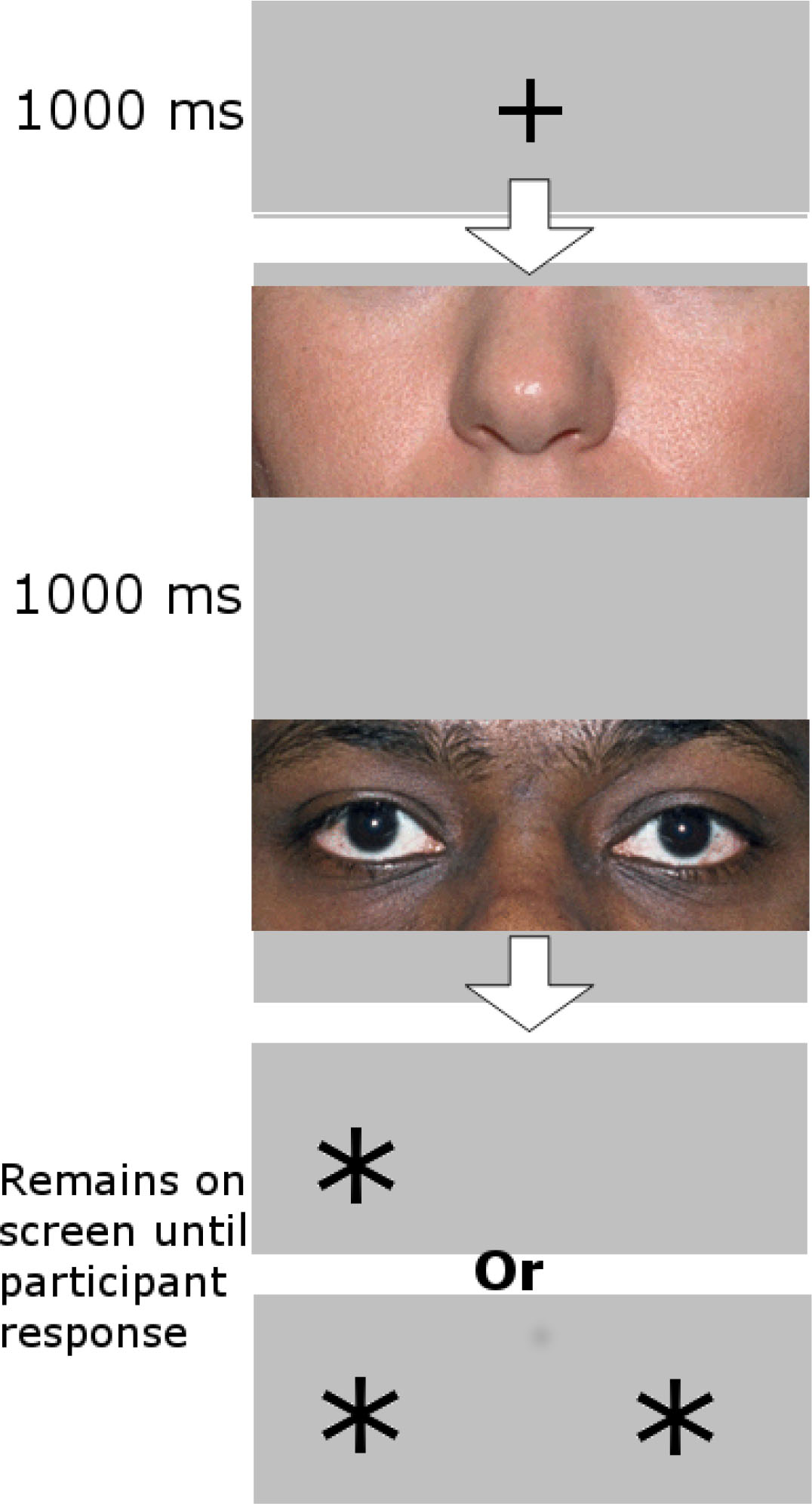
Figure 1
Illustration of experimental task set-up.
Table 2
Table summarising the dot-probe task procedure in the pre-training, training and post-training phases
| Group | Pre-Training Assessment | Training Phase | Post-Training Assessment | ||||||
|---|---|---|---|---|---|---|---|---|---|
| Control | Fixation cross 1000ms | Eyes and nose images above and below fixation cross. 1000ms Eyetracking (incudes 10 catch trials) | One or two * probe/s at the location previously occupied by the nose or eyes image remain/s on screen until a response is made. RT and response accuracy collected. | Fixation cross 1000ms | Eyes and nose images above and below fixation cross. 1000ms | One or two * probe/s at the location previously occupied by the nose or eyes image remain/s on screen until a response is made. | Fixation cross 1000ms | Eyes and nose images above and below fixation cross. 1000ms Eyetracking (incudes 10 catch trials) | One or two * probe/s at the location previously occupied by the nose or eyes image remain/s on screen until a response is made. RT and response accuracy collected |
| ABM Training | Fixation cross 1000ms | Eyes and nose images above and below fixation cross. 1000ms Eyetracking (incudes 10 catch trials) | One or two * probe/s at the location previously occupied by the nose or eyes image remain/s on screen until a response is made. RT and response accuracy collected. | Fixation cross 1000ms | Eyes and nose images above and below fixation cross. 1000ms | One or two * probe/s at the location previously occupied by the eyes image only remain/s on the screen until a response is made. | Fixation cross 1000ms | Eyes and nose images above and below fixation cross. 1000ms Eyetracking (incudes 10 catch trials) | One or two * probe/s at the location previously occupied by the nose or eyes image remain/s on screen until a response is made. RT and response accuracy collected |
[i] Italicised underlined indicates differences between the control and ABM training groups.
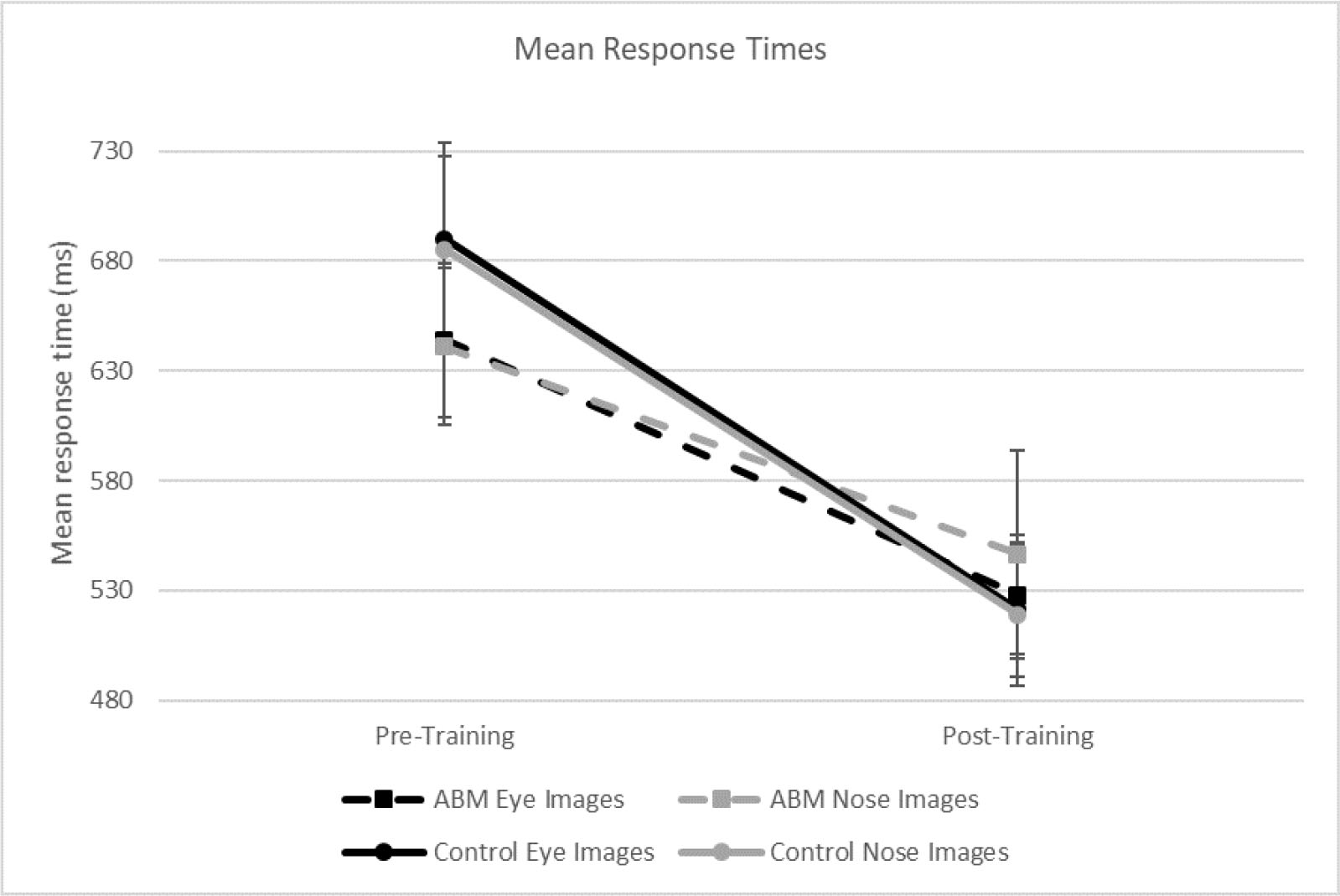
Figure 2
Mean response times (ms) to probes by stimulus type and time point in the ABM and control conditions (error bars, in this and all other figures, indicate standard error)
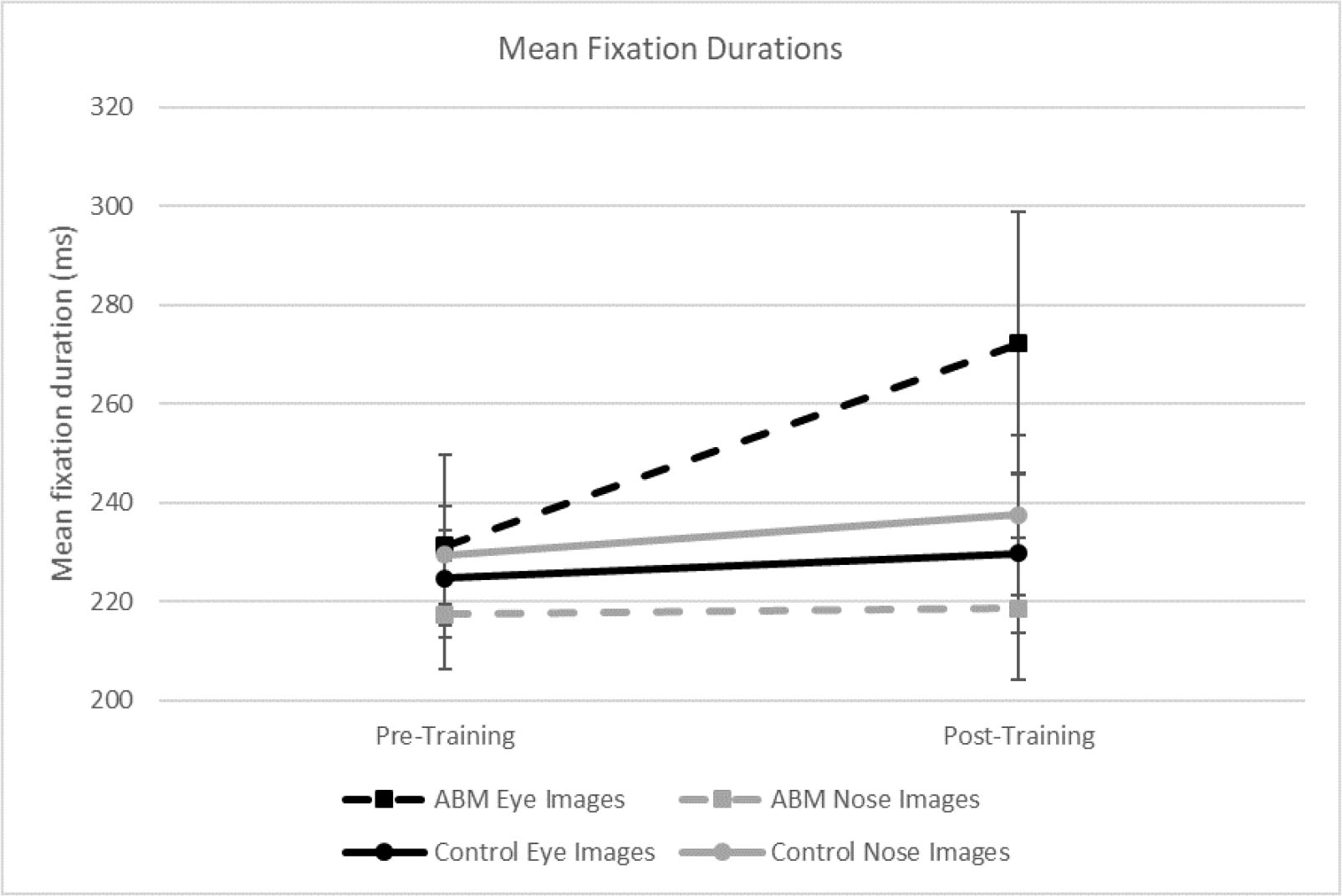
Figure 3
Mean fixation durations (ms) on ROIs by stimulus type and time point in the ABM and control conditions
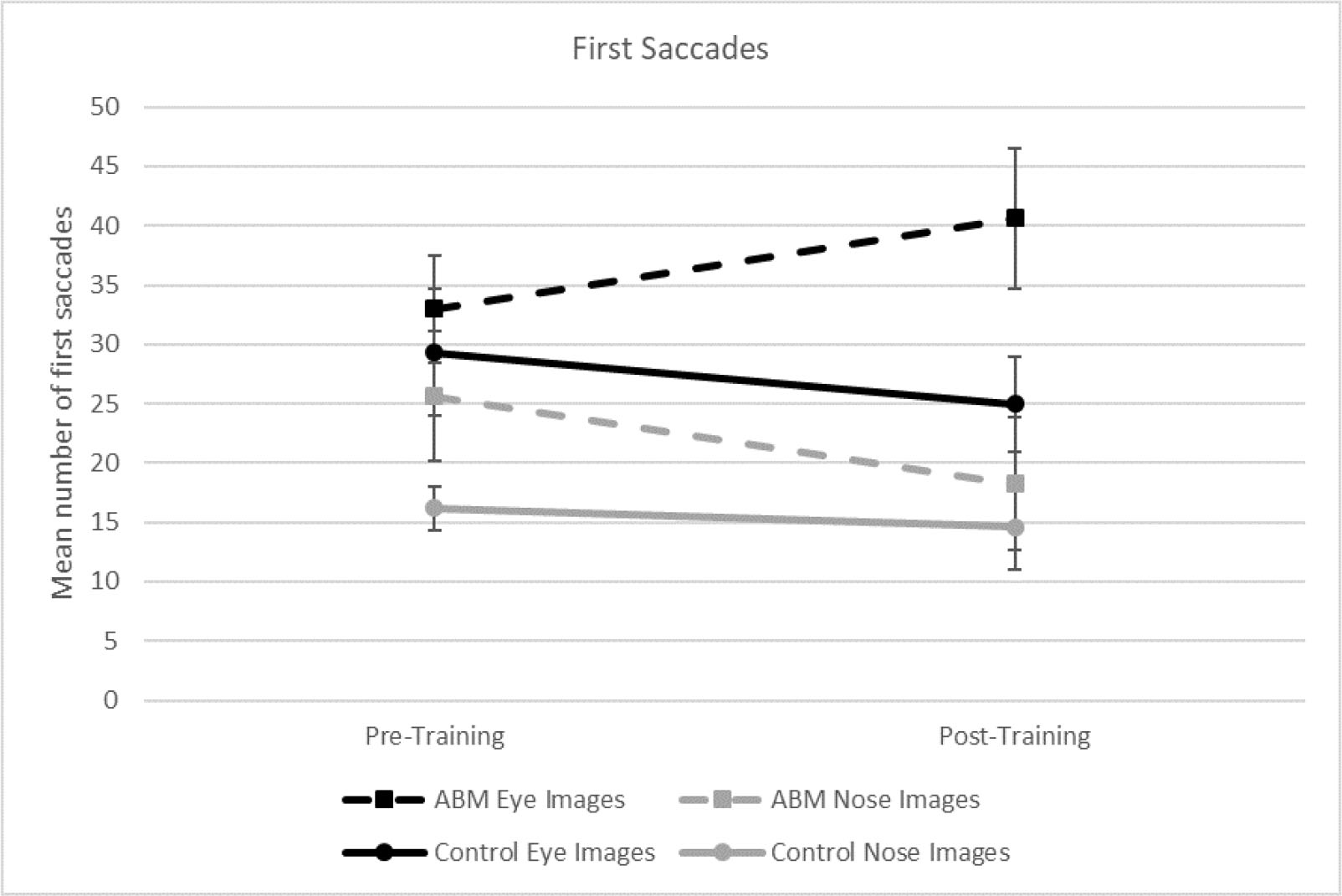
Figure 4
Mean number of first saccades ending on ROIs by stimulus type and time point in the ABM and control conditions