

Fig 1
The map of the Canterbury Plains. The studied site is represented by filled circle (map source: www.d-maps.com).
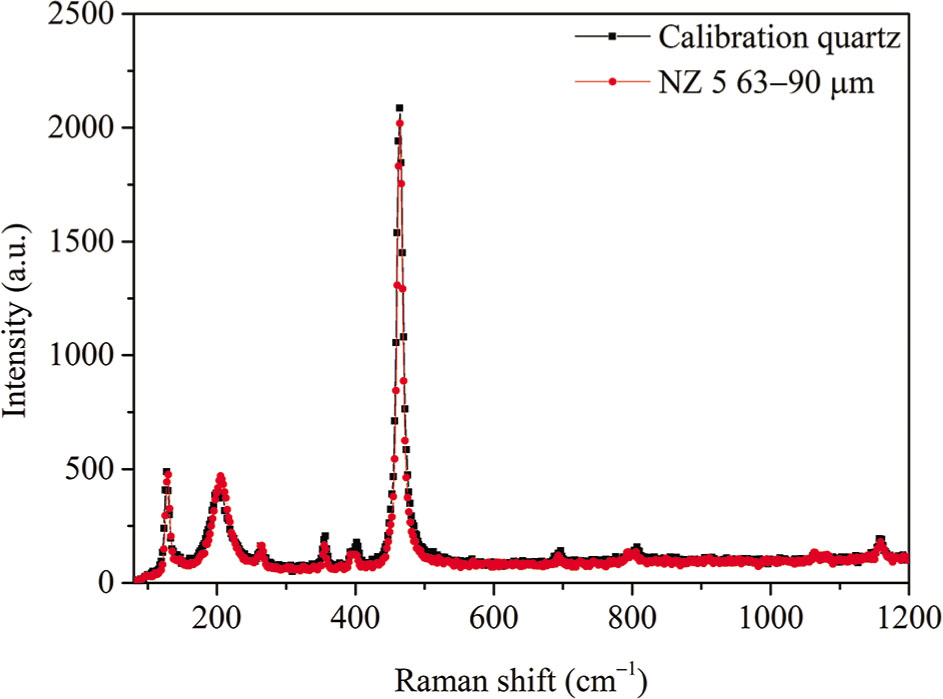
Fig 2
Comparison of calibration quartz (filled squares) RAMAN spectra with that of the 63–90 μm quartz (filled circles) extracted from sample NZ5.
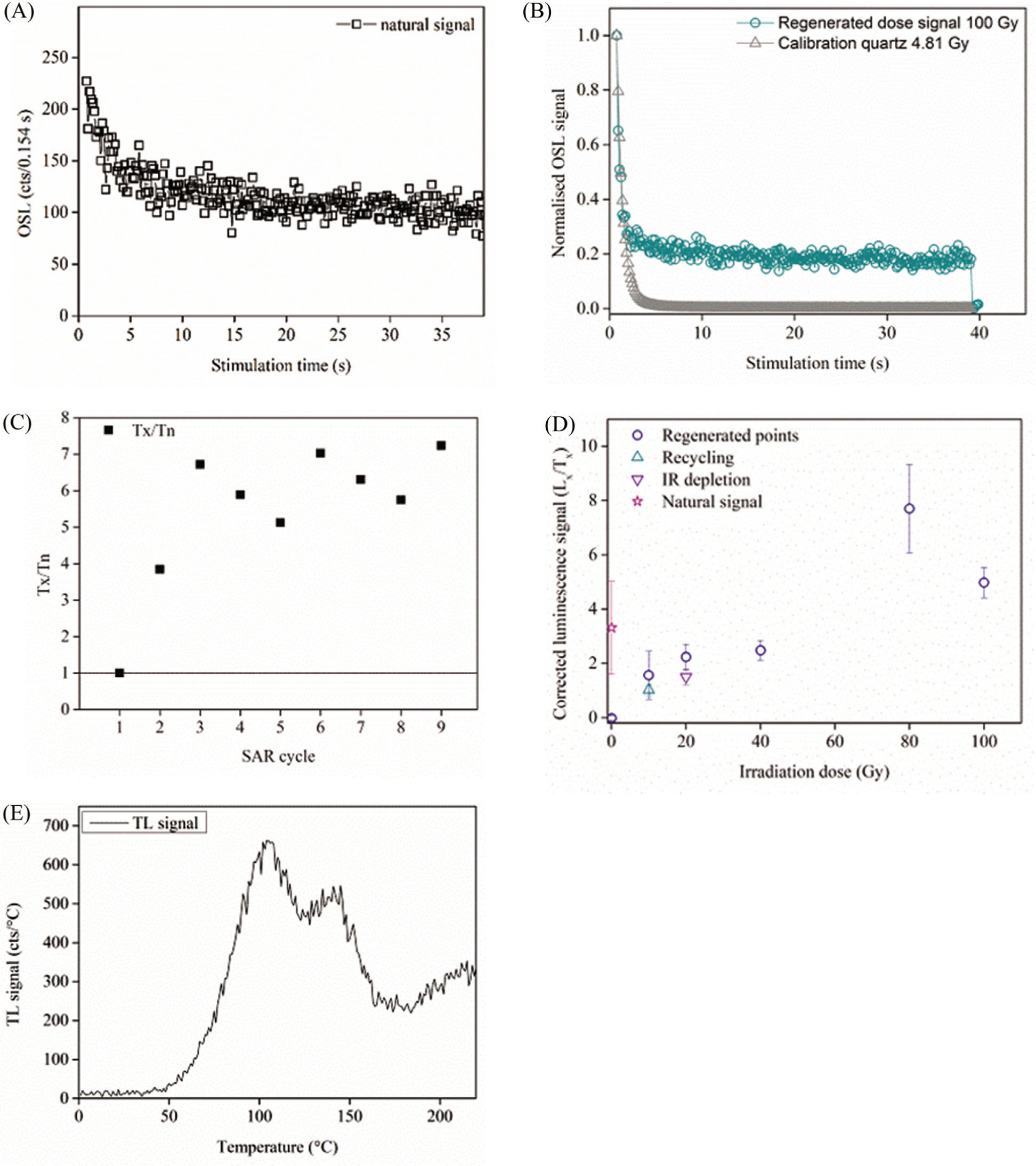
Fig 3
Representative luminescence behaviour of 63–90 μm quartz extracted from sample NZ 3. (A) the decay curve of natural continuous-wave optically stimulated luminescence (CW-OSL) signal (open squares); (B) comparison between the decay curve of a regenerated dose of 100 Gy (open circles) and the typical decay curve of a calibration quartz (open triangles); data is normalised to the number of counts collected in the first channel of stimulation; (C) variation of the Tx/Tn ratio during SAR cycles; (D) representative sensitivity-corrected dose response curve. The sensitivity corrected natural signal is depicted as a star. Recycling and IR depletion points are represented as an upward triangle and inverse triangle, respectively; (E) TL signal recorded during the preheat to 220°C employed in a typical SAR cycle after irradiation with a regenerative dose of 100 Gy. SAR, single-aliquot regenerative-dose; TL, thermoluminescence.
Table 1
Results of dose recovery tests on NZ 3 63–90 μm quartz.
| Signal sensitivity for the dose to be recovered (cts in 1.2 s) | Average signal sensitivity (cts in 1.2 s) for dose to be recovered | Signal sensitivity for 100 Gy in SAR (cts in 1.2 s) | Average signal sensitivity for 100 Gy in SAR (cts in 1.2 s) | Recycling ratio | IR depletion ratio | Recovered/given dose | |
|---|---|---|---|---|---|---|---|
| aliq 1 | 3789 | 2571± 684 | 6268 | 4472 ± 930 | 1.13 | 0.78 | 0.81 |
| aliq 2 | 1422 | 3154 | 0.83 | 0.76 | 0.60 | ||
| aliq 3 | 2502 | 3993 | 1.11 | 0.78 | 0.94 |
[i] IR, infrared.
Table 2
Results of dose recovery tests after repeated cycles of bleaching and irradiation and heating and irradiation.
| Treatment applied before the dose recovery test | Aliq No. | Signal sensitivity for the dose to be recovered (cts in 1.2 s) | Average signal sensitivity for the dose to be recovered (cts in 1.2 s) | Signal sensitivity for 100 Gy in SAR (cts in 1.2 s) | Average signal sensitivity for 100 Gy in SAR (cts in 1.2 s) | Recycling ratio | IR depletion ratio | Recovered/given dose |
|---|---|---|---|---|---|---|---|---|
| Experiment (i) Bleach/dose (100 Gy) × 5 | 1 | 2685 | 2858 ± 718 | 2869 | 3015 ± 565 | 1.06 | 1.23 | 0.91 |
| 2 | 1710 | 2119 | 1.14 | 0.89 | 0.66 | |||
| 3 | 4180 | 4058 | 0.82 | 0.57 | 1.08 | |||
| Experiment (ii) Heat to 500°C/dose (100 Gy) × 5 | 1 | 34665 | 49960 ± 12765 | 41173 | 60220 ± 16152 | 1.00 | 0.97 | 0.94 |
| 2 | 39905 | 47148 | 0.98 | 1.01 | 0.95 | |||
| 3 | 75311 | 92339 | 1.00 | 0.99 | 0.92 | |||
| Experiment (iii) Heat to 500°C× 5 | 1 | 10406 | 20287 ± 6244 | 11556 | 25794 ± 8760 | 0.98 | 0.99 | 0.97 |
| 2 | 18612 | 24073 | 1.02 | 0.98 | 0.92 | |||
| 3 | 31842 | 41754 | 0.98 | 1.01 | 0.94 |
[i] IR, infrared.
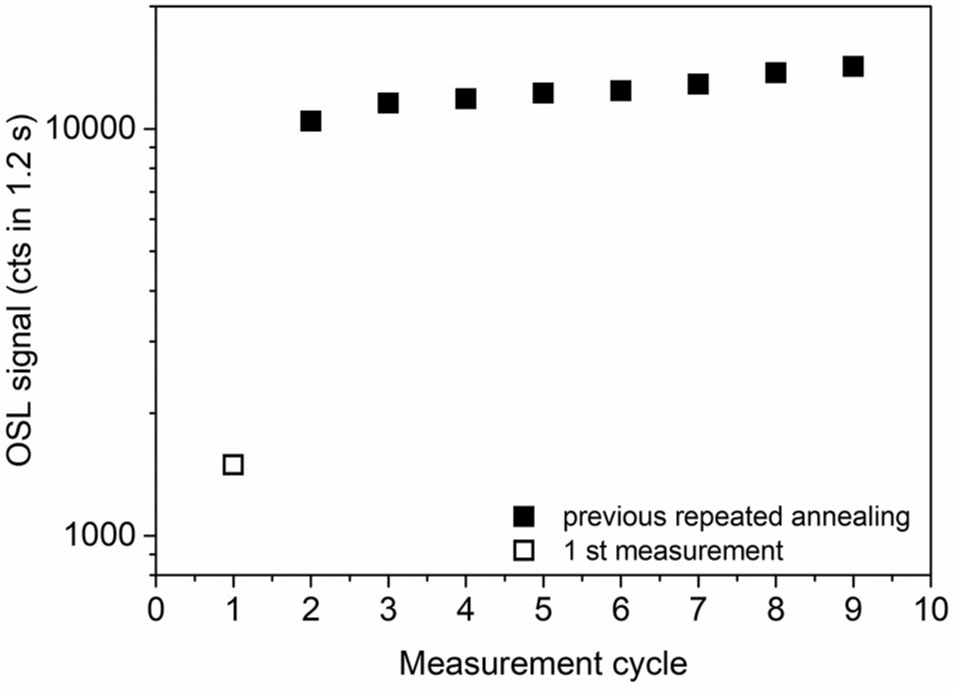
Fig 4
The OSL signal sensitisation after repeated annealing to 500°C. The luminescence signal intensities were measured after an irradiation to 100 Gy and a preheat to 220°C for 10 s. The OSL signal recorded before the first annealing is presented as an open square whereas the luminescence signals recorded following repeated annealing irradiation cycles are represented as solid squares. OSL, optically stimulated luminescence.
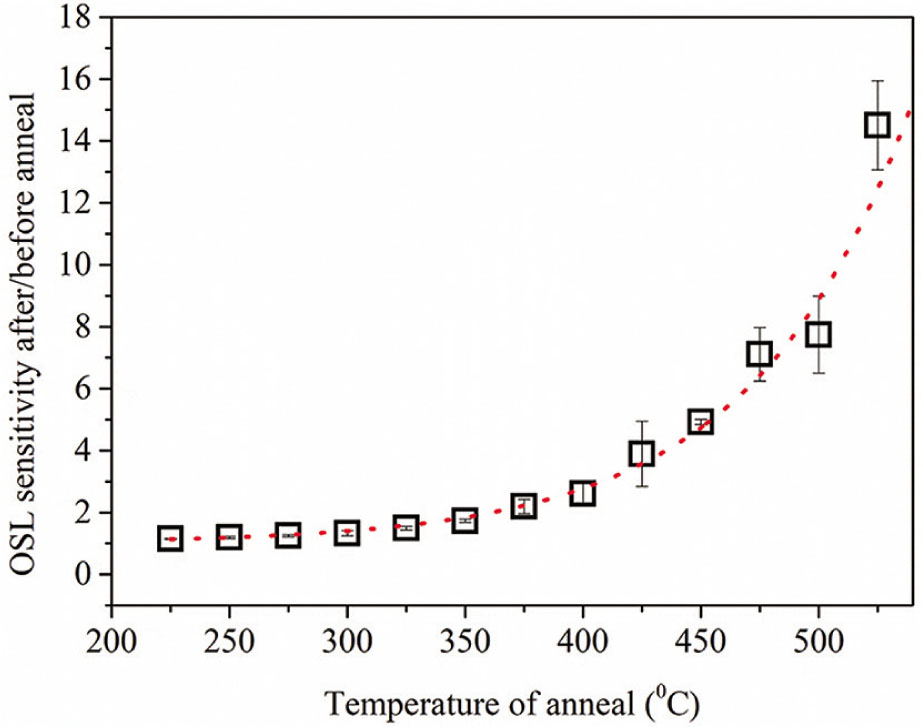
Fig 5
Sensitivity increase of the OSL signal as function of the annealing temperature. The dotted line represents an exponential dependence. OSL, optically stimulated luminescence.
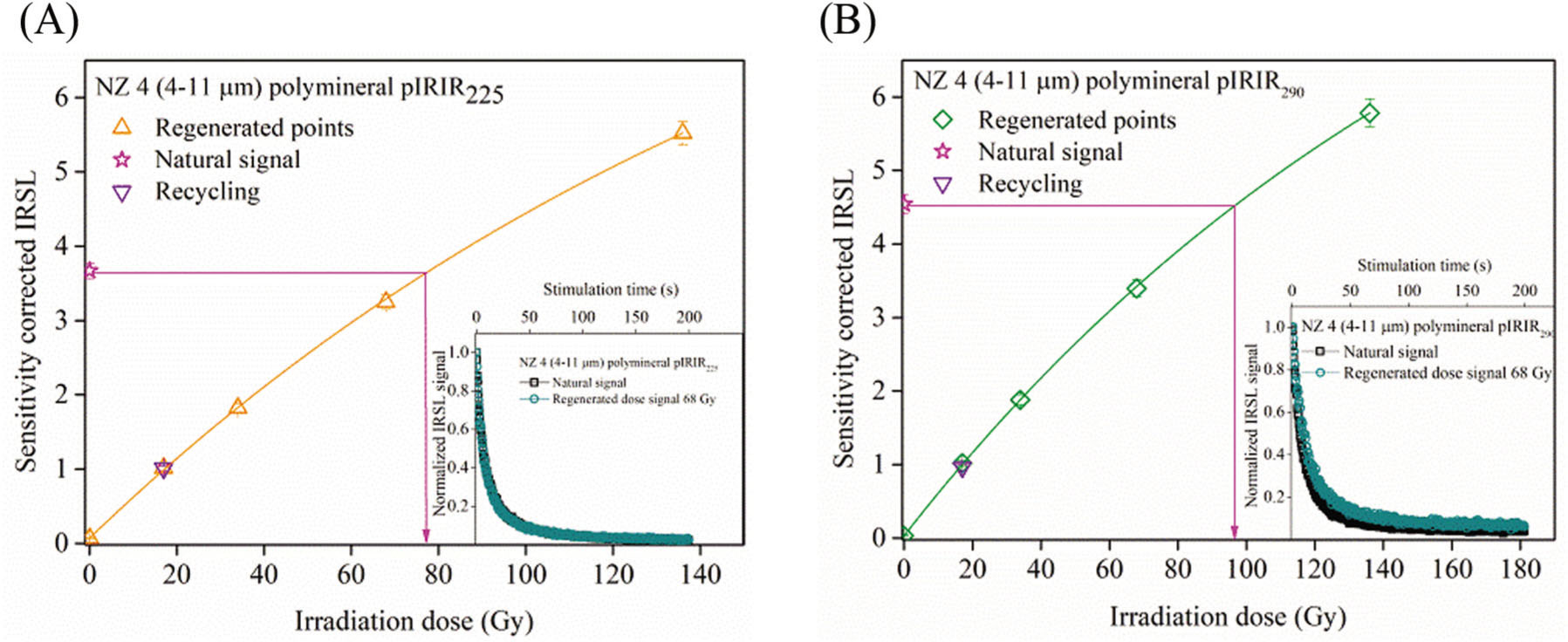
Fig 6
Representative sensitivity-corrected dose-response curves constructed for one aliquot from sample NZ 4 on polymineral fine (4–11 μm) grains using (A) pIRIR225 and (B) pIRIR290 protocol. The sensitivity corrected natural signals are depicted as stars interpolated on the dose response curves for indicating the equivalent doses. The recycling point is represented as an inverse triangle. Insets show typical decay curves of natural CW-OSL signals (open squares) in comparison to a regenerated signals (open circles) induced by a beta dose approximately equal to the equivalent dose. pIRIR, post-infrared–infrared protocol.
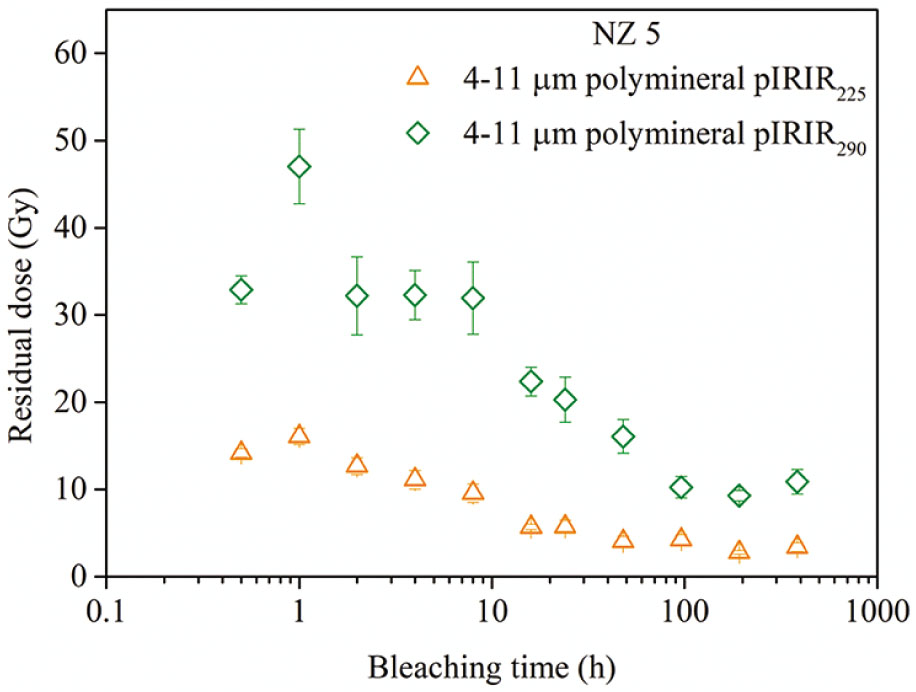
Fig 7
Residual doses measured using pIRIR225 (upward triangle) and pIRIR290 (diamond) after different bleaching times. The natural signal was bleached under natural conditions under window light. The shortest bleaching time was 0.5 h while the longest was 192 h. pIRIR, post-infrared–infrared protocol.
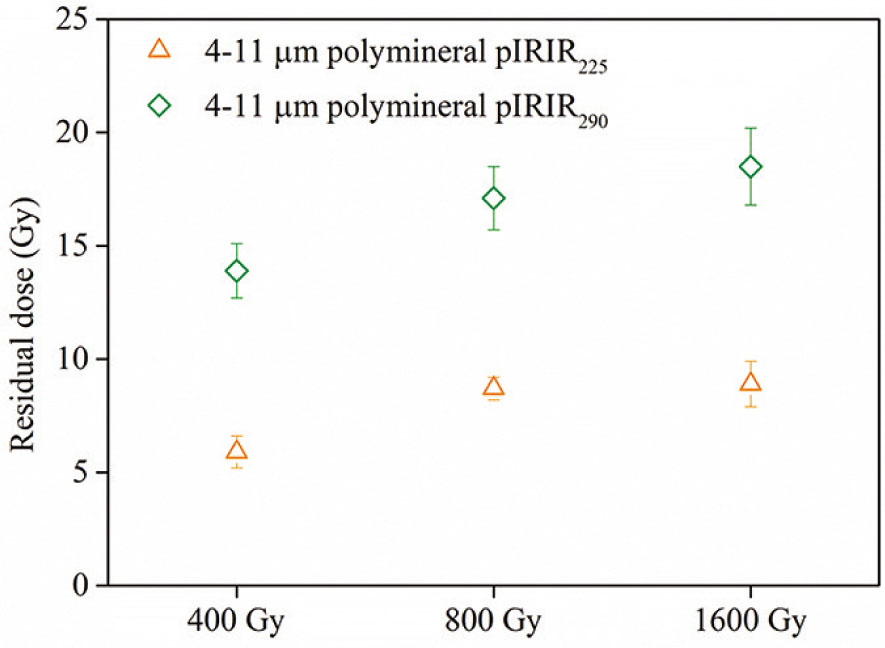
Fig 8
Residual dose as a function of previously given dose. pIRIR, post-infrared–infrared protocol.
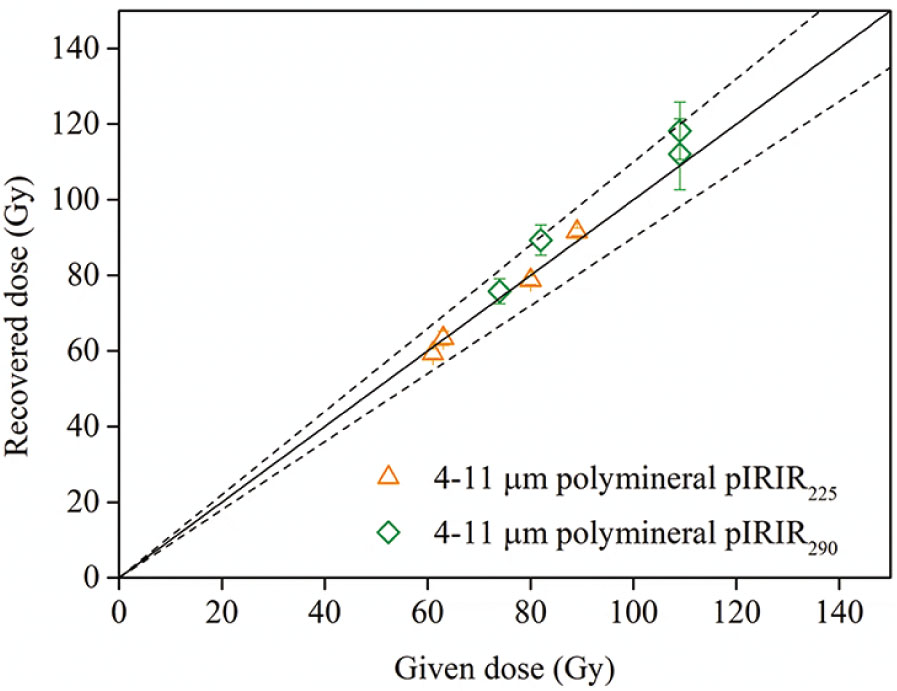
Fig 9
Dose recovery test results for polymineral fine grains using pIRIR225 (open triangles) and pIRIR290 (open diamonds) protocols. The given irradiation dose was chosen to match the equivalent dose of each sample. The solid line indicates the ideal 1:1 dose-recovery ratio while the dashed lines bracket a 10% variation from unity.
Table 3
Summary of the pIRIR225 and pIRIR290 ages.
| Sample code | Depth (cm) | ED (Gy) | Specific activities (Bq/kg) | Total dose rate (Gy ka−1) | Ages (ka) (1) | Ages (ka) (2) | |||||
|---|---|---|---|---|---|---|---|---|---|---|---|
| pIRIR225 pfg | pIRIR290 pfg | K-40 | Ra-226 | Th-232 | pIRIR225/290 pfg | pIRIR225 pfg | pIRIR290 pfg | pIRIR225 pfg | pIRIR290pfg | ||
| NZ 2 | 30 | 57 ± 2 | 60 ± 4 | 635 ± 17 | 36 ± 1 | 39 ± 1 | 4.2 ± 0.1 | 14 ± 1 | 14 ± 1 | 15 ± 1 | 18 ± 2 |
| NZ 3 | 50 | 59 ± 2 | 63 ± 4 | 607 ± 17 | 27 ± 2 | 24 ± 1 | 3.4 ± 0.1 | 17 ± 1 | 18 ± 2 | 18 ± 2 | 24 ± 2 |
| NZ 4 | 70 | 76 ± 3 | 100 ± 7 | 599 ± 16 | 26 ± 1 | 27 ± 1 | 3.4 ± 0.1 | 25 ± 2(*) | 29 ± 3 | 26 ± 2(*) | 32 ± 3 |
| NZ 5 | 140 | 85 ± 3 | 91 ± 6 | 604 ± 16 | 35 ± 1 | 37 ± 2 | 4.0 ± 0.1 | 22 ± 2 | 25 ± 3 | 23 ± 2 | 28 ± 3 |
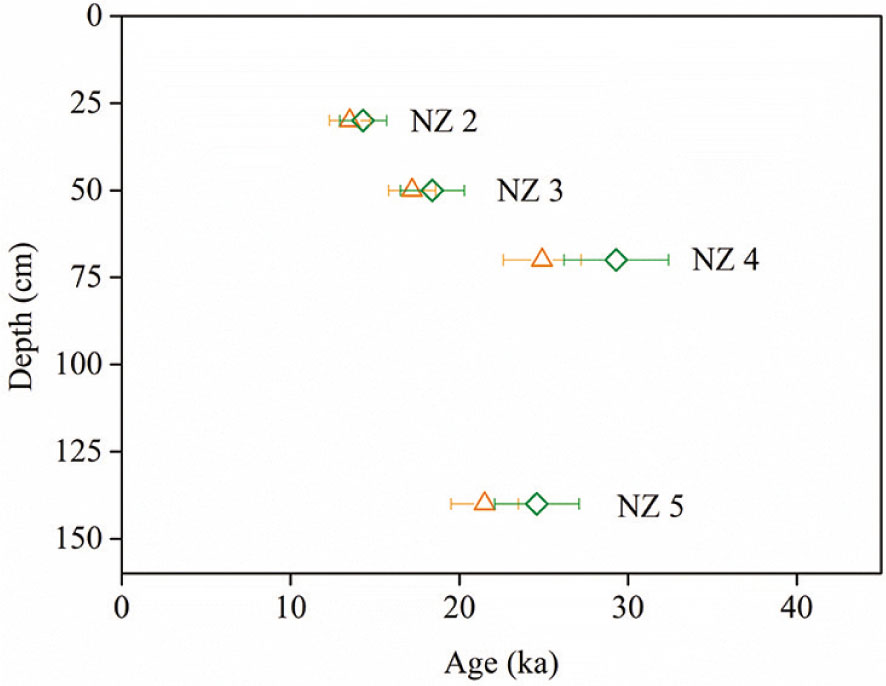
Fig 10
pIRIR225 (open triangles) and pIRIR290 (open diamonds) luminescence-ages plotted as function of depth. pIRIR, post-infrared–infrared protocols.