
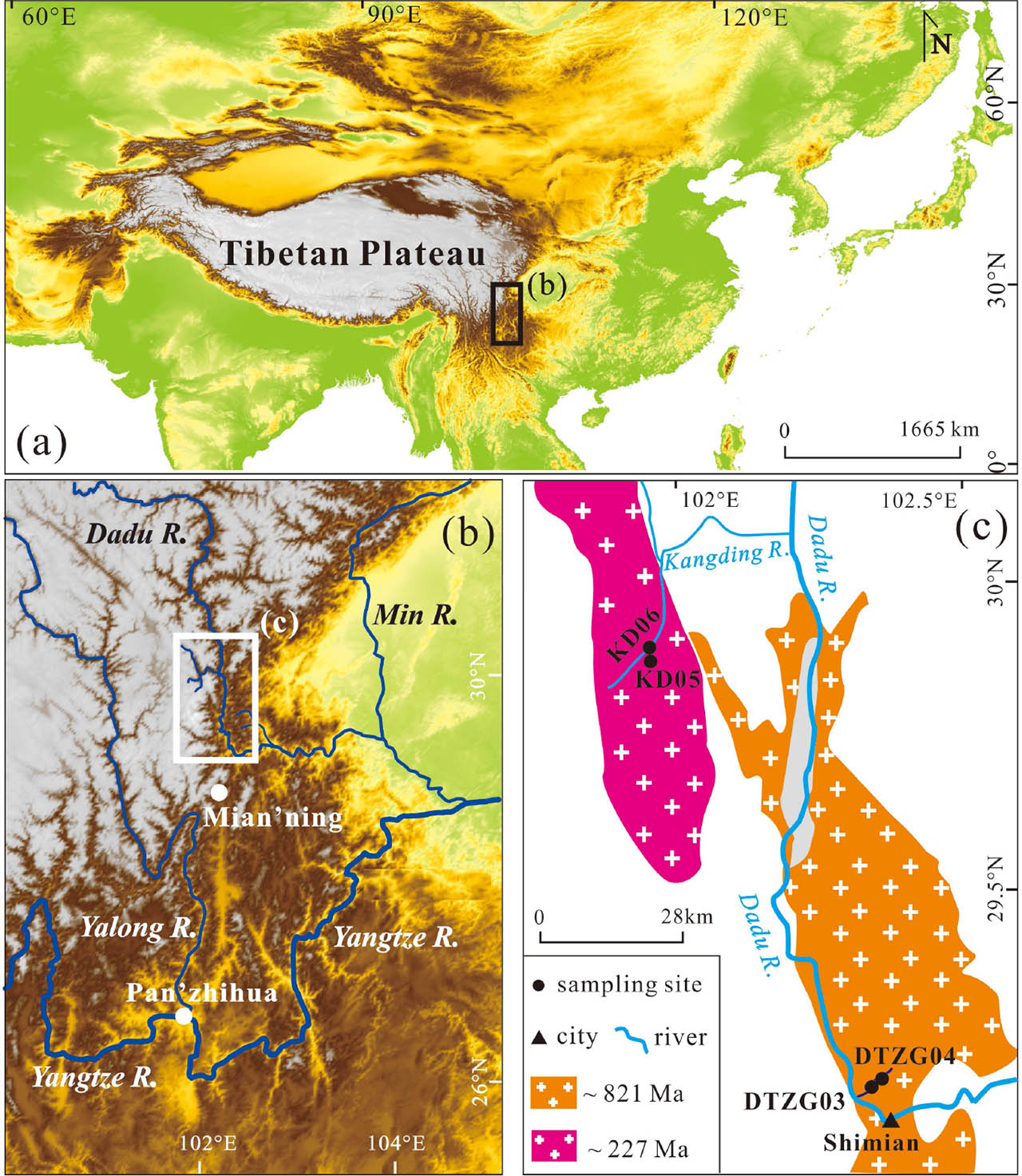
Fig. 1
Map showing study area and geological setting of sampling sites. (a) and (b) show study area located in the eastern Tibetan Plateau. (c) show geological setting and sampling site of Kang’ding River and Diao’tengzi River. The Pan’zhihua River and the Mian’ning River are marked as two black circles on 1–(b). The source rock age data are from China Intrusive Rock Isotope Age Atlas by K-Ar dating method.
Table 1
Sample information used in this study.
| No. | Drainage | Sample name | Sample type | Latitude (°N) | Longitude (°E) | Rock age and dating method used |
|---|---|---|---|---|---|---|
| 1 | Mian’ning River | MN05 | modern river sediments | 28°31′30″ | 102°03′42″ | 134 Ma (kb) |
| 2 | MN06 | bedrocks | 28°31′30″ | 102°03′42″ | 134 Ma (kb) | |
| 3 | Kang’ding River | KD05 | bedrocks | 29°54′34″ | 101°57′24″ | 227 Ma (kb) |
| 4 | KD06 | modern river sediments | 29°59′42″ | 101°56′50″ | 227 Ma (kb) | |
| 5 | Pan’zhihua River | PZH01 | bedrocks | 26°25′21″ | 101°44′00″ | 783 Ma (uz) |
| 6 | PZH03 | modern river sediments | 26°25′28″ | 101°44′48″ | 783 Ma (uz) | |
| 7 | Diao’tengzi River | DTZG03 | historical sediments | 29°16′01″ | 102°18′26″ | 821 Ma (kw) |
| 8 | DTZG04 | modern river sediments | 29°16′01″ | 102°18′26″ | 821 Ma (kw) |
[i] All samples were collected within the river drainage of single granitic lithology. Rock age: formation age of quartz-containing rock, kb is K-Ar dating of biotite, uz is U-Pb dating of zircon, kw is K-Ar dating of whole rock. The quartz origin ages are compiled from the Geological Map of the Isotope Dating of Intrusive Rocks in China (Ma and Zhou, 2002).
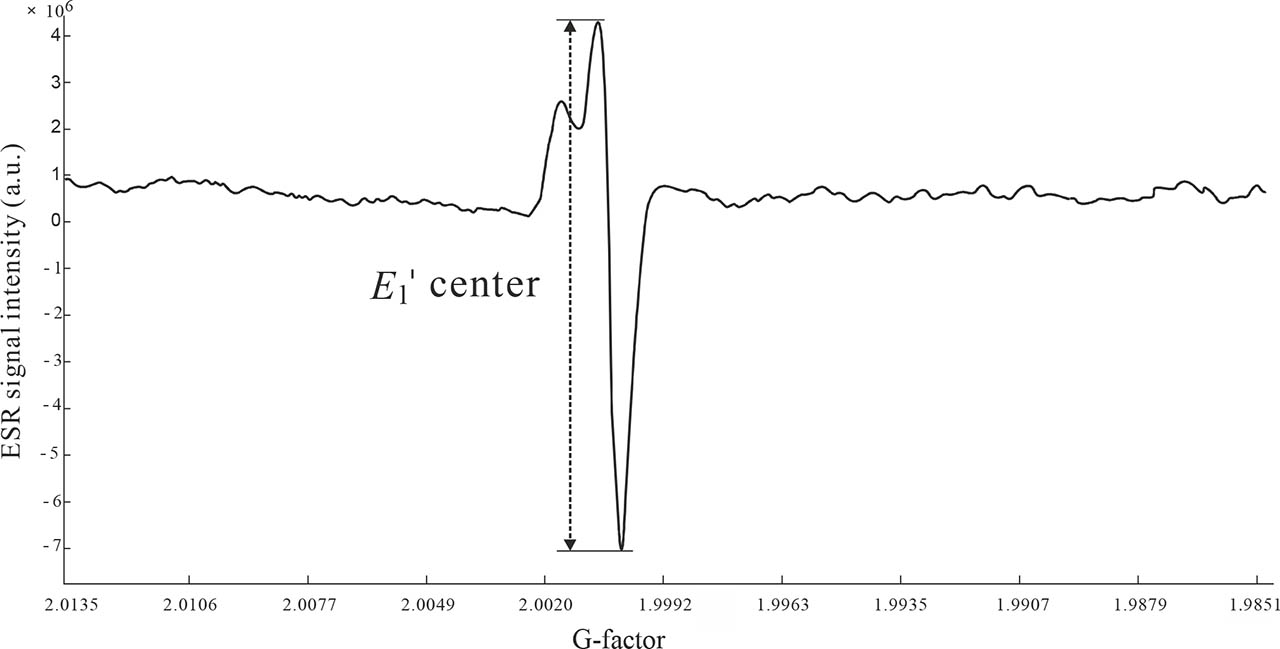
Fig. 2
Typical E1’ centre ESR spectrum of quartz in this study.
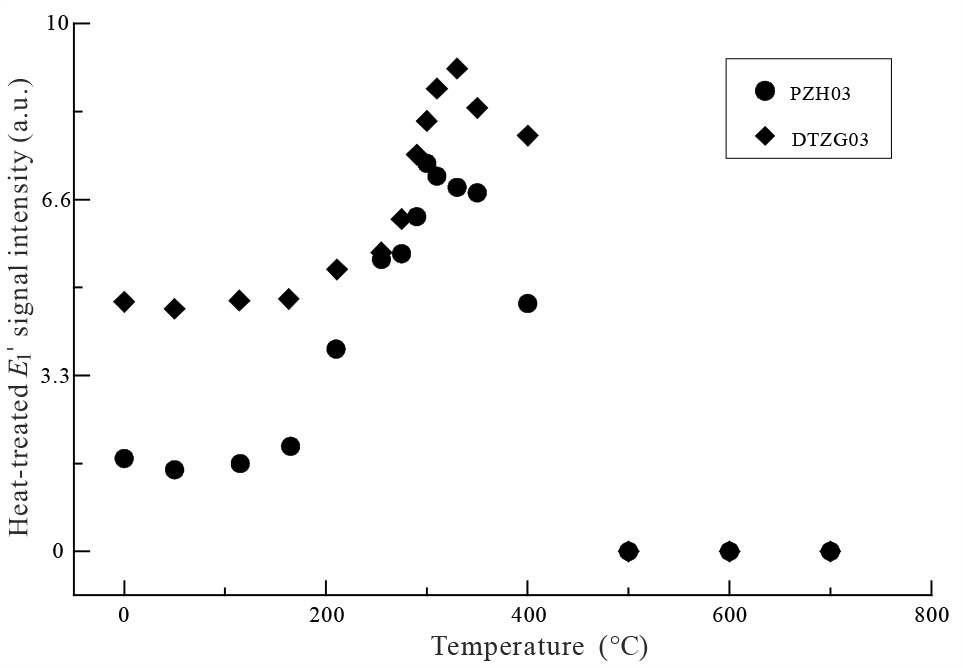
Fig. 3
The heat-treated E1’ signal intensity response to heating temperatures. The similar changes upon heating indicate that the heat-treated E1’ signal intensity of quartz extracted from fluvial sediment can reach the maximum value at about 300°C for 15 min. However, the maximum heat-treated E1’ signal intensity varies in quartz with different formation ages. For example, PZH03 reaches the maximum value at 300°C while DTZG03 at 330°C. Above about 400°C, the E1’ signal intensity of PZH03 and DTZG03 are zero.
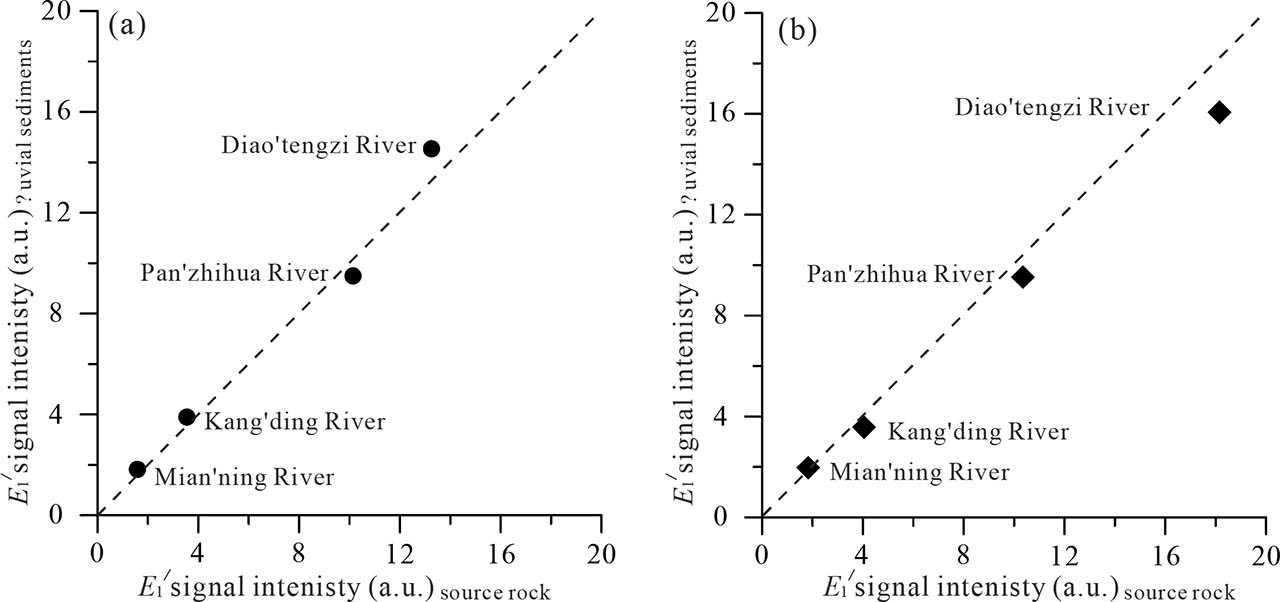
Fig. 4
Correlation between heat-treated E1’ signal intensity of quartz in source rock and its fluvial sediments heated at 300°C (a) and 330°C (b).
Table 2
Difference of quartz heat-treated E1’ signal intensity between sediment and its source rock.
| drainage | heating temperature (°C) | heat-treated E1′ signal intensity | |(A-B)| | (A+B)/2 | difference value (%) | |
|---|---|---|---|---|---|---|
| sediment | source rock | |||||
| Mian’ning River | 300 | 1.06 | 1.22 | 0.16 | 1.14 | 14 |
| 330 | 1.06 | 1.21 | 0.15 | 1.135 | 13 | |
| Kang’ding River | 300 | 2.60 | 2.36 | 0.24 | 2.48 | 10 |
| 330 | 2.61 | 2.36 | 0.25 | 2.49 | 10 | |
| Pan’zhi’hua River | 300 | 6.75 | 6.31 | 0.44 | 6.53 | 7 |
| 330 | 6.74 | 6.30 | 0.44 | 6.52 | 7 | |
| Diao’teng’zi River | 300 | 8.82 | 9.64 | 0.82 | 9.23 | 9 |
| 330 | 11.92 | 10.58 | 1.34 | 11.25 | 12 | |
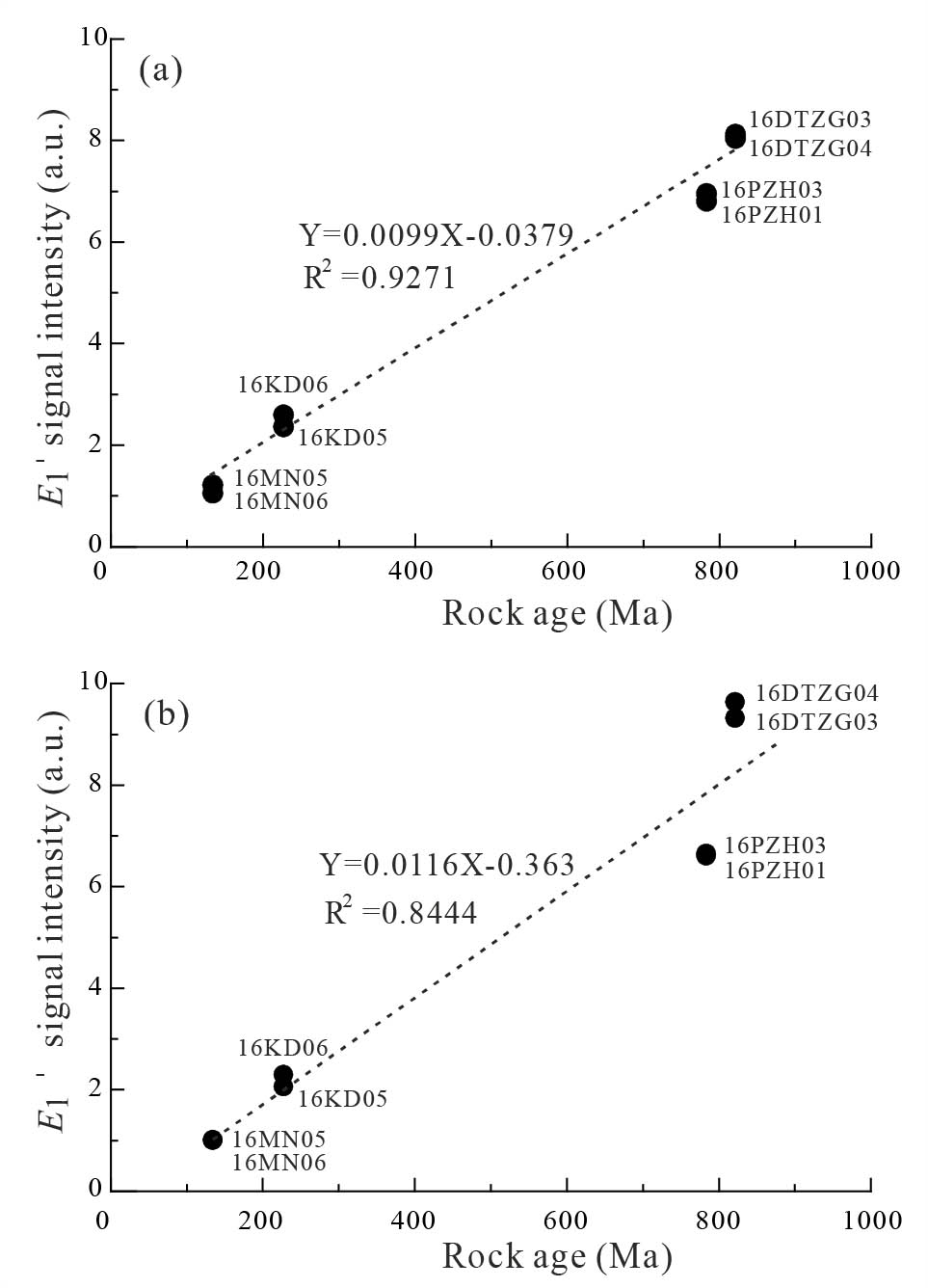
Fig. 5
Correlation between rock age and its heat-treated E1’ signal intensity. (a) heating temperature is 300°C; (b) heating temperature is 330°C.