
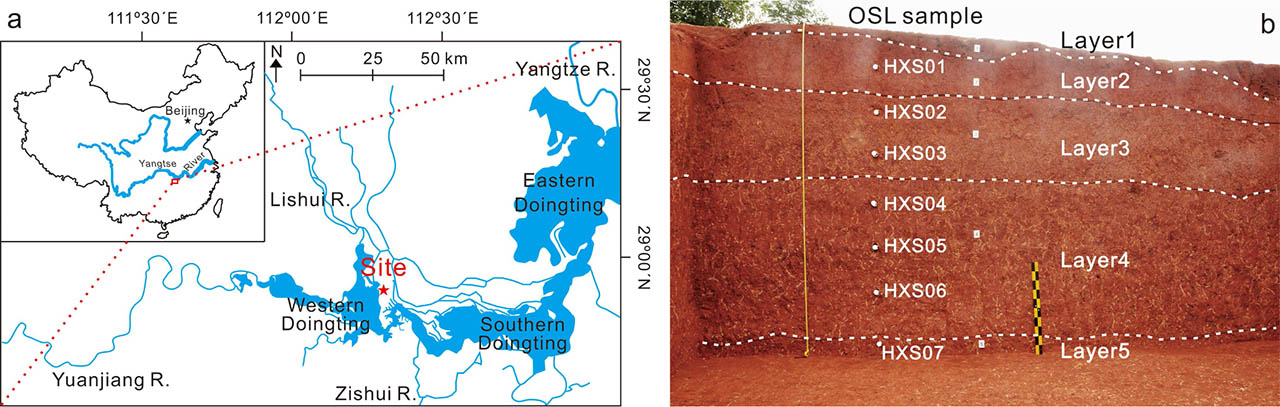
Fig. 1
(a) Map showing the location of the study site, and (b) photograph of the excavation pit showing the stratigraphy and the positions of OSL samples.
Table 1
Protocols used for De measurements of fine quartz grains.
| Step | OSL-SAR protocol | Observed | Step | OSL-SMAR protocol | Observed | Step | TT-OSL SAR procedure | Observed |
|---|---|---|---|---|---|---|---|---|
| 1 | Give dose, Di | Part 1 Detection of natural OSL signal | Part 1 Detection of thermal-transferred OSL signal | |||||
| 2 | Preheating at 250°C for 10 s | 1-1 | Preheating at 250°C for 10 s | 1-1 | Give dose, Di | |||
| 2 | Blue stimulation at 125°C for 40 s | Li | 1-2 | Blue stimulation at 125°C for 40 s | Ln | 1-2 | Preheating at 250°C for 10 s | |
| 4 | Give test dose, Dt (18.3 Gy) | 1-3 | Give test dose, Dt (18.3 Gy) | 1-3 | Blue stimulation at 125°C for 300 s | |||
| 5 | Cut heat at 160°C for 5 s | 1-4 | Cut heat at 160°C for 5 s | 1-4 | Preheating at 250°C for 10 s | |||
| 6 | Blue stimulation at 125°C for 40 s | Ti | 1-5 | Blue stimulation at 125°C for 40 s | Tn | 1-5 | Blue stimulation at 125°C for 40 s | LTTOSL |
| 7 | Blue stimulation at 280°C for 40 s | Part 2 Detection of regenerative OSL signal | 1-6 | Give test dose, Dt (18.3 Gy) | ||||
| 8 | Return to step 1 | 2-1 | Bleaching at 125°C for 60 s | 1-7 | Cut heat at 160°C for 5 s | |||
| 2-2 | Give dose, Di | 1-8 | Blue stimulation at 125°C for 100 s | TTTOSL | ||||
| 2-3 | Preheating at 250°C for 10 s | Part 2 Detection of basic-transferred OSL signal | ||||||
| 2-4 | Blue stimulation at 125°C for 40 s | Li | 2-1 | Annealing to 300°C for 10 s | ||||
| 2-5 | Give test dose, Dt (18.3 Gy) | 2-2 | Blue stimulation at 125°C for 100 s | |||||
| 2-6 | Cut heat at 160°C for 5 s | 2-3 | Preheating at 250°C for 10 s | |||||
| 2-7 | Blue stimulation at 125°C for 40 s | Ti | 2-4 | Blue stimulation at 125°C for 100 s | LBTOSL | |||
| 2-5 | Give test dose, Dt (18.3 Gy) | |||||||
| 2-6 | Cut heat at 220°C for 10 s | |||||||
| 2-7 | Blue stimulation at 125°C for 100 s | TBTOSL | ||||||
| 2-8 | Blue stimulation at 280°C for 100 s | |||||||
[i] Note that Di=0 when measuring natural signals.
Table 2
Procedures used for De measurements of fine polymineral grains.
| Step | MET-pIRIR procedure | Observed | Step | Two-step pIRIR procedure | Observed |
|---|---|---|---|---|---|
| 1 | Give dose, Di | 1 | Give dose, Di | ||
| 2 | Preheating at 320°C for 60 s | 2 | Preheating at 320°C for 60 s | ||
| 3 | Infrared stimulation at 50°C for 100 s | Lx(50) | 3 | Infrared stimulation at 100°C for 200 s | |
| 4 | Infrared stimulation at 150°C for 100 s | Lx(150) | 4 | Infrared stimulation at 275°C for 200 s | Li |
| 5 | Infrared stimulation at 200°C for 100 s | Lx(200) | 5 | Give test dose, Dt (91.5 Gy) | |
| 6 | Infrared stimulation at 250°C for 100 s | Lx(250) | 6 | Cut heat at 320°C for 60 s | |
| 7 | Infrared stimulation at 290°C for 100 s | Lx(290) | 7 | Infrared stimulation at 100°C for 200 s | |
| 8 | Give test dose, Dt (91.5 Gy) | 8 | Infrared stimulation at 275°C for 200 s | Ti | |
| 9 | Preheating at 320°C for 60 s | 9 | Infrared stimulation at 325°C for 200 s | ||
| 10 | Infrared stimulation at 50°C for 100 s | Tx(50) | 10 | Return to step 1 | |
| 11 | Infrared stimulation at 150°C for 100 s | Tx(150) | |||
| 12 | Infrared stimulation at 200°C for 100 s | Tx(200) | |||
| 13 | Infrared stimulation at 250°C for 100 s | Tx(250) | |||
| 14 | Infrared stimulation at 290°C for 100 s | Tx(290) | |||
| 15 | IR bleaching at 325°C for 100 s | ||||
| 16 | Return to step 1 | ||||
[i] Note that Di=0 when measuring natural signals.
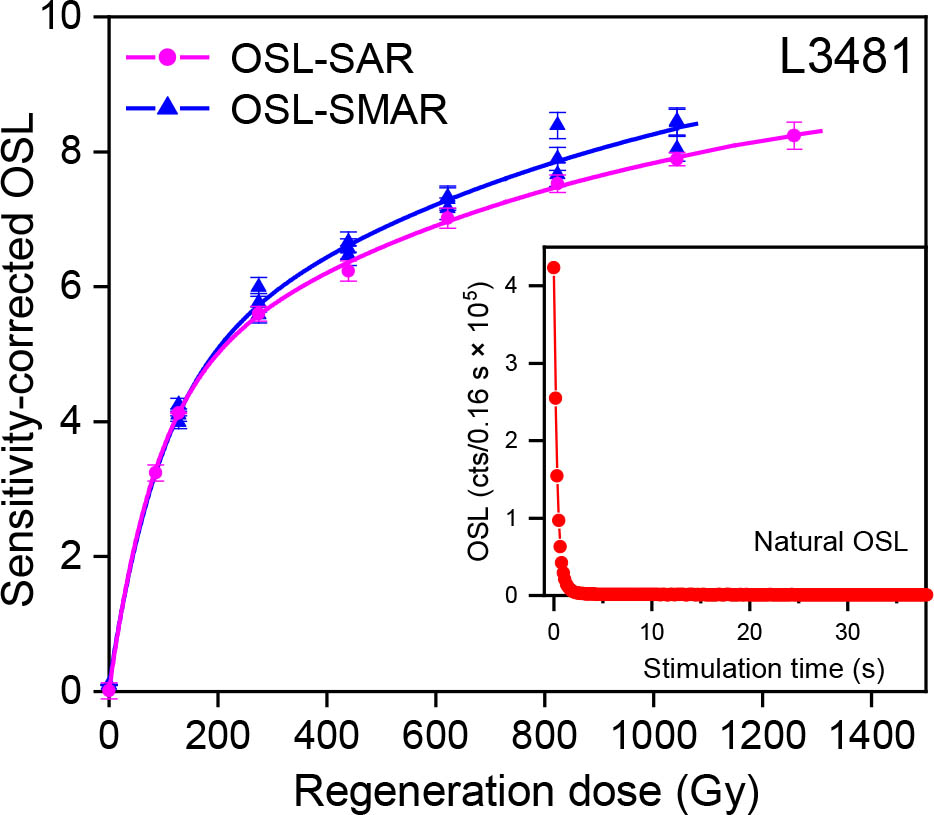
Fig. 2
Comparison of dose-response curves constructed using the quartz OSL-SAR and OSL-SMAR protocols for sample L3481. The inset shows a natural decay curve for the same aliquot.
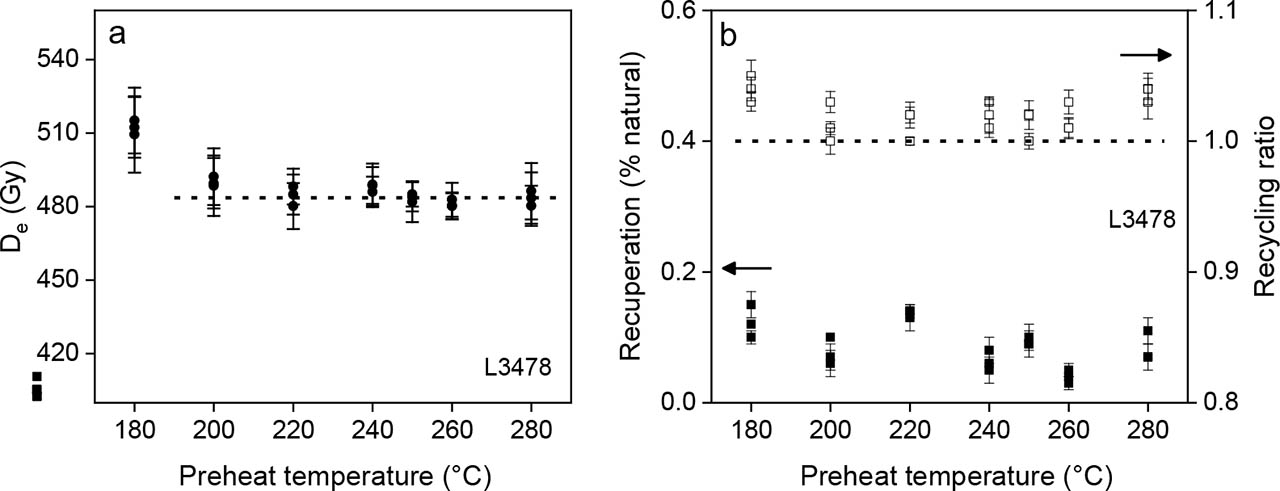
Fig. 3
(a) Plot of De values as a function of preheat temperature in the range of 180 and 280°C at 20°C increments for sample L3478, and (b) recycling ratios and recuperation against preheat temperature. Three aliquots were determined at each preheat temperature.
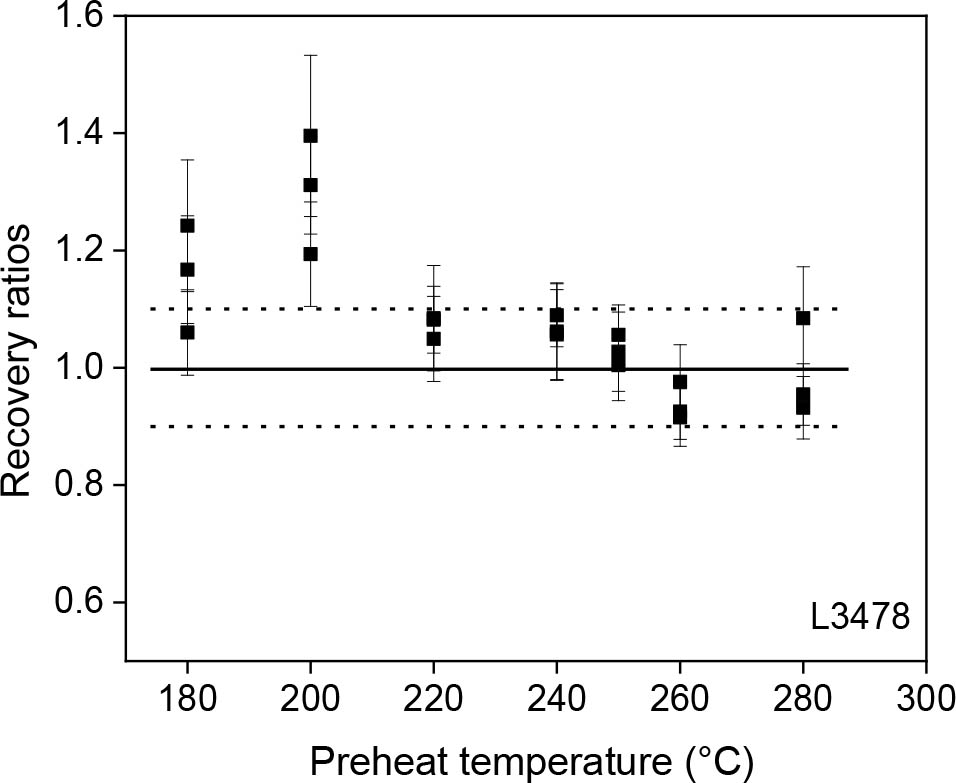
Fig. 4
Plot of recovery ratios versus preheat temperature for sample L3478. Three aliquots were tested at each preheat temperature.
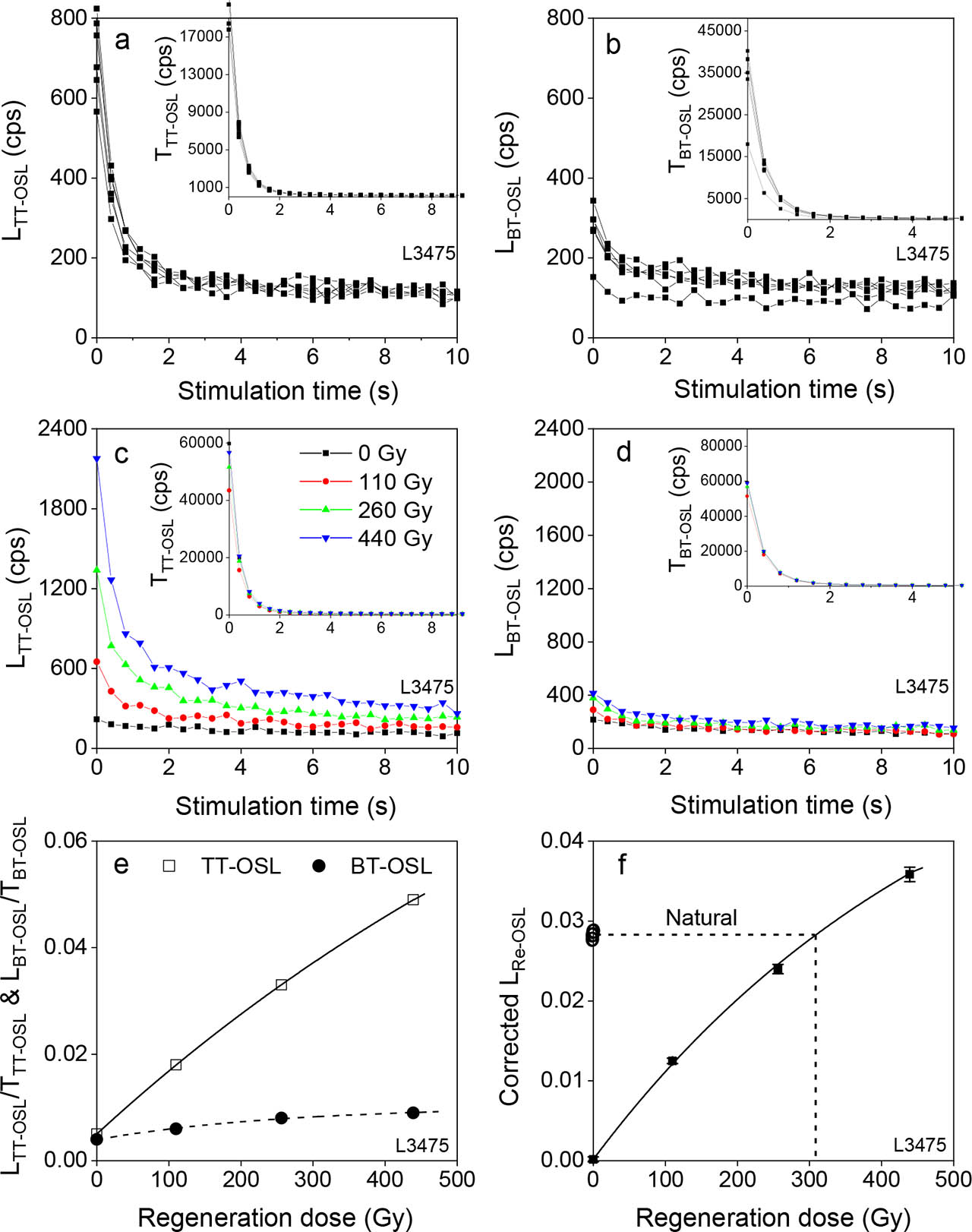
Fig. 5
Decay curves of natural (a) thermally-transferred (TT) and (b) basic-transferred (BT) OSL, regenerative-dose (c) TT-OSL and (d) BT-OSL signals; dose-response curves for the sensitivity-corrected TT-OSL (square) and BT-OSL (solid circle) signals (e) and recuperated OSL (Re-OSL) signals (f). The insets in (a–d) showing the test-dose (18.3 Gy) OSL signals following natural and regenerative-dose OSL measurements.
Table 3
The results of luminescence dating of fine-grained quartz using different procedures and fine polymineral grains using the pIRIR(100, 275) procedure.
| Lab No. | Layer | Depth (cm) | U (ppm) | Th (ppm) | K (%) | Water (%) | Cosmic dose rate (Gy/ka)a | Mineral | Number of Aliquotb | Method | Dose rate (Gy ka−1) | De (Gy) | Age (ka) |
|---|---|---|---|---|---|---|---|---|---|---|---|---|---|
| L3475 | 2 | 50 | 4.1 | 19.7 | 1.8 | 23.0 | 0.20 | Quartz | 9 | OSL-SAR | 4.3 ± 0.3 | 290.8 ± 7.3 | 67 ± 4 |
| 3(6) | OSL-SMAR | 283.1 ± 5.1 | 66 ± 4 | ||||||||||
| 6(6) | TT-OSL SAR | 268.9 ± 8.9 | 62 ± 4 | ||||||||||
| Polymineral | 3 | pIRIR(100, 275) | 5.1 ± 0.3 | 389.5 ± 27.8 | 77 ± 7 | ||||||||
| L3476 | 3 | 100 | 3.7 | 18.0 | 1.7 | 23.0 | 0.18 | Quartz | 9 | OSL-SAR | 4.0 ± 0.2 | 361.8 ± 9.6 | 91 ± 6 |
| 3(6) | OSL-SMAR | 334.7 ± 10.1 | 84 ± 6 | ||||||||||
| 6(6) | TT-OSL SAR | 307.5 ± 21.7 | 78 ± 7 | ||||||||||
| Polymineral | 3 | pIRIR(100, 275) | 4.6 ± 0.3 | 546.3 ± 24.4 | 118 ± 8 | ||||||||
| L3477 | 3 | 150 | 3.7 | 19.0 | 1.7 | 23.0 | 0.17 | Quartz | 9 | OSL-SAR | 4.0 ± 0.2 | 371.4 ± 21.0 | 92 ± 8 |
| 3(6) | OSL-SMAR | 364.4 ± 25.7 | 90 ± 8 | ||||||||||
| 6(6) | TT-OSL SAR | 334.0 ± 21.23 | 83 ± 7 | ||||||||||
| Polymineral | 3 | pIRIR(100, 275) | 4.7 ± 0.3 | 518.3 ± 7.2 | 110 ± 6 | ||||||||
| L3478 | 4 | 200 | 3.2 | 16.5 | 1.6 | 23.0 | 0.16 | Quartz | 9 | OSL-SAR | 3.6 ± 0.2 | 466.2 ± 18.3 | 129 ± 9 |
| 3(6) | OSL-SMAR | 380.4 ± 9.1 | 105 ± 7 | ||||||||||
| 6(6) | TT-OSL SAR | 400.1 ± 24.4 | 111 ± 9 | ||||||||||
| Polymineral | 4 | pIRIR(100, 275) | 4.2 ± 0.2 | 732.4 ± 60.8 | 174 ± 17 | ||||||||
| L3479 | 4 | 250 | 3.8 | 17.5 | 1.5 | 23.0 | 0.15 | Quartz | 9 | OSL-SAR | 3.8 ± 0.2 | 423.9 ± 7.6 | 113 ± 7 |
| 3(6) | OSL-SMAR | 398.1 ± 8.7 | 106 ± 7 | ||||||||||
| 6(6) | TT-OSL SAR | 396.8±5.3 | 105 ± 7 | ||||||||||
| Polymineral | 3 | pIRIR(100, 275) | 4.4 ± 0.3 | 458.0 ± 18.8 | 103 ± 7 | ||||||||
| L3480 | 4 | 300 | 4.0 | 19.3 | 1.4 | 23.0 | 0.14 | Quartz | 9 | OSL-SAR | 3.9 ± 0.3 | 442.3 ± 20.1 | 114 ± 9 |
| 3(6) | OSL-SMAR | 423.9 ± 21.9 | 110 ± 9 | ||||||||||
| 6(6) | TT-OSL SAR | 442.2 ± 20.1 | 114 ± 9 | ||||||||||
| Polymineral | 3 | pIRIR(100, 275) | 4.6 ± 0.3 | 465.2 ± 9.9 | 101 ± 6 | ||||||||
| L3481 | 5 | 350 | 3.6 | 16.7 | 1.3 | 23.0 | 0.13 | Quartz | 9 | OSL-SAR | 3.5 ± 0.2 | 459.6 ± 6.2 | 133 ± 9 |
| 3(6) | OSL-SMAR | 426.9 ± 17.4 | 123 ± 9 | ||||||||||
| 6(6) | TT-OSL SAR | 440.0 ± 9.5 | 127 ± 9 | ||||||||||
| Polymineral | 5 | pIRIR(100, 275) | 4.1 ± 0.2 | 586.6 ± 74.3 | 143 ± 20 |
a Cosmic dose rates (Gy/ka) were calculated according to Prescott and Hutton (1994).
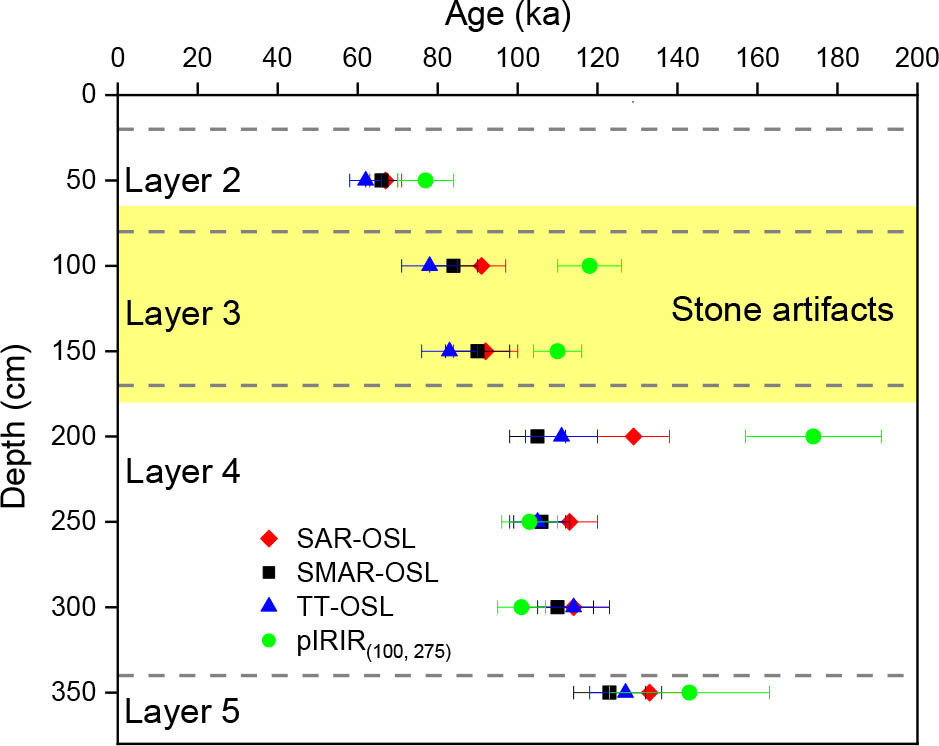
Fig. 6
Age – depth model showing the quartz SAR-, SMAR-, TT-OSL ages and the polymineral pIRIR(100, 275) ages of the seven samples. The shaded area shows the sedimentary layer where stone artifacts were unearthed.
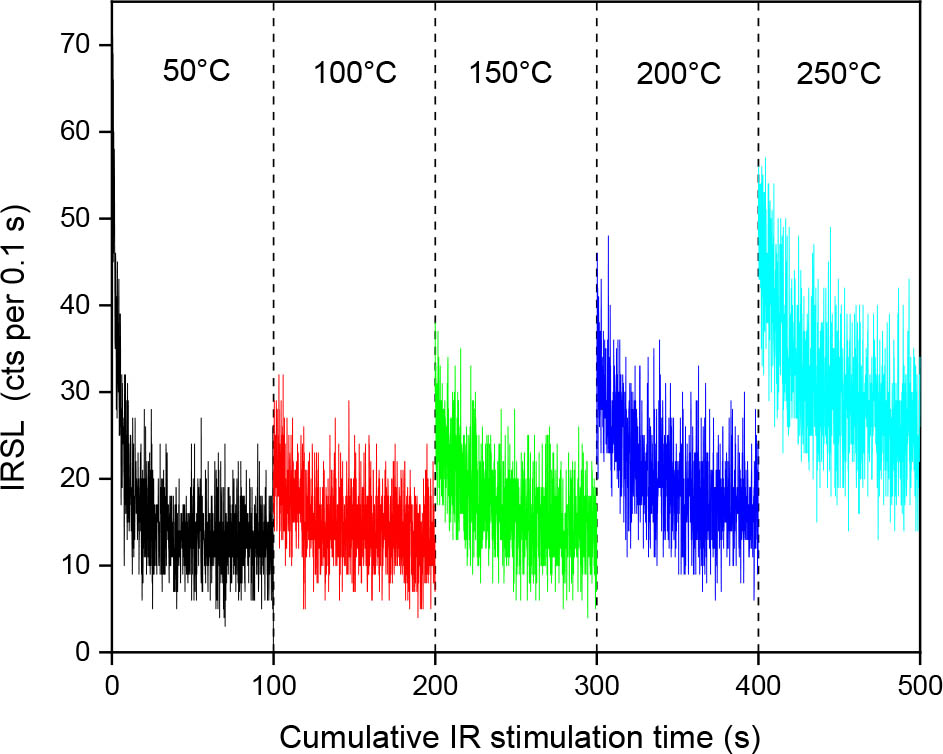
Fig. 7
Decay curves of IRSL (50°C) and MET-pIRIR signals measured at different stimulation temperatures for a single polymineral aliquot of sample L3478.
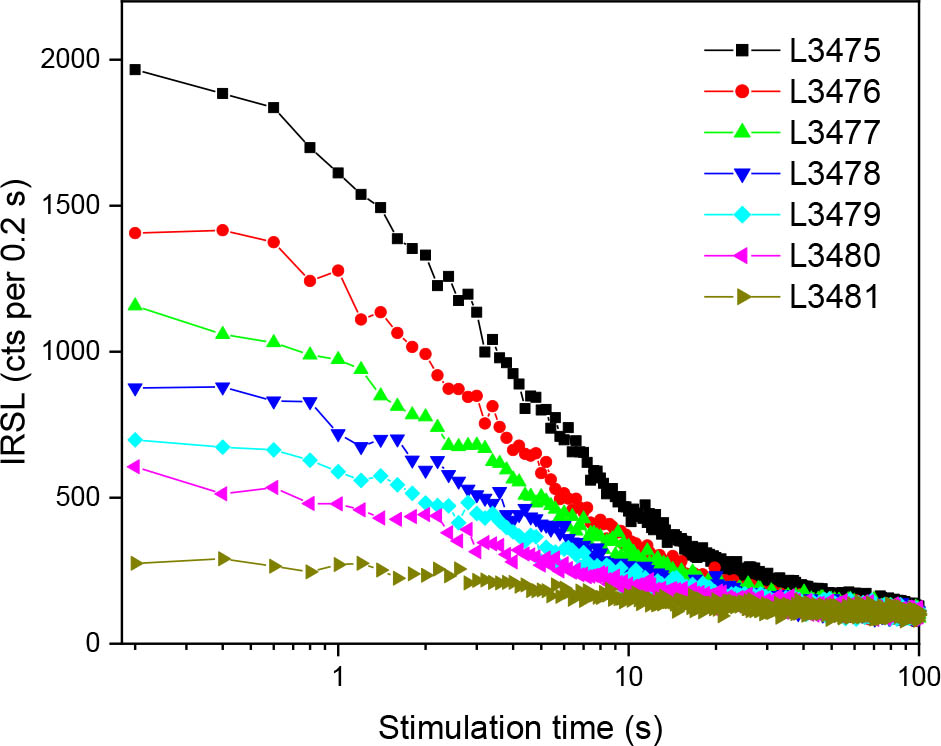
Fig. 8
Natural decay curves of the polymineral pIRIR(100, 275) signals for the study samples.
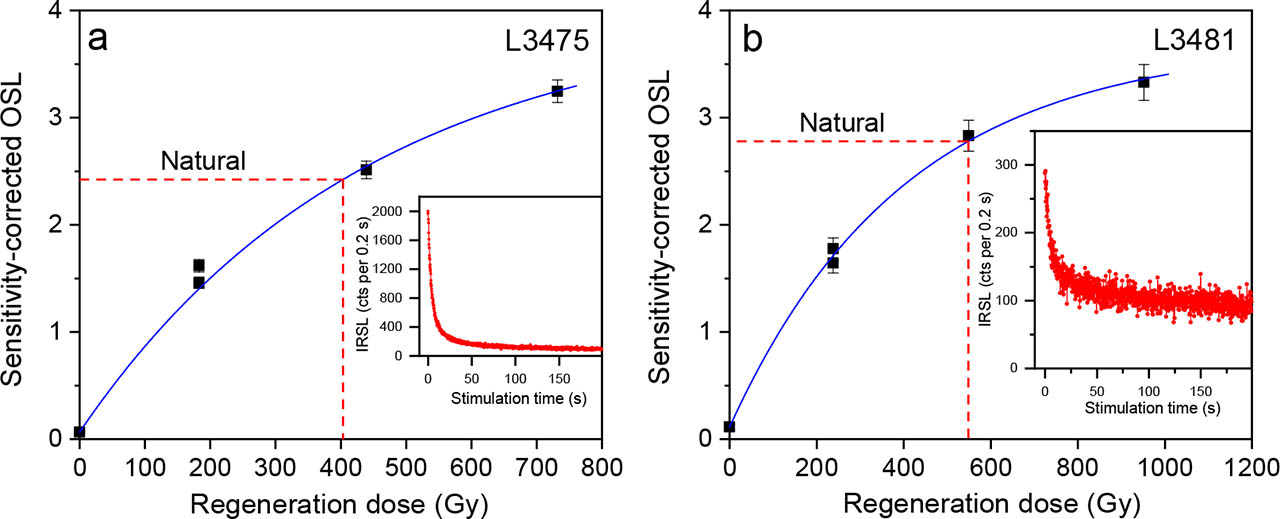
Fig. 9
Dose-response curves of pIRIR(100, 275) signals for single polymineral aliquots of the top sample (L3475, a) and the bottom sample (L3481, b). Insets show the natural decay curves for the two samples.
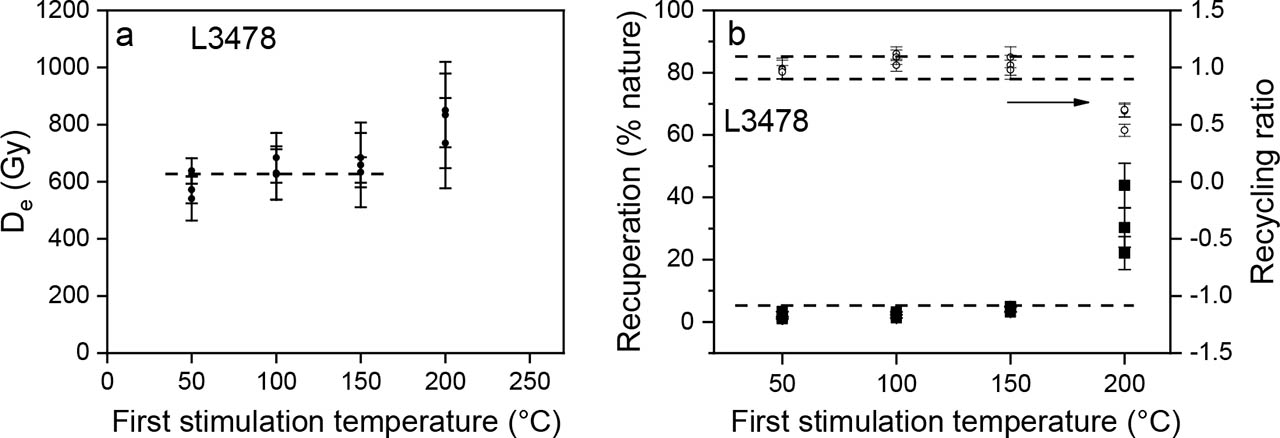
Fig. 10
Plots of pIRIR275 De values against different sample temperatures for the first IRSL measurements for sample L3478. Three fine polymineral aliquots were measured at each temperature for the IRSL measurements.