
Table 1
List of samples investigated in this study.
| Origin | Mineral | Grain size (μm) |
|---|---|---|
| Qaidam Basin, dune sands | Quartz, Q-QB | 125–180 |
| Otindag Desert, dune sands | Quartz, Q-HD | 125–180 |
| Northern Tian Shan, fluvial sands | Quartz, Q-NTS; K-feldspar, F-NTS | 125–180 |
| DTU Risø laboratory | Quartz, Q-CAL | 90–180 |
| Shantou | Perthite, F-PST | 90–125 |
| Qaidam Basin, dune sands* | Quartz, 17YDE2C | 125–180 |
| Junggar Basin, dune sands* | K-feldspar, 15MNS01 | 125–180 |
Table 2
Procedures for investigating the characteristics of post-IR PBLSL and post-IR PGLSL signals.
| Step | Treatment | Observation |
|---|---|---|
| 1 | Give dose, DR Gy | |
| 2 | Preheat at 260°C for 10 s | |
| 3 | IR stimulation for 100 s at TIR | |
| 4 | Pulsed blue light stimulation for 200 s at TBL | Post-IR PBLSL |
| 5 | Give dose, DR Gy | |
| 6 | Preheat at 260°C for 10 s | |
| 7 | IR stimulation for 100 s at TIR | |
| 8 | Pulsed green light stimulation for 200 s at TGL | Post-IR PGLSL |
| 9 | Return to step 1 |
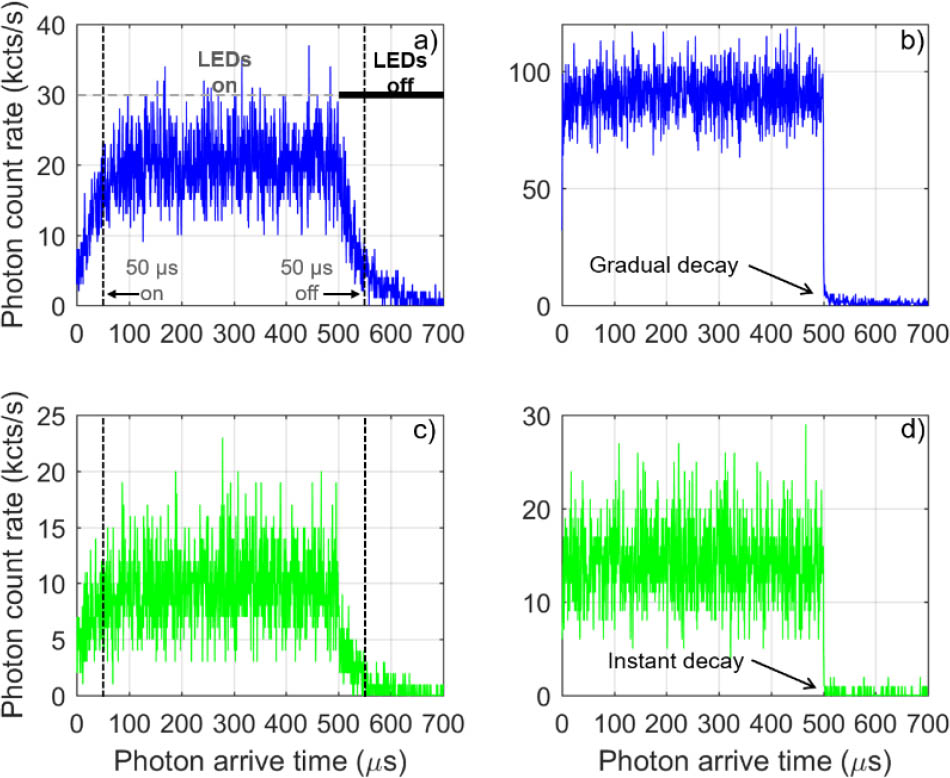
Fig. 1
Time resolved post-IR PBLSL and post-IR PGLSL curves of the quartz and K-feldspars. TR-post-IR PBLSL curves for a) bright quartz of Q-HD and b) K-feldspar of F-NTS, and TR-post-IR PGLSL curves for c) bright quartz of Q-HD and d) K-feldspar of F-NTS. The channel width is 512 ns and the photon count rate is the integration of signal during the initial 2.4 s stimulation. The curves are truncated at 700 μs for clarity. The vertical dashed lines in a) and c) indicate the timing of the end of on-period and off-period for the subsequent post-IR PBLSL and post-IR PGLSL measurements.
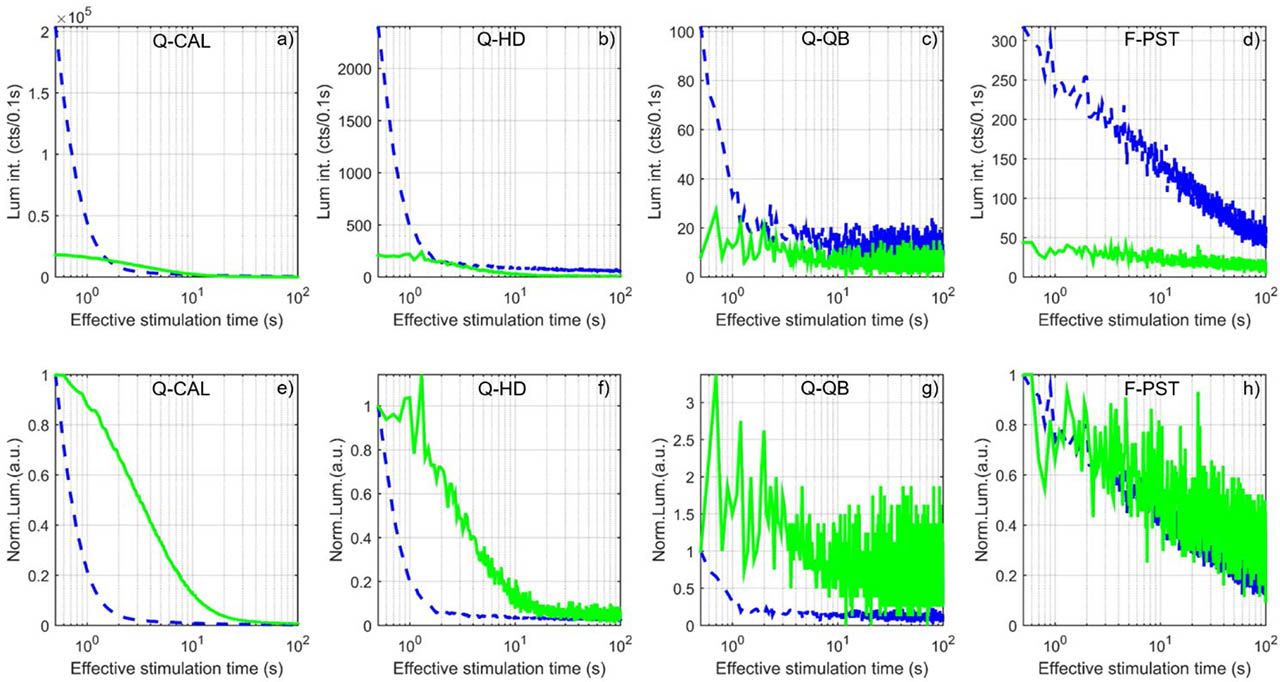
Fig. 2
The raw and normalized post-IR PBLSL (dashed line) and post-IR PGLSL (solid line) decay curves for quartz and feldspars. a) and e) quartz of Q-CAL; b) and f) quartz of Q-HD; c) and g) quartz of Q-QB; d) and h) feldspar of F-PST. The effective stimulation time is calculated by multiplying the ratio of the on period to the sum of on and off period with the total stimulation time.
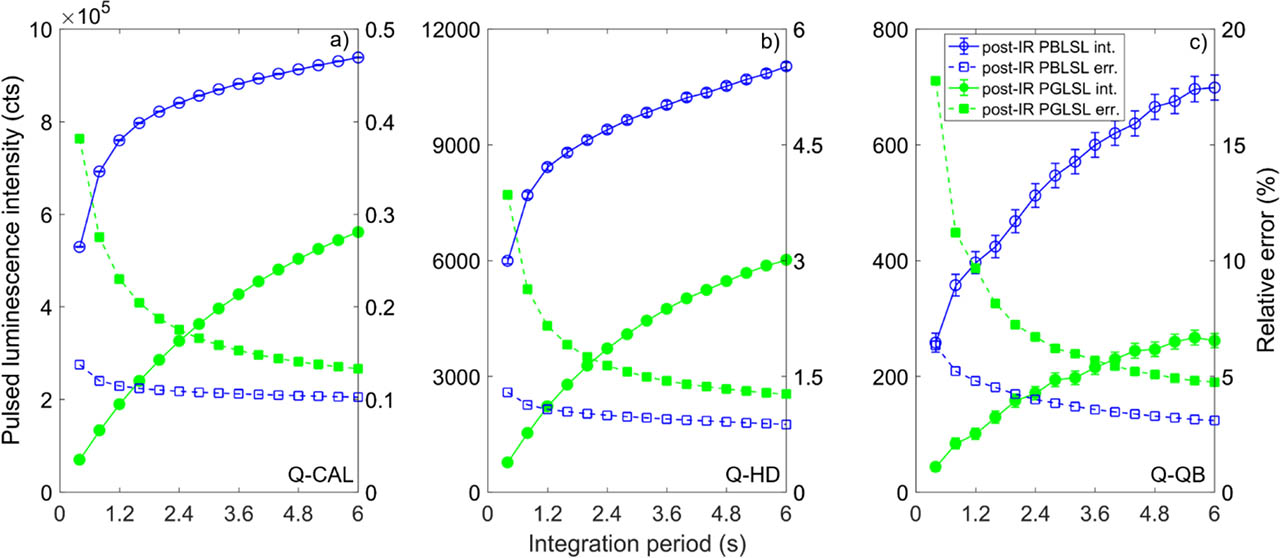
Fig. 3
Variation of the integrated luminescence intensity (circle) and their associated relative counting error (square) for the post-IR PBLSL (open symbol) and post-IR PGLSL (solid symbol) signals of quartz aliquots. a) Q-CAL; b) Q-HD and c) Q-QB.
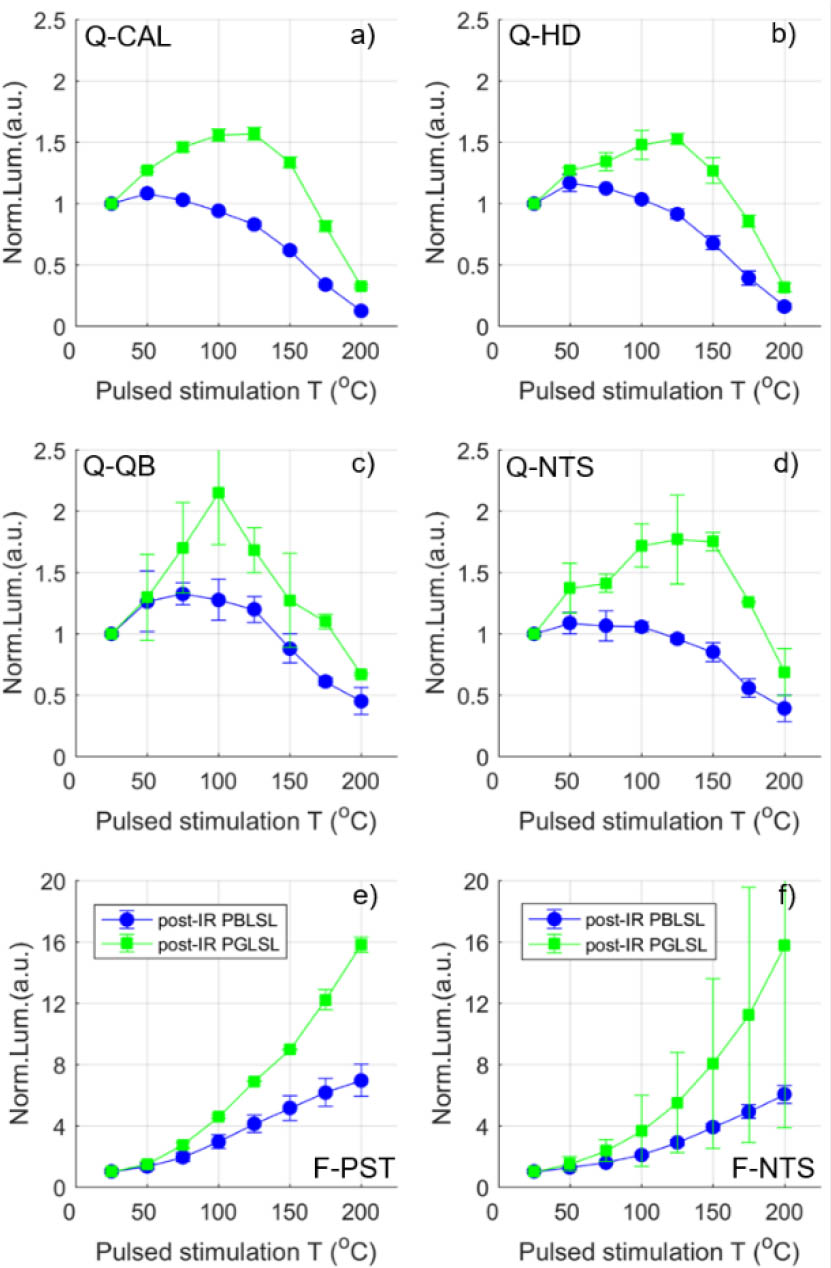
Fig. 4
Variation of the normalized post-IR PBLSL (circle) and post-IR PGLSL (square) intensity on the pulsed stimulation temperature for quartz and feldspars. a) Q-CAL; b) Q-HD; c) Q-QB; d) Q-NTS; e) F-PST and f) F-NTS. The signal intensity was integrated using the initial 0.4 s effective stimulation time with subtraction of the integration of the last 1 s effective stimulation time.
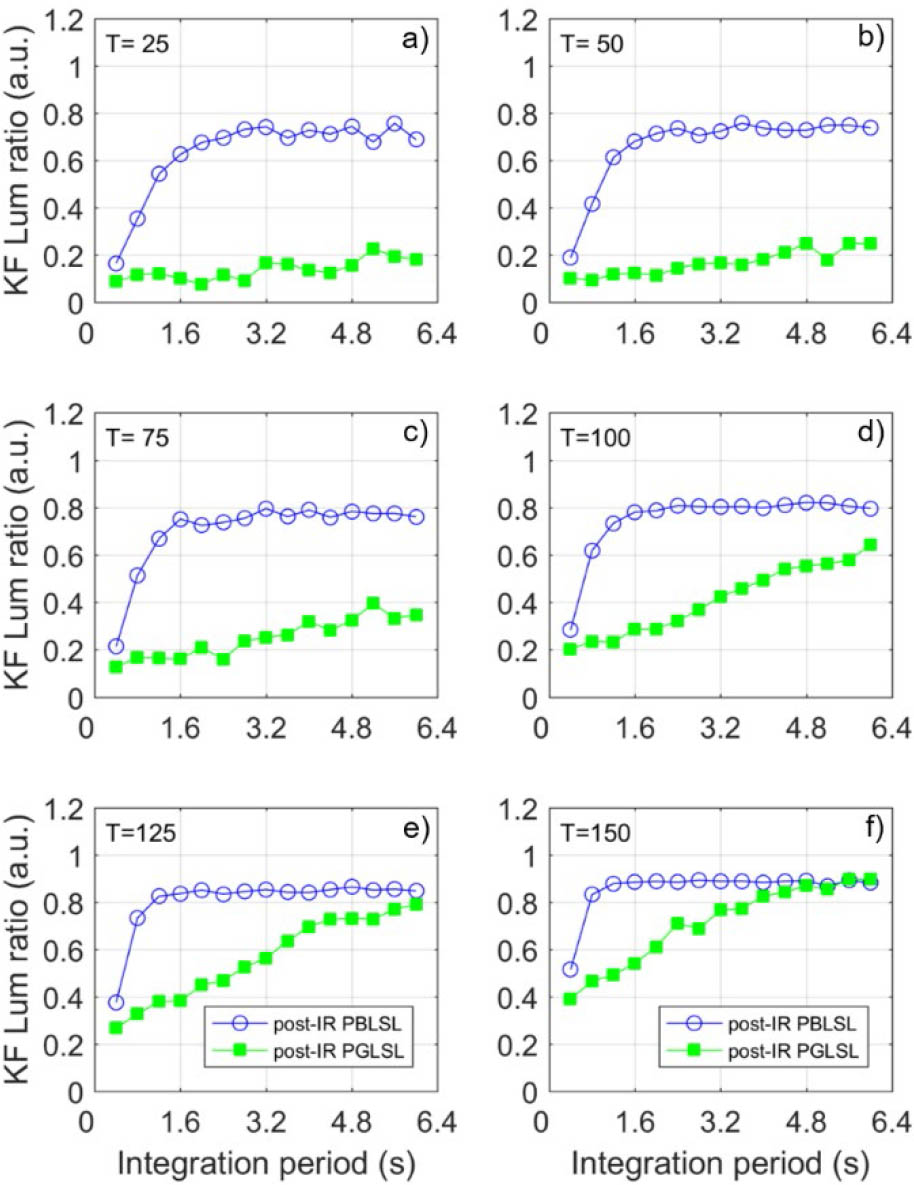
Fig. 5
Variation of the relative feldspar contribution to the post-IR PBLSL (open circle) and post-IR PGLSL (solid square) signals with the integration period for the hypothetical quartz (Q-HD) and feldspar (F-NTS) mixture under various pulsed stimulation temperatures. a) 25°C; b) 50°C; c) 75°C; d) 100°C; e) 125°C and f) 150°C.
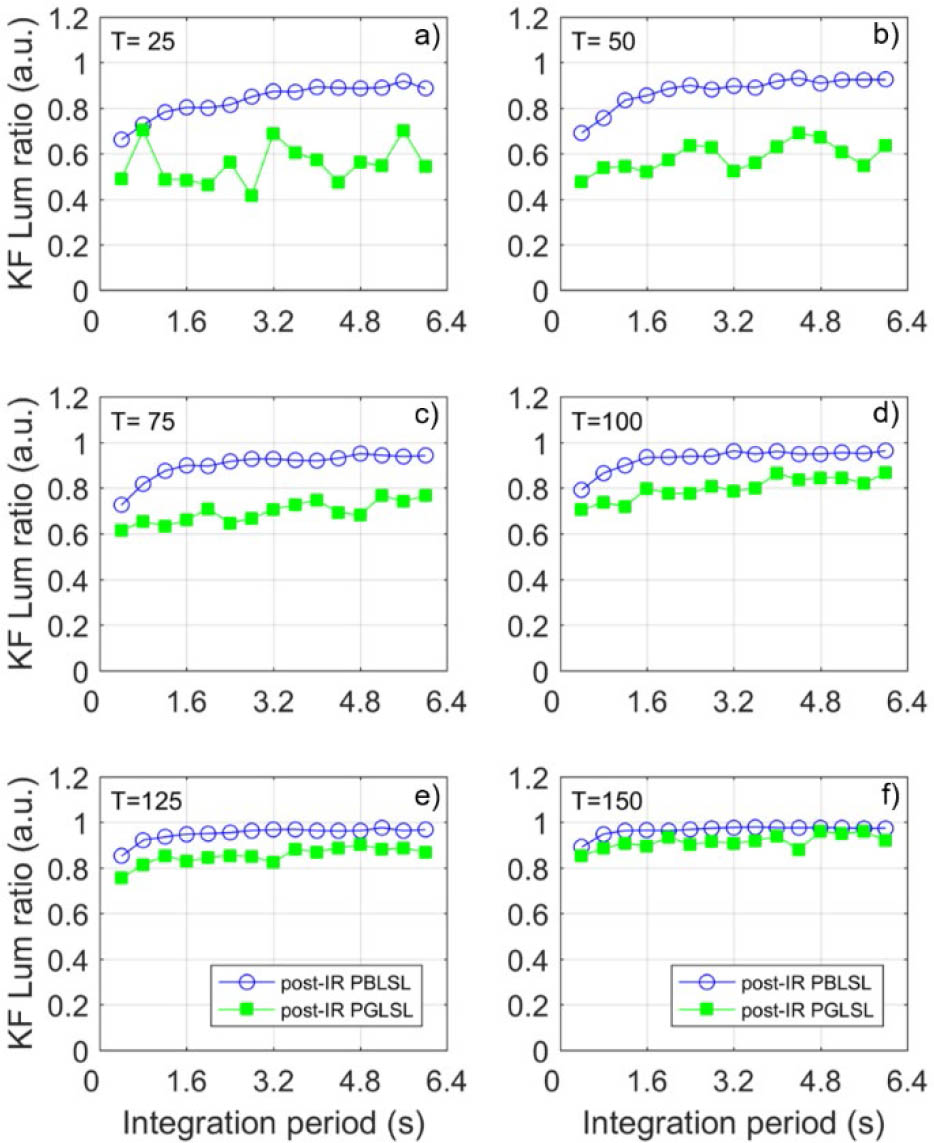
Fig. 6
Variation of the relative feldspar contribution to the post-IR PBLSL (open circle) and post-IR PGLSL (solid square) signals with the integration period for the hypothetical quartz (Q-NTS) and feldspar (F-NTS) mixture under various pulsed stimulation temperatures. a) 25°C; b) 50°C; c) 75°C; d) 100°C; e) 125°C and f) 150°C.
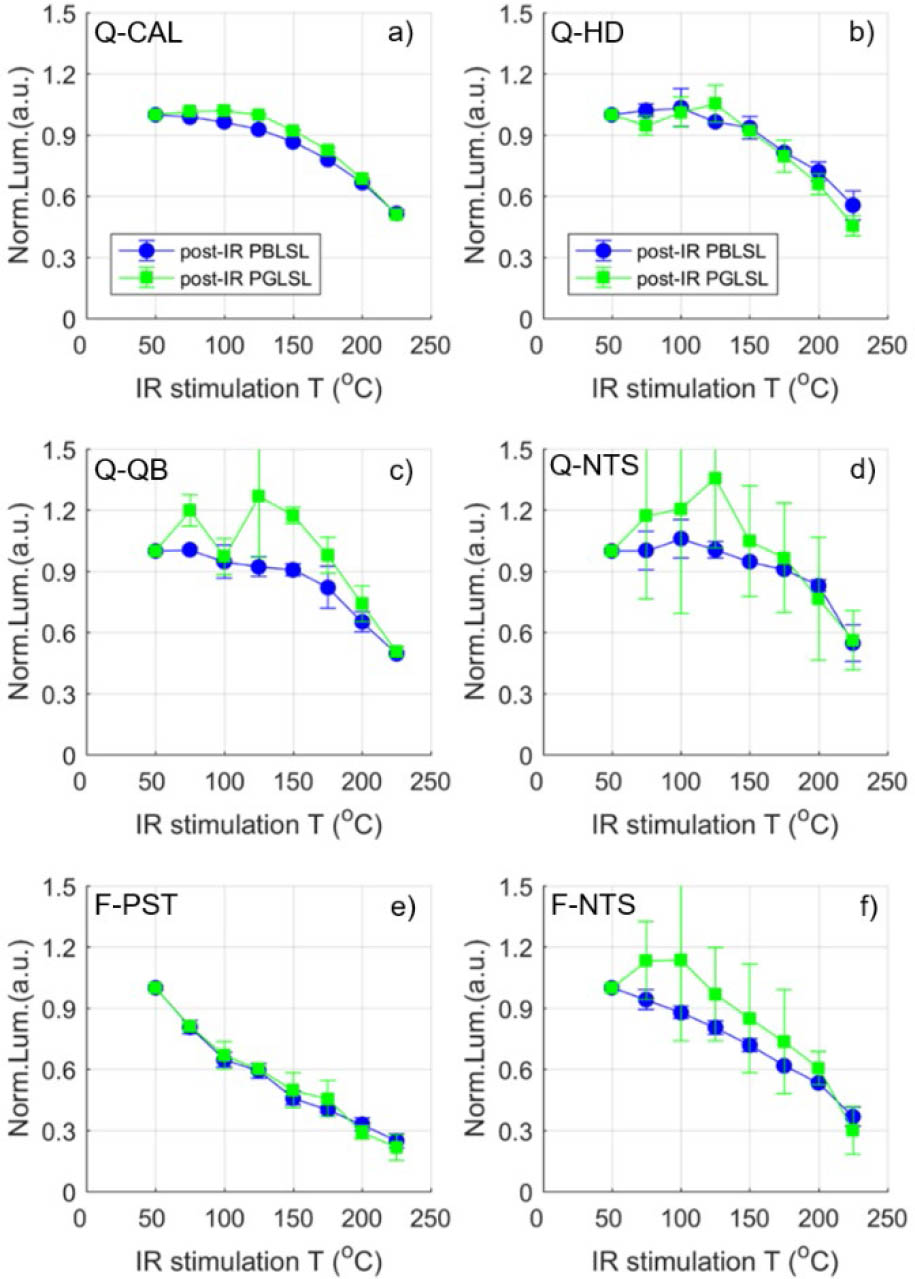
Fig. 7
Variation of the normalized post-IR PBLSL (circle) and post-IR PGLSL (square) intensity with the temperature of IR stimulation prior to the pulsed stimulation for quartz and feldspars. a) Q-CAL; b) Q-HD; c) Q-QB; d) Q-NTS; e) F-PST and f) F-NTS. The signal intensity was integrated using the initial 0.4 s effective stimulation time with subtraction of the integration of the last 1 s effective stimulation time.
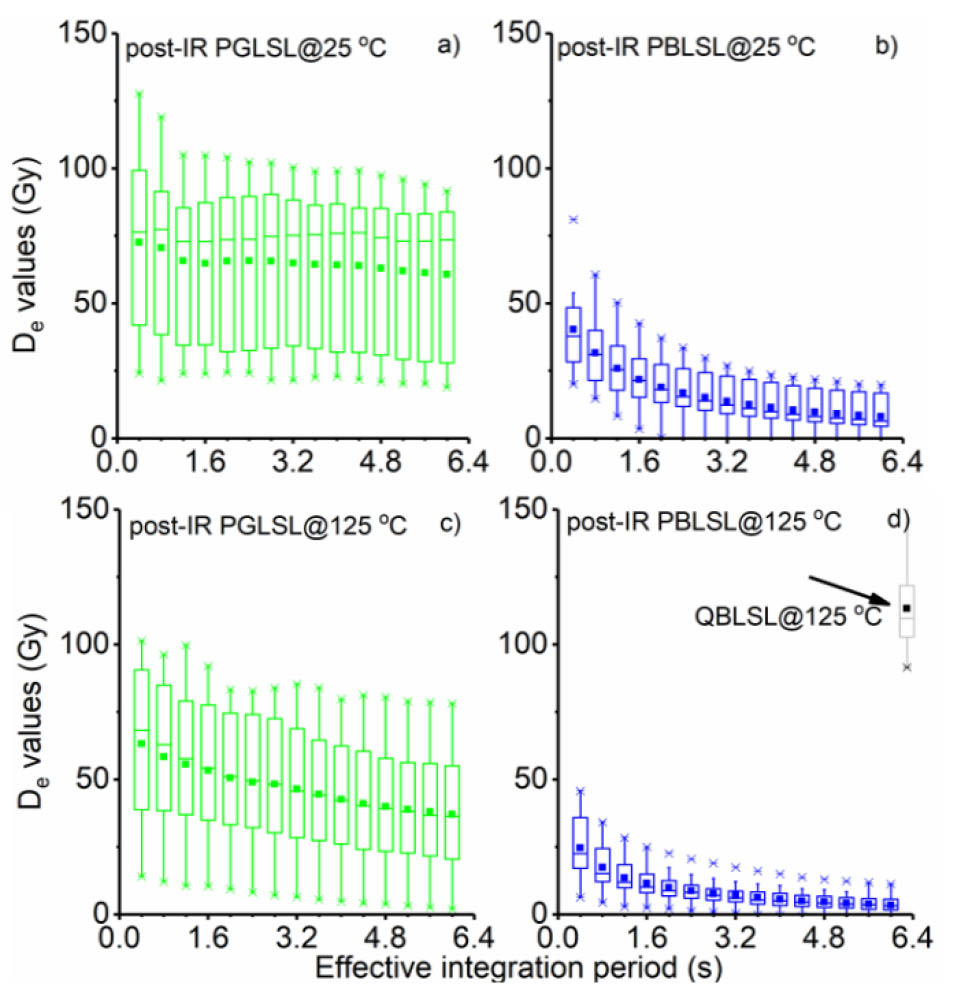
Fig. 8
Box plots of De values measured by various measurement procedures. a) post-IR PGLSL and b) post-IR PBLSL stimulated at 25°C; c) post-IR PGLSL and d) post-IR PBLSL stimulated at 125°C. The De value determined by the conventional BLSL signal of quartz of 17YDE2C is shown in d).