
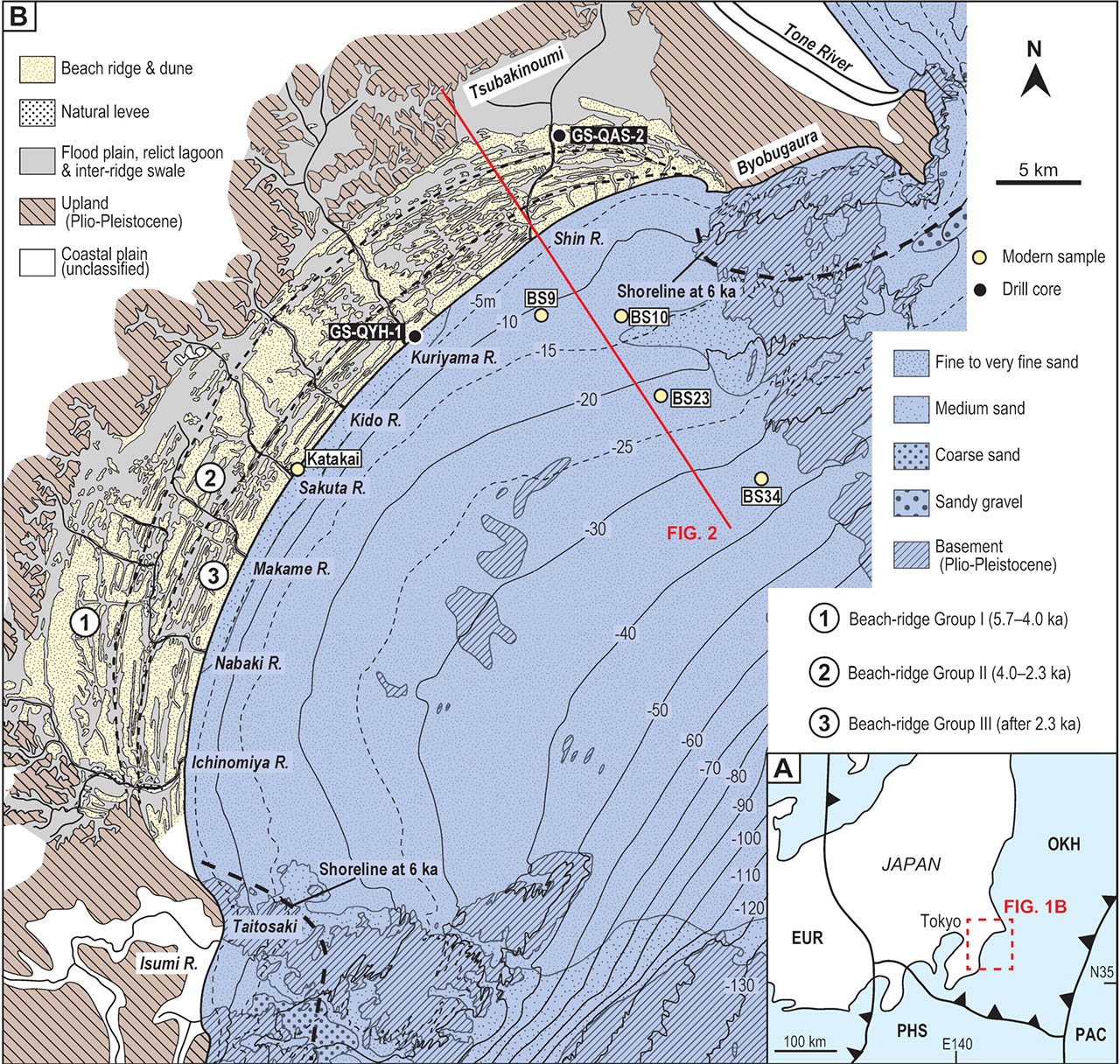
Fig. 1
A) Location map of the study area and plate boundaries between the Eurasian (EUR), Okhotsk (OKH), Philippine Sea (PHS), and Pacific Ocean (PAC) plates. B) Morpho-sedimentary map of the Kujukuri beach-ridge plain and offshore showing the locations of modern samples and drill cores (modified from Tamura et al., 2008b). Five modern samples (Katakai, BS9, 10, 23, and 34) and two drill cores (GS-QYH-1 and GS-QAS-2) were used for the analysis. The red line shows the location of the cross section in Fig. 2. The definition of beach-ridge groups I–III is after Moriwaki (1979) and their formative durations were determined based on radiocarbon chronology in a cross section near the Makame and Sakuta rivers (Masuda et al., 2001b; Tamura et al., 2007).
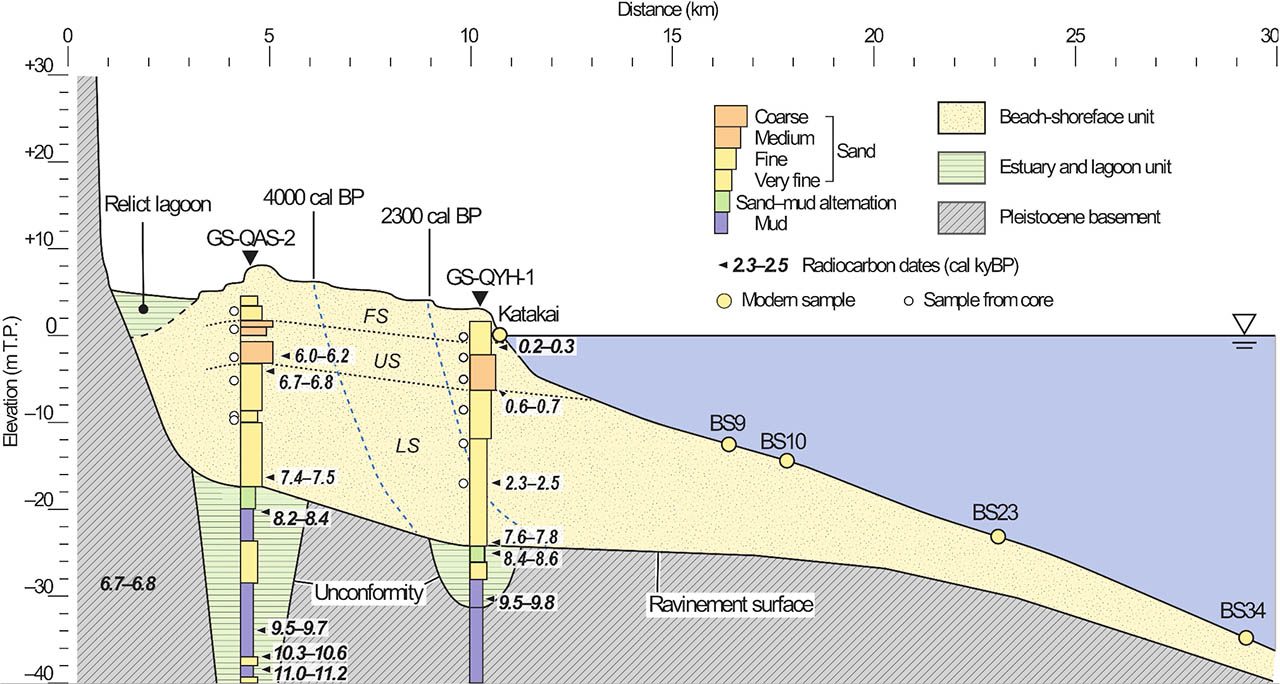
Fig. 2
Cross section across the Kujukuri beach-ridge plain and offshore area (see location in Fig. 1b). The positions of the two drill cores and five modern sediment samples analyzed herein were projected onto a single section. Six samples were taken for analysis from each drill core. Radiocarbon dates of molluscan shells and a plant fragment are shown beside the columns of the cores. Dashed lines indicate the isochrones of the beach-ridge group boundary. The stratigraphic outline was defined on the basis of drill cores and compilations of previous studies in the central part of the plain (e.g., Tamura et al., 2003, 2007, 2008a, 2008b). FS: foreshore and backshore facies; US: upper shoreface facies; LS: lower shoreface facies; T.P.: Tokyo Peil, the standard datum for elevation measurements in Japan.
Table 1
Details of modern samples. Equivalent doses (De) were determined from IR50, pIRIR150, and pIRIR290.
| Site | Lab code | Latitude | Longitude | Water depth (m) | De from IR50 (Gy) | De from pIRIR150 (Gy) | De from pIRIR290 (Gy) |
|---|---|---|---|---|---|---|---|
| Katakai | gsj15160 | N35°32′28.2″ | E140°27′55.8″ | 0 | 0.09 ± 0.01 | 0.93 ± 0.08 | 11.93 ± 1.66 |
| BS9 | gsj17282 | N35°37′42.1″ | E140°37′13.9″ | 13 | 0.04 ± 0.01 | 1.80 ± 0.16 | 27.28 ± 1.08 |
| BS10 | gsj17283 | N35°37′42.3″ | E140°40′16.6″ | 14 | 0.07 ± 0.003 | 2.45 ± 0.13 | 29.09 ± 1.44 |
| BS23 | gsj17284 | N35°35′11.9″ | E140°41′48.5″ | 23 | 0.18 ± 0.01 | 3.25 ± 0.33 | 29.27 ± 1.47 |
| BS34 | gsj17273 | N35°32′40.0″ | E140°45′39.4″ | 34 | 0.06 ± 0.01 | 2.26 ± 0.14 | 23.92 ± 1.60 |
Table 2
Details of Holocene samples taken from drill cores: sample level, water, U, Th, K, and Rb contents, estimated dose rates, and expected ages from radiocarbon dates. The internal dose rate was estimated to be 0.738±0.123 Gy/ka for all samples.
| Lab code | Depth (m) | Water content (%) | U (ppm) | Th (ppm) | K (%) | Rb (ppm) | Cosmic dose rate (Gy/ka) | Total dose rate (Gy/ka) | Expected age (ka) |
|---|---|---|---|---|---|---|---|---|---|
| GSJ-QAS2 (N35°43′17.3″ E140°37′52.0″ Elevation: +5.2 m) | |||||||||
| gsj15149 | 2.2 | 21 | 0.67 | 2.9 | 1.1 | 39 | 0.15 ± 0.02 | 2.07 ± 0.14 | 5.89 ± 0.08 |
| gsj15151 | 4.2 | 31 | 0.89 | 3.6 | 1.3 | 48 | 0.12 ± 0.01 | 2.17 ± 0.14 | 6.01 ± 0.08 |
| gsj15154 | 7.5 | 20 | 0.7 | 3.0 | 1.4 | 55 | 0.09 ± 0.01 | 2.28 ± 0.14 | 6.26 ± 0.08 |
| gsj15155 | 10.2 | 39 | 1.1 | 4.3 | 1.6 | 62 | 0.07 ± 0.01 | 2.26 ± 0.14 | 6.88 ± 0.08 |
| gsj15157 | 14.4 | 34 | 0.89 | 3.8 | 1.6 | 60 | 0.05 ± 0.01 | 2.28 ± 0.14 | 7.13 ± 0.08 |
| gsj15158 | 14.8 | 42 | 1.2 | 3.8 | 1.6 | 62 | 0.05 ± 0.00 | 2.21 ± 0.14 | 7.15 ± 0.08 |
| GSJ-QYH1 (N35°37′00.0″ E140°32′29.2″ Elevation: +2.1 m) | |||||||||
| gsj15254 | 2.3 | 20 | 0.91 | 4.8 | 0.97 | 34 | 0.15 ± 0.02 | 2.13 ± 0.14 | 0.23 ± 0.08 |
| gsj15255 | 4.9 | 33 | 0.88 | 3.1 | 1.6 | 58 | 0.11 ± 0.01 | 2.30 ± 0.14 | 0.45 ± 0.08 |
| gsj15256 | 7.2 | 30 | 0.67 | 3.3 | 1.5 | 52 | 0.09 ± 0.01 | 2.23 ± 0.14 | 0.66 ± 0.08 |
| gsj15257 | 10.7 | 33 | 0.76 | 4.0 | 1.5 | 50 | 0.06 ± 0.01 | 2.16 ± 0.14 | 1.13 ± 0.08 |
| gsj15258 | 14.6 | 31 | 0.73 | 3.1 | 1.6 | 50 | 0.05 ± 0.01 | 2.21 ± 0.14 | 1.74 ± 0.08 |
| sj15259 | 19.2 | 31 | 0.8 | 3.5 | 1.6 | 51 | 0.03 ± 0.00 | 2.24 ± 0.14 | 2.44 ± 0.08 |
Table 3
Radiocarbon dating results for drill core samples.
| Access code | Core depth (m) | Sample | Conventional 14C age (yr BP) | Calibrated age (2s) (cal yr BP) | Probability |
|---|---|---|---|---|---|
| GS-QAS-2 | |||||
| IAAA-153551 | 7.3 | Shell (Mactra chinensis) | 5720 ± 30 | 6019–6239 | 1.000 |
| IAAA-153282 | 9.1 | Shell (M. chinensis) | 6290 ± 30 | 6653–6843 | 1.000 |
| IAAA-153552 | 21.3 | Shell (Raetellops pulchellus) | 6970 ± 30 | 7411–7540 | 1.000 |
| IAAA-153283 | 25.4 | Shell (R. pulchellus) | 7850 ± 30 | 8224–8388 | 1.000 |
| IAAA-153284 | 38.9 | Shell (Glossaulax didyma) | 8950 ± 30 | 9511–9708 | 1.000 |
| IAAA-153553 | 41.8 | Shell (Dosinia angulosa) | 9570 ± 40 | 10295–10551 | 1.000 |
| IAAA-151461 | 43.6 | Plant fragment | 9700 ± 40 | 10878–10933 | 0.097 |
| 11080–11212 | 0.903 | ||||
| GS-QYH-1 | |||||
| IAAA-153560 | 3.4 | Shell (Chion semigranosa) | 620 ± 20 | 146–164 | 0.026 |
| 187–312 | 0.974 | ||||
| IAAA-153288 | 8.4 | Shell (M. chinensis) | 1150 ± 20 | 649–749 | 1.000 |
| IAAA-153561 | 19.1 | Shell (Siliqua pulchella) | 2680 ± 30 | 2303–2456 | 1.000 |
| IAAA-153289 | 25.8 | Shell (R. pulchellus) | 7220 ± 30 | 7596–7761 | 1.000 |
| IAAA-153562 | 27.3 | Shell (Macoma tokyoensis) | 8020 ± 30 | 8393–8556 | 1.000 |
| IAAA-153290 | 32.4 | Shell (Dentalium octangulatum) | 9010 ± 40 | 9540–9822 | 1.000 |
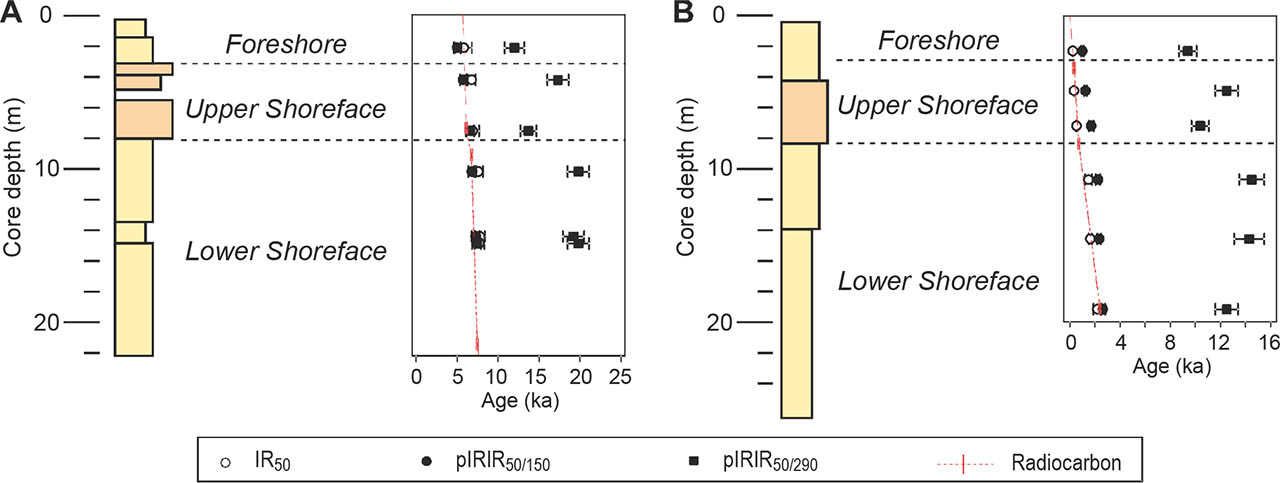
Fig. 3
Fading-corrected final luminescence age estimates of samples taken from (A) core GS-QAS-2 and (B) core GS-QYH-1. Radiocarbon ages of molluscan shells are also shown for comparison. Radiocarbon ages at the ground surface were assumed to be 5.7 ka and 0 ka for cores GS-QAS-2 and GS-QYH-1, respectively, to define the expected ages (red lines).
Table 4
Summaries of the IR50, pIRIR150, and pIRIR290 single-aliquot regenerative dose protocols used in this study.
| Step | post-IR IRSL (150°C) | Signal | post-IR IRSL (290°C) | Signal |
|---|---|---|---|---|
| 1 | Preheat at 180°C for 60 s | Preheat at 320°C for 60 s | ||
| 2 | IR stimulation at 50°C for 100 s | Lx for IRSL50 | IR stimulation at 50°C for 200 s | |
| 3 | IR stimulation at 150°C for 100 s | Lx for post-IR IRSL150 | IR stimulation at 290°C for 200 s | Lx for post-IR IRSL290 |
| 4 | Test dose | Test dose | ||
| 5 | Preheat at 180°C for 60 s | Preheat at 320°C for 60 s | ||
| 6 | IR stimulation at 50°C for 100 s | Tx for IRSL50 | IR stimulation at 50°C for 200 s | |
| 7 | IR stimulation at 150°C for 100 s | Tx for post-IR IRSL150 | IR stimulation at 290°C for 200 s | Tx for post-IR IRSL290 |
| 8 | Dose and return to step 1 | IR stimulation at 325°C for 200 s | ||
| 9 | Dose and return to step 1 |
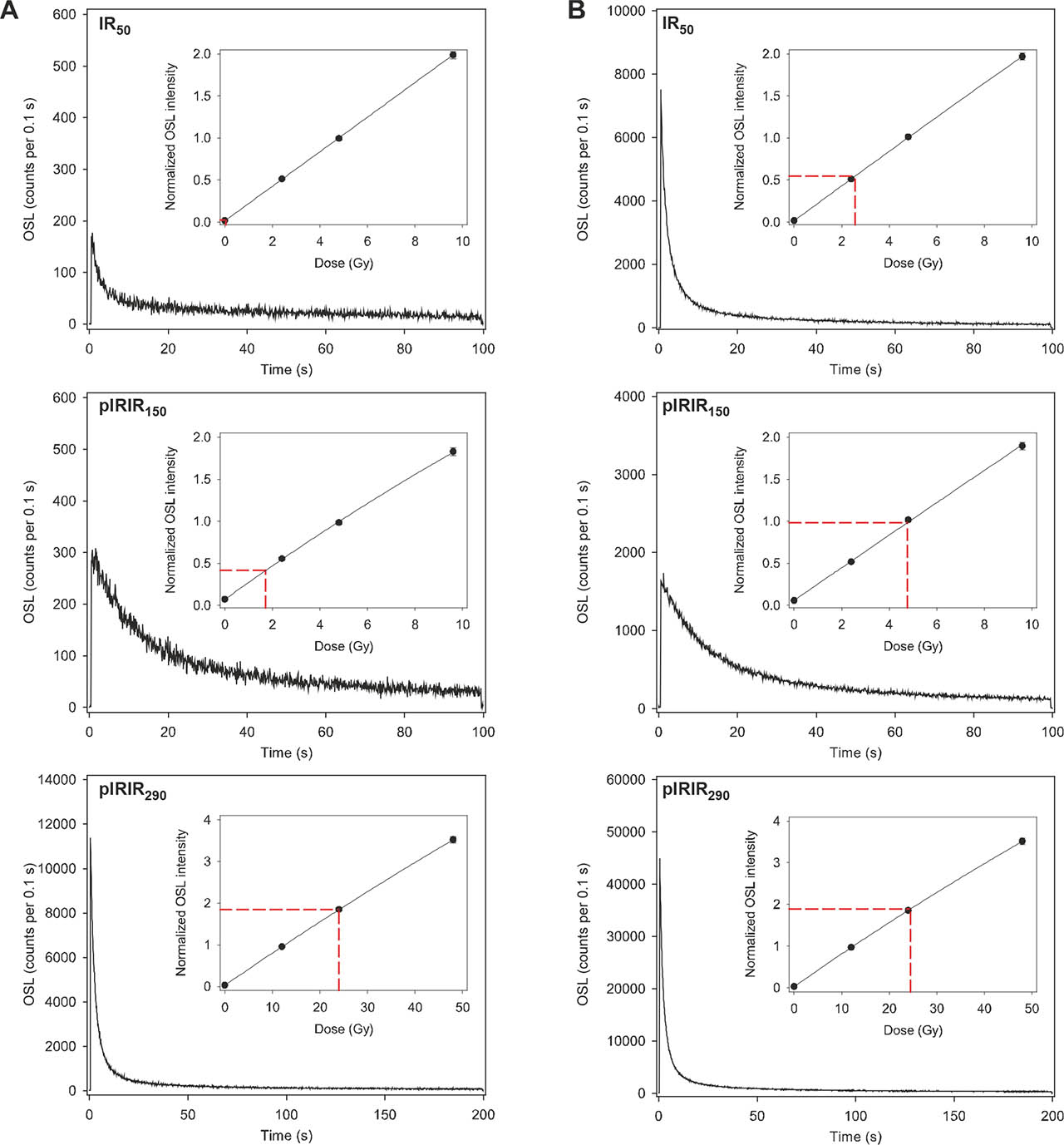
Fig. 4
Decay curves and dose–response curves (inset) of IR50, pIRIR150, and pIRIR290 measured on samples (A) gsj15259 and (B) gsj17282. The intersections of the natural OSL intensity with the dose–response curve and the corresponding equivalent dose are highlighted with red dashed lines.
Table 5
Equivalent dose (De), uncorrected age, g-value, corrected age, offset from expected age, and De offset from expected for IR50 signals of Holocene samples.
| Lab code | Depth (m) | De (Gy) | Uncorrected age (ka) | g-value (%/decade) | Corrected age (ka) | Age offset from expected (ka) | De offset from expected (Gy) |
|---|---|---|---|---|---|---|---|
| GS-QAS-2 | |||||||
| gsj15149 | 2.2 | 5.25 ± 0.09 | 2.5 ± 0.2 | 8.48 ± 0.73 | 5.8 ± 1.0 | −0.1 ± 1.0 | −0.17 ± 0.14 |
| gsj15151 | 4.2 | 6.78 ± 0.11 | 3.1 ± 0.2 | 7.96 ± 0.15* | 6.8 ± 0.5 | 0.8 ± 0.5 | 1.6 ± 0.07 |
| gsj15154 | 7.5 | 7.64 ± 0.20 | 3.4 ± 0.2 | 7.51 ± 0.45 | 6.9 ± 0.8 | 0.6 ± 0.8 | 1.5 ± 0.11 |
| gsj15155 | 10.2 | 7.89 ± 0.13 | 3.5 ± 0.2 | 7.96 ± 0.15* | 7.6 ± 0.5 | 0.7 ± 0.5 | 1.6 ± 0.07 |
| gsj15157 | 14.4 | 8.10 ± 0.09 | 3.6 ± 0.2 | 7.96 ± 0.15* | 7.8 ± 0.6 | 0.6 ± 0.6 | 1.5 ± 0.09 |
| gsj15158 | 14.8 | 7.82 ± 0.11 | 3.5 ± 0.2 | 7.96 ± 0.15* | 7.7 ± 0.6 | 0.6 ± 0.6 | 1.3 ± 0.08 |
| GS-QYH-1 | |||||||
| gsj15254 | 2.3 | 0.28 ± 0.01 | 0.13 ± 0.01 | 8.21 ± 0.42 | 0.2 ± 0.0 | 0.0 ± 0.1 | 0.01 ± 0.01 |
| gsj15255 | 4.9 | 0.40 ± 0.01 | 0.18 ± 0.01 | 8.26 ± 0.28 | 0.3 ± 0.0 | −0.1 ± 0.1 | −0.29 ± 0.01 |
| gsj15256 | 7.2 | 0.67 ± 0.02 | 0.30 ± 0.02 | 7.39 ± 0.10 | 0.5 ± 0.0 | −0.1 ± 0.1 | −0.27 ± 0.01 |
| gsj15257 | 10.7 | 1.46 ± 0.03 | 0.68 ± 0.05 | 8.93 ± 0.90 | 1.5 ± 0.3 | 0.4 ± 0.3 | 0.77 ± 0.04 |
| gsj15258 | 14.6 | 1.95 ± 0.02 | 0.88 ± 0.06 | 7.20 ± 0.13 | 1.6 ± 0.1 | −0.1 ± 0.1 | −0.26 ± 0.02 |
| gsj15259 | 19.2 | 2.49 ± 0.03 | 1.1 ± 0.1 | 7.73 ± 0.73 | 2.2 ± 0.3 | −0.3 ± 0.3 | −0.57 ± 0.05 |
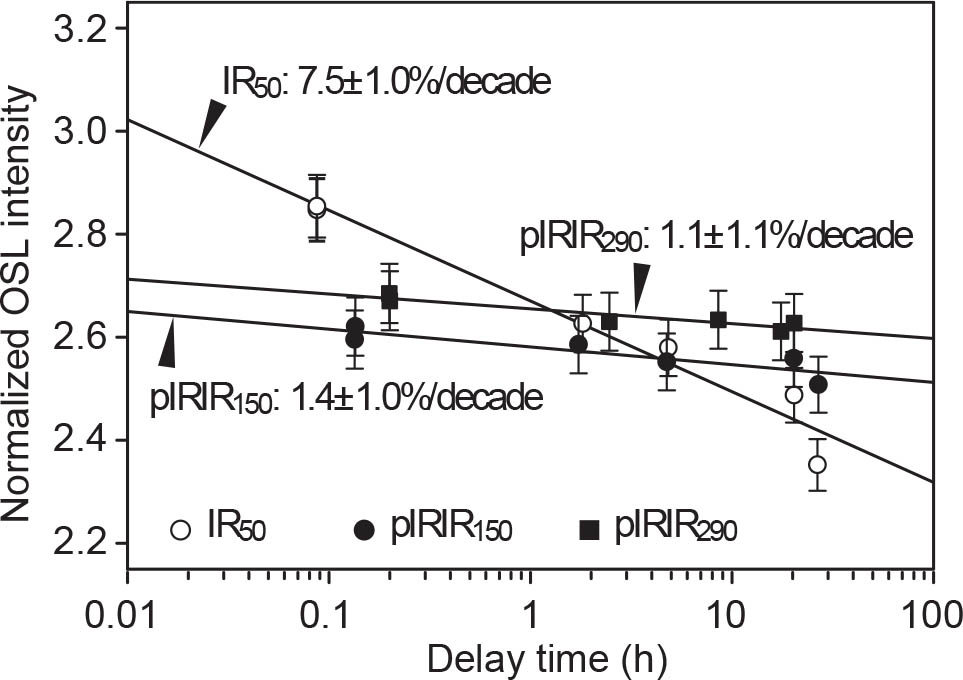
Fig. 5
Fading test results of IR50, pIRIR150, and pIRIR290 signals measured for sample gsj15258. A regression line was defined for each signal based on the least-squares method and then applied to estimate the g-value.
Table 6
Equivalent dose (De), uncorrected age, g-value, corrected age, offset from expected age, and De offset from expected for pIRIR150 signals of Holocene samples.
| Lab code | Depth (m) | De (Gy) | Uncorrected age (ka) | g-value (%/decade) | Corrected age (ka) | Age offset from expected (ka) | De offset from expected (Gy) |
|---|---|---|---|---|---|---|---|
| GS-QAS-2 | |||||||
| gsj15149 | 2.2 | 9.63 ± 0.35 | 4.7 ± 0.4 | 1.05 ± 0.38 | 5.0 ± 0.4 | −0.9 ± 0.4 | −1.82 ± 0.06 |
| gsj15151 | 4.2 | 11.43 ± 0.46 | 5.3 ± 0.4 | 1.21 ± 0.11* | 5.7 ± 0.4 | −0.3 ± 0.4 | −0.6 ± 0.05 |
| gsj15154 | 7.5 | 13.53 ± 0.25 | 5.9 ± 0.4 | 1.32 ± 0.15 | 6.6 ± 0.5 | 0.3 ± 0.5 | 0.7 ± 0.07 |
| gsj15155 | 10.2 | 14.12 ± 0.34 | 6.2 ± 0.4 | 1.21 ± 0.11* | 6.8 ± 0.5 | −0.1 ± 0.5 | −0.1 ± 0.07 |
| gsj15157 | 14.4 | 15.15 ± 0.45 | 6.7 ± 0.5 | 1.21 ± 0.11* | 7.3 ± 0.5 | 0.1 ± 0.5 | 0.3 ± 0.07 |
| gsj15158 | 14.8 | 14.89 ± 0.42 | 6.7 ± 0.5 | 1.21 ± 0.11* | 7.4 ± 0.5 | 0.2 ± 0.5 | 0.5 ± 0.07 |
| GS-QYH-1 | |||||||
| gsj15254 | 2.3 | 1.93 ± 0.12 | 0.9 ± 0.1 | 1.37 ± 0.70 | 1.0 ± 0.1 | 0.8 ± 0.1 | 1.60 ± 0.02 |
| gsj15255 | 4.9 | 2.62 ± 0.12 | 1.1 ± 0.1 | 1.30 ± 0.14 | 1.2 ± 0.1 | 0.8 ± 0.1 | 1.83 ± 0.02 |
| gsj15256 | 7.2 | 3.62 ± 0.35 | 1.6 ± 0.2 | 0.78 ± 0.18 | 1.7 ± 0.2 | 1.0 ± 0.2 | 2.34 ± 0.03 |
| gsj15257 | 10.7 | 4.47 ± 0.29 | 2.1 ± 0.2 | 1.15 ± 0.14 | 2.2 ± 0.2 | 1.1 ± 0.2 | 2.40 ± 0.03 |
| gsj15258 | 14.6 | 4.73 ± 0.11 | 2.1 ± 0.1 | 1.25 ± 0.15 | 2.3 ± 0.2 | 0.6 ± 0.2 | 1.32 ± 0.02 |
| gsj15259 | 19.2 | 5.31 ± 0.15 | 2.4 ± 0.2 | 1.48 ± 0.27 | 2.6 ± 0.2 | 0.2 ± 0.2 | 0.42 ± 0.03 |
Table 7
Equivalent dose (De), uncorrected age, g-value, corrected age, offset from expected age, and De offset from expected for pIRIR150 signals of Holocene samples.
| Lab code | Depth (m) | De (Gy) | Uncorrected age (ka) | g-value (%/decade) | Corrected age (ka) | Age offset from expected (ka) | De offset from expected (Gy) |
|---|---|---|---|---|---|---|---|
| GS-QAS-2 | |||||||
| gsj15149 | 2.2 | 22.83 ± 1.25 | 11.0 ± 0.9 | 1.13 ± 0.17 | 12.0 ± 1.2 | 6.1 ± 1.2 | 12.64 ± 0.16 |
| gsj15151 | 4.2 | 34.00 ± 1.51 | 15.7 ± 1.2 | 1.28 ± 0.09* | 17.3 ± 1.3 | 11.3 ± 1.3 | 24.46 ± 0.18 |
| gsj15154 | 7.5 | 28.50 ± 1.17 | 12.5 ± 0.9 | 1.16 ± 0.08 | 13.7 ± 1.0 | 7.4 ± 1.0 | 16.88 ± 0.15 |
| gsj15155 | 10.2 | 40.57 ± 1.17 | 17.9 ± 1.2 | 1.28 ± 0.09* | 19.8 ± 1.3 | 12.9 ± 1.3 | 29.21 ± 0.18 |
| gsj15157 | 14.4 | 39.51 ± 1.36 | 17.3 ± 1.2 | 1.28 ± 0.09* | 19.2 ± 1.3 | 12.0 ± 1.3 | 27.40 ± 0.19 |
| gsj15158 | 14.8 | 39.62 ± 1.03 | 17.9 ± 1.2 | 1.28 ± 0.09* | 19.8 ± 1.3 | 12.7 ± 1.3 | 27.95 ± 0.18 |
| GS-QYH-1 | |||||||
| gsj15254 | 2.3 | 18.08 ± 0.60 | 8.5 ± 0.6 | 1.45 ± 0.37 | 9.4 ± 0.7 | 9.2 ± 0.7 | 19.58 ± 0.10 |
| gsj15255 | 4.9 | 26.42 ± 1.38 | 11.5 ± 0.9 | 1.11 ± 0.16 | 12.5 ± 0.9 | 12.0 ± 0.9 | 27.69 ± 0.12 |
| gsj15256 | 7.2 | 21.50 ± 0.85 | 9.6 ± 0.7 | 1.05 ± 0.32 | 10.4 ± 0.7 | 9.8 ± 0.7 | 21.78 ± 0.10 |
| gsj15257 | 10.7 | 28.89 ± 0.79 | 13.4 ± 0.9 | 1.07 ± 0.12 | 14.5 ± 1.0 | 13.3 ± 1.0 | 28.85 ± 0.14 |
| gsj15258 | 14.6 | 26.99 ± 1.02 | 12.2 ± 0.9 | 1.96 ± 0.36 | 14.3 ± 1.2 | 12.6 ± 1.2 | 27.81 ± 0.17 |
| gsj15259 | 19.2 | 25.46 ± 0.64 | 11.4 ± 0.8 | 1.31 ± 0.18 | 12.5 ± 0.9 | 10.1 ± 0.9 | 22.66 ± 0.13 |
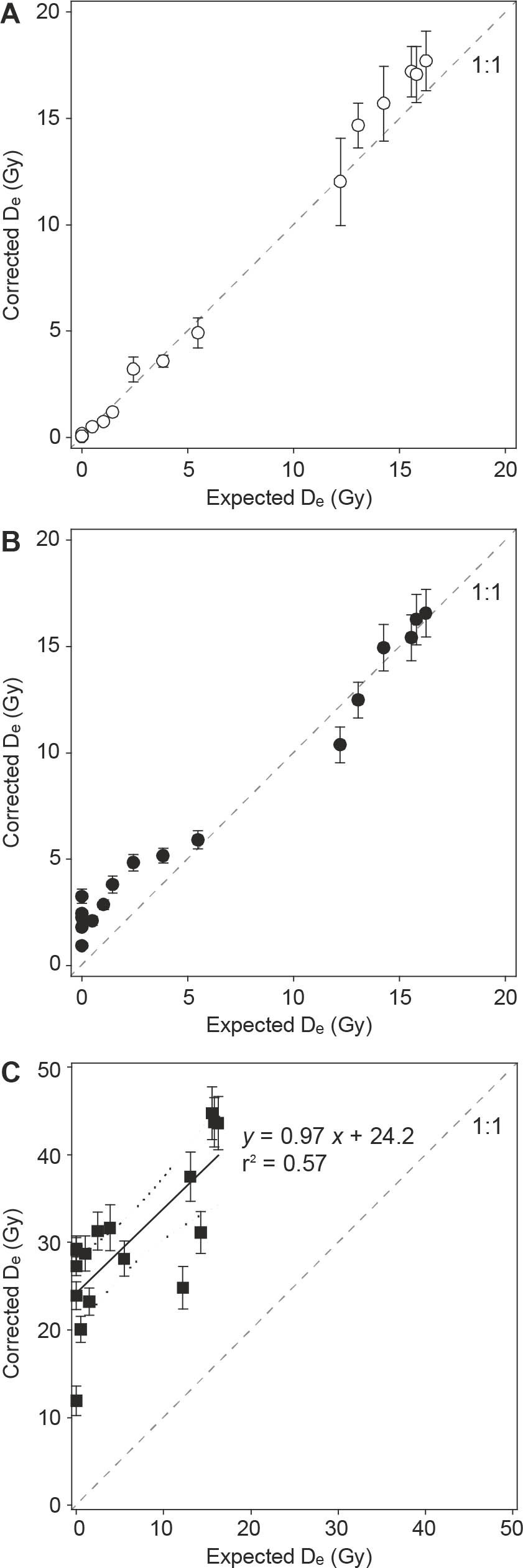
Fig. 6
Plots of fading-corrected De derived from (A) IR50, (B) pIRIR150, and (C) pIRIR290 against expected De. The y-intercept of the regression line for pIRIR290 represents the average residual dose, which is estimated as 24.2 Gy. Dotted lines indicate the 95% confidence interval.
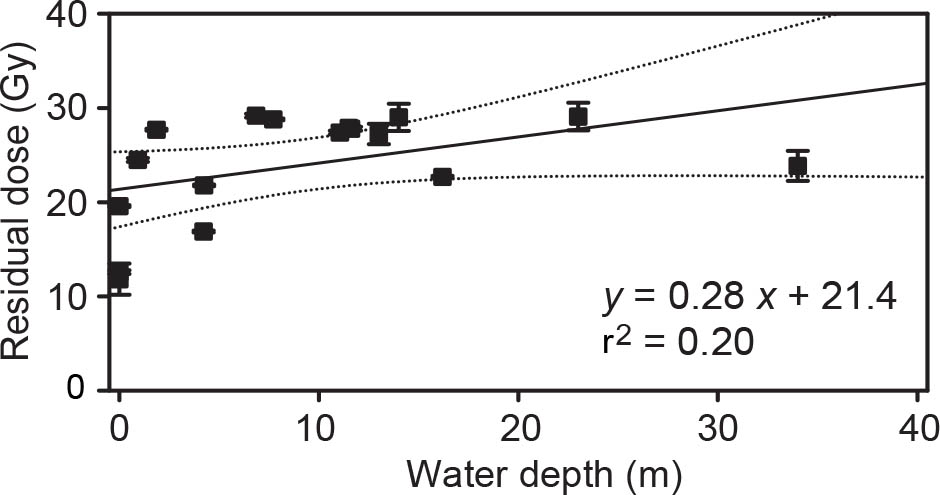
Fig. 7
Plots of residual dose estimated for pIRIR290 against depositional water depth of the sample. The regression line exhibits only a very weak correlation; however, a few samples taken from less than 5 m water depth exhibit slightly lower residual doses than others. Dotted lines indicate the 95% confidence interval.