
Fig 1
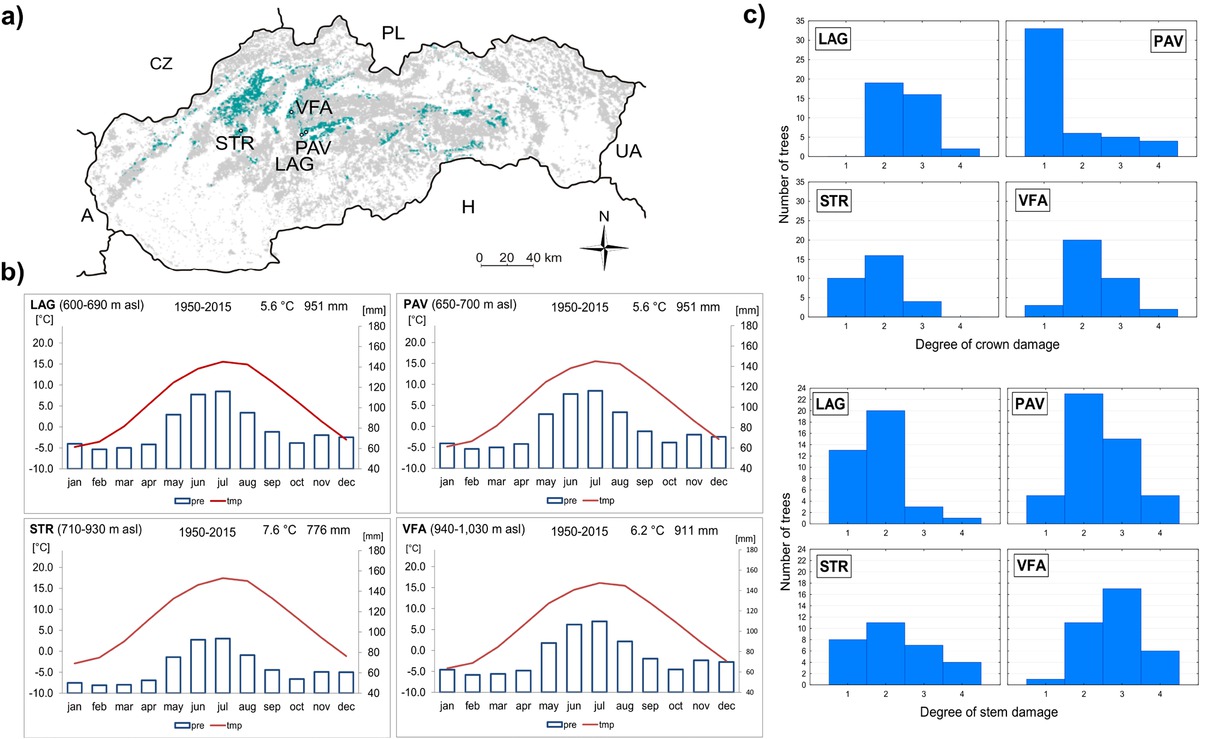
a) Location of the study sites STR (Strazov Mts.), PAV, LAG (Stare Hory Mts.) and VFA (Great Fatra) in Slovakia; b) climate diagrams showing mean monthly courses of temperature and precipitation sums; climate data were derived from KNMI monthly E-OBS 0.25° gridded observations (E-OBS 19.0e); c) number of trees in crown and stem damage classes according to localities.
Table A1
Description of the study sites
| Study area | Lackov Grun | Pavelcovo | Strazov | Velka Fatra |
|---|---|---|---|---|
| Orographic unit | Stare Hory Mts. | Stare Hory Mts. | Strazov Mts | Great Fatra |
| Name | LAG | PAV | STR | VFA |
| Type of management | managed forest with the main protection function—soil erosion, water retention | managed forest with the main wood production function, 7% of plots are special purpose forests with main protection function | 52%—managed forest with the main protection function—soil erosion, water retention 48%—managed forest with the main wood production function | managed forest with the main protection function—soil erosion, water retention, 10%—managed forest with the main wood production function |
| Altitude (m asl) | 603–688 | 640–720 | 710–930 | 940–1,030 |
| Exposition | NE | S, NE | NW–N–NE | NW–N–NE |
| Slope inclination | 20–40° | 10–30° | 25–45° | 20–40° |
| Ground surface | sampling plots had no parent rock present on the surface ground | sampling plots had no parent rock present on the surface ground | 13% of sampling plots had parent rock present on the surface ground | 25% of sampling plots had parent rock present on the surface ground |
| Canopy cover estimation | 0.7–1.0 all plots placed inside the forest stands | 0.7–1.0 57% of plots placed inside the forest stand 43% of plots placed in cut forest where yew trees were present in group of trees of remaining mature stand | 0.4–1.0 83% of plots placed inside the forest stands 17% of plots placed in cut forest where yew trees grow solitary or in small groups of trees | 0.7–1.0 all plots placed inside the forest stands |
| Sign of disturbance (based on stumps being present on the sampling plot) | all plots | all plots except two | all plots | 1/3 of plots were recorded as having no disturbance sign |
| Relief | 93% of plots were established in the middle and upper part of the hill (slope) | except one, all plots were established in the middle and upper part of the hill (slope) | plots were established mainly (74%) in the middle part of the hill (slope) | plots were established in the middle and upper part of the hill (slope) |
| Number of plots | 30 | 30 (13-fieldmapped) | 23 | 31 |
| Size of the plot (m2) | 500 | 500 (one plot—2,500) | 500 (1x300; 2x200) | 500 |
| Radius (m) | 12.62 | 12.62 | 12.62 (1x9.77; 2x7.98) | 12.62 |
| Number of tree species | 13 | 10 | 9 | 9 |
| Year of the sampling | 2017 | 2015 | 2016 | 2017 |
| Disturbance | small scale signs of disturbance—selfthining or windthrow of trees | regeneration cut has begun in forest stands | small scale signs of disturbance—selfthinning 17% of plots—finished regeneration cut | small scale signs of disturbance—selfthining or windthrow of trees 6% of plots—regeneration cut |
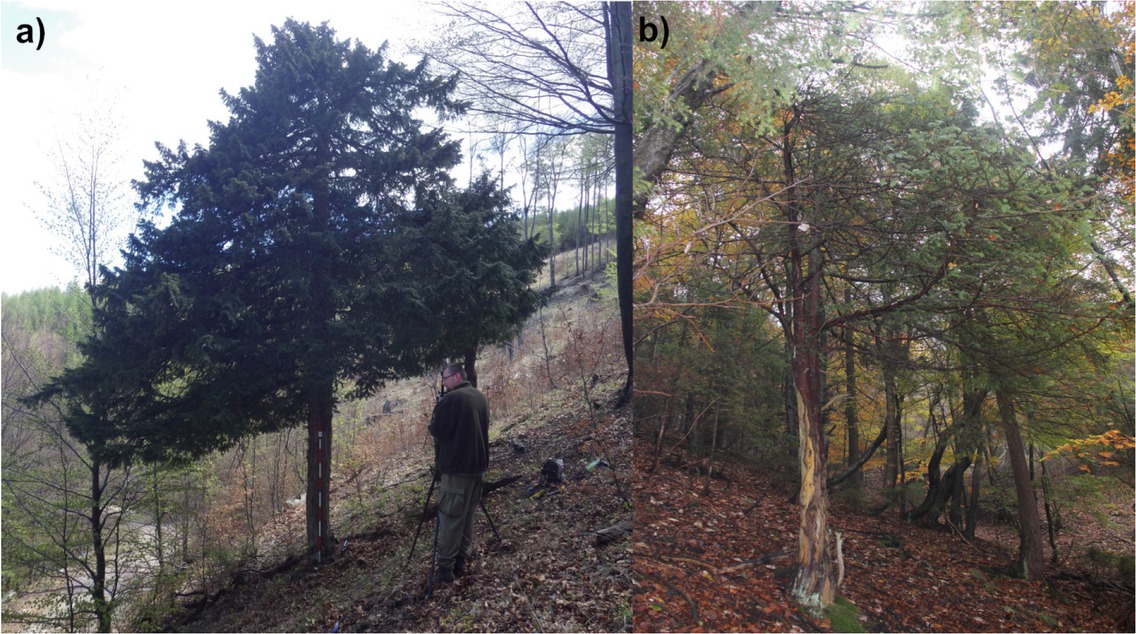
Fig A1
a) Healthy-looking yew with undamaged stem and crown; b) multiple stem, more than 50% of the stem circumference is stripped by deer, crown with transparency of more than 50%.
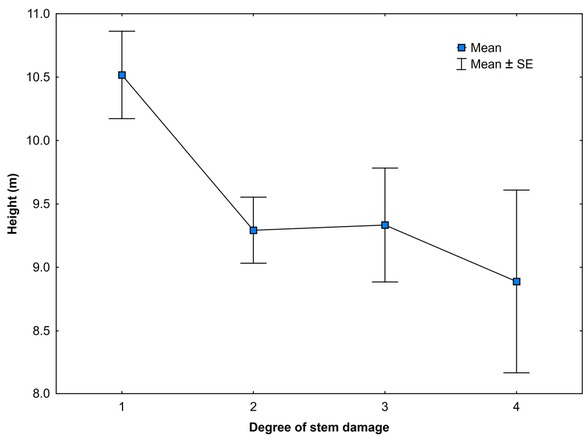
Fig A2
Degree of bark stripping damage related to mean height of yew trees in Slovakia. SE—standard error.
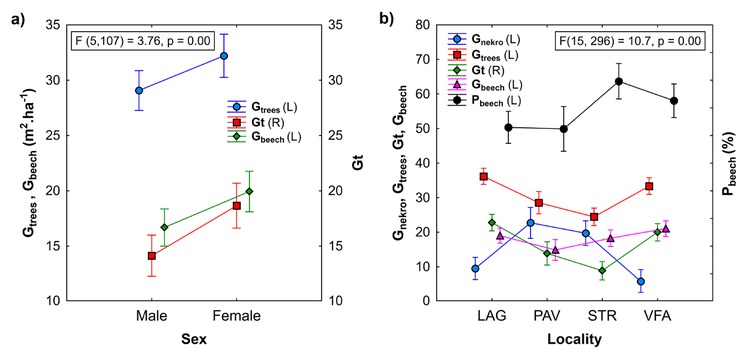
Fig 2
Summarisation of mean values and their differences among a) sex categories (non-significant differences in Gnekro and Pbeech between male and female trees are not displayed) and b) localities of the yew trees in surrounding stand characteristics Gtrees, Gnekro, Gt, Gbeech and Pbeech; Gtrees—basal area of living trees, Gnekro—basal area of standing dead trees and stumps, Gbeech—basal area of living beech trees, Pbeech—proportion of beech, LAG (Lackov Grun), PAV (Pavelcovo), STR (Strazov), VFA (Velka Fatra), L and R—left and right y-axis.
Table 1
Basic description of sampled male and female trees of European yew at four localities in Slovakia
| Locality | Sex | Trees | DBH (cm) | Height (m) | G(cm2) | Crown width (m) | Crown length (m) | Pith age (years) | ||||||
|---|---|---|---|---|---|---|---|---|---|---|---|---|---|---|
| Nt | Mean | SD | Mean | SD | Mean | SD | Mean | SD | Mean | SD | Mean | SD | ||
| LAG | ♂ | 16 | 23.9 | 3.70 | 11.2 | 1.49 | 0.05 | 0.01 | 5.5 | 0.94 | 8.0 | 1.16 | 137 | 33.3 |
| ♀ | 21 | 21.6 | 4.79 | 9.8 | 2.69 | 0.04 | 0.02 | 5.8 | 0.95 | 7.4 | 2.48 | 135 | 22.0 | |
| PAV | ♂ | 27 | 21.1 | 7.14 | 10.1 | 2.07 | 0.02 | 0.02 | 5.1 | 1.37 | 7.1 | 2.05 | 101 | 10.8 |
| ♀ | 21 | 20.3 | 5.64 | 10.6 | 2.33 | 0.02 | 0.02 | 5.0 | 1.25 | 7.6 | 2.31 | 102 | 10.6 | |
| STR | ♂ | 17 | 30.3 | 7.77 | 9.6 | 2.65 | 0.08 | 0.04 | 7.1 | 1.55 | 7.4 | 2.31 | 206 | 33.3 |
| ♀ | 13 | 26.3 | 9.25 | 8.1 | 2.01 | 0.06 | 0.05 | 6.2 | 1.30 | 5.7 | 1.89 | 223 | 11.8 | |
| VFA | ♂ | 18 | 26.1 | 7.99 | 9.3 | 2.24 | 0.06 | 0.03 | 5.0 | 1.12 | 7.1 | 2.14 | 187 | 52.9 |
| ♀ | 15 | 21.6 | 4.52 | 7.7 | 1.15 | 0.04 | 0.02 | 4.8 | 0.94 | 5.3 | 1.27 | 199 | 35.7 | |
| ○ | 2 | 27.0 | 4.17 | 8.8 | 0.78 | 0.06 | 0.02 | 4.7 | 0.40 | 6.2 | 1.06 | 235 | 5.0 | |
| ALL | 150 | 23.6 | 7.12 | 9.7 | 2.34 | 0.04 | 0.03 | 5.5 | 1.37 | 7.0 | 2.15 | 154 | 53.9 | |
[i] ♂—male, ♀—female, ○—undetermined, DBH—tree diameter at breast height (1.3 m above ground), G—tree basal area, Nt—number of sampled trees, SD—standard deviation, PAV—Pavelcovo; LAG—Lackov Grun; STR—Strazov; and VFA—Velka Fatra
Table A2
Results of ANOVA showing summary of all effects (locality and sex) of trees in stand characteristics Gtrees, Gnekro, Gt, Gbeech and Pbeech surrounding focal yew trees
| Gnekro (m2ha-1) | Gtrees (m2ha-1) | Gt | |||||||||||
|---|---|---|---|---|---|---|---|---|---|---|---|---|---|
| Effect | Df | SS | MS | F | p | SS | MS | F | p | SS | MS | F | p |
| Intercept | 1 | 23229 | 23229 | 251 | 0.00 | 103581 | 103581 | 2101 | 0.00 | 29759 | 29759 | 575 | 0.00 |
| Locality | 3 | 5299 | 1766 | 19.07 | 0.00 | 2551 | 850 | 17.2 | 0.00 | 3690 | 1230 | 23.8 | 0.00 |
| Sex | 1 | 0.21 | 0.21 | 0.0 | 0.96 | 224 | 224 | 4.5 | 0.04 | 579 | 579 | 11.2 | 0.00 |
| Error | 114 | 10557 | 92.6 | 5619 | 49.3 | 5900 | 51.7 | ||||||
| Total | 118 | 15882 | 8567 | 10485 | |||||||||
| GBeech (m2ha-1) | PBeech (%) | ||||||||||||
| Effect | Df | SS | MS | F | p | SS | MS | F | p | ||||
| Intercept | 1 | 36796 | 36796 | 849 | 0.00 | 391216 | 391216 | 1279 | 0.00 | ||||
| Locality | 3 | 466 | 155 | 3.58 | 0.02 | 6059 | 2020 | 6.6 | 0.00 | ||||
| Sex | 1 | 267 | 267 | 6.1 | 0.01 | 168.7 | 169 | 0.55 | 0.46 | ||||
| Error | 114 | 4939 | 43.3 | 34859 | 305.8 | ||||||||
| Total | 118 | 5697 | 40973 | ||||||||||
[i] Gtrees—basal area of living trees, Gnekro—basal area of standing dead trees and stumps, Gbeech—basal area of living beech trees, Pbeech—proportion of beech, significant effects are marked bold, Df—degrees of freedom, SS—sum of squares, MS—mean square, F—test criterion, p—level of significance
Table 2
Stand characteristics Gtrees, Gnekro, Gt, Gbeech and Pbeech surrounding central yew trees, their mean values and inter-correlations
| Mean | SD | Gnekro(m2ha-1) | Gtrees(m2ha-1) | Gt | GBeech(m2ha-1) | PBeech (%) | |
|---|---|---|---|---|---|---|---|
| Gnekro | 13.0 | 11.60 | 1.00 | −0.51 | −0.41 | −0.29 | 0.01 |
| Gtrees | 31.1 | 8.50 | −0.51 | 1.00 | 0.62 | 0.67 | 0.04 |
| Gt | 17.0 | 9.36 | −0.41 | 0.62 | 1.00 | 0.44 | 0.06 |
| Gbeech | 18.6 | 6.98 | −0.29 | 0.67 | 0.44 | 1.00 | 0.71 |
| Pbeech | 59.6 | 18.54 | 0.01 | 0.04 | 0.06 | 0.71 | 1.00 |
[i] Gtrees—basal area of living trees, Gnekro—basal area of standing dead trees and stumps, Gbeech—basal area of living beech trees, Pbeech—proportion of beech, SD— standard deviation; significant correlations at p < 0.05 are marked bold
Table A3
Two-way table showing no relationship between stem and crown damage of European yew trees expressed in relative frequencies (Pearson’s chi-square = 15.69; Df = 9; p < 0.07)
| Degree | Stem damage | ||||
|---|---|---|---|---|---|
| Crown transparency | 1 | 2 | 3 | 4 | All |
| 1 | 3.33 | 17.33 | 8.00 | 2.00 | 30.67 |
| 2 | 12.00 | 13.33 | 10.67 | 4.67 | 40.67 |
| 3 | 2.00 | 10.67 | 6.67 | 4.00 | 23.33 |
| 4 | 0.67 | 2.00 | 2.67 | 0.00 | 5.33 |
| All | 18.00 | 43.33 | 28.00 | 10.67 | 100.00 |
[i] Observed frequencies > 7% are marked bold in a two-way table, relative frequencies were calculated from the total number of observations (Nt=150), Df—degrees of freedom, p—level of significance
Table 3
Parameter estimates and goodness-of-fit statistics of the generalised linear regression model applied to test the relationship of stand canopy closure (shading) and crown damage (transparency) of yew adult trees.
| Parameter estimates | |||||||
|---|---|---|---|---|---|---|---|
| Effect | Level of effect | Column | Estimate | SE | p | ||
| Intercept n1 | 1 | 0.11 | 0.36 | 0.77 | 0.77 | ||
| Intercept n2 | 2 | 2.48 | 0.44 | 0.00 | 0.00 | ||
| Intercept n3 | 3 | 4.94 | 0.65 | 0.00 | 0.00 | ||
| Gt | 4 | −30.09 | 0.02 | 0.00 | 0.00 | ||
| Scale | 1.00 | 0.00 | |||||
| Goodness-of-fit statistics | |||||||
| Deviance | Scaled deviance | Pearson’s chi2 | Scaled P. chi2 | AIC | BIC | Loglikelyhood | |
| Df | 359 | 359 | 359 | 359 | |||
| Statistic | 263.04 | 263.04 | 383.01 | 383.01 | 271.04 | 282.23 | −131.52 |
| Stat/Df | 0.73 | 0.73 | 1.07 | 1.07 |
[i] SE—standard error, p—level of significance, Pearson’s chi2—Pearson’s chi-square statistic, AIC—Akaike information criterion, BIC—Bayesian information criterion, Df—degrees of freedom
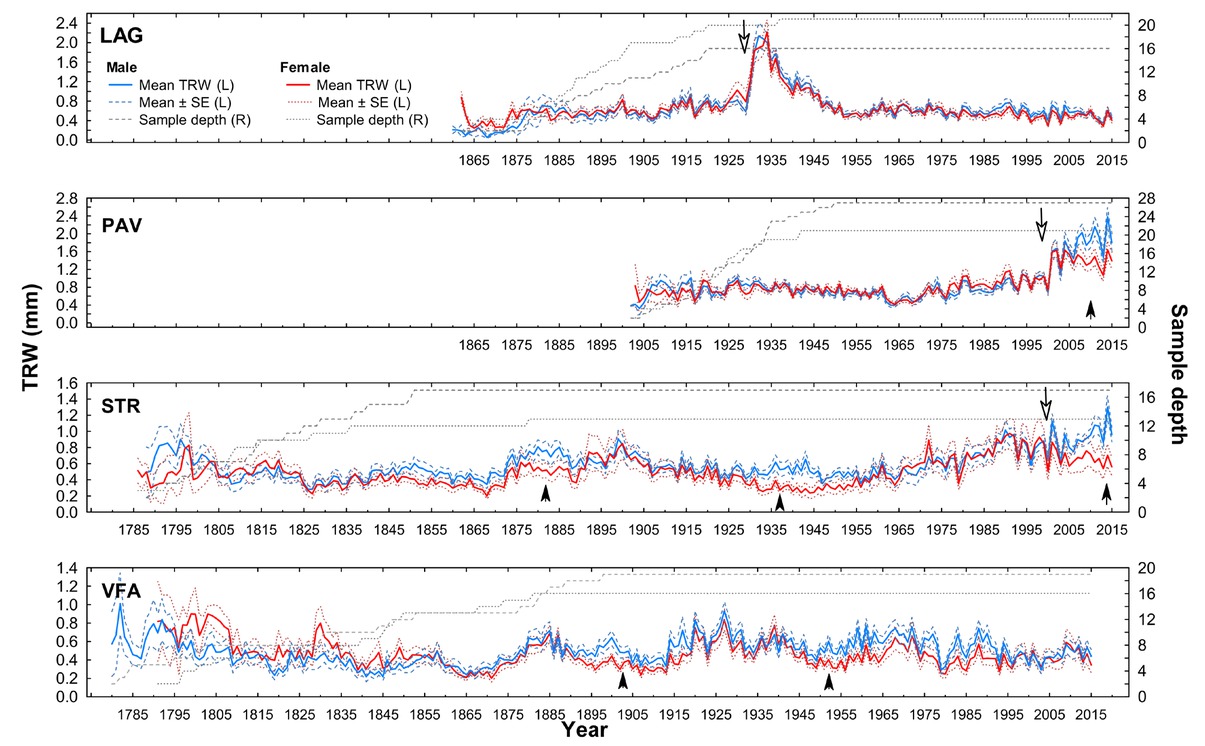
Fig 3
Sex-specific mean raw tree-ring width (TRW) chronologies of yew according to four localities. Dashed (male) and dotted (female) lines on left (L) y-axis denote standard error (SE) of the mean TRW chronology value. Dashed (male) and dotted (female) lines on the right (R) y-axis refer to the number of sampled trees, from which the mean chronology was constructed. LAG (Lackov Grun), PAV (Pavelcovo), STR (Strazov) and VFA (Velka Fatra); black arrows point to significant within-site differences in growth between male and female chronologies (sequences of sex-specific mean chronologies, in which curves of SE do not overlap), white arrows show release as a response to known cutting treatment.
Table 4
Basic statistics of European yew tree-ring series and standardised chronologies for the common periods in four localities of Slovakia
| Locality | Raw series | Standardised chronology | |||||||
|---|---|---|---|---|---|---|---|---|---|
| Time span | Nt | MSL | TRW | SD | MSs | AC1 | RBT | EPS | |
| LAG | 1766-2015 | 37 | 127 | 0.713 | 0.44 | 0.251 | 0.81 | 0.526 | 0.976 |
| PAV | 1897-2015 | 48 | 94 | 0.885 | 0.52 | 0.257 | 0.76 | 0.303 | 0.952 |
| STR | 1782-2015 | 30 | 204 | 0.551 | 0.32 | 0.236 | 0.83 | 0.187 | 0.869 |
| VFA | 1755-2015 | 35 | 185 | 0.495 | 0.27 | 0.270 | 0.88 | 0.224 | 0.967 |
[i] Nt—number of sampled trees, MSL—mean series length, TRW—mean tree-ring width (mm), SD—standard deviation, MSs—mean sensitivity of individual series, AC1— first-order autocorrelation coefficient, RBT—mean correlations between trees, EPS—expressed population signal calculated for the common interval, PAV—Pavelcovo; LAG—Lackov Grun; STR—Strazov; and VFA—Velka Fatra.
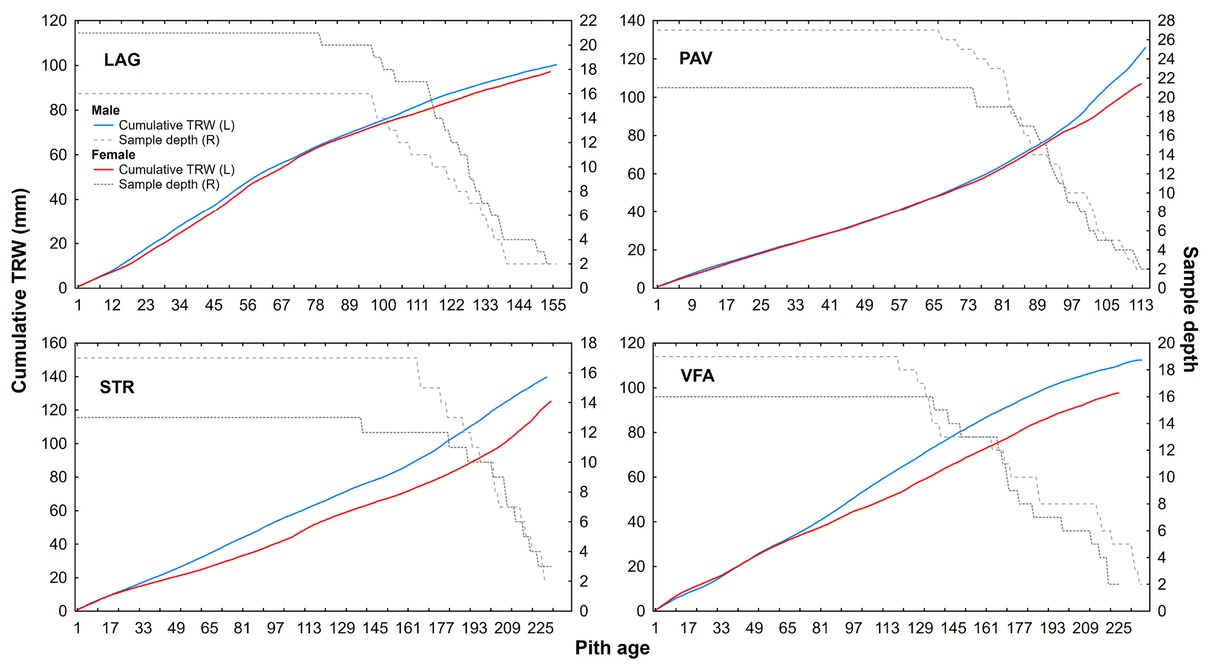
Fig 4
Cumulative radial growth of female (blue line) and male (red line) yew trees according to four localities (L-left y-axis): LAG (Lackov Grun), PAV (Pavelcovo), STR (Strazov) and VFA (Velka Fatra). Number of corresponding averaged male (dashed line) and female (dotted line) trees displayed on the right (R) y-axis.
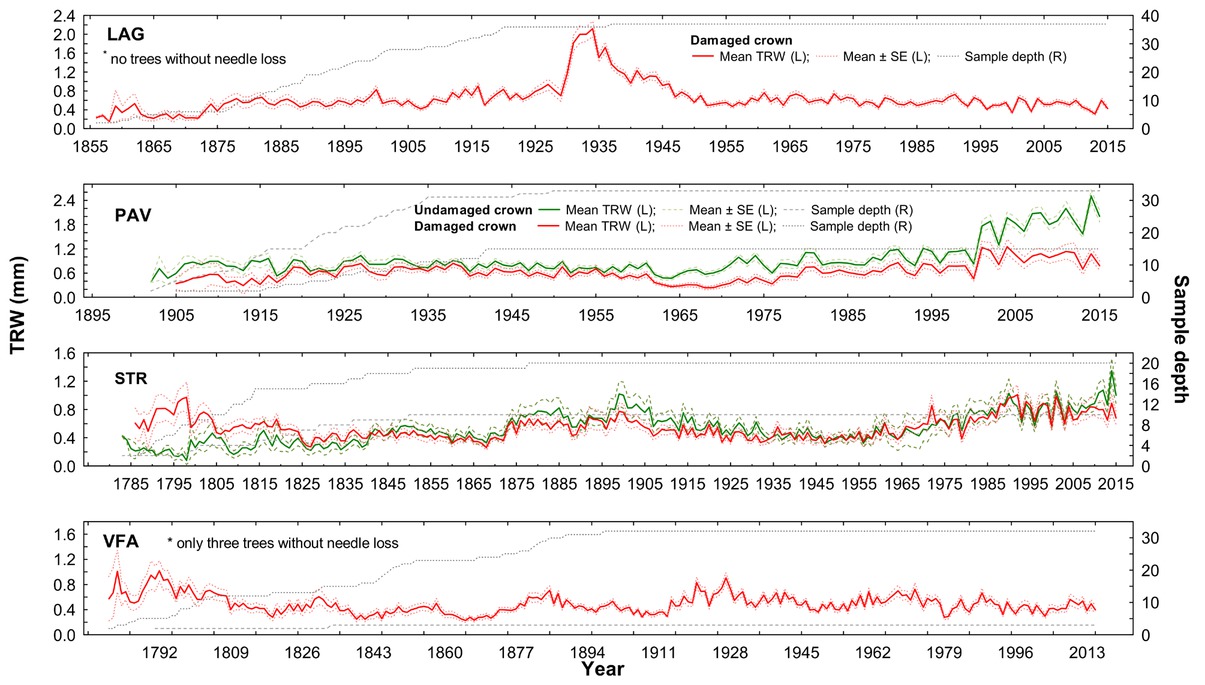
Fig 5
Raw tree-ring width chronologies of damaged/undamaged yew trees according to crown transparency status in four localities: LAG (Lackov Grun), PAV (Pavelcovo), STR (Strazov) and VFA (Velka Fatra). Values of mean TRW (solid lines) and corresponding standard error (dashed line for undamaged and dotted line for damaged trees) are displayed on left (L) y-axis. Right (R) y-axis displays respective values of sampling depth.
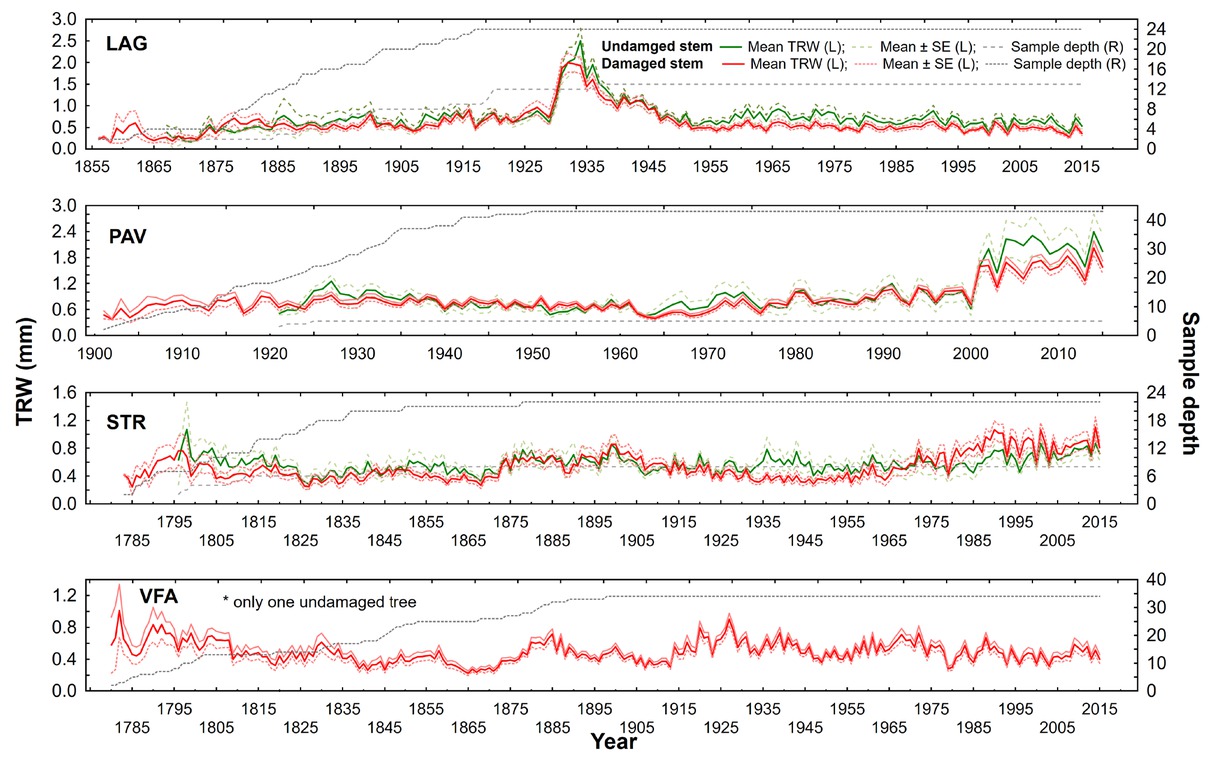
Fig 6
Raw tree-ring width chronologies of damaged/undamaged yew trees according to stem status in four localities: LAG (Lackov Grun), PAV (Pavelcovo), STR (Strazov) and VFA (Velka Fatra). Values of mean TRWs (solid lines) and corresponding standard error (dashed line for undamaged and dotted line for damaged trees) are displayed on left (L) y-axis. Right (R) y-axis displays respective values of sampling depth.
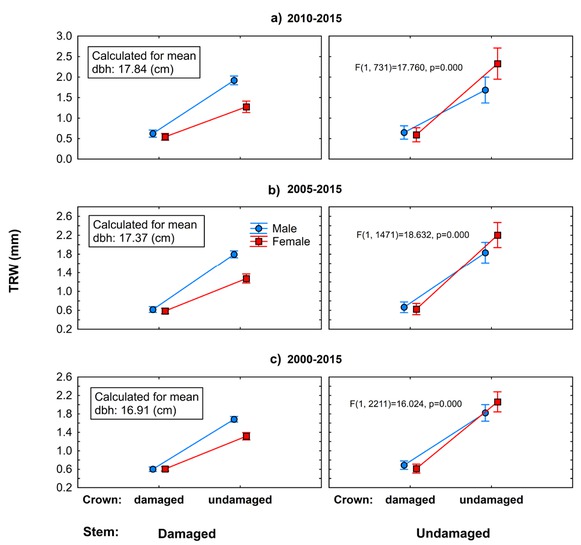
Fig 7
Results of the general linear model, which evaluates interactions of stem and crown damage in relation to yew female and male radial growth in selected periods: a) 2010–2015, b) 2005–2015, c) 2000–2015. Main effect (F) calculated for means of independent continuous variables (DBH). Vertical lines denote 0.95 confidence interval.
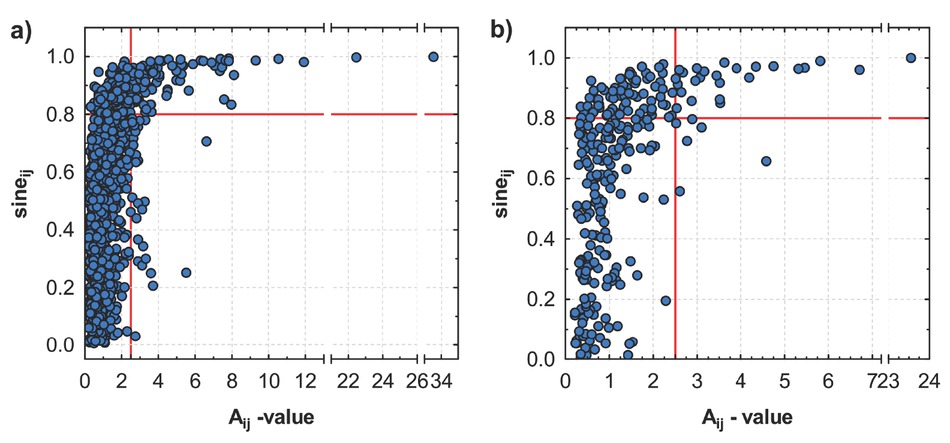
Fig 8
Plotted A-values against the sines of the included angle for all taller neighbours of central yew at localities a) LAG (Lackov Grun) and b) STR (Strazov). For A-value above 2.0, the sine value of the respective angle reaches Gt mainly of more than 0.8, which allows to select the threshold for selective release cutting of trees i in surrounding of the central yew trees j. In the cutting scheme, trees in the right upper corner are marked to be removed.
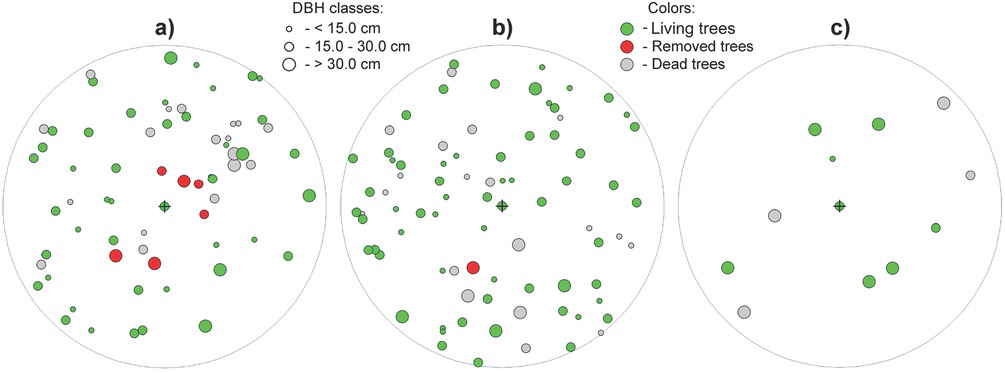
Fig 9
Example of cutting scheme (with cross-marked central yew tree in the middle of the three sampling plots) at localities a, b) LAG (Lackov Grun) and c) STR (Strazov). The set criteria of release cut are A-value = 2.5, Tdist < 0 and sineϑ ≥ 0.8. On two sampling plots at locality Lackov Grun with comparable stand basal area (density) a) G = 37.0 m2ha-1b) G = 38.8 m2ha-1, the intensity of release cut is higher (24.35% from basal area) on the plot a) with unfavourable canopy closure (Gt = 20.15), and on the plot b) with more favourable canopy closure (Gt = 11.91), removal of one neighbouring tree is planned. c) In low stand density (G = 17.2 m2ha-1) and low canopy closure (Gt = 4.78), cutting intervention is not indicated. In the figure, circles refer to position of trees on the sampling plot and their size corresponds to DBH of trees; red colour marks trees to be removed by the release cutting, green colour marks living trees, and grey colour marks of standing dead trees and stumps.