
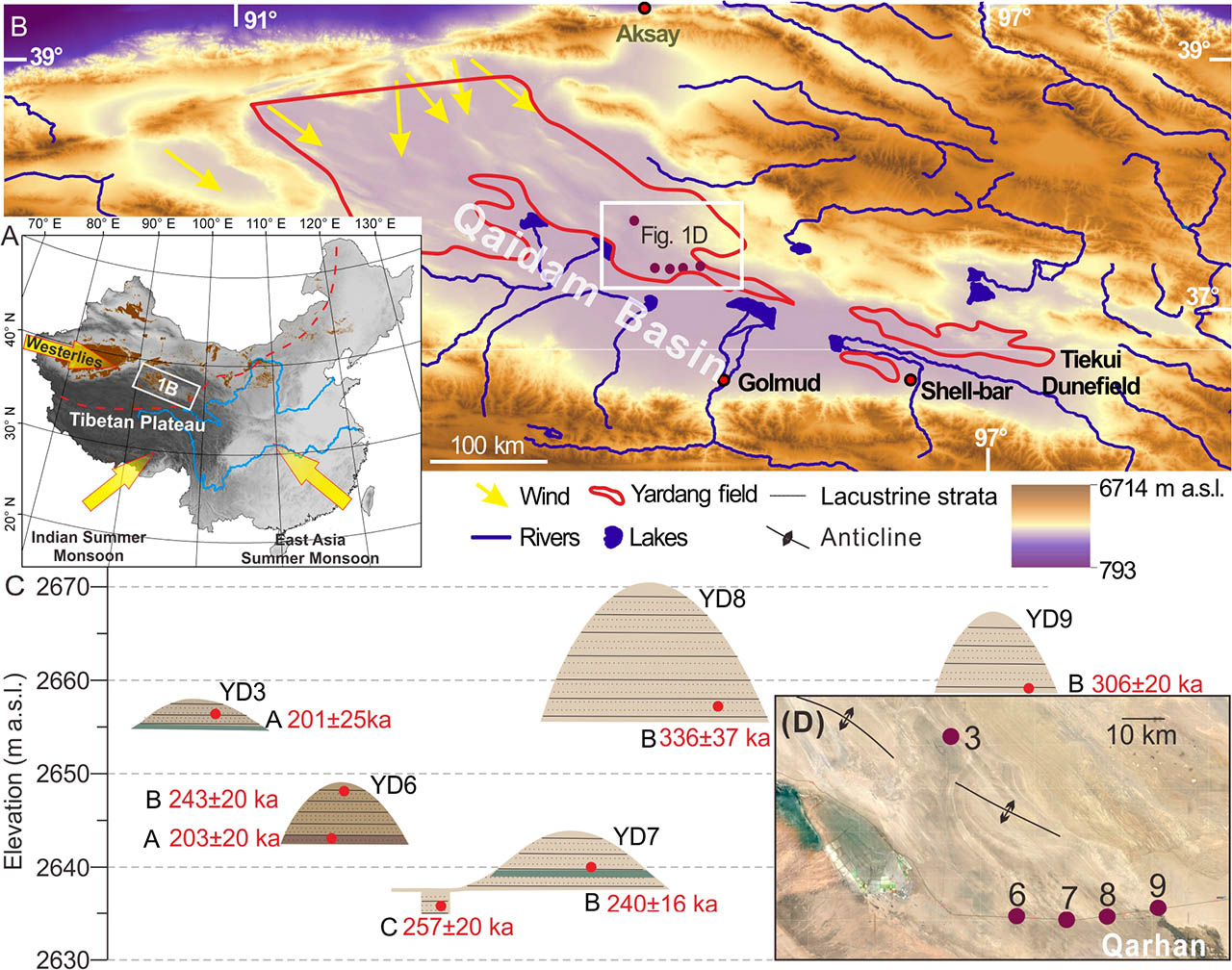
Fig. 1
Landform (A-B) and sampled yardangs (C-D) in the Qaidam Basin. The elevations measured by differential GPS were used in Fig. 1C as it's more accurate.
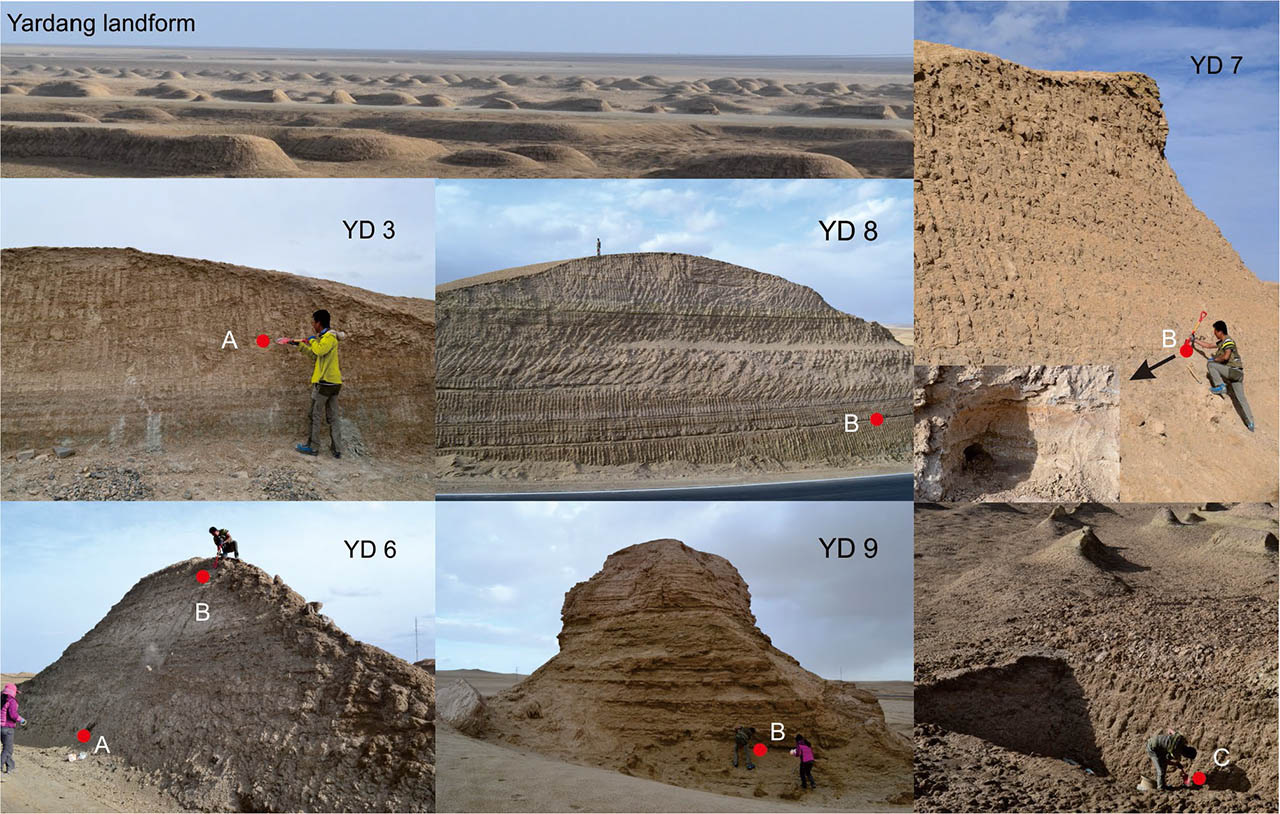
Fig. 2
Yardang landform and sampling sections. The filled red circles denote the positions of sampling.
Table 1
Age results of MET-pIRIR250 with sample informations.
| Sample Lithofacies and structures | Yardang height (m) | Grain size (μm) | Depth (m) | Altitude (m) | Water content (%) | Environmental Dose Rate (Gy·ka−1) | MET-pIRIR250 | ||
|---|---|---|---|---|---|---|---|---|---|
| De (Gy) | Age (ka) | ||||||||
| YD3-A | Gray-brown clay, horizontal stratification | 3 | 4–11 | 1+10 a | 2656 | 15±5 | 5.4±0.6 | 1082±75 | 201±25 |
| YD6-A | Gray-brown sandy clay, horizontal stratification | 5.5 | 63–90 | 5+10 a | 2644 | 15±5 | 4.8±0.3 | 980±55 | 203±20 |
| YD6-B | Gray-brown clay, horizontal stratification | 4–11 | 0.5+10 a | 2648 | 15±5 | 4.1±0.2 | 985±74 | 243±20 | |
| YD7-B | Reddish-brown sandy clay, plane-parallel lamination | 6 | 150–180 | 4+10 a | 2640 | 15±5 | 2.8±0.1 | 673±37 | 240±16 |
| YD7-C | Clay-bank clay, horizontal stratification | 4–11 | 8+10 a | 2636 | 15±5 | 4.2±0.2 | 1061±75 | 257±20. | |
| YD8-B | Yellow sand, plane-parallel lamination | 15 | 150–180 | 13+10 a | 2658 | 15±5 | 2.7±0.1 | 902.2±92.2 | 336±37 |
| YD9-B | Yellow sand, plane-parallel lamination | 8 | 150–180 | 8+10 a | 2659 | 15±5 | 2.6±0.1 | 790.0±39.5 | 306±20 |
Table 2
Age results of MET-pIRIR250 with sample informations.
| (a) MET-pIRIR250 of Feldspar | (b) pIR50IR250 of Feldspar | |||
|---|---|---|---|---|
| Step | Treatment | Measured | Treatment | Measured |
| 1 | Dose | - | Dose | - |
| 2 | Preheat 320°C for 60 s | - | Preheat 280°C for 60 s | - |
| 3 | IRSL 50°C for 100 s | - | IRSL 50°C for 500 s | - |
| 4 | IRSL 100°C for 100 s | - | IRSL 250°C for 500 s | Lx |
| 5 | IRSL 150°C for 100 s | - | Test dose | - |
| 6 | IRSL 200°C for 100 s | - | Preheat 280°C for 60 s | - |
| 7 | IRSL 250°C for 100 s | Lx | IRSL 50°C for 500 s | - |
| 8 | IRSL 290°C for 100 s | - | IRSL 250°C for 500 s | Tx |
| 9 | Test dose | - | Return to step 1 | |
| 10 | Preheat 320°C for 60 s | - | ||
| 11 | IRSL 50°C for 100 s | - | ||
| 12 | IRSL 100°C for 100 s | - | ||
| 13 | IRSL 150°C for 100 s | - | ||
| 14 | IRSL 200°C for 100 s | - | ||
| 15 | IRSL 250°C for 100 s | Tx | ||
| 16 | IRSL 290°C for 100 s | - | ||
| 17 | IRSL 320°C for 100 s | - | ||
| 18 | Return to step 1 | |||
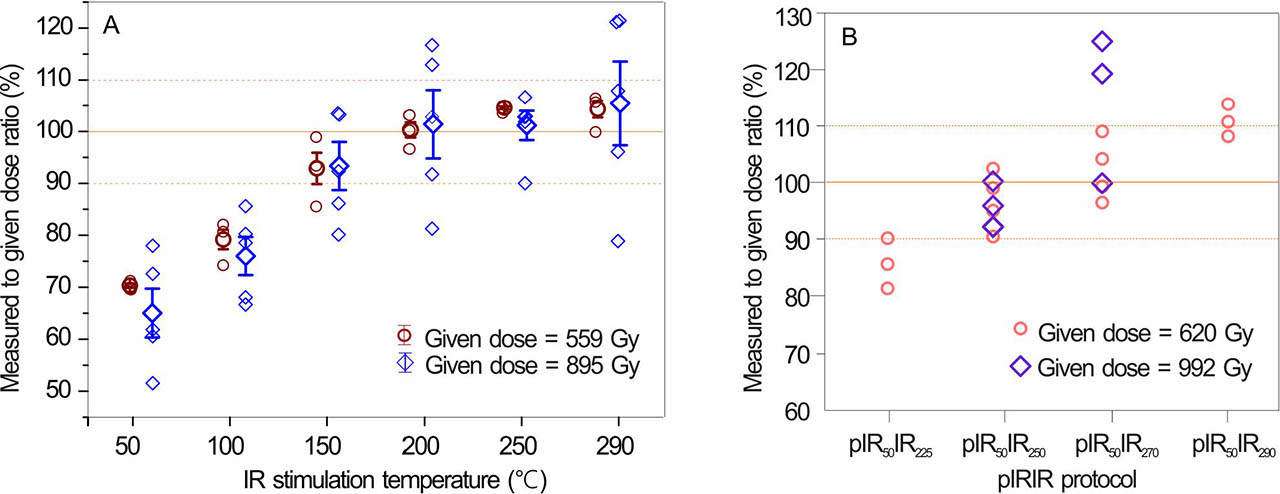
Fig. 3
Dose recovery test for MET-pIRIR protocols (A) and two-step pIRIR protocols (B).
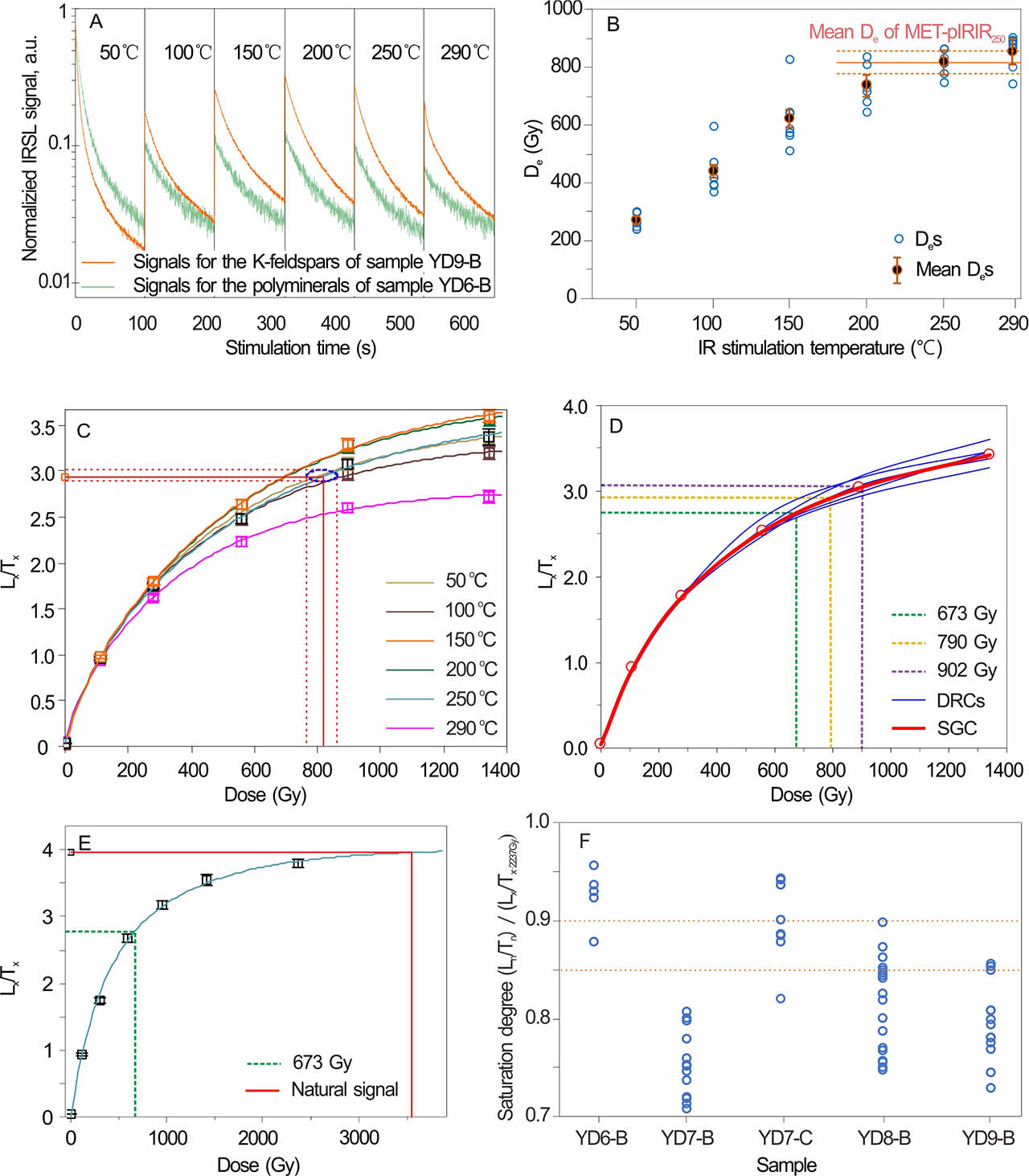
Fig. 4
Luminescence properties of MET-pIRIR signals using the protocol in Table 2a: (A) Decay curves of K-feldspars and polyminerals, (B) Des at different stimulation temperatures and (C) corresponding DRCs for sample YD9-B, (D) DRCs of MET-pIRIR250 signals of sample YD8-B and their SGC. (E) DRC of MET-pIRIR250 signal of sample of field saturation in the QB, using two exponentials function. (F) Saturate ratio. It is expressed by the ratios of (Ln/Tn) (natural signals) and (Ls/Tn), the latter is derived from ~1969 Gy and field saturated dose for fine-grain polyminerals and coarse-grain K-feldspars, respectively (no fine-grain sample of field saturation were collected).
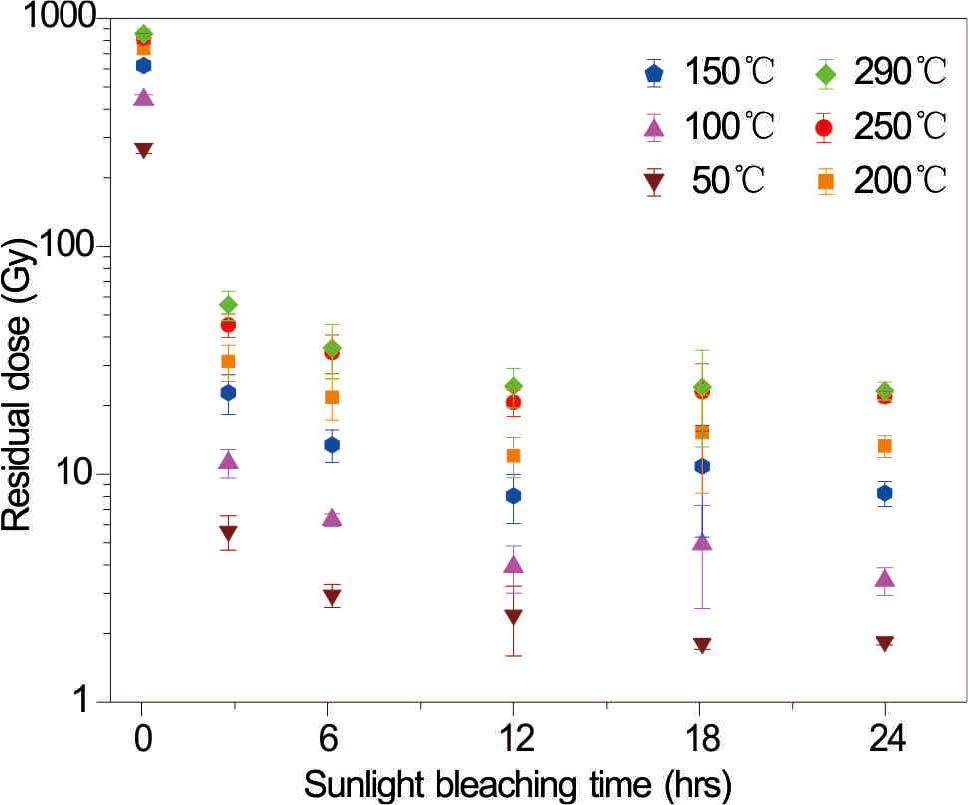
Fig. 5
Residual doses as a function of sunlight bleaching time for the MET-pIRIR signals of sample YD9-B.
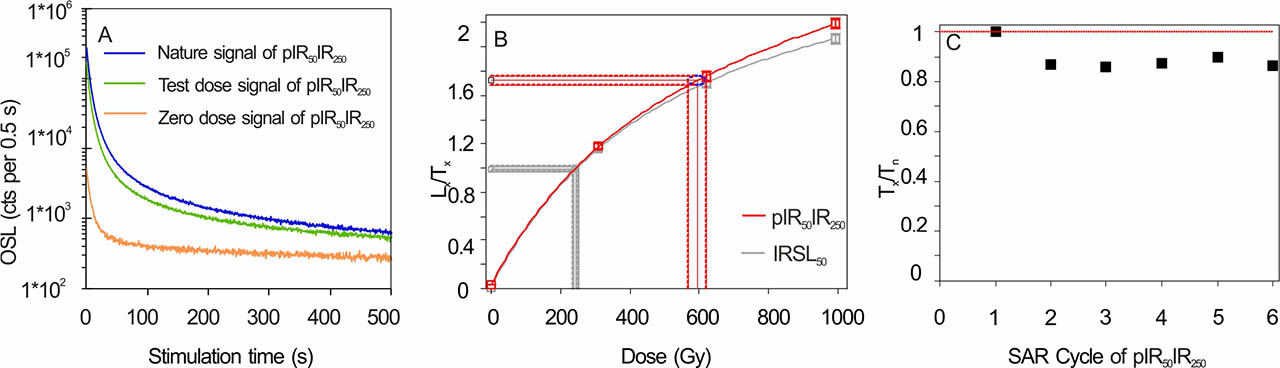
Fig. 6
Luminescence properties of two-step pIRIR signals. (A) Decay curves of IR50IR250 signals, (B) DRCs and natural doses of IRSL50 and IR50IR250, and (C) Sensitivity changes of pIR50IR250 for sample YD9-B.
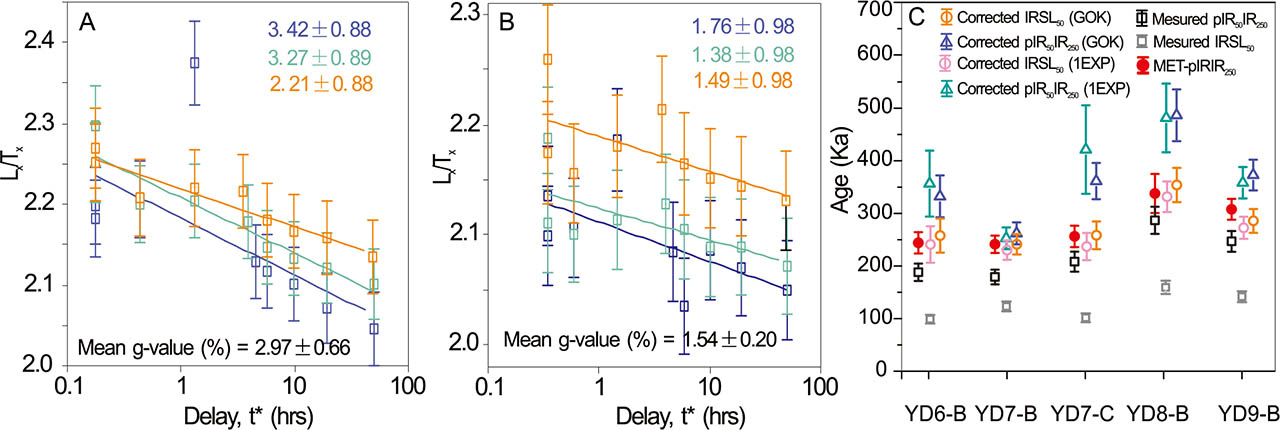
Fig. 7
Fading test of IRSL50 (A) and pIR50IR250 (B) signals of sample YD9-B, and Comparison of multiple age results (C).
Table 3
The results corrected by Huntley (2006) method.
| Function | Sample | IRSL50 | |||||
|---|---|---|---|---|---|---|---|
| (n/N) | (n/N)_SS | Measured Dea (Gy) | Corrected D0b (Gy) | Corrected Dec (Gy) | Corrected Aged (ka) | ||
| 1EXP | YD6-B | 0.54±0.02 | 0.60±0.13 | 397±16 | 372±1 | 973±124 | 240±34 |
| YD7-B | 0.43±0.01 | 0.58±0.14 | 345±11 | 465±1 | 642±29 | 229.0±19 | |
| YD7-C | 0.52±0.02 | 0.59±0.13 | 429±18 | 422±1 | 981±85 | 236±25.8 | |
| YD8-B | 0.48±0.01 | 0.57±0.14 | 427±14 | 479±1 | 886±49 | 330±29 | |
| YD9-B | 0.44±0.01 | 0.59±0.14 | 364±10 | 467±1 | 700±27 | 271±21 | |
| GOK | YD6-B | 0.46±0.02 | 0.60±0.17 | 401±20 | 362±1 | 1040±110 | 256±32 |
| YD7-B | 0.37±0.01 | 0.60±0.16 | 345±12 | 501±2 | 673±30 | 240±19 | |
| YD7-C | 0.34±0.01 | 0.62±0.15 | 423±21 | 463±3 | 1070±82 | 257±26 | |
| YD8-B | 0.40±0.01 | 0.57±0.12 | 428±17 | 494±1 | 945±59 | 352±32 | |
| YD9-B | 0.32±0.01 | 0.59±0.12 | 365±11 | 583±1 | 733±31 | 284±23 | |
| Function | Sample | IR50IR250 | |||||
|---|---|---|---|---|---|---|---|
| (n/N) | (n/N)_SS | Measured Dea (Gy) | Corrected D0b (Gy) | Corrected Dec (Gy) | Corrected Aged (ka) | ||
| 1EXP | YD6-B | 0.72±0.02 | 0.72±0.21 | 716±40 | 439±1 | 1440±2334 | 355±62 |
| YD7-B | 0.57±0.02 | 0.71±0.2 | 491±18 | 483±1 | 705±33 | 252±21 | |
| YD7-C | 0.73±0.02 | 0.72±0.2 | 815±48 | 487±1 | 1744±328 | 419±84 | |
| YD8-B | 0.69±0.02 | 0.71±0.2 | 726±36 | 497±2 | 1286±151 | 480±65 | |
| YD9-B | 0.61±0.02 | 0.71±0.19 | 616±23 | 535±2 | 920±46 | 357±30 | |
| GOK | YD6-B | 0.54±0.02 | 0.72±0.19 | 760±42 | 485±2 | 1342±133 | 331±40 |
| YD7-B | 0.41±0.01 | 0.72±0.22 | 500±20 | 605±3 | 731±32 | 261±21 | |
| YD7-C | 0.31±0.01 | 0.72±0.23 | 862±54 | 800±11 | 1497±102 | 360±34 | |
| YD8-B | 0.52±0.02 | 0.71±0.19 | 766±45 | 549±2 | 1300±98 | 484±49 | |
| YD9-B | 0.24±0.01 | 0.72±0.24 | 633±28 | 1170±26 | 957±39 | 371±29 | |
a De calculated through measured DRC (King et al., 2018).
b D0 for simulated natural DRC (King et al., 2018).
c De calculated through simulated natural DRC (King et al., 2018).
d Age calculated through simulated natural DRC (King et al., 2018).
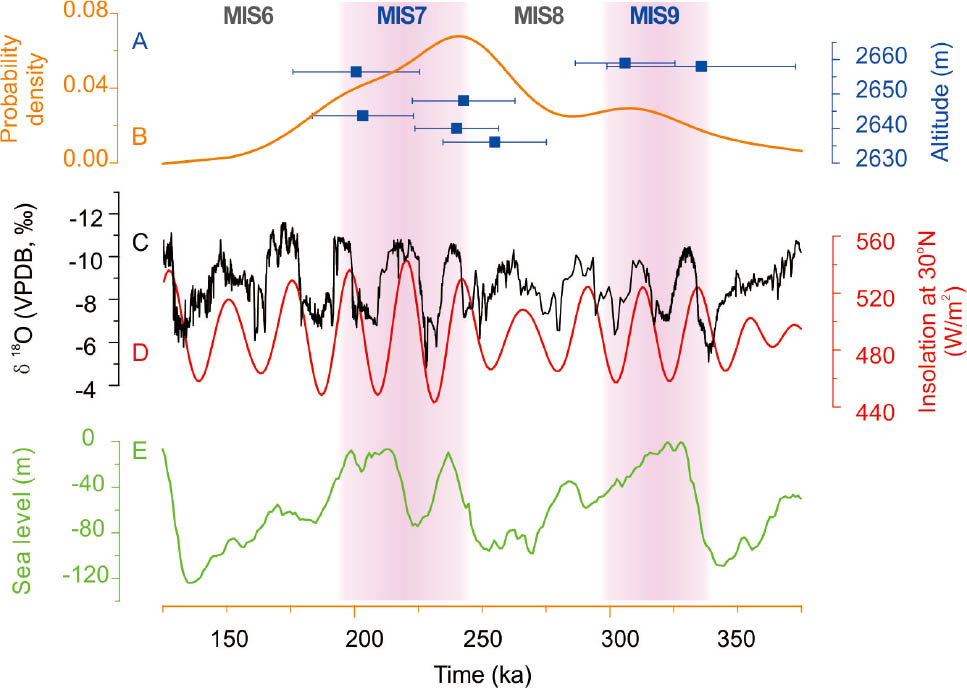
Fig. 8
(A) Scatter diagram of lacustrine ages against altitudes. (B) Probability density of lacustrine ages. (C) The composite δ 18O record of stalagmites (Cheng et al., 2016). (D) Insolation at 30° N (Berger and Loutre, 1991). (E) Composite sea level stack (Spratt and Lisiecki, 2016).