
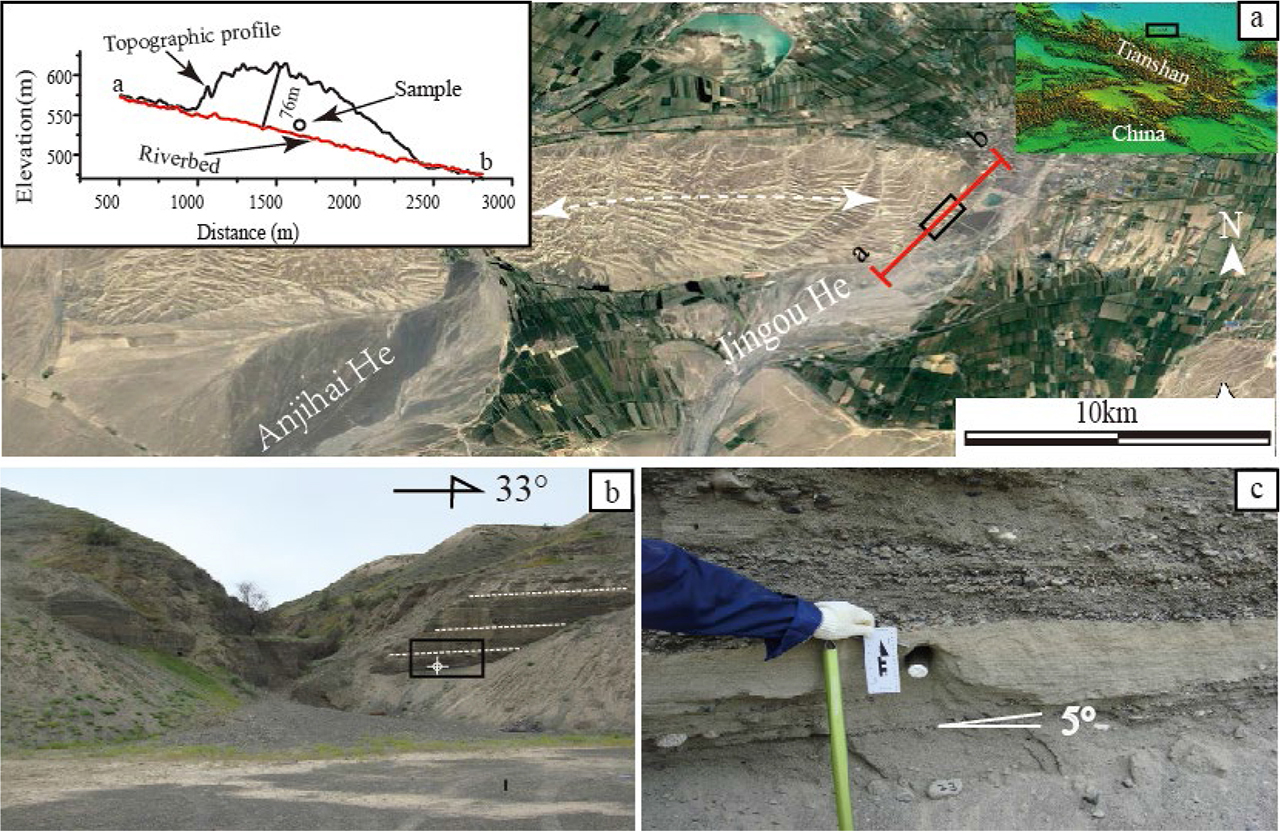
Fig. 1
Sampling site at the eastern tip of Anjihai anticline and the lithology. a) Google Earth image of the Anjihai anticline. The black square marks the location of the strata for sampling. The inset is a topographic profile of the eastern tip Anjihai anticline with the sample location; photos shown in b) and c) are the close look of the sampling site and strata.
Table 1
Single-grain pIRIR and multiple-aliquot MET-pIRIR measurements procedures.
| Steps | Single grain pIRIR225 | Single grain pIRIR290 | MAR-MET-pIRIR290 |
|---|---|---|---|
| 1 | Natural or regenerative dose Di | Natural or regenerative dose Di | Natural or regenerative dose Di |
| 2 | PH at 250°C for 60 s | PH at 320°C for 60 s | PH at 320°C for 60 s |
| 3 | IR laser @ 50°C for 1.2 s | IR laser @ 50°C for 1.2 s | IRLED @ 50°C for 100 s |
| 4 | IR laser @ 225°C for 1.2 s | IR laser @ 290°C for 1.2 s | IRLED @ 100°C for 100 s |
| 5 | IRLED @ 225°C for 100 s | IRLED @ 290°C for 100 s | IRLED @ 150°C for 100 s |
| 6 | Test dose | Test dose | IRLED @ 200°C for 100 s |
| 7 | PH at 250°C for 60 s | PH at 320°C for 60 s | IRLED @ 250°C for 100 s |
| 8 | IR laser @ 50°C for 1.2 s | IR laser @ 50°C for 1.2 s | IRLED @ 290°C for 100 s |
| 9 | IR laser @ 225°C for 1.2 s | IR laser @ 290°C for 1.2 s | Test dose |
| 10 | IRLED @ 290°C for 100 s | IRLED @ 325°C for 100 s | PH at 320°C for 60 s |
| 11 | Return to step1 | Return to step1 | IRLED @ 50°C for 100 s |
| 12 | IRLED @ 100°C for 100 s | ||
| 13 | IRLED @ 150°C for 100 s | ||
| 14 | IRLED @ 200°C for 100 s | ||
| 15 | IRLED @ 250°C for 100 s | ||
| 16 | IRLED @ 290°C for 100 s | ||
| 17 | Solar simulator bleach for 4 hrs | ||
| 18 | Normalization dose Dr | ||
| 19 | Run steps 2-16 | ||
| 20 | Return to step1 |
[i] 1) For the natural sample, the given dose Di = 0 Gy
[ii] 2) The same Dr (Dr = 518 Gy) is applied to procedure (c)
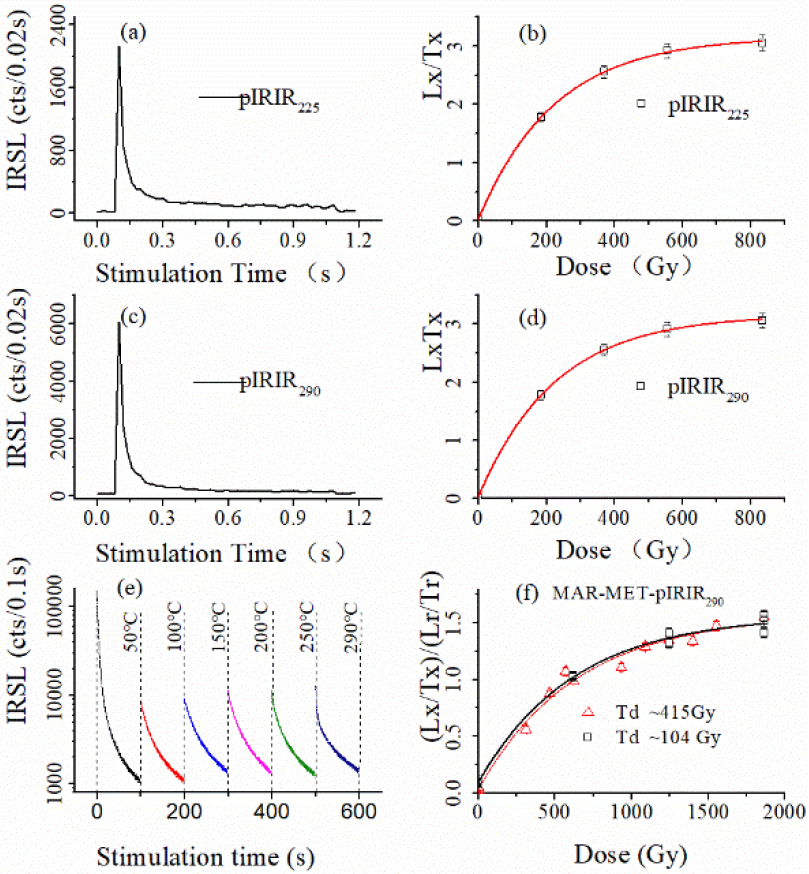
Fig. 2
Typical luminescence decay curves and growth curves of the K-feldspar single grain pIRIR and MAR-MET-pIRIR signals. a) and b) are the decay curve and growth curve of single grain pIRIR225 signal, respectively; c) and d) are the decay curve and growth curve of single grain pIRIR290 signal, respectively; e) MAR-MET-pIRIR decay curves; f) typical growth curves of MAR-MET-pIRIR290 signals. Black line\squares show the growth curve with a test dose of 104 Gy. Red line and triangles show the growth curve with a test dose of 415 Gy.
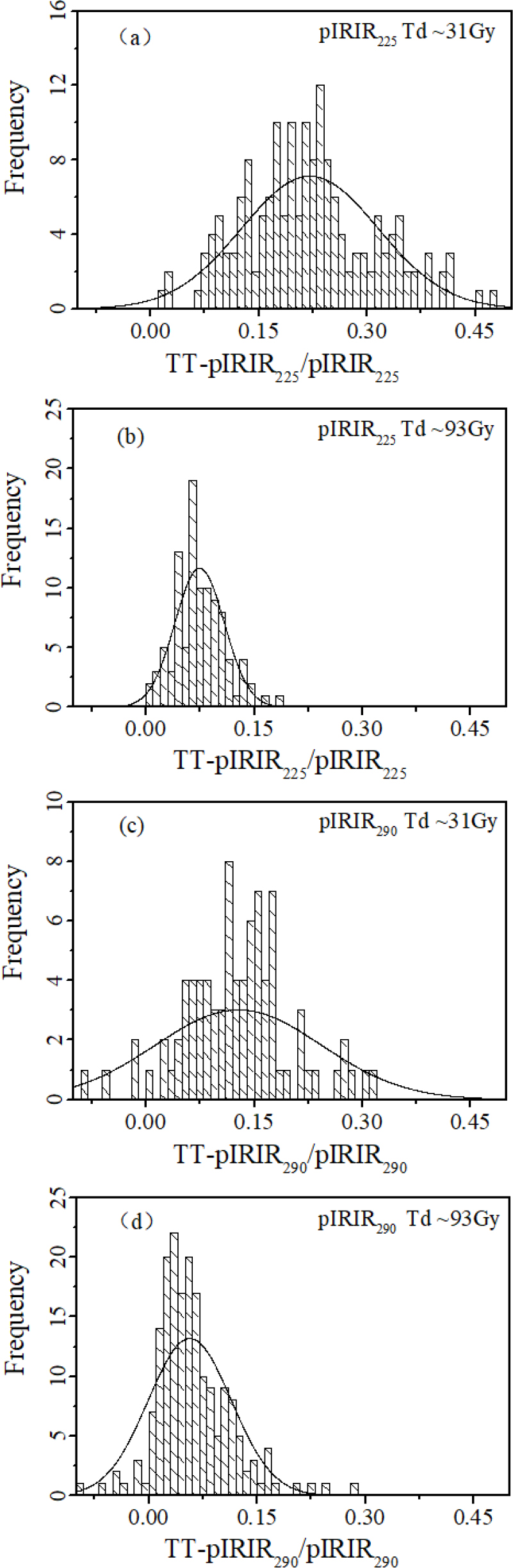
Fig. 3
The frequency distribution of thermal transfer ratios for single grain pIRIR225 and pIRIR290 signals with different test doses. a) and b) pIRIR225 signal with a test dose of 31Gy and 93 Gy, respectively; c) and d) pIRIR290 signal with a test dose 31 Gy and 93 Gy, respectively.
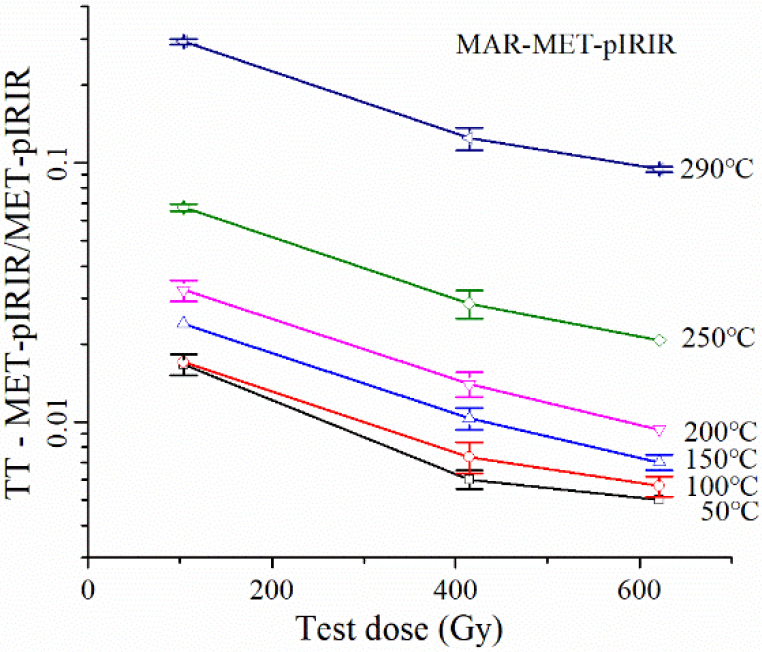
Fig. 4
The dependence of thermal transfer ratios on the test dose. The thermal transfer ratio is evaluated with a test dose of ∼103 Gy, ∼415 Gy and ∼622 Gy for MAR-MET-pIRIR signals, respectively.
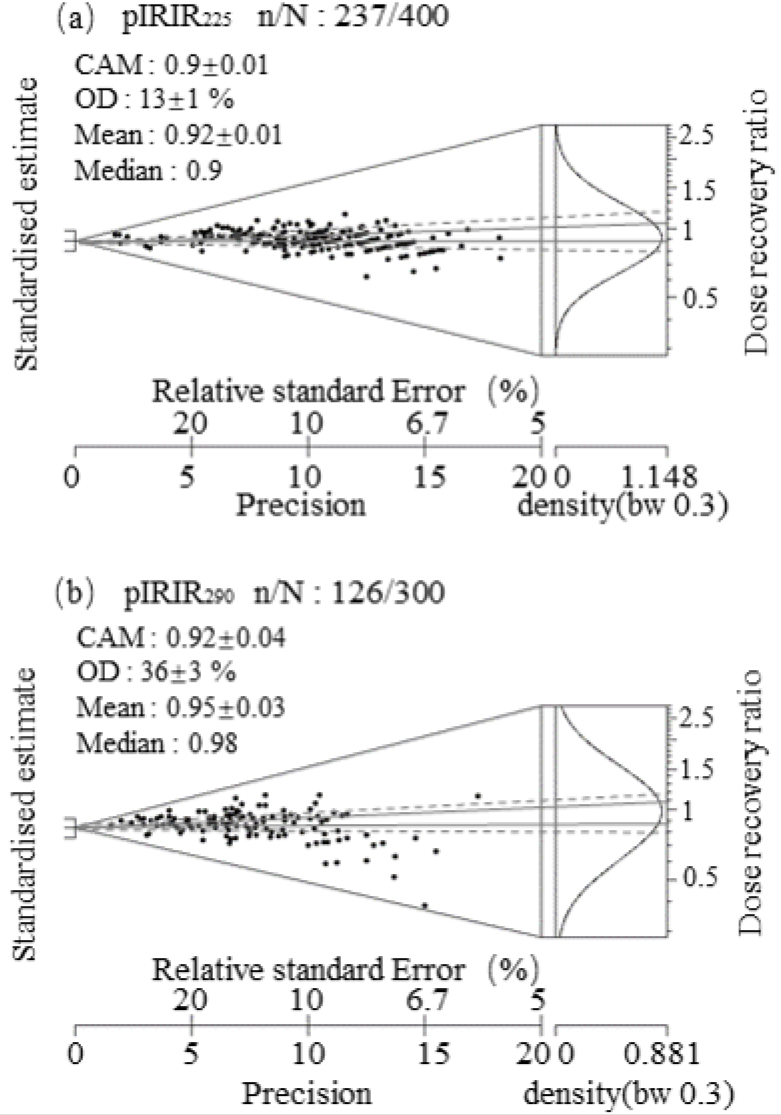
Fig. 5
The abanico plots of dose recovery results with a given dose of ∼556 Gy and test dose ∼93 Gy for single grain pIRIR225 and single grain pIRIR290 procedures. The solid line show the range between 0.9 and 1.1, while the dashed line show the range between 0.8 and 1.2.
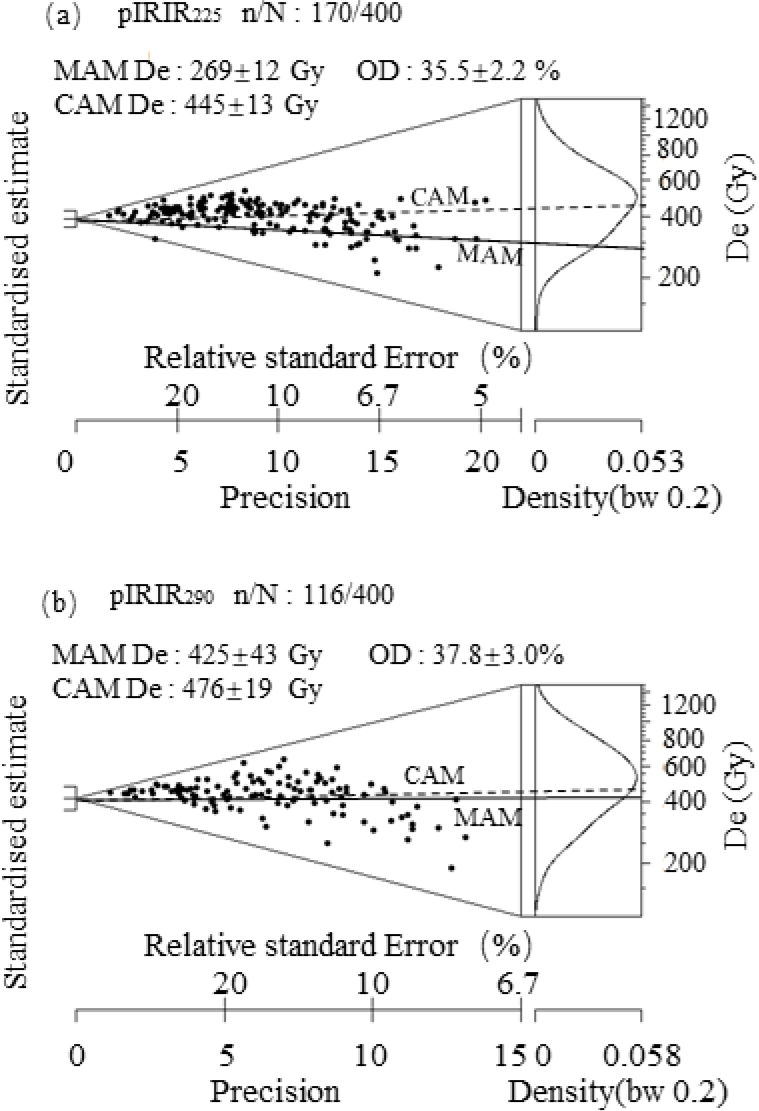
Fig. 6
The abanico plot of De distribution for single grain pIRIR225 and single grain pIRIR290 procedures with a test dose of 93 Gy. MAM De was calculated with sigmab of 0.13 and 0.36 for pIRIR225 and pIRIR290 signals, respectively.
Table 2
The statistics of De values.
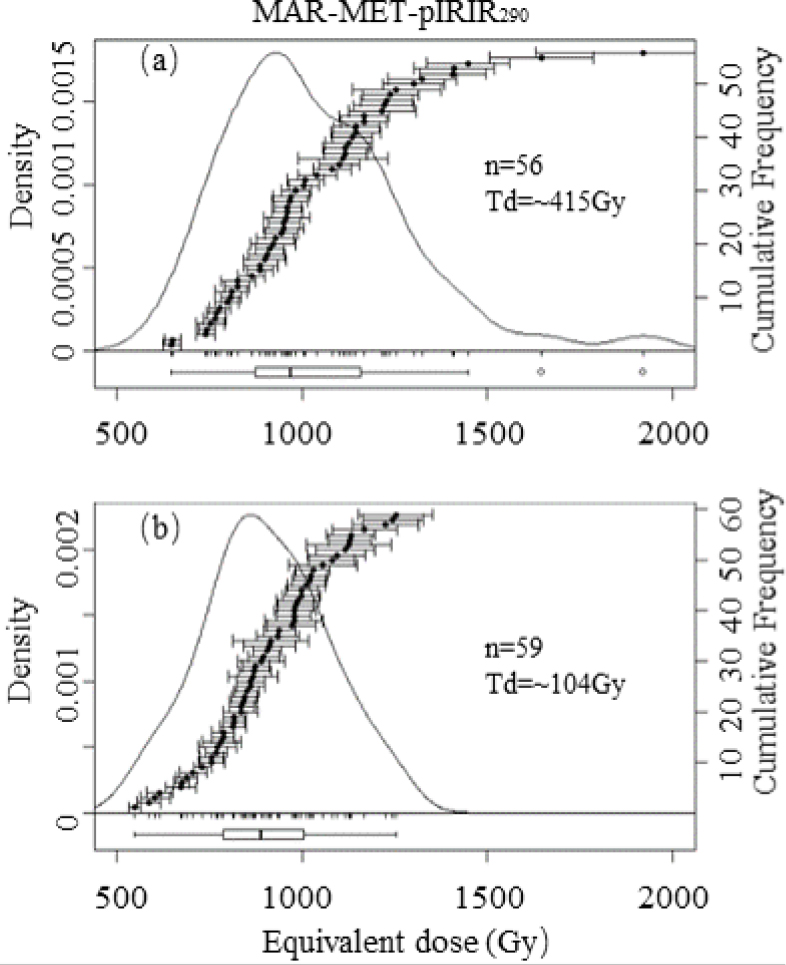
Fig. 7
Kernel density estimate of MAR-MET-pIRIR290 De values. De distributions measured with test dose of ∼415 Gy and ∼104 Gy are shown in a) and b), respectively.
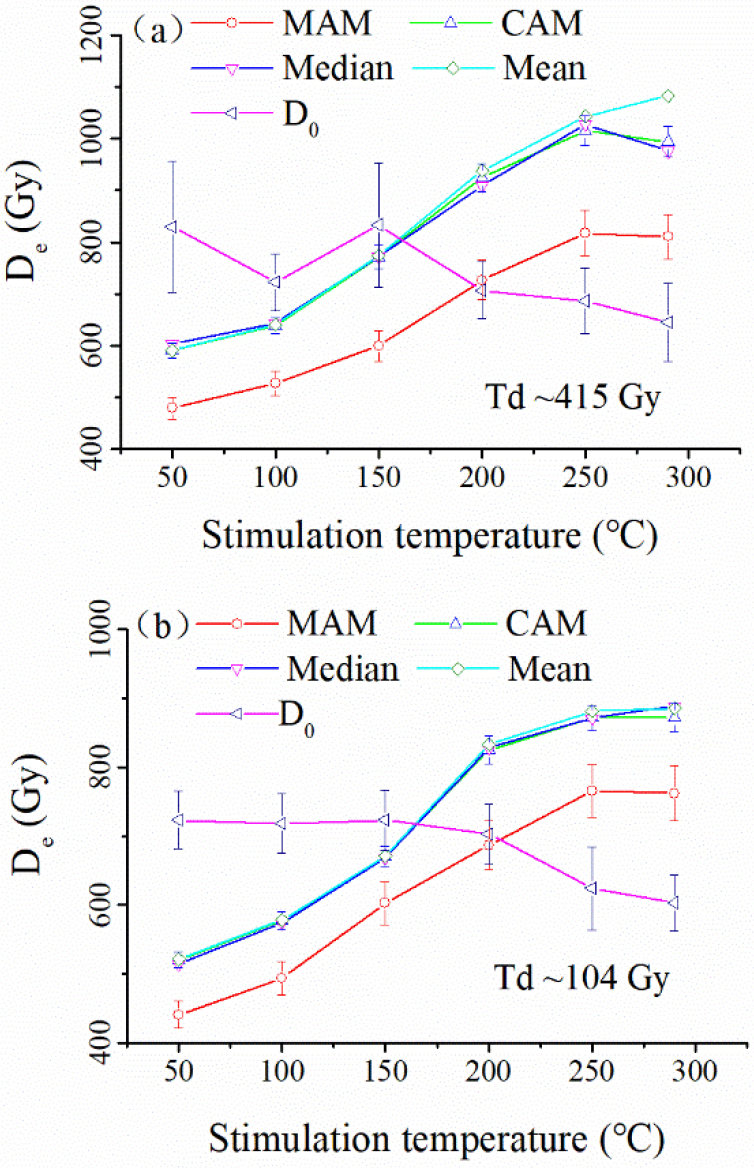
Fig. 8
Dependence of MAR-MET-pIRIR De values on stimulation temperature. a) with a test dose of 415 Gy; b) with a test dose of 104 Gy.
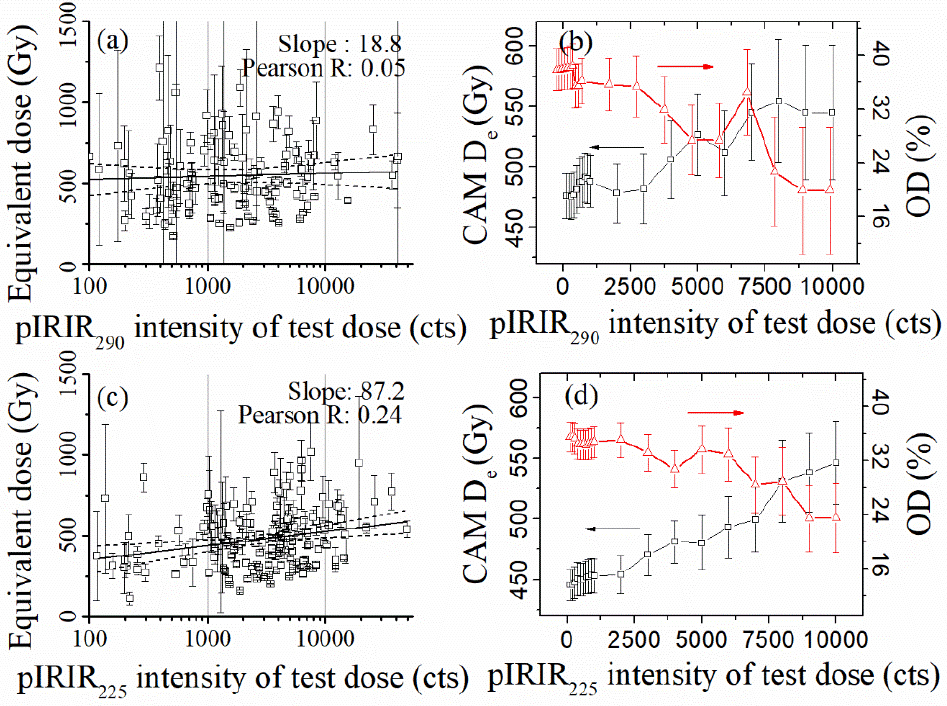
Fig. 9
Dependence of K-feldspar single grain De value on the pIRIR sensitivity (response to a test dose of 93 Gy) a) pIRIR225 and c) pIRIR290 signals. The solid line is linear fit and the dashed line is the 95% confidence band. The dependence of CAM De and OD on the lowest pIRIR sensitivity employed to screen the K-feldspar for analysis are shown in b) and d).
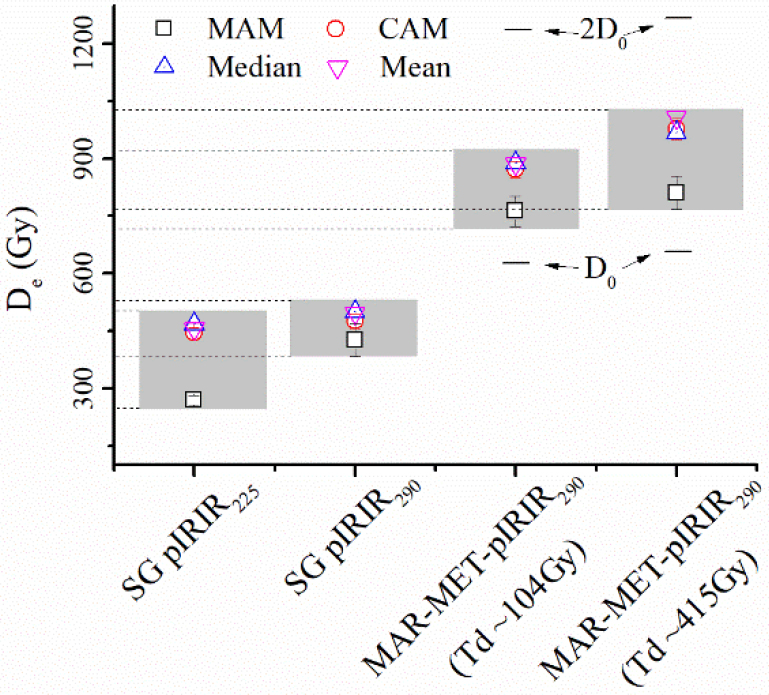
Fig. 10
Comparison of De values obtained by the single grain pIRIR procedures and MAR-MET-pIRIR290 procedures. Various statistical models were applied to the measured De values. The D0 and 2·D0 values are shown for MAR-MET-pIRIR290 procedures with test doses of 104 Gy and 415 Gy, respectively. The shaded region shows the whole range of De values measured with different procedures.