
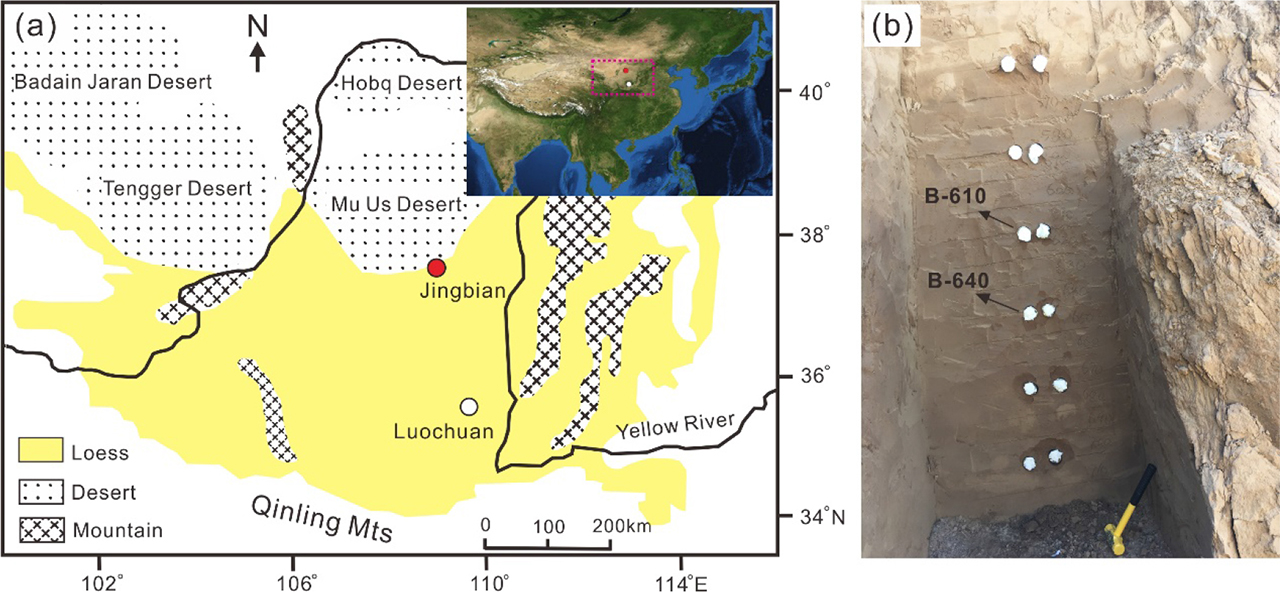
Fig. 1
a) Locations of the Jingbian and Luochuan loess sections. b) Photograph of the sampling of section B at Jingbian.
Table 1
The five post-IR IRSL dating protocols used in this study. The first four are the SAR protocols with pIR50IR290, pIR200IR290, MET-pIRIR250 and MET-pIRIR300 signals, respectively. The fifth is the MAR protocol with the MET-pIRIR300 signal and a ‘cutheat to 500°C’ treatment added before the test dose, simplified as ‘MAR with heat’ (modified from Li et al. (2013)).
| Step | SAR pIR50/200IR290 | SAR MET-pIRIR250/300 | ‘MAR with heat’ | |||
|---|---|---|---|---|---|---|
| Treatment | Observed | Treatment | Observed | Treatment | Observed | |
| 1 | Regenerative dose, Di | Regenerative dose, Di | Regenerative dose, Di | |||
| 2 | Preheat at 320°C, 60 s | Preheat at 300°C or 320°C, 60 s | Preheat at 320°C, 60 s | |||
| 3 | IRSL 200 s at 50/200°C | IRSL 100 s at 50°C | IRSL 100 s at 50°C | |||
| 4 | IRSL 200 s at 290°C | Lx (290) | IRSL 100 s at 100°C | IRSL 100 s at 100°C | ||
| 5 | IRSL 100 s at 150°C | IRSL 100 s at 150°C | ||||
| 6 | IRSL 100 s at 200°C | IRSL 100 s at 200°C | ||||
| 7 | IRSL 100 s at 250°C | Lx (250) | IRSL 100 s at 250°C | |||
| 8 | IRSL 100 s at 300°C or not | Lx (300) | IRSL 100 s at 300°C | Lx (300) | ||
| 9 | Cutheat to 500°C | |||||
| 10 | Test dose, Dt | Test dose, Dt | Test dose, Dt | |||
| 11 | Preheat at 320°C, 60 s | Preheat at 300°C or 320°C, 60 s | Preheat at 320°C, 60 s | |||
| 12 | IRSL 200 s at 50/200°C | IRSL 100 s at 50°C | IRSL 100 s at 50°C | |||
| 13 | IRSL 200 s at 290°C | Tx (290) | IRSL 100 s at 100°C | IRSL 100 s at 100°C | ||
| 14 | IR at 325°C, 200 s | IRSL 100 s at 150°C | IRSL 100 s at 150°C | |||
| 15 | Return to step 1 | IRSL 100 s at 200°C | IRSL 100 s at 200°C | |||
| 16 | IRSL 100 s at 250°C | Tx (250) | IRSL 100 s at 250°C | |||
| 17 | IRSL 100 s at 300°C or not | Tx (300) | IRSL 100 s at 300°C | Tx (300) | ||
| IR at 320 or 325°C, 100 s | ||||||
| Return to step 1 | ||||||
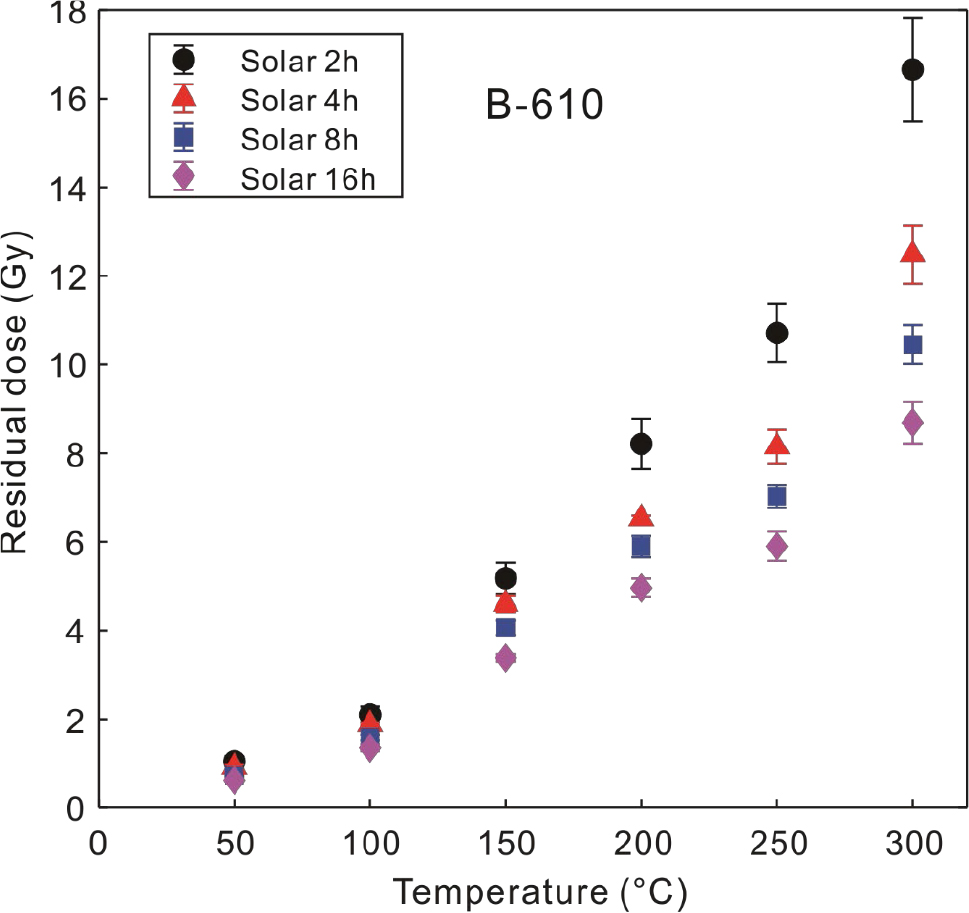
Fig. 2
Residual doses of IRSL signals stimulated at different temperatures using the SAR MET-pIRIR protocol. After 8 hr of bleaching with the solar simulator, the residual doses were reduced to ∼10 Gy for the MET-pIRIR300 signal.
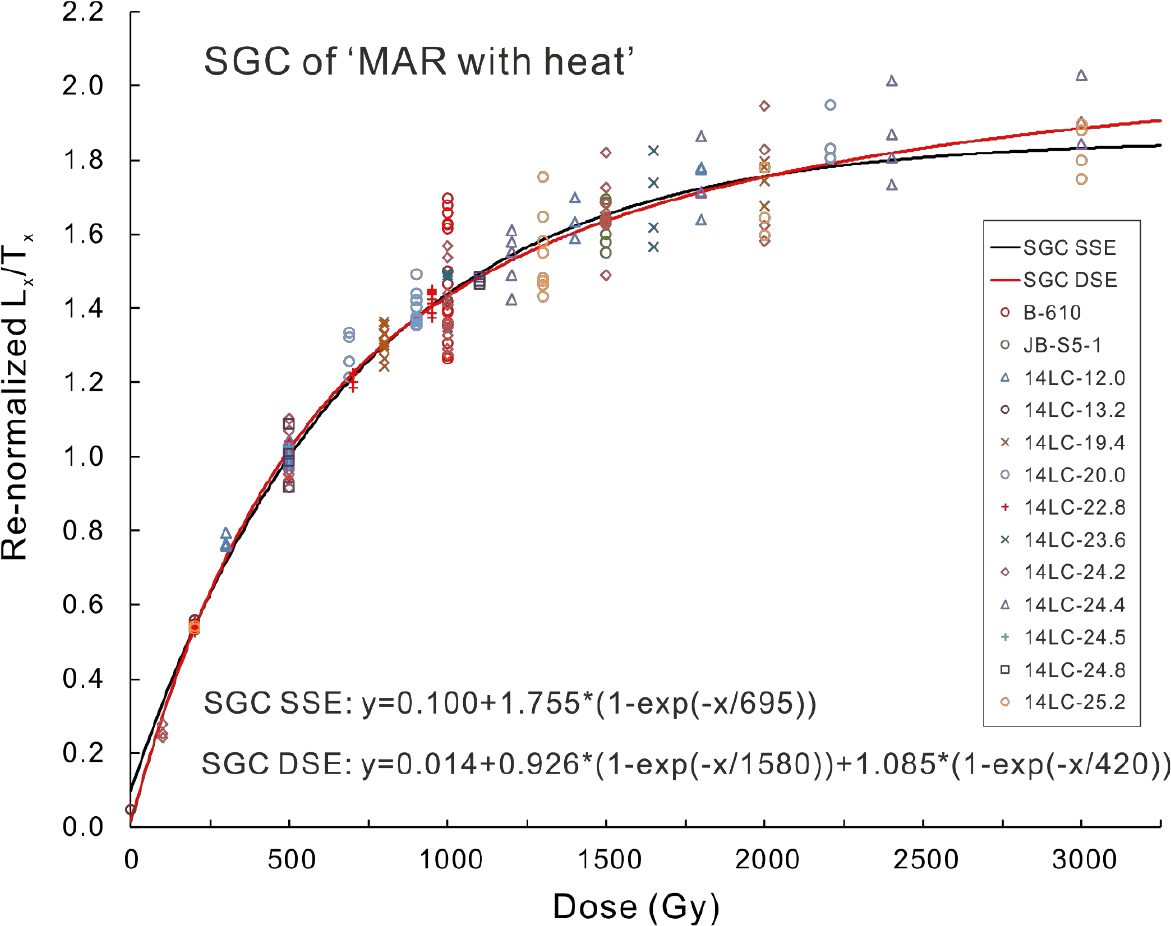
Fig. 3
Standard growth curve (SGC) of the ‘MAR with heat’ protocol. The re-normalisation dose was 500 Gy. SGC curves were fitted with the single saturating exponential (SSE) function: y = y0 + A*(1-exp(-x/D0)) and the double saturating exponential (DSE) function: y = y0 + A1*(1-exp(-x/D1)) + A2*(1-exp(-x/D2)), respectively. The fitted results are shown in the graph. Note that the two SGCs only begin to diverge when the dose exceeds 2000 Gy.
Table 2
De values obtained using the five protocols. In the ‘MAR with heat’ protocol, the first ‘n’ indicates the aliquots used to measure the natural signal, and the second refers to the aliquots used to measure the signal of a regenerative dose.
| Sample | Depth (cm) | SAR pIR50IR290 | SAR pIR200IR290 | SAR MET-pIRIR250 | SAR MET-pIRIR300 | MAR with heat | |||||
|---|---|---|---|---|---|---|---|---|---|---|---|
| De ± σ | n | De ± σ | n | De ± σ | n | De ± σ | n | De ± σ | n | ||
| A-570 | 570 | 373 ± 35 | 7 | 424 ± 11 | 19 | 415 ± 9 | 15 | \ | \ | 381 ± 11 | 12;12 |
| A-1050 | 1050 | 615 ± 54 | 7 | 706 ± 34 | 8 | 706 ± 17 | 8 | \ | \ | 747 ± 53 | 16;8 |
| B-0 | 220 | 543 ± 17 | 6 | 673 ± 57 | 4 | 640 ± 13 | 8 | 712 ± 57 | 6 | 856 ± 73 | 24;14 |
| B-610 | 830 | 652 ± 20 | 10 | 734 ± 21 | 14 | 753 ± 17 | 9 | 773 ± 45 | 6 | 925 ± 62 | 24;20 |
| B-640 | 860 | 613 ± 51 | 6 | 741 ± 18 | 9 | 773 ± 22 | 7 | 749 ± 57 | 6 | 901 ± 51 | 14;10 |
| B-1000 | 1190 | 649 ± 61 | 6 | 822 ± 35 | 5 | 762 ± 25 | 7 | 800 ± 47 | 6 | 897 ± 71 | 24;20 |
Table 3
Dose rates and ages of the samples using the five protocols.
| Sample | Water (%) | K20 (%) | Alpha count | Dose rate (Gy/ka) | Age (ka) | ||||
|---|---|---|---|---|---|---|---|---|---|
| SAR pIR50IR290 | SAR pIR200IR290 | SAR MET-pIRIR250 | SAR MET-pIRIR300 | MAR with heat | |||||
| A-570 | 15 ± 5 | 2.03 | 9.55 ± 0.15 | 3.21 ± 0.12 | 116 ± 12 | 132 ± 6 | 129 ± 6 | \ | 119 ± 6 |
| A-1050 | 15 ± 5 | 2.19 | 10.83 ± 0.16 | 3.44 ± 0.13 | 179 ± 17 | 206 ± 13 | 206 ± 9 | \ | 217 ± 17 |
| B-0 | 15 ± 5 | 1.95 | 10.14 ± 0.18 | 3.30 ± 0.12 | 165 ± 8 | 204 ± 19 | 194 ± 8 | 216 ± 19 | 260 ± 24 |
| B-610 | 19.3 ± 5 | 2.50 | 11.88 ± 0.19 | 3.55 ± 0.13 | 183 ± 9 | 206 ± 10 | 212 ± 9 | 217 ± 15 | 260 ± 20 |
| B-640 | 19.3 ± 5 | 2.40 | 11.85 ± 0.19 | 3.59 ± 0.13 | 171 ± 16 | 206 ± 9 | 215 ± 10 | 209 ± 18 | 251 ± 17 |
| B-1000 | 15 ± 5 | 2.22 | 10.74 ± 0.18 | 3.43 ± 0.13 | 189 ± 19 | 240 ± 14 | 222 ± 11 | 233 ± 16 | 261 ± 23 |
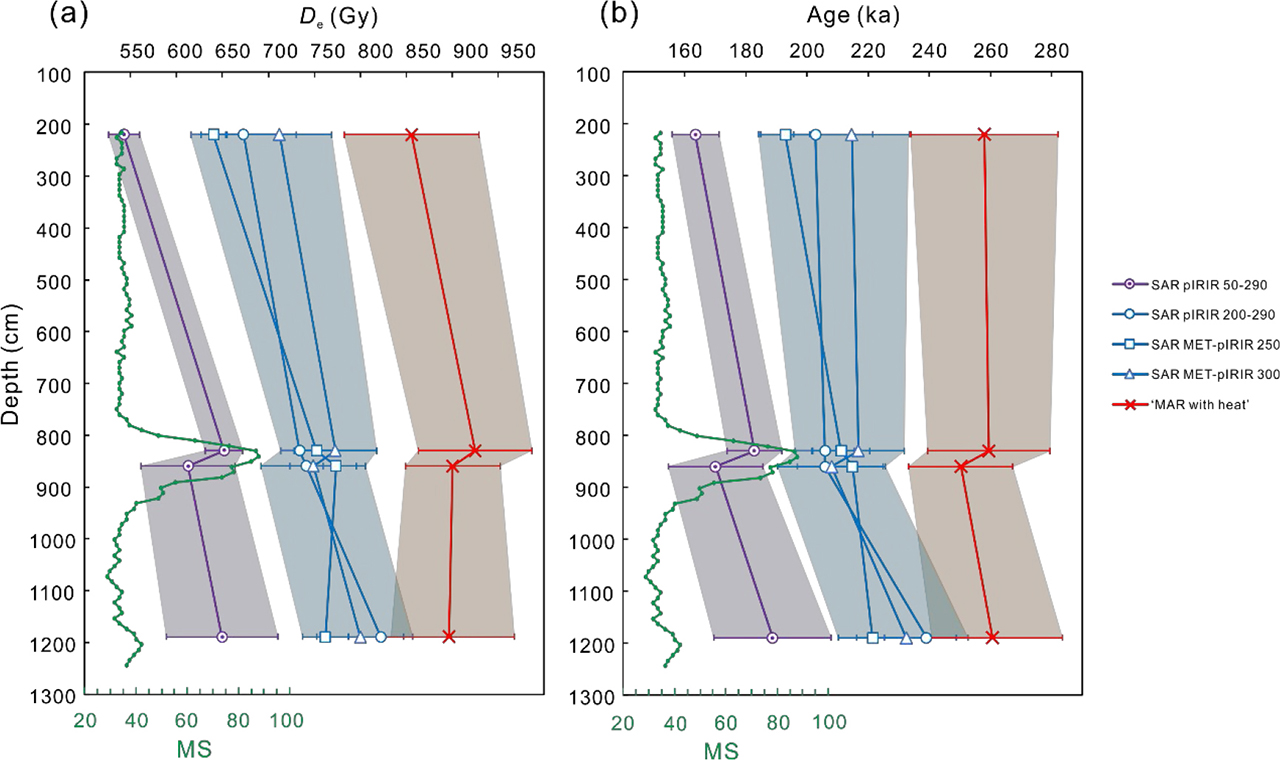
Fig. 4
De values and age versus depth relationship for section B. The SAR pIR50IR290 protocol has the youngest ages; the SAR pIR50IR290, MET-pIRIR250 and MET-pIRIR300 protocols have similar ages; and the ‘MAR with heat’ protocol has the oldest ages.
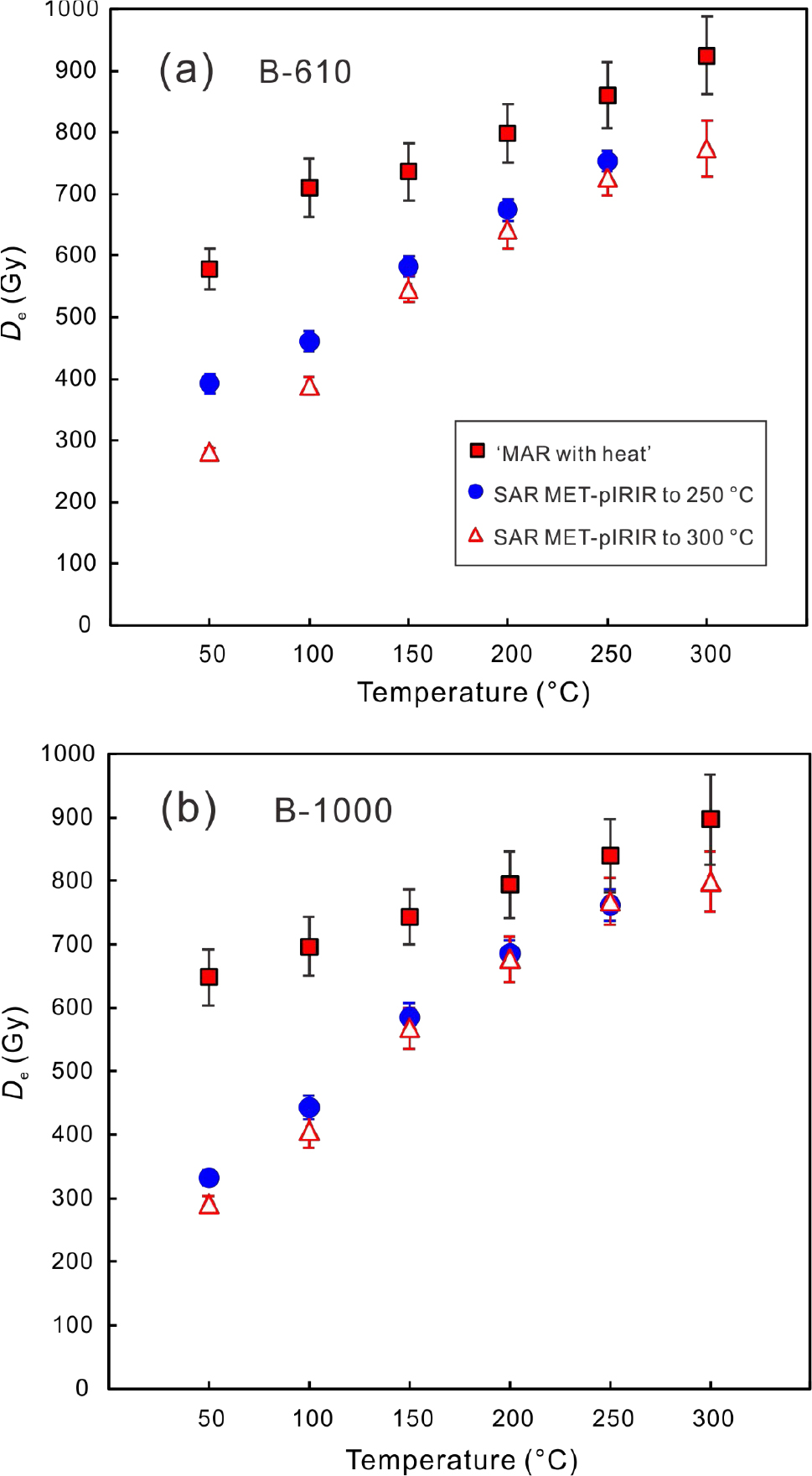
Fig. 5
De values with different stimulation temperatures for the two SAR protocols with MET-pIRIR stimulation to 250°C or 300°C, and the ‘MAR with heat’ protocol. Note that the MAR De values always exceed the SAR De values.
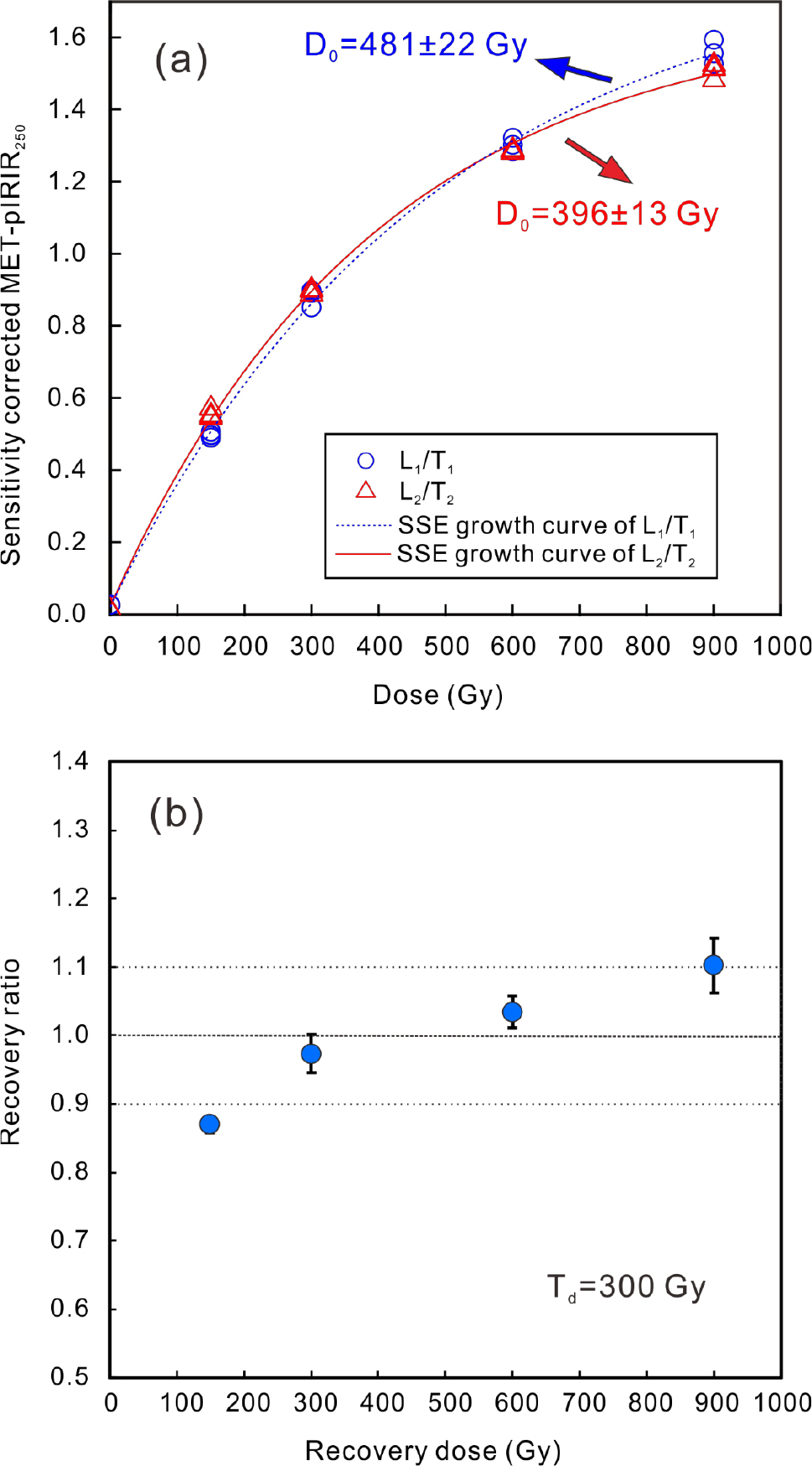
Fig. 6
Results of dose-recovery-like experiments for sample B-1000. (a) The growth curves of the L1/T1 and L2/T2 signals fitted with a single saturating exponential (SSE) function: y= y0+a*(1-exp(-x/D0)). (b) Regenerative doses of the first cycle are taken as unknown and recovered by the growth curve of L2/T2. The recovery ratios are plotted versus the recovery doses. Note that the recovery ratios are slightly overestimated when the doses exceed 600 Gy.