
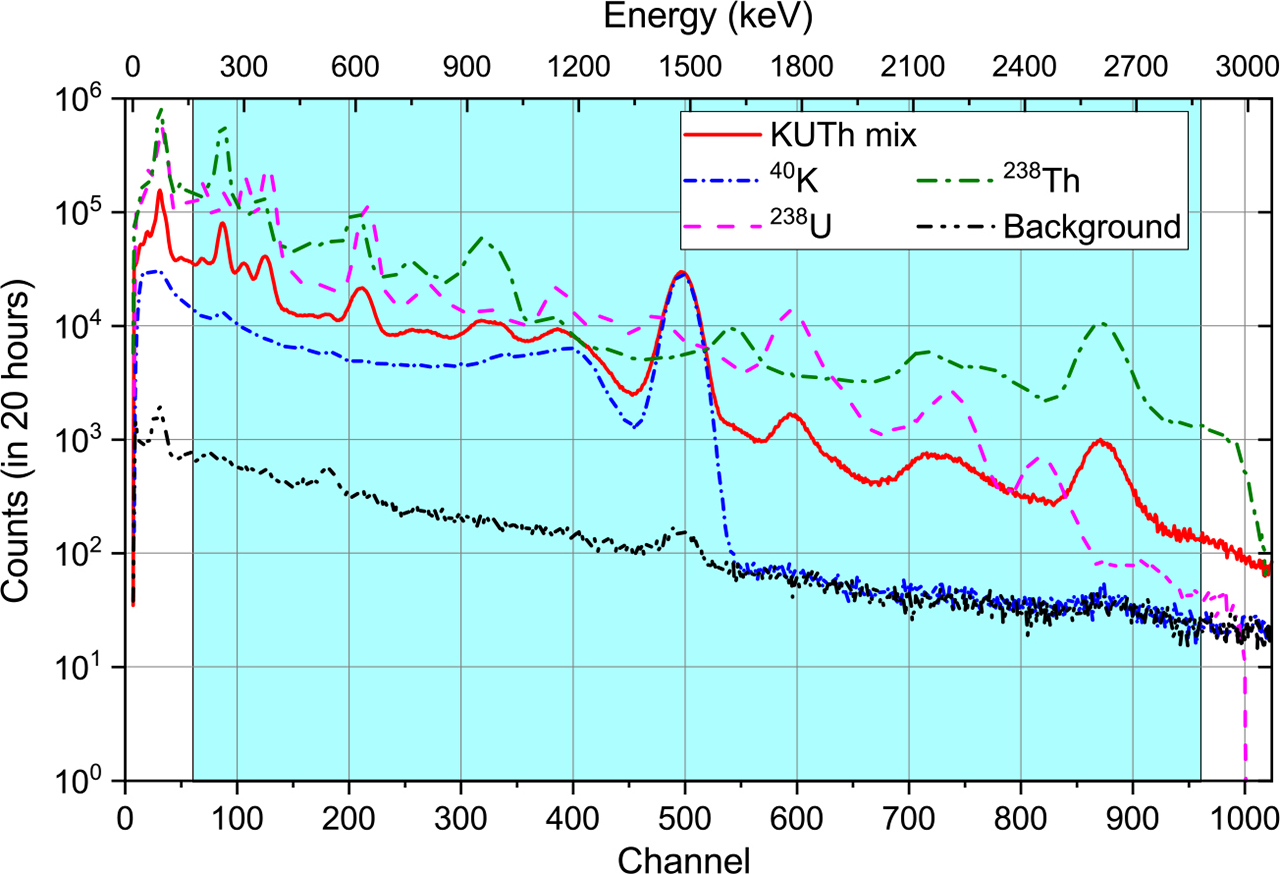
Fig. 1
Drift correction reference spectrum KUTh mix, and drift-corrected spectra from 40K, 238U and 232Th calibration standards and background.
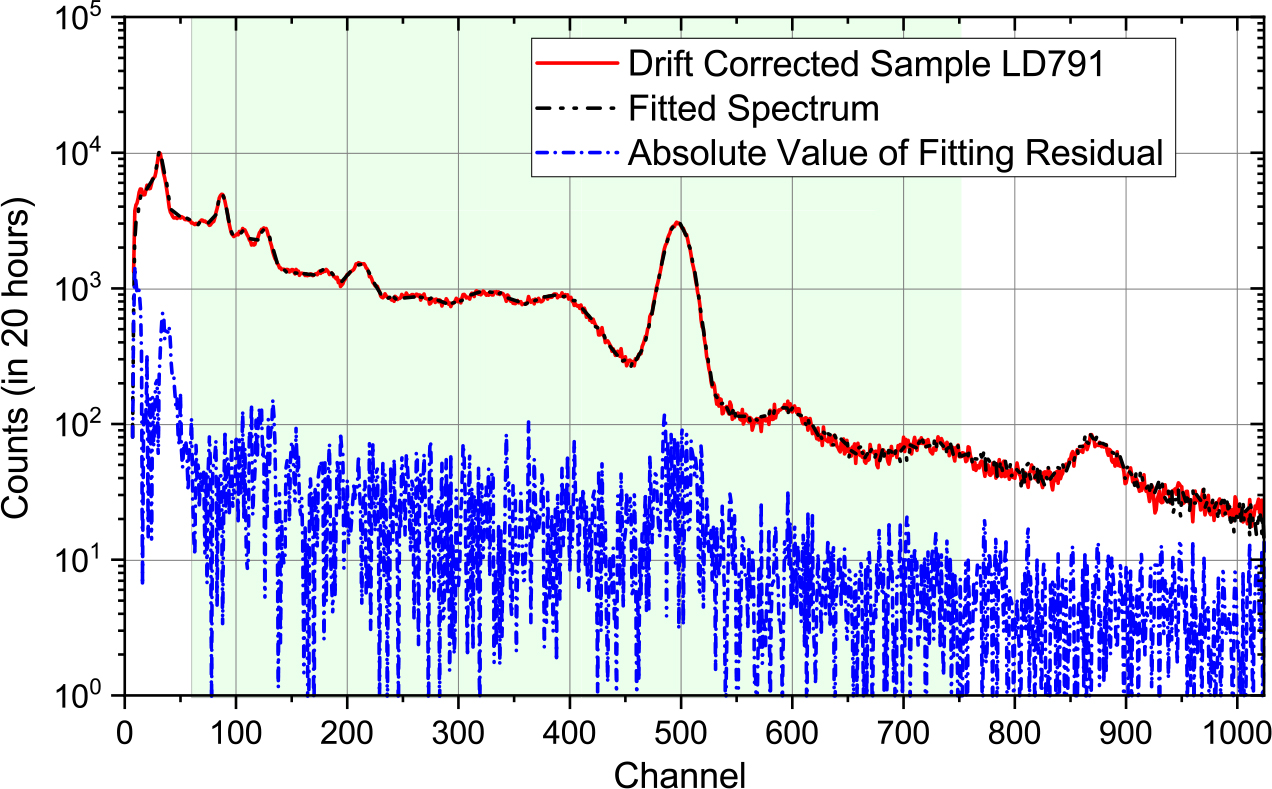
Fig. 2
Illustration of the agreement of a calculated fitted spectrum with the original sample spectrum, together with fitting residuals in each channel.
Table 1
Updated 40K, 238U and 232Th activity concentration per ppm for dose rate derivation.
| Radionuclide | Activity concentration (Bq·kg−1) | Uncertainty (Bq·kg−1) |
|---|---|---|
| 40K | 317 | 3 |
| 238U | 12.922 | 0.025 |
| 232Th | 4.061 | 0.029 |
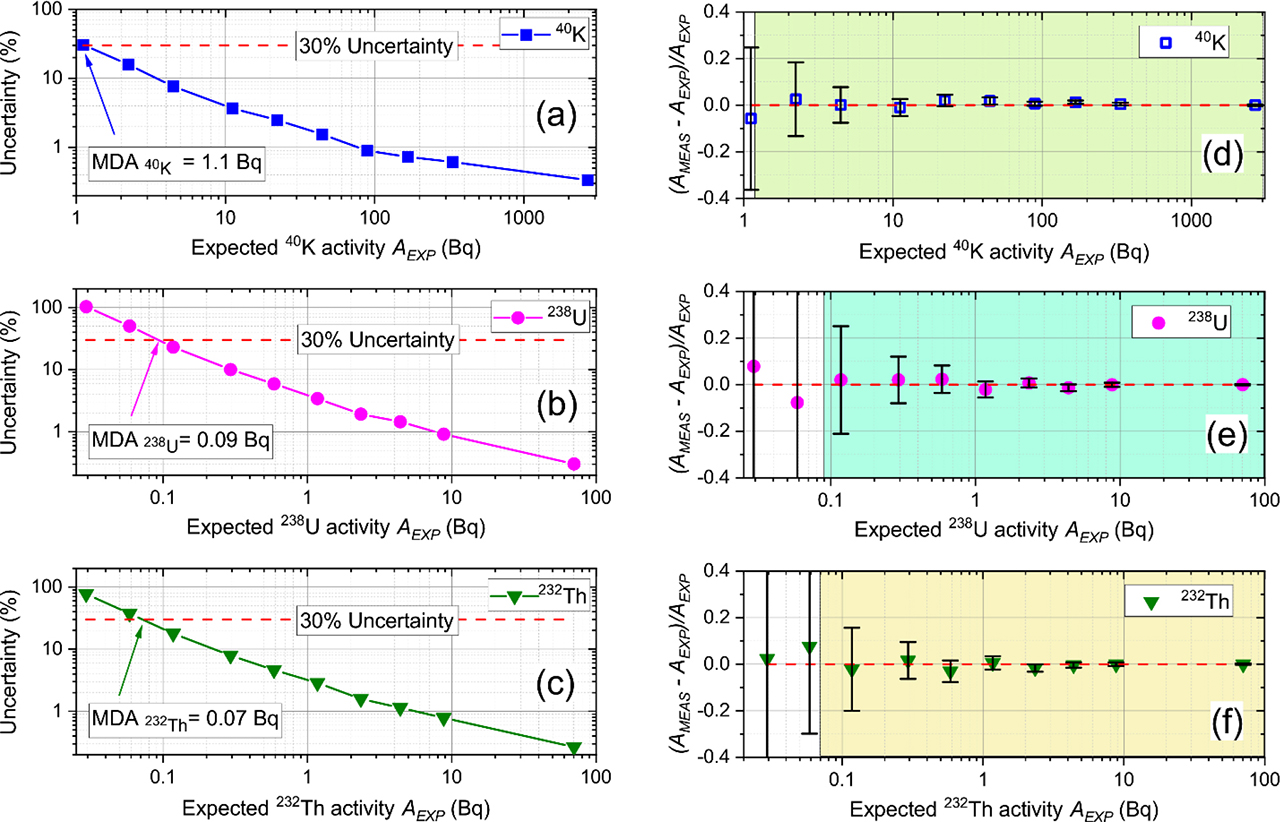
Fig. 3
(a–c) Minimum detection limits (MDLs) for activities of 40K, 238U and 232Th, respectively, defined as random uncertainty approaching 30%, when random uncertainty is expressed as a function of expected activity (AEXP); (d–f) Comparison of measured 40K, 238U and 232Th activity concentration (AMEAS) and expected activity concentration (AEXP), showing the accuracy of measurement and FSA analysis. The error bars in panels (d-f) shows the random uncertainty.
Table 2
Comparison of MDLs (Bq·kg−1) from different studies.
| Nuclide | NaI(Tl) spectrometer (Sample weight: 0.23 kg) | HPGe spectrometer (Sample weight: 0.25 kg) | |
|---|---|---|---|
| FSA (This study) | 3-Window (Bu et al., 2018) | (Murray et al., 2018) | |
| 40K | 4.8 | 21 | 0.6 |
| 238U | 0.4 | 4.0 | 0.04 |
| 232Th | 0.3 | 2.1 | 0.03 |
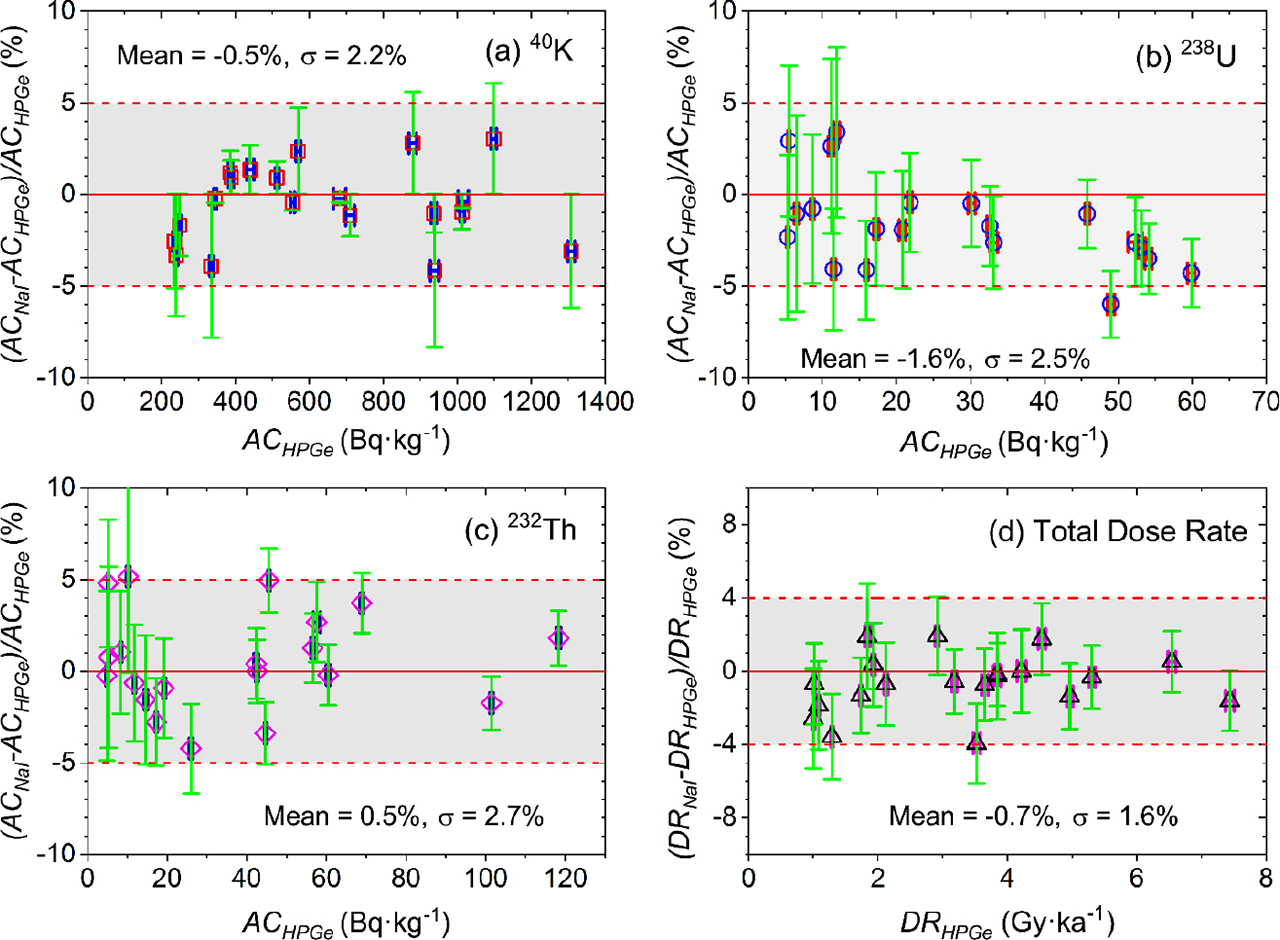
Fig. 4
Normalized deviations between those activity concentrations for 40K, 238U and 232Th (a–c), and total (β + γ) dose rates (d) determined by the NaI(Tl) spectrometer and those determined by an HPGe spectrometer, for 20 geological samples. The shaded regions represent ±5% deviation in panels (a–c), and ±4% deviation in panel (d). The standard deviation for 20 data in each subpanel show a high measurement precision on NaI(Tl) spectrometer. All error bars in panel (a-c) and in panel (d) are derived from the total uncertainties of ACNaI and ACHPGe, and total uncertainties of DRNaI and DRHPGe, respectively.
Table 3
Average ratios of ACNaI/ACHPGe and DRNaI/DRHPGe (n = 20).
| Average ratio | |
|---|---|
| 40K | 0.995 ± 0.005 |
| 238U | 0.984 ± 0.005 |
| 232Th | 1.005 ± 0.006 |
| Total dose rate | 0.993 ± 0.004 |
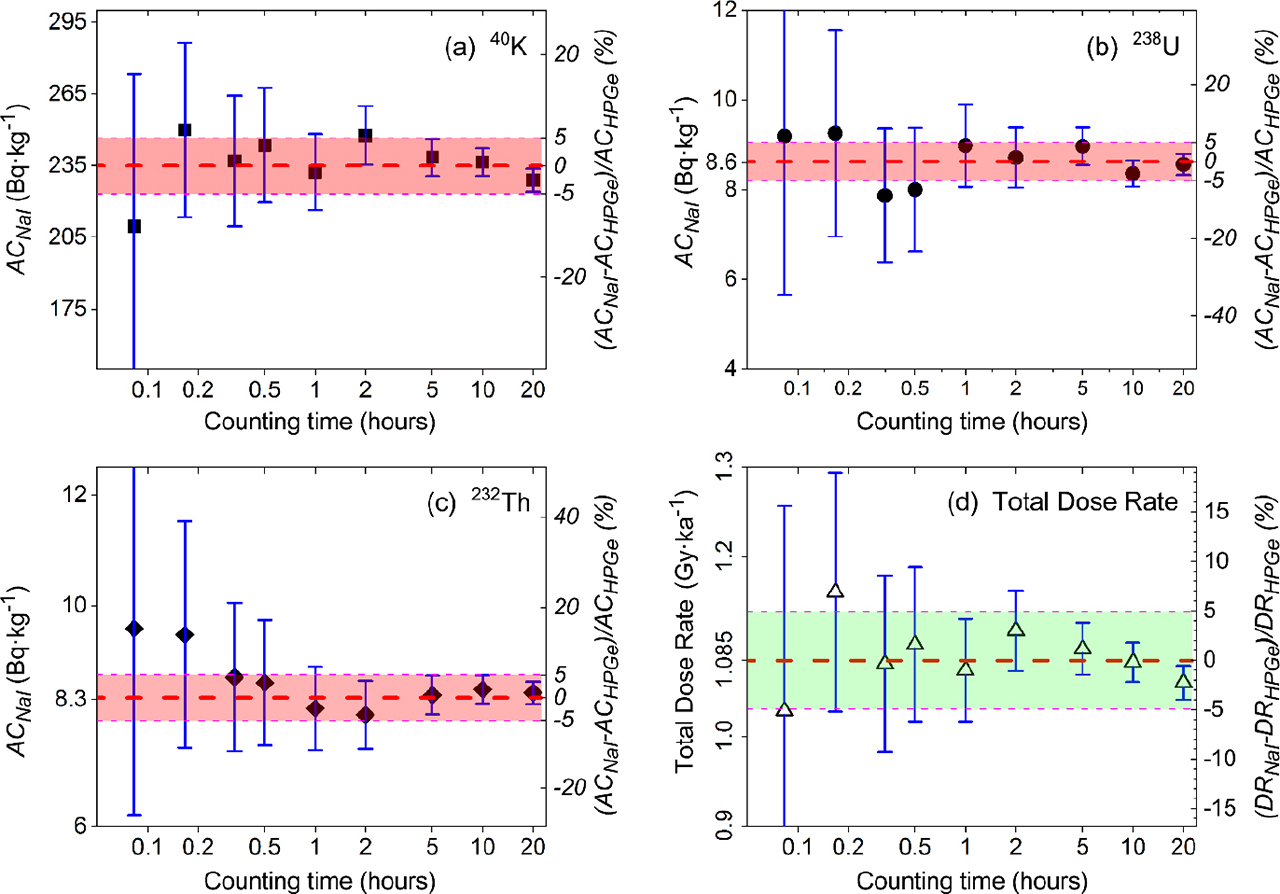
Fig. 5
Activity concentrations (a-c) and total dose rate (d) of a natural sample (LD962) counted with different counting time on NaI(Tl spectrometer. The horizontal dashed line in the centre of shaded region in each subpanel represents the activity concentration (a-c) and total dose rate (d) from HPGe spectrometer. All error bars in panel (a-c) and in panel (d) denote the total uncertainties of ACNaI, and total uncertainties of DRNaI, respectively.
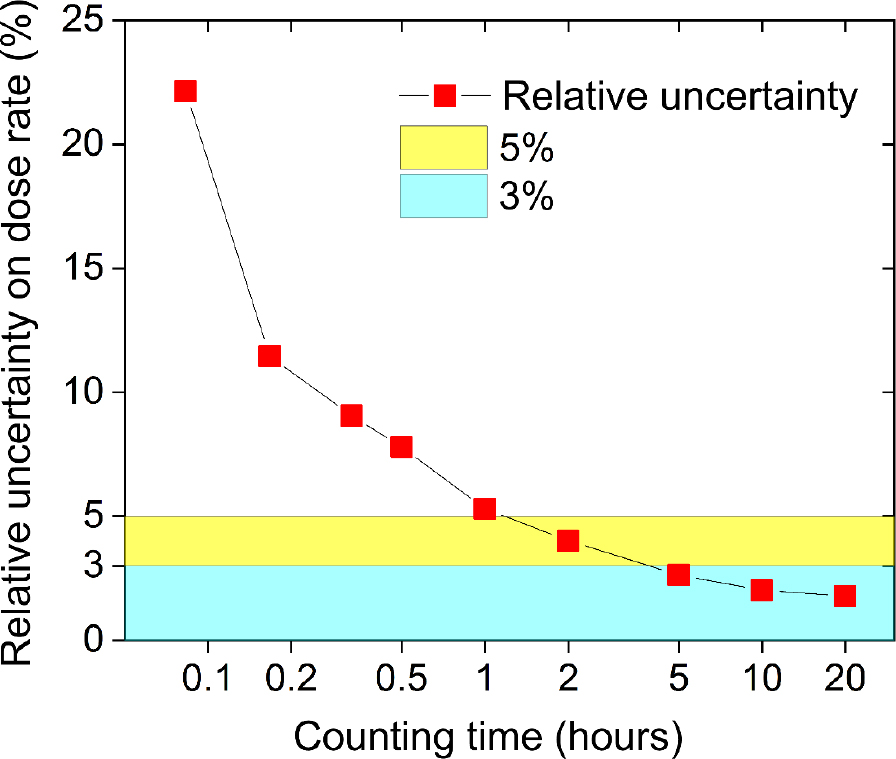
Fig. 6
Dependence of relative total dose rate uncertainty on counting time, for a sample containing 235, 8.6, and 8.3 Bq·kg−1 of 40K, 238U and 232Th, respectively and a total dose rate of 1.09 Gy·ka−1.