
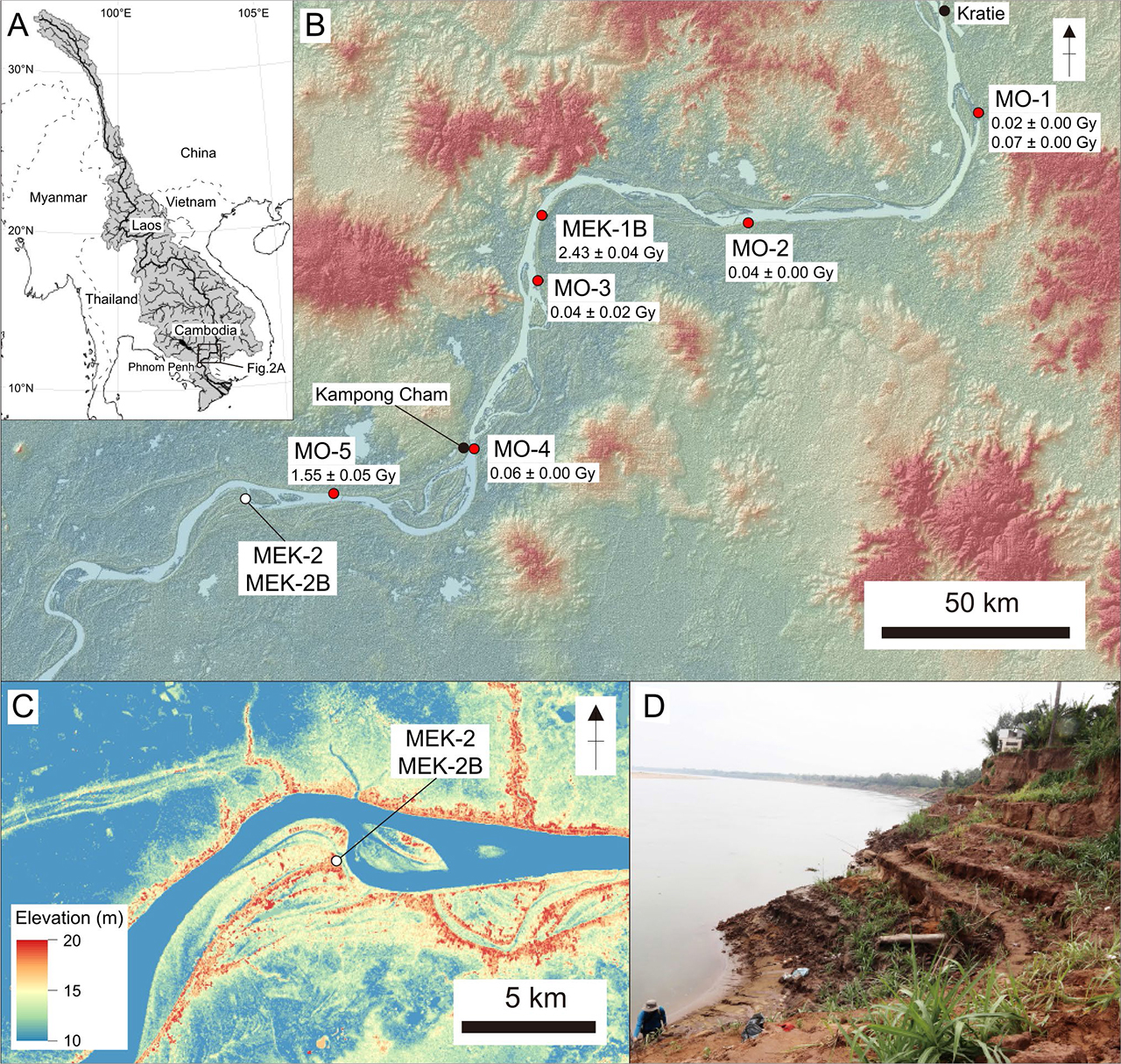
Fig. 1
(A) Map showing the drainage basin (shaded) of the Mekong River. (B) Relief map of the study area. Sampling locations for the modern flood sediments are shown by red circles, which are labelled with the residual doses of fine-grained quartz samples. The white circle represents the location of MEK-2 and MEK-2B. (C) Digital Surface Model (DSM) around the MEK-2 and MEK-2B sites. The DSM used is ALOS World 3D – 30 m (AW3D30), released from the Japan Aerospace Exploration Agency (JAXA). (D) Photograph of the section at site MEK-2B.
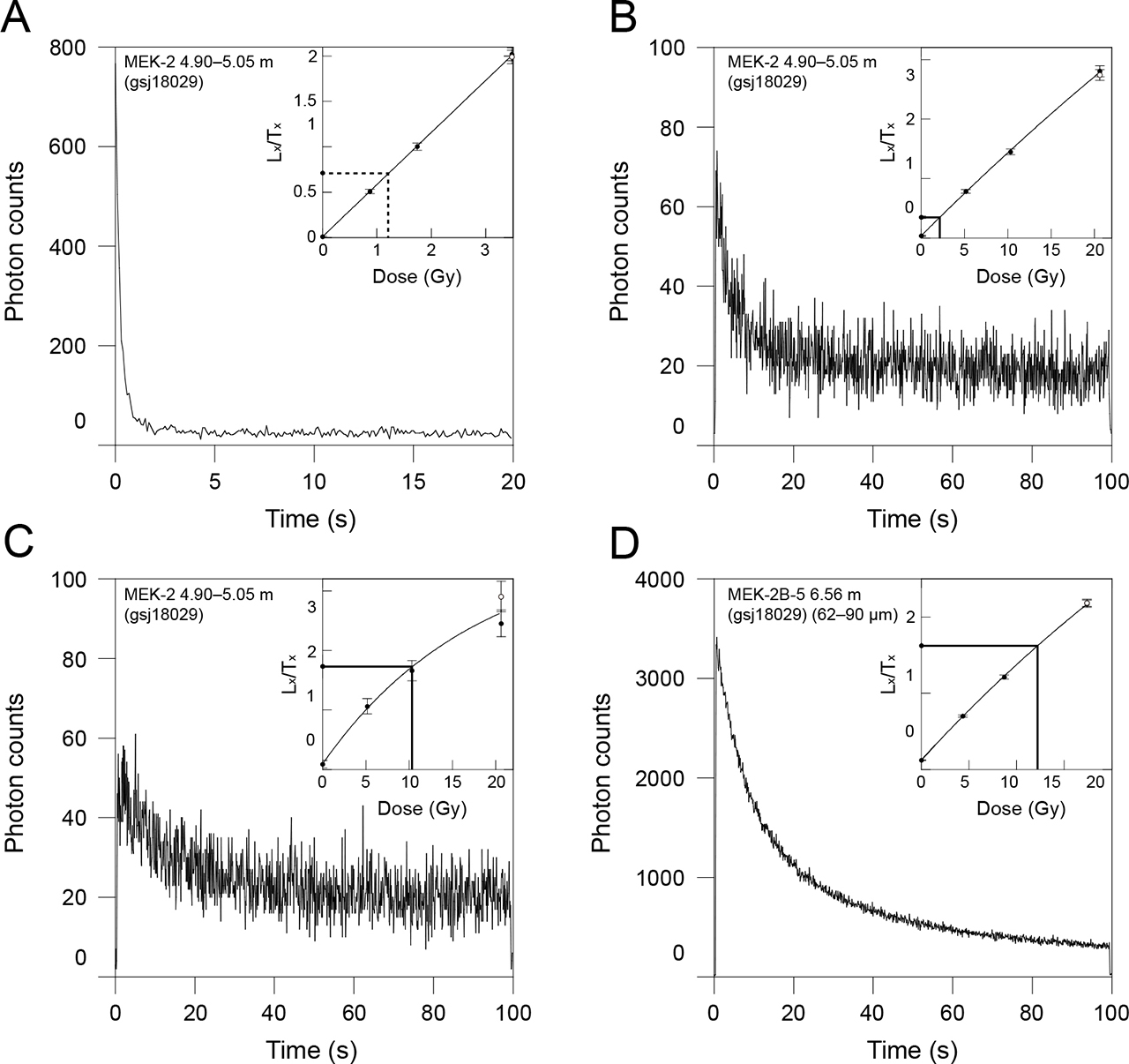
Fig. 2
Examples of decay curves and dose-response curves (insets) for (A) fine-grained quartz, (B) IR50 of polymineral fine grains, (C) pIRIR150 of polymineral fine grains, and (D) pIRIR150 of K-feldspars. White points in the insets denote recycling points.
Table 1
Summaries of OSL, IRSL and post-IR IRSL SAR protocols used in this study.
| Step | OSL | IRSL and post-IR IRSL |
|---|---|---|
| 1 | Preheat at 200 or 220°C for 10 s | Preheat at 180°C for 60 s |
| 2 | Blue stimulation at 125°C for 20 s | IR stimulation at 50°C for 100 s |
| 3 | Test dose | IR stimulation at 150°C for 100 s |
| 4 | Cut-heat at 160°C | Test dose |
| 5 | Blue stimulation at 125°C for 20 s | Preheat at 180°C for 60 s |
| 6 | Dose and return to step 1 | IR stimulation at 50°C for 100 s |
| 7 | IR stimulation at 150°C for 100 s | |
| 8 | Dose and return to step 1 |
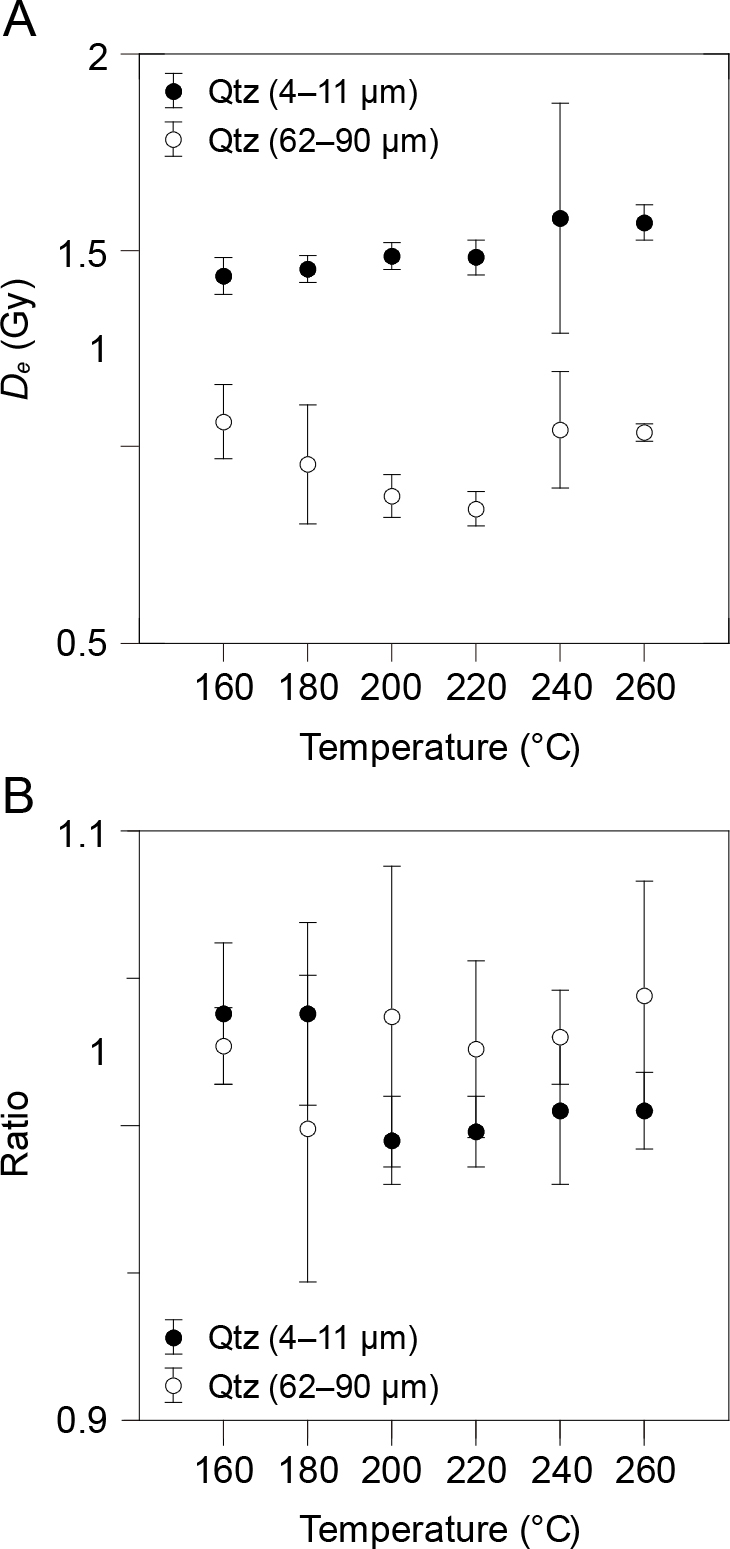
Fig. 3
(A) Preheat plateau tests and (B) preheat dose recovery tests for samples gsj18031 (4–11 μm) and gsj18032 (62–90 μm).
Table 2
Summary of dated samples and dosimetry data. The number of measured and accepted aliquots is shown. We added 5% to the water content values obtained from samples collected during dry season to account the seasonal changes. The “Q”, “F”, and “P” denotes quartz, K-feldspar, and polymineral fine grains, respectively.
| Laboratory code | Depth (m) | Grain size (μm) | K (%) | U (ppm) | Th (ppm) | Rb (ppm) | Water content (%) | Dose rate | |
|---|---|---|---|---|---|---|---|---|---|
| Quartz (Gy/ka) | F or P (Gy/ka) | ||||||||
| MEK-2 | |||||||||
| gsj18025 | 0.85–1.00 | 4–11 | 2.2 | 3.0 | 14.9 | 138.0 | 27.5 | 3.79 ± 0.19 | 4.39 ± 0.22 |
| gsj18026 | 1.90–2.05 | 4–11 | 1.4 | 1.9 | 11.2 | 77.7 | 14.0 | 2.93 ± 0.15 | 3.43 ± 0.17 |
| gsj18027 | 2.90–3.05 | 4–11 | 1.6 | 2.3 | 12.6 | 100.0 | 24.8 | 2.99 ± 0.15 | 3.50 ± 0.17 |
| gsj18028 | 3.85–4.00 | 4–11 | 1.5 | 2.1 | 11.8 | 86.6 | 31.4 | 2.61 ± 0.13 | 3.04 ± 0.15 |
| gsj18029 | 4.90–5.05 | 4–11 | 1.7 | 2.5 | 13.7 | 109.0 | 38.9 | 2.86 ± 0.14 | 3.34 ± 0.16 |
| MEK-2B | |||||||||
| gsj18035 | 4.75 | 120–150 | 1.2 | 2.0 | 14.5 | 62.0 | 8.9 | 2.51 ± 0.15 | - |
| 211–250 | 2.45 ± 0.14 | - | |||||||
| gsj18034 | 6.6 | 62–90 | 1.2 | 1.6 | 9.0 | 60.3 | 9.5 | 2.04 ± 0.10 | 2.78 ± 0.19 |
| 211–250 | 1.96 ± 0.12 | 2.92 ± 0.15 | |||||||
| gsj18033 | 7.4 | 4–11 | 1.7 | 3.0 | 13.8 | 104.0 | 36.6 | 3.06 ± 0.17 | 3.65 ± 0.17 |
| gsj18032 | 8.2 | 62–90 | 1.3 | 1.3 | 7.0 | 64.2 | 30.4 | 1.62 ± 0.10 | 2.19 ± 0.14 |
| 211–250 | 1.55 ± 0.09 | 2.46 ± 0.12 | |||||||
| gsj18031 | 9.0 | 4–11 | 1.8 | 3.0 | 13.9 | 108.0 | 43.0 | 2.86 ± 0.14 | 3.38 ± 0.16 |
| gsj18030 | 10.0 | 211–250 | 1.0 | 0.8 | 3.8 | 50.3 | 10.7 | 1.34 ± 0.09 | - |
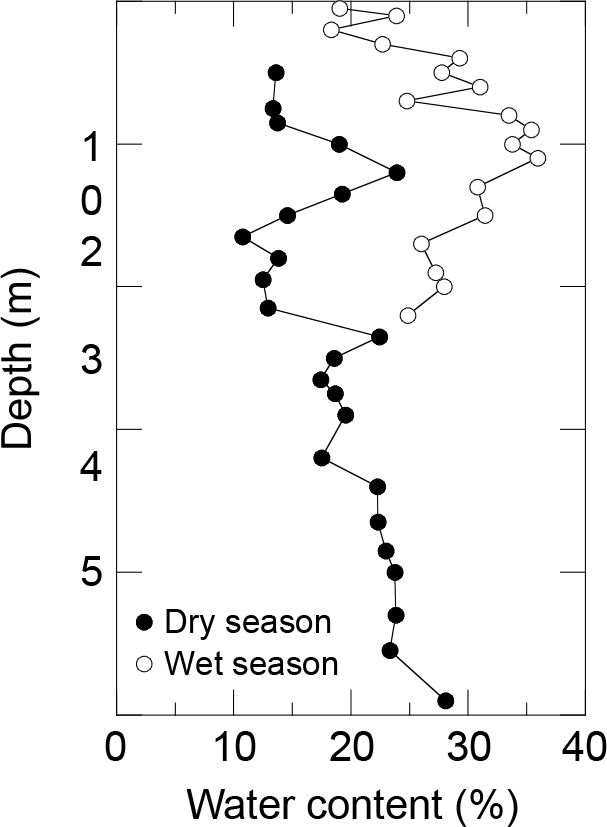
Fig. 4
Depth profiles of water content in the dry and wet seasons at site MEK-2.
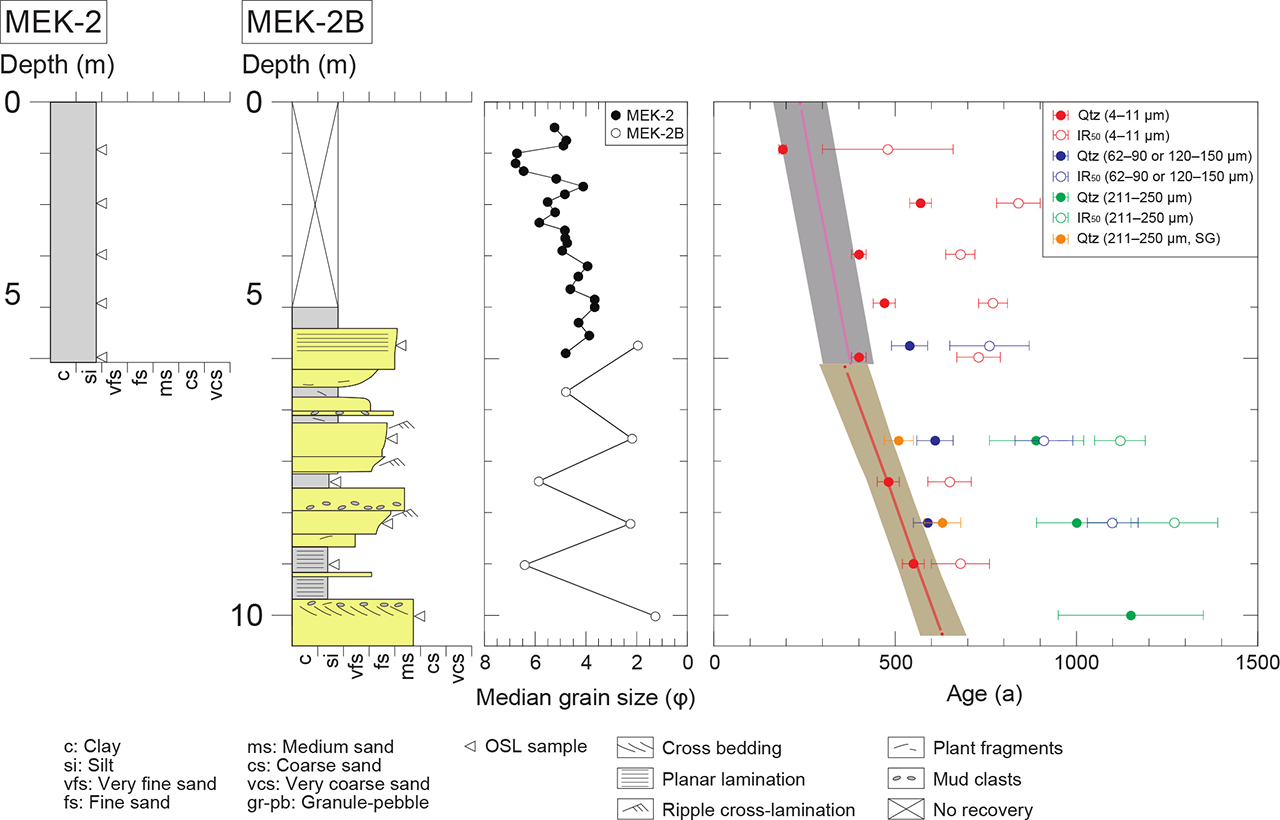
Fig. 5
Sedimentary columns of sites MEK-2 and MEK-2B. Vertical grain size profile and age-depth plots are also shown. The OSL ages are shown with 1 σ errors. The age-depth model was constructed by Bacon software (Blaauw and Christen, 2011). The dashed line shows ‘best’ model from the weighted average age and the shaded area indicates the 95% confidence interval. The single-grain ages calculated using the minimum age model (10% overdispersion value) are shown.
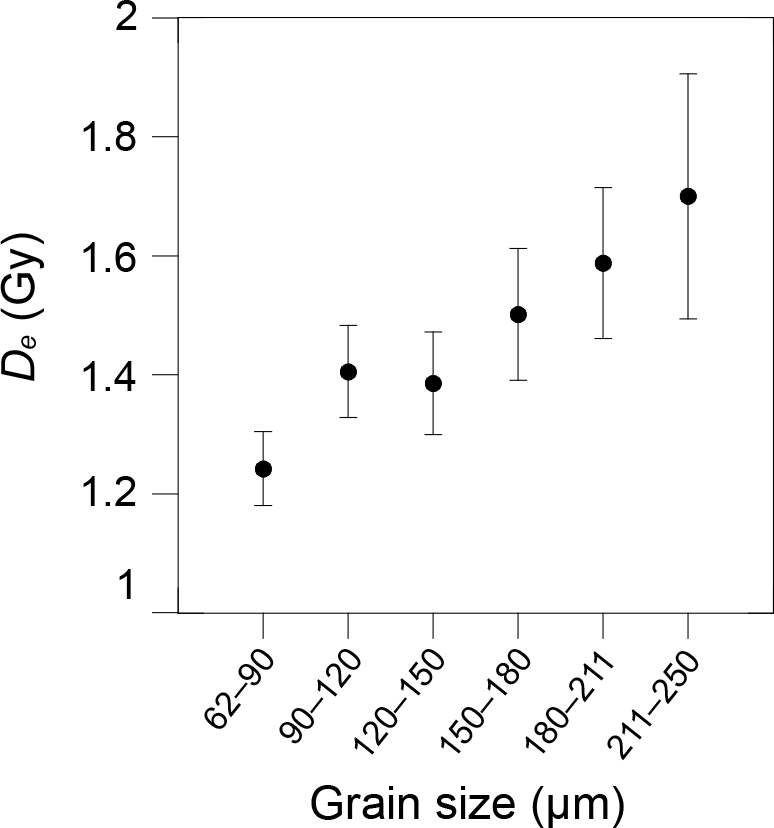
Fig. 6
Quartz equivalent doses obtained from different grain size fractions of sand sample (gsj18034).
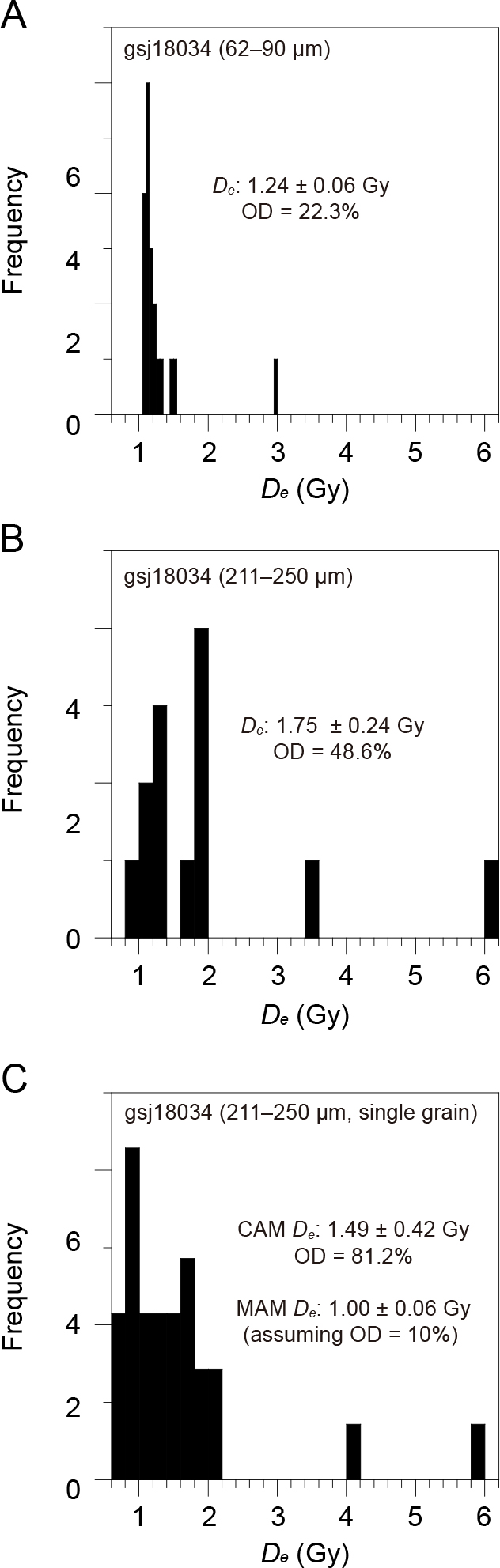
Fig. 7
Frequency distribution of equivalent doses obtained from multi-grain measurements of (A) 62–90 μm fractions and (B) 211–250 μm fractions of gsj18034, and (C) single-grain measurements of 211–250 μm fractions of gsj18034.
Table 3
Luminescence ages obtained from point-bar and natural levee deposits. “OD” is overdispersion value of quartz sample calculated using central age model. OSL ages with errors exceeding 10 a are rounded to the nearest decade.
| Laboratory code | Depth (m) | Grain size (μm) | Number of aliquots | De | Age | OD (%) | ||||||
|---|---|---|---|---|---|---|---|---|---|---|---|---|
| Q | F or P | Quartz (Gy) | IR50 (Gy) | pIRIR150 (Gy) | Quartz (a) | Uncorrected IR50 (a) | Corrected IR50 (a) | Uncorrected pIRIR150 (a) | ||||
| MEK-2 | ||||||||||||
| gsj18025 | 0.85–1.00 | 4–11 | 6 (6) | 6 (6) | 0.7 ± 0.02 | 1.7 ± 0.66 | - | 190 ± 10 | 390 ± 150 | 480 ± 180 | - | 5.2 |
| gsj18026 | 1.90–2.05 | 4–11 | 6 (6) | 6 (6) | 1.67 ± 0.04 | 2.32 ± 0.14 | - | 570 ± 30 | 680 ± 50 | 840 ± 60 | - | 3.6 |
| gsj18027 | 2.90–3.05 | 4–11 | 6 (6) | 6 (6) | 1.19 ± 0.04 | 1.91 ± 0.06 | - | 400 ± 20 | 550 ± 30 | 680 ± 40 | - | 5.9 |
| gsj18028 | 3.85–4.00 | 4–11 | 5 (6) | 6 (6) | 1.22 ± 0.02 | 1.89 ± 0.05 | - | 470 ± 30 | 620 ± 30 | 770 ± 40 | - | 0 |
| gsj18029 | 4.90–5.05 | 4–11 | 6 (6) | 6 (6) | 1.15 ± 0.04 | 1.97 ± 0.09 | - | 400 ± 20 | 590 ± 40 | 730 ± 60 | - | 6.7 |
| MEK-2B | ||||||||||||
| gsj18035 | 4.75 | 120–150 | 17 (20) | - | 1.36 ± 0.10 | - | - | 540 ± 50 | - | - | - | 29.9 |
| 211–250 | 17 (20) | - | 1.86 ± 0.24 | - | - | 760 ± 110 | - | - | - | 52.9 | ||
| gsj18034 | 6.6 | 62–90 | 20 (20) | 6 (6) | 1.24 ± 0.06 | 1.92 ± 0.02 | 11.87 ± 0.27 | 610 ± 50 | 690 ± 50 | 910 ± 80 | 4270 ± 300 | 22.3 |
| 211–250 | 13 (20) | 6 (6) | 1.75 ± 0.24 | 2.46 ± 0.06 | 9.48 ± 0.50 | 890 ± 130 | 840 ± 50 | 1120 ± 70 | 3250 ± 240 | 48.6 | ||
| gsj18033 | 7.4 | 4–11 | 6 (6) | 5 (6) | 1.47 ± 0.02 | 1.96 ± 0.15 | - | 480 ± 30 | 530 ± 50 | 650 ± 60 | - | 0.9 |
| gsj18032 | 8.2 | 62–90 | 20 (20) | 6 (6) | 0.96 ± 0.03 | 1.81 ± 0.03 | 11.42 ± 0.30 | 590 ± 40 | 830 ± 50 | 1100 ± 70 | 5220 ± 350 | 11.8 |
| 211–250 | 17 (20) | 6 (6) | 1.55 ± 0.15 | 2.33 ± 0.21 | 9.02 ± 0.67 | 1000 ± 110 | 950 ± 100 | 1270 ± 120 | 3680 ± 330 | 38.2 | ||
| gsj18031 | 9.0 | 4–11 | 6 (6) | 5 (6) | 1.57 ± 0.03 | 1.84 ± 0.18 | - | 550 ± 30 | 550 ± 60 | 680 ± 80 | - | 2.3 |
| gsj18030 | 10.0 | 211–250 | 17 (20) | - | 1.53 ± 0.25 | - | - | 1150 ± 200 | - | - | - | 66.6 |
Table 4
Results of single-grain measurements. The number of measured and accepted grains is shown. The ages were calculated using central age model (CAM) and minimum age model (MAM) assuming the overdispersion values of 10% (OD = 10) and.20% (OD = 20). OD is calculated as part of central age model.
| Laboratory code | Depth (m) | Grain size (μm) | Number of grains | CAM | MAM (OD = 10) | MAM (OD = 20) | OD (%) | |||
|---|---|---|---|---|---|---|---|---|---|---|
| De (Gy) | Age (a) | De (Gy) | Age (a) | De (Gy) | Age (a) | |||||
| MEK-2B | ||||||||||
| gsj18034 | 6.6 | 211–250 | 30 (2400) | 1.49 ± 0.24 | 800 ± 160 | 1.00 ± 0.06 | 510 ± 40 | 1.15 ± 0.07 | 590 ± 50 | 81.2 |
| gsj18032 | 8.2 | 211–250 | 26 (2400) | 1.57 ± 0.29 | 960 ± 160 | 0.98 ± 0.05 | 630 ± 50 | 1.01 ± 0.07 | 650 ± 60 | 96.3 |
Table 5
Residual doses of modern flood deposits. The “Q”, “F”, and “P” denotes quartz, K-feldspar, and polymineral fine grains, respectively. “OD” is overdispersion value of quartz sample calculated using central age model.
| Laboratory code | Grain size (μm) | Setting | Number of aliquots | De | OD (%) | |||
|---|---|---|---|---|---|---|---|---|
| Q | F or P | Quartz (Gy) | IR50 (Gy) | pIRIR150 (Gy) | ||||
| MO-1 | ||||||||
| gsj18320 | 4–11 | levee | 6 (6) | 6 (6) | 0.02 ± 0.00 | 0.79 ± 0.03 | - | 32.2 |
| gsj18321 | 4–11 | levee | 6 (6) | 6 (6) | 0.07 ± 0.00 | 0.82 ± 0.03 | - | 3.2 |
| MO-2 | ||||||||
| gsj18322 | 90–120 | bar | 20 (20) | 6 (6) | 0.68 ± 0.20 | 3.89 ± 0.24 | 39.5 ± 2.4 | 131.6 |
| 211–250 | bar | 18 (20) | 6 (6) | 0.32 ± 0.20 | 3.91 ± 1.44 | 28.4 ± 6.0 | 263.7 | |
| gsj18323 | 4–11 | bar | 6 (6) | 6 (6) | 0.04 ± 0.00 | 1.38 ± 0.05 | - | 16.8 |
| gsj18324 | 90–120 | bar | 20 (20) | 6 (6) | 0.62 ± 0.27 | 4.04 ± 0.62 | 42.5 ± 2.8 | 194.1 |
| 211–250 | bar | 20 (20) | 6 (6) | 0.32 ± 0.15 | 6.11 ± 1.19 | 33.6 ± 2.9 | 202.0 | |
| MO-3 | ||||||||
| gsj18325 | 4–11 | levee | 6 (6) | 6 (6) | 0.04 ± 0.02 | 1.22 ± 0.05 | - | 101.9 |
| MO-4 | ||||||||
| gsj18326 | 4–11 | levee | 6 (6) | 6 (6) | 0.06 ± 0.00 | 0.93 ± 0.04 | - | 17.8 |
| gsj18327 | 211–250 | levee | 20 (20) | 6 (6) | 0.43 ± 0.13 | 1.41 ± 0.13 | 15.3 ± 1.0 | 130.0 |
| MO-5 | ||||||||
| gsj18328 | 62–90 | bar | 20 (20) | 6 (6) | 0.49 ± 0.12 | 4.02 ± 0.13 | 39.4 ± 1.0 | 110.0 |
| gsj18329 | 4–11 | bar | 6 (6) | 6 (6) | 1.55 ± 0.05 | 3.36 ± 0.20 | - | 7.6 |
| MEK-1B | ||||||||
| gsj18330 | 4–11 | levee | 6 (6) | 6 (6) | 2.43 ± 0.04 | 1.87 ± 0.03 | - | 2.3 |
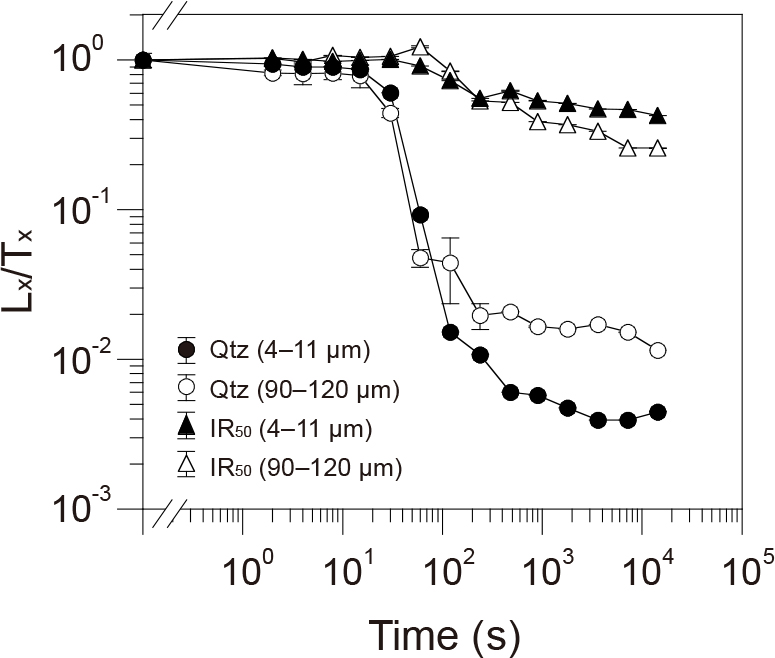
Fig. 8
Bleaching rates for OSL and IR50 of fine-grained and sand-sized samples (gsj18033 and gsj18034). The error bars represent one standard error.