
Table 1
Overview of the different groups working on ESR dating of quartz over the last decades (non-exhaustive list). The description of the experimental setup is based on the information provided in the respective publications cited in the last column.
| Institution, city, country | ESR spectrometer (temperature of ESR measurement) | Reference |
|---|---|---|
| Museum National d’Histoire Naturelle, Paris, France | Bruker EMX (107 K) | Voinchet et al., 2010 |
| University of Cologne, Cologne, Germany | Bruker ESP 300 (115 K) | Beerten et al., 2006 |
| Centro Nacional de Investigacion sobre la Evolucion Humana (CENIEH), Burgos, Spain | Bruker EMXmicro 6/1 (90 K) | Duval et al., 2017a |
| McMaster University, Hamilton, Canada | JEOL FA-100 (77 K) | Burdette et al., 2013 |
| China Earthquake Administration, Beijing, China | Bruker ER041XG (77 K) | Liu et al., 2010 |
| Okayama University of Science, Okayama, Japan | JEOL PX-2300 (81–84 K) | Toyoda et al., 2006 |
Table 2
Description of Experimental Setups #1, #2 and #3.
| Experimental Setup #1 | Experimental Setup #2 | Experimental Setup #3 | |
|---|---|---|---|
| ESR spectrometer | Bruker EMX 6/1 micro | Bruker Elexsys E500 | Bruker Elexsys E500 |
| Resonator model | ER4102ST(1): standard cavity | ER4102ST(2): standard cavity | SHQE: high sensitivity cavity |
| Low temperature system | ER4141VT Digital Temperature control system | ER4131VTM Digital Temperature (stabilized via PID) | ER4131VTM Digital Temperature (stabilized via PID) |
| Chiller | Thermo Scientific NESLAB ThermoFlex 3500 (water-cooled) | Riedel PC-100-02 (water-to-air cooled) | Riedel PC-100-02 (water-to-air cooled) |
| Acquisition software | Bruker Win EPR | Bruker Xepr | Bruker Xepr |
Table 3
Acquisition parameters employed for the three experimental setups during the ESR measurements of Al and Ti centres.
| Al centre | Ti centre | |||
|---|---|---|---|---|
| Experimental Setup | Setup #1 | Setup #2 Setup #3 | Setup #1 | Setup #2 Setup #3 |
| ESR spectrometer | EMX 6/1 micro | Elexsys E500 | EMX 6/1 micro | Elexsys E500 |
| Resonator model | ER4102ST(1) | ER4102ST(2) SHQE | ER4102ST(1) | ER4102ST(2) SHQE |
| Microwave power (mW) | 10 | 10 | 5 | 5 |
| Sweep width (mT) | 18 | 18 | 18 | 18 |
| HF modulation (kHz) | 100 | 100 | 100 | 100 |
| Modulation amplitude (mT) | 0.1 | 0.1 | 0.1 | 0.1 |
| Number of points | 1024 | 1024 | 1024 | 1024 |
| Conversion time (ms) | 40 | 40 | 60 | 60 |
| Sweep time (s) | 40.96 | 40.96 | 61.44 | 61.44 |
| Number of scans | 1 | 1 | 2–4 | 2–4 ST resonator 1–2 HSQE |
| Receiver Gain | 3169.8 | 60 dB | 25178.5 | 81 dB |
| Temperature (K) | 90 | 94 | 90 | 94 |
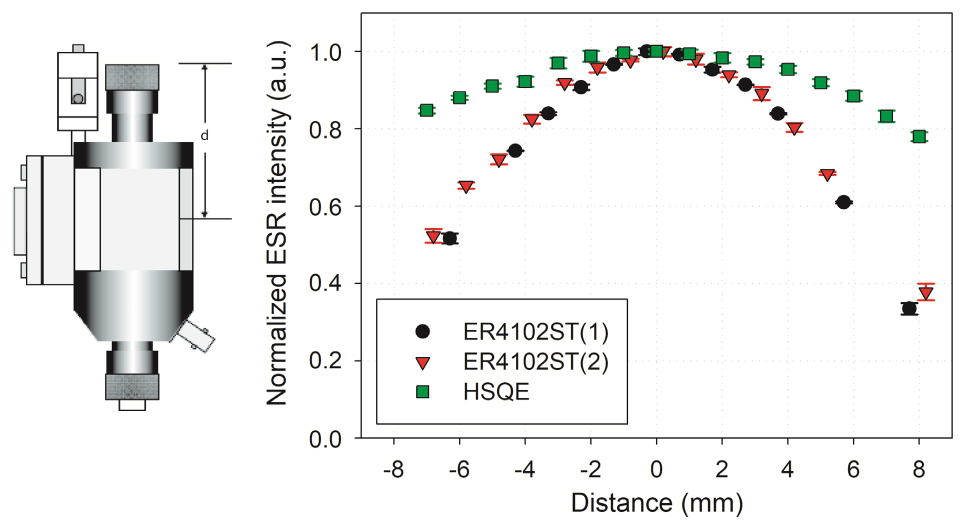
Fig. 1
Vertical distribution of ESR signal intensities obtained for three different resonators. The ER4102ST (1) profile was obtained using an EMX micro 6/1 ESR spectrometer (setup #1), while the ER4102ST (2) and SHQE resonator profiles were derived from the Elexsys E500 ESR spectrometer (setups #2 and #3). To facilitate comparisons, ESR intensities were normalized according to the highest intensity value for each profile. Key: Distance = sample distance from the resonator centre. d = Distance from the centre to the top of the resonator.
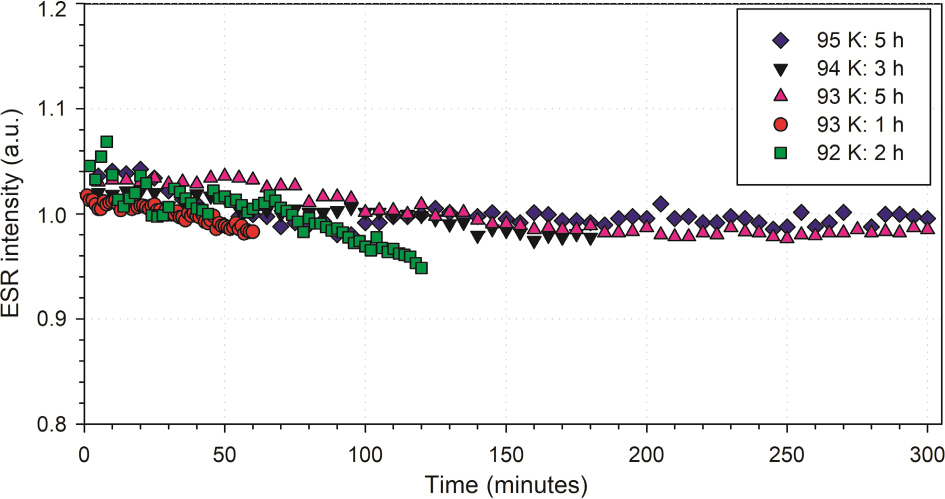
Fig. 2
Evolution of the ESR intensity with time using setup #2. Different temperatures were tested. Al ESR intensities were normalized to the mean ESR intensity obtained for each aliquot. Acquisition conditions: 1 scan / 5 min for the 3−5 h tests, 1 scan / 2 min for the 2 h test and 1 scan / min for the 1 h test.
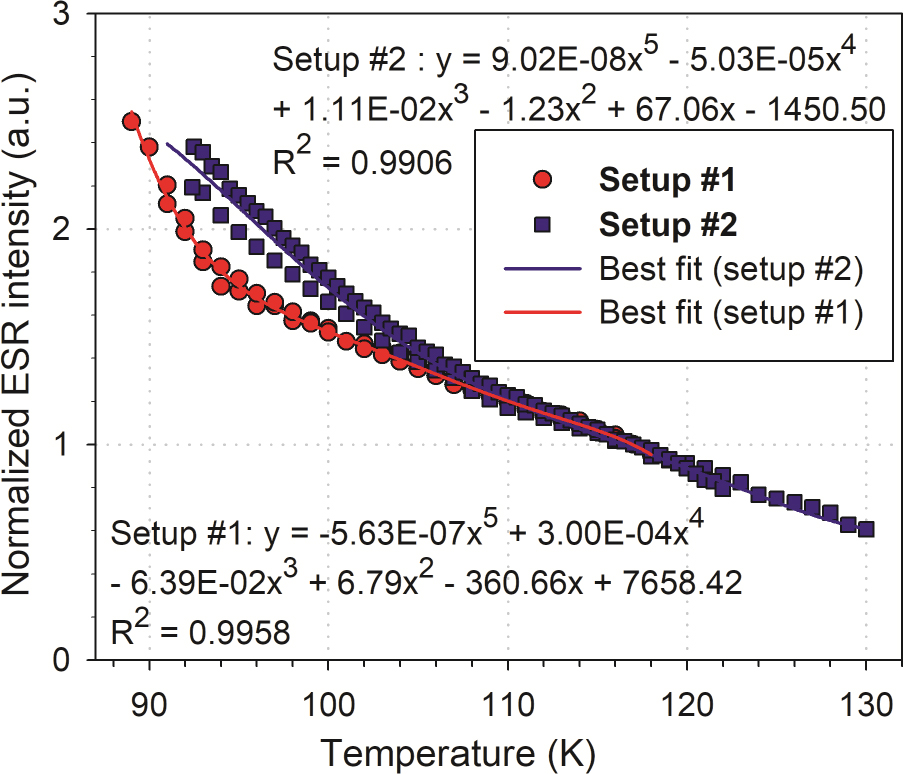
Fig. 3
Comparison of the evolution of the ESR intensities (Al centre) with the temperature (intensities normalized for T= 117 K) for setups #1 and #2.
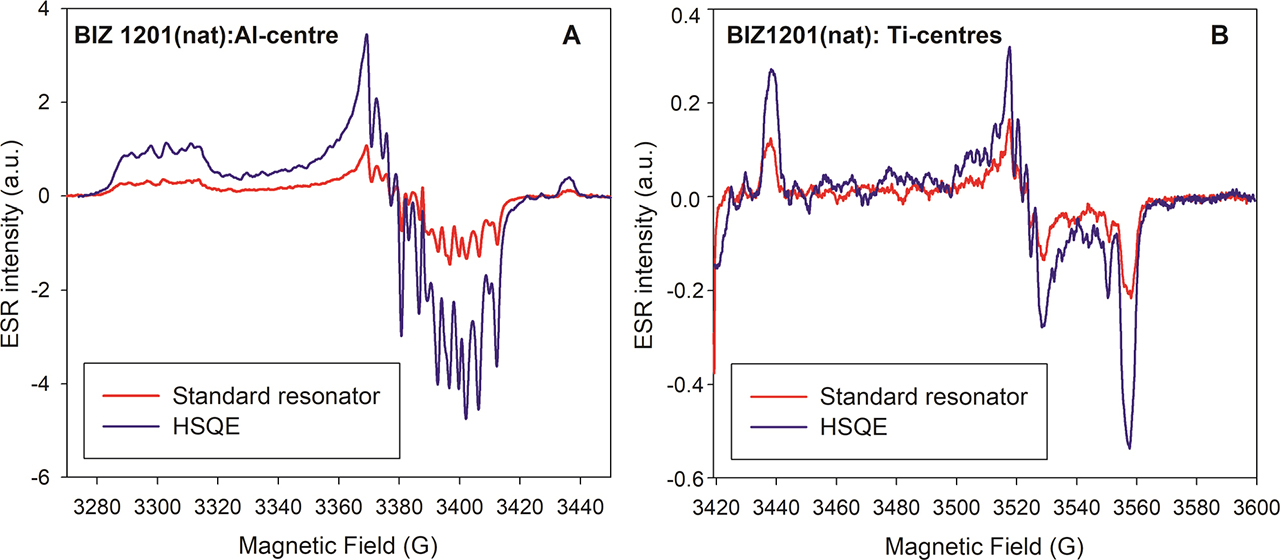
Fig. 4
ESR spectra of sample BIZ1201 (natural aliquot) for (A): Al- and (B): Ti-centres, using both, a standard ER4102ST(2) and a HSQE resonators. ESR spectra of each centre were recorded with the same acquisition parameters. For Al centre: modulation frequency = 100 KHz, modulation amplitude = 1 G, microwave power = 10 mW, sweep time = 40.96 s, receiver gain = 60 dB and T = 94 K. For Ti centre: modulation frequency = 100 KHz, modulation amplitude = 1 G, scan = 2, microwave power = 5 mW, sweep time = 61.44 s, receiver gain = 81 dB and T= 94 K. All spectra were recorded with the Elexsys E500 ESR spectrometer.
Table 4
Variability of the ESR intensities of samples BIZ1201, BIZ1202 (Al and Ti centres) derived from experimental setups #1, #2 and #3.
| Al Centre | Ti Centre | ||||||
|---|---|---|---|---|---|---|---|
| Sample | Experimental setup | Day | Number of aliquots per sample | Precision of each sample measurements: mean CV (%) | Precision of 3 day measurements: mean CV (%) | Precision of each sample measurements: mean CV (%) | Precision of 3 day measurements: mean CV (%) |
| BIZ1201 | Setup #1 | 1 | 13 | 0.82 | 1.67 | 3.80 | 2.59 |
| 2 | 13 | 1.05 | 3.63 | ||||
| 3 | 13 | 1.04 | 3.62 | ||||
| Setup #2 | 1 | 13 | 0.79 | 2.02 | 2.57 | 4.96 | |
| 2 | 13 | 1.25 | 3.32 | ||||
| 3 | 13 | 1.76 | 3.57 | ||||
| Setup #3 | 1 | 13 | 1.31 | 1.28 | 3.82 | 4.15 | |
| 2 | 13 | 1.58 | 2.66 | ||||
| 3 | 13 | 1.54 | 4.08 | ||||
| BIZ1202 | Setup #1 | 1 | 13 | 1.37 | 1.21 | 4.08 | 3.78 |
| 2 | 13 | 1.47 | 3.65 | ||||
| 3 | 13 | 1.01 | 2.59 | ||||
| Setup #2 | 1 | 13 | 1.07 | 1.84 | 2.79 | 3.06 | |
| 2 | 13 | 1.45 | 2.84 | ||||
| 3 | 13 | 1.19 | 2.39 | ||||
| Setup #3 | 1 | 13 | 2.29 | 1.81 | 3.00 | 5.00 | |
| 2 | 13 | 1.63 | 2.54 | ||||
| 3 | 13 | 1.47 | 2.92 | ||||
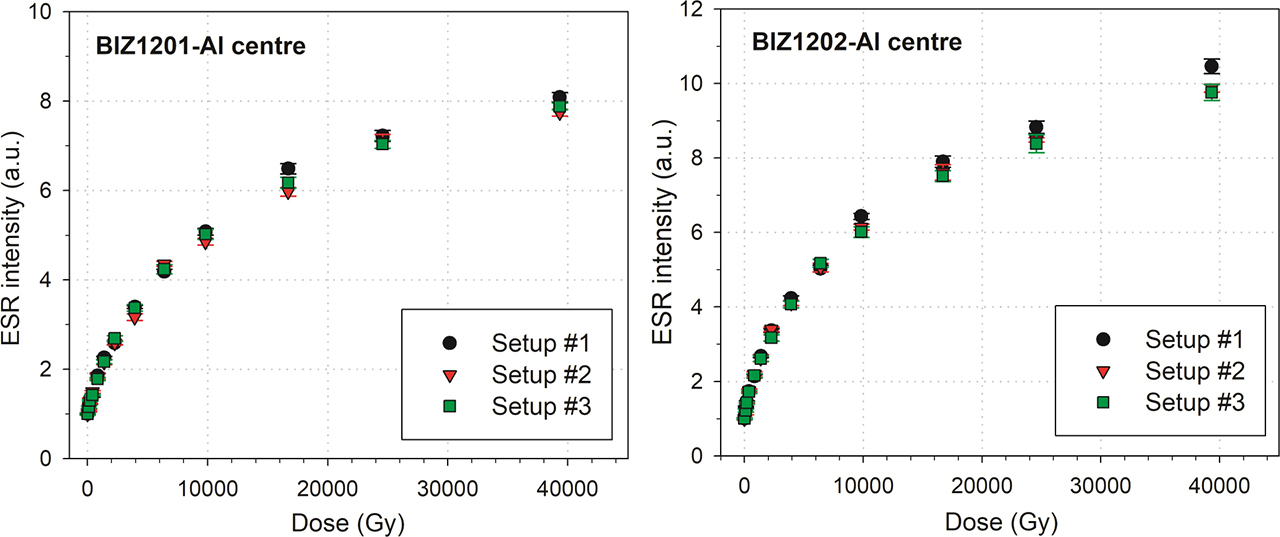
Fig. 5
Comparison of the ESR intensities (Al centre) obtained from samples BIZ1201 and BIZ1202 with the three experimental setups. The spectra were recorded using the acquisition parameters shown in Table 3. ESR intensities were normalized according to the natural intensity of each DRC.
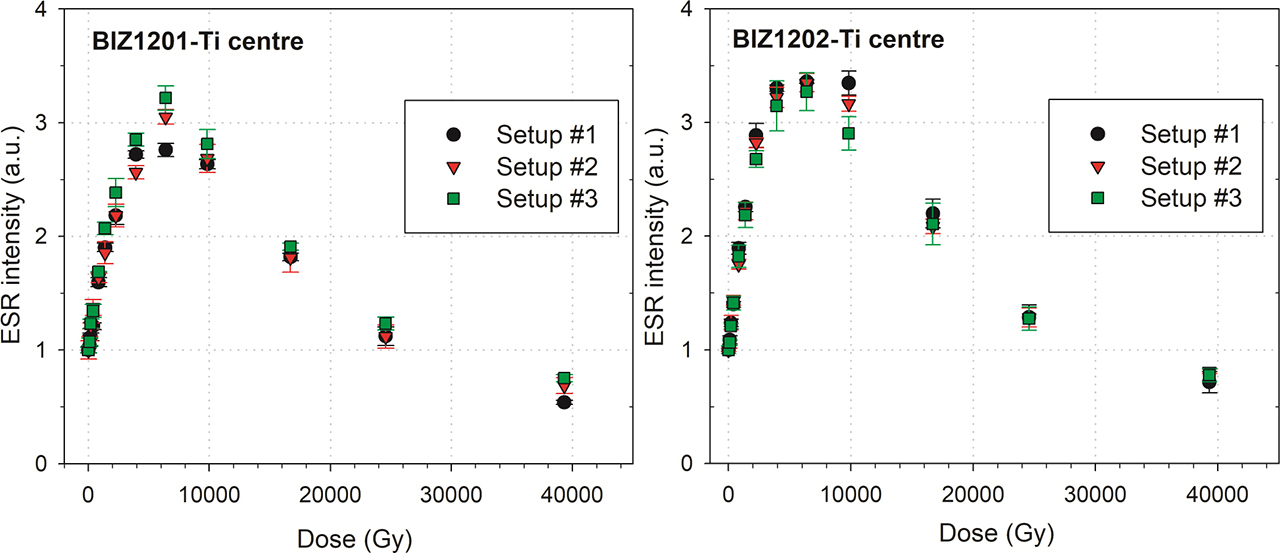
Fig. 6
Comparison of the ESR intensities (Ti centre) obtained from samples BIZ1201 and BIZ1202 with the three experimental setups. Spectra were recorded using the acquisition parameters shown in Table 3. ESR intensities were normalized according to the natural intensity of each DRC.
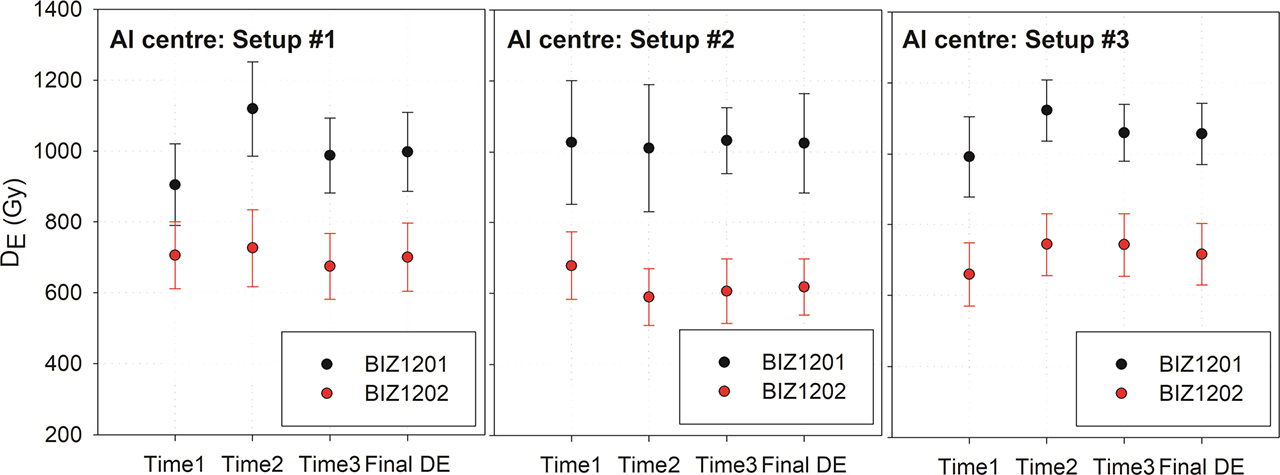
Fig. 7
DE values (Al centre) obtained from samples BIZ1201 and BIZ1202 with the three experimental setups. DE values were obtained by the fitting of an EXP+LIN function through each DRC. Final DE values are obtained by averaging the ESR intenstities derived from the 3 repeated measurements.
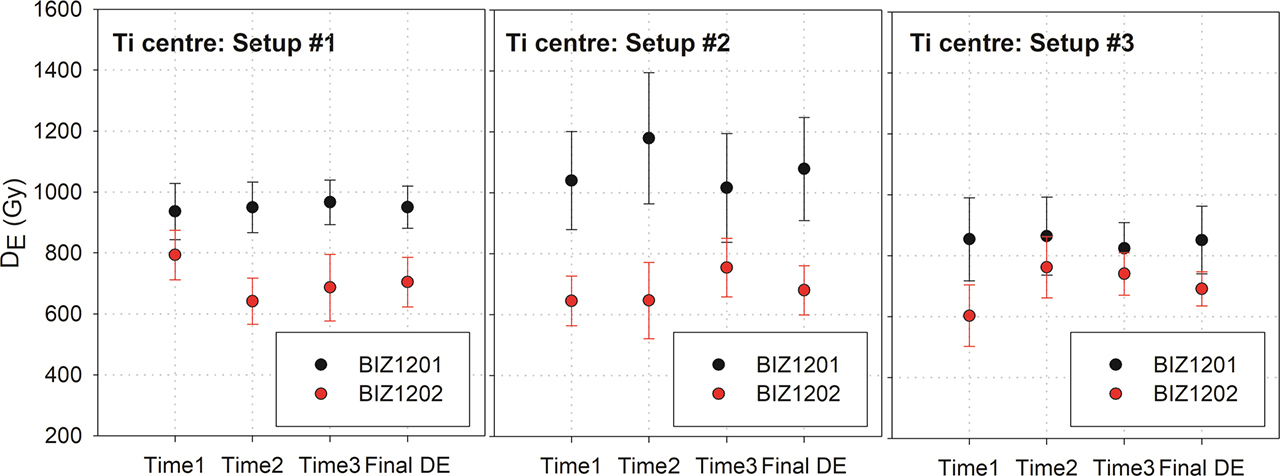
Fig. 8
DE values (Ti centre) obtained from samples BIZ1201 and BIZ1202 with the three experimental setups. DE values were obtained by the fitting of a Ti-2 function through each DRC. Final DE values are obtained by averaging the ESR intenstities derived from the 3 repeated measurements.