
1. Introduction
Sports shoes are becoming indispensable for travel, sports, and leisure activities, constituting nearly 40% of total footwear consumption [1]. This trend indicates promising development prospects for sports shoes.
Warp-knitted fabrics enhanced by innovative jacquard technologies are increasingly favored for sports shoe uppers due to their superior physical qualities, efficient one-time molding process, and reduced production costs [2–3]. Traditionally, double needle bed jacquard warp knitting machines produce warp-knitted jacquard uppers, known for their easy maintenance, shape retention, comfort, and ability to meet functional and aesthetic demands [4]. However, such fabrics often possess a dense texture unsuitable for summer wear. In contrast, single-layer jacquard uppers, being lighter and thinner, are preferred for summer but struggle to offer the multicolor jacquard effects desired for customization. To address the shortcomings of the three-layer fabric’s bulkiness and the single-layer’s limited aesthetic appeal, researchers developed a dual jacquard upper material. While this dual-layer jacquard offers a multicolor design, it lacks the spacer layer found in sandwich constructions, compromising cushioning and flexibility. Consequently, despite its aesthetic richness, the dual jacquard fabric does not match the breathability, moisture-wicking, resilience, and cushioning properties of its counterparts, limiting its widespread production.
This study introduces a single-layer jacquard upper that addresses the traditional single-layer products’ limitation to a single color, while maintaining their lightweight and slim profile, catering to consumer demands for customization in summer sports footwear. Additionally, the novel double jacquard interval fabric effectively resolves the challenges faced by traditional single-effect jacquard fabrics and double-layered jacquards lacking a spacer layer, aligning with consumer desires for comfort, style, and personalization in spring and autumn sports shoes. The two production methods of the jacquard upper proposed in this study enrich theoretical knowledge and prove practical for sports shoe development, as well as offering insights for manufacturing.
2. Mechanism and looping process of the looping jacquard warp-knitting machine
2.1. Introduction to the looping models
The looping jacquard warp-knitting machine is a warp-knitting machine equipped with looping jacquard bars and Piezo jacquard technology. Table 1 shows the main kinds of this warp-knitting machine including RSJ4/1, RSJ5/1, RSJ5/1EL, RDPJ in series, et al.
Table 1.
Introduction to looping models
| Machine type | Guide bar arrangement | Needle bed used with jacquard bars |
|---|---|---|
| RSJ4 /1 | JB1.1, JB1.2, GB2, GB3, GB4 | Single needle bar |
| RSJ5 /1(EL) | JB1.1, JB1.2, GB2, GB3, GB4, GB5 | Single needle bar |
| RDPJ5 /1(EL) | GB1, GB2, GB3, JB4, GB5 | Single needle bar |
| RDPJ6 /1(EL) | GB1, GB2, GB3, JB4.1, JB4.2, GB5, GB6 | Front and back needle bar |
| RDPJ7 /1(EL) | GB1, GB2, GB3, GB4, JB5.5, JB5.2, GB6, GB7 | Front and back needle bar |
| RDPJ4 /2(EL) | GB1, JB2.1, JB2.2, JB3.1, JB3.2, GB4 | Front and back needle bar |
| RDPJ6 /2(EL) | GB1, GB2, JB3.1, JB3.2, JB4.1, JB4.2, GB5, GB6 | Front and back needle bar |
RSJ4/1 and RDPJ5/1 are typical models of jacquard warp-knitting machine with a single-needle bar and double-needle bar, respectively. Each jacquard guide bar comprises two split jacquard bars in half-gauge. Among them, jacquard bars can adopt both the positive EBA electronic let-off system and negative yarn feeding system, while all ground guide bars employ the EBA electronic let-off system. The N-type pattern control mechanism and EL electronic shogging control mechanism [6] often serve as shogging systems in the ground guide bar. After these two types of machines, a double jacquard wrap-knitting machine with a two-needle bar was invented. With the emergence of this novel type of jacquard machine, jacquard technology has been improved and a new knitting method developed.
2.2. Jacquard knitting principle
Take the RDPJ6/2 warp-knitting machine for instance, single-needle bar jacquard fabric, double-needle bar jacquard fabric, single jacquard fabric and double jacquard fabrics can all be flexibly produced on this machine. For example, a RDPJ5/2 warp-knitting machine can be obtained when one ground guide bar of an RDPJ6/2 is not used. If one ground guide bar is in vacancy and the back jacquard guide bar only knits plain stitches, it is equivalent to an RDPJ5/1 machine. When stopping using one needle bar and ground guide bars of another needle bar, two jacquard bars and the remaining two ground guide bars are in the same needle bar for knitting, and then double jacquard wrap-knitting fabric with one needle bar can be manufactured. The guide bar arrangement of RDPJ6/2 is shown in Figure 1.
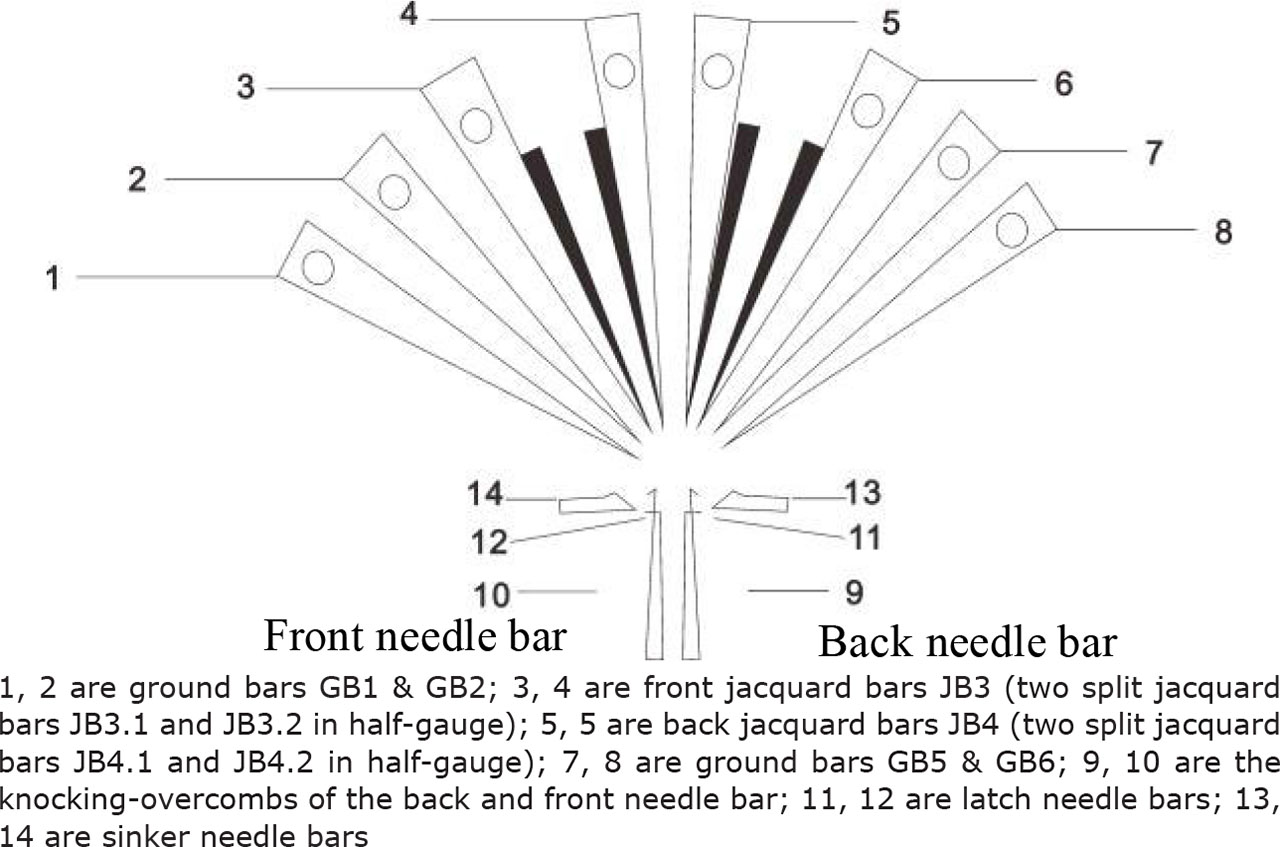
Fig. 1.
Guide bar arrangement of RDPJ6/2
In Figure 1, GB1can only be knitted on the front needle bar, while GB5 and GB6 can only be knitted on the back needle bar. GB2, JB3 and JB4 can be applied in both the front and back needle bar. On the one hand, a wide variety of double jacquard spacer fabrics can be produced with outstanding properties including air permeability, moisture dissipation, compression resistance and heat dissipation performance [6,7,8,9,10]. On the other hand, with two jacquard bars threaded in different raw materials, elastic or inelastic double jacquard spacer fabrics with different colors and structures can be processed.
3. Characteristic and knitting principle of single jacquard fabric
3.1. Characteristic of single jacquard fabric
In the traditional jacquard technique, the jacquard guide bar deviates only at the moment of back lateral movement. The front lateral movement of the looping jacquard bar is often employed on the jacquard warp-knitting machine with a double-needle bar. By controlling the offset information of front lateral movement, three sorts of effects including the miss-lapping stitch, single-needle loop stitch and double loop stitch can be attained. Coupled with various effects formed by the different needle distance on the back needle bar, a richer pattern effect and stronger stereoscopic effect are obtainable [11].
3.2. Knitting principle of single jacquard fabric
The jacquard bar of warp-knitted single-layer two-color shoe vamp fabric adopts triple-needle jacquard looping technology. The basic data of two split jacquard bars is 1-0/1-2//. Since the offset of overlapping and back lateral movement can both occur, not only can the mesh, thin and thick pattern effect be formed, but miss-lapping, a single-needle loop and double loop stitch can also be obtained [12]. The application of a double loop stitch is helpful to improve the transverse tear resistance of the fabric. With this technology, it not only changes the jacquard method, but also forms tension compensation on the cloth surface. The reasonable combination of these factors can form many functional areas on the shoe such as the breathability and reinforcement function. In the meantime, the variety of designs and colors can be enriched, which improves the singleness of warp-knitting in color jacquard. Table 2 shows offset jacquard information. With the jacquard notation of 1-0/1-2//, 16 lapping modes can be secured. As commonly defined, the control signal of non-displacement is represented with H, while the signal of displacement is represented with T. Each color stands for a type of stitch, and the color can be chosen according to individual preferences.
Table 2.
Offset jacquard information
| Jacquard colors | Lapping data | Jacquard effect | Control data |
|---|---|---|---|
| 4# | 1-0/1-2// | Thin stich | HHHH |
| 10# | 1-0/2-2// | Sigle-needle loop + miss-lapping | HHTH |
| 16# | 1-0/1-3// | Sigle-needle loop + double loop | HHHT |
| 1# | 1-0/2-3// | Thick stitch | HHTT |
| 6# | 2-0/1-2// | Double loop + single-needle loop | THHH |
| 5# | 2-0/2-2// | Sigle-needle loop+ miss-lapping | THTH |
| 25# | 2-0/1-3// | Double loop | THHT |
| 15# | 2-0/2-3// | Double loop + single-needle loop | THTT |
| 23# | 1-1/1-2// | Miss-lapping + single-needle loop | HTHH |
| 2# | 1-1/2-2// | Inlay stitch | HTTH |
| 11# | 1-1/1-3// | Miss-lapping + double-needle loop | HTHT |
| 33# | 1-1/2-3// | Miss-lapping + single-needle loop | HTTT |
| 12# | 2-1/1-2// | Pillar stitch | TTHH |
| 7# | 2-1/2-2// | Sigle-needle + miss-lapping | TTTH |
| 41# | 2-1/1-3// | Sigle-needle + double loop | TTHT |
| 8# | 2-1/2-3// | Thin stich | TTTT |
3.3. Warping principle of two-color jacquard fabric
For warp-knitted two-color jacquard fabric, two split jacquard bars in half gauge are generally threaded in two color yarns or two yarns with different dyeing performances independently. The former can get the two-color effect directly after the fabric is off the machine, while the latter can possess the effect after dyeing so that the jacquard part exhibits the two-color effect. The two split bars correspond to the odd and even wale of the fabric, respectively. Then, through the selective overlapping of the jacquard bar or the displacement of back lateral movement, miss-lapping, a single-needle loop stitch and double loop stitch are formed. Thus, the effect of two-color penetration is formed on the cloth surface.
4. Characteristics and knitting principle of double jacquard spacer fabric
4.1. Characteristics of double jacquard spacer fabric
Double jacquard spacer fabrics are produced on an RDPJ6/2 warp-knitting machine. Warp-knitted double jacquard spacer fabric possesses distinct layers, abundant jacquard effects and varied structures, with three layers: the surface layer, spacer layer and inner layer. Spacer fabrics of different thickness, color and structure can be formed through the different textures and various color yarns of the two jacquard bars on the front and back needle bar. The emergence of this kind of fabric mainly addresses two major problems: one is the single color of single jacquard fabric, and the other that there is no spacer layer of double jacquard fabric with double layers. Herein, a more convenient and concise fabric design, as well as a more abundant and diverse pattern can be achieved by double jacquard technology.
4.2. Knitting principle of double jacquard spacer fabric
Jacquard bars can be knitted into loops on the front and back needle bars alternately. On the RDPJ6/2 model, shown in Figure 1, the technical face, knitted on the back needle bar, is usually regarded as the jacquard effect face. Take the front jacquard bar as an example, its basic lapping data is 1-0-1-1/1-2-1-1// in a minimum jacquard grid unit including stitch information of four courses [13]. The four courses are odd courses on the front and back needle bars and even courses on the front and back needle bars, respectively. Jacquard elements can receive signals at the overlapping and underlapping of one loop to decide whether to make a displacement (signal T) or non-displacement (signal H). Therefore, the jacquard guide bar has eight times to choose whether to swing in a jacquard unit. As shown in Figure 2, they are odd course overlapping A, underlapping B on the front needle bar, odd course overlapping C, underlapping D on the back needle bar, even course overlapping E, underlapping F on the front needle bar and even course overlapping G, and underlapping H on the back needle bar. With the cooperation of two jacquard bar systems, the front and back sheet connection in the stitch structure, as well as the visual sesame texture effect (single-needle loop connection), jacquard effect (multiple loop connection), and pure color jacquard effect can be formed [8]. When the basic structure of jacquard fabric is determined, there are 28 kinds of offset of each jacquard bar. Consequently, the jacquard effect of double jacquard fabric exhibits much greater abundance than that of single jacquard fabric.
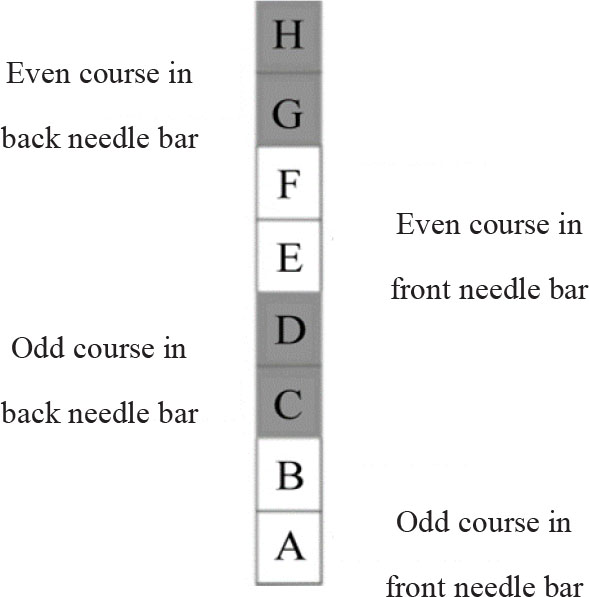
Fig. 2.
Offset information of double jacquard fabric
4.2.1. Jacquard sesame texture fabric
The sesame texture jacquard effect means that the jacquard bar forms a loop linking structure to the opposite needle bar in a jacquard unit, bringing into being a pattern appearance of sesame texture on the jacquard effect surface. There are two different methods of producing jacquard sesame texture fabric. One commonly used method is where the jacquard bar forms a loop on the opposite needle bar through displacement in the jacquard unit to be connected, and forms a non-loop on its own needle bar. In this way, a mesh linking stitch can be obtained. Meanwhile, uniform tension of the yarn and good loop coverage of the jacquard position can be realized. Another method is where the jacquard bar makes a displacement in the jacquard unit that needs to be connected, and forms a loop on both the front and back needle bar. As a result, a thin linking stitch and a thick linking stitch can be formed. And the surface of the finished fabric is relatively flat, but the yarn is subjected to greater tension. Therefore, the linking area of the front and back layers of the fabric can be sparse or dense, gaining the appearance of varied patterns.
In the sesame texture jacquard effect, basic lapping data of JB3 and JB4 are 1-0-1-1/1-2-1-1//, 1-1-1-0/1-1-1-2//, respectively. Some common jacquard linking stitches are listed in Table 3 and a jacquard sesame texture vamp fabric is shown in Figure 3(a).
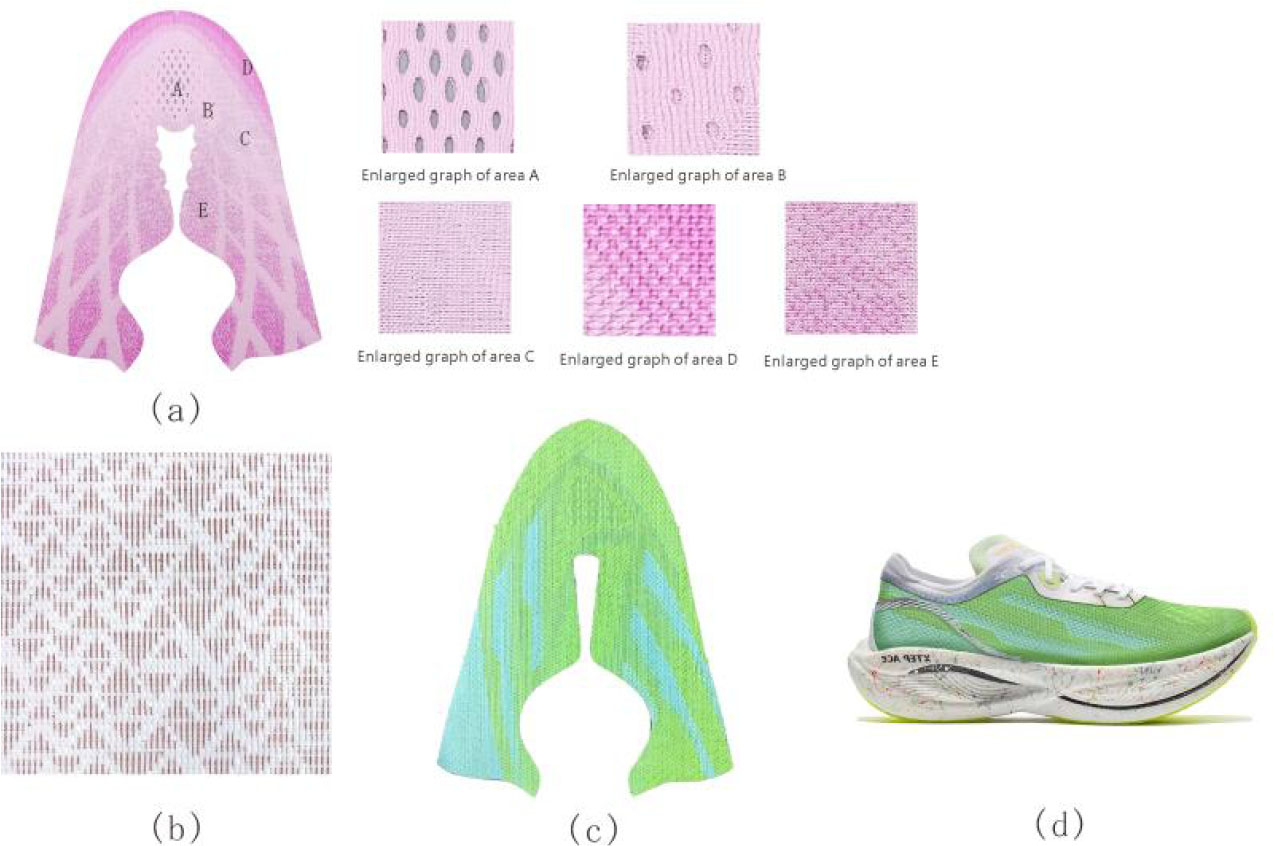
Fig. 3.
Double jacquard spacer fabric: (a) jacquard sesame texture fabric, (b) jacquard spacer fabric, (c) pure color jacquard fabric, (d) finished shoes
4.2.2. Jacquard spacer fabric
The jacquard effect refers to that in one or more consecutive jacquard units, where two courses on the same needle bar form a continuous loop, attaining a regular or irregular small cycle jacquard effect. Through one jacquard guide bar, it can form a thin, thick and mesh stitch, on which another jacquard bar forms the jacquard effect. Since it has a spacer layer, various physical performance indexes, such as air permeability, moisture absorption and moisture conductivity, compression resistance and structural integrity are satisfied. Therefore, this type of fabric can be used as sports shoe vamps, car cushions, mattresses and carpets for decoration.
In the jacquard effect, basic lapping data of JB3 and JB4 are 1-0-1-1/1-2-1-1//, 1-1-1-2/1-1-1-0//, respectively [14]. Some common jacquard stitches applied in jacquard spacer fabric are listed in Table 4 and a jacquard spacer fabric is shown in Figure 3(b).
Table 4.
Common jacquard stitch
| Jacquard effects of front jacquard bar | Lapping data | Control data of front jacquard bar |
|---|---|---|
| linking front and back layer | 1-1-1-2/1-2-1-1// | HTHT/HHHH |
| linking front and back layer | 1-1-1-1/1-2-1-2// | HTHH/HHHT |
| Non-jacquard on back needle bar | 2-1-1-1/1-2-1-1// | TTHH/HHHH |
| Jacquard on back needle bar | 2-1-2-1/1-2-2-2// | TTTH/THTT |
| Jacquard on back needle bar | 1-1-2-1/2-2-1-2// | HTTH/THHT |
4.2.3. Pure color jacquard fabric
For pure color jacquard fabric, the front and back jacquard guide bars can not only form thin, thick and mesh stitches on their own needle bar, but they can also be formed on the opposite needle bar. Therefore, in double-jacquard pure color jacquard fabric, at least one jacquard guide bar needs to apply triple-needle jacquard technology on the front and back needle bar [15]. In this process, assume that the basic lapping data of JB2 are 1-0-1-0/1-2-1-2//, and the lapping data of JB4 can be the same as for JB3 or 1-1-1-0/1-1-1-2//. Provided that the technical face on the back needle bar is used as the jacquard effect face, the back jacquard guide bar forms the thin and mesh stitch on the back needle bar, and the front jacquard bar forms the pure color jacquard effect on the back needle bar through the offset of jacquard bars. Common jacquard stitches are listed in Table 5, a pure color jacquard fabric is shown in Figure 3(c), and finished shoes in Figure 3(d).
5. Process design of single jacquard fabric
5.1. Design of raw material
Shoe vamp fabric should play a role in protecting the foot from external damage and show good shape preservation performance to ensure the beauty of shoes when worn. The vamp materials commonly used contain polyester DTY, polyester FDY, nylon DTY, nylon FDY, cationic modified polyester, high elastic spandex core-spun yarns, et al. Usually, for single-layer shoe vamp fabrics, chemical filaments that are easy to wash and quick to dry are usually selected, such as polyester and nylon, which can provide a comfortable and breathable micro-environment for vamp fabric [16].
5.2. Design of stitch structure
Basic lapping data of jacquard bars are 1-0/1-2// while those of the ground guide bar are 1-0/0-1//. Aimed to improve the transverse shape preservation performance of single-layer vamp fabric, a ground guide bar can be used to perform the inlay movement with lapping data of 1-1/0-0//. Under the control of offset information of the jacquard bar, large and small meshes as well as the thin and thick stitch jacquard effect can be ensured, as shown in Figure 4(a–e).
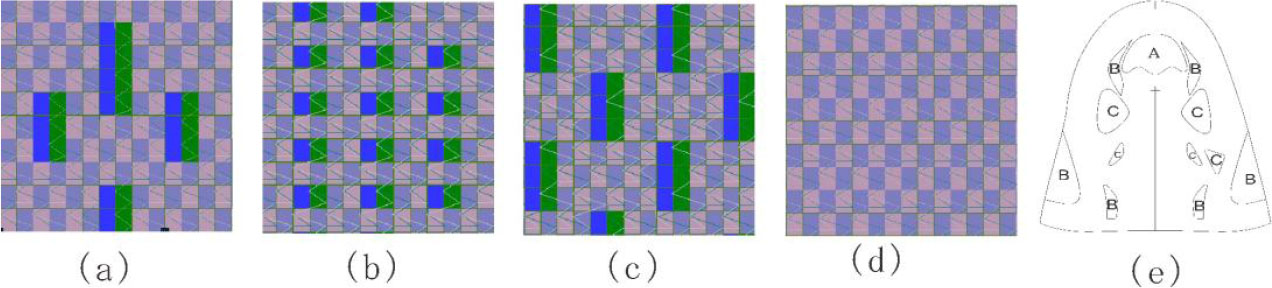
Fig. 4.
(a) Large mesh stitch, (b) small mesh stitch, (c) thin stitch, (d) thick stitch, (e) different areas of shoe vamp
According to the distinguishable physical properties of different parts of shoe vamp materials, different jacquard structures are adopted. The tip of the shoe (area A of Figure 4(c)) not only supports the shape of the shoe, but also protects human toes. And the heel of the shoe plays a part in supporting the foot heel. Therefore, large and small mesh stitches can be used to enhance the abrasion resistance and air permeability of the toe and heel. Both the shoe cap and shoe tongue are situated in the tarsal back part of the foot (area B of Figure 4(c)), which not only protect the tarsus back part of the human foot but also have the function of air permeability and heat dissipation. Thus, the mesh structure is appropriate for this area, which improves the air convection inside and outside the shoe and ensure dryness and comfort in the shoe. Area C (Figure 4(c)) is the edge of the mesh stitch. A thick stitch is usually chosen for this part, which is conducive to protect the stability of the mesh stitch and reduce the influence of external forces on the mesh stitch.
5.3. Design of pattern structure
5.3.1. Calculation of pattern size
According to the size of the shoe vamp, the length of the adult shoe last = (shoe size of adult + 13) × 0.9 + 10 (cm) [17]. The pattern height of the shoe vamp mainly depends on the length of the finished product and on the drawing density on the machine. While the pattern width mainly depends on the width and course density of the finished product. On top of these, the loom-state shrinkage, setting shrinkage, dyeing and finishing shrinkage of the fabric should also be taken into consideration. For jacquard fabrics, the shrinkage of the fabric can also be influenced by the great difference in the structure density of the fabric [16].
5.3.2. Design of pattern
The pattern on the vamp should be in correspondence with the design theme and be designed according to the specific requirements of each part of the vamp. Different functional areas use different patterns to reflect their own style and characteristics, meeting the dual requirements of function and beauty.
5.3.3. Balance of yarn tension
Under general circumstances, the two adjacent yarns should not form loops on the same needle as far as possible to avoid collision. To make sure that the loops are formed smoothly and the yarns will not break due to great tension, the number of loops on the same needle should not exceed four. Therefore, a miss-lapping stitch and double loop stitch can be applied together. The yarn can form a double loop stitch or a triple-needle tricot stitch before or after the formation of the miss-lapping stitch, aiming to keep the tension balance of the yarn.
5.4. Design of process parameter
Warp-knitted single jacquard fabric can be produced on a single jacquard warp-knitted machine. In the practical process, the speed of machine is generally 350–480 r/min and the machine gauge for the shoe vamp is usually 22 or 24 pin/25.4 mm. The course density of the finished product is controlled in the scope of 8.26–10.23 wale/cm. The loom-stage density is usually set to 12.00–19.00 course/cm. The warp run-in is adjusted according to the stitch structure, loom-stage density and specifications of raw material [11].
5.5. Design of textile finishing
Textile finishing means using physical or chemical methods to treat the fabric, to further improve the style and feel of the fabric, or to make the fabric have some special properties, such as flame retardancy and radiation protection performance. Usually, the finishing process of warp-knitted shoes includes dry cleaning, blank setting, dyeing and re-setting [18].
To soften the fabric, 0.5%–2% softener is sometimes added during dyeing, but excessive use can overly smooth the material, hindering post-processing like logo application in shoe manufacturing. The setting of upper materials involves methods like flat, shrinkage, or stretching, chosen based on the grey cloth’s width, density, and desired final dimensions. For instance, on an E26 warp knitting machine, a grey cloth with E28 density undergoing shrinkage will yield a finished E32 density. Conversely, on an E22 machine, stretching a grey cloth from E24 to E20 density accommodates material characteristics; high-shrinkage fibers like spandex require shrinkage setting, while low-shrinkage materials like polyester FDY are suited for stretching setting.
For both single-sided and double-sided jacquard fabrics, selecting the appropriate setting method is crucial. The primary goal is to maintain consistent upper dimensions without weft deviation. To achieve this, it is important to minimize variations in the longitudinal length of the fabric. Additionally, when loading the fabric into the molding machine, ensure that the feeding speed is uniform on both sides to prevent skewing.
5.6. Example of operating process design
5.6.1. Material selection
The warp-knitted single-layer two-color jacquard shoe vamp designed was composed of two kinds of yarns with different dyeing performances. In this design, the jacquard guide bar adopted 166.7 dtex polyester filament.
5.6.2. Stitch structure
Two split half-gauge jacquard bars mainly played the role of forming the jacquard effect layer, while the other three ground guide bars assisted to form the jacquard effect and strengthen the transverse and longitudinal shape preservation performance of the fabric. Thus, the resultant fabric was compact and delicate.
5.6.3. Process parameters
An RSJ5/1 warp-knitting machine was chosen to prepare the fabric. The working width of the machine is 345 cm (136″) and the machine gauge 22 pin/25.4 mm. The electronic shogging mechanism and electronic let-off mechanism were employed. Each ground guide bar corresponded to a warp beam, and two split jacquard bars in half-gauge to a warp beam. Each warp beam was equipped with six-barrel heads. And the number of headlines used in the ground guide bar was 480, while that used in the jacquard bar was 240. The warp run-in was set according to the yarn used in the lapping movement of the corresponding guide bar. The machine speed was 450 r/min, the drawing density of the fabric 15 course/25.4 mm, the horizontal density 21 line/25.4 mm, and the gram weight of the fabric was 178 g/m2. Formula for calculating the square gram weight:
PA: transverse density of the fabric, PB: longitudinal density of the fabric, l: coil length, mm, li=(Warp quantity)/480), mi: menstruation rate, Tti: linear density.The knitting process parameters are shown in Table 6. The jacquard graph, simulation diagrams, and practical diagrams of shoe vamp fabric designed are shown in Figure 5.
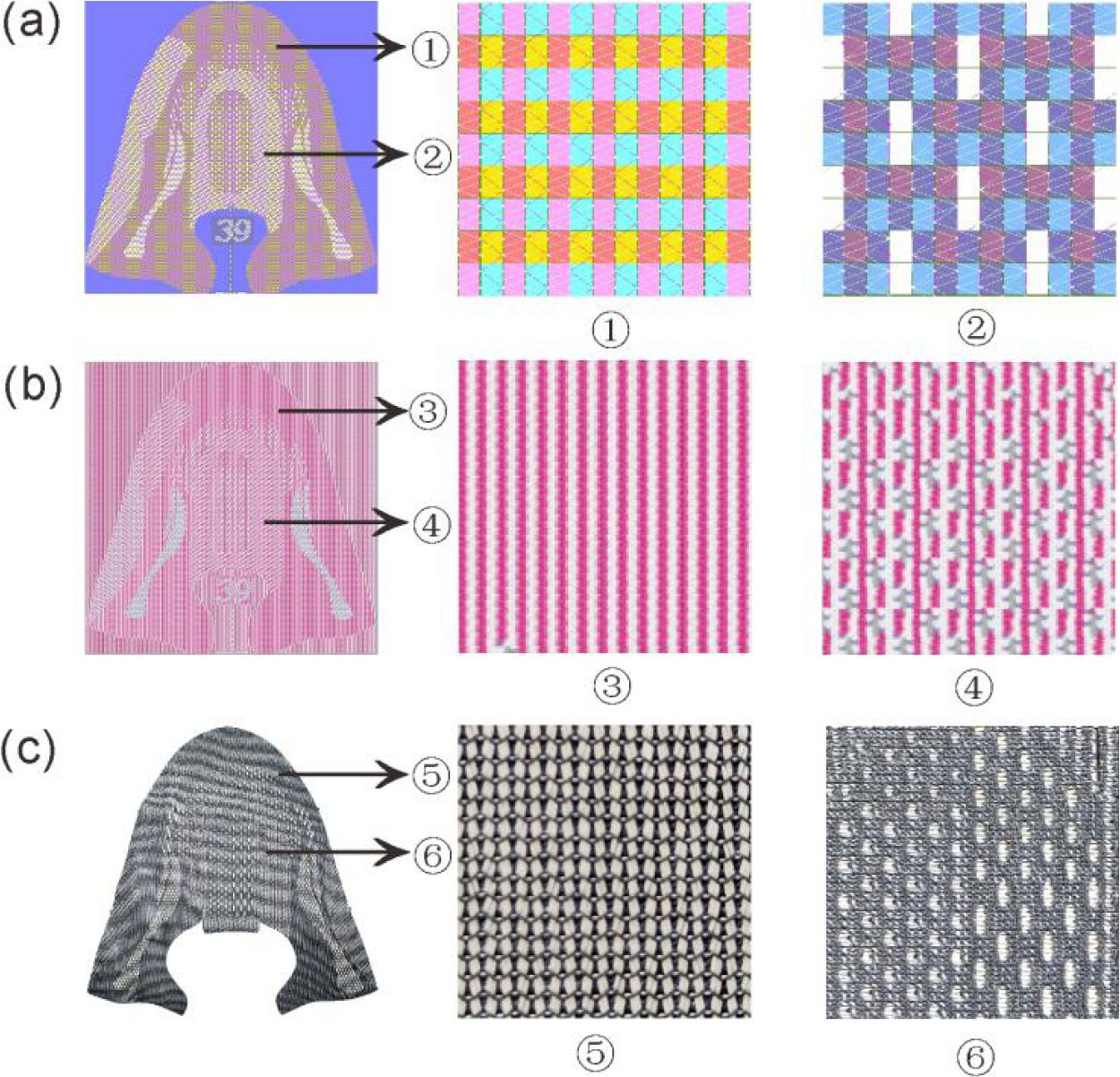
Fig. 5.
Single jacquard shoe vamp fabric designed: (a) jacquard graph, (b) simulation diagram, (c) practical diagram
Table 6.
Knitting process parameters of RSJ5/1 machine
| Guide bar | Lapping data | Threading | Raw material | Warp run-in/(mm/rack) |
|---|---|---|---|---|
| GB1 | 1-0/1-0// | All in | 111.0 dtex/72 f polyester FDY | 1400 |
| JB2.1 | 1-0/1-2// | All in | 166.7 dtex/72 f polyester DTY | 1950 |
| JB2.2 | 1-0/1-2// | All in | 166.7 dtex/72 f cationic polyester DTY | 1950 |
| GB3 | 1-0/0-1// | All in | 111.0 dtex/72 f polyester FDY | 1400 |
| GB4 | 0-0/1-1// | All in | 83.3 dtex/36 f polyester FDY | 600 |
6. Process design of double jacquard spacer fabric
6.1. Design of raw material
The vamp materials commonly used are similar to single jacquard fabric. Sometimes yarns with special properties are employed, such as reflective yarns, segment dyed yarns, yarns with antibacterial and deodorizing functions, et al [9].
The selection of yarns in warp-knitted jacquard shoe vamp fabric determines the physical properties and wearing comfort of vamp materials to a great extent. Polyester exhibits high strength and good abrasion resistance, but its high dyeing temperature renders the difficulty of dark dyeing. Thus, it is extensively used in the development of monochromatic jacquard fabrics. The dyeing temperature of cationic modified polyester is round 25°C lower than that of polyester, which contributes to dyeing dark fabrics. However, the dyeing time is too long and it is easy to be brittle, which affects the physical properties, such as the tensile, tearing and abrasion resistance of the fabric. It is often applied to develop two-color jacquard fabric or dark jacquard fabric. Nylon is more elastic than polyester and easy to retract, which will lead to a discrepancy in the actual proportion between the finished product and the model. And the stability of nylon is inferior to polyester. It is often used in the development of two-color or multiple-color jacquard fabric with polyester.
Spandex is relatively less used for jacquard vamp fabric due to its high elasticity and great difficulty in shaping. Functional yarn is generally thick and hard, which easily wears out the jacquard bars, and it is difficult to knock over in the process of knitting. Herein, it is not suitable for a jacquard guide bar. Functional yarn is usually used on a warp-knitting machine in smaller gauge, but the resultant fabric feels hard. Additionally, the selection of the gauge of the warp-knitting machine has great correlation with the fineness of the raw materials employed [19]. Moreover, the number of yarn feeders will also affect the hand feeling of the fabric. For the same linear density of yarn, the larger the number of yarn feeders, the more delicate the fabric feels. And the weight of the raw material network structure will have an effect on loop coverage and the hand feeling of the fabric.
6.2. Design of stitch structure
In this paper, the jacquard shoe vamp fabric designed adopts the technical face on the back needle bar as the practical face. The main function of the ground guide bar is to form the ground layer or spacer layer. Locknit and mesh stitches are common stitches employed by the ground guide bar. To ensure shape preservation along the longitudinal direction of the fabric, the chain stitch can be applied with one ground guide bar. When designing a double jacquard stitch, jacquard stitches also vary in accordance with different parts of the shoe vamp, like the single jacquard design above.
6.3. Design of pattern structure
6.3.1. Calculation of pattern size
When drawing a jacquard graph, red is usually used to represent a dense stitch, while white stands for a mesh stitch. The shoe vamp graph is shown in Figure 6, and Figure 6(b) and (c) are partially enlarged graphs of Figure 6(a). The lines in Figure 6(b) represent the outer outline of the shoe vamp. The dense stitch outside the lines is relatively close, while the mesh stitches of the whole shoe body are sparse. If the mesh stitch is close to the outer outlines, the sparse mesh stitch will be stretched outward by the dense stitch after the setting process. As a result, the mesh stitch will exceed the area of the outer outlines. In an attempt to avoid this situation, when there is a large variation in the density degree of the stitch structure, the mesh stitch is usually indented 1.5–3.0 mm into the outer outline according to the requirement. And the greater the distinction is, the more the inward indentation is, as shown in Figure 6(c).
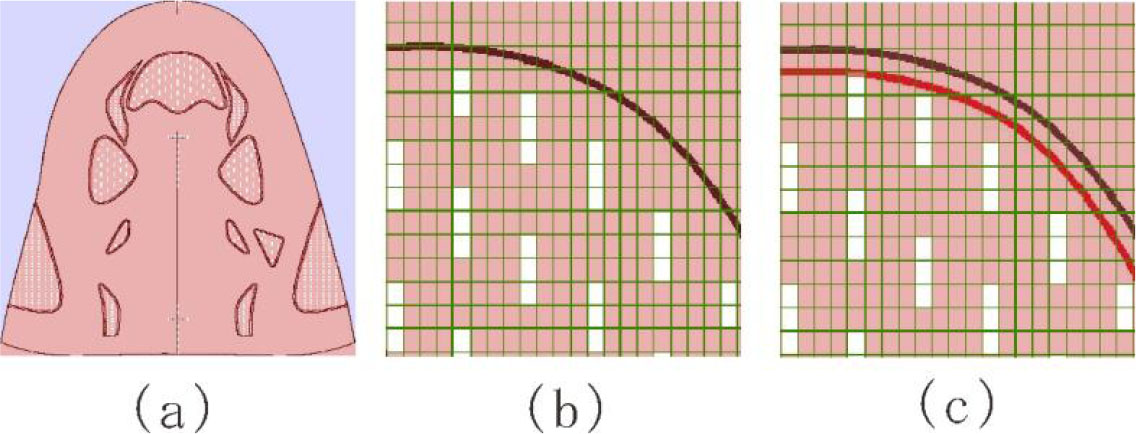
Fig. 6.
Jacquard graph of warp-knitted double jacquard shoe vamp fabric:(a) jacquard graph, (b) partially enlarged graph, (c) partially enlarged graph after inward indentation
6.3.2. Design of pattern
Taking the age of the wearer into account is of great significance when designing jacquard pattern. The design of a children’s shoe vamp is mainly based on cartoon animation, which is in consistence with the innocence of children. The design of a youth’s shoe vamp mainly considers passion and vitality, reflecting the energetic aspect of teenagers. And the design of an adult’s shoe vamp tends to be simple, reflecting the maturity and stability of adults. In addition, the pattern lines should not be too fine or too dense. For instance, when leaf veins are reflected by jacquard fabric, the veins are too delicate and not easy to be reflected on the fabric. Under this circumstance, the leaf veins can be enlarged, which will be easier to achieve, and more supple and beautiful lines can be obtained.
6.3.3. Balance of yarn tension
For a double jacquard warp-knitting machine with double needle bars, because the jacquard guide bar can make a displacement at the time when overlapping or underlapping occurs on the front or back needle bar, the resultant fabric may form loops on only one needle bar or two needle bars in the same course. Another situation is that there is no loop but miss-lapping on the front and back needle bars. Consequently, controlling the balance of yarn tension has become a major difficulty in stitch design and knitting on the machine [7]. In the process of design, the total looping number of each longitudinal yarn on the front and back needle bars should maintain almost no variation to avoid yarn breaking caused by excessive difference in local yarn tension.
6.4. Design of process parameter
Warp-knitted double jacquard spacer fabric can be produced on a RDPJ5/2 or RDPJ6/2 double jacquard warp-knitting machine. Owing to the different difficulty degree of the double jacquard process and different speed of the machine, the machine gauge with respect to the shoe vamp is usually 22 or 24 pin/25.4 mm. The course density of the finished product is generally controlled at 9.44–10.63 wale/cm. The loom-stage density is usually set to 13.00–18.00 course/cm.
6.5. Example of operating process design
6.5.1. Material selection
For the warp-knitted double jacquard spacer fabric developed in this paper, jacquard bars on the front and back needle bars were threaded in yarns with different dyeing performances. The front jacquard bar was threaded with 16.67 tex (150 D) cationic polyester mixed yarn, while for the back jacquard bar, 16.67 tex black polyester yarn was applied. Two-color jacquard fabric could be obtained directly on the machine, and the tricolor effect could be realized after dyeing.
6.5.2. Separated areas of jacquard fabric
A permeable mesh stitch was chosen for the tip and both sides of the shoe to ensure air permeability. A dense and thick stitch was selected for the foot tarsal to support the shoes. It is of great necessity for the mouth of shoes to have better flexibility when worn, thus thin tissue was selected [20].
6.5.3. Jacquard graph
A jacquard graph of the warp-knitted jacquard fabric was drawn for different jacquard areas of the fabric using warp-knitting CAD software. According to the separated areas of the jacquard fabric, different stitch structures were selected in different areas. Then, the jacquard graph was drawn, with different colors representing different stitch structures [18].
6.5.4. Process parameters
An RDPJ6/2 warp-knitting machine was chosen to produce the fabric. The working width of the machine is 345 cm (136″) and the machine gauge 24 pin/25.4 mm adopted The electronic shogging mechanism and electronic let-off mechanism were adopted. The number of headlines used in the ground guide bar was 528, while that used in the jacquard bar was 264. The warp run-in was set according to the yarn used in the lapping movement of the corresponding guide bar. The machine speed was 350 r/min, the distance of the knocking-over bar 2.5 mm, the drawing density of the fabric 15.50 course/cm, and the gram weight of the fabric was 349 g/m2. The knitting process parameters are shown in Table 7.
Table 7.
Knitting process parameters of RDPJ6/2 machine
| Guide bar | Lapping data | Threading | Raw material | Warp run-in/(mm/rack) |
|---|---|---|---|---|
| GB1 | 1-2-1-1/1-0-1-1// | All in | 111.0 dtex/48 f polyester FDY | 2250 |
| GB2 | 2-1-2-3/1-2-1-0// | All in | 33.3dtex polyester monofilament | 8000 |
| JB3.1 | 1-0-1-0/1-2-1-2// | All in | 166.7 dtex/72 f cationic polyester mixed DTY | 3550 |
| JB3.2 | 1-0-1-0/1-2-1-2// | All in | 166.7 dtex/72 f cationic polyester mixed DTY | 3550 |
| JB4.1 | 1-0-1-0/1-2-1-2// | All in | 166.7 dtex/72 f dark polyester DTY | 3550 |
| JB4.2 | 1-0-1-0/1-2-1-2// | All in | 166.7 dtex/72 f dark polyester DTY | 3550 |
| GB5 | (1-1-1-0/1-1-1-2/)*2/ | 1A1* | 111.0 dtex/36 f polyester FDY | 1950 |
| GB6 | (1-1-2-3/1-1-2-1/)*2// | 1*1A | 111.0 dtex/36 f polyester FDY | 1950 |
A plain stich was knitted by GB1 as the basic cloth, a spacer layer was formed by GB2. and GB5 and GB6 were used to knit a mesh stitch, forming jacquard effect face basic cloth. And the jacquard effect face was obtained by JB3 and JB4, which were alternately knitted into loops on the front and back needle bars. Simulation diagrams, a jacquard graph and practical diagrams of the shoe vamp fabric designed are shown in Figure 7.
6.5.5. Test data report
According to the production mode proposed in this study, a physical performance test report of the product was written, shown in Table 8.
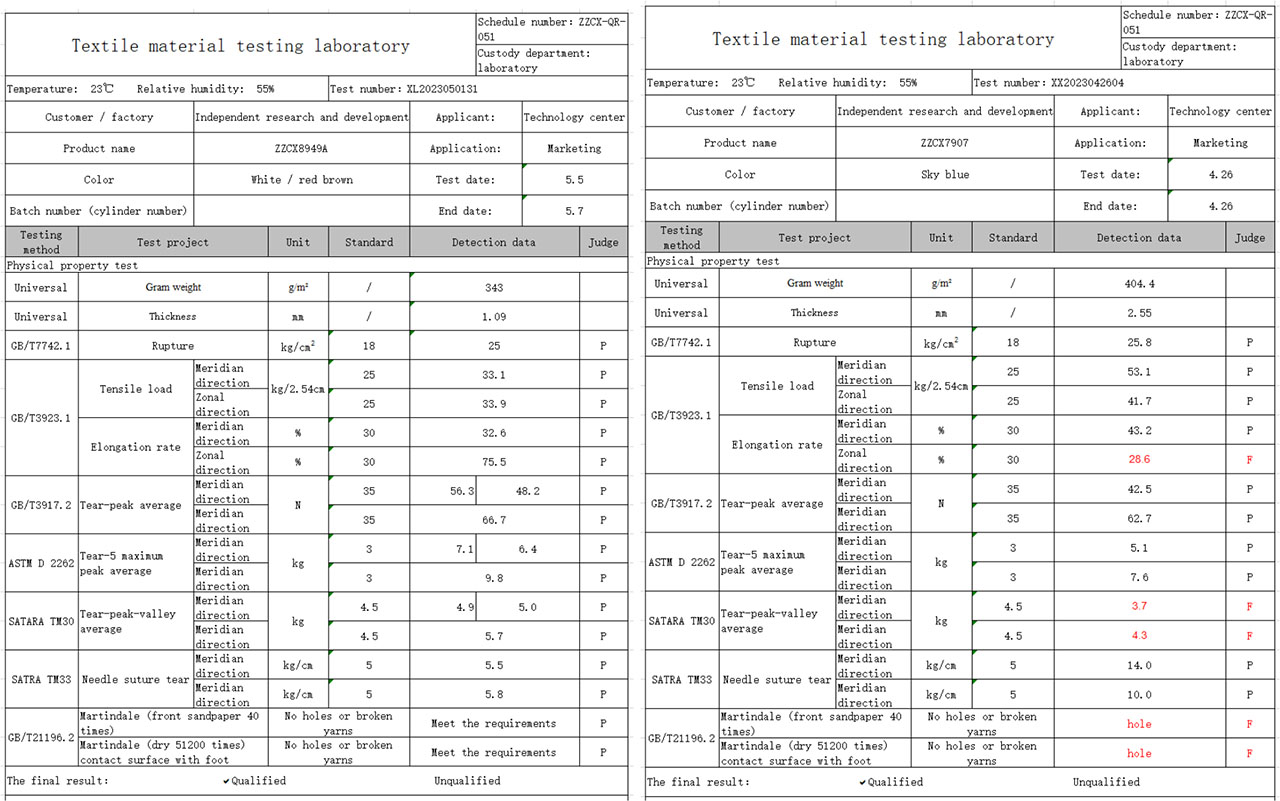
As detailed in Table 8, the tensile strength, rupture, elongation, tear resistance, and Martindale wear resistance of the product obtained in this study (ZZCX8949A) surpass the testing standards outlined in the Standard column (which is the highest standard set by the textile laboratory for the needs of domestic and international brands). In contrast, the physical property report labeled ZZCX7907, corresponding to traditional jacquard products, shows that its weft elongation, tear resistance in both the warp and weft, and Martindale wear resistance fall short of these standards. This comparison highlights the physical property advancements achieved by the products developed in this study.
7. Conclusion
1) The jacquard principle of single and double jacquard is introduced, which provides a theoretical basis for the development of warp knitted single and double jacquard fabrics.
2) This paper introduces a design method for single and double jacquard shoe vamp fabric and provides a theoretical basis for the development of warp-knitted single/double jacquard fabric with double needle bars.
3) Taking the practical operating process design of two types of fabrics as an example, the process parameters of the fabric were designed according to the characteristics of the warp-knitting machine. Finally, single and double jacquard shoe vamp fabrics with a rich pattern and color appearance were obtained. The proposed method is feasible and offers an effective practical method for the production and research of warp-knitted single/double jacquard shoe vamp materials.