
Table 1.
The type of disease depends on the frequency of vibrations [1]
| Activity | Disease | Frequency, Hz |
|---|---|---|
| All | Labyrinth disorders | 5 – 15 |
| Operator of a construction machine | Bone lesions, vascular neurosis | 70 – 200 |
| Driver of an agricultural tractor | Changes along the spine within the intervertebral joints | 6 – 12 |
| Operator of a manual mechanical tool, e.g. a hammer drill | Osteoarticular changes | 10 – 130 |
| Truck driver | Nerve vascular disease | 40 – 260 |
| Operator of a machine for whipping the ground | Abnormalities in the circulatory system | above 30 |
| Operator of an orbital sander | Disorders in the muscular system | 50 |
| Operator of a pneumatic hammer | Paroxysmal finger skin whitening | above 30 |
| Helicopter pilot | Weakness of vision, blurred vision | 18 |
| Machine operator for excavation and drilling | Angioneurotic problems Raynaud syndrome Keratosis of the skin Sensation problem | 40 – 300 |
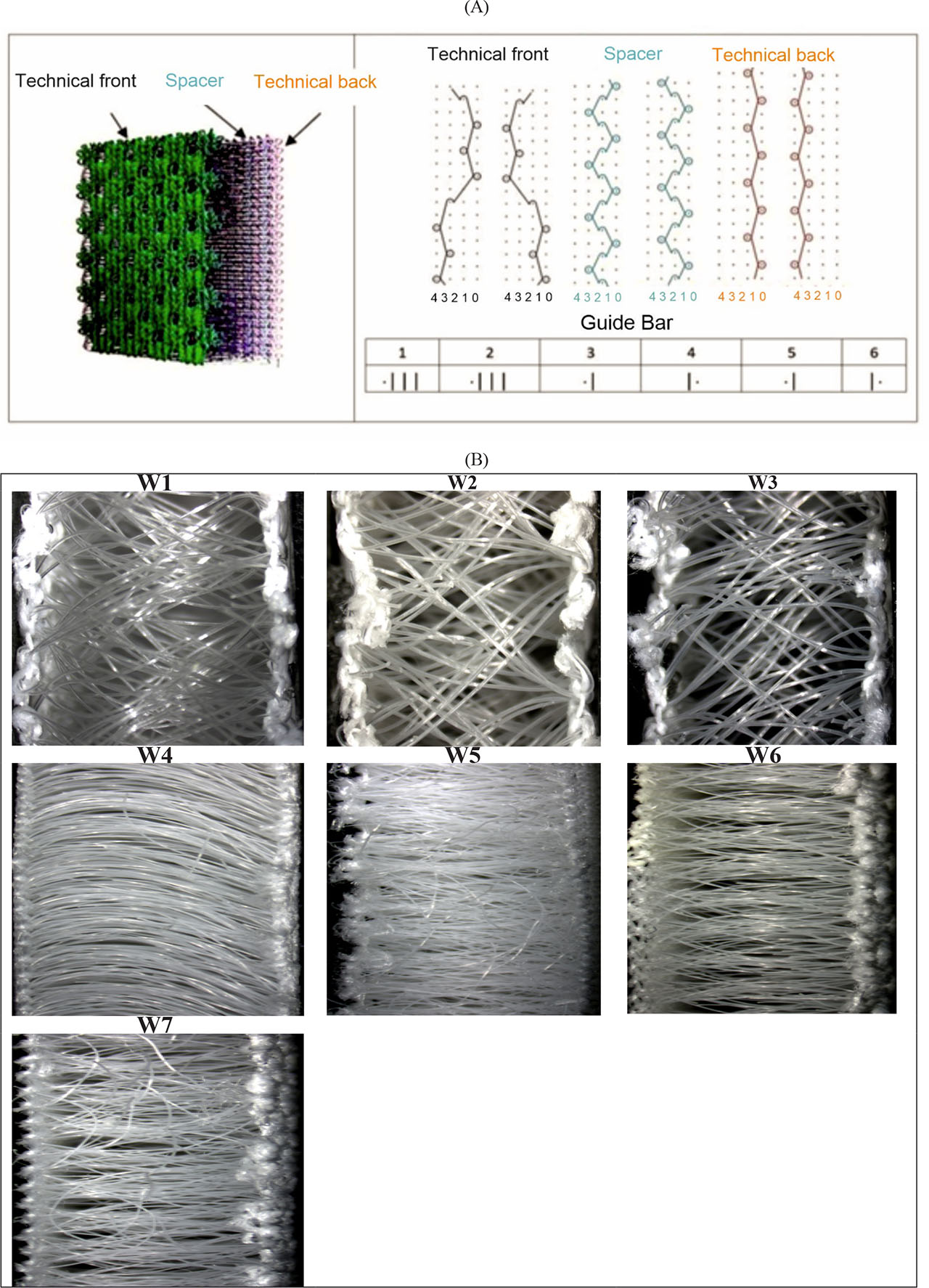
Fig. 1.
(A) Example construction of a spacer knit structure; CAD visualization of knitted structure, guide bar of front and back view and spacer. (B) Cross section photographs of all the variants of the tested materials (OPTA-TECH X2000 microscope, magnification range: standard equipment 8-80x (head 1:10); from 8x 330x (optional equipment - head 1:10)
Table 2.
Physical and mechanical parameters of distance knitted fabrics
| Thickness, mm | Areal density, g/m2 | Stiffness compression module, kPa | Material | |
|---|---|---|---|---|
| W1 | 16.94 | 642 | 31.54 | polyester |
| W2 | 15.22 | 786 | 56.37 | polyester |
| W3 | 14.43 | 661 | 41.57 | polyester |
| W4 | 7.98 | 743 | 111.34 | polyester |
| W5 | 8.18 | 489 | 29.46 | polyester |
| W6 | 6.30 | 446 | 83.42 | polyester |
| W7 | 5.30 | 400 | 117.82 | polyester |
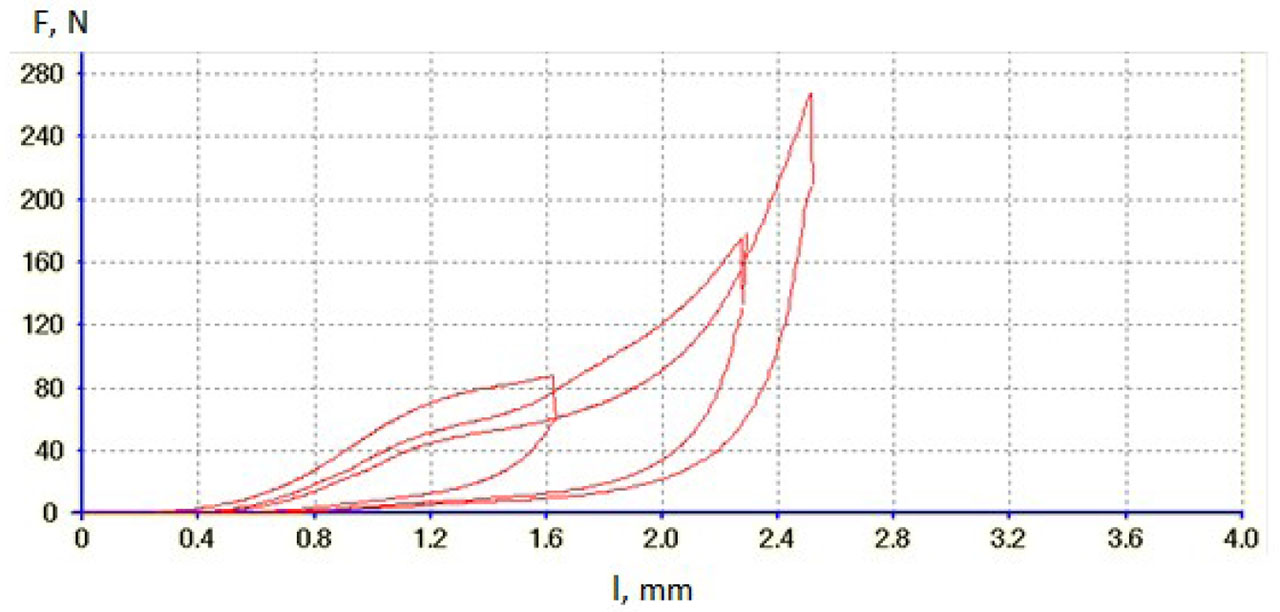
Fig. 2.
Hysteresis loops for compression forces F25%, F50% and F75% for sample W5
Table 3.
Linear density of component yarns of spacer knitted fabrics
| Code of yarn | Yarn 1 | Yarn 2 | Yarn 3 | Yarn 4 | Yarn 5 | Yarn 6 |
|---|---|---|---|---|---|---|
| linear density of mass | tex | tex | tex | tex | tex | tex |
| W1 | 167 | 167 | 434 | 434 | 167 | 167 |
| W2 | 167 | 167 | 677 | 677 | 167 | 167 |
| W3 | 167 | 167 | 677 | 677 | 167 | 167 |
| W4 | 111 | 111 | 50 | 50 | 111 | 111 |
| W5 | 111 | 111 | 50 | 50 | 111 | 111 |
| W6 | 111 | 111 | 50 | 50 | 111 | 111 |
| W7 | 111 | 111 | 50 | 50 | 111 | 111 |
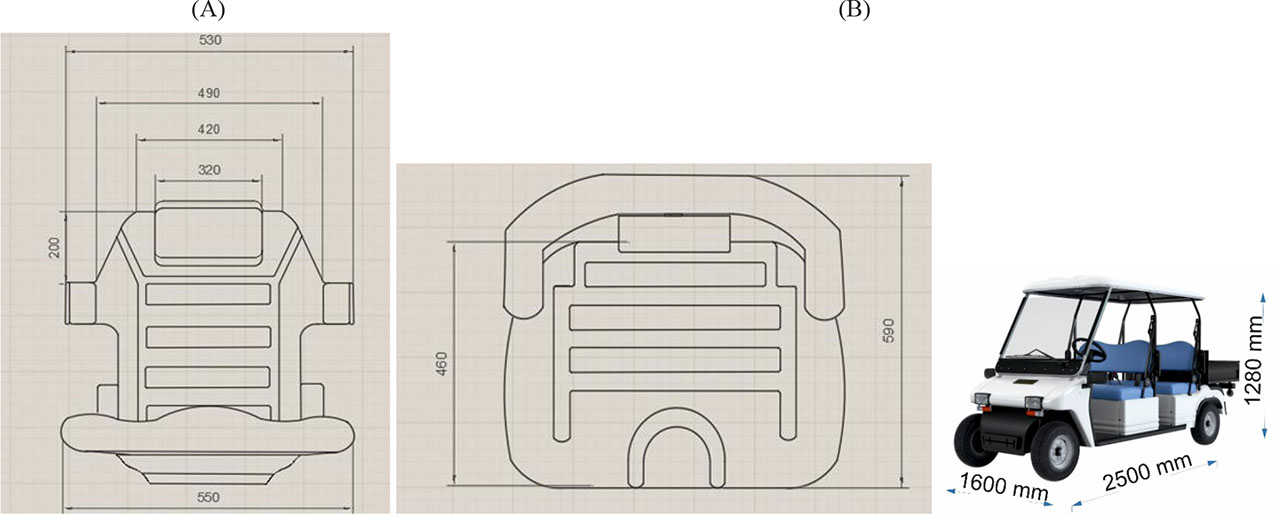
Fig. 3.
Main dimensions of the seat of the melex test vehicle: (A) front view and top view ; (B) Melex dimensions
Table 4.
List of detailed dimensions of the Melex test vehicle
| Parameter | Dimension in, 10−3m | |
|---|---|---|
| MELEX vehicle dimensions | Length of melex | 2500 |
| Width of melex | 1600 | |
| Height of melex | 1280 | |
| Length of seat | 1100 –for 2 people; 530 –for 1 person | |
| Distance from floor to the seat (seat height) | 360 | |
| Distance from seat to the inside back of seat | 250 | |
| Seat dimensions | Width of seat | 530 |
| Length of inside back of seat | 490 | |
| Width of inside back of seat | 460 |
Table 5.
Anthropometric measurements of the human body
| Nr. | Body Measurements | Measurement, 10−3m |
|---|---|---|
| 1 | Hip Circumference | 346 |
| 2 | Thigh length from rise to knee level | 472 |
| 3 | Sciatic bone length finishing at buttock level | 134.3 |
| 4 | Length from the middle of knee to the end of the buttock | 606.3 |
| 5 | Length from the knee level to the end of the buttock | 646 |
| 6 | Length from the middle of the knee to the end of the knee | 39.7 |
| 7 | Length from the floor to hip level (hip height) | 99.4 |
| 8 | Length from the floor to knee level (knee height) | 52,2 |
| 9 | Knee height; middle of knee height | 108; 54 |
| 10 | Tibia length from ankle to knee level | 429 |
| 11 | Length from the floor to the knee bentat 95° | 466 |
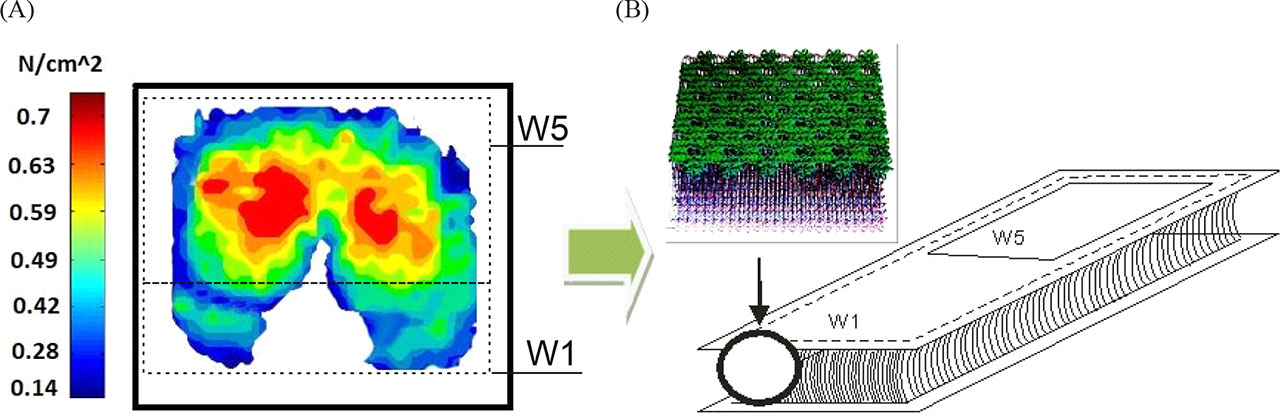
Fig. 4.
(A) Distribution of pressure forces on the seat through the lower body part for a typical man;. (B) Scheme of the distribution of knitted layers in the prototype seat – consisting of two segments of material, W5 and W1
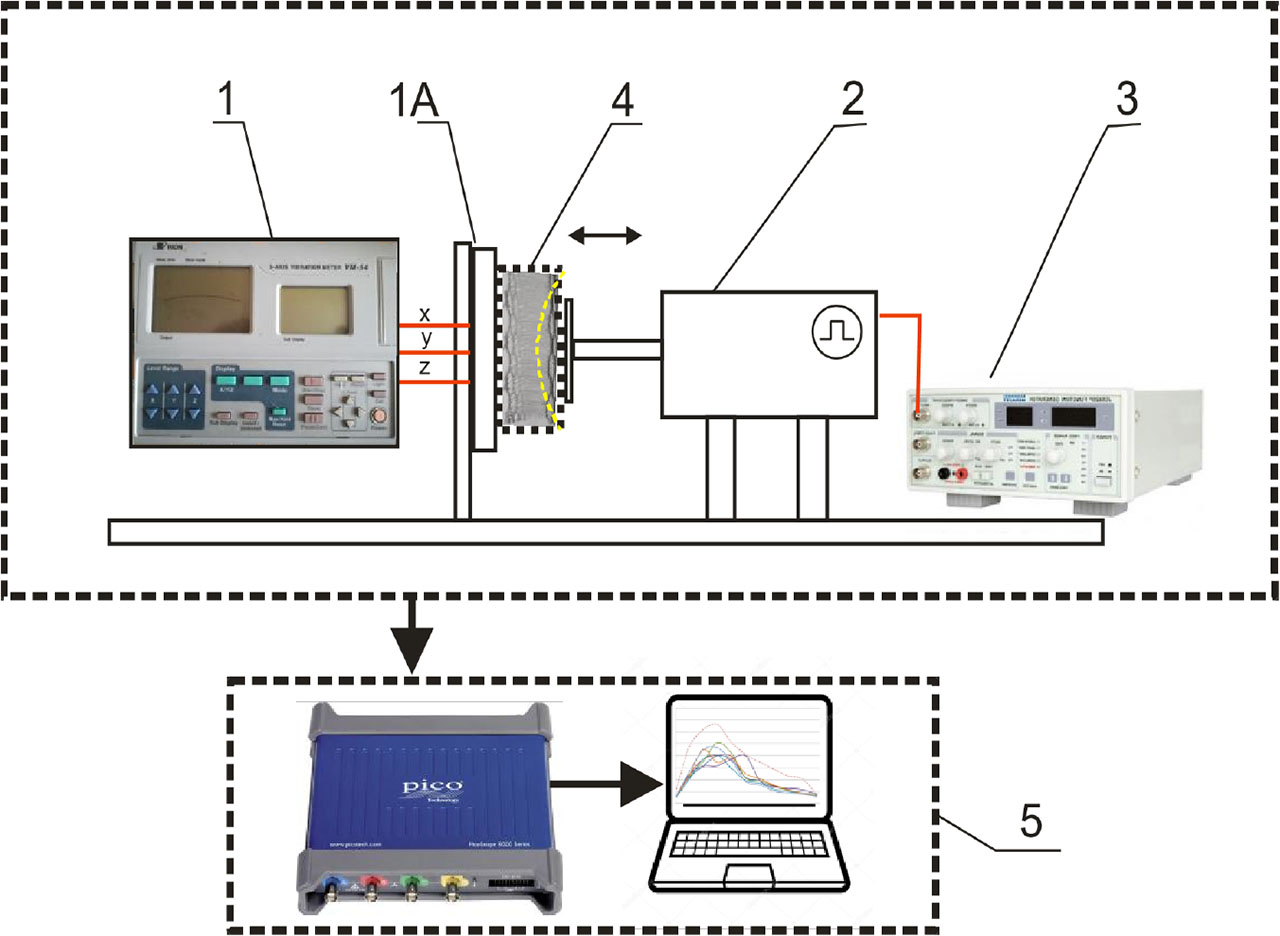
Fig. 5.
Laboratory scheme used to measure the overall vibration excitation in the low frequency range
Table 6.
List of standards for testing vibrations transmitted by the chair onto the human body in real conditions [23,24]
| Norm | Norm name |
|---|---|
| ISO 2631 – 1:1997 | Mechanical vibrations and shocks - assessment of human exposure to whole body vibration - part 1: General requirements |
| ISO 8041 - 2005 | Human reaction to vibrations - measuring instrumentation |
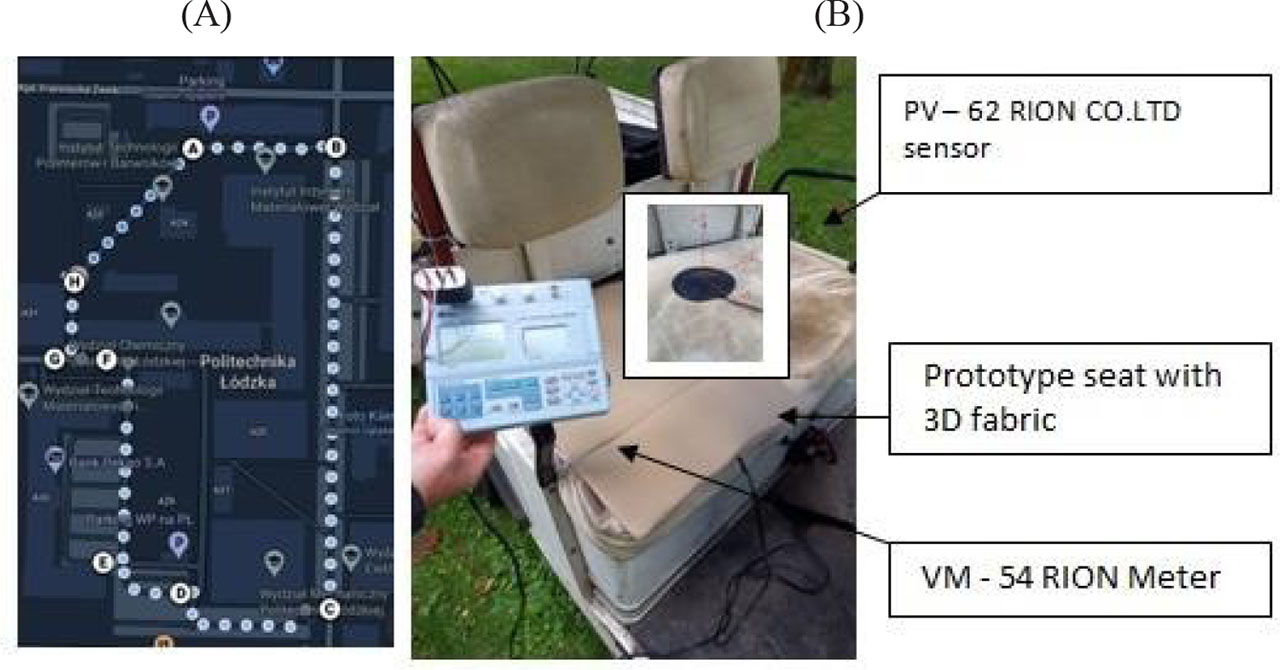
Fig. 6.
(A) Dotted line shows the route taken for the two tests. (B) Components of the measuring system; prototype seat with 3D knitted fabric and the measuring system: meter VM - 54 RION and sensor PV - 62 RION CO.LTD.
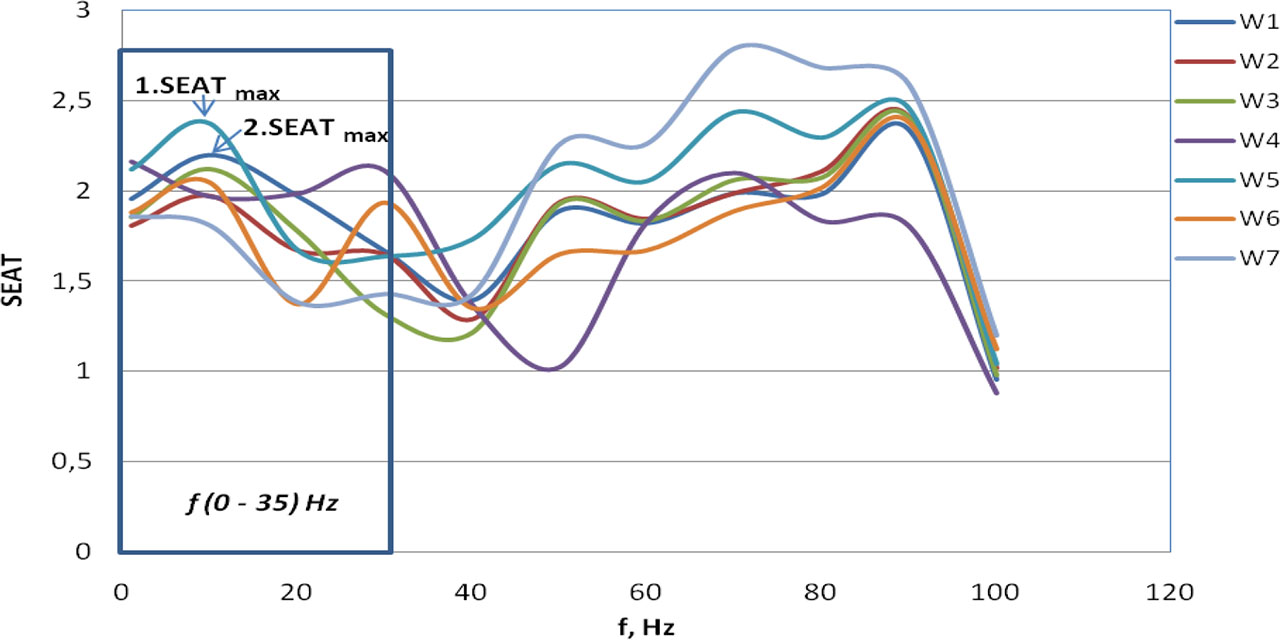
Fig. 7.
Characteristics of the SEAT damping protection effectiveness coefficient for the materials tested
Table 7.
Average RMS values and the calculated SEAT damping coefficient for individual components X, Y, Z
| Average value RMS (X) | Average value RMS (Y) | Average value RMS (Z) | |
|---|---|---|---|
| Sample Zero - Mean | 1.146 m/s2 | 0.625 m/s2 | 2.130 m/s2 |
| Medium sample | 0.765 m/s2 | 0.626 m/s2 | 2.053 m/s2 |
| SEAT coefficient for the prototype seat | 1.499 | 1.000 | 1.000 |
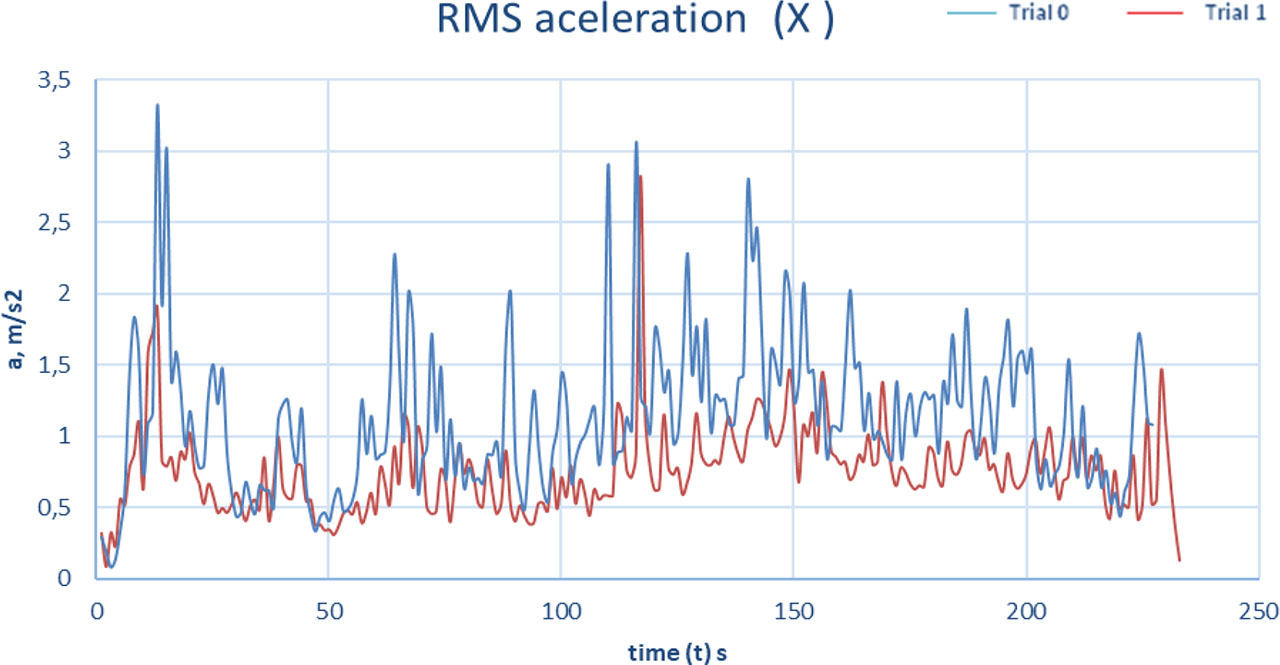
Fig. 8.
Graph showing RMS acceleration (a, m/s2) values over time for the X axis
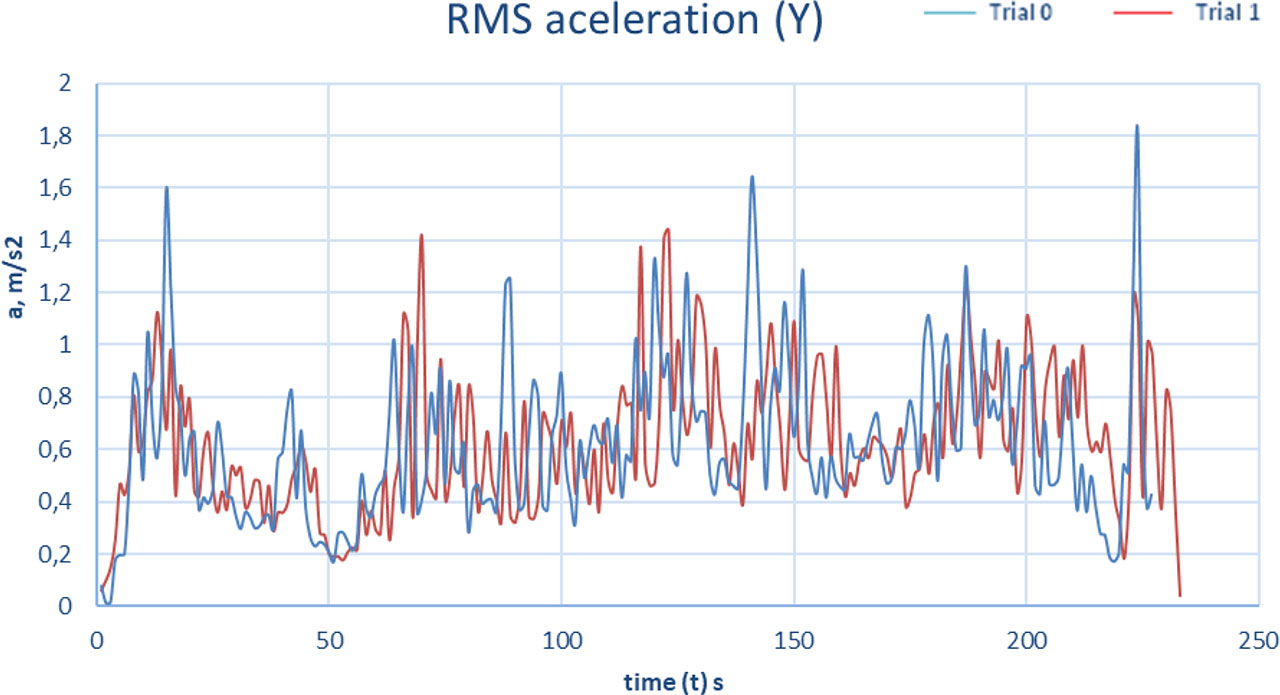
Fig. 9.
Graph showing RMS acceleration (a, m/s2) values over time for the Y axis
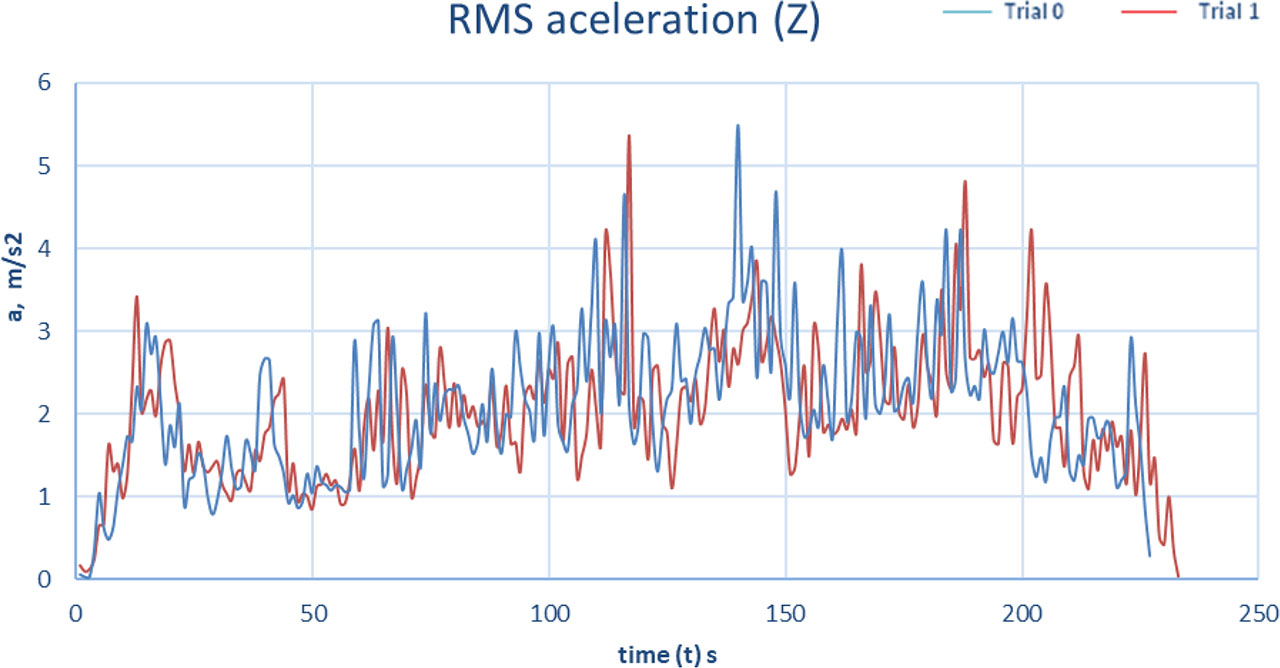
Fig. 10.
Graph showing RMS acceleration (a, m/s2) values over time for the Z axis
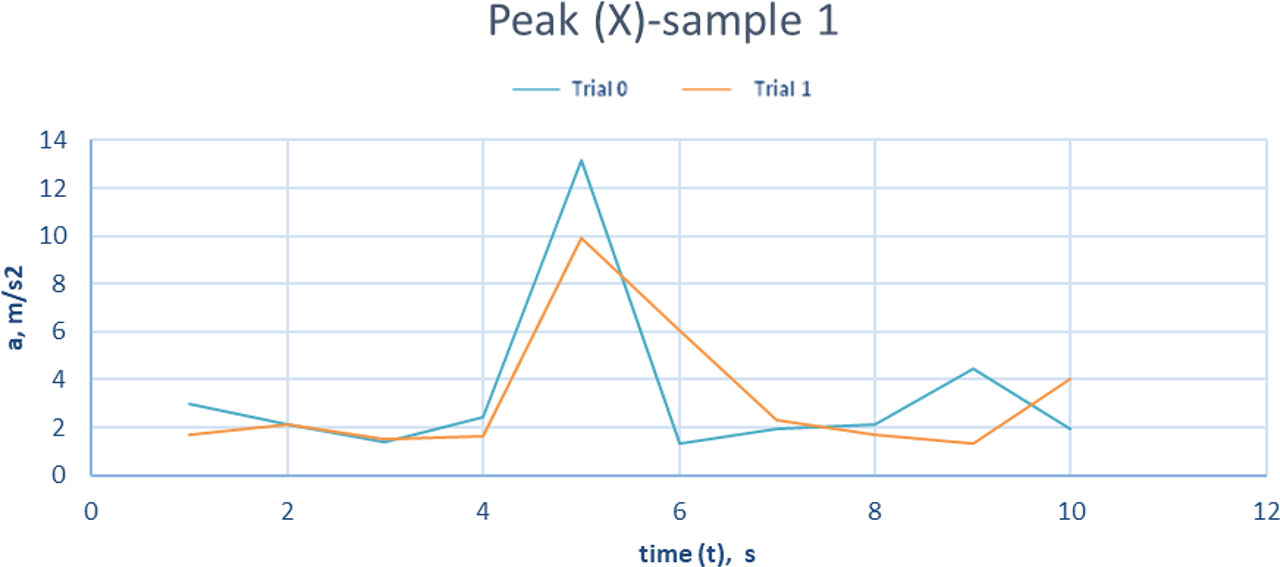
Fig. 11.
Graph showing the values of the instantaneous peak accelerations for the X axis – sample 1
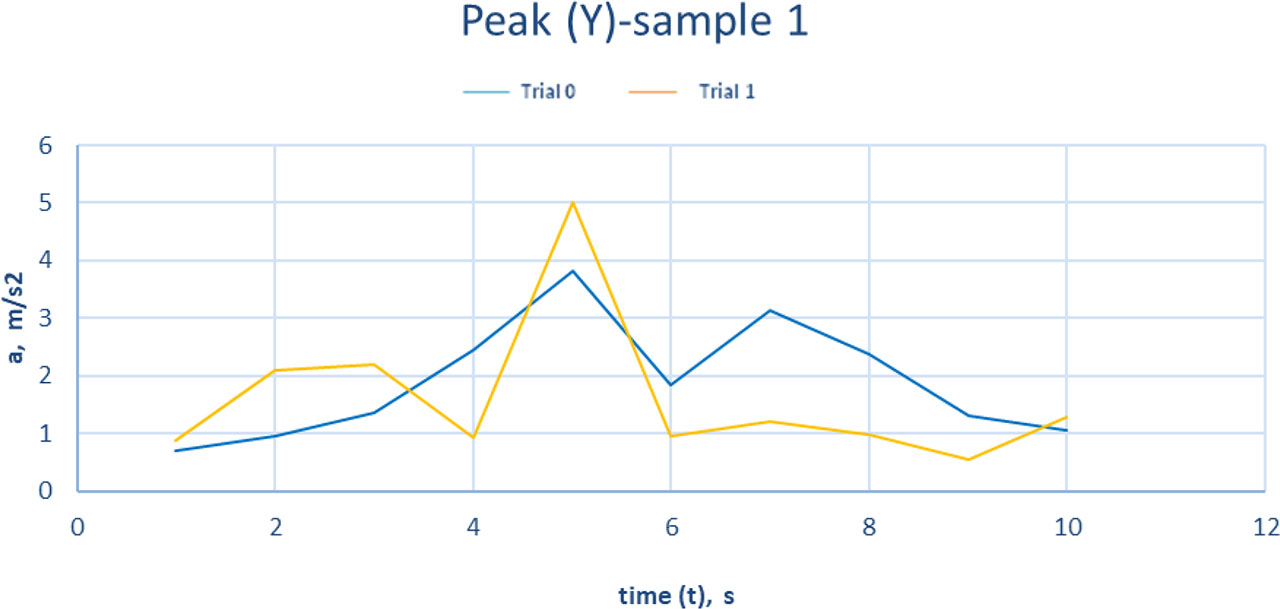
Fig. 12.
Graph showing the values of the instantaneous peak accelerations for the Y axis – sample 1
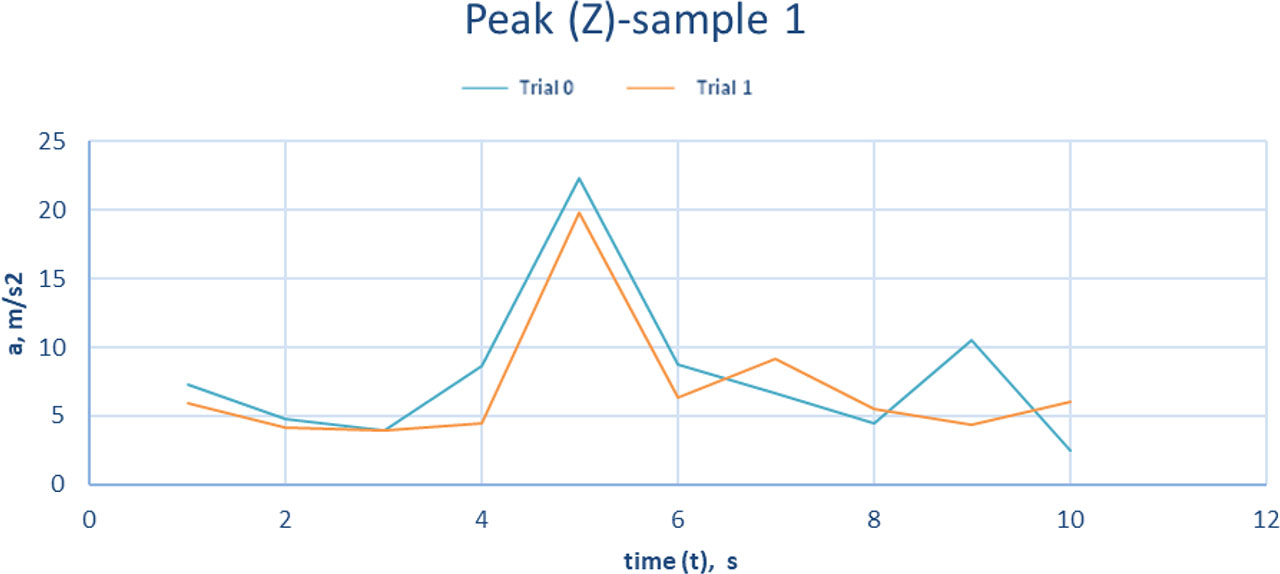
Fig. 13.
Graph showing the values of instantaneous peak accelerations for the z axis – sample 1
Table 8.
SEAT coefficient for instantaneous peak accelerations on selected segments for individual axes at 10-second segments and at the highest point
| Segment number | X Axis | Y Axis | Z Axis | |
|---|---|---|---|---|
| SEAT factor (10 second segment) | Segment 1 | 1,5 | 1,0 | 1,2 |
| Segment 2 | 1,1 | 1,2 | 1,1 | |
| SEAT ratio at the highest point | Segment 1 | 1,6 | 1,0 | 1,1 |
| Segment 2 | 1,3 | 0,8 | 1,3 |