
Table 1.
pH value of extract and chemical pigment
| № | Dye solution | PH |
|---|---|---|
| 1 | Oak bark (Quercus cortex) | 3,5 |
| 2 | Chemical pigment | 6,5 |
Table 2.
Finishing recipe used in application
| CHEMICALS | APPLICATION Coat (gramme) | DESCRIPTION |
|---|---|---|
| Stage 1 | ||
| CPT 2350 | 150 | Acrylic Binder (Alpa Chemistry) |
| CPT 2345 | 150 | Binder (Alpa Chemistry) Acrylic Polymer |
| CPU 1641 | 150 | Polyurethane Binder (Stahl) |
| CRE 1036 | 200 | Acrylic Binder (Alpa Chemistry) |
| CST 6760 | 200 | StukoWax (Alpa Chemistry) |
| CW 171 | 50 | Synthetic Wax (Alpa Chemistry) |
| CW 159 | 50 | StukoWax (Stahl) |
| CST HD | 50 | Polyurethane Binder (Stahl) |
| Dyestuff | 2000 | Plant Extract (oak bark) or chemical pigment |
| 1) 3×spray – RotoPress (80°C, 150 Bar) - 3×spray – RotoPress (80°C,70 Bar) - 3×spray (80°C,70 Bar) | ||
| Stage 2 | ||
| CK 1622 | 150 | Polyurethane lacs (Stahl) |
| Dyestuff | 300 | Plant Extract (oak bark) or chemical pigment |
| 1) 2×spray – RotoPress (90°C, 70Bar) | ||
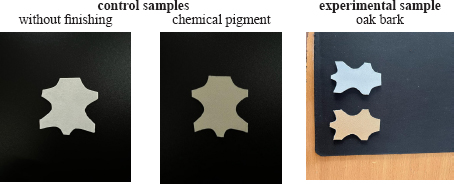
Fig. 1.
Leather samples
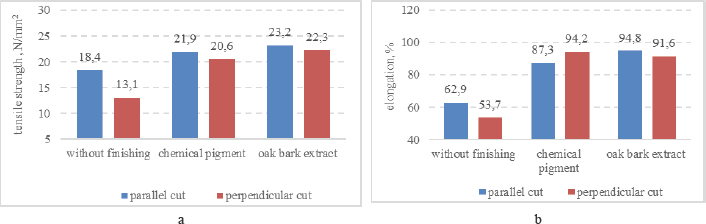
Fig. 2.
Physical and mechanical properties of leather samples
Table 3.
Values of the single and double edge tear load of the finished and control groups
| SamPles | Edges | Thickness, mm | Tear load, N |
|---|---|---|---|
| Control | |||
| Without finishing | Single edge (Parallel) | 1.73 | 83.6 |
| Single edge (Perpendicular) | 1.72 | 96.7 | |
| Double edge (Parallel) | 1.72 | 158.2 | |
| Double edge (Perpendicular) | 1.78 | 155.9 | |
| Chemical pigment | Single edge (Parallel) | 1.75 | 87.5 |
| Single edge (Perpendicular) | 1.77 | 90.4 | |
| Double edge (Parallel) | 1.76 | 140.1 | |
| Double edge (Perpendicular) | 1.74 | 137.5 | |
| Experimental | |||
| Oak bark | Single edge (Parallel) | 1.78 | 94.1 |
| Single edge (Perpendicular) | 1.78 | 108.5 | |
| Double edge (Parallel) | 1.75 | 150.2 | |
| Double edge (Perpendicular) | 1.76 | 179.5 | |
Table 4.
Results of water absorption
| Type of leather | m1, g | m0, g | W0, % |
|---|---|---|---|
| Control | |||
| Without finishing (Parallel) | 7.78 | 5.55 | 40.1 |
| Without finishing (Perpendicular) | 7.46 | 5.64 | 32.3 |
| Chemical pigment (Parallel) | 6.13 | 4.93 | 24.3 |
| Chemical pigment (Perpendicular) | 6.79 | 5.35 | 26.9 |
| Experimental | |||
| Oak bark (Parallel) | 5.25 | 4.83 | 8.7 |
| Oak bark (Perpendicular) | 5.15 | 4.37 | 17.8 |
Table 5.
Results of water penetration
| Type of leather | mam1, g | mam0, g | mwt, g |
|---|---|---|---|
| control | |||
| Without finishing (Parallel) | 7.71 | 5.56 | 2.15 |
| Without finishing (Perpendicular) | 7.34 | 5.62 | 1.72 |
| Chemical pigment (Parallel) | 6.05 | 4.91 | 1.14 |
| Chemical pigment(Perpendicular) | 6.77 | 5.32 | 1.45 |
| Experimental | |||
| Oak bark (Parallel) | 5.01 | 4.82 | 0.19 |
| Oak bark (Perpendicular) | 5.08 | 4.34 | 0.74 |