
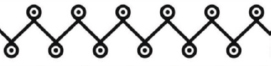
Fig. 1.
Diagram of 1×1 rib stitch used in the construction of the heating mat
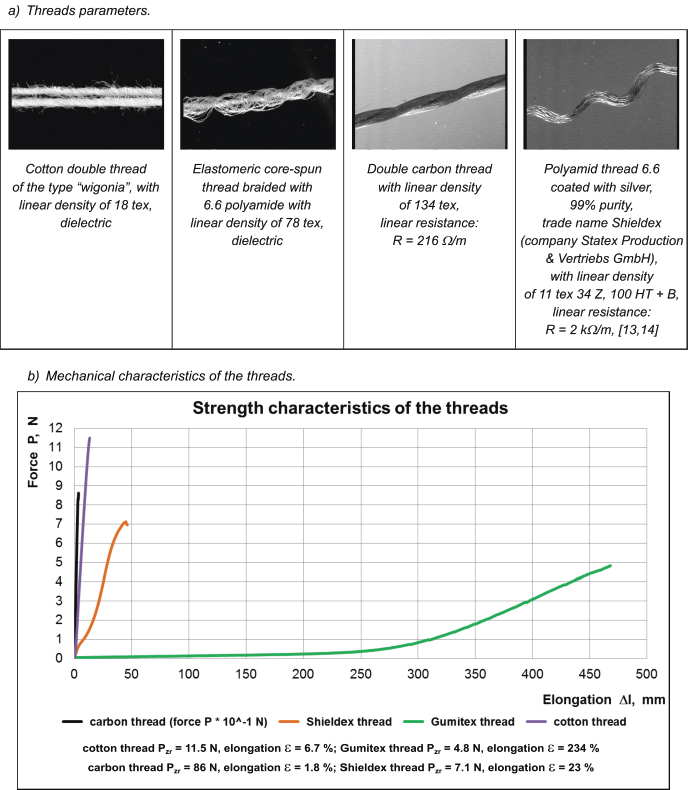
Fig. 2.
Characteristics of the threads used for manufacturing knitted fabric
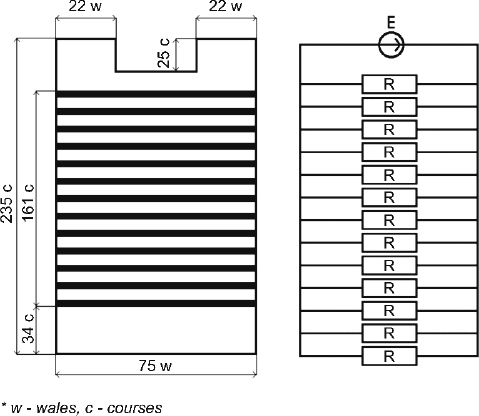
Fig. 3.
Schematic diagram of heating mat M1 and parallel connection of resistors
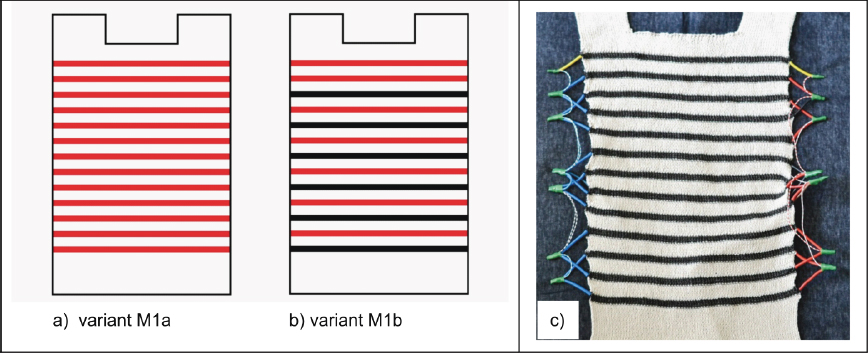
Fig. 4.
Supplying power to carbon strips: a) full, b) selective c) real view of the system
Table 1.
Characteristics of M1 heating mat
| Characteristics of M1 heating mat | |
|---|---|
| Supply voltage | 12 V |
| Power | 32 W for full powering of the strips, 16 W for selective powering |
| Maximum heating temperature | 60 °C |
| Mat dimensions | 470×300 mm |
| Additional information | The upper “patches” enable fastening the mat to the seat or back-rest |
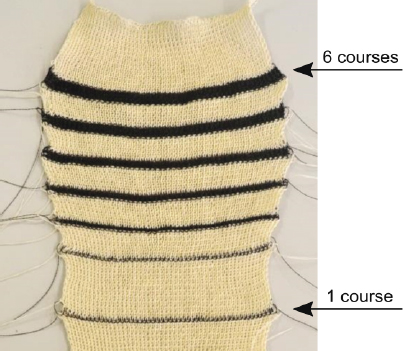
Fig. 5.
Knitted fabric with six heating strips with a varying number of courses made of carbon yarn
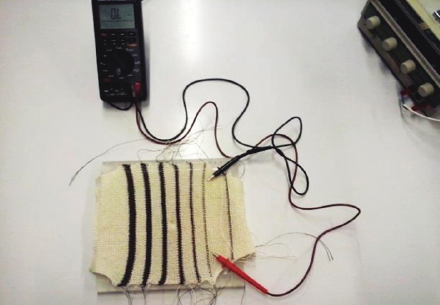
Fig. 6.
Measuring resistance of a fabric with a constant width of 22 cm
Table 2.
Resistance measurements for individual heating strips of the fabric made of carbon yarn
| Number of courses made of carbon yarn | Length of the strip after 24-hour relaxation, cm | Length of the course after stretching, cm | Length increase, % | Average resistance value of the strip after 24-hour relaxation, Ω | Average resistance value of the strip after stretching, Ω | Change in resistance value, % |
|---|---|---|---|---|---|---|
| 1 | 15.0 | 22 | 47 | 219 | 179 | -18.3 |
| 2 | 16.0 | 22 | 38 | 109 | 98 | -9.7 |
| 3 | 16.5 | 22 | 33 | 77 | 73 | -5.3 |
| 4 | 17.0 | 22 | 29 | 56 | 57 | 1.8 |
| 5 | 17.5 | 22 | 26 | 45 | 45 | 0.0 |
| 6 | 18.0 | 22 | 22 | 37 | 38 | 2.7 |
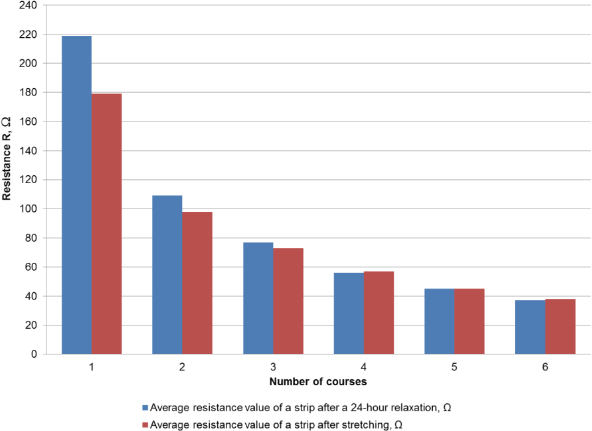
Fig. 7.
Graph of resistance changes depending on the change of width of the carbon strip
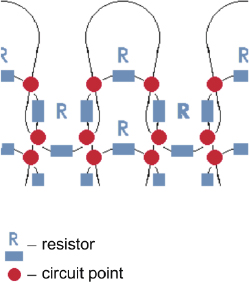
Fig. 8.
Schematic drawing of short-circuit points in the structure of the knitted loop
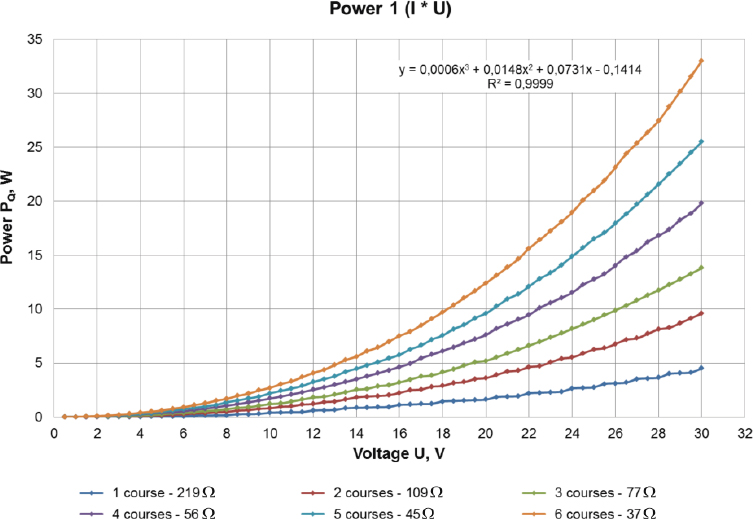
Fig. 9.
Dependence of the power of courses made of carbon threads as a function of the voltage increase
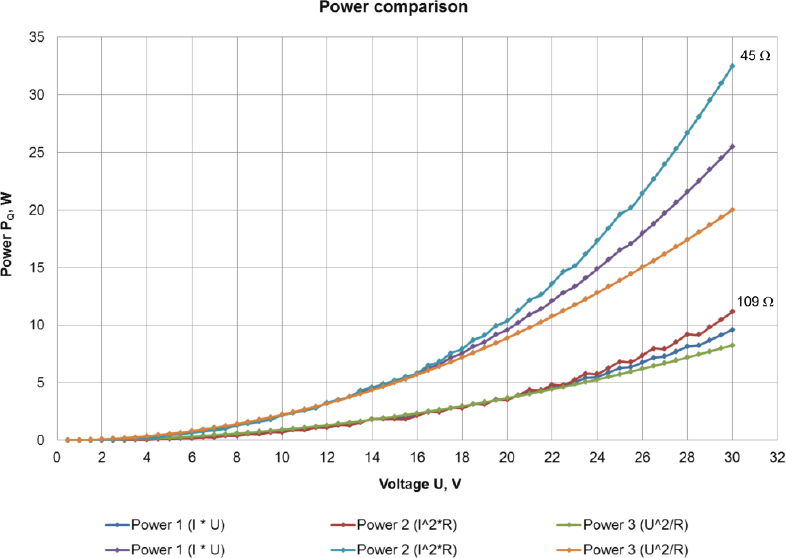
Fig. 10.
Differences in thermal power depending on the calculation method
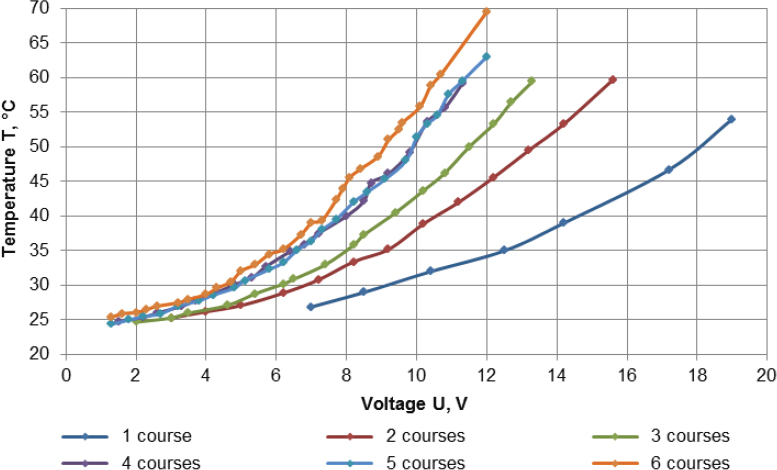
Fig. 11.
Diagram of temperature dependence on the voltage change for strips made of carbon yarn with different numbers of courses
Table 3.
Values of thermal power for courses made of carbon threads
| Width and resistance of the heating strip | Supply voltage | Power 1 (I×U), W | Power 2 (I2·R), W | Power 3 (U2/R), W |
|---|---|---|---|---|
| 1 course 219 W | U = 12 V | 0.60 | 0.55 | 0.66 |
| U = 24 V | 2.64 | 2.65 | 2.63 | |
| 2 courses 109 W | U = 12 V | 1.20 | 1.09 | 1.32 |
| U = 24 V | 5.52 | 5.77 | 5.28 | |
| 3 courses 77 W | U = 12 V | 1.80 | 1.73 | 1.87 |
| U = 24 V | 8.16 | 8.90 | 7.48 | |
| 4 courses 56 W | U = 12 V | 2.52 | 2.47 | 2.57 |
| U = 24 V | 11.52 | 12.90 | 10.29 | |
| 5 courses 45 W | U = 12 V | 3.24 | 3.28 | 3.20 |
| U = 24 V | 14.88 | 17.30 | 12.80 | |
| 6 courses 37 W | U = 12 V | 4.08 | 4.28 | 3.89 |
| U = 24 V | 18.96 | 23.09 | 15.57 |
Table 4.
Selection of the number of carbon yarn strips and strips and courses made of cotton yarn in a knitted radiator
| Variant | Number of carbon yarn courses in 1 strip | Number of cotton yarn courses in 1 strip | Number of carbon yarn strips | Equivalent resistance of the radiator, Riz, Ω | Number of cotton yarn strips | Number of remaining courses | Heaating surface, % | Current I, A | Thermal power of the heater, PQi, W |
|---|---|---|---|---|---|---|---|---|---|
| 1 | 5 | 8 | 13 | 3.46 | 12 | 74 | 69 | 2.70 | 25.2 |
| 2 | 5 | 9 | 13 | 3.46 | 12 | 62 | 74 | 2.70 | 25.2 |
| 3 | 5 | 10 | 13 | 3.46 | 12 | 50 | 79 | 2.70 | 25.2 |
| 4 | 5 | 8 | 8 | 5.62 | 7 | 139 | 41 | 1.68 | 15.9 |
| 5 | 5 | 8 | 9 | 5.00 | 8 | 126 | 46 | 1.91 | 18.2 |
| 6 | 5 | 8 | 10 | 4.50 | 9 | 113 | 52 | 2.11 | 20.0 |
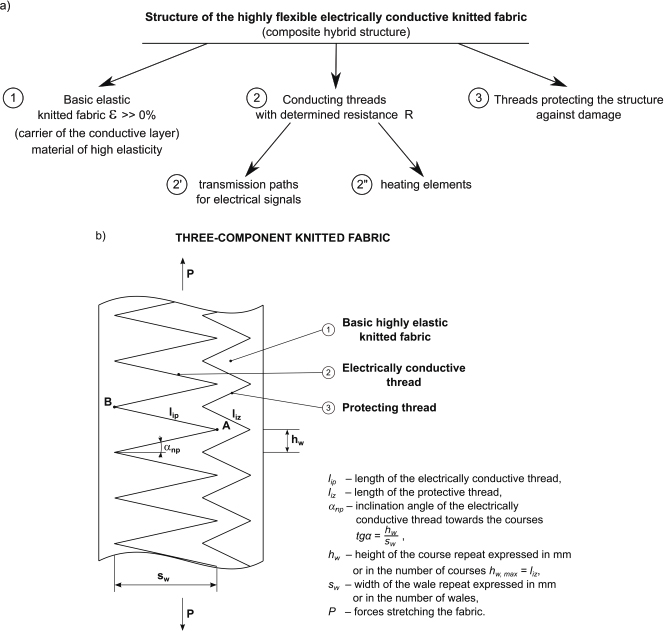
Fig. 12.
Concept of highly flexible electrically conductive knitted fabric: a) conceptual idea, b) constructional assumptions of the fabric structure
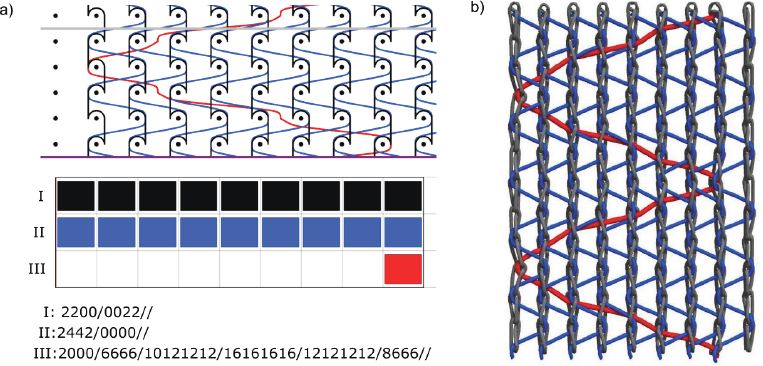
Fig. 13.
Three-guide warp-knitted fabric built of weft stitches with electroconductive threads: a) schematic diagram of stitches, b) real 3D view of the stitch
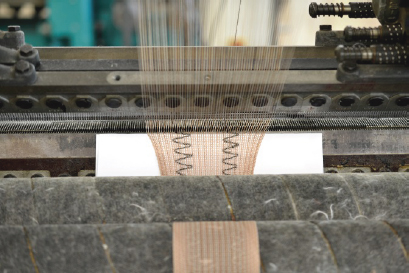
Fig. 14.
Technology of manufacturing a knitted strip with carbon threads on a warp-knitting machine Karl Mayer type RL5NF
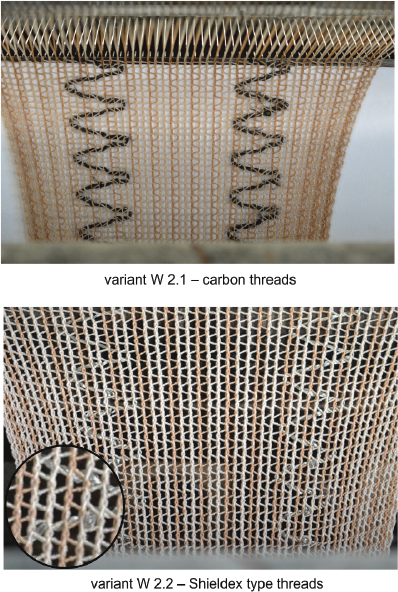
Fig. 15.
Highly elastic strip with electrically conductive threads
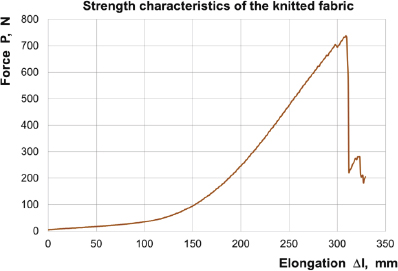
Fig. 16.
Mechanical characteristics of the fabric in the stretching process
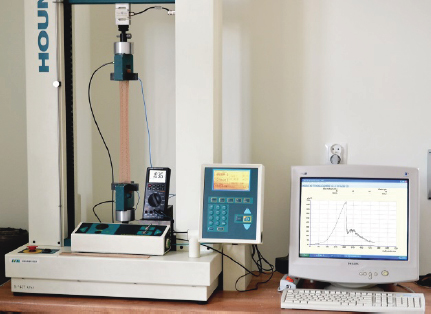
Fig. 17.
Methodology of measuring resistance changes of electrically conductive threads in the process of stretching a knitted strip
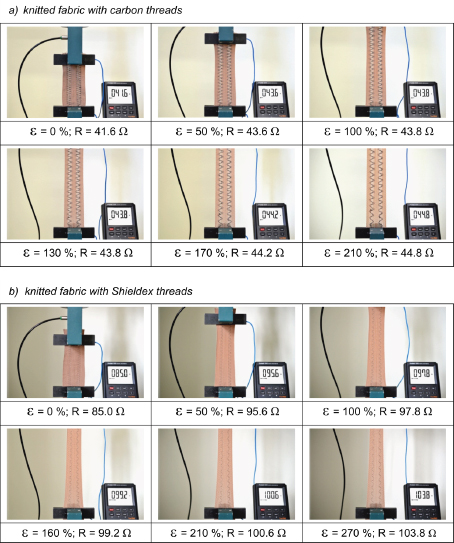
Fig. 18.
Selected stages of the stretching cycle for a knitted fabric with electrically conductive threads
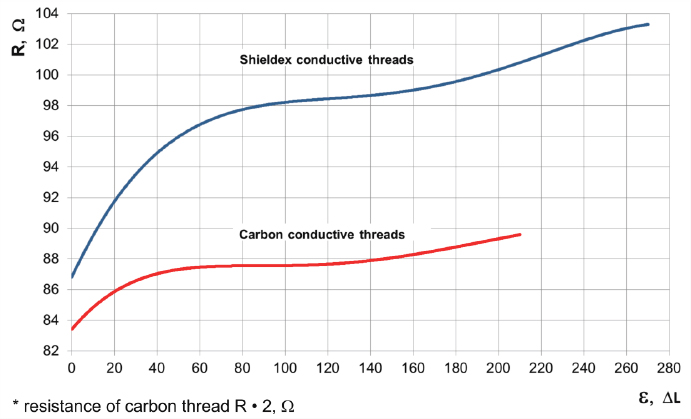
Fig. 19.
Characteristics of resistance changes as a function of fabric elongation