
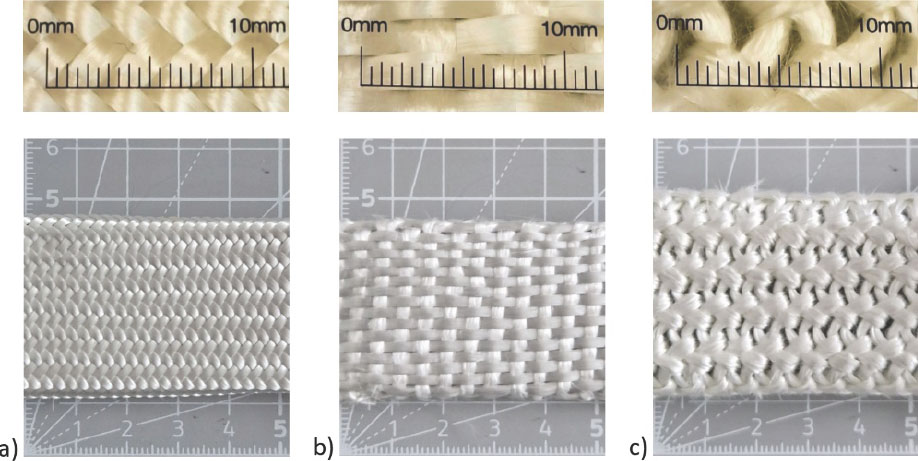
Fig. 1.
Textile reinforcement on 3DP core: a) braid, b) woven fabric, c) knitted fabric
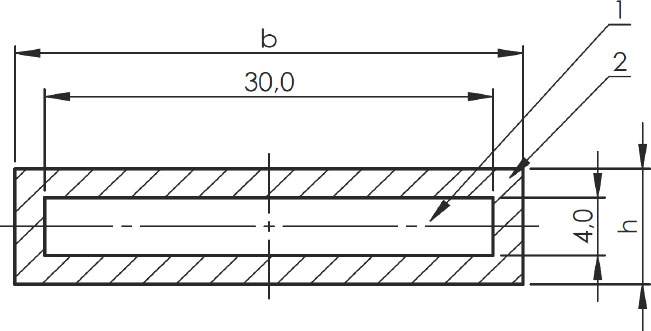
Fig. 2.
Structure of composite: 1) 3D printed core, 2) impregnated textile reinforcement
Table 1.
Dimensions of composites
| Textile structure | h [mm] | b [mm] |
|---|---|---|
| Braid | 5,5 | 32,5 |
| Woven fabric | 5,8 | 32,8 |
| Knitted fabric | 9,5 | 35,5 |
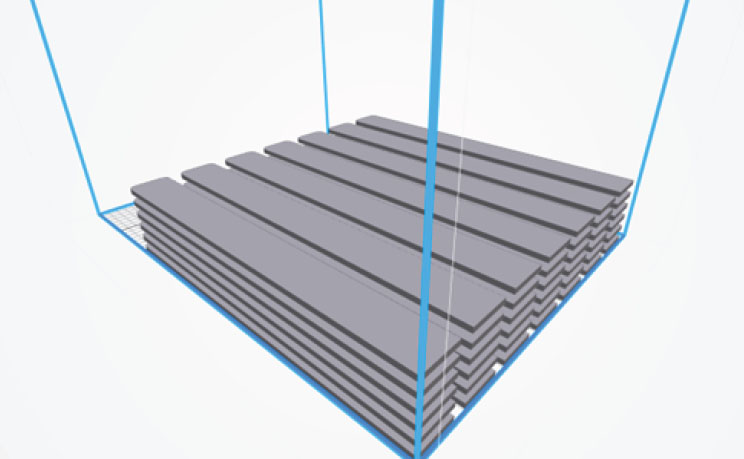
Fig. 3.
X-orientation of 3D printed core
Table 2.
Properties of 3D printed core
| Properties | Value | Unit |
|---|---|---|
| Density | 1,01 | [g/cm3] |
| Tensile modulus Et (X) | 1242 ± 28 | [MPa] |
| Tensile strength σmax (X) | 47 ± 0,9 | [MPa] |
| Flexural stress σf (X) | 50 ± 0,9 | [MPa] |
| Flexural modulus Ef(X) | 1146 ± 51 | [MPa] |
| Elongation at break εb (X) | 19 ± 2,8 | [%] |
Table 3.
Parameters of composites and textile materials
| Parameter | Braid | Woven fabric | Knitted fabric |
|---|---|---|---|
| Density of composite [g/cm3] | 1,17 | 1,11 | 1,23 |
| Areal weight of textile structure [g/m2] | 1 100 | 800 | 4 200 |
| Areal weight of composite outer layer [g/m2] | 2 340 | 1 545 | 9 310 |
| Mass fraction of composite outer layer [%] | 45,5 | 50,5 | 45 |
| Linear density of the yarn [tex] | 800 | 1200 x 800 1 | 2 600 |
| Structure configuration | 2/2 twill | 1/1 plain | S1 2 |
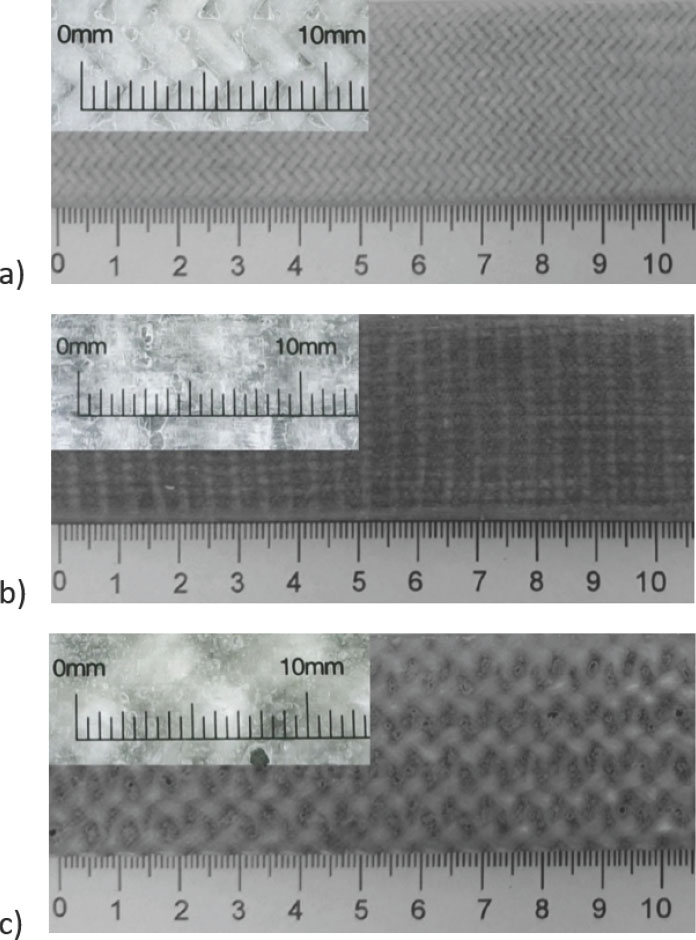
Fig. 4.
Composite reinforcement: a) braid fabric, b) woven fabric, c) knitted fabric
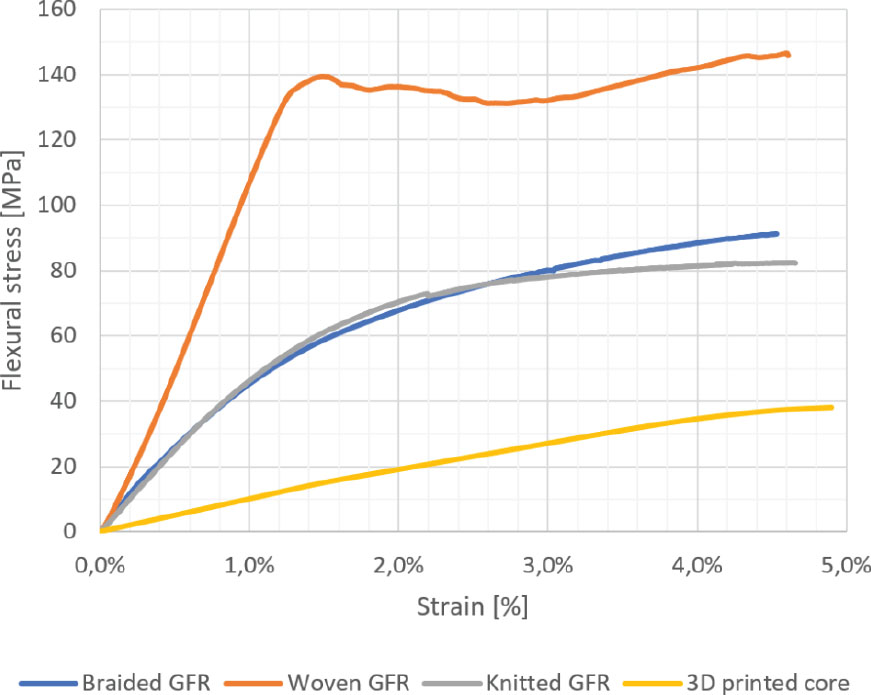
Fig. 5.
Flexural stress-strain curves of tubular glass fiber reinforcement (GFR) composites and 3D printed core
Table 4.
Flexural properties of glass fiber reinforcement composite
| Parameter | Braid | Woven fabric | Knitted fabric |
|---|---|---|---|
| Flexural stress σfM [MPa] | 79 ±3,5 | 140 ±5 | 73 ±4 |
| Flexural strain εfM [%] | 2,9 ±0,3 | 1,3 ±0,1 | 2,2 ± 0,4 |
| Flexural modulus Ef [MPa] | 5 820 ±675 | 9 330 ±575 | 5 210 ± 180 |
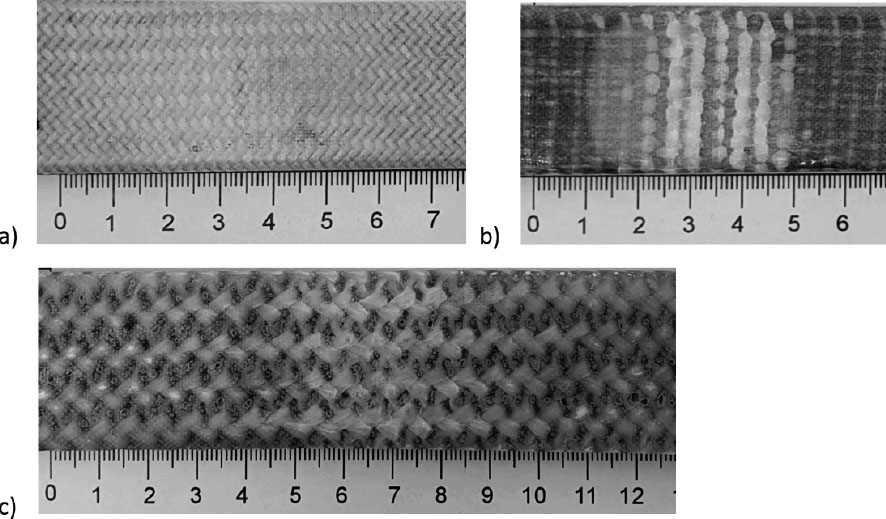
Fig. 6.
Sample after flexural test: a) braided GFR, b) woven fabric GFR, c) knitted fabric GFR
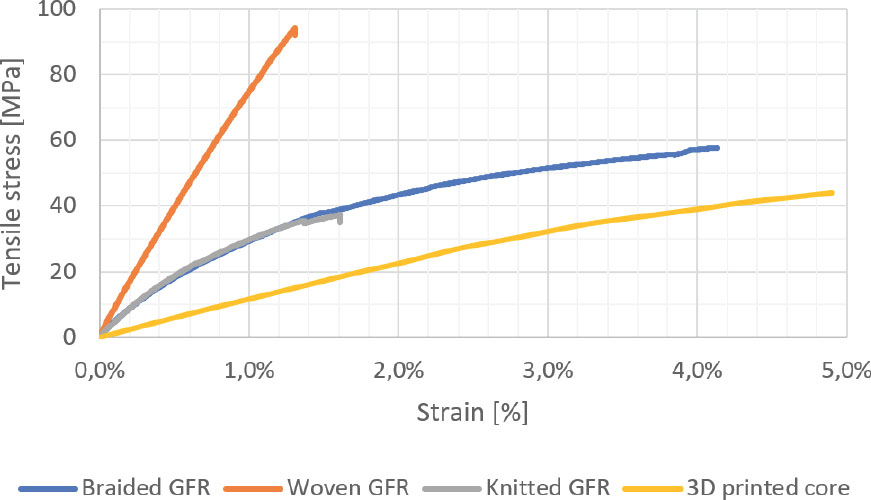
Fig. 7.
Tensile stress-strain curves of tubular glass fiber reinforcement (GFR) composites and 3D printed core
Table 5.
Tensile properties of glass fiber reinforcement composite
| Parameter | Braid | Woven fabric | Knitted fabric |
|---|---|---|---|
| Tensile strength σm [MPa] | 37,8 ±0,4 | 94 ±16 | 23 ±1 |
| Tensile strain εm [%] | 1,5 ±0,1 | 1,3 ±0,2 | 0,7 ± 0,1 |
| Tensile modulus Et [MPa] | 3 875 ±240 | 7 970 ±440 | 4140 ± 130 |
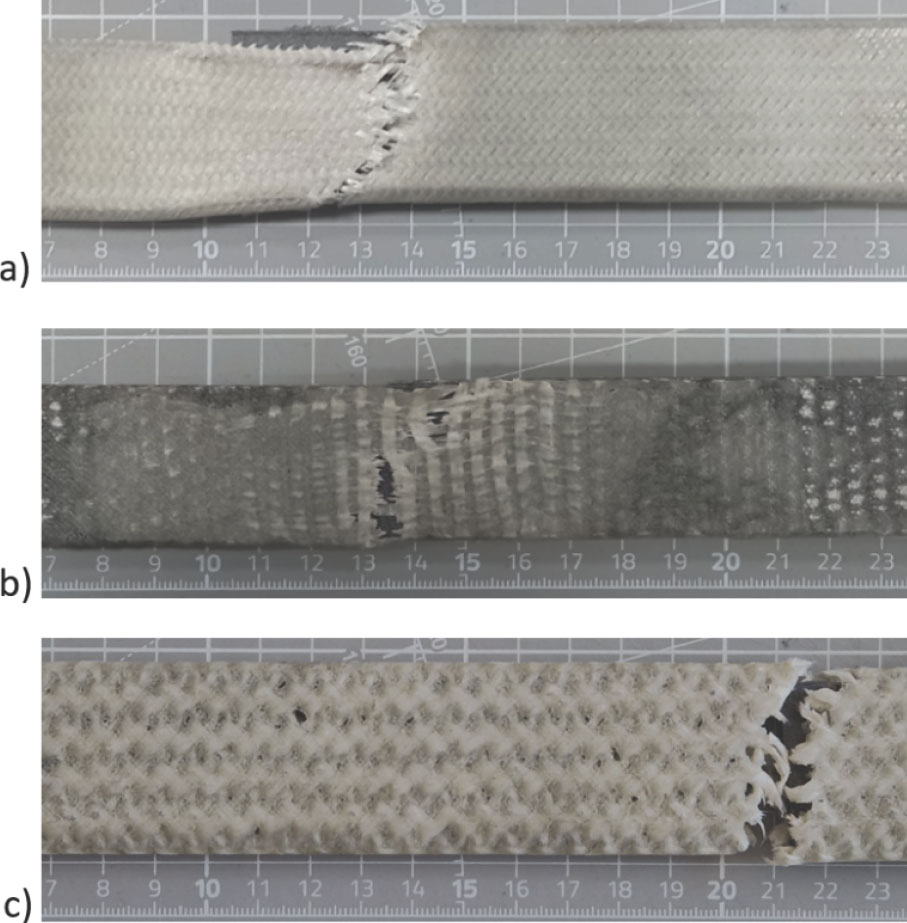
Fig. 8.
Sample after tensile test: a) braided GFR, b) woven fabric GFR, c) knitted fabric GFR
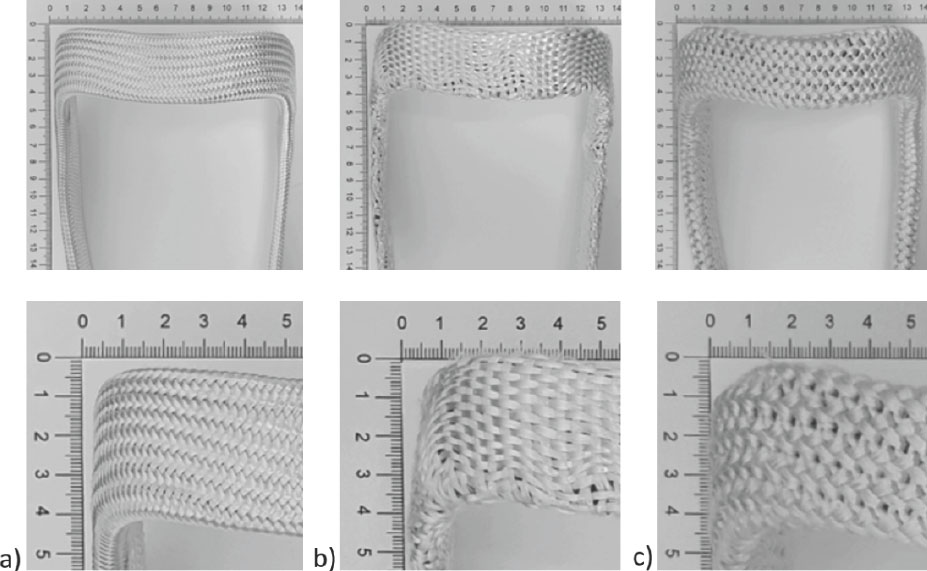
Fig. 9.
Drapeability of textile structure: a) braided, b) woven, c) knitted fabric