
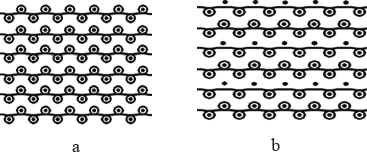
Fig. 1.
Fabric structures (a) 1×1 rib (b) half-Milano
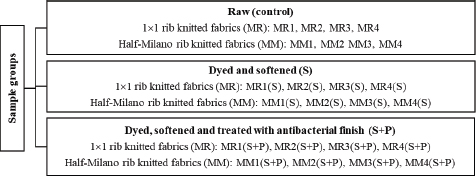
Fig. 2.
Sample groups of the knitted fabrics investigated
Table 1.
Characteristics of the knitted fabrics investigated
| Sample Code | Fiber Composition (%) | Yarn Linear Density (tex) | Wale Density (cm−1) | Course Density (cm−1) | Loop Density (cm−2) | Fabric Thickness (mm) | Fabric Area Density (g/m2) |
|---|---|---|---|---|---|---|---|
| 1×1 rib fabrics (MR) | |||||||
| MR1 | 90 % CO, 10 % PETA | 28.1×3 | 15.0±0.5 | 10.6±0.6 | 159.0 | 1.95±0.04 | 597.73±0.09 |
| MR1(S) | 16.0±0.0 | 12.0±0.0 | 192.0 | 1.82±0.02 | 611.50±0.06 | ||
| MR1(S+P) | 16.0±0.0 | 12.0±0.0 | 192.0 | 1.80±0.02 | 603.60±0.05 | ||
| MR2 | 80 % CO, 20 % PETA | 28.1×3 | 15.0±0.5 | 11.0±0.0 | 165.0 | 1.95±0.05 | 577.60±0.10 |
| MR2(S) | 16.0±0.0 | 12.0±0.0 | 192.0 | 1.78±0.02 | 607.10±0.06 | ||
| MR2(S+P) | 16.0±0.0 | 12.0±0.0 | 192.0 | 1.80±0.01 | 608.10±0.06 | ||
| MR3 | 70 % CO, 30 % PETA | 18.5×4 | 14.6±0.5 | 10.6±0.6 | 154.8 | 1.90±0.03 | 565.73±0.05 |
| MR3(S) | 16.0±0.0 | 12.0±0.0 | 192.0 | 1.84±0.01 | 528.70±0.05 | ||
| MR3(S+P) | 16.0±0.0 | 12.0±0.0 | 192.0 | 1.87±0.02 | 616.40±0.09 | ||
| MR4 | 65 % CO, 35 % PETA | 14.8×3 | 15.8±0.5 | 11.6±0.6 | 183.3 | 1.89±0.02 | 511.07±0.12 |
| MR4(S) | 16.0±0.0 | 12.0±0.0 | 192.0 | 1.71±0.01 | 524.90±0.07 | ||
| MR4(S+P) | 16.0±0.0 | 12.0±0.0 | 192.0 | 1.81±0.02 | 509.60±0.08 | ||
| Half-Milano rib fabrics (MM) | |||||||
| MM1 | 90 % CO, 10 %PETA | 28.1×3 | 14.0±0.5 | 13.8±0.5 | 193.2 | 1.96±0.04 | 587.33±0.09 |
| MM1(S) | 16.0±0.0 | 18.0±0.0 | 288.0 | 1.80±0.02 | 642.40±0.08 | ||
| MM1(S+P) | 16.0±0.0 | 18.0±0.0 | 288.0 | 1.83±0.01 | 641.20±0.05 | ||
| MM2 | 80 % CO, 20 %PETA | 28.1×3 | 14.2±0.5 | 13.8±0.5 | 196.0 | 1.95±0.05 | 588.40±0.09 |
| MM2(S) | 16.0±0.0 | 18.0±0.0 | 288.0 | 1.77±0.01 | 659.30±0.05 | ||
| MM2(S+P) | 16.0±0.0 | 18.0±0.0 | 288.0 | 1.79±0.02 | 658.30±0.05 | ||
| MM3 | 70 % CO, 30 % PETA | 18.5×4 | 13.0±0.5 | 13.8±0.5 | 179.4 | 1.91±0.04 | 544.67±0.05 |
| MM3(S) | 16.0±0.0 | 18.0±0.0 | 288.0 | 1.86±0.01 | 577.60±0.04 | ||
| MM3(S+P) | 16.0±0.0 | 18.0±0.0 | 288.0 | 1.94±0.02 | 667.60±0.06 | ||
| MM4 | 65 % CO, 35 % PETA | 14.8×3 | 14.0±0.5 | 12.2±0.5 | 170.8 | 1.91±0.03 | 498.13±0.07 |
| MM4(S) | 16.0±0.0 | 16.0±0.0 | 256.0 | 1.83±0.01 | 539.30±0.06 | ||
| MM4(S+P) | 16.0±0.0 | 16.0±0.0 | 256.0 | 1.82±0.02 | 506.70±0.04 | ||
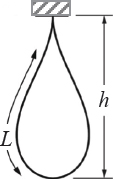
Fig. 3.
Principle of bending stiffness testing according to the method of a hanging pear loop [21]
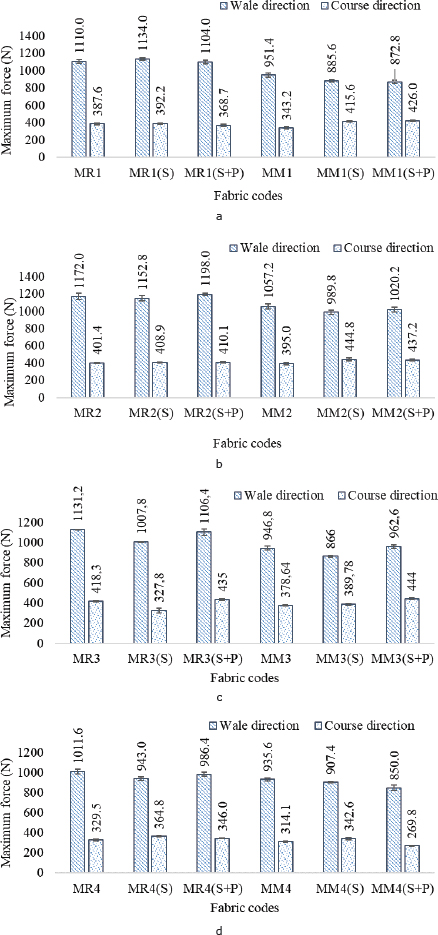
Fig. 4.
Maximum force of the knitted fabrics raw samples for both 1×1 rib knitted fabrics (MR1, MR2, MR3, MR4) and for half-Milano rib knitted fabrics (MM1, MM2, MM3, MM4); (S) – softened samples; (S+P) – samples treated with softener and antibacterial finish. Fabrics’ fiber content: a - 90 % CO / 10 % PETA; b - 80 % CO / 20 % PETA; c -70 % CO / 30 % PETA; d - 65 % CO / 35 % PETA
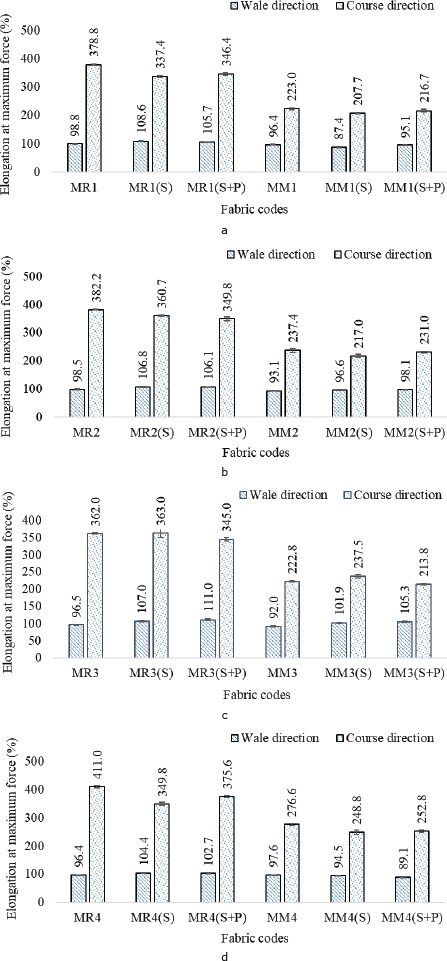
Fig. 5.
Elongation at maximum force of the knitted fabrics: raw samples investigated for both 1×1 rib knitted fabrics (MR1, MR2, MR3, MR4) and half-Milano rib knitted fabrics (MM1, MM2, MM3, MM4); (S) – softened samples; (S+P) – samples treated with softener and antibacterial finish. Fabrics’ fiber content: a - 90 % CO / 10 % PETA; b - 80 % CO / 20 % PETA; c -70 % CO / 30 % PETA; d - 65 % CO / 35 % PETA
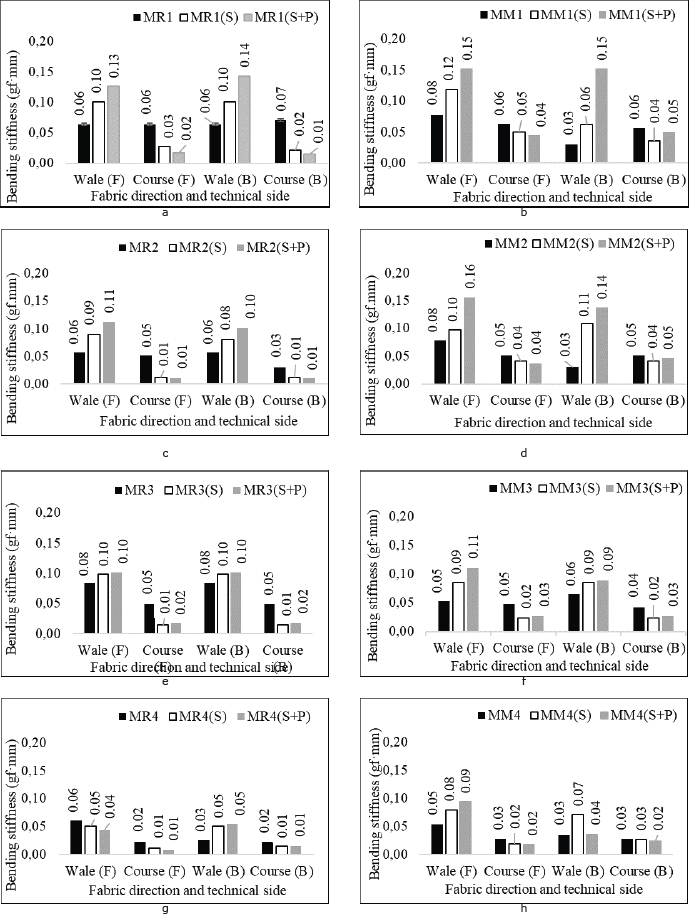
Fig. 6.
Results of bend stiffness of the knitted fabrics investigated applying the hanging pear loop method: raw (control) samples for 1×l rib knitted fabrics (MR1, MR2, MR3, MR4) and for half-Milano rib knitted fabrics (MM1, MM2, MM3, MM4); (S) – softened samples; (S+P) – samples treated with softener and antibacterial finish. Fabrics’ fiber content: a - 90 % CO / 10 % PETA; b - 80 % CO / 20 % PETA; c -70 % CO / 30 % PETA; d - 65 % CO / 35 % PETA.