
Table 1
SWOT factors for SHC retailing
| Strengths | Weaknesses | ||
|---|---|---|---|
| S1 | There is a strong presence of SHC country-wide with a great variety of products and increased choosability options | W1 | Lack of storage/warehouse facilities and pressure to provide lower prices in the competitive environment |
| S2 | SHC are quality products, durable and affordable for the local majority | W2 | Prices from wholesalers are high because of the high importation and other related costs |
| S3 | Retailers and suppliers can independently operate businesses and grow financially faster | W3 | Obtaining financial assistance to startups is difficult for young entrepreneurs |
| S4 | The serviceability range is more comprehensive for consumers such that it extends garment's life-cycle and reduces fast fashion demand | W4 | Poor supply chain delivery systems. There is no good logistics infrastructure to transport goods around |
| S5 | It's easier shopping second-hand; this gives space to boost sales and market growth improvements | W5 | Clothes are less hygienic and sometimes require alteration for which there are existing skillset-gaps |
| W6 | Low level of corporation between members of the supply chain | ||
| Opportunities | Treats | ||
| O1 | Selling SHC creates employment avenues that lead to poverty alleviation | T1 | Increased competition from new entrants |
| O2 | Favorable conditions for investment that support women empowerment | T2 | Fast-changing consumers’ choices in the clothing segment |
| O3 | Loan opportunities may lead to growth in demand and promote new market expansion | T3 | Unstable tax schemes and import duties |
| O4 | Quantity discount from wholesalers to retailers has the potential to allow the low capital requirement for beginners | T4 | Competition from the Fast Fashion market that changes the taste of consumers |
| T5 | High likelihood of banning SHC to promote the local textile industry | ||
| T6 | Unstable prices and exchange rates due to dual currency and frequent government demolition of market structures | ||
Table 2
Respondents
| Measure | Items | Red Light | Waterside | Duala | Omega | ||||
|---|---|---|---|---|---|---|---|---|---|
| Freq | % | Freq | % | Freq | % | Freq | % | ||
| Gender | Male | 4 | 10 | 9 | 30 | 3 | 15 | 1 | 10 |
| Female | 36 | 90 | 21 | 70 | 17 | 85 | 11 | 90 | |
| Age | 10–19 | 2 | 5 | 3 | 10 | 1 | 5 | 1 | 10 |
| 20–29 | 18 | 45 | 9 | 30 | 5 | 25 | 2 | 20 | |
| 30–39 | 5 | 12.5 | 9 | 30 | 6 | 30 | 3 | 30 | |
| 40–49 | 6 | 15 | 5 | 16.7 | 5 | 25 | 2 | 20 | |
| 50–59 | 4 | 10 | 2 | 6.7 | 2 | 10 | 1 | 10 | |
| 60 & above | 5 | 12.5 | 2 | 6.7 | 1 | 5 | 1 | 10 | |
| Total | 40 | 100 | 30 | 100 | 20 | 100 | 10 | 100 | |
Table 3
Radom index values
| Matrix | 1 | 2 | 3 | 4 | 5 | 6 | 7 | 8 | 9 | 10 | 11 | 12 |
|---|---|---|---|---|---|---|---|---|---|---|---|---|
| Random index (RI) | 0 | 0 | 0.58 | 0.9 | 1.12 | 1.24 | 1.32 | 1.41 | 1.45 | 1.49 | 1.51 | 1.58 |
Table 4
Group and ensemble weights of SWOT group from AHP & FAHP computations
| Factors | Group Weights | Ensemble Weights | |
|---|---|---|---|
| AHP | FAHP | ||
| S | 0.255 | 0.321 | 0.288 |
| W | 0.111 | 0.197 | 0.154 |
| O | 0.193 | 0.185 | 0.189 |
| T | 0.442 | 0.298 | 0.370 |
Table 5
Local, global, and ensemble weights of all sub-factors from AHP & FAHP computations
| Factors | Local Weights | Group Weights | Global Weights | Ensemble Weights | |||
|---|---|---|---|---|---|---|---|
| AHP | FAHP | AHP | FAHP | AHP | FAHP | ||
| S1 | 0.086 | 0.056 | 0.022 | 0.018 | 0.020 | ||
| S2 | 0.280 | 0.316 | 0.071 | 0.102 | 0.086 | ||
| S3 | 0.255 | 0.279 | 0.255 | 0.321 | 0.065 | 0.089 | 0.077 |
| S4 | 0.136 | 0.112 | 0.035 | 0.036 | 0.035 | ||
| S5 | 0.243 | 0.237 | 0.062 | 0.076 | 0.069 | ||
| W1 | 0.082 | 0.065 | 0.009 | 0.013 | 0.011 | ||
| W2 | 0.321 | 0.353 | 0.036 | 0.070 | 0.053 | ||
| W3 | 0.324 | 0.360 | 0.111 | 0.197 | 0.036 | 0.071 | 0.053 |
| W4 | 0.150 | 0.141 | 0.017 | 0.028 | 0.022 | ||
| W5 | 0.059 | 0.037 | 0.007 | 0.007 | 0.007 | ||
| W6 | 0.064 | 0.043 | 0.007 | 0.008 | 0.008 | ||
| O1 | 0.474 | 0.581 | 0.091 | 0.107 | 0.099 | ||
| O2 | 0.247 | 0.230 | 0.193 | 0.185 | 0.048 | 0.043 | 0.045 |
| O3 | 0.097 | 0.053 | 0.019 | 0.010 | 0.014 | ||
| O4 | 0.182 | 0.136 | 0.035 | 0.025 | 0.030 | ||
| T1 | 0.060 | 0.040 | 0.027 | 0.012 | 0.019 | ||
| T2 | 0.043 | 0.028 | 0.019 | 0.008 | 0.014 | ||
| T3 | 0.230 | 0.252 | 0.442 | 0.298 | 0.102 | 0.075 | 0.088 |
| T4 | 0.060 | 0.047 | 0.027 | 0.014 | 0.020 | ||
| T5 | 0.420 | 0.469 | 0.186 | 0.140 | 0.163 | ||
| T6 | 0.186 | 0.164 | 0.082 | 0.049 | 0.065 | ||
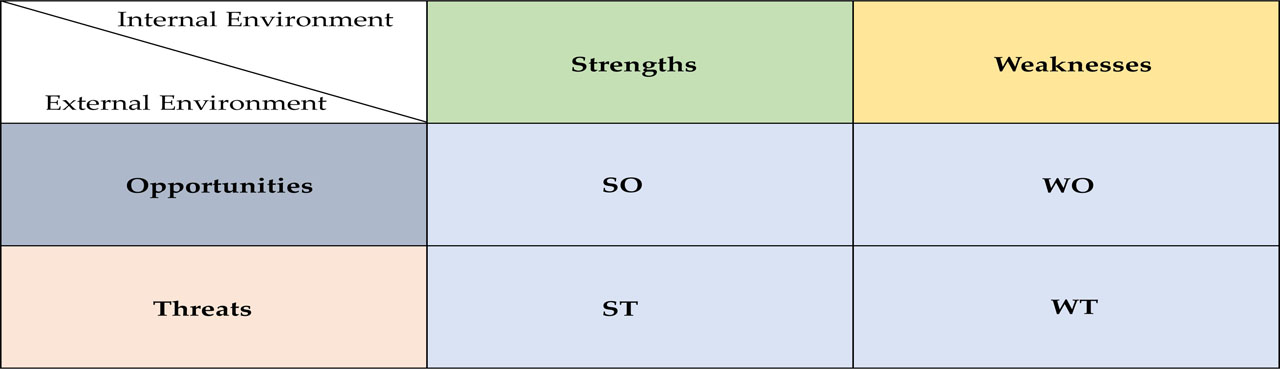
Fig. 1
SWOT group matrix analysis
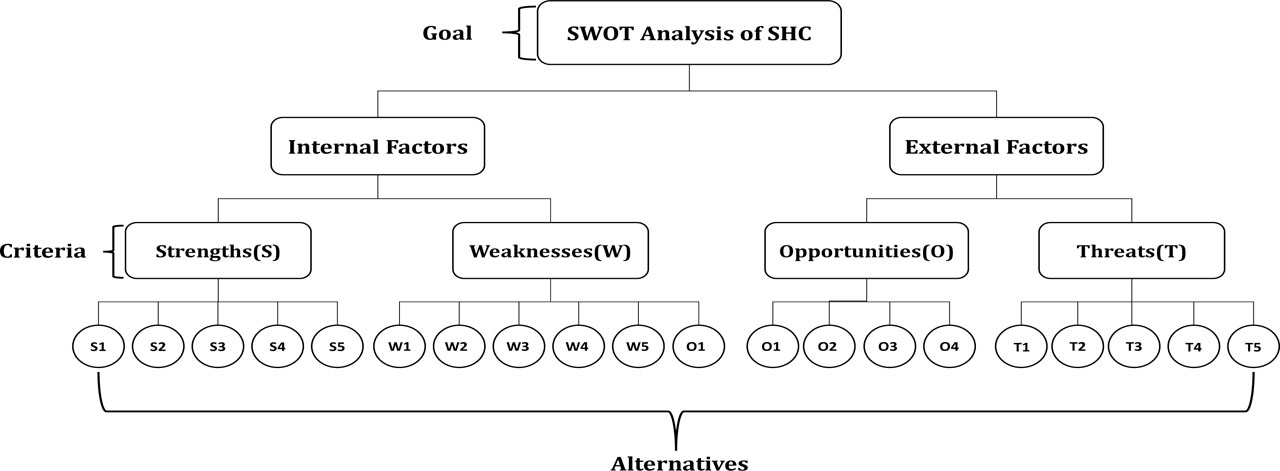
Fig. 2
The SWOT AHP hierarchical model
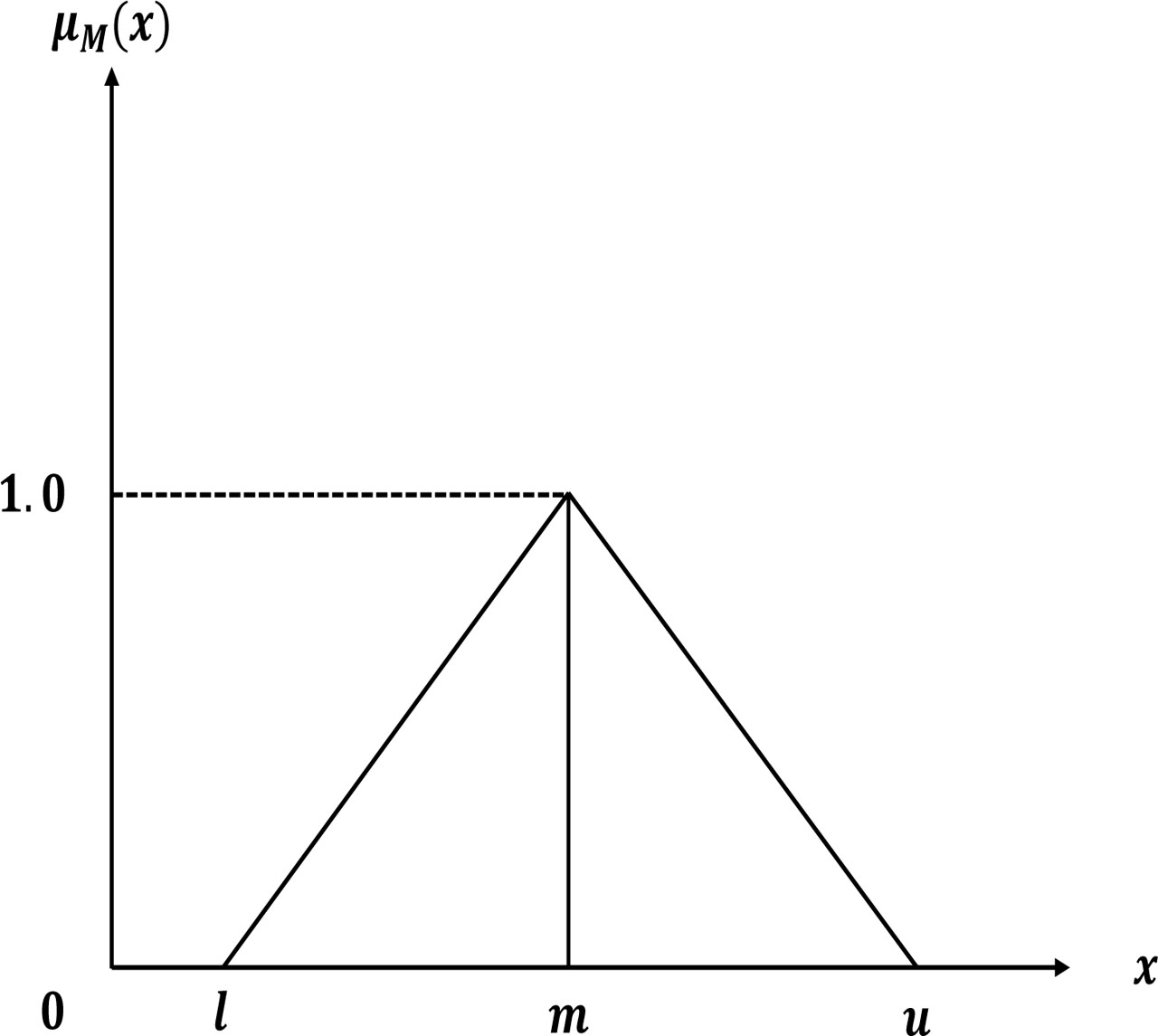
Fig. 3
A Triangular fuzzy number (TFN)
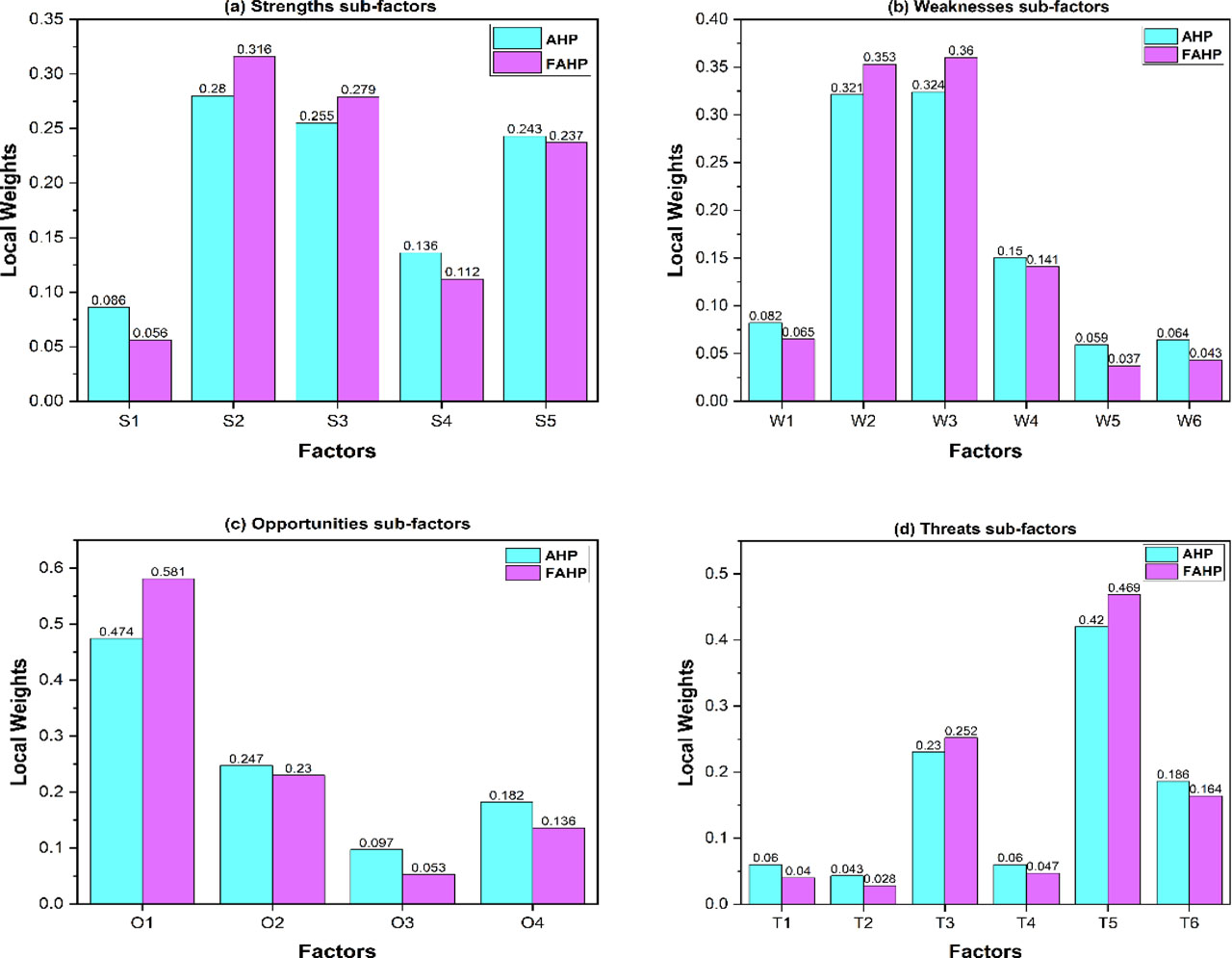
Fig. 4
Local Weights of both AHP & FAHP
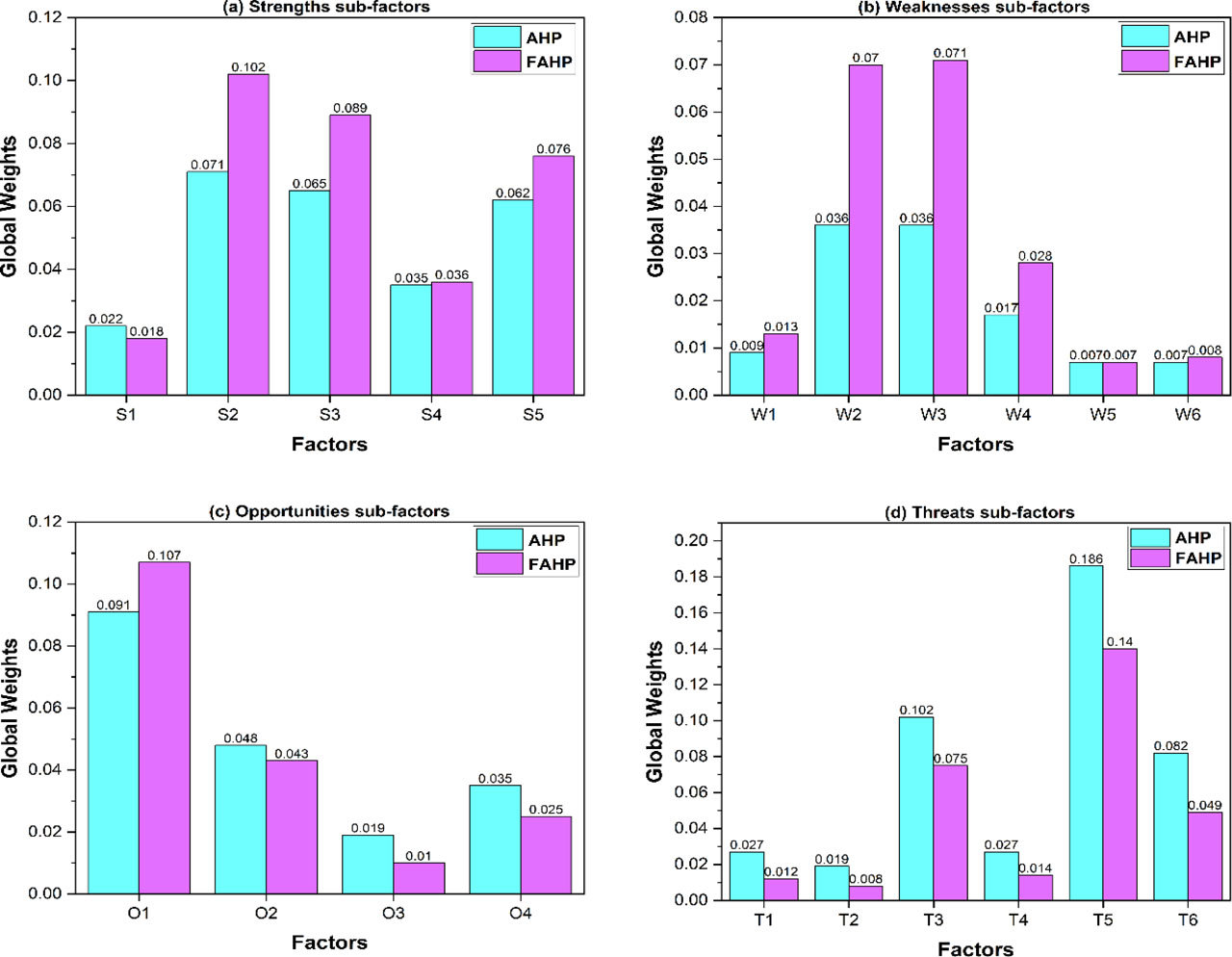
Fig. 5
Global weights of both AHP & FAHP
Table 6
TOPSIS
| Strategy | d+i | d−i | CCi | Rank |
|---|---|---|---|---|
| SO1 | 3.660 | 3.536 | 0.491 | 4 |
| SO2 | 5.705 | 1.481 | 0.206 | 6 |
| SO3 | 4.808 | 2.387 | 0.332 | 5 |
| WO1 | 5.865 | 1.307 | 0.182 | 7 |
| WO2 | 6.669 | 0.488 | 0.068 | 11 |
| WO3 | 6.661 | 0.498 | 0.070 | 10 |
| ST1 | 6.352 | 0.795 | 0.111 | 8 |
| ST2 | 2.306 | 4.886 | 0.679 | 2 |
| ST3 | 2.027 | 5.138 | 0.717 | 1 |
| WT1 | 2.535 | 4.651 | 0.647 | 3 |
| WT2 | 6.585 | 0.595 | 0.083 | 9 |
| WT3 | 7.041 | 0.107 | 0.015 | 12 |
Table A1
Experts involved in the identification, and categorization of SWOT factors
| Expert | Years of experience | Academic Qualification |
|---|---|---|
| 1 | >17 | PhD |
| 2 | >14 | PhD |
| 3 | >14 | PhD |
| 4 | >12 | PhD Candidate |
| 5 | >10 | MBA |
| 6 | >8 | MSc |
Table A2
Saaty's AHP and fuzzy pairwise comparing scale
| AHP Rating | Inverse | Fuzzy Number | Linguistic Scale | TFN | Inverse TFN |
|---|---|---|---|---|---|
| 1 | 1 |  | Equally important (EI) | (1,1,1) | (1,1,1) |
| 2 | 1/2 |  | Intermediate value (IV) | (1,2,3) | (1/3, 1/2, 1) |
| 3 | 1/3 |  | Moderately important | (2,3,4) | (1/4, 1/3, 1/2) |
| 4 | 1/4 |  | Intermediate value (IV) | (3,4,5) | (1/5, 1/4, 1/3) |
| 5 | 1/5 |  | Strongly more important (SMI) | (4,5,6) | (1/6,1/5, 1/4) |
| 6 | 1/6 |  | Intermediate value (IV) | (5,6,7) | (1/7, 1/6, 1/5) |
| 7 | 1/7 |  | Very strongly important (VSI) | (6,7,8) | (1/8, 1/7, 1/6) |
| 8 | 1/8 |  | Intermediate value (IV) | (7,8,9) | (1/9, 1/8, 1/7) |
| 9 | 1/9 |  | Extremely more important (EMI) | (8,9,9) | (1/9, 1/9, 1/7) |
Table A3
Pairwise comparison matrix
| X1 | X2 | X3 | X4 | X5 | |
|---|---|---|---|---|---|
| X1 | a1⁄a1 | a1⁄a2 | a1⁄a3 | a1⁄aj | a1⁄an |
| X2 | a2⁄a1 | a2⁄a2 | a2⁄a3 | a2⁄aj | a2⁄an |
| X3 | a3⁄a1 | a3⁄a2 | a3⁄a3 | a3⁄aj | a3⁄an |
| X4 | ai ⁄a1 | ai ⁄a2 | ai ⁄a3 | ai ⁄aj | ai ⁄an |
| X5 | an ⁄a1 | an ⁄a2 | an ⁄a3 | an ⁄aj | an ⁄an |
Table A4
Results of AHP pairwise comparison of SWOT group and sub-factors
| AHP | ||||||
|---|---|---|---|---|---|---|
| SWOT Grp | S | W | O | T | ||
| S | 1.000 | 2.000 | 2.000 | 0.500 | ||
| W | 0.500 | 1.000 | 0.333 | 0.333 | ||
| O | 0.500 | 3.000 | 1.000 | 0.333 | ||
| T | 2.000 | 3.000 | 3.000 | 1.000 | ||
| CR=0.07 | λmax=4.19 | CI=0.06 | ||||
| Strengths | S1 | S2 | S3 | S4 | S5 | |
| S1 | 1.000 | 0.500 | 0.333 | 0.500 | 0.250 | |
| S2 | 2.000 | 1.000 | 1.000 | 2.000 | 2.000 | |
| S3 | 3.000 | 1.000 | 1.000 | 2.000 | 1.000 | |
| S4 | 2.000 | 0.500 | 0.500 | 1.000 | 0.500 | |
| S5 | 4.000 | 0.500 | 1.000 | 2.000 | 1.000 | |
| CR=0.03 | λmax=5.16 | CI=0.04 | ||||
| Weaknesses | W1 | W2 | W3 | W4 | W5 | W6 |
| W1 | 1.000 | 0.250 | 0.250 | 0.500 | 2.000 | 1.000 |
| W2 | 4.000 | 1.000 | 1.000 | 4.000 | 4.000 | 4.000 |
| W3 | 4.000 | 1.000 | 1.000 | 3.000 | 5.000 | 5.000 |
| W4 | 2.000 | 0.250 | 0.333 | 1.000 | 3.000 | 4.000 |
| W5 | 0.500 | 0.250 | 0.200 | 0.333 | 1.000 | 1.000 |
| W6 | 1.000 | 0.250 | 0.200 | 0.250 | 1.000 | 1.000 |
| CR=0.04 | λmax=6.27 | CI=0.05 | ||||
| Opportunities | O1 | O2 | O3 | O4 | ||
| O1 | 1.000 | 3.000 | 3.000 | 3.000 | ||
| O2 | 0.333 | 1.000 | 3.000 | 2.000 | ||
| O3 | 0.333 | 0.333 | 1.000 | 0.333 | ||
| O4 | 0.333 | 0.500 | 3.000 | 1.000 | ||
| CR=0.09 | λmax=4.26 | CI=0.08 | ||||
| Threats | T1 | T2 | T3 | T4 | T5 | T6 |
| T1 | 1.000 | 3.000 | 0.250 | 0.500 | 0.142 | 0.166 |
| T2 | 0.333 | 1.000 | 0.200 | 1.000 | 0.142 | 0.200 |
| T3 | 4.000 | 5.000 | 1.000 | 4.000 | 0.500 | 2.000 |
| T4 | 2.000 | 1.000 | 0.250 | 1.000 | 0.142 | 0.250 |
| T5 | 7.000 | 7.000 | 2.000 | 7.000 | 1.000 | 4.000 |
| T6 | 6.000 | 5.000 | 0.500 | 4.000 | 0.250 | 1.000 |
| CR=0.08 | λmax=6.51 | CI=0.10 | CR=0.08 |
Table A5
Results of FAHP pairwise comparison of SWOT group and sub-factors
| Fuzzy AHP | ||||||
|---|---|---|---|---|---|---|
| SWOT Grp | S | W | O | T | ||
| S | (1, 1, 1) | (2, 3, 4) | (2, 3, 4) | (0.25, 0.333, 0.5) | ||
| W | (0.25, 0.333, 0.5) | (1, 1, 1) | (4, 5, 6) | (0.2, 0.25, 0.333) | ||
| O | (0.25, 0.333, 0.5) | (0.166, 0.2, 0.25) | (1, 1, 1) | (4, 5, 6) | ||
| T | (2, 3, 4) | (3, 4, 5) | (0.166, 0.2, 0.25) | (1, 1, 1) | ||
| Strengths | S1 | S2 | S3 | S4 | S5 | |
| S1 | (1, 1, 1) | (0.25, 0.333, 0.5) | (0.166, 0.2, 0.25) | (0.25, 0.333, 0.5) | (0.142, 0.166, 0.2) | |
| S2 | (2, 3, 4) | (1, 1, 1) | (1, 1, 1) | (2, 3, 4) | (2, 3, 4) | |
| S3 | (4, 5, 6) | (1, 1, 1) | (1, 1, 1) | (2, 3, 4) | (1, 1, 1) | |
| S4 | (2, 3, 4) | (0.25, 0.333, 0.5) | (0.25, 0.333, 0.5) | (1, 1, 1) | (0.25, 0.333, 0.5) | |
| S5 | (5, 6, 7) | (0.25, 0.333, 0.5) | (1, 1, 1) | (2, 3, 4) | (1, 1, 1) | |
| Weaknesses | W1 | W2 | W3 | W4 | W5 | W6 |
| W1 | (1, 1, 1) | (0.142, 0.166, 0.2) | (0.142, 0.166, 0.2) | (0.25, 0.333, 0.5) | (4, 5, 6) | (1, 1, 1) |
| W2 | (5, 6, 7) | (1, 1, 1) | (1, 1, 1) | (5, 6, 7) | (5, 6, 7) | (5, 6, 7) |
| W3 | (5, 6, 7) | (1, 1, 1) | (1, 1, 1) | (4, 5, 6) | (6, 7, 8) | (6, 7, 8) |
| W4 | (4, 5, 6) | (0.142, 0.166, 0.2) | (0.166, 0.2, 0.25) | (1, 1, 1) | (4, 5, 6) | (5, 6, 7) |
| W5 | (0.25, 0.333, 0.5) | (0.142, 0.166, 0.2) | (0.125, 0.142, 0.166) | (0.166, 0.2, 0.25) | (1, 1, 1) | (1, 1, 1) |
| W6 | (1, 1, 1) | (0.142, 0.166, 0.2) | (0.125, 0.142, 0.166) | (0.142, 0.166, 0.2) | (1, 1, 1) | (1, 1, 1) |
| Opportunities | O1 | O2 | O3 | O4 | ||
| O1 | (1, 1, 1) | (4, 5, 6) | (4, 5, 6) | (4, 5, 6) | ||
| O2 | (0.166, 0.2, 0.25) | (1, 1, 1) | (4, 5, 6) | (2, 3, 4) | ||
| O3 | (0.166, 0.2, 0.25) | (0.166, 0.2, 0.25) | (1, 1, 1) | (0.166, 0.2, 0.25) | ||
| O4 | (0.166, 0.2, 0.25) | (0.25, 0.333, 0.5) | (4, 5, 6) | (1, 1, 1) | ||
| Threats | T1 | T2 | T3 | T4 | T5 | T6 |
| T1 | (1, 1, 1) | (4, 5, 6) | (0.142, 0.166, 0.2) | (0.25, 0.333, 0.5) | (0.111, 0.111, 0.125) | (0.111, 0.125, 0.142) |
| T2 | (0.166, 0.2, 0.25) | (1, 1, 1) | (0.125, 0.142, 0.166) | (1, 1, 1) | (0.111, 0.111, 0.125) | (0.125, 0.142, 0.166) |
| T3 | (5, 6, 7) | (6, 7, 8) | (1, 1, 1) | (5, 6, 7) | (0.25, 0.333, 0.5) | (2, 3, 4) |
| T4 | (2, 3, 4) | (1, 1, 1) | (0.166, 0.2, 0.25) | (1, 1, 1) | (0.111, 0.111, 0.125) | (0.142, 0.166, 0.2) |
| T5 | (8, 9, 9) | (8, 9, 9) | (2, 3, 4) | (8, 9, 9) | (1, 1, 1) | (5, 6, 7) |
| T6 | (7, 8, 9) | (6, 7, 8) | (0.25, 0.333, 0.5) | (5, 6, 7) | (0.142, 0.166, 0.2) | (1, 1, 1) |
Table A6
Summarized table of SWOT categorized strategies
| SO1 | It's easier shopping second-hand clothes because it has a solid country-wide presence with a great variety of products and increased choosability options which creates employment avenues that lead to poverty alleviation and women empowerment in particular |
| SO2 | SHC are quality products, durable and affordable for the local majority. Both retailers and suppliers can independently operate businesses with a much faster realization of improvements. If its serviceability range is more comprehensive for consumers, it will extend the garment's life-cycle and reduce fast fashion demand |
| SO3 | Institutional loan opportunities coupled with quantity discounts from wholesalers to retailers may lead to low capital requirements for beginners as well as promote market expansion |
| WO1 | Obtaining financial assistance to startups will promote new market expansion for young entrepreneurs |
| WO2 | Providing skillsets that will improve those clothes that sometimes require alteration creates additional employment avenues. |
| WO3 | The corporation between members of the supply chain could ease the lack of storage/warehouse facilities as well as regulate the increasing pressure to provide lower prices in the competitive environment |
| ST1 | Fast-changing consumers’ choices, particularly in the clothing segment, has created a strong demand for SHC nation-wide upsetting intense competition from new entrants |
| ST2 | Unstable tax schemes and import duties will significantly affect the importation of quality and affordable SHC products for the local majority |
| ST3 | Regulators improving on unstable prices and exchange rates due to dual currency and frequent demolition of market structures will promote the local textile industry in upcycling. Policies on banning the importation of SHC will derail progress in poverty alleviation and women empowerment. |
| WT1 | Due to a volatile tax system, exchange rates, dual currencies, import duties, and the constant breakdown of market structures, retailers face more uncertainties as prices from wholesalers are high, and consumers are reluctant to buy |
| WT2 | The supply chain lacks a sound delivery system due to poor logistics infrastructure to transport goods around |
| WT3 | Consumers’ choices keep changing at a faster pace due to competition from the Fast Fashion market and the growing number of new entrants |