
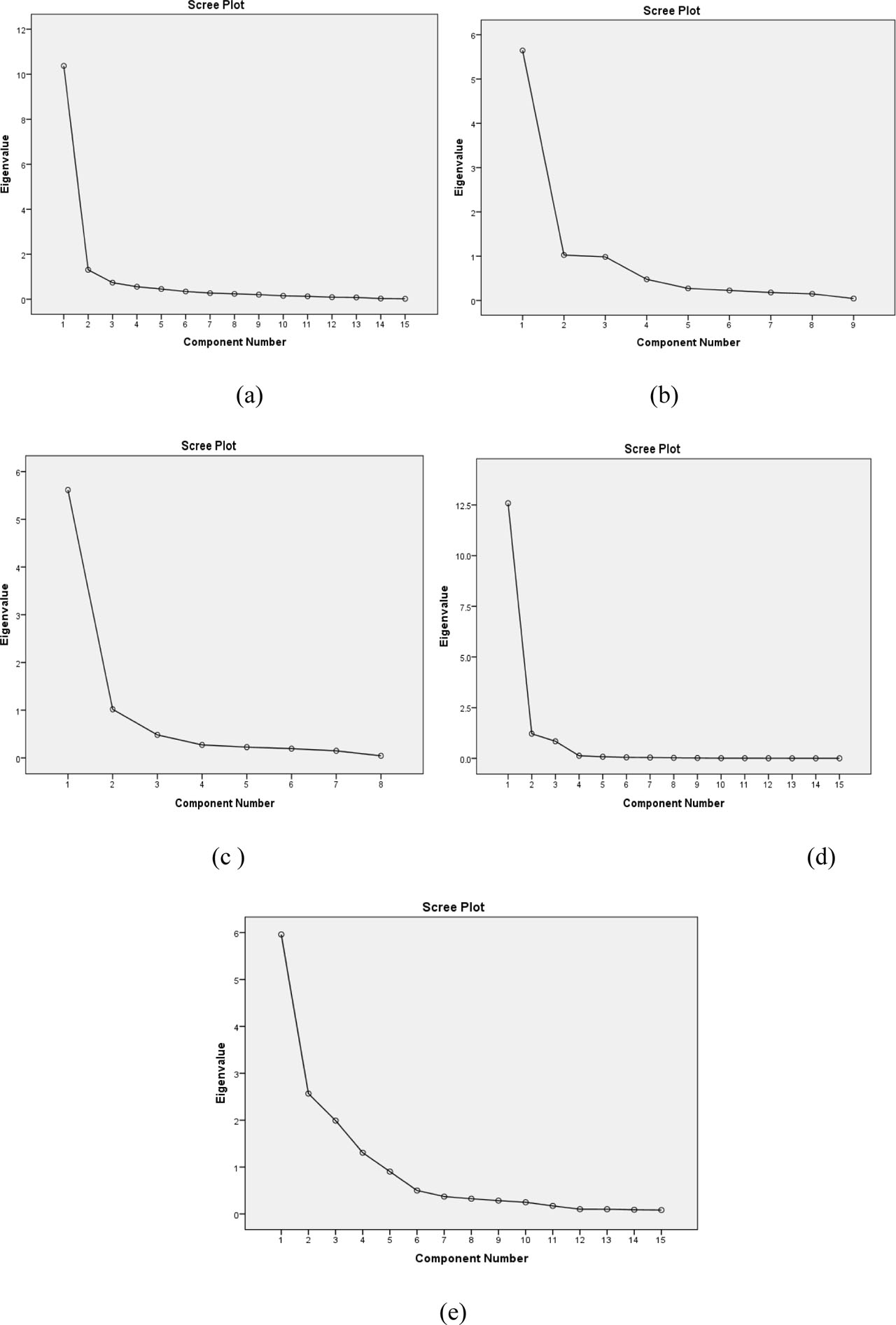
Fig. 1
Scree Plot for (a) Benefits (b) Challenges (c) Challenges Post Removal of Item C8 (d) Motivation to adopt and (e) Attitude towards adoption of TPU- Based 3D Printed Fashion Clothes
Table 1
Items Used in the Research for Creating Model of TPU-Based 3D Printed Fashion Clothes
| Short-form | Original Factor |
|---|---|
| Items under Benefits of TPU Based 3D Printed Fashion Clothes | |
| B1 | 3D-printed parts with TPU are durable |
| B2 | Such material can withstand ambient temperatures of up to 80 degrees Celsius |
| B3 | Available in a range of colours |
| B4 | Good vibration damping and shock absorption |
| B5 | Chemical-resistant |
| B6 | Low warpage and shrinkage |
| B7 | Can be very stretchy depending on the elongation at the break |
| B8 | Elastic and soft material |
| B9 | Simulates rubber-like characteristics |
| B10 | Good chemical and thermal stability |
| B11 | Excellent printability |
| B12 | Semi-transparent |
| B13 | Better chemical resistance to oils and greases |
| B14 | Hard flex filament facilitating 3D printing |
| B15 | Scratch-resistant |
| Items under Challenges of TPU Based 3D Printed Fashion Clothes | |
| C1 | While it is possible to print TPU using a desktop printer, the flexible filament is difficult to work with as it can easily disrupt layer thickness and jam or clog the printhead. |
| C2 | TPU 3D printed parts also take much longer than traditional non-flexible materials because the print speed must be reduced. |
| C3 | Depending on the make and model of the extrusion printer, the shore hardness of the TPU filament can be limited. |
| C4 | If the temperature is too high, stringing can occur |
| C5 | If the temperature is too low, layer adhesion will be poor |
| C6 | Resistance to UV light is poor |
| C7 | Needs to be printed at low temperatures |
| C8 | Difficult to post-process |
| C9 | Degrade in wet conditions |
| Items under Motivation to adopt TPU Based 3D Printed Fashion Clothes for Customer | |
| M1 | High Quality |
| M2 | Design and Aesthetics |
| M3 | Feel and fit of the material |
| M4 | To fit in with friends |
| M5 | Esteem of Brand |
| M6 | Follow the trend |
| M7 | Value of Money |
| M8 | Brand Name |
| M9 | Show off |
| M10 | To differentiate myself from others |
| M11 | To protect environment |
| M12 | I like to try new and innovative products |
| M13 | TPU material based 3D printing fashion clothes are the future of the fashion industry |
| M14 | The media significantly influenced me to make the purchase |
| M15 | Representation of celebrities Associates with TPU material based 3D printing fashion clothes influence me into purchasing them |
| Items under Attitude towards adoption TPU Based 3D Printed Fashion Clothes for Customer | |
| Consumer knowledge | |
| CK1 | My knowledge about TPU material based 3D printing fashion clothes is sufficient. |
| CK2 | My knowledge about TPU material-based 3D printing fashion clothes is based on previous experience such as purchasing/consuming/hearing from others/reading about it. |
| CK3 | I have a positive experience/impression about TPU material-based 3D printing fashion clothes. |
| Environmental concern | |
| EC1 | I pay a lot of attention to the environment |
| EC2 | The environmental aspect is very important in my purchase intention. |
| EC3 | I believe that TPU material-based 3D printing fashion clothes is more environmentally friendly than conventional clothes. |
| Personal norm | |
| PN1 | I feel I should choose TPU material-based 3D printing fashion clothes instead of conventional fashion clothes. |
| PN2 | I get a good conscience about myself if I choose TPU material-based 3D printing fashion clothes. |
| PN3 | I believe that choosing TPU material based 3D printing fashion clothes is a right decision |
| Subjective norm | |
| SN1 | When it comes to choosing TPU material based 3D printing fashion clothes, I behave as others do. |
| SN2 | Due to the impact of social pressure (society, environment, social network, etc), I choose TPU material-based 3D printing fashion clothes. |
| SN3 | Most people who are important to me would like me to choose TPU material-based 3D printing fashion clothes. |
| Purchase intention | |
| PI1 | I would often like to purchase TPU material based 3D printing fashion clothes |
| PI2 | I am more likely to purchase TPU material based 3D printing fashion clothes next time going shopping. |
| PI3 | I am willing to pay extra for TPU material based 3D printing fashion clothes. |
Table 2
KMO- Bartlett Test for Benefits of TPU-Based 3D Printed Fashion Clothes
| KMO and Bartlett's Test | ||
|---|---|---|
| Kaiser-Meyer-Olkin Measure of Sampling Adequacy. | 0.925 | |
| Bartlett's Test of Sphericity | Approx. Chi-Square | 1660.795 |
| Df | 105 | |
| Sig. | 0.000 | |
Table 3
Rotated Component Matrix
| Rotated Component Matrixa | ||
|---|---|---|
| Component | ||
| 1 | 2 | |
| B1 | 0.958 | |
| B2 | 0.761 | |
| B3 | 0.874 | |
| B4 | 0.887 | |
| B5 | 0.941 | |
| B6 | 0.815 | |
| B7 | 0.905 | |
| B8 | 0.677 | |
| B9 | 0.858 | |
| B10 | 0.865 | |
| B11 | 0.864 | |
| B12 | 0.892 | |
| B13 | 0.913 | |
| B14 | 0.860 | |
| B15 | 0.889 | |
Table 4
KMO-Bartlett Test for Challenges of TPU Based 3D Printed Fashion Clothes
| KMO and Bartlett's Test | ||
|---|---|---|
| Kaiser-Meyer-Olkin Measure of Sampling Adequacy. | 0.899 | |
| Bartlett's Test of Sphericity | Approx. Chi-Square | 703.069 |
| Df | 36 | |
| Sig. | 0.000 | |
Table 5
Rotated Component Matrix for Challenges of TPU-Based 3D Printed Fashion Clothes
| Rotated Component Matrixa | ||
|---|---|---|
| Component | ||
| 1 | 2 | |
| C1 | 0.879 | |
| C2 | 0.887 | |
| C3 | 0.898 | |
| C4 | 0.978 | |
| C5 | 0.873 | |
| C6 | 0.825 | |
| C7 | 0.894 | |
| C8 | ||
| C9 | 0.902 | |
Table 6
KMO-Bartlett Test for Challenges of TPU-Based 3D Printed Fashion Clothes Post Removal of Item C8
| KMO and Bartlett's Test | ||
|---|---|---|
| Kaiser-Meyer-Olkin Measure of Sampling Adequacy. | 0.904 | |
| Bartlett's Test of Sphericity | Approx. Chi-Square | 697.302 |
| Df | 28 | |
| Sig. | 0.000 | |
Table 7
Rotated Component Matrix for Challenges of TPU Based 3D Printed Fashion Clothes Post Removal of Item C8
| Rotated Component Matrixa | ||
|---|---|---|
| Component | ||
| 1 | 2 | |
| C1 | 0.881 | |
| C2 | 0.902 | |
| C3 | 0.996 | |
| C4 | 0.975 | |
| C5 | 0.871 | |
| C6 | 0.837 | |
| C7 | 0.897 | |
| C9 | 0.893 | |
Table 8
KMO-Bartlett Test for Motivation to adopt TPU-Based 3D Printed Fashion Clothes for Customers
| KMO and Bartlett's Test | ||
|---|---|---|
| Kaiser-Meyer-Olkin Measure of Sampling Adequacy. | 0.897 | |
| Bartlett's Test of Sphericity | Approx. Chi-Square | 9176.643 |
| Df | 105 | |
| Sig. | 0.000 | |
Table 9
Rotated Component Matrix for Challenges of TPU-Based 3D Printed Fashion Clothes
| Rotated Component Matrixa | ||
|---|---|---|
| Component | ||
| 1 | 2 | |
| M1 | 0.769 | |
| M2 | 0.502 | 0.812 |
| M3 | 0.521 | 0.792 |
| M4 | 0.906 | |
| M5 | 0.882 | |
| M6 | 0.906 | |
| M7 | 0.753 | 0.533 |
| M8 | 0.736 | 0.541 |
| M9 | 0.811 | |
| M10 | 0.908 | |
| M11 | 0.904 | |
| M12 | 0.912 | |
| M13 | 0.867 | |
| M14 | 0.869 | |
| M15 | 0.798 | 0.543 |
Table 10
KMO-Bartlett Test for Attitude towards adoption TPU-Based 3D Printed Fashion Clothes for Customers
| KMO and Bartlett's Test | ||
|---|---|---|
| Kaiser-Meyer-Olkin Measure of Sampling Adequacy. | 0.795 | |
| Bartlett's Test of Sphericity | Approx. Chi-Square | 2433.364 |
| Df | 105 | |
| Sig. | 0.000 | |
Table 11
Rotated Component Matrix for Attitude towards adoption of TPU- Based 3D Printed Fashion Clothes
| Rotated Component Matrixa | ||||
|---|---|---|---|---|
| Component | ||||
| 1 | 2 | 3 | 4 | |
| CK1 | 0.592 | 0.518 | ||
| CK2 | 0.546 | |||
| CK3 | 0.561 | 0.525 | ||
| EC1 | 0.838 | |||
| EC2 | 0.788 | |||
| EC3 | 0.843 | |||
| PN1 | 0.936 | |||
| PN2 | 0.877 | |||
| PN3 | 0.899 | |||
| SN1 | 0.747 | |||
| SN2 | 0.919 | |||
| SN3 | 0.882 | |||
| PI1 | 0.923 | |||
| PI2 | 0.865 | |||
| PI3 | 0.851 | |||
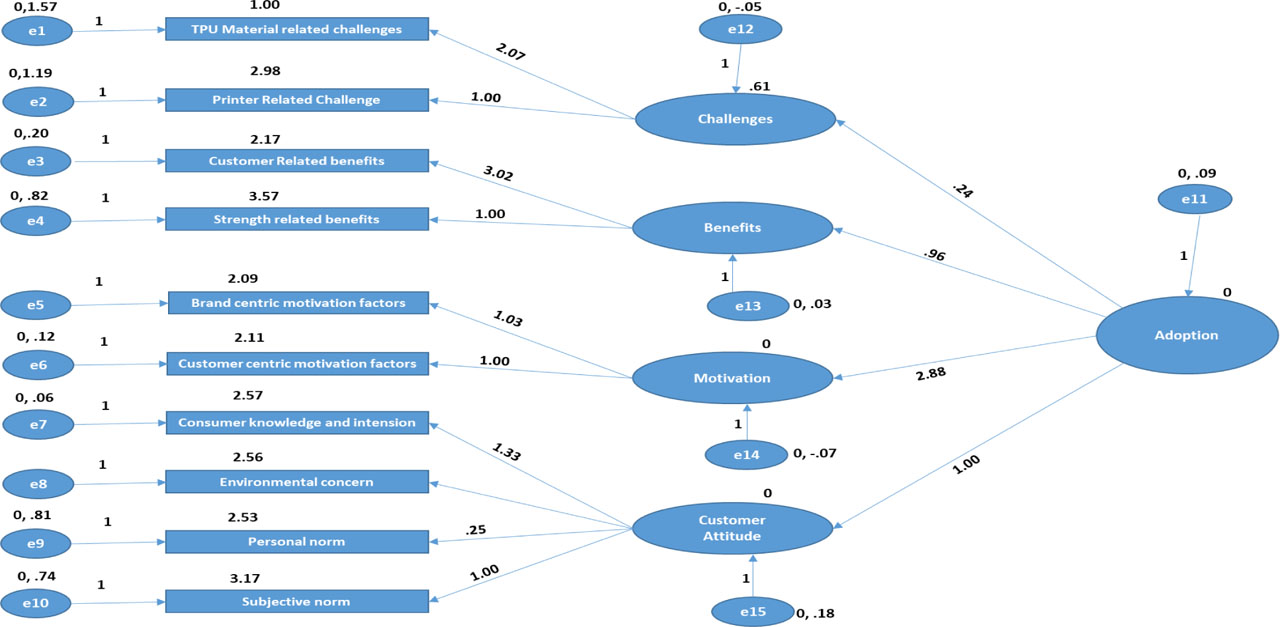
Fig. 2
Proposed Model for Adoption of TPU-Based 3D Printed Fashion Clothes
Table 12
Model Fit Indices for Exploratory Factor Analysis
| Chi-Square Statistic Model Fit Indices | ||||
|---|---|---|---|---|
| CMIN | P-Value | CMIN/df | ||
| Model Fit indices | 81.237 | 0.00 | 2.621 | |
| Baseline Comparison Model Fit Indices | ||||
| NFI | TLI | CFI | ||
| Model Fit Indices | 0.799 | 0.745 | 0.856 | |
| FMIN Model Fit Indices | ||||
| FMIN | F0 | LO 90 | HI90 | |
| Model Fit Indices | 0.312 | 0.193 | 0.105 | 0.311 |
| RMSEA Model Fit Indices | ||||
| RMSEA | LO 90 | HI90 | PCLOSE | |
| Model Fit Indices | 0.079 | 0.058 | 0.100 | 0.013 |